
Castle nut specifications play a vital role in mechanical assemblies. Industry standards guide the design and manufacturing of المسامير والبراغي, especially for safety-critical uses. Regulatory bodies require المثبتات المخصصة to meet strict criteria for heavy machinery and construction equipment.
- Castle nuts secure axle assemblies, maintain wheel alignment, and prevent accidents.
- Their locking design supports high-stress applications and resists vibration-induced loosening.
- Reliable fastening ensures stability in conveyor systems and cranes.
A مُصنِّع أدوات التثبيت المخصصة must follow these specifications to guarantee performance and compliance.
Castle Nut Definition and Purpose
What is a castle nut?
Design features of castle nuts
A castle nut features a hexagonal body with slots or notches cut into one end. These slots align with a hole in the bolt or stud, allowing a cotter pin to pass through both the nut and the bolt. This design creates a secure locking mechanism that resists loosening under vibration or dynamic loads. The robust construction of a castle nut supports its use in demanding environments. Engineers often select this nut for assemblies where safety and reliability are critical.
Common applications for castle nuts
Castle nuts play a vital role in mechanical systems that require secure, vibration-resistant fastening. Automotive manufacturers use them to fasten suspension systems and steering components, ensuring these parts remain tightly secured even on rough roads. Aerospace engineers rely on castle nuts to secure aircraft components, where any loosening could lead to catastrophic failure. Heavy machinery and industrial equipment also benefit from their use, as these nuts maintain the integrity of assemblies exposed to constant movement and stress. In each case, the combination of a bolt, castle nut, and cotter pin provides a reliable solution for high-stress environments.
How castle nuts work
Locking mechanism of castle nuts
The locking mechanism of castle nuts relies on the interaction between the slots in the nut and a cotter pin inserted through a hole in the bolt. This method exemplifies positive locking, as the cotter pin physically prevents the nut from rotating and coming loose. The friction between the nut and the bolt threads, combined with the mechanical stop provided by the cotter pin, ensures a secure fastening. This approach effectively counters the effects of vibration and dynamic loads, which can cause other types of nuts to loosen over time.
Advantages of castle nuts over other nut types
- Castle nuts utilize slots or notches for a cotter pin, enhancing their locking capability.
- They perform exceptionally well in high-stress and high-vibration applications, unlike slotted nuts that suit lighter jobs.
- The design allows for a thicker cotter pin, providing better security against loosening.
Tip: When selecting a fastening solution for critical applications, consider the unique advantages of castle nuts. Their design offers superior resistance to loosening, making them ideal for safety-critical assemblies in automotive, aerospace, and heavy machinery sectors.
Industry Standards for Castle Nuts
Industry standards define the essential characteristics and performance requirements for hex castle nuts. These standards ensure compatibility, safety, and reliability in critical assemblies. Manufacturers and engineers rely on these guidelines to select the correct castle nut for each application.
DIN standards for castle nuts
The German Institute for Standardization (DIN) sets widely recognized standards for fasteners, including hex castle nuts. These standards specify dimensions, materials, and performance criteria.
DIN 935 metric hex castle nuts
DIN 935 covers hexagon slotted castle nuts. This standard outlines the standard dimensions and material options for these nuts. Hex castle nuts produced under DIN 935 feature a robust profile and suit a broad range of mechanical and structural applications. Engineers often select these nuts for assemblies that require a secure locking mechanism and consistent performance.
DIN 937 hex thin slotted castle nuts
DIN 937 defines hexagon thin castle nuts. These nuts have a thinner profile compared to those specified in DIN 935. The reduced thickness allows for use in assemblies with limited space or where weight reduction is necessary. DIN 937 castle nuts maintain the essential locking features but serve more specialized applications.
The following table highlights the main differences between DIN 935 and DIN 937:
| قياسي | Type | Characteristics |
|---|---|---|
| DIN 935 | Hexagon Slotted Castle Nut | Standard dimensions, various materials |
| DIN 937 | Hexagon Thin Castle Nut | Thinner profile, specific applications |
Note: Selecting the correct DIN standard ensures that the hex castle nuts will fit and function as intended in the assembly.
ANSI and ASME standards for castle nuts
North American industries follow standards set by the American National Standards Institute (ANSI) and the American Society of Mechanical Engineers (ASME). These organizations provide detailed specifications for hex castle nuts used in a variety of sectors.
ANSI/ASME specifications for hex castle nuts
ASME B18.2.2 serves as the primary standard for hex castle nuts in North America. This standard addresses the dimensions, tolerances, and mechanical properties of castellated nuts. Hex castle nuts designed to ASME B18.2.2 feature notches that align with cross-drilled holes in bolts, allowing for secure fastening with a cotter pin. This design ensures reliable locking in automotive, aerospace, and heavy equipment applications.
SAE standards for castle nuts
The Society of Automotive Engineers (SAE) also publishes standards relevant to hex castle nuts. SAE standards focus on the performance and testing requirements for fasteners used in transportation and heavy machinery. These guidelines help engineers select hex castle nuts that meet the rigorous demands of automotive and industrial environments.
ISO standards for castle nuts
The International Organization for Standardization (ISO) provides globally recognized standards for fasteners, including hex castle nuts. ISO standards promote consistency and interchangeability across international markets.
ISO 7035 metric hex castle nuts
ISO 7035 specifies the requirements for metric hex castle nuts. This standard defines the dimensions, thread types, and material properties necessary for reliable performance. Hex castle nuts manufactured to ISO 7035 can be used in a wide range of mechanical and structural assemblies worldwide.
International equivalence of castle nut standards
Many hex castle nuts produced to DIN or ASME standards have equivalents in the ISO system. This equivalence allows manufacturers and engineers to source compatible fasteners for global projects. Understanding the relationship between DIN, ASME, and ISO standards helps ensure that the selected hex castle nuts will meet the necessary requirements for safety and performance.
Tip: Always verify the applicable standards before selecting a castle nut for any project. This practice reduces the risk of incompatibility and ensures compliance with industry regulations.
Compliance and certification for castle nuts
Markings and identification requirements
Manufacturers must follow strict guidelines for markings and identification to ensure traceability and authenticity. Each castle nut receives a unique marking that indicates the production batch, material grade, and compliance with relevant standards. These markings help engineers and inspectors verify the origin and quality of the fastener during installation and maintenance.
- Batch codes allow for quick identification in case of recalls or quality audits.
- Material grades ensure compatibility with the intended application.
- Standard compliance marks confirm adherence to industry requirements.
Note: Proper identification prevents the use of counterfeit or substandard fasteners, which can compromise safety and performance.
Testing and certification procedures
Certification involves rigorous testing to confirm that each castle nut meets the requirements of global standards. Testing procedures vary depending on the application and the specific standard in use. Engineers conduct dimensional checks, load testing, corrosion resistance evaluations, and environmental compliance assessments.
The following table summarizes key requirements for castle nut certification across major standards:
| قياسي | Key Requirements |
|---|---|
| DIN 935 | Slot alignment: ±1° tolerance for cotter pin insertion Surface finish: Ra ≤ 3.2 μm Load testing: 150% of rated tensile strength for aerospace variants |
| ASTM F594 | Corrosion resistance: 500+ hours without red rust (marine grade) Torque consistency: ±5% deviation across production batches Temperature resilience: -50°F to +300°F operational range |
| ISO 4032 | Material traceability: Blockchain-tracked steel batches Dimensional checks: Automated vision systems verify 12+ parameters Environmental compliance: REACH/RoHS-certified coatings |
Engineers use automated vision systems to verify dimensional accuracy and slot alignment. Load testing ensures the nut withstands forces well above its rated capacity, especially in aerospace applications. Corrosion resistance tests simulate harsh environments to confirm durability. Material traceability, often supported by blockchain technology, guarantees the origin and quality of steel used in production. Environmental compliance checks confirm that coatings meet REACH and RoHS requirements.
Certification bodies issue documentation after successful completion of all tests. This documentation provides assurance that the castle nut meets the highest standards for safety and performance.
Tip: Always request certification documents and inspect markings before installing fasteners in critical assemblies. This practice ensures compliance and reduces the risk of failure.
Castle Nut Thread Standards
UNC castle nut thread standards
Unified National Coarse thread specifications
Engineers rely on castle nut thread standards to ensure compatibility and performance in mechanical assemblies. The UNC castle nut uses Unified National Coarse threads, which feature a larger pitch and deeper threads. This design provides greater resistance to stripping and allows for easier installation in softer materials. Manufacturers follow strict technical requirements for UNC castle nut thread standards. The table below outlines the nominal sizes and basic major diameters commonly used:
| Nominal Size or Basic Major Dia. of Thread | Value |
|---|---|
| 1/4 بوصة | 0.250″ |
| 5/16″ | 0.3125″ |
| 3/8 بوصة | 0.375″ |
| 7/16″ | 0.4375″ |
| 1/2 بوصة | 0.500″ |
| 9/16″ | 0.5625″ |
| 5/8 بوصة | 0.625″ |
Note: The coarse thread profile of the UNC castle nut improves durability and reduces the risk of cross-threading during assembly.
Applications of UNC castle nuts
The UNC castle nut performs well in automotive, agricultural, and heavy machinery applications. Technicians often select this nut for assemblies exposed to vibration and impact. The coarse thread allows for quick installation and removal, making it ideal for maintenance tasks. Assemblies that require frequent adjustment benefit from the robust design of the UNC castle nut.
UNF castle nut thread standards
Unified National Fine thread specifications
The UNF castle nut uses Unified National Fine threads, which feature a smaller pitch and finer thread profile. This configuration provides greater tensile strength and allows for precise torque control. Castle nut thread standards specify the exact dimensions and tolerances for UNF castle nuts, ensuring consistent performance in demanding environments.
Applications of UNF castle nuts
Engineers choose the UNF castle nut for applications that require high precision and tight tolerances. Aerospace assemblies, suspension systems, and critical automotive components often use this nut. The fine thread profile reduces the risk of loosening under dynamic loads and supports secure fastening in safety-critical connections.
Metric thread standards for castle nuts
Metric thread specifications for hex castle nuts
Metric castle nut thread standards define the thread pitch, diameter, and material requirements for hex castle nuts. Manufacturers produce metric castle nuts in sizes ranging from M6 to M20. The specifications for wire diameter used in metric castle nuts include:
- M6-M8 castle nuts use 1.6mm diameter stainless steel wire.
- M10-M12 utilize 1.8mm diameter wire.
- M16-M20 employ 2.4mm diameter wire.
Regulatory standards, such as FAA Technical Standard Order TSO-C1002 and EASA Part 23, govern the use of metric castle nuts in transport aircraft and flight-critical connections. Military and automotive OEM specifications also detail material and safety wire requirements for metric castle nuts.
Selecting metric castle nuts
Engineers evaluate castle nut thread standards when selecting metric castle nuts for their projects. They consider load requirements, environmental factors, and regulatory compliance. Metric castle nuts offer versatility and compatibility with international assemblies. The selection process ensures that the nut meets safety and performance criteria for each application.
Tip: Always verify thread specifications and regulatory requirements before choosing a castle nut for critical assemblies.
Technical Specifications and Dimensions of Castle Nuts
Standard dimensions for castle nuts
Diameter range of castle nuts
Castle nuts come in a wide range of diameters to suit different bolt sizes and mechanical requirements. Manufacturers typically produce these nuts in sizes from 1/4 inch up to 1 inch for inch series, and from M6 to M20 for metric series. This variety allows engineers to select the correct nut for both light-duty and heavy-duty applications. The diameter directly affects the load-bearing capacity and compatibility with the corresponding bolt or stud.
Height and slot width specifications
The height and slot width of a castle nut play a crucial role in its locking performance. Standard specifications define the minimum and maximum height for each diameter, ensuring proper engagement with the bolt threads. Slot width must accommodate the cotter pin without excessive play, which prevents rotation and maintains a secure lock. For example, a 1/2-inch castle nut may have a height of approximately 0.5 inches and slot widths ranging from 0.09 to 0.12 inches. These precise dimensions guarantee reliable performance in safety-critical assemblies.
Dimensional tables for hex castle nuts
Dimensional tables provide essential reference data for selecting the correct castle nut. These tables list the main dimensions, material properties, and typical applications, helping engineers match the nut to the requirements of their project.
Inch series dimensional table
The following table summarizes common inch series hex castle nuts, their material properties, and typical applications:
| نوع الجوز | Material Properties | Typical Applications |
|---|---|---|
| Slotted Hex Nut | Carbon steel, stainless steel, alloy steel | Automotive steering, aircraft landing gear, agricultural equipment, heavy machinery |
This table helps users quickly identify the right nut based on the application and required material properties.
Metric series dimensional table
Metric series castle nuts follow international standards for dimensions and thread pitch. The table below outlines typical metric sizes and their uses:
| Metric Size | Thread Pitch (mm) | الارتفاع (مم) | Slot Width (mm) | Common Uses |
|---|---|---|---|---|
| M6 | 1.0 | 5.0 | 1.8 | Light machinery, automotive |
| M10 | 1.5 | 8.0 | 2.4 | Industrial equipment, cranes |
| M16 | 2.0 | 13.0 | 3.2 | Heavy vehicles, construction |
Dimensional tables like these allow engineers to compare options and ensure the selected nut meets the assembly’s requirements.
Selecting the right thread type for castle nuts
Choosing the correct thread type is essential for ensuring proper fit and function. Engineers must consider the application’s mechanical demands, the environment, and regional standards.
UNC vs. UNF vs. Metric thread comparison
The table below compares common thread types used in castle nuts, highlighting their characteristics, advantages, and typical applications:
| نوع الخيط | الوصف | المزايا | Applications |
|---|---|---|---|
| Coarse Thread | Threads are widely spaced. | More durable, easier and faster to assemble, less prone to cross-threading. | General mechanical connections, construction, automotive. |
| Fine Thread | Threads are closely spaced. | Greater tensile strength, better for precision adjustments, holds better in high-stress applications. | High-stress applications, aerospace, automotive, precise machinery. |
| Reverse Thread | Tightens counterclockwise. | Prevents loosening due to motion or vibration, provides secure fastening. | Applications where normal motion could loosen the fastener, such as bicycle pedals, machinery with rotating parts. |
| Metric Thread | Measured in millimeters. | Commonly used worldwide, standardized measurements. | International applications, automotive, machinery. |
| American Thread | Measured in inches. | Widely used in the USA, standardized measurements. | Domestic applications in the USA, aerospace, construction. |
This comparison helps users understand the strengths of each thread type and select the most suitable option for their needs.
Choosing thread standards based on application
Engineers evaluate several factors when choosing thread standards for castle nuts. They consider the operating environment, load requirements, and regional preferences. Coarse threads offer durability and ease of assembly, making them ideal for general mechanical and construction uses. Fine threads provide higher tensile strength and precision, which benefits aerospace and high-stress automotive applications. Metric threads support international compatibility, while American threads remain standard in the United States. Reverse threads serve specialized roles where vibration or motion could cause loosening.
Tip: Always consult dimensional tables and thread specifications before selecting a castle nut. This practice ensures the nut will fit the assembly and perform reliably under expected conditions.
Material and Hardness Requirements for Castle Nuts
Common materials used for castle nuts
Carbon steel castle nuts
Manufacturers often select carbon steel for castle nuts in general mechanical applications. Carbon steel provides reliable strength and affordability. Engineers specify surface treatments, such as zinc plating, to improve corrosion resistance. Zinc plating protects carbon steel nuts in humid environments and extends their service life.
Stainless steel castle nuts (A2, A4)
Stainless steel castle nuts, including grades A2 and A4, offer superior corrosion resistance. These nuts perform well in moist or chemically exposed environments. Marine and food processing industries rely on stainless steel castle nuts for their durability and hygiene. Stainless steel resists rust and maintains mechanical integrity under challenging conditions.
Brass and alloy castle nuts
Brass castle nuts provide good corrosion resistance and electrical conductivity. Engineers use brass nuts in electrical assemblies and low-load applications. Alloy steel castle nuts deliver excellent mechanical performance for high-load assemblies. Alloy steel requires surface treatments to protect against corrosion. Titanium castle nuts combine exceptional corrosion resistance with a high strength-to-weight ratio. Racing and aerospace sectors prefer titanium for critical connections.
Tip: Material selection depends on the operating environment and load requirements. Stainless steel suits corrosive settings, while alloy steel supports heavy loads.
Hardness and strength ratings for castle nuts
Minimum hardness requirements (Brinell scale)
Castle nuts must meet strict hardness and strength ratings for safety-critical applications. Engineers verify these properties using the Brinell scale. Minimum hardness ensures the nut resists deformation and maintains thread integrity. Safety wire castle nuts are mandatory for primary structures. Grade 10.9 hex or allen nuts are required for secondary structures. Specification-grade materials must include certifications and traceability. Manufacturers conduct coupon testing and mechanical property verification for every production lot.
- Safety wire castle nuts: Required for primary structures
- Grade 10.9 hex or allen nuts: Required for secondary structures
- Material certifications and traceability: Mandatory for specification-grade materials
- Coupon testing and mechanical property verification: Required for all lots
Grade classifications and heat treatment standards
Castle nuts receive grade classifications based on their mechanical properties. Grade 8 and Grade 10.9 represent common high-strength options. Heat treatment processes, such as quenching and tempering, enhance hardness and toughness. Engineers review grade markings and heat treatment documentation to confirm compliance with industry standards.
Corrosion resistance of castle nuts
Surface finishes for hex castle nuts
Surface finishes play a crucial role in corrosion resistance. Zinc plating enhances the durability of carbon steel castle nuts, especially in indoor conditions. Anodizing protects aluminum castle nuts from erosion. Physical vapor deposition (PVD) coatings provide additional surface hardness and aesthetic appeal. Engineers select finishes based on environmental exposure and performance requirements.
- Zinc plating: Improves durability for carbon steel nuts
- Anodizing: Protects aluminum nuts from erosion
- PVD coating: Adds surface hardness and visual appeal
Environmental considerations for castle nuts
Environmental factors influence material and finish selection. Moisture, chemicals, and temperature extremes challenge castle nut performance. Stainless steel and titanium resist corrosion in marine and aerospace environments. Brass suits electrical assemblies but does not support heavy loads. Engineers assess environmental risks and choose materials that ensure long-term reliability.
Note: Proper material and finish selection prevents premature failure and maintains safety in demanding applications.
Why Castle Nut Standards Matter: Performance and Safety
Ensuring fit and function of castle nuts
Preventing loosening in castle nut applications
Castle nut standards play a critical role in mechanical assemblies. These standards require precise slot alignment and proper torque application. The locking mechanism uses slots that align with a cotter pin, forming a secure fastening system. This design works well in high-impact environments, such as car wheel bearings and airplane landing gear. The nut resists loosening under stress when tightened to the correct torque and when the slots align with the cotter pin. This approach guarantees a reliable fit and function, reducing the risk of mechanical failure.
Maintaining structural integrity with castle nuts
Properly installed castle nuts maintain the structural integrity of assemblies. Standards specify the dimensions and tolerances that ensure each nut fits its corresponding bolt. Engineers follow these guidelines to prevent gaps or misalignment. Regular inspections help identify rust, wear, or deformation. Technicians verify torque settings with calibrated tools and replace any damaged components. These practices keep assemblies safe and extend their service life.
Safety implications of castle nut standards
Failure risks of non-compliant castle nuts
Non-compliant nuts pose significant safety risks. Incorrect installation or substandard materials can lead to loosening, which may cause catastrophic failure in critical systems. The following table outlines essential steps for safe installation and their purposes:
| Step | Action | الغرض |
|---|---|---|
| Torque Application | Use torque wrench, avoid impact gun | Prevent over-tightening |
| Washer Placement | Place washer if provided | Align cotter pin hole |
| Cotter Pin Insertion | Insert and bend cotter pin | Secure nut against loosening |
| التفتيش | Check cotter pin and nut alignment | Ensure safety and reliability |
Technicians must follow each step to maintain safety and reliability in structural applications.
Regulatory compliance for castle nuts
Industry standards require regular maintenance and inspection. Technicians should inspect castle nuts visually every month for signs of rust, wear, or deformation. They verify torque settings quarterly using calibrated tools. Any nut or cotter pin that shows damage must be replaced immediately. These actions ensure compliance with safety regulations and help prevent accidents.
Tip: Consistent adherence to standards protects both equipment and personnel in high-stress environments.
Comparing Castle Nut Standards and Specifications
DIN vs. ANSI vs. ISO castle nut standards
Key differences between castle nut standards
Castle nut standards differ based on regional and international requirements. DIN, ANSI, and ISO each provide unique guidelines for manufacturing and performance. Engineers must understand these distinctions to ensure compatibility and compliance in their projects.
| قياسي | الوصف | Influence |
|---|---|---|
| ANSI | Represents the U.S. in international standards, ensuring alignment with global requirements. | Critical for American tools to meet international expectations. |
| ISO | Develops worldwide standards with member bodies from over 170 countries, serving as a universal engineering language. | Closest to a global standard for engineering. |
| DIN | Germany’s national standards body, influential in Europe and often the basis for ISO standards. | Many DIN standards are adopted into ISO with minimal changes. |
DIN standards originate in Germany and often serve as the foundation for ISO specifications. ISO standards provide universal guidelines, making them essential for global projects. ANSI standards focus on American requirements but align with international expectations. Engineers select the appropriate standard based on project location, supply chain, and regulatory needs.
Application suitability for hex castle nuts
Hex castle nuts must meet the demands of their intended application. DIN standards suit European assemblies and often influence ISO requirements. ISO castle nuts offer broad compatibility, making them ideal for multinational projects. ANSI castle nuts fit American equipment and ensure compliance with U.S. regulations. Engineers evaluate the assembly environment, regional standards, and supply chain logistics before choosing a standard.
Tip: Selecting the correct standard streamlines procurement and ensures reliable performance in critical assemblies.
UNC vs. UNF vs. Metric castle nut thread standards
Pros and cons of each thread standard
Thread standards impact the performance and installation of castle nuts. The UNC castle nut features a larger pitch, which simplifies assembly and supports quick installation. This design works well in automotive suspension systems and other applications where speed matters. The UNF castle nut uses a finer pitch, providing greater strength and resistance to vibration. Engineers rely on UNF nuts for high-precision assemblies, such as aerospace components. Metric castle nuts enable global compatibility, especially in Europe and Asia. These nuts ensure standardization across international supply chains and support projects with diverse sourcing requirements.
- UNC: Easy to assemble, ideal for quick installation, less precise.
- UNF: Stronger, resists vibration, suited for precision applications.
- متري: Globally compatible, supports international projects, standardized measurements.
Choosing the right castle nut thread standard
Engineers select thread standards based on application needs and regional preferences. UNC threads suit automotive and heavy machinery in North America. UNF threads provide reliability in high-stress environments, such as aerospace and advanced manufacturing. Metric threads offer versatility for projects spanning multiple countries. The choice depends on the required strength, precision, and supply chain considerations.
Note: Matching thread standards to the application ensures proper fit, reduces installation errors, and maintains safety in mechanical assemblies.
Selecting the Right Castle Nut
Application considerations for castle nuts
Load requirements for castle nuts
Engineers assess load requirements before selecting a castle nut. The nut must withstand the forces present in the assembly. The slots in castle nuts allow for the insertion of a cotter pin, which acts as a secondary locking mechanism. This double-locking system ensures the nut remains secure, even under extreme conditions. Castle nuts offer a cost-effective solution for securing critical components. They are widely available and inexpensive, making them practical for many applications.
- The cotter pin provides extra security against loosening.
- Castle nuts suit assemblies exposed to vibration and dynamic loads.
- Visual inspection of the cotter pin simplifies maintenance and safety checks.
Environmental factors affecting castle nut selection
Environmental conditions influence the choice of castle nut material and finish. Engineers select materials based on exposure to moisture, chemicals, or temperature extremes. Castle nuts come in various sizes and materials, suitable for a wide range of applications.
- Steel offers strength and affordability for general uses.
- Brass provides corrosion resistance and an attractive appearance, ideal for marine or decorative assemblies.
- Aluminum delivers lightweight performance and corrosion resistance, preferred in aerospace and aviation.
- Bronze combines corrosion resistance and strength, used in marine and high-temperature environments.
- Plastic offers lightweight and corrosion-resistant properties for non-critical assemblies.
Sizing and compatibility of castle nuts
Matching threads and dimensions for hex castle nuts
Proper sizing ensures compatibility between the castle nut and the bolt or stud. Engineers match thread size, pitch, and slot dimensions to the assembly requirements. The following table presents typical metric castle nut dimensions and torque values:
| مقاس الخيط | Pitch (mm) | Across Flats (mm) | الارتفاع (مم) | Slot Width (mm) | Slot Depth (mm) | Weight (g) Steel Grade 5 | Std Torque (N⋅m) |
|---|---|---|---|---|---|---|---|
| M8 | 1.25 | 13 | 10.5 | 2.2 | 6.0 | 7.2 | 13 |
| M10 | 1.5 | 16 | 13.0 | 2.8 | 7.5 | 12.5 | 22 |
| M12 | 1.75 | 19 | 15.5 | 3.5 | 9.0 | 19.8 | 35 |
| M16 | 2.0 | 24 | 20.5 | 4.0 | 11.5 | 45.2 | 70 |
| M20 | 2.5 | 30 | 25.5 | 5.0 | 14.5 | 88.5 | 115 |
| M24 | 3.0 | 36 | 30.5 | 5.5 | 17.0 | 152.0 | 180 |
| M30 | 3.5 | 46 | 38.5 | 6.5 | 21.0 | 288.0 | 320 |
| M36 | 4.0 | 55 | 46.0 | 7.5 | 25.0 | 508.0 | 520 |
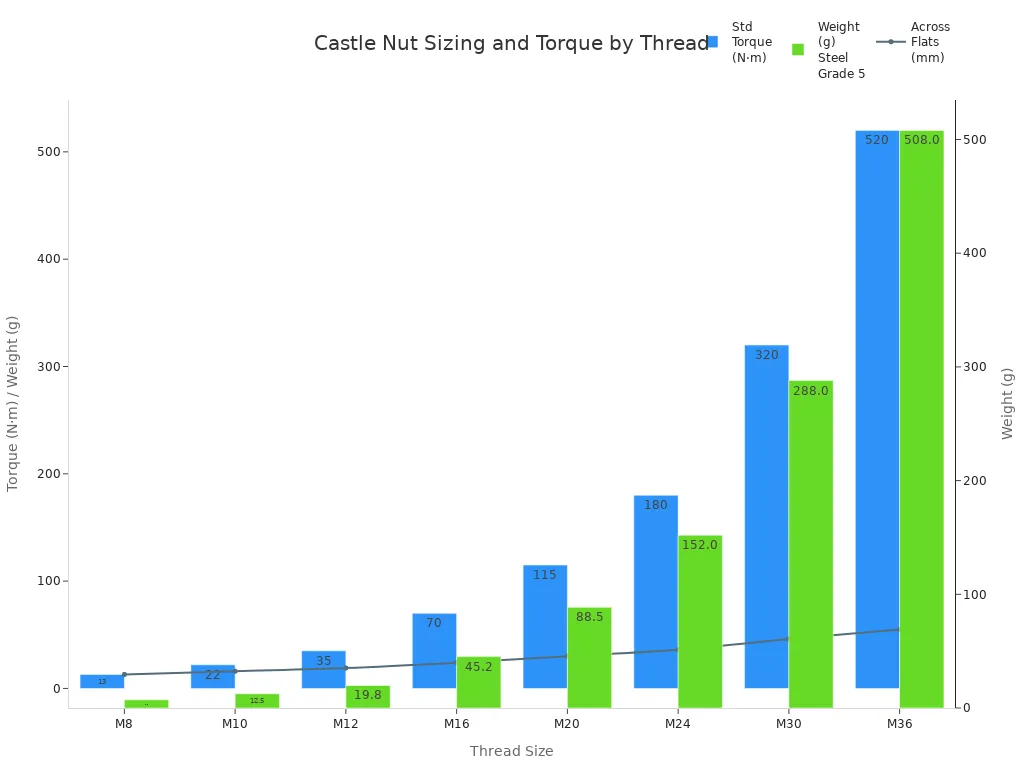
Castle nuts accommodate both metric coarse pitch and fine pitch variants. This affects torque specifications and installation techniques. Safety wire sizing follows specific standards, ensuring proper engagement and corrosion resistance. Compliance with regulations such as FAA and military specifications is crucial for safety-critical applications.
Material selection for castle nuts
Material selection depends on the operating environment and mechanical demands. Engineers choose steel for strength and affordability. Brass and bronze resist corrosion in marine settings. Aluminum suits aerospace applications due to its light weight. Plastic castle nuts serve non-critical assemblies where corrosion resistance is needed but strength is less important.
Checklist for castle nut compliance
Verifying castle nut standards
Engineers verify that castle nuts meet relevant standards before installation. They check markings for material grade, batch codes, and compliance certifications. Regulatory requirements demand adherence to standards such as DIN, ANSI, ISO, FAA, and military specifications.
Inspecting castle nut quality
Quality inspection ensures reliability and safety. Technicians examine slot alignment, thread integrity, and cotter pin engagement. They confirm torque values and inspect for corrosion or deformation. Regular maintenance and inspection help prevent failures in critical assemblies.
Tip: Always follow a compliance checklist when selecting and installing castle nuts. This practice maintains safety and performance in mechanical systems.
- Castle nuts feature both metric coarse and fine pitch variants, supporting industrial and precision applications.
- Standard torque values and proper slot alignment maintain assembly integrity.
- Safety wire installation prevents nut rotation and enhances reliability.
Engineers should always consult industry standards and verify compliance before selecting a castle nut. This practice ensures safe and dependable performance in critical assemblies.
الأسئلة الشائعة
What is the main purpose of a castle nut?
A castle nut secures mechanical assemblies by preventing loosening under vibration. Engineers use it with a cotter pin for positive locking. This design ensures safety in automotive, aerospace, and heavy machinery applications.
How do engineers select the correct castle nut size?
Engineers match the nut size to the bolt diameter and thread pitch. Dimensional tables and industry standards guide selection. Proper sizing ensures reliable fit and prevents assembly failures.
Which materials offer the best corrosion resistance for castle nuts?
Stainless steel and titanium provide excellent corrosion resistance. Brass suits electrical assemblies. Engineers choose materials based on environmental exposure and load requirements.
Are castle nuts compatible with both metric and inch threads?
Manufacturers produce castle nuts in metric and inch thread variants. Engineers must verify thread type and pitch before installation. Compatibility ensures proper fit and performance.
What certifications should castle nuts have for safety-critical applications?
Castle nuts require certifications from standards bodies such as DIN, ANSI, ISO, FAA, or military specifications. Engineers check markings and documentation to confirm compliance.
How often should technicians inspect castle nuts in assemblies?
Technicians inspect castle nuts monthly for signs of wear, rust, or deformation. Quarterly torque checks ensure proper fastening. Regular maintenance maintains safety and reliability.
Can castle nuts be reused after removal?
Engineers recommend replacing castle nuts after removal, especially in safety-critical assemblies. Reusing nuts may compromise locking integrity and increase failure risk.
What is the difference between a castle nut and a slotted nut?
A castle nut features deeper slots and supports thicker cotter pins. Slotted nuts have shallower slots and suit lighter applications. Castle nuts provide superior locking for high-stress environments.