
A rivnut, also called a rivet nut, serves as a specialized type of fastener that creates strong threads in thin or soft materials where traditional nuts and bolts fail. This custom fastener expands on the blind side of a workpiece when installed, forming a secure, reusable threaded insert. Many industries rely on rivet nuts because they can install them from one side, avoid damaging surfaces, and reduce labor costs. Recent reports show the global blind rivet nut market could reach USD 184.6 million by 2033, with growth fueled by automotive, aerospace, and custom fasteners manufacturer demand for efficient assembly.
- Key reasons for choosing rivet nuts in thin materials:
- Installation from one side
- No heat required, lowering damage risk
- Works after painting, preserving finish
- Fast, clean production process
Rivet Nut: Basic Definition and Features
What Is a Rivnut or Rivet Nut?
A rivnut, also known as a rivet nut, combines the functions of a nut and a rivet. Engineers use rivet nuts to create strong, permanent threads in thin or soft materials. These fasteners install from one side, making them ideal for blind-side applications. The rivet nut expands during installation, locking itself securely in place. Once set, it provides a reusable internal thread similar to a standard nut. Rivet nuts serve as tubular fasteners that allow bolting in materials where conventional tapping cannot work.
Rivet nuts solve the challenge of attaching components to thin sheet metal, plastics, or composites. They offer a reliable solution when access to the back side of the material is limited.
- Rivet nuts:
- Combine nut and rivet functionality
- Install from one side (blind-side)
- Provide permanent internal threads
- Work in thin materials where tapping is impractical
Key Features of Rivet Nuts
Rivet nuts offer several features that make them valuable in manufacturing and assembly. Their versatility and performance distinguish them from other fasteners.
- Permanent internal threads: Rivet nuts create strong threads that withstand repeated use.
- Blind installation: Workers can install rivet nuts without accessing the back side of the material.
- Compatibility with thin materials: Rivet nuts perform well in sheet metal, plastics, and composites.
- Fast installation: Rivet nuts require minimal tools and reduce labor time.
- Reusability: Rivet nuts allow for easy removal and replacement of bolts or screws.
- Vibration resistance: Rivet nuts maintain secure connections even in environments with vibration.
Tip: Rivet nuts help preserve painted or finished surfaces because they install after surface treatments.
Rivet Nuts vs. Other Fasteners
Rivet nuts differ from other fasteners in several ways. The table below highlights key differences between rivet nuts, traditional rivets, and threaded inserts.
| Feature | Rivet Nut | Traditional Rivet | Threaded Insert |
|---|---|---|---|
| Provides Internal Thread | Yes | No | Yes |
| Blind Installation | Yes | Yes | Sometimes |
| Reusability | Yes | No | Yes |
| Suitable for Thin Materials | Yes | Yes | Yes |
| Vibration Resistance | High | Moderate | High |
Rivet nuts stand out because they combine the advantages of rivets and nuts. They provide strong threads in thin materials, allow blind installation, and support repeated assembly and disassembly. Traditional rivets do not offer internal threads and cannot be reused. Threaded inserts may require access to both sides or special tools.
Note: Rivet nuts improve assembly efficiency and reduce the risk of damaging delicate materials.
Rivet Nut Installation: How It Works
The Rivet Nut Installation Process
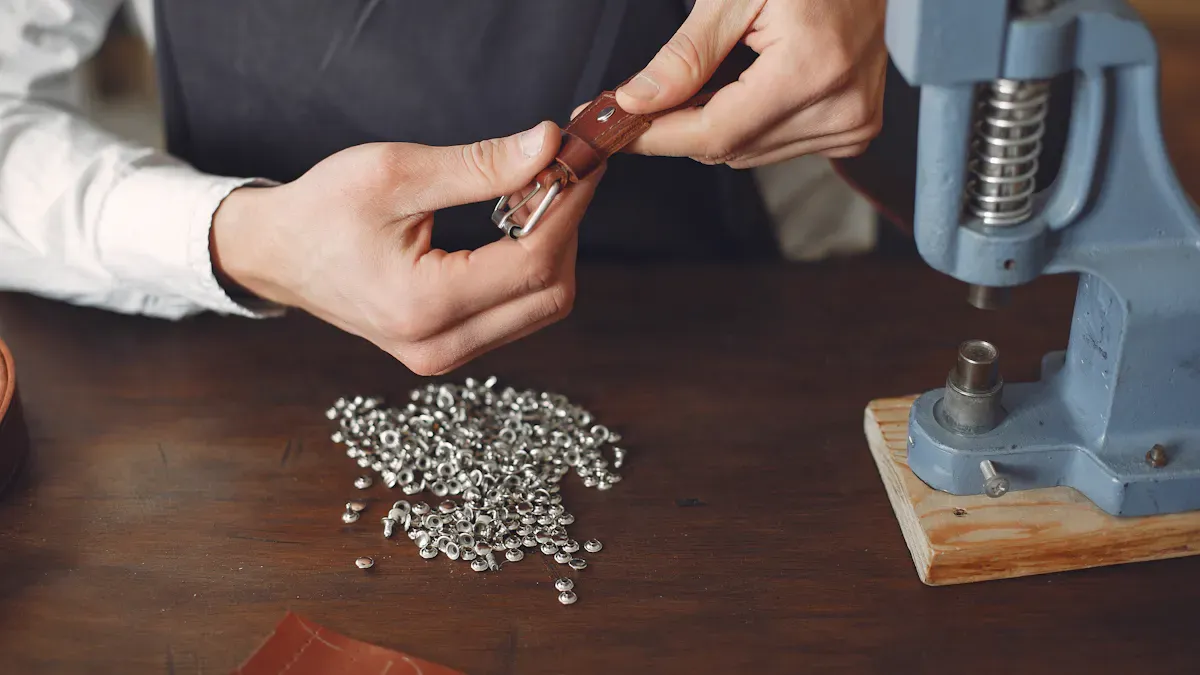
Rivet nut installation transforms a simple hole in thin material into a strong, reusable anchor point. The process begins with drilling or punching a hole that matches the rivet nut’s body diameter. The installer then inserts the rivet nut into the hole from one side of the workpiece. Using a specialized tool, the installer pulls on the internal threads of the rivet nut while holding its flange against the material. This action causes the unthreaded portion of the rivet nut to expand and grip the back side of the material, creating a secure mechanical lock.
The installation process offers several advantages. Workers can complete the installation from only one side, which is essential for blind applications. The process does not require heat or welding, so it preserves the integrity of painted or coated surfaces. Rivet nut installation also works well in automated assembly lines, reducing labor time and increasing consistency.
However, installers may encounter challenges during rivet nut installation. The following table outlines common issues, their causes, and practical solutions:
| Challenge | Possible Causes | Solutions |
|---|---|---|
| Rivet Nut Spinning | Base material too thin or soft, insufficient pulling force, oversized hole, smooth-body nut on smooth metal | Adjust tool stroke, follow recommended hole diameter, use knurled nuts, avoid flat-body nuts in soft materials |
| Rivet Nut Stripping | Excessive pulling force, small thread size, soft materials in high-torque | Follow torque specs, select steel nuts for high-load, use torque-controlled tools, avoid overtightening |
| Rivet Nut Deformation | Excessive pulling force, large hole diameter, incorrect panel thickness, misalignment of tool | Select nuts per grip range, control pulling stroke, ensure tool alignment, maintain accurate hole diameter |
| Rivet Nut Under-Setting | Short stroke on tool, material thickness too high, insufficient flange compression | Use adjustable stroke tools, choose larger nuts for thick materials, inspect expansion shape |
| Difficult Bolt Installation | Damaged internal thread, nut installed at an angle, edge deformation | Maintain alignment, use thread gauges, ensure flange area is flat and unobstructed |
Tip: Proper hole sizing and tool alignment prevent most installation problems and ensure a secure rivet nut connection.
Creating Threads in Thin Materials
Rivet nuts solve the challenge of adding strong threads to thin or soft materials. Traditional tapping methods often fail in sheet metal or plastic because there is not enough material to form durable threads. Rivet nuts, also called nutserts, overcome this limitation by expanding and locking into place during installation. This expansion forms a robust anchor point for screws or bolts.
- Rivet nuts create a strong and removable threaded connection in thin materials, which is advantageous when traditional tapping methods are not feasible due to limited material thickness.
- They expand and lock into place during installation, forming a durable anchor point for screws or bolts, unlike tapping and extrusion tapping methods that may lack strength in thin materials.
- Tapped threads are often impractical in thin sheet metal due to insufficient material for a robust connection, making rivet nuts a preferred choice.
- Rivet nuts, also known as nutserts, are installed from one side and expand against the material, providing a reliable threaded anchor.
This method allows engineers to use lightweight materials without sacrificing strength or reliability. Rivet nuts also support repeated assembly and disassembly, which is not possible with traditional rivets.
Strength and Reusability of Rivet Nuts
Rivet nuts deliver impressive strength in a wide range of material thicknesses. For example, the K Series ribbed rivet nut supports material thicknesses from 0.020 inches (0.5 mm) to 0.312 inches (7.9 mm). This versatility allows manufacturers to select the right rivet nut for each application, ensuring optimal load-bearing capacity.
| Rivet Nut Style | Material Thickness Range |
|---|---|
| K Series Ribbed | 0.020″ (0.5mm) to 0.312″ (7.9mm) |
Rivet nuts also offer excellent reusability. Once installed, they provide permanent internal threads that withstand repeated use. Users can remove and replace bolts or screws multiple times without damaging the rivet nut or the base material. This feature makes rivet nuts ideal for applications that require ongoing maintenance or future upgrades.
Note: Rivet nuts maintain their strength and integrity even after multiple assembly cycles, making them a cost-effective solution for both initial installation and long-term service.
Types of Rivet Nuts
Manufacturers and engineers can choose from a wide range of rivet nut designs to match specific application needs. The main types of rivet nuts fall into two categories: standard and specialty. Each type offers unique features that address different installation challenges and performance requirements.
Standard Rivet Nuts
Standard rivet nuts provide reliable performance in most general-purpose applications. They come in several body shapes and head styles to suit various installation environments.
Round Body Rivet Nut
A round body rivet nut features a cylindrical shape that fits easily into pre-drilled round holes. This simple structure makes installation straightforward. Round body rivet nuts work best in low-torque applications, such as machinery panels or enclosures, where rotation is not a major concern. Their versatility and ease of use make them a popular choice for many assembly lines.
Hex Body Rivet Nut
Hex body rivet nuts have a hexagonal exterior that resists spinning during installation and use. Installers often select these for applications that require higher torque or where vibration may loosen other fasteners. The hex shape locks into hexagonal holes, providing excellent anti-rotation performance. Full hex body rivet nuts offer maximum resistance, while half hex designs combine easy insertion with improved grip.
Tip: Hex body rivet nuts are ideal for automotive chassis and construction machinery, where strength and reliability are critical.
Specialty Rivet Nuts
Specialty rivet nuts address unique challenges in demanding environments. These designs enhance sealing, grip, or adaptability for specific materials.
Sealed Rivet Nut
A sealed rivet nut, also known as a closed-end rivet nut, features a sealed bottom that prevents dust, moisture, or contaminants from entering the assembly. This design protects sensitive components and extends service life in harsh or wet environments. Automotive manufacturers often use sealed rivet nuts in waterproof equipment and vehicle bodies.
Jack Nut
Jack nuts provide a solution for fastening into brittle or thin materials, such as plastics or composites. When installed, the jack nut collapses behind the panel, creating a large bearing surface. This action distributes the load and reduces the risk of material damage. Installers use jack nuts in electronics housings and lightweight panels.
Tri-Fold Rivet Nut
Tri-fold rivet nuts expand into three sections during installation. This unique design creates a strong grip in soft or thin materials. Tri-fold rivet nuts excel in applications where standard rivet nuts might pull through or fail to anchor securely.
Rivet Nut Material Options
Material selection plays a key role in rivet nut performance. The most common materials include steel, aluminum, and stainless steel. Each material offers distinct advantages and limitations.
| Material | Advantages | Disadvantages |
|---|---|---|
| Steel | High strength, cost-effective | Requires protective coatings |
| Aluminum | Lightweight, easy to install, corrosion-resistant | Difficult to remove, may protrude, corrosion issues in some environments |
| Stainless Steel | Excellent corrosion resistance, high durability | Heavier, more expensive |
Steel Rivet Nut
Steel rivet nuts deliver high strength and durability at a reasonable cost. They suit applications that demand robust fastening but do not require extreme corrosion resistance. Manufacturers often apply protective coatings to steel rivet nuts to prevent rust.
Aluminum Rivet Nut
Aluminum rivet nuts offer a lightweight solution for weight-sensitive projects. They resist corrosion and install easily, making them suitable for moderate loads in non-extreme conditions. Aerospace and electronics industries often prefer aluminum rivet nuts for their balance of strength and weight.
Stainless Steel Rivet Nut
Stainless steel rivet nuts provide superior corrosion resistance and strength. They perform well in harsh or humid environments, such as marine or outdoor equipment. Although heavier and more expensive, stainless steel rivet nuts ensure long-term reliability where failure is not an option.
Note: Open-end rivet nuts allow bolts to pass through, while closed-end rivet nuts seal the bottom to block contaminants.
The following table summarizes the most common types of rivet nuts and their typical uses:
| Type | Characteristics | Typical Uses |
|---|---|---|
| Flat Head Rivet Nut | Wide flange, flush fit, stable bearing surface | Automotive interiors, appliance panels |
| Reduced Head Rivet Nut | Small flange, fits tight spaces | Electronics housings, light machinery |
| Countersunk Head Rivet Nut | Flange fits chamfer, flat appearance | Furniture, decorative surfaces |
| Round Body Rivet Nut | Simple, fits round holes | Machinery, low-torque applications |
| Half Hex Body Rivet Nut | Part hex, anti-rotation, easy insertion | Thin plates, soft materials |
| Full Hex Body Rivet Nut | Full hex, high anti-rotation | Automotive chassis, construction machinery |
| Open-End Rivet Nut | Thread passes through, for longer bolts | General fastening |
| Closed-End Rivet Nut | Sealed bottom, blocks dust/moisture | Waterproof equipment, automotive |
Selecting the right types of rivet nuts ensures secure, long-lasting connections in any project.
Rivet Nut Installation Guide
Tools for Rivet Nut Installation
Selecting the right rivet nut tool is essential for efficient and reliable installation. The most common options include manual, cordless, and air-powered tools. Each type offers unique advantages for different project requirements.
Manual Rivet Nut Tools
Manual rivet nut guns operate with hand force. They suit low-volume tasks, typically fewer than 100 rivet nuts per project. These tools provide precise control and work well for maintenance, repair, or small assembly jobs. Operators can use a manual rivet nut gun in tight spaces or locations without access to power.
Power Rivet Nut Tools
Power rivet nut guns increase speed and reduce operator fatigue. Cordless rivnut guns use battery power, making them ideal for fieldwork or areas without compressed air. These tools can handle larger sizes, such as up to M12 in stainless steel. Air rivet nut guns, also called pneumatic tools, deliver the fastest cycle times and the highest pull force. Manufacturers often choose air rivet nut guns for high-volume production lines where efficiency is critical.
Tip: Cordless and air-powered rivet nut guns improve productivity in demanding environments.
Step-by-Step Rivet Nut Installation
A successful rivet nut installation follows a clear process. This rivet nut guide outlines each step to ensure strong, reliable connections.
Preparing the Hole for Rivet Nut
- Drill or punch a hole in the workpiece. The hole diameter must match the rivet nut’s specifications for a secure fit.
- Remove any burrs or debris to prevent interference during installation.
Inserting the Rivet Nut
- Place the rivet nut into the prepared hole. The flange should sit flush against the material surface.
Setting the Rivet Nut
- Attach the rivet nut tool to the internal threads of the rivet nut.
- Activate the tool. The tool pulls the mandrel, causing the rivet nut to expand and grip the back side of the material.
Checking Rivet Nut Installation
- Inspect the installed rivet nut. Ensure it sits flush and does not spin in the hole.
- Test the threads with a bolt to confirm proper installation.
Note: Following each step in the rivet nut guide helps prevent installation failures and ensures long-term performance.
Choosing the Right Rivet Nut Tool
Several factors influence the selection of a rivet nut tool for specific applications:
- Workpiece material and thickness
- Application environment (shop, field, or production line)
- Load requirements and grip range
- Stroke length and pull force needed
- Types of available nose assemblies
- Cycle time for power tools
- Tool weight, ease of use, and battery charge length for cordless models
A power rivet nut gun suits high-volume or heavy-duty jobs, while a manual rivet nut gun works best for occasional use or tight spaces. Cordless rivnut guns offer flexibility for remote locations. Air rivet nut guns provide unmatched speed and consistency in fixed installations.
Choosing the correct rivet nut tool ensures efficient installation and long-lasting results.
Removing Rivet Nuts
When to Remove a Rivet Nut
Technicians and engineers sometimes need to remove rivet nuts during maintenance or repair. Several scenarios in industrial and automotive settings make removal necessary:
- Hole Size Mismatch: The rivet nut may not anchor securely if the hole is too large. If the hole is too small, installation becomes difficult or impossible.
- Incorrect Grip Range Selection: Rivet nuts are designed for a specific material thickness. If the application exceeds that range, the fastener may not collapse fully or could bottom out.
- Under- or Over-Torquing: Manual installations can cause inconsistent deformation. Under-torquing leads to a loose fit, while over-torquing can distort threads or crush the base material.
- Spin-Out During Installation: The nut may rotate with the tool if it does not grip the panel, especially with round-body rivet nuts in smooth holes.
- Tool Wear or Calibration Issues: A worn mandrel or misaligned tool can cause improper collapses, especially in high-throughput environments.
- Retrofitting Oversized Holes: Wear, mis-drilling, or prior rework can create oversized holes, making it necessary to remove the rivet nut.
These situations require careful removal to avoid damaging the workpiece or surrounding components.
Rivet Nut Removal Methods
Using Hand Tools for Removal
Hand tools offer a controlled approach for removing rivet nuts, especially in delicate or thin materials. Technicians often use a drill and a suitable bit to cut away the flange of the rivet nut. They select a drill bit slightly smaller than the rivet head to avoid enlarging the hole. Applying the drill straight and using low speed helps minimize pressure on the surrounding material. After drilling through the flange, they can push the remaining body through the hole.
A hacksaw or file can also help remove protruding rivet nuts. These tools allow for gradual material removal and reduce the risk of damaging the base material.
Using Power Tools for Removal
Power tools, such as rotary tools or electric drills, speed up the removal process in high-volume or industrial environments. Operators must use caution to prevent overheating or excessive force, which can deform thin panels. They often use a step drill or specialized removal bit to cut through the rivet nut efficiently. Proper alignment and steady pressure ensure a clean removal without damaging the workpiece.
Tips to Prevent Damage During Removal
Experts recommend several strategies to protect thin materials during rivet nut removal:
- Choose a drill bit slightly smaller than the total rivet head.
- Apply the drill straight to minimize pressure on the surrounding material.
- Use a low drilling speed for precise removal.
These tips help maintain the integrity of the workpiece and prepare the surface for a new fastener. Anyone seeking guidance on how to remove rivet nuts should follow these best practices for safe and effective results.
Note: Careful removal preserves the original hole size and reduces the need for additional repairs.
Benefits of Rivet Nuts
Strong Threads in Thin Materials
Rivet nuts deliver robust threaded connections in materials where traditional fasteners struggle. Many industries, such as automotive and machinery manufacturing, rely on rivet nuts to create internal threads in thin plates and tubes. These fasteners excel in applications where direct tapping is impossible due to limited material thickness. Rivet nuts provide a secure anchor point for bolts and screws, even in lightweight metals and plastics.
The following table highlights how rivet nuts compare to weld nuts when used in thin materials:
| Feature | Rivet Nuts | Weld Nuts |
|---|---|---|
| Installation Method | Installed in pre-drilled holes | Requires welding equipment |
| Material Compatibility | Thin metals and plastics | Limited to thicker materials |
| Strength of Connection | Strong threaded connection | Potential for damage to surrounding material |
Rivet nuts offer a reliable solution for engineers who need strong threads without risking damage to the base material. They are designed for materials that cannot be directly tapped, ensuring a dependable connection every time.
Tip: Rivet nuts allow for strong, reusable threads in thin materials, making them ideal for lightweight assemblies.
Fast and Easy Rivet Nut Installation
Rivet nut installation stands out for its speed and simplicity. Workers can install these fasteners from one side of the workpiece, which eliminates the need for access to the back. This feature reduces assembly time and labor costs. Rivet nuts require only a pre-drilled hole and a compatible tool, making the process straightforward.
- Rivet nuts are easy to install and reliable in strength.
- The installation process does not require heat or welding, which helps preserve surface finishes.
- Rivet nuts support quick repairs and modifications, as users can remove and replace bolts without damaging the threads.
Many manufacturers choose rivet nuts for high-volume production lines because they streamline assembly and minimize downtime.
Versatility of Rivet Nuts
The versatility of rivet nuts sets them apart from other fasteners. These components adapt to a wide range of materials, including metals, plastics, and composites. Engineers use rivet nuts in diverse industries, from automotive to electronics, due to their ability to provide strong threads in challenging environments.
- Rivet nuts work in thin, brittle, or soft materials where other fasteners may fail.
- They accommodate different grip ranges and material thicknesses.
- Rivet nuts support both permanent and removable connections, allowing for ongoing maintenance or upgrades.
The benefits of rivet nuts extend to custom projects, repairs, and mass production. Their adaptability and ease of use make them a preferred choice for many applications.
Note: The benefits of rivet nuts include strong threads, fast installation, and unmatched versatility, making them essential in modern assembly processes.
Reusability and Maintenance
Rivet nuts offer exceptional reusability, making them a preferred choice for engineers and technicians who value efficient maintenance. Unlike traditional rivets, which require destructive removal, rivet nuts allow users to remove and reinstall bolts or screws multiple times without compromising the integrity of the fastener or the base material. This feature supports ongoing maintenance, upgrades, and repairs in a wide range of industries.
Many manufacturers design rivet nuts to withstand repeated assembly cycles. The internal threads remain stable, even after frequent bolt changes. This durability ensures that equipment and structures maintain their strength over time. Technicians can access components for inspection or replacement without damaging the workpiece, which reduces downtime and repair costs.
Tip: Rivet nuts simplify maintenance in automotive, aerospace, and industrial applications. They enable quick access to panels, covers, and assemblies for routine service.
The following table compares rivet nuts with other fasteners regarding maintenance and reusability:
| Fastener Type | Reusability | Maintenance Ease | Risk of Material Damage |
|---|---|---|---|
| Rivet Nut | High | Easy | Low |
| Weld Nut | Moderate | Difficult | Moderate |
| Traditional Rivet | None | Difficult | High |
Technicians often select rivet nuts for projects that require frequent access or adjustments. For example, in electronics enclosures, rivet nuts allow engineers to open and close panels without weakening the threads. In automotive repair, mechanics can replace parts or upgrade systems without removing the entire fastener.
Maintenance teams benefit from the versatility of rivet nuts. They can use standard tools to remove bolts, inspect internal threads, and reinstall fasteners as needed. If a rivet nut shows signs of wear or damage, technicians can remove it using hand or power tools and install a new one in the same hole. This process preserves the original material and avoids costly rework.
- Key advantages of rivet nut reusability:
- Supports repeated bolt installation and removal
- Reduces maintenance time and labor costs
- Minimizes risk of damaging thin or finished materials
- Allows for easy upgrades and repairs
Rivet nuts provide a reliable solution for maintenance-intensive environments. Their reusability and ease of service help extend the lifespan of equipment and structures, ensuring consistent performance and safety.
Rivet Nuts in Common Applications
Automotive Rivet Nut Uses
Automotive engineers rely on rivet nuts to secure components in thin sheet metal, plastic panels, and tubular structures. These fasteners provide robust connections where traditional nuts and bolts cannot perform. Rivet nuts allow for quick installation and removal, making them ideal for assembling dashboards, securing body panels, and mounting brackets. Mechanics often use rivet nuts to attach accessories, such as roof racks or fender flares, without damaging painted surfaces.
The following table highlights common rivet nut applications in automotive and related industries, along with their benefits:
| Application | Benefits |
|---|---|
| Automotive | Provides robust connections for thin materials |
| Marine | Versatile fastening solutions |
| General Manufacturing | Securely fastens components |
Rivet nuts offer versatility and strength, making them suitable for various applications in vehicles and equipment.
Industrial and Manufacturing Applications
Manufacturing facilities use rivet nuts to streamline assembly processes and improve operational efficiency. Workers install rivet nuts into pre-drilled holes in thin metals and plastics, eliminating the need for specialized welding equipment. This approach reduces safety risks associated with welding fumes and lowers training costs. Rivet nuts can be installed after painting or coating, which minimizes the risk of surface damage and reduces costly rework.
Production teams benefit from the quick and repeatable installation of rivet nuts. The process enhances production predictability compared to manual welding. Rivet nuts occupy less floor space, allowing for compact installation stations that replace larger welding cells. This improvement increases overall operational efficiency. Rivet nuts do not alter the base material’s structure, avoiding heat-related damage and preserving the integrity of closed sections and box frames.
Tip: Rivet nuts provide a reliable solution for fastening components in industrial environments, supporting maintenance and upgrades without disrupting production.
Home and DIY Rivet Nut Projects
Homeowners and DIY enthusiasts use rivet nuts to tackle a wide range of projects. Rivet nuts simplify the installation of shelving, cabinetry, and furniture, especially when working with thin materials. Hobbyists often choose rivet nuts for assembling bicycle racks, garden equipment, or custom storage solutions. Rivet nuts allow for strong, removable connections, making them ideal for projects that require frequent adjustments or repairs.
Rivet nuts enable users to create professional-quality results without specialized tools or welding. The fasteners work in thin metals, plastics, and composites, making them suitable for various applications around the home. Rivet nuts support creativity and innovation, allowing individuals to build and modify projects with confidence.
Note: Rivet nut applications extend from automotive and industrial settings to home workshops, demonstrating their adaptability and reliability.
Electronics and Appliance Uses
Rivet nuts play a critical role in the electronics and appliance industries. Engineers and manufacturers rely on these fasteners to create strong, reliable connections in devices where space is limited and precision is essential. The compact design of rivet nuts allows them to fit into tight enclosures, making them ideal for modern electronics and home appliances.
In electronics manufacturing, rivet nuts secure both internal and external components. Device enclosures often require robust fastening solutions that do not compromise the integrity of delicate circuit boards or thin panels. Rivet nuts provide a durable anchor point for screws and bolts, ensuring that assemblies remain stable during operation and transport. Technicians use rivet nuts to attach mounting brackets, secure connectors, and fasten covers in products such as computers, audio equipment, and communication devices.
Appliance manufacturers also benefit from the versatility of rivet nuts. These fasteners simplify the assembly of panels and brackets in products like refrigerators, washing machines, and ovens. Rivet nuts allow for quick installation and removal of parts, which streamlines production and supports efficient maintenance. The ability to install rivet nuts from one side of a panel reduces labor time and minimizes the risk of damaging finished surfaces.
Key uses and benefits of rivet nuts in electronics and appliances include:
- Fastening device enclosures and circuit boards with precision in tight spaces
- Assembling panels and brackets in large appliances for enhanced durability
- Supporting modular designs that require frequent assembly and disassembly
- Providing strong threads in thin or brittle materials, such as sheet metal or plastic
- Allowing for maintenance and upgrades without damaging the original structure
Tip: Rivet nuts help maintain the appearance and function of electronics and appliances by enabling secure connections without welding or adhesives.
The following table summarizes common applications and the advantages rivet nuts offer in these industries:
| Application Area | Typical Use Case | Key Benefit |
|---|---|---|
| Device Enclosures | Fastening covers and panels | Secure fit, easy access |
| Circuit Boards | Mounting brackets and connectors | Precision, minimal damage |
| Appliance Panels | Assembling outer shells and frames | Durability, fast assembly |
| Internal Brackets | Securing internal components | Strong threads, reusability |
Manufacturers choose rivet nuts for electronics and appliances because these fasteners deliver consistent performance, support rapid assembly, and enable ongoing maintenance. Their adaptability ensures that products remain reliable and serviceable throughout their lifespan.
A rivet nut creates strong threads in thin materials, supporting efficient assembly and maintenance. Industry experts highlight that selecting the right fastener type ensures reliability and cost-effectiveness. The table below summarizes key considerations:
| Key Aspect | Details |
|---|---|
| Types of Rivets | Solid, blind, and self-piercing suit different applications. |
| Advantages | High strength, vibration resistance, and lightweight design. |
| Installation | Quick, simple process with minimal tools. |
| Applications | Common in automotive, aerospace, and construction. |
| Cost-effectiveness | Lower cost and faster installation than welding. |
| Performance Considerations | Proper selection improves project longevity. |
Rivet nuts offer versatility for professionals and DIY users across many industries.
FAQ
What is the main difference between a rivet nut and a traditional rivet?
A rivet nut provides internal threads for bolts or screws. A traditional rivet only joins materials without threads. Rivet nuts allow for removable connections, while traditional rivets create permanent joints.
Can rivet nuts be installed without special tools?
Technicians can install small rivet nuts with basic hand tools, but specialized rivet nut tools ensure proper expansion and secure fit. For best results, professionals recommend using dedicated installation tools.
Are rivet nuts reusable after removal?
Rivet nuts usually cannot be reused once removed. The removal process often damages the fastener. Technicians should install a new rivet nut if they need to replace one.
Which materials work best with rivet nuts?
Rivet nuts perform well in thin metals, plastics, and composites. They create strong threads in materials that cannot support traditional tapping. Engineers select the rivet nut material based on the application’s strength and corrosion requirements.
How do you prevent a rivet nut from spinning during installation?
Installers use the correct hole size and select knurled or hex body rivet nuts. These features grip the material and prevent spinning. Proper tool alignment also helps ensure a secure fit.
What sizes do rivet nuts come in?
Manufacturers offer rivet nuts in standard sizes, such as M3 to M12 (metric) and #6-32 to 1/2″-13 (imperial). The size depends on the application’s thread and grip range requirements.
Are rivet nuts suitable for outdoor or marine environments?
Stainless steel rivet nuts resist corrosion and perform well outdoors or in marine settings. Engineers choose sealed or closed-end designs for extra protection against moisture and contaminants.