
A rivet nut serves as a specialized fastener designed to create strong, threaded connections in thin or soft materials where traditional nuts and bolts cannot work. Engineers rely on rivet nuts to provide secure attachment points in critical industries. For example, the automotive industry uses them to attach panels and components under stress, while aerospace applications benefit from their lightweight strength. Electronics manufacturers use rivet nuts to secure circuit boards efficiently, and furniture makers depend on them for sturdy, adjustable connections. Many custom fasteners manufacturers offer rivet nuts as part of their product lines, meeting unique project needs where custom fasteners are essential.
How a Rivet Nut Works
Basic Function
Creating a Threaded Hole
A rivet nut creates a strong, threaded hole in materials that lack the thickness for conventional threading. Engineers often select a rivet nut when they need to add threads to sheet metal, plastics, or other thin substrates. The internal threads of a rivet nut allow screws or bolts to attach securely, even in materials that would otherwise strip or deform under load. Compared to bolts and self-tapping screws, a rivet nut provides superior holding strength in thin or weak materials. This advantage makes it a preferred choice in applications where reliable load-bearing threads are essential.
Securing to Thin Materials
A rivet nut excels at securing components to thin materials. Its design enables installation from one side, which proves valuable when access to the backside is restricted. The rivet nut forms a bulge behind the material, clamping it tightly and preventing movement. This method ensures a secure fit and reduces the risk of loosening over time. Manufacturers rely on rivet nuts to create durable connections in automotive panels, electronics housings, and furniture frames. The ability to install a rivet nut without reaching behind the workpiece streamlines assembly and enhances efficiency.
A rivet nut offers a quick and reliable method for inserting threads into thin materials, outperforming traditional nuts and bolts in situations where the backside is inaccessible.
Installation Process
Using a Rivet Nut Tool
A rivet nut tool, also known as an installation tool, plays a crucial role in setting a rivet nut. The tool grips the rivet nut and applies force to expand its body inside the hole. Operators choose between manual, pneumatic, or hydraulic installation tools based on the project requirements. Each rivet nut tool ensures consistent deformation and proper seating of the rivet nut. The tool’s mechanism pulls the internal threads upward while holding the rivet nut body in place, causing the lower section to bulge outward. This process locks the rivet nut securely and creates reusable internal threads.
Steps for Setting a Rivet Nut
The installation process follows a series of mechanical steps:
- Drill a hole in the workpiece, such as sheet metal or a hollow tube.
- Insert the rivet nut into the hole until its flange rests on the surface.
- Use a rivet nut tool or installation tool to grip the rivet nut.
- Activate the tool, which pulls the internal threads upward and causes the body to bulge outward.
- The deformation locks the rivet nut in place, providing a strong, reusable thread without needing access to the back side.
Operators often prefer rivet nuts for their speed and ease of installation. In many cases, a rivet nut can be set faster than a traditional nut and bolt, especially when quick assembly and disassembly are required.
- Rivets are generally easier and faster to remove and replace than traditional nuts and bolts.
- A mentor demonstrated that he could remove a rivet nut faster than a nut and bolt, which led to increased use of rivet nuts in assembly lines.
How Rivet Nuts Hold in Place
Expansion Mechanism
A rivet nut relies on compression to secure itself in thin materials. When installed, the collapse chamber of the rivet nut expands outward, forming a bulge that clamps the material tightly against the fastener’s head. This expansion creates a mechanical lock, preventing the rivet nut from pulling out under load. The grip range of a rivet nut defines the minimum and maximum thickness it can effectively clamp. Selecting the correct grip range ensures proper seating and prevents a loose fit.
| Grip Range | Material Thickness | Result |
|---|---|---|
| Too Small | Too thick | Loose fit |
| Correct | Within range | Secure hold |
| Too Large | Too thin | Improper seating |
Preventing Rotation
A rivet nut must resist rotation during and after installation. The bulge formed by the expansion mechanism clamps the material, but additional features may enhance rotational resistance. Some rivet nuts have knurled or hexagonal bodies that grip the hole more effectively. Proper installation tool use ensures the rivet nut seats correctly and prevents spinning. If the pull force is insufficient, the rivet nut may spin in the hole. Excessive force can strip the threads, so operators must follow best practices for installation.
The design of a rivet nut, combined with the correct installation tool and technique, ensures a secure fit and prevents rotation, even in demanding applications.
Types of Rivet Nuts
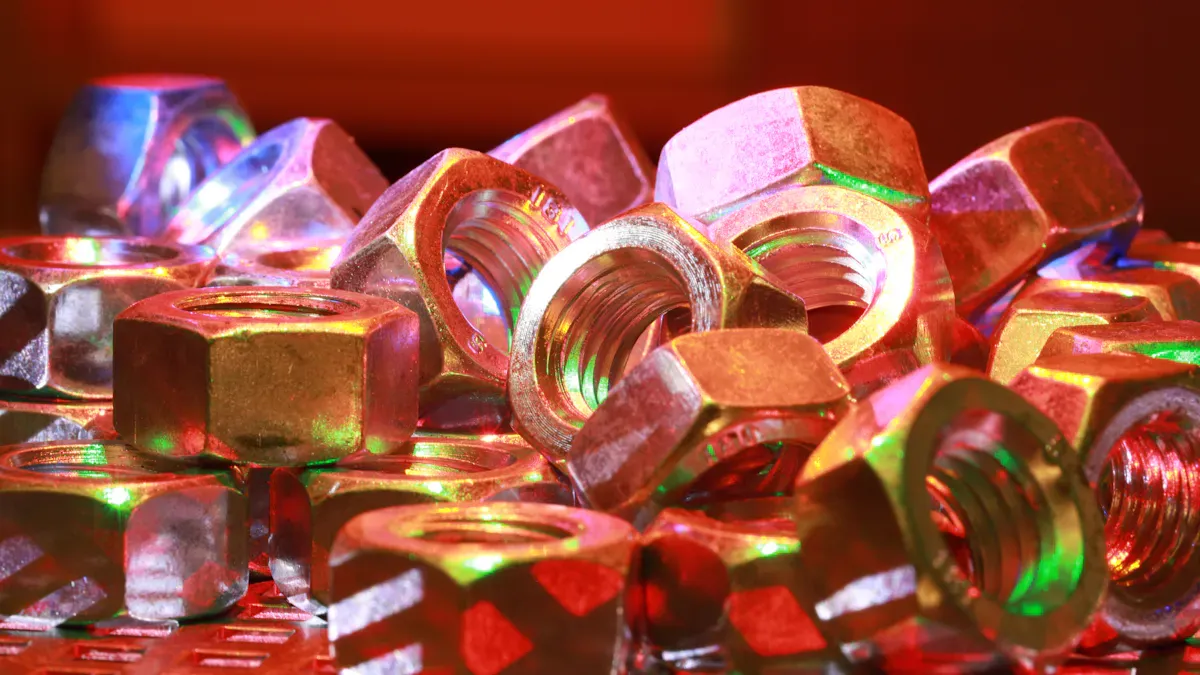
Standard Rivet Nuts
Standard rivet nuts serve as the foundation for most fastening applications. Engineers select these fasteners for their reliability and versatility in creating strong, permanent threads in thin materials.
Round Body
Round body rivet nuts feature a smooth cylindrical shape. This design allows for quick installation in pre-drilled holes. Manufacturers often use round body types in applications where moderate resistance to rotation is sufficient. These rivet nuts perform well in soft materials or when paired with knurled surfaces that enhance grip.
Hex Body
Hex body rivet nuts provide superior resistance to spinning. Their six-sided shape fits into hexagonal holes, locking the fastener in place and preventing rotation during installation or use. Automotive and industrial sectors prefer hex body designs for high-torque applications or when vibration is a concern.
Tip: Hex body rivet nuts offer a simple solution for applications that require extra rotational security.
Comparison Table: Standard Rivet Nuts
| Advantages of Standard Rivet Nuts | Disadvantages of Standard Rivet Nuts |
|---|---|
| Cost-effective compared to welding and adhesives | Requires more workforce for installation |
| Provides strong permanent threads | Increased structural weight in metal fastening |
| Suitable for one-sided installations | Lack of aesthetic finish compared to welded structures |
| Variety of designs available | Permanent joints that are difficult to remove |
| No special materials required for connections | Potential corrosion issues with differing materials |
Material Options
The choice of material impacts rivet nut characteristics such as strength, corrosion resistance, and ease of installation. Each material offers unique benefits for specific environments.
Steel Rivet Nuts
Steel rivet nuts deliver high strength and durability. Low-carbon steel provides good ductility and cost-effectiveness, making it suitable for general applications. High-carbon steel increases wear resistance but may require heat during installation due to reduced ductility. Steel options remain popular in automotive and heavy machinery assembly.
Aluminum Rivet Nuts
Aluminum rivet nuts offer a lightweight solution with excellent corrosion resistance. These fasteners work well in applications where weight reduction is critical, such as aerospace and electronics. However, aluminum has lower strength compared to steel, so engineers use it in less demanding environments.
Stainless Steel Rivet Nuts
Stainless steel rivet nuts combine strength with outstanding corrosion resistance. They perform reliably in harsh or outdoor conditions. Industries that require both durability and a clean finish, such as food processing and marine equipment, often choose stainless steel. Recent innovations in materials science have improved the strength and longevity of these fasteners, expanding their use in lightweight structures.
Material Comparison Table
| Material | Strengths | Weaknesses |
|---|---|---|
| Aluminum | Lightweight, corrosion-resistant | Lower strength compared to steel |
| Low-carbon steel | Good ductility, cost-effective | Prone to rust without coating |
| High-carbon steel | High strength, good wear resistance | Less ductile, may crack during installation |
| Stainless steel | Excellent corrosion resistance, strong | More expensive, harder to work with |
| Brass | Good corrosion resistance, easy to machine | Softer, lower strength than steel |
| Copper | Excellent conductivity, good corrosion resistance | Soft, not suitable for high-stress applications |
Special Designs
Special design rivet nuts address unique installation challenges and performance requirements. These variants enhance versatility and reliability in demanding environments.
Open-End Rivet Nuts
Open-end rivet nuts allow the bolt or screw to pass completely through the fastener. This design suits applications where full thread engagement is necessary. Open-end types are common in furniture assembly and lightweight structures.
Closed-End Rivet Nuts
Closed-end rivet nuts feature a sealed bottom, preventing the bolt from passing through. This design protects against moisture, debris, and contamination. Closed-end types work well in electronics and environments where cleanliness is essential.
Blind Rivet Nut
A blind rivet nut installs from one side of the workpiece, making it ideal for situations with limited access. The fastener creates a strong bond by bulging on the backside when torque is applied. This feature improves load distribution and reduces the risk of damaging the parent material. Originally developed for aerospace and automotive industries, the blind rivet nut now enhances design flexibility in many fields.
Swaged Rivet Nut
Swaged rivet nuts use a swaging process to deform the fastener into the parent material. This method produces a secure, vibration-resistant connection. Swaged designs excel in high-stress or high-vibration environments, such as heavy equipment and transportation.
Note: The body style of a rivet nut, including thick-wall and thin-wall options, influences performance. Thick-wall types provide greater strength, while thin-wall options offer cost savings and versatility.
Common Uses for Rivet Nuts
Rivet nuts serve as essential fasteners across a wide range of industries and projects. Their unique design and installation method make them suitable for many challenging applications where traditional fasteners fall short.
Automotive Applications
Attaching Components
Automotive engineers rely on the rivet nut to attach components securely to dashboards, firewalls, chassis, and body frames. This fastener provides a strong, threaded connection in thin metals and plastics, which are common in vehicle construction. The rivnut fastener attaches radiators, roof racks, spoilers, and plastic fenders with efficiency. Manufacturers prefer this solution because it protects delicate materials from damage and ensures consistent performance under vibration.
| Application | Benefits |
|---|---|
| Attaching panels and trim | Provides strong, secure threaded connections in thin materials. |
| Used in dashboards and firewalls | Reliable under vibration, ensuring parts remain securely fastened. |
| Installed in chassis and frames | Quick assembly and disassembly, favorable for assembly line production. |
Repair and Maintenance
Technicians use the rivet nut during repair and maintenance tasks to restore or reinforce attachment points. This fastener allows for quick replacement of damaged threads without welding or complex procedures. The rivnut fastener streamlines repairs, saving time and reducing labor costs. Its versatility supports a wide range of automotive applications, from securing engine covers to reattaching body panels.
Industrial and Manufacturing
Machinery Assembly
Manufacturers in the industrial sector use the rivet nut for machinery assembly. This fastener creates strong, load-bearing threads in thin sheet metal, aluminum, and composite panels. The rivet nut simplifies the assembly process, especially in areas where access is limited to one side. It also supports quick disassembly for maintenance or upgrades.
Sheet Metal Work
Sheet metal workers depend on the rivet nut for reliable fastening in enclosures, cabinets, and structural frames. The fastener resists pull-out and vibration, which is critical in high-stress environments. Its use extends to industries such as electronics, transportation, and aluminum equipment manufacturing.
Note: Primary industries that use rivet nuts include automotive, aerospace, construction, manufacturing, electronics, medical prosthetics, transportation, recreational equipment, wood assembly, boat making, hot tub manufacturing, and aluminum equipment manufacturing.
Home and DIY Projects
Furniture Assembly
Homeowners and DIY enthusiasts choose the rivet nut for furniture assembly. This fastener provides a clean, professional finish and strong threads in wood, metal, or plastic. The installation process requires only access to one side, making it ideal for box frames and tubing.
Repairs Around the House
The rivet nut simplifies repairs around the house. It works on a variety of materials and delivers a high-strength, load-bearing thread. Users appreciate the convenience and effectiveness of the rivet nut tool, which installs the fastener quickly and leaves a flush, attractive finish. The rivet nut eliminates the need for welding or adhesives, making it a preferred choice for many home applications.
- Versatility: Works on steel, aluminum, plastic, and composites.
- Strength: Provides a high-strength, load-bearing thread.
- Convenience: Installs from one side, ideal for closed-off sections.
- Clean Finish: Offers a professional look without welding.
Advantages of Using Rivet Nuts
Strong and Reliable Fastening
Secure Threads in Thin Materials
A rivet nut creates secure threads in materials that lack thickness for conventional fasteners. Engineers often select this fastener to reinforce thin metals, plastics, or composites. The rivet nut provides a strong connection that resists stripping and deformation. This feature proves essential in automotive, aerospace, and electronics industries, where thin materials require reliable fastening.
Vibration Resistance
Rivet nuts deliver excellent shear strength and vibration resistance. They maintain joint integrity even in environments with repeated stress. Unlike screws, which can loosen under vibration, rivet nuts hold firm and prevent failures. This advantage makes them a superior choice for machinery, vehicles, and equipment exposed to constant movement.
Rivet nuts outperform traditional fasteners in vibration-prone environments, ensuring long-lasting connections.
Easy Installation
No Need for Access to Both Sides
The rivet nut installs from one side of the workpiece. This feature eliminates the need for access to the back, streamlining assembly in closed or hard-to-reach areas. Workers save time and avoid complex procedures, especially in automotive panels and electronic enclosures.
Quick Setup
Professionals and DIY users rate rivet nuts highly for their ease of installation. Many users report that rivet nuts are simple to use and available in multiple sizes. These threaded inserts allow fast assembly of panels and components. The installation process requires minimal tools and training, making rivet nuts accessible for a wide range of projects.
- A user rated rivet nuts 5 out of 5, stating they are easy to use and purchased multiple sizes.
- Another user mentioned that these threaded inserts are the best way to assemble panels and other items.
Table: Rivet Nuts vs. Welding and Traditional Fasteners
| Advantage | Description |
|---|---|
| Efficiency | Rivet nuts are less time-consuming for production compared to welding and traditional fasteners. |
| Safety | No harmful gases or fire hazards are produced during installation, ensuring a safer working environment. |
| Cost-effectiveness | Rivet nuts offer significant economic advantages, being low-cost alternatives to welding and traditional nuts and bolts. |
Versatility
Wide Range of Materials
Rivet nuts adapt to many materials, including metal, plastic, carbon fiber, and wood. Manufacturers produce rivet nuts in steel, aluminum, stainless steel, brass, and rubber. This variety enhances compatibility with different applications and environments.
- Metal
- Plastic
- Carbon fibre
- Wood
Multiple Sizes and Types
Rivet nuts come in various sizes and designs. Engineers select the appropriate type based on material thickness, load requirements, and installation method. The flexibility of rivet nuts supports custom solutions for machinery, electronics, and furniture.
Table: Material Type and Applications
| Material Type | Applications |
|---|---|
| Steel | Heavy machinery |
| Aluminum | Electronics |
| Composites | Various industries |
Rivet nuts offer unmatched versatility, supporting a wide range of materials and applications.
Installing and Removing Rivet Nuts
Tools Needed
Rivet Nut Tool
Rivet nut installation requires specialized installation tools to ensure a secure and precise fit. Operators select from several options based on project scale and material type. Double action lever tools work well for larger rivet nuts, using handles to pull the fastener into position. Plunger double action lever tools allow for quicker release after installation, increasing efficiency in repetitive tasks. Hi-Torquer threaded insert tools require less exertion, making them suitable for small-scale projects. Threaded insert hand tools function at a 90° angle, ideal for installations with downward handle compression.
| Tool Name | Function |
|---|---|
| Double Action Lever Tool | Ideal for larger rivet nuts; uses handles to pull the rivet nut into position. |
| Plunger Double Action Lever Tool | Allows for quicker release after installation. |
| Hi-Torquer Threaded Insert Tool | Requires less exertion; suitable for small-scale projects. |
| Threaded Insert Hand Tool | Functions at a 90° angle; good for downward handle compression. |
Hand Tools
Expendable tools offer an economical option for home repairs. These tools use a mandrel and wrenches for rivet nut installation. Operators often choose hand tools for quick jobs or when working with softer materials. Proper selection of installation tools directly affects the quality and durability of the finished connection.
Tip: Always use the correct tool for the job and follow manufacturer instructions to ensure safe and effective rivet nut installation.
Step-by-Step Installation
Preparing the Hole
Successful rivet nut installation begins with careful preparation. Operators select a bolt size and matching rivet nut to ensure compatibility. They drill a hole that matches the outer diameter of the rivet nut, referencing a size chart for accuracy. The work surface must be flat and clean to promote proper seating.
Setting the Rivet Nut
The installation process follows a clear sequence:
- Load the rivet nut tool with the correct mandrel and nosepiece.
- Thread the rivet nut onto the mandrel.
- Insert the rivet nut into the pre-drilled hole, ensuring the flange sits flush.
- Compress the rivet nut by squeezing the tool handles, locking it in place.
- Remove the tool by unscrewing or releasing it from the rivet nut.
- Test the installation by threading a bolt into the rivet nut.
Note: Secure the material before starting and avoid over-tightening to prevent damage.
Removing a Rivet Nut
Methods for Removal
Removal of a rivet nut requires careful technique to avoid damaging the base material. Operators gather necessary tools such as a rivet nut removal tool, pliers, wrenches, and safety equipment. They identify the type and size of the rivet nut to select the appropriate removal tool. Inspecting surrounding components prevents accidental damage. Operators remove any fasteners connected to the rivet nut, then use the removal tool to apply reverse force and break the nut’s grip. Gently extracting the rivet nut with pliers or the removal tool completes the process.
| Removal Methods | Description |
|---|---|
| Drilling or Grinding | Drill or grind off the head for removal; care needed to avoid damage to materials. |
| Reverse Force | Use removal tool to break the nut’s grip and extract it safely. |
Tips for Avoiding Damage
Operators should always wear safety glasses and gloves to protect against flying debris and sharp edges. They secure the material being fastened to ensure stability. If no removal tools are available, drilling out the rivet nut slowly minimizes damage. Careful drilling prevents harm to the mating material. Protecting nearby components with masking tape or covers reduces the risk of accidental damage.
Safety remains paramount during installation and removal. Operators must use caution when drilling and applying force, and avoid over-tightening or under-tightening.
Troubleshooting and Tips for Rivet Nut Installation
Common Installation Problems
Spinning Rivet Nuts
Spinning rivet nuts present a frequent challenge during installation. When the rivet nut rotates inside the hole, the installer cannot achieve proper torque or secure the fastener. This issue often occurs in smooth materials or when the hole is slightly oversized. Engineers observe that spinning leads to weak joints and unreliable connections. Hex-body rivet nuts and knurled designs offer enhanced grip, reducing the risk of spin-out. Surface treatments such as dimpling increase friction, helping the rivet nut stay firmly in place.
Tip: Select a rivet nut with features that resist rotation, especially for installations in smooth or slippery materials.
Misaligned Holes
Misaligned holes complicate rivet nut installation and can cause assembly delays. When the hole does not line up with the intended fastener location, the installer struggles to insert the bolt or screw. This misalignment may result from inaccurate drilling or shifting during fabrication. RIV-FLOAT® rivet nuts accommodate minor misalignments, providing a tolerance buffer that allows for easier bolt insertion. Engineers recommend these floating rivet nuts for applications where perfect alignment proves difficult.
| Problem | Cause | Solution |
|---|---|---|
| Spinning Rivet Nut | Smooth material, oversized hole | Use hex-body or knurled rivet nut |
| Misaligned Hole | Inaccurate drilling, shifting | Use RIV-FLOAT® rivet nut |
Solutions and Best Practices
Proper Tool Use
Installers achieve reliable results by using the correct tools for rivet nut installation. Rivet nut tools must match the size and type of the fastener. Operators should inspect the tool for wear and ensure the mandrel fits the rivet nut precisely. Applying steady, even force prevents damage and ensures the rivet nut expands correctly. Over-tightening can strip threads, while under-tightening leaves the fastener loose. Technicians recommend practicing on scrap material to master tool operation before working on the final assembly.
- Inspect tools before use.
- Match mandrel and nosepiece to rivet nut size.
- Apply steady force during installation.
- Practice on scrap material for skill improvement.
Choosing the Right Rivet Nut
Selecting the appropriate rivet nut improves installation quality and prevents common issues. Hex-body rivet nuts resist rotation and perform well under torque loads. Knurled rivet nuts provide extra grip in smooth materials. Surface treatments like dimpling enhance friction and stability. RIV-FLOAT® rivet nuts solve alignment challenges by allowing slight movement during bolt insertion. Engineers evaluate material thickness, hole size, and application requirements before choosing a rivet nut.
Note: Careful selection of rivet nut type and thoughtful preparation of the installation site ensure strong, reliable connections and minimize troubleshooting.
Rivet nuts deliver strong, reliable threaded connections in thin materials. Engineers value their ability to install from one side, resist vibration, and maintain consistent clamping force. When selecting a rivet nut, consider body type, material, thread size, and grip range. For installation, verify tool setup, apply proper force, and inspect the base material for defects. These factors ensure durable fastening across automotive, industrial, and home projects.
FAQ
What is the main advantage of using a rivet nut?
A rivet nut creates strong, reusable threads in thin materials. Engineers value its ability to install from one side, which saves time and improves efficiency in assembly.
Can a rivet nut be installed without special tools?
Most rivet nuts require a dedicated installation tool for proper expansion. Some hand tools work for small jobs, but professional tools ensure consistent results and prevent damage.
How does a rivet nut prevent spinning in the hole?
Hex-body and knurled rivet nuts resist rotation by gripping the hole surface. Proper tool use and accurate hole sizing further reduce the risk of spinning during installation.
Which materials work best with rivet nuts?
Steel, aluminum, and stainless steel provide reliable performance. Engineers select the material based on strength, corrosion resistance, and application requirements.
Are rivet nuts suitable for outdoor environments?
Stainless steel rivet nuts offer excellent corrosion resistance. They perform well in outdoor and marine environments, maintaining strength and appearance over time.
How can an installer remove a rivet nut without damaging the material?
Careful drilling or using a removal tool helps extract the rivet nut. Operators protect the surrounding area with tape and work slowly to avoid harming the base material.
What should an engineer do if the rivet nut spins during installation?
Switching to a hex-body or knurled rivet nut improves grip. Engineers may also dimple the hole surface or use a larger rivet nut for better rotational resistance.