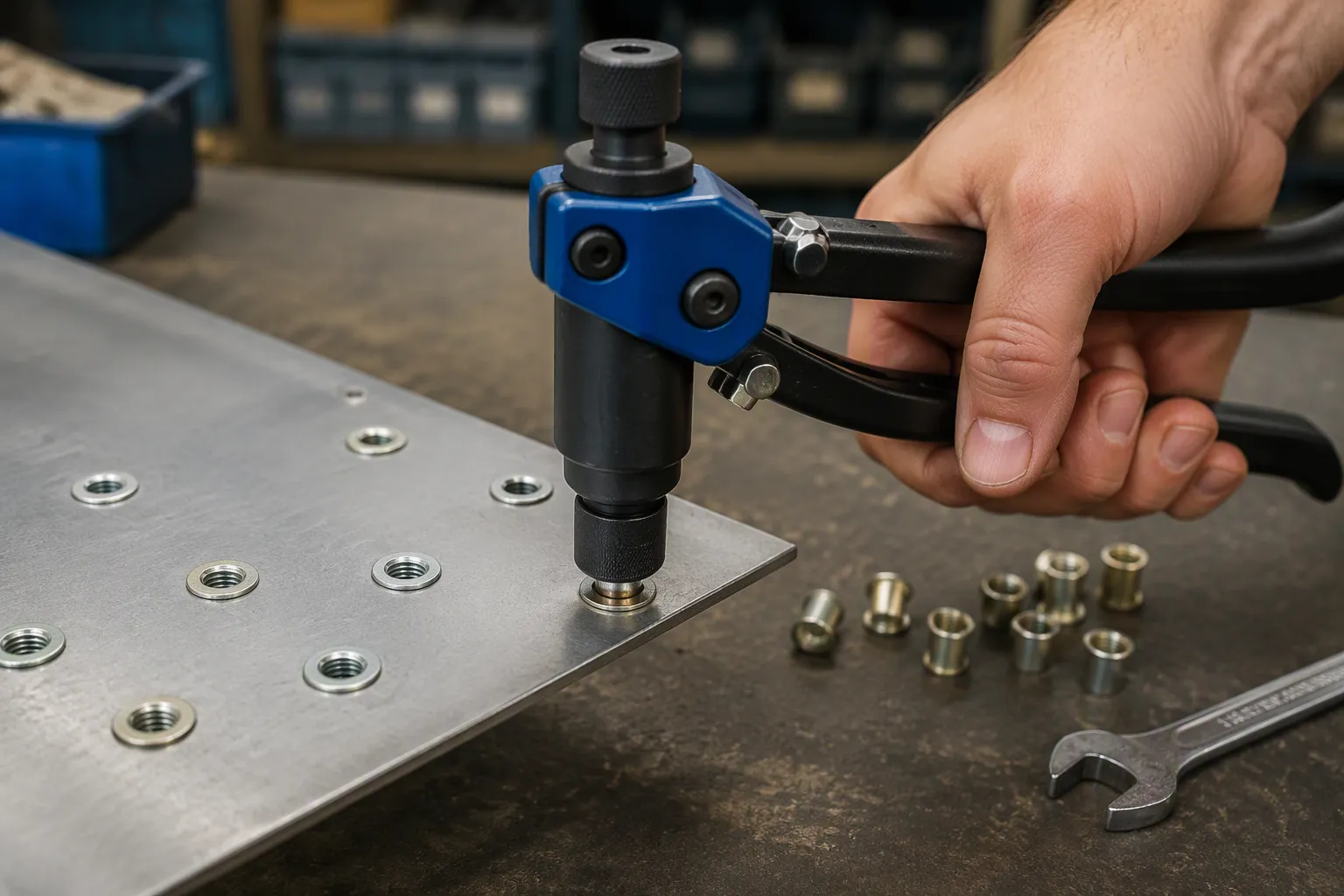
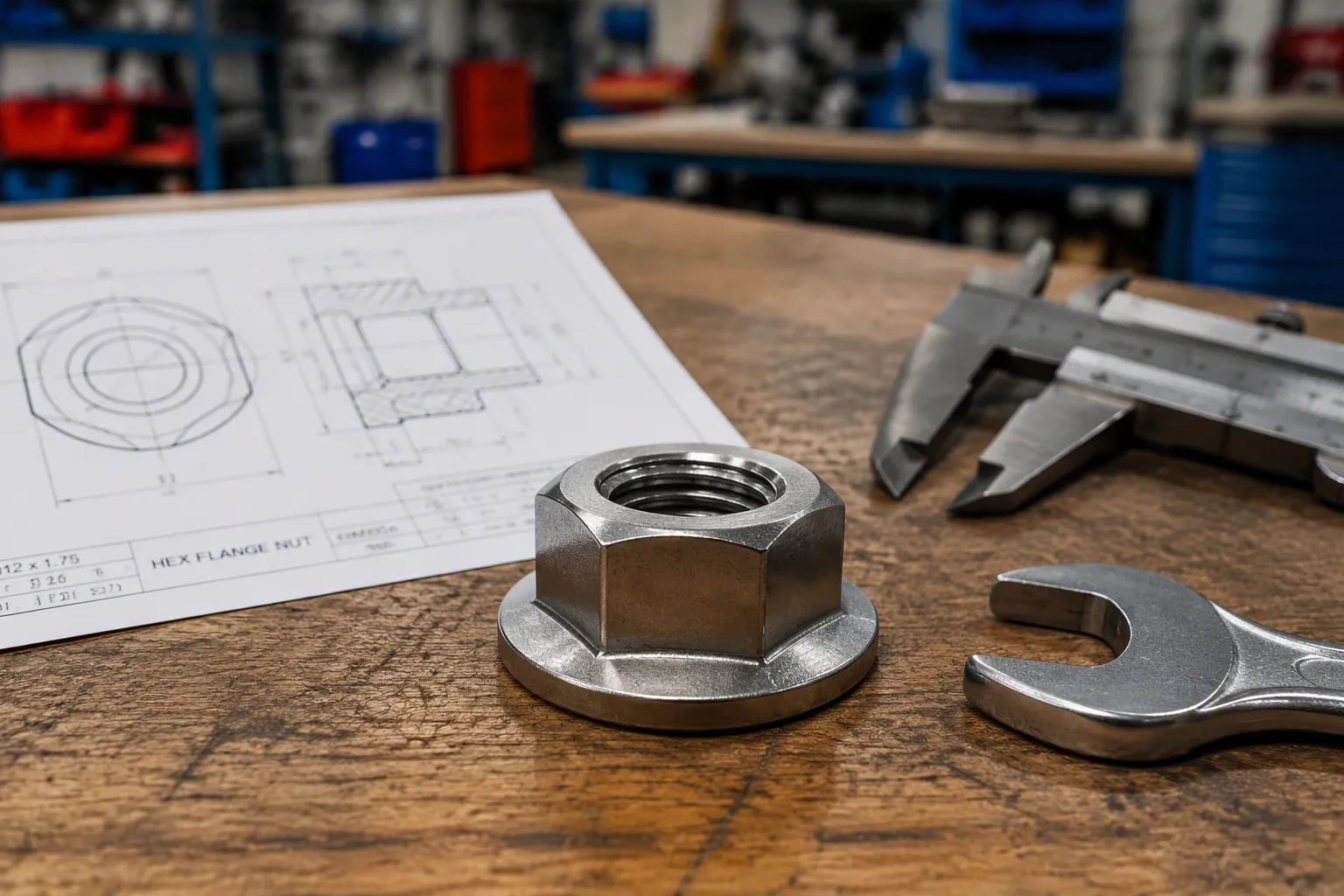
A flange nut is an internally threaded nut with an integrated flange at one end that acts as a built-in washer. The flange geometry distributes clamping load over a larger surface area, which prevents workpiece damage and ensures even loading. Serrated flange nuts feature radial serrations on the flange face that dig into the mating surface to resist vibration loosening. Flange nuts eliminate the need for a separate flat washer, simplifying assembly and reducing part count. Engineers specify these المسامير والبراغي for automotive, machinery, structural, and general fastening applications that demand a secure, stable connection. When reviewing the technical specifications of flange nuts, key dimensions include flange diameter, nut height, thread pitch, and material grade. A مُصنِّع أدوات التثبيت المخصصة يمكن أن ينتج المثبتات المخصصة, tailoring the flange diameter and other dimensions of each flange nut to meet exact requirements.
What Is a Flange Nut?
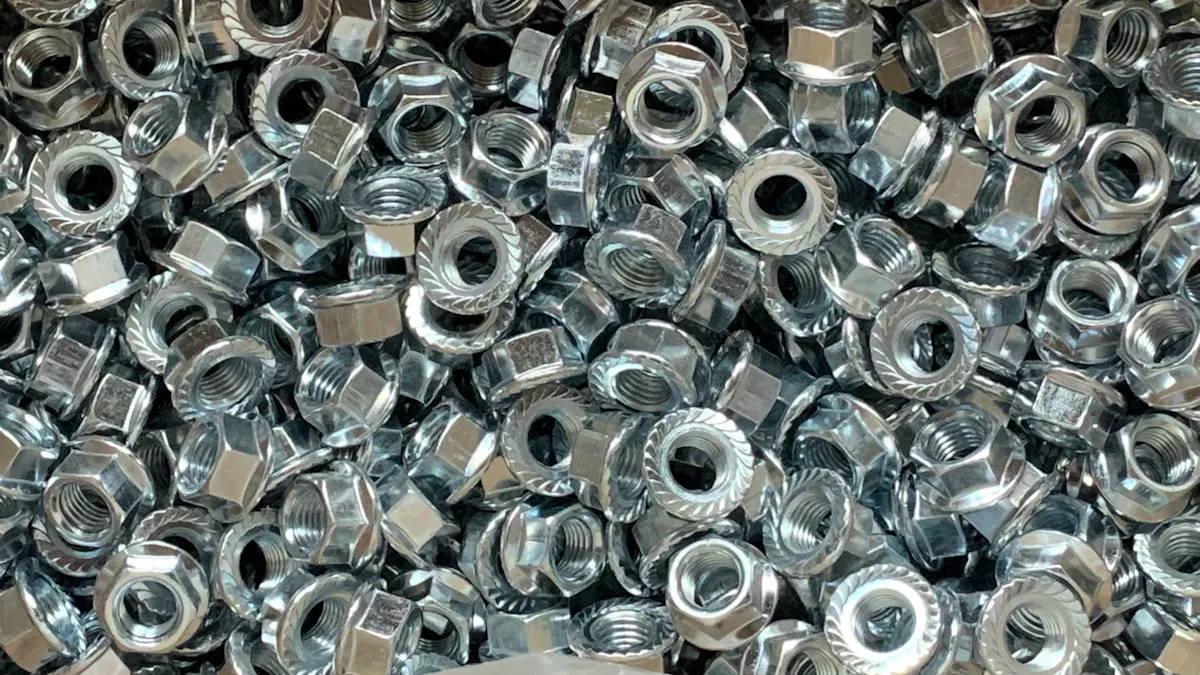
A flange nut is a threaded fastener with a wide, integrated base that performs the same job as a standard nut and washer combined. Engineers and assemblers use these fasteners when they need a secure connection that spreads force across a broader area. The design addresses a common problem in bolted joints: concentrated pressure that damages soft materials or loosens over time. Understanding what is a flange nut requires examining its three core design elements, the differences between serrated and smooth versions, and the industries that rely on them most.
Basic Design and Function
The flange nut combines three structural features into a single piece of hardware. Each feature contributes to the fastener’s performance in distinct ways.
Hexagonal Body
The hexagonal body provides the wrenching surface for installation and removal. Standard wrenches, sockets, and automated tools grip these six flat sides to apply torque. The hex shape follows conventional nut designs, so workers do not need special tooling. The body height varies by specification and strength class. Higher-profile bodies accommodate more thread engagement and withstand greater tensile loads.
شفة مدمجة
The integrated flange extends outward from the bottom of the hexagonal body. This wide, circular collar acts as a built-in washer. The flange geometry creates a larger bearing surface than the hex body alone provides. A flange nut can have a smooth bearing face or a serrated one, depending on the intended application. The integrated flange reduces the need for a separate flat washer in many assemblies. However, the flange does not always replace a washer, particularly when the mating surface requires protection or when specific friction characteristics are necessary.
Load Distribution Mechanism
The flange spreads clamping force over a wider contact area. This distribution reduces the pressure on the mating material and helps prevent indentation or deformation. A comparison of design principles shows how the flange nut differs from a standard hex nut:
| Design Principle | صامولة الشفة | Standard Hex Nut |
|---|---|---|
| Bearing end geometry | Has an integrated flange at the bearing end | Flat bearing face without an integrated flange |
| Contact interface | Larger contact interface with the mating component due to the flange | Smaller bearing face, so contact area is limited to the hex body face |
| Flange surface options | Can be smooth, serrated, combined with a locking feature, or customer-specific | No flange surface; no serration or flange-based variation |
| Locking function | Flange geometry alone does not equal locking; locking is a separate function (e.g., prevailing-torque version) | Locking is not inherent either; requires separate locking features |
| Product classification | A product family rather than a single configuration (smooth, serrated, prevailing-torque, fine-pitch, custom) | A single standard configuration defined by hex wrenching geometry and internal thread |
| Wrenching geometry | Hexagonal body plus integrated flange | Hexagonal body only |
| Washer relationship | Integrated flange can reduce the need for a separate washer in suitable applications, but does not always replace it | Typically requires a separate washer when a larger bearing interface is needed |
Finite element analysis studies reveal important details about how the flange actually distributes load. The following table summarizes key findings:
| Aspect | Integrated Flange Head | Separate Flat Washer |
|---|---|---|
| Stiffness | Flange heads are stiffer than standard flat washers. | Standard flat washers are less stiff. |
| Contact surface | The contact face is not perfectly flat and may be slightly conical, producing a pressure gradient across the diameter that is harder to predict. | The washer thickness is generally not great enough to distribute loads evenly across its diameter. |
| Load distribution | Pressure-sensitive film studies of flange nuts and screws show uneven clamp load and non-uniform pressure distribution. | Even with a flat washer under a hex cap screw head, the load is not evenly distributed across the washer diameter. |
| Friction and bolt tension | Increasing the contact diameter increases frictional resistance to applied torque, reducing bolt tension for a given torque; substituting flange-head for hex-head fasteners reduced tension by about 12 percent. | A flat washer may provide a more consistent friction coefficient, reduce galling or stick-slip, and protect the underlying finish, but it does not effectively spread the bolt load. |
| FEA/pressure findings | In the cited pressure-distribution example, peak pressure remained about 40 percent greater than predicted by dividing bolt tension by contact area at the joint faces. | The standard washer’s thickness is insufficient to evenly distribute loads across its diameter; a hardened washer of the same dimensions behaves the same way. |
These findings show that the flange improves load distribution compared to a bare hex nut, but the distribution is not perfectly uniform. Engineers must account for this behavior when designing critical joints.
Serrated Flange Nut vs. Non-Serrated Flange Nut
Flange nuts come in two main configurations: serrated and smooth. Each type serves different purposes and offers distinct advantages.
Serrated Flange Nut Features
A serrated flange nut has small, radial teeth cut into the flange face. These teeth dig into the mating surface when the nut tightens. The serrations create resistance to vibration-induced loosening. This locking feature works through mechanical interference rather than chemical or friction-based methods. The teeth bite into softer materials like aluminum or mild steel, creating a mechanical lock. A serrated flange nut works well in applications with moderate vibration, such as automotive brackets or appliance assemblies. The serrations can damage painted or finished surfaces, so they are not suitable for every application.
Non-Serrated Flange Nut Features
A smooth flange nut has a flat, untextured bearing face. This design protects the mating surface from scratches and gouges. The smooth flange nut distributes load evenly without creating stress concentrations at the tooth contact points. Assemblers use smooth flange nuts when the joint requires a clean appearance or when the mating material is soft or coated. The smooth flange nut does not provide vibration resistance on its own. Additional locking methods, such as thread-locking compounds or prevailing-torque features, may be necessary in high-vibration environments.
Application Differences
The choice between serrated flange nut vs smooth flange nut depends on the specific requirements of the joint. The following factors guide the selection:
- Vibration level: Serrated versions resist loosening better in dynamic loads.
- Surface condition: Smooth versions protect finished or soft surfaces.
- Reusability: Smooth versions allow repeated assembly without surface damage.
- Electrical grounding: Serrated teeth can cut through paint to create electrical contact.
A prevailing-torque flange nut combines the flange design with a deformed thread section that resists rotation. This type offers locking without surface damage and suits applications where both vibration resistance and surface protection matter.
التطبيقات الشائعة
Flange nuts serve a wide range of industries. Revenue data shows the distribution of usage across major sectors:
| الصناعة | Revenue Share |
|---|---|
| السيارات | 50% |
| Construction & Infrastructure | 30% |
| Machinery | 20% |
Automotive manufacturing remains the largest volume driver. Construction applications generate significant demand. Aerospace and heavy machinery are emerging as high-growth pockets.
Automotive and Transportation
Automotive manufacturers use flange nuts extensively in vehicle assembly. These fasteners secure brackets, panels, suspension components, and engine parts. The integrated flange eliminates separate washers, which speeds up assembly line operations. Serrated versions provide vibration resistance for critical joints. Electric vehicle manufacturers use flange nuts in battery pack assemblies and motor mounts. The automotive sector’s dominance in flange nut consumption reflects the industry’s high production volumes and demanding fastening requirements.
الآلات الصناعية
Industrial machinery relies on flange nuts for equipment assembly and maintenance. Conveyors, pumps, compressors, and manufacturing equipment use these fasteners in structural connections. The flange geometry helps distribute loads on sheet metal and castings. Smooth flange nuts protect machined surfaces on precision equipment. Maintenance teams appreciate the simplified assembly that flange nuts provide, especially in tight spaces where installing a separate washer would be difficult.
Construction and Structural Steel
Construction applications use flange nuts in steel frame connections, guardrails, and scaffolding. The fasteners must meet specific strength and corrosion resistance requirements for structural joints. Hot-dip galvanized flange nuts resist outdoor weathering. The wide flange helps distribute loads on bolted steel connections. Construction codes often specify the grade and dimensions of flange nuts used in load-bearing applications. The 30 percent revenue share from construction reflects the massive scale of infrastructure projects worldwide.
Flange Nut Dimensions and Sizes
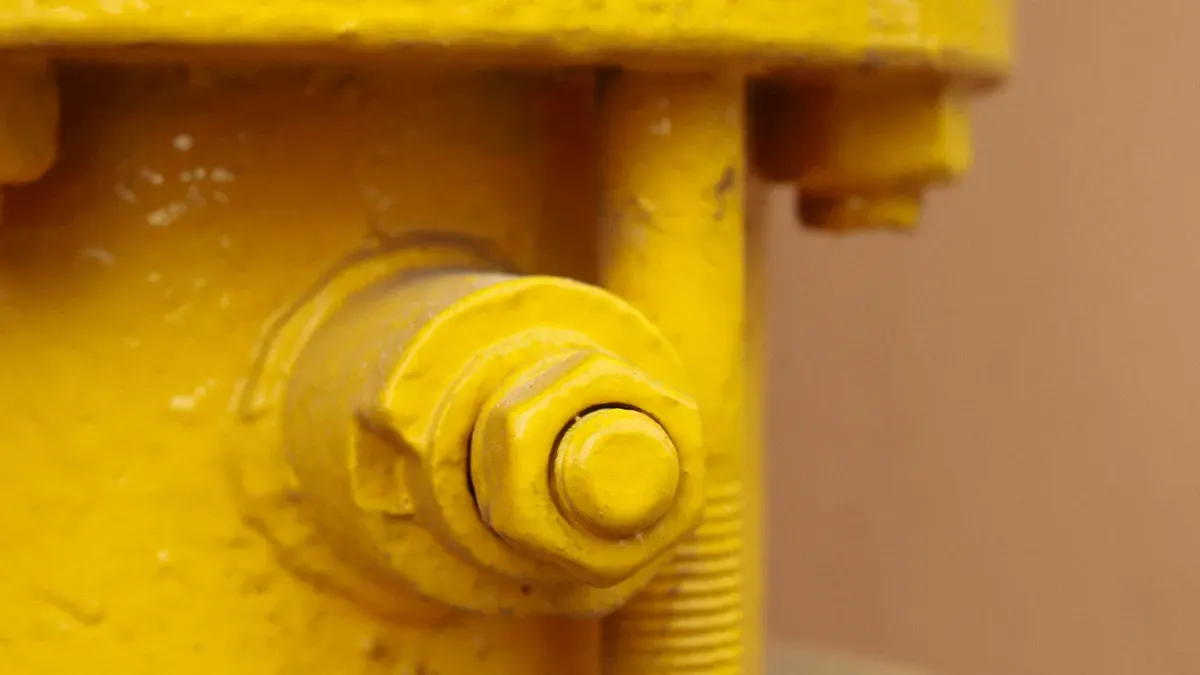
Engineers select flange nuts by matching dimensions to the joint requirements. The technical specifications of flange nuts cover thread size, body geometry, and tolerance class. Each measurement affects fit, strength, and load distribution.
Standard Size Ranges
Manufacturers produce flange nuts in inch and metric series. Production data reveals the most common sizes available.
Inch Series Sizes
Inch flange nuts follow Unified Coarse (UNC) and Unified Fine (UNF) thread systems. Common inch sizes include 5/16-18, 5/16-24, 3/8-16, 3/8-24, 7/16-14, 7/16-20, 1/2-13, 1/2-20, 9/16-12, 9/16-18, 5/8-11, 5/8-18, 3/4-10, 3/4-16, 7/8-9, 7/8-14, 1-8, and 1-12.
Metric Series Sizes
Metric flange nuts conform to DIN 6923 and JIS B1190 standards. Standard metric sizes include M5, M6, M8, M10, M12, M14, M16, and M20. The general production range spans M4 to M16.
Metric thread sizes typically range from M5 to M24.
Stock availability varies by region and supplier:
- Standard stock sizes: M5 to M24
- Custom sizes available: up to M36 or inch-equivalent
Key Measurement Parameters
Five critical dimensions define every hex flange nut. These parameters determine whether a nut fits a specific joint.
Thread Diameter and Pitch
Thread diameter measures the nominal size of the internal threads. Thread pitch describes the distance between adjacent thread crests. Coarse threads suit general applications, while fine-pitch flange nuts provide greater resistance to vibration and offer finer adjustment.
Hex Width Across Flats (WAF)
Width across flats measures the distance between two opposite sides of the hexagonal body. This dimension determines the wrench or socket size required for installation.
Flange Diameter
Flange diameter measures the full width of the integrated flange. This dimension directly affects load distribution across the mating surface. A larger flange diameter spreads force over a wider area.
Overall Height
Overall height measures the total distance from the flange base to the top of the hexagonal body. Taller nuts provide more thread engagement and higher tensile strength.
Flange Thickness
Flange thickness measures the depth of the flange collar. This dimension influences the stiffness of the bearing surface and the nut’s overall load-bearing capacity.
The following table shows representative flange nut dimensions for common metric sizes:
| Flange Nut Size | العرض بين الأسطح المستوية (مم) | Flange Diameter (mm) | الارتفاع (مم) | Thread Pitch (mm) |
|---|---|---|---|---|
| M5 | 8 | ~11.8 | 5 | 0.8 |
| M6 | 10 | 14.2 | 6 | 1.0 |
| M8 | 13 | 17.9 | 8 | 1.25 |
| M10 | 15 | 21.8 | 10 | 1.5 |
| M12 | 18 | 26.0 | 12 | 1.75 |
| M16 | 24 | 34.5 | 16 | 2.0 |
Tolerance and Classes
Tolerance classes define acceptable variation in flange nut dimensions. These classes ensure interchangeability between manufacturers.
Inch Tolerance Classes
Inch flange nuts use tolerance classes defined by ASME B18.2.2. The most common class is 2B for internal threads. Class 2B provides a medium fit suitable for general applications.
Metric Tolerance Classes
Metric flange nuts follow ISO 965 tolerance classes. The standard class for internal threads is 6H. This class provides a medium fit for general fastening. Class 6H ensures proper thread engagement without excessive clearance.
Materials and Finishes
The performance of a flange nut depends on its base material and surface coating. Engineers consider strength, corrosion resistance, temperature range, and cost when choosing materials. The technical specifications of flange nuts always include material grade and finish. Proper flange nut material selection ensures the fastener meets application demands.
Common Base Materials
Manufacturers produce flange nuts from several base materials, each offering distinct properties.
الفولاذ الكربوني
Carbon steel provides the most common base material for these fasteners. It offers high tensile strength and good wear resistance at a low cost. Grade 5 and Grade 8 carbon steel nuts deliver required mechanical properties for automotive and structural applications. Carbon steel requires a protective coating to resist corrosion.
الفولاذ المقاوم للصدأ
Stainless steel flange nuts contain chromium and nickel for natural corrosion resistance. Grades 304 and 316 perform well in wet and chemical environments. Stainless steel maintains strength at elevated temperatures.
Brass and Bronze
Brass and bronze flange nuts serve applications requiring electrical conductivity or non-sparking properties. These copper alloys resist corrosion in marine environments. Bronze offers higher strength and better wear resistance than brass.
Nylon and Plastic
Plastic flange nuts suit applications needing electrical insulation or chemical resistance. Nylon offers good strength for moderate-load fastening. Plastic nuts have lower tensile strength than metal versions.
Surface Coatings and Finishes
Surface coatings protect the base material from corrosion and modify frictional properties. The choice depends on the operating environment.
Zinc Plating
Zinc plating provides an economical corrosion barrier. The electroplating process deposits a thin zinc layer. Chromate conversion coatings improve corrosion resistance. Zinc plating suits indoor applications.
الجلفنة بالغمس الساخن
Hot-dip galvanizing immerses the nut in molten zinc. This finish provides excellent corrosion resistance for outdoor and marine environments. Hot-dip galvanized nuts require oversized tapping.
Phosphate and Oil
Phosphate coating with oil provides a base-level corrosion barrier. The porous surface holds oil and improves lubricity. This finish suits temporary storage and indoor use.
أكسيد أسود
Black oxide provides a dark appearance with minimal corrosion protection. This finish works best for indoor controlled environments.
Dacromet and Geomet
Dacromet and Geomet are zinc flake coating systems. They provide excellent corrosion resistance without hydrogen embrittlement. These coatings suit high-strength fasteners.
Corrosion Resistance Ratings
Engineers use standardized tests to evaluate coating performance.
Salt Spray Test Standards
ASTM B117 defines the neutral salt spray test. The test exposes samples to a continuous fog of sodium chloride solution. Zinc plating typically provides 72 to 100 hours of resistance. Hot-dip galvanizing can exceed 1,000 hours.
Finish Selection by Environment
Indoor environments allow phosphate or zinc finishes. Outdoor structures require hot-dip galvanizing. Marine environments demand stainless steel or thick galvanized coatings. Each specification of surface finish must match exposure conditions.
Thread Types and Pitch
Thread type and pitch rank among the most important choices in fastener selection. These two parameters determine how a nut mates with its bolt and how much load the joint can carry. The technical specifications of flange nuts always list thread form, thread diameter, and thread pitch together. Engineers must match all three values to the mating bolt. A mismatch causes cross-threading, weak engagement, or joint failure.
Unified Inch Threads
The Unified Thread Standard governs inch-based threads in the United States and Canada. This system defines thread angle, crest shape, and pitch series. Three pitch families serve most inch applications.
UNC (Unified Coarse)
UNC threads use the largest pitch for a given diameter. The coarse pitch provides deep thread engagement and fast assembly. These threads resist stripping in soft materials like aluminum and cast iron. Most general-purpose inch fasteners use UNC threads. Common examples include 1/4-20, 5/16-18, and 3/8-16. The number after the dash shows threads per inch. A larger number means a finer pitch.
UNF (Unified Fine)
UNF threads use a smaller pitch than UNC for the same diameter. The finer pitch increases the minor diameter and adds tensile stress area. These threads handle vibration better than coarse threads. They also allow finer adjustment during assembly. UNF fasteners appear in automotive, aerospace, and instrument applications. Common sizes include 1/4-28, 5/16-24, and 3/8-24.
UNEF (Extra Fine)
UNEF threads use the smallest pitch in the Unified system. These threads offer the greatest resistance to vibration and the finest adjustment. Thin-wall tubing and aircraft components often require UNEF threads. The extra-fine pitch reduces the material removed from the wall. This feature preserves wall strength in thin sections. UNEF fasteners cost more and see use only in specialized applications.
Metric Threads
The ISO metric thread system dominates global fastener production. This system measures pitch in millimeters rather than threads per inch. Two pitch families cover most metric applications.
Coarse Pitch
Metric coarse threads serve as the default for general fastening. The pitch value follows the nominal diameter in a standard progression. An M10 coarse thread uses a 1.5 mm pitch. An M12 coarse thread uses a 1.75 mm pitch. Coarse threads assemble quickly and resist damage during handling. Most metric flange nuts ship with coarse threads as standard stock.
Fine Pitch
Metric fine threads use a smaller pitch than the coarse series. An M10 fine thread uses a 1.25 mm pitch instead of 1.5 mm. A fine-pitch flange nut offers several advantages over its coarse counterpart. The finer pitch increases the tensile stress area and improves fatigue resistance. Fine-pitch flange nuts also resist vibration loosening better than coarse versions. Automotive and aerospace engineers often specify fine-pitch flange nuts for critical joints. The table below compares coarse and fine metric pitches for common sizes.
| Nominal Size | Coarse Pitch (mm) | Fine Pitch (mm) |
|---|---|---|
| M8 | 1.25 | 1.0 |
| M10 | 1.5 | 1.25 |
| M12 | 1.75 | 1.25 |
| M16 | 2.0 | 1.5 |
| M20 | 2.5 | 1.5 |
Thread Fit Classes
Thread fit describes the clearance between mating threads. A loose fit eases assembly but reduces load capacity. A tight fit increases strength but demands precise manufacturing. Both inch and metric systems define fit classes to standardize this clearance.
Inch Fit Classes
The Unified system defines three fit classes for inch threads. Class 1 provides a loose fit for quick assembly and dirty environments. Class 2 offers a medium fit for general applications and serves as the default for most commercial fasteners. Class 3 provides a tight fit for precision work and high-stress joints. Internal threads on inch flange nuts typically use Class 2B. The letter B indicates an internal thread.
Metric Fit Classes
The ISO metric system uses a different notation for fit classes. A number shows the tolerance grade, and a letter shows the fundamental deviation. Internal threads commonly use a 6H designation. The number 6 indicates a medium tolerance grade. The letter H shows the position of the tolerance zone. A 6H fit provides proper engagement without excessive play. This class matches the medium fit of inch Class 2B threads.
Special Thread Forms
Standard thread families cover the vast majority of fastening needs. Some applications require thread geometries that fall outside these conventions. Flange nuts with special thread forms serve niche functions where sealing, rotation direction, or installation constraints dictate the thread design.
Pipe Threads
Pipe threads seal fluid and gas connections. These threads differ from standard fastening threads in two fundamental ways. First, they have a tapered diameter that creates an interference fit. Second, they use a specific thread angle and form optimized for sealing. A pipe thread flange nut combines the load-spreading flange with a tapered internal thread. This combination allows the nut to seal a threaded pipe or fitting while distributing clamping force over a wider area.
Manufacturers produce pipe thread flange nuts in NPT (National Pipe Taper) and BSP (British Standard Pipe) configurations. The thread size follows pipe dimension conventions rather than bolt diameter standards. A 1/2-inch NPT flange nut measures approximately 0.84 inches in outer diameter at the thread. The flange diameter exceeds this value to provide proper load distribution.
Applications include hydraulic systems, pneumatic equipment, and fluid transfer assemblies. The flange helps seal connections on thin-walled reservoirs or tanks. Installers must apply appropriate sealant or tape to pipe threads before assembly. The tapered thread geometry creates a mechanical lock that prevents leakage under pressure.
Pipe thread flange nuts remain less common than standard threaded versions. Most flange nut production focuses on UNC, UNF, and metric threads. Engineers specify pipe thread versions only when the joint requires both sealing and load distribution. Availability may require special orders from a custom fasteners manufacturer.
Left-Hand Threads
Left-hand threads tighten when the installer turns the nut counterclockwise. This reversal prevents loosening under rotational forces that would unscrew a standard right-hand nut. The left-hand thread reverses the helix direction of the thread form. Most left-hand flange nuts carry an identifying mark, such as a notch on the hex flat or an “LH” marking on the flange face.
Applications include rotating machinery, conveyor systems, and automotive components. Left-hand threads secure components on shafts that rotate in the direction that would loosen right-hand threads. Examples include grinding wheel arbors, circular saw blades, and some bicycle pedal assemblies.
The flange geometry does not change with thread direction. The thread size and pitch follow standard dimensions, but the helix reverses. Engineers must verify thread direction before assembly. Installing a left-hand nut with clockwise rotation damages both the nut and the bolt.
Supply chain considerations matter for left-hand flange nuts. Most distributors stock left-hand versions only for common sizes like M10, M12, 3/8-inch, and 1/2-inch. Large quantities may require custom manufacturing. Lead times and minimum order quantities apply. Engineers should confirm availability early in the design process.
Standards and Grades
Standards and grades give engineers a common language for specifying flange nuts. These documents define dimensions, materials, mechanical properties, and testing methods. A clear specification ensures that a صمولة ذات شفة سداسية from one supplier matches the fit and strength of another. Buyers should always confirm the applicable product standard before placing an order.
American Standards
American standards govern flange nut production for domestic automotive, industrial, and structural markets.
SAE J995
SAE J995 covers mechanical and quality requirements for steel nuts. This standard defines proof load, hardness, and grade markings for inch-series fasteners. Grade 5 and Grade 8 nuts fall under this specification.
SAE J1199
SAE J1199 specifies mechanical and material requirements for metric fasteners. This standard parallels J995 but uses metric dimensions and property classes. It covers classes 8.8, 9.8, and 10.9 for steel nuts.
ASTM A194
ASTM A194 addresses high-temperature and high-pressure service nuts. This standard covers carbon, alloy, and stainless steel grades for bolted connections in petrochemical and power generation equipment.
ASTM F467
ASTM F467 provides specifications for nonferrous nuts. It covers brass, bronze, and nickel alloy fasteners for corrosion-resistant or non-magnetic applications.
International Standards
International standards harmonize flange nut dimensions across global supply chains.
ISO 4161
ISO 4161 defines dimensions for hexagon nuts with flange and fine pitch thread. This standard covers metric sizes from M5 to M20. It serves as the primary international reference for flanged nut geometry.
DIN 6923
DIN 6923 specifies hexagon nuts with flange and coarse thread. This German standard covers metric sizes from M5 to M20. Many suppliers treat DIN 6923 and ISO 4161 as interchangeable for common sizes. The table below shows dimensional data for an M8 flange nut under both standards.
| Dimension | DIN 6923 M8 | ISO 4161 M8 |
|---|---|---|
| Flange diameter (d2) max | 17.9 mm | 17.9 mm |
| Width across flats (s) | 13 mm | 13 mm |
| Nut thickness (m/h) max | 8 mm | 8 mm |
| Across corners (e) min | 14.38 mm | 14.38 mm |
DIN 6926
DIN 6926 covers hexagon nuts with flange and a prevailing torque feature. This standard adds a locking element to the flange design. The prevailing torque resists vibration loosening without surface damage.
JIS B1190
JIS B1190 defines flange nuts for the Japanese industrial market. This standard covers metric sizes and specifies dimensions, tolerances, and mechanical properties. Many Asian manufacturers produce to JIS B1190.
Grade Markings and Strength Classes
Grade markings identify the strength level of a flange nut. Manufacturers stamp these marks on the top face or side of the hex body.
Inch Grade Markings
Inch flange nuts use grade markings defined by SAE J995. Grade 2 nuts carry no marking. Grade 5 nuts show three radial lines. Grade 8 nuts display six radial lines. These marks allow quick identification during assembly and inspection.
Metric Class Markings
Metric flange nuts use property class numbers. Class 8 nuts show the number 8 on the hex face. Class 10 nuts display the number 10. A manufacturer’s identification mark often accompanies the class number. These markings confirm that the flange nuts meet the required strength specifications for the application.
Testing and Quality Requirements
Manufacturers perform three primary tests to verify that flange nuts meet their published specifications. These tests confirm strength, material integrity, and dimensional accuracy before the fasteners leave the factory.
Proof Load Testing
Proof load testing applies a specified tensile force to the nut without causing permanent deformation. The nut must withstand this load while remaining fully functional. A test fixture threads the nut onto a hardened mandrel and pulls with a calibrated machine. The nut passes if it holds the load and shows no cracks or elongation. This test verifies the strength of the flange nuts for their rated property class. Proof load values vary by grade and size. A Grade 8 nut carries a higher proof load than a Grade 5 nut of the same diameter. Engineers rely on these values when designing critical joints.
Hardness Testing
Hardness testing measures the resistance of the nut material to indentation. Technicians use Rockwell or Brinell methods depending on the specification. The test creates a small indentation on the nut surface and measures its depth or diameter. Hardness correlates with tensile strength, so this test provides a quick check of material quality. A nut that is too soft may strip under load. A nut that is too hard may crack during installation. Standards such as SAE J995 and ISO 898-2 define acceptable hardness ranges for each grade and class. Manufacturers test a sample from each production lot to confirm consistency.
Dimensional Verification
Dimensional verification ensures that each nut matches the required thread size, hex width, flange diameter, and height. Inspectors use calibrated gauges, micrometers, and optical comparators to measure critical features. Thread gauges confirm proper pitch and fit class. Go and no-go gauges check that the internal thread falls within tolerance limits. A go gauge must thread fully onto the nut. A no-go gauge must not enter more than two turns. Flange diameter and thickness receive measurement against the standard drawing. Width across flats must match the specified wrench size. Any deviation outside the tolerance range causes rejection of the lot. This step in flange nut quality inspection protects assemblers from fit problems and joint failures.
A nut that passes proof load and hardness tests can still fail if its dimensions fall outside tolerance. Dimensional verification closes that gap.
Comparison to Other Nuts
Engineers choose among several nut types for any given joint. Each option offers different trade-offs in cost, assembly speed, and locking performance. The comparisons below help specifiers match the fastener to the application.
Flange Nut vs. Standard Hex Nut
Design Differences
A standard hex nut has a flat bearing face and relies on a separate washer for load spreading. Flange nuts carry an integrated flange that performs this job without extra hardware. The flange adds a wider bearing surface directly beneath the hex body.
Load Distribution Comparison
The integrated flange spreads clamping force over a larger area than a bare hex face. This wider contact reduces pressure on soft materials and lowers the risk of indentation. A standard hex nut concentrates stress on a smaller ring of contact.
Cost and Convenience
Flange nuts cost slightly more per piece than plain hex nuts. However, they eliminate the washer, which reduces part count and assembly time. The total installed cost often favors the flange design.
Flange Nut vs. Nylon-Insert Locknut
Locking Mechanism Differences
A nylon-insert locknut uses a nylon collar that grips the bolt threads. A prevailing-torque flange nut instead deforms its own threads to create friction. The serrated flange nut adds teeth that bite the mating surface for extra grip.
Reusability Comparison
Nylon-insert nuts lose locking force after several removals. The prevailing-torque locking mechanism in a flange nut also degrades with reuse, though some designs tolerate more cycles. Neither type suits unlimited reassembly.
Temperature and Torque Considerations
Nylon inserts soften above 250°F (120°C) and lose holding power. A prevailing-torque flange lock nut made of all-metal construction handles higher temperatures. Installers must also account for the higher running torque these nuts require.
Flange Nut vs. Toothed Lock Washer with Hex Nut
Locking Feature Integration
A toothed lock washer adds a separate locking feature beneath a hex nut. The flange nut vs washer + hex nut comparison shows a clear difference: the flange design builds the bearing surface into the nut itself. A smooth flange nut provides no teeth, so it relies on other methods for vibration control.
Assembly and Part Count
The washer-plus-hex-nut approach requires handling two pieces per joint. A flange nut needs only one. This reduction speeds assembly and lowers the chance of dropped or missing washers on the line.
مقاومة الاهتزاز
Toothed washers grip both the nut and the workpiece for strong vibration resistance. A serrated flange nut achieves similar grip through its flange teeth. A smooth flange nut offers the least vibration resistance of the three options.
Flange Nut vs. Weld Nut
A flange nut and a weld nut serve different fastening strategies. The choice between them depends on the assembly process and the need for future access. Each type excels in distinct conditions.
Installation Method
Weld nuts require a welding operation for installation. The installer places the nut against a metal workpiece and fuses it in place using resistance welding or arc welding. This process creates a permanent attachment. The nut becomes part of the workpiece itself. No separate bolt hole preparation is necessary on the back side. The weld nut provides a threaded hole in locations where access exists only from one side. Automotive body panels and sheet metal enclosures often use weld nuts for this reason.
A flange-type nut does not require welding. The installer simply threads it onto a mating bolt or stud. The integrated flange spreads load as the assembler tightens the nut. No special equipment or power source is necessary. A hand wrench or powered socket does the job. This simplicity reduces assembly line complexity and allows installation in field locations without welding capability.
| Aspect | Weld Nut | Flange-Type Nut |
|---|---|---|
| Attachment method | Fusion welding to workpiece | Threading onto bolt or stud |
| Required equipment | Welding power supply, electrode | Hand wrench or socket |
| Skill requirement | Trained welder | General assembler |
| Installation time | Seconds per nut plus welding cycle | Seconds per nut |
| Permanence | Permanent joint | Removable joint |
| Access requirement | One-side access acceptable | Both-side access for bolt head |
The table shows the fundamental differences. Weld nuts suit high-volume production where the joint never needs disassembly. The nut with integrated flange suits assemblies that require maintenance or part replacement.
Repositioning and Reusability
A weld nut cannot be repositioned after installation. Welding joins the nut to the workpiece at the atomic level. Moving the nut requires cutting or grinding the weld. This process damages both the nut and the workpiece. A misplaced weld nut becomes scrap. Production lines that use weld nuts must position them precisely before welding. Design changes that shift a hole location require retooling the welding fixture.
A flange-type nut offers full repositioning capability. The assembler can remove the nut, rotate it, or transfer it to another assembly. No damage occurs to either the nut or the workpiece. A flange-type nut tolerates repeated installation and removal cycles. This feature suits equipment that requires periodic service or component replacement.
Warehouse and field service operations benefit from this flexibility. Technicians carry a supply of standard flange nuts and install them at the point of use. This approach eliminates the need for pre-planning hole locations and welding schedules.
Reusability also differs between the two types. A weld nut serves one joint for its entire service life. Removing the bolt does not affect the weld nut, but the nut itself remains fixed in place. A flange-type nut can transfer from one assembly to another. Smooth versions tolerate dozens of reuses without any performance loss. Serrated versions may show wear on the teeth after repeated removal, but they remain functional for many cycles. The choice between the two types depends on the frequency of disassembly and the cost of replacement.
A flange nut is a specialized hex nut with an integrated flange that distributes load and optionally locks via serrations. Key technical specifications of flange nuts include thread diameter and pitch, hex and flange dimensions, material grade, surface finish, and compliance with standards such as SAE J995 or ISO 4161. Selection must consider the application’s strength requirements, environment, and vibration level. A serrated flange nut resists vibration, while a smooth flange nut protects finished surfaces. The flange geometry and flange diameter directly affect load distribution. Compared to other nut types, flange nuts offer simplicity and often better resistance to loosening. A hex flange nut eliminates the separate washer. Always verify grade markings and proof load ratings before use in critical assemblies.
A smooth flange nut protects soft or coated surfaces, but it does not lock on its own.
الأسئلة الشائعة
What is a flange nut used for?
A flange nut secures bolted joints in automotive, machinery, and structural applications. The integrated flange spreads clamping load over a wider area than a standard hex nut. This design protects soft materials from damage and eliminates the need for a separate flat washer.
What is the difference between a serrated and a non-serrated flange nut?
A serrated flange nut has radial teeth on the flange face. These teeth bite into the mating surface and resist vibration loosening. A non-serrated flange nut has a smooth bearing face. It protects painted or soft surfaces but provides no locking action on its own.
How do I choose the right flange nut size?
Match the thread diameter and pitch to the mating bolt first. Then confirm the hex width across flats fits the available wrench or socket. Check the flange diameter for adequate load distribution. Verify overall height and flange thickness against the joint requirements.
What materials are flange nuts made from?
Carbon steel is the most common base material. Stainless steel grades 304 and 316 resist corrosion in wet or chemical environments. Brass and bronze serve electrical or marine applications. Nylon and plastic versions provide insulation and chemical resistance at lower strength.
Which standards apply to flange nuts?
ISO 4161 and DIN 6923 cover metric flange nut dimensions. SAE J995 governs inch-series steel nuts. ASTM A194 addresses high-temperature service. JIS B1190 defines the Japanese industrial standard. Always confirm the applicable standard before ordering.
Do flange nuts resist vibration loosening?
Serrated flange nuts resist vibration through mechanical interference between the teeth and the mating surface. Smooth flange nuts do not lock on their own. A prevailing-torque flange nut offers all-metal locking for high-vibration joints without surface damage.
Can I reuse a flange nut?
A smooth flange nut tolerates many installation and removal cycles without performance loss. A serrated flange nut may show tooth wear after repeated use. A prevailing-torque flange nut loses locking force gradually with each reuse. Inspect the nut before reinstalling it in a critical joint.
How does a flange nut compare to a standard hex nut with a washer?
A flange nut combines the nut and washer into one piece. This design reduces part count and speeds assembly. The integrated flange also distributes load more effectively than a thin flat washer. Total installed cost often favors the flange nut.