Selecting the right metric flange nut requires careful consideration of size, material compatibility, and environmental factors. A flange nut features a wide base that distributes load evenly, reducing the risk of loosening under vibration. In engineering, flange nuts play a vital role in securing nuts and bolts, especially when working with custom fasteners or seeking solutions from a custom fasteners manufacturer. The table below highlights key challenges faced when choosing metric flange nuts:
| Challenge | Description |
|---|---|
| Sizing | Achieving a secure seal depends on selecting the correct size. |
| Torque Application | Proper torque ensures the necessary clamping force. |
| Material Compatibility | Materials must withstand operational stresses. |
| Environmental Considerations | Temperature changes affect clamping force. |
| Lubrication | Proper lubrication prevents excessive friction. |
| Vibration | Vibration can loosen the flange nut over time. |
Understanding and Choosing Metric Flange Nuts
What Are Metric Flange Nuts?
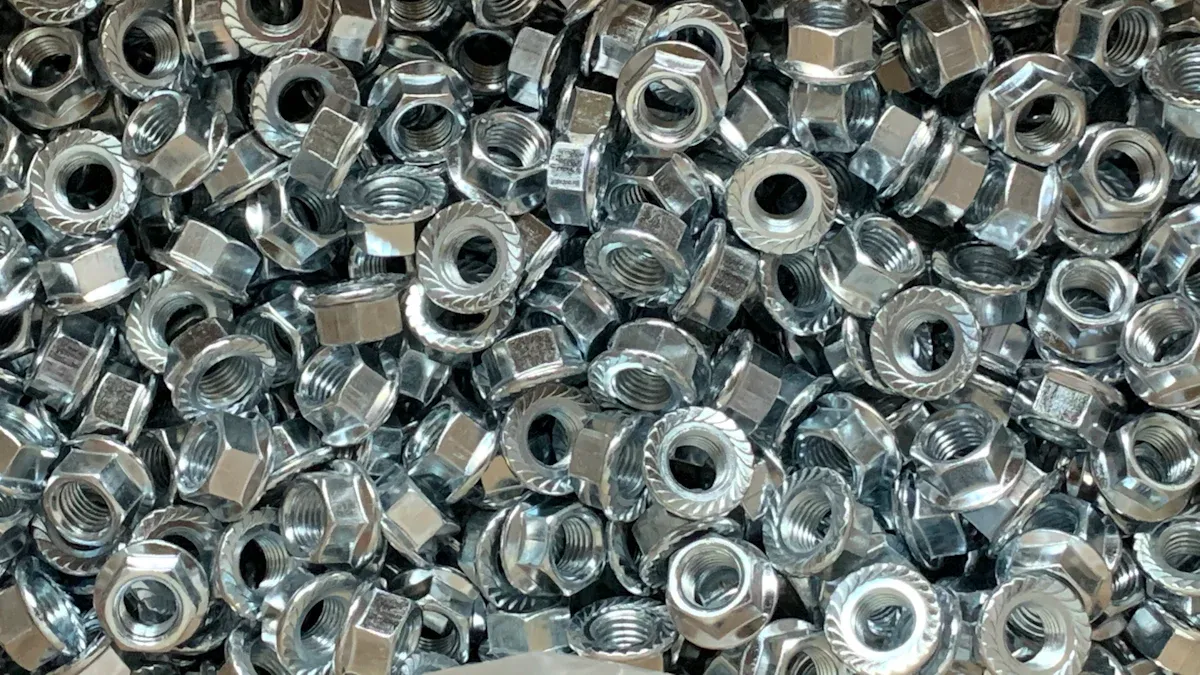
A metric flange nut is a specialized fastener designed to provide a secure and stable connection. The integrated flange acts as a built-in washer, increasing the bearing surface area and distributing load more evenly. Manufacturers produce these nuts in compliance with international standards such as GB, DIN, ANSI, and BS. They use high-grade materials like carbon steel and stainless steel, including SS304 and SS316. Strength grades range from Class 8 to Class 10 and 12, making them suitable for demanding applications. Surface treatments include yellow zinc plating, white zinc plating, hot-dip galvanization, and Dacromet. Serrated flange nuts offer an anti-vibration grip, while non-serrated versions suit specialized surface requirements.
- Complies with international standards (GB, DIN, ANSI, BS)
- Manufactured from high-grade materials (carbon steel, stainless steel)
- Available in strength grades (Class 8, 10, 12)
- Features professional surface treatments (yellow zinc, white zinc, HDG, Dacromet)
- Integrated wide flange increases bearing surface area
- Options for serrated and non-serrated designs
Common Uses and Applications
Metric flange nuts serve a critical role in many industries. Their design ensures reliable connections and stability in assemblies where safety and performance matter. The table below highlights the most frequent industry uses and typical applications:
| Industry | Application Description |
|---|---|
| Automotive | Secures components such as engines, transmissions, and suspension systems |
| Aerospace | Provides security and stability for critical components where safety and performance are paramount |
| Construction | Secures beams, panels, and other structural components, ensuring reliable connections under various stresses |
| Manufacturing | Commonly used in structural applications to provide strong connections |
| Electrical/Electronic | Secures connectors, circuit boards, and other components for stable and reliable connections |
Engineers often focus on choosing metric flange nuts for assemblies that require vibration resistance and consistent load distribution. These nuts help prevent loosening and maintain structural integrity in high-stress environments.
Key Features and Benefits
Metric flange nuts offer several advantages that make them a preferred choice in demanding applications. The integrated flange increases the bearing surface, reducing the risk of damage to connected parts. Serrated designs provide enhanced grip, minimizing the chance of loosening due to vibration. High-strength grades ensure durability and performance under heavy loads. Surface treatments protect against corrosion and extend service life. When choosing metric flange nuts, engineers gain confidence in the reliability and longevity of their assemblies.
Tip: Selecting the right nut for your application improves safety and reduces maintenance costs. Always verify material, strength grade, and surface treatment to match operational requirements.
Types for Selecting the Proper Nut
Standard Flange Nuts
Standard flange nuts provide a reliable fastening solution for many general-purpose applications. They feature a smooth, wide flange that acts as a built-in washer. This design helps distribute pressure over a larger area, which protects the connected surfaces from damage. Engineers often choose standard flange nuts for assemblies that do not require extra resistance to vibration or loosening. These nuts work well in automotive, construction, and manufacturing settings where consistent clamping force is essential.
Note: Standard flange nuts offer simplicity and ease of installation. They suit projects where vibration is minimal and where the main goal is to spread load evenly.
Serrated Flange Nuts
Serrated flange nuts stand out for their enhanced resistance to loosening. Their design includes precision-cut teeth on the flange surface. These teeth grip the mating material, creating a physical interlock that resists rotation. When tightened, the hardened serrations embed into the substrate. This action increases breakaway torque resistance by 200–400% compared to non-serrated types. Serrated flange nuts perform well in environments with constant vibration or dynamic loads, such as machinery or automotive assemblies.
- Serrated teeth provide a secure grip.
- The nut resists loosening under vibration.
- Breakaway torque increases significantly.
Serrated flange nuts help maintain joint integrity in demanding conditions. They reduce the need for frequent maintenance and improve overall safety.
Locking Flange Nuts
Locking flange nuts use specialized mechanisms to prevent loosening, even in high-vibration environments. These nuts combine several features to ensure a secure fit. The table below outlines the main mechanisms found in locking flange nuts:
| Mechanism | Description |
|---|---|
| Serrated edges | These edges lock the nut in place and prevent loosening under vibration. |
| Built-in flanges | Help with alignment during installation and provide a tight fit. |
| Deformed threads | Increase friction and resistance to movement, ensuring the nut remains secure. |
Locking flange nuts provide extra security for critical assemblies. They suit applications where safety and reliability are top priorities, such as heavy equipment, transportation, and structural connections.
Tip: When selecting the proper nut, consider the level of vibration and the need for long-term stability. Locking flange nuts offer peace of mind in challenging environments.
High-Strength Flange Nuts
High-strength flange nuts deliver superior performance in demanding environments. Engineers select these nuts for assemblies that require exceptional load-bearing capacity and resistance to mechanical stress. Manufacturers produce high-strength flange nuts using advanced alloy steels and apply precise heat treatments. These processes increase the nut’s tensile strength and durability.
Industries such as heavy machinery, automotive, and construction rely on high-strength flange nuts. These nuts secure critical joints in equipment that faces dynamic loads and high vibration. The enhanced strength ensures that connections remain stable, even under extreme force.
The load ratings for high-strength metric flange nuts vary by size and grade. The table below summarizes the typical load capacities for common metric sizes:
| Size | Grade 8.8 | Grade 9.8 | Grade 10.9 | Grade 12.9 |
|---|---|---|---|---|
| M10 | 3,370kg | 3,770kg | 4,810kg | 5,630kg |
| M12 | 4,890kg | 5,480kg | 7,000kg | 8,180kg |
| M16 | 9,100kg | 10,200kg | 13,000kg | 15,200kg |
| M20 | 14,700kg | N/A | 20,300kg | 23,800kg |
| M24 | 21,200kg | N/A | 29,300kg | 34,200kg |
| M30 | 33,700kg | N/A | 46,600kg | 54,400kg |
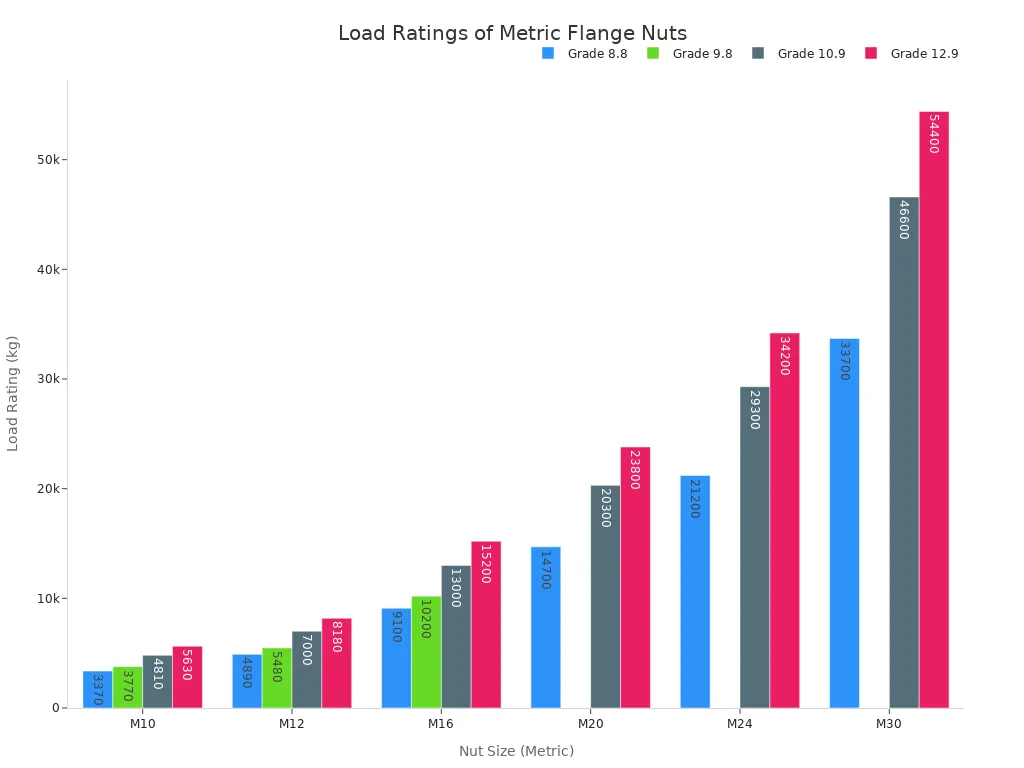
Selecting the correct grade is essential. Grade 8.8 and 10.9 nuts suit most industrial applications. Grade 12.9 nuts provide maximum strength for the most demanding uses. The choice depends on the required clamping force and the safety margin needed for the assembly.
Note: High-strength flange nuts resist deformation and maintain preload, even when exposed to shock or vibration. This reliability reduces the risk of joint failure and extends equipment life.
Key benefits of high-strength flange nuts include:
- Increased tensile and yield strength
- Enhanced resistance to fatigue and loosening
- Reliable performance in high-stress environments
- Compatibility with high-strength bolts for critical assemblies
Engineers should always verify the load requirements and select a nut grade that matches or exceeds the application’s demands. Proper selection ensures safety, reliability, and long-term performance.
Material Selection for Choosing Metric Flange Nuts
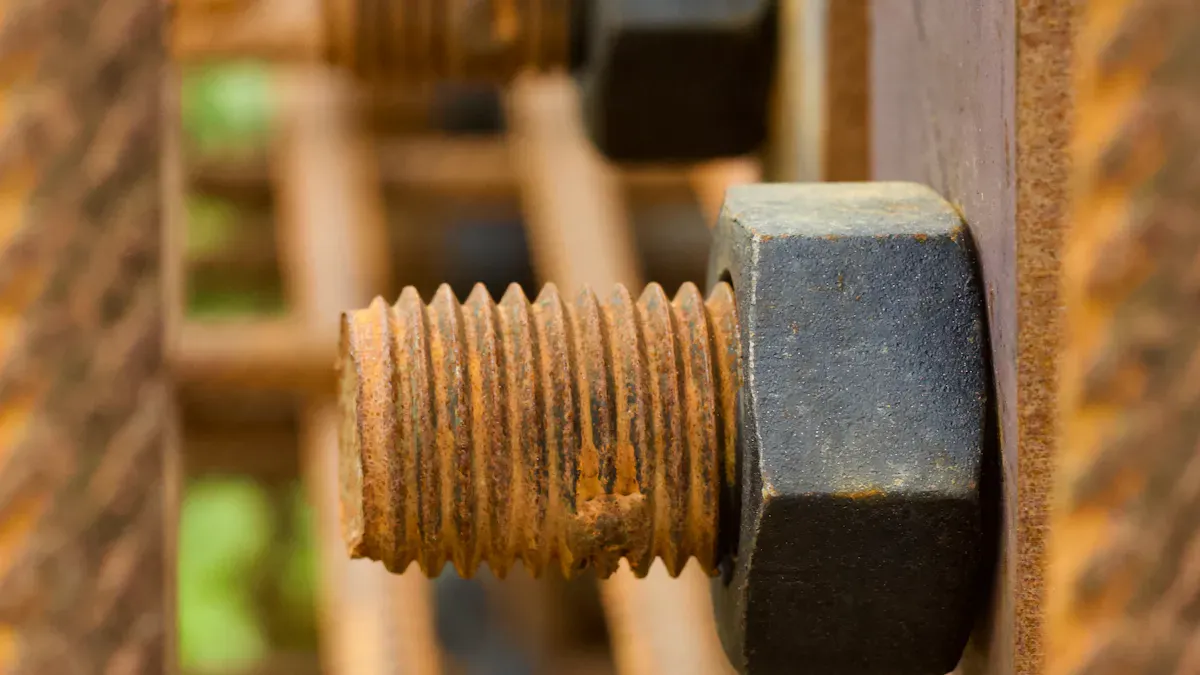
Choosing the right material for flange nuts plays a critical role in the performance and longevity of any assembly. Material selection impacts mechanical strength, corrosion resistance, and suitability for specific environments. Engineers must understand the properties of each material type to make informed decisions.
Steel Flange Nuts
Steel remains the most common material for flange nuts. Manufacturers often select steel for its high strength and versatility. The two main categories include carbon steel and alloy steel.
Carbon Steel
Carbon steel flange nuts offer a balance of strength and affordability. They suit high-vibration environments, automotive assemblies, and industrial machinery. The table below summarizes the mechanical properties and applications of common grades:
| Material Type | Grade | Tensile Strength (MPa) | Applications |
|---|---|---|---|
| Carbon Steel | Grade 8 (Class 8) | ~830 | High-vibration environments, automotive, industrial machinery |
| Carbon Steel | Grade 10 (Class 10) | >1000 | Extreme structural loads, bridges, cranes |
Grade 8 and Grade 10 carbon steel nuts provide reliable clamping force. Grade 10 offers higher tensile strength for extreme loads.
Alloy Steel
Alloy steel flange nuts contain additional elements such as chromium or molybdenum. These elements increase hardness and resistance to wear. Engineers choose alloy steel when assemblies require enhanced mechanical properties. Applications include heavy equipment and structural connections where safety is paramount.
Stainless Steel Flange Nuts
Stainless steel provides excellent corrosion resistance. This material selection works well in environments exposed to moisture, chemicals, or temperature changes.
A2 Stainless Steel
A2 stainless steel, also known as SS304, resists rust and staining. It fits indoor machinery, food processing equipment, and architectural hardware. A2 stainless steel maintains its appearance and strength over time.
A4 Stainless Steel
A4 stainless steel, or SS316, contains molybdenum for improved corrosion resistance. This material performs well in marine hardware, pharmaceutical pipelines, and chemical processing. The table below compares corrosion resistance:
| Material | Corrosion Resistance |
|---|---|
| Stainless Steel | Highly resistant due to chromium forming a protective oxide layer. |
| Brass | Can corrode and tarnish over time, especially in moist environments. |
Stainless steel flange nuts provide long-term durability in harsh environments.
Brass and Other Materials
Brass flange nuts offer a good balance between cost and corrosion resistance. They excel in electrical applications due to their superior conductivity. The table below outlines the advantages and disadvantages:
| Advantages | Disadvantages |
|---|---|
| Good balance between cost and corrosion resistance | Limited use in highly corrosive environments due to lower corrosion resistance |
| Better electrical conductivity (H59 and H62 brass) | Potential lead content may be a concern in some applications |
| No need for additional surface treatments like plating |
Brass remains a popular choice for electrical assemblies. However, it may not suit highly corrosive or wet environments. Other materials, such as nylon or specialty alloys, serve niche applications where weight reduction or chemical resistance is necessary.
Tip: Always match the material selection to the application’s mechanical and environmental demands. This approach ensures safety, reliability, and cost-effectiveness.
Choosing the Right Material for Your Application
Selecting the right material for a metric flange nut determines the performance and longevity of any assembly. Engineers evaluate several factors before making a decision. Each application presents unique challenges, so the material must match the demands of the environment and the mechanical requirements.
A careful review of the following factors helps ensure the best choice:
| Factor | Description |
|---|---|
| Load and Stress Requirements | High-grade alloy or heavy-hex nuts are necessary for high-load applications. |
| Environmental Conditions | Stainless steel or coated carbon steel is crucial for corrosive environments. |
| Vibration and Movement | Lock nuts or prevailing torque nuts are recommended for high-vibration settings. |
| Temperature Exposure | Materials with heat-resistant properties are needed for high-temperature applications. |
| Coating and Surface Treatment | Various coatings can enhance durability in harsh conditions. |
Engineers often start by considering the load and stress requirements. High-load applications demand a material with superior strength, such as alloy steel. For assemblies exposed to moisture or chemicals, stainless steel or coated carbon steel offers better protection against corrosion. In environments with frequent vibration, the right material combined with a locking feature prevents loosening and maintains joint integrity.
Temperature exposure also plays a significant role. Some materials lose strength at elevated temperatures, so heat-resistant options become necessary in these cases. Surface treatments and coatings further improve the durability of the base material, especially in harsh or outdoor environments.
A simple checklist can help guide the selection process:
- Identify the maximum load and stress the nut will face.
- Assess the likelihood of exposure to moisture, chemicals, or salt.
- Determine if the assembly will experience vibration or movement.
- Evaluate the operating temperature range.
- Consider if additional coatings or treatments are needed for extra protection.
Tip: Always match the material to both the mechanical and environmental demands of the application. This approach reduces the risk of premature failure and ensures long-term reliability.
Choosing the right material for a metric flange nut requires a balance between strength, corrosion resistance, and cost. By carefully analyzing the application’s needs, engineers can select a material that delivers optimal performance and safety.
Coating and Finish Options When Selecting the Proper Nut
Choosing the right coating for metric flange nuts protects the fastener and extends its service life. Engineers evaluate several finish options to match the demands of each application. Coating selection depends on environmental exposure, mechanical requirements, and industry standards.
Zinc Plating
Zinc plating offers a cost-effective solution for corrosion protection. Manufacturers apply a thin layer of zinc to the nut’s surface using an electroplating process. This coating acts as a sacrificial barrier, preventing rust and oxidation. Zinc-plated flange nuts suit indoor environments and assemblies with moderate moisture exposure. Automotive and manufacturing industries often use these nuts for their balance of protection and affordability.
- Zinc plating provides basic corrosion resistance.
- The finish maintains a clean appearance.
- Engineers select zinc-plated nuts for general-purpose applications.
A table below summarizes the advantages and limitations:
| Advantage | Limitation |
|---|---|
| Affordable protection | Limited durability outdoors |
| Easy to inspect visually | Not suitable for marine use |
Note: Zinc plating works best in environments with low humidity and minimal chemical exposure.
Hot-Dip Galvanizing
Hot-dip galvanizing delivers superior corrosion resistance. The process involves dipping the nut into molten zinc, creating a thick, durable coating. This finish withstands harsh outdoor conditions, including exposure to rain, salt, and chemicals. Construction and infrastructure projects rely on hot-dip galvanized flange nuts for long-term reliability.
- Hot-dip galvanizing forms a robust protective layer.
- The coating resists abrasion and mechanical damage.
- Engineers choose this option for outdoor and marine applications.
The table below compares hot-dip galvanizing with zinc plating:
| Feature | Zinc Plating | Hot-Dip Galvanizing |
|---|---|---|
| Thickness | Thin | Thick |
| Corrosion Resistance | Moderate | High |
| Application | Indoor | Outdoor/Marine |
Tip: Hot-dip galvanized nuts may require oversized threads to accommodate the thicker coating.
Black Oxide
Black oxide provides a unique finish for metric flange nuts. The process creates a chemical conversion layer that enhances appearance and offers mild corrosion resistance. Black oxide coating suits indoor applications where aesthetics matter. Electronics and machinery manufacturers often select black oxide nuts for their sleek look and reduced glare.
- Black oxide improves visual appeal.
- The coating offers limited protection against rust.
- Engineers use black oxide nuts in controlled environments.
A list of key benefits includes:
- Enhanced appearance
- Reduced light reflection
- Minimal impact on thread dimensions
Alert: Black oxide coating does not protect against heavy moisture or aggressive chemicals.
Coating selection plays a crucial role in the performance and longevity of metric flange nuts. Engineers must assess environmental conditions and mechanical demands before choosing the appropriate finish.
Other Protective Coatings
Engineers often consider additional protective coatings for metric flange nuts when standard finishes do not meet application demands. These specialized coatings enhance performance in unique environments. Dacromet, a zinc and aluminum-based coating, provides excellent corrosion resistance without the risk of hydrogen embrittlement. This coating suits automotive, marine, and construction applications where exposure to salt or chemicals is common.
Phosphate coatings offer another solution. They create a porous surface that improves paint adhesion and provides mild corrosion resistance. Manufacturers use phosphate coatings for nuts in automotive and machinery assemblies. These coatings also reduce friction during installation.
Nickel plating delivers a bright, attractive finish and resists wear. This coating works well in decorative or high-visibility applications. Engineers select nickel-plated flange nuts for electrical equipment and consumer products.
Some industries require PTFE (polytetrafluoroethylene) coatings. PTFE creates a non-stick surface that resists chemicals and moisture. This coating performs well in food processing, chemical plants, and environments with aggressive cleaning agents.
A summary table highlights the main features of these coatings:
| Coating Type | Key Benefit | Typical Application |
|---|---|---|
| Dacromet | High corrosion resistance | Marine, automotive, construction |
| Phosphate | Paint adhesion, lubrication | Automotive, machinery |
| Nickel | Wear resistance, aesthetics | Electrical, consumer products |
| PTFE | Chemical resistance | Food processing, chemical plants |
Tip: Specialized coatings can extend the service life of flange nuts in harsh or regulated environments.
Selecting the Best Coating for Your Environment
Coating selection depends on the specific conditions the flange nut will face. Engineers must evaluate factors such as moisture, temperature, chemical exposure, and visibility. For outdoor or marine environments, a thick, corrosion-resistant coating like hot-dip galvanizing or Dacromet provides the best protection. Indoor assemblies with minimal moisture may only require zinc plating or black oxide.
In chemical plants or food processing facilities, PTFE coatings prevent contamination and resist harsh cleaning agents. For assemblies that require a decorative finish, nickel plating offers both protection and visual appeal.
A simple checklist helps guide coating selection:
- Assess exposure to moisture, salt, or chemicals.
- Determine if the assembly requires a decorative or low-friction finish.
- Consider industry regulations or standards.
- Match the coating to the expected service life and maintenance schedule.
Note: The right coating ensures long-term reliability and reduces maintenance costs.
Engineers should always consult with suppliers or materials experts when uncertain about the best coating for a specific application. Proper coating selection protects both the fastener and the assembly.
Thread Compatibility and Fit for Choosing Metric Flange Nuts
Understanding Metric Thread Sizes
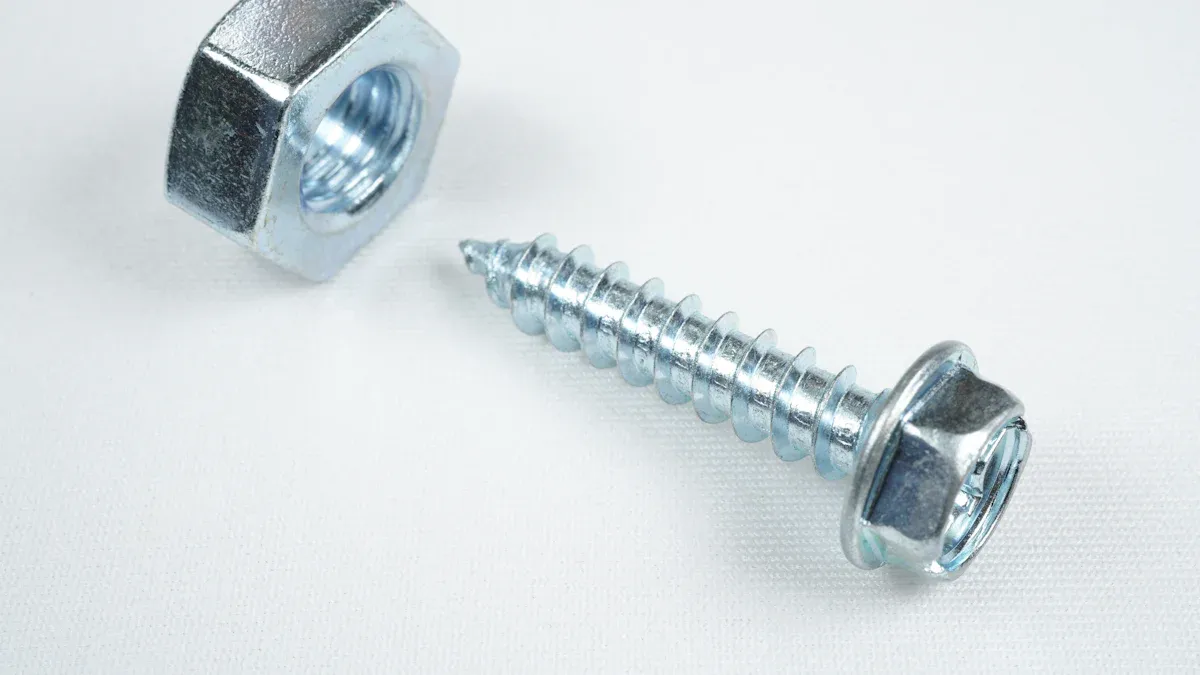
Metric thread sizes follow international standards, such as ISO 261 and ISO 965. These standards define the thread pitch, diameter, and tolerance classes. Engineers identify metric threads using a designation like M10 × 1.5, where “M10” indicates a 10-millimeter nominal diameter and “1.5” refers to the thread pitch in millimeters. The pitch represents the distance between adjacent threads. Coarse threads have a larger pitch, while fine threads have a smaller pitch. Selecting the correct thread size ensures that the nut and bolt engage properly and distribute load evenly.
A table below summarizes common metric thread sizes:
| Designation | Nominal Diameter (mm) | Pitch (mm) |
|---|---|---|
| M6 | 6 | 1.0 |
| M8 | 8 | 1.25 |
| M10 | 10 | 1.5 |
| M12 | 12 | 1.75 |
| M16 | 16 | 2.0 |
Tip: Always verify the thread size on both the nut and bolt before assembly to prevent compatibility issues.
Matching Nut and Bolt Threads
Proper engagement between the nut and bolt threads is essential for joint integrity. When engineers select a metric flange nut, they must ensure that the thread pitch and diameter match the corresponding bolt. Mismatched threads can cause improper engagement and uneven load distribution. Over time, this mismatch may lead to the joint loosening, which increases the risk of fatigue failure. In severe cases, the fastener can fracture, resulting in catastrophic structural failures.
To avoid these issues, engineers should:
- Confirm both the nominal diameter and pitch match exactly.
- Use thread gauges or calipers to measure threads when in doubt.
- Reference manufacturer specifications for both nuts and bolts.
Alert: Never force a nut onto a bolt if the threads do not align smoothly. Forcing can damage both components and compromise safety.
Tolerance and Fit Considerations
Tolerance and fit play a significant role in the performance of metric flange nuts. Tolerance refers to the allowable variation in thread dimensions, while fit describes how tightly the nut and bolt engage. ISO standards classify thread tolerances using numbers and letters, such as 6H for nuts and 6g for bolts. These classes ensure a balance between ease of assembly and secure fit.
A loose fit may speed up installation but can reduce the joint’s resistance to vibration. A tight fit increases resistance to loosening but may require more torque during assembly. Engineers must select the appropriate tolerance class based on the application’s requirements.
Key points to consider:
- Choose standard tolerance classes (e.g., 6H/6g) for most industrial applications.
- Opt for tighter tolerances in high-vibration or safety-critical assemblies.
- Avoid mixing tolerance classes, as this can lead to poor engagement and reduced performance.
Note: Proper thread compatibility and fit ensure the reliability and safety of the assembled joint, reducing maintenance needs and preventing unexpected failures.
Load and Performance Requirements for Selecting the Proper Nut
Assessing Mechanical Strength
Engineers must evaluate the mechanical strength of each nut before selecting it for an application. The strength depends on both the grade and the material used in manufacturing. In heavy machinery, flange nuts must meet strict standards to ensure safety and reliability. The table below outlines common grades, their material types, and typical tensile strengths:
| Grade | Material Type | Tensile Strength (MPa) | Applications |
|---|---|---|---|
| 8 | Quenched and tempered steel | ~830 | High-vibration environments like automotive and industrial machinery |
| 10 | Micro-alloyed boron steel | >1000 | Extreme structural loads in bridges and heavy machinery |
Selecting the correct grade ensures the nut can withstand the forces present in the assembly. Engineers should always match the mechanical properties of the nut to the demands of the application. Using a lower-grade material in a high-stress environment increases the risk of failure.
Vibration and Loosening Resistance
Assemblies exposed to vibration require nuts with enhanced resistance to loosening. Several design features improve this resistance and help maintain joint integrity:
- Serrated edges provide a gripping mechanism that prevents loosening.
- The built-in flange functions like a washer, distributing pressure evenly.
- Flange nuts assist in alignment during installation, ensuring a tight fit.
These features work together to reduce the risk of unintentional loosening. Serrated edges bite into the mating surface, while the flange spreads the load and minimizes surface damage. Proper alignment during installation also contributes to a secure connection. Engineers should prioritize these features when selecting a nut for dynamic or high-vibration environments.
Tip: Always inspect the assembly for signs of loosening during routine maintenance, especially in applications with constant movement.
Temperature and Corrosion Resistance
Temperature extremes and corrosive environments can compromise the performance of a nut. The choice of material and coating plays a critical role in resisting these challenges. The table below compares how different materials respond to temperature changes:
| Material | Low Temperature Effects | High Temperature Effects |
|---|---|---|
| Steel | Becomes brittle, more likely to crack or break | Loses strength, crystal structure changes, softer |
| Stainless Steel | Less brittle than steel, but toughness reduced | Oxidation occurs, outer layer forms scale |
| Brass | More prone to cracking under stress | Expands significantly, can lead to loosening |
Engineers must select a material that maintains its properties across the expected temperature range. Stainless steel offers better performance in both low and high temperatures compared to standard steel or brass. In corrosive environments, stainless steel or coated steel provides longer service life. The right material selection prevents premature failure and reduces maintenance costs.
Note: Always consider both the operating temperature and the presence of corrosive agents when choosing a nut for critical assemblies.
Environmental Factors in Choosing Metric Flange Nuts
Indoor vs. Outdoor Applications
Engineers must evaluate the installation environment before selecting a metric flange nut. Indoor applications typically present fewer challenges. Most indoor environments have stable temperatures and low humidity. Carbon steel flange nuts often provide a cost-effective solution for these conditions. They deliver reliable performance in machinery, furniture, and general assembly.
Outdoor applications introduce more variables. Fluctuating temperatures, rain, and exposure to UV rays can degrade fasteners over time. Corrosion becomes a primary concern. Stainless steel 304 flange nuts perform better in humid outdoor settings. For marine or highly corrosive environments, stainless steel 316 offers superior resistance. The following table summarizes the main corrosion types that affect flange nuts outdoors:
| Corrosion Type | Impact on Flange Nuts |
|---|---|
| Pitting | Degrades sealing surfaces, compromising integrity. |
| Crevice | Leads to localized corrosion, affecting performance. |
| Galvanic | Occurs when dissimilar metals are in contact, causing damage. |
Note: Outdoor assemblies benefit from nuts with protective coatings or made from corrosion-resistant materials.
Exposure to Chemicals or Moisture
The presence of moisture, salts, or chemicals in the operating environment significantly influences material and coating selection. Moisture accelerates corrosion, especially when combined with salts or industrial chemicals. Stainless steel 304 resists rust in humid conditions. Stainless steel 316 remains the preferred choice for marine or chemical exposure due to its enhanced corrosion resistance.
- Carbon steel flange nuts are economical for general use.
- Stainless steel 304 is better for humid environments.
- Stainless steel 316 is ideal for marine or chemical exposure.
In marine applications, flange nuts secure components on ships and offshore platforms. Saltwater exposure demands protective coatings to prevent rapid corrosion. Chemical processing plants expose fasteners to aggressive substances. Coatings that resist chemical attacks extend service life and maintain joint integrity.
Tip: Always assess the presence of moisture, salts, and chemicals, along with the required service life of the fastener in that environment.
High-Temperature Environments
High temperatures can weaken flange nuts and accelerate corrosion. Standard carbon steel may lose strength or deform under heat. Stainless steel maintains its properties at elevated temperatures, making it suitable for industrial ovens, engines, or exhaust systems. Some applications require specialty alloys or additional coatings to withstand extreme heat.
Engineers should consider both the maximum operating temperature and the duration of exposure. Selecting a nut with the right material and finish ensures safety and reliability in high-temperature settings.
Alert: Never use standard carbon steel flange nuts in environments where temperatures exceed their rated limits. Always verify the material’s temperature tolerance before installation.
Standards and Certifications for Selecting the Proper Nut
ISO and DIN Standards
International standards ensure consistency and safety in fastener selection. Engineers often reference DIN and ISO standards when choosing a metric flange nut. The DIN 6923 standard, developed in Germany, describes a hexagonal nut with a wide flange. This flange acts as an integrated washer, available in both smooth and serrated designs. Serrated versions help resist loosening from vibration. DIN 6923 covers metric thread sizes from M5 to M24 and includes property classes such as 8, 10, and 12 for carbon steel, as well as A2-70 and A4-80 for stainless steel. Surface treatments like zinc plating and hot-dip galvanizing are also specified.
ISO 4161 serves as the internationally harmonized version of DIN 6923. Both standards are directly interchangeable, which simplifies sourcing and replacement. In China, GB/T 6177 offers similar dimensions, with only minor variations in flange diameter. The table below compares these standards:
| Standard | Origin | Key Difference | Interchangeability |
|---|---|---|---|
| DIN 6923 | Germany | Metric serrated/smooth flange, hexagonal drive | Benchmark standard |
| ISO 4161 | International | Harmonized version of DIN 6923 | Directly interchangeable |
| GB/T 6177 | China | Minor flange diameter variations | Mostly interchangeable |
Note: Selecting a nut that complies with recognized standards ensures compatibility and performance in global supply chains.
Industry-Specific Requirements
Different industries impose unique requirements on fasteners. The automotive sector demands high-strength nuts that can withstand vibration and temperature changes. Aerospace applications require lightweight materials and strict traceability. Construction projects often specify corrosion-resistant finishes for outdoor use. Electrical and electronic assemblies may call for non-magnetic or conductive properties.
A summary of industry requirements:
- Automotive: High strength, vibration resistance, corrosion protection
- Aerospace: Lightweight alloys, traceability, precision manufacturing
- Construction: Corrosion resistance, large size range, robust coatings
- Electrical: Conductivity, non-magnetic materials, compact design
Engineers must review project specifications and industry codes before selecting a nut for critical assemblies.
Importance of Certification
Certification verifies that a fastener meets all relevant standards and quality benchmarks. Certified nuts undergo rigorous testing for material composition, mechanical strength, and dimensional accuracy. Suppliers provide documentation such as material test reports (MTRs) and certificates of conformity. These records help engineers confirm compliance and traceability.
Tip: Always request certification documents from suppliers, especially for safety-critical or regulated applications.
Certification reduces the risk of failure and ensures that each nut performs as expected in demanding environments. Reliable documentation supports quality assurance and simplifies audits.
Cost-Effectiveness and Budgeting When Choosing Metric Flange Nuts
Balancing Quality and Price
Project managers and engineers often face the challenge of balancing quality and price when selecting metric flange nuts. They must evaluate several factors to ensure the fasteners meet performance requirements without exceeding budget constraints. The following list highlights the most important considerations:
- Material selection determines strength and corrosion resistance. Stainless steel suits harsh environments, while carbon steel offers affordability.
- Thread size and compatibility ensure nuts fit bolts correctly, maintaining system integrity.
- Load and strength requirements dictate the grade of nut needed for heavy-duty applications.
- Coatings and finishes, such as galvanization, enhance durability in specific environments.
- Quantity and packaging affect cost savings and storage needs.
- Lead time and delivery influence project schedules and prevent delays.
- Quality assurance and standards guarantee compliance with industry benchmarks.
- Cost versus quality remains a critical factor. High-quality nuts provide long-term reliability and reduce maintenance costs.
Engineers must avoid sacrificing quality for price. They recognize that investing in high-quality flange nuts prevents premature failures and ensures safety.
Bulk Purchasing Considerations
Large-scale projects often require bulk purchasing of metric flange nuts. Buyers must assess storage capabilities and future needs before placing orders. Bulk orders can reduce unit costs and streamline procurement. However, excessive inventory may lead to waste or increased storage expenses. Suppliers sometimes offer discounts for large quantities, but buyers must verify the consistency of quality across batches.
A table below summarizes the advantages and challenges of bulk purchasing:
| Advantage | Challenge |
|---|---|
| Lower unit price | Storage requirements |
| Streamlined supply | Quality consistency |
| Reduced lead times | Risk of overstocking |
Tip: Buyers should coordinate with suppliers to ensure timely delivery and maintain quality standards throughout the order.
Long-Term Value
Long-term value plays a vital role in fastener selection. Engineers consider the total cost of ownership, including installation, maintenance, and replacement. High-quality flange nuts reduce downtime and extend the lifespan of assemblies. They minimize the risk of unexpected failures, which can disrupt operations and increase repair costs. Investing in durable, reliable nuts supports project sustainability and enhances overall performance.
Note: Choosing flange nuts based on long-term value rather than initial price delivers greater returns and supports operational efficiency.
Supplier Selection and Quality Assurance for Selecting the Proper Nut
Choosing a Reliable Supplier
Selecting a reliable supplier forms the foundation of any successful fastener procurement process. Engineers and purchasing managers often evaluate suppliers based on their track record, industry reputation, and ability to deliver consistent quality. A reputable supplier maintains clear communication, provides technical support, and demonstrates a commitment to customer satisfaction. Many organizations prefer suppliers with established certifications, such as ISO 9001, which signals a robust quality management system.
A checklist for evaluating suppliers includes:
- Years of experience in the fastener industry
- Availability of technical support and after-sales service
- Compliance with international standards and certifications
- Transparent lead times and delivery schedules
Tip: A supplier with a proven history of meeting deadlines and maintaining product quality reduces the risk of project delays.
Verifying Product Quality
Product quality directly impacts the performance and safety of any assembly. Engineers must ensure that each metric flange nut meets the required specifications. Reliable suppliers implement strict quality assurance processes, including material testing, dimensional inspections, and traceability protocols. These measures help detect defects before products reach the customer.
A table below outlines common quality assurance practices:
| Practice | Purpose |
|---|---|
| Material certification | Confirms correct material composition |
| Dimensional inspection | Ensures nuts meet size specifications |
| Mechanical testing | Verifies strength and durability |
| Traceability records | Tracks production batches |
Quality assurance not only prevents failures but also builds trust between buyers and suppliers. Engineers should request evidence of these practices during the supplier evaluation process.
Requesting Documentation and Samples
Requesting documentation and product samples allows engineers to verify quality before committing to large orders. Essential documents include material test reports, certificates of conformity, and inspection records. These documents provide proof that the nuts comply with industry standards and project requirements.
Engineers often request samples for hands-on evaluation. Testing samples in real-world conditions helps confirm fit, finish, and performance. This step ensures that the selected metric flange nuts will meet the demands of the intended application.
Note: Comprehensive documentation and sample testing form a critical part of any quality assurance program. They help identify potential issues early and support informed decision-making.
By prioritizing supplier reliability and robust quality assurance, organizations can secure high-quality metric flange nuts that deliver long-term performance and safety.
Practical Tips for Choosing Metric Flange Nuts
Creating a Selection Checklist
A structured checklist streamlines the process of choosing metric flange nuts. Engineers often rely on such lists to ensure no critical factor gets overlooked. The following checklist covers the most important considerations:
- Confirm the correct thread size and pitch.
- Select the appropriate material for the environment.
- Assess the required strength grade.
- Choose the right coating or finish for corrosion resistance.
- Verify compatibility with the mating bolt.
- Evaluate the need for vibration resistance.
- Check compliance with relevant standards.
- Review supplier certifications and quality assurance.
Tip: A well-prepared checklist reduces the risk of errors and saves time during procurement.
Common Mistakes to Avoid
Mistakes in choosing metric flange nuts can lead to assembly failures or increased maintenance costs. The most frequent errors include:
- Selecting the wrong thread size or pitch, which causes poor fit.
- Overlooking environmental factors, such as moisture or chemicals, that affect nut performance.
- Ignoring the need for proper coatings in outdoor or corrosive settings.
- Using a nut with insufficient strength for the application.
- Failing to match the nut material with the bolt material, which can cause galvanic corrosion.
- Neglecting to verify supplier quality or certifications.
A table below summarizes these mistakes and their consequences:
| Mistake | Consequence |
|---|---|
| Wrong thread size | Assembly failure |
| Inadequate material selection | Premature corrosion or breakage |
| Lack of proper coating | Reduced service life |
| Insufficient strength grade | Joint failure under load |
Alert: Avoid these pitfalls to ensure reliable and safe assemblies.
When to Consult an Expert
Some applications require specialized knowledge. Engineers should consult an expert when:
- The assembly faces extreme loads or harsh environments.
- Industry standards or certifications are unclear.
- Custom fasteners or unique materials are needed.
- Previous failures have occurred with similar assemblies.
Experts provide guidance on choosing metric flange nuts that meet all technical and safety requirements. Their input helps prevent costly mistakes and ensures long-term reliability.
Note: Early consultation with a fastener specialist can optimize design and reduce project risks.
Selecting the right metric flange nut involves several important steps. Engineers should:
- Identify the correct size and thread compatibility.
- Choose materials and coatings that match the environment.
- Verify strength grades and industry standards.
- Evaluate supplier reliability and quality assurance.
Tip: Prioritizing fit, performance, and reliability ensures safe and long-lasting assemblies. Careful selection reduces maintenance costs and prevents unexpected failures.
FAQ
What is the main advantage of using a metric flange nut?
A metric flange nut distributes load over a larger area. This design reduces the risk of damage to connected parts. It also helps prevent loosening from vibration.
How does a serrated flange nut differ from a standard flange nut?
A serrated flange nut features teeth on the flange surface. These teeth grip the mating material and resist rotation. Standard flange nuts have a smooth flange and do not provide this extra resistance.
Can stainless steel flange nuts be used outdoors?
Yes. Stainless steel flange nuts resist corrosion and perform well outdoors. They suit environments with moisture, rain, or temperature changes.
How can engineers ensure thread compatibility?
Engineers should match the thread size and pitch of the nut and bolt. Using a thread gauge or caliper helps verify compatibility. Reference to manufacturer specifications ensures a proper fit.
When should high-strength flange nuts be selected?
High-strength flange nuts suit applications with heavy loads or high stress. Industries such as construction, automotive, and heavy machinery often require these nuts for safety and reliability.
What coatings provide the best corrosion resistance?
Hot-dip galvanizing and Dacromet coatings offer excellent corrosion resistance. These finishes protect flange nuts in marine, chemical, or outdoor environments.
Why is supplier certification important?
Supplier certification confirms that flange nuts meet industry standards. Certification ensures consistent quality, traceability, and compliance with project requirements.
What is the best way to avoid common selection mistakes?
Engineers should use a checklist. This checklist should include thread size, material, coating, strength grade, and supplier quality. Careful review prevents errors and ensures reliable assemblies.