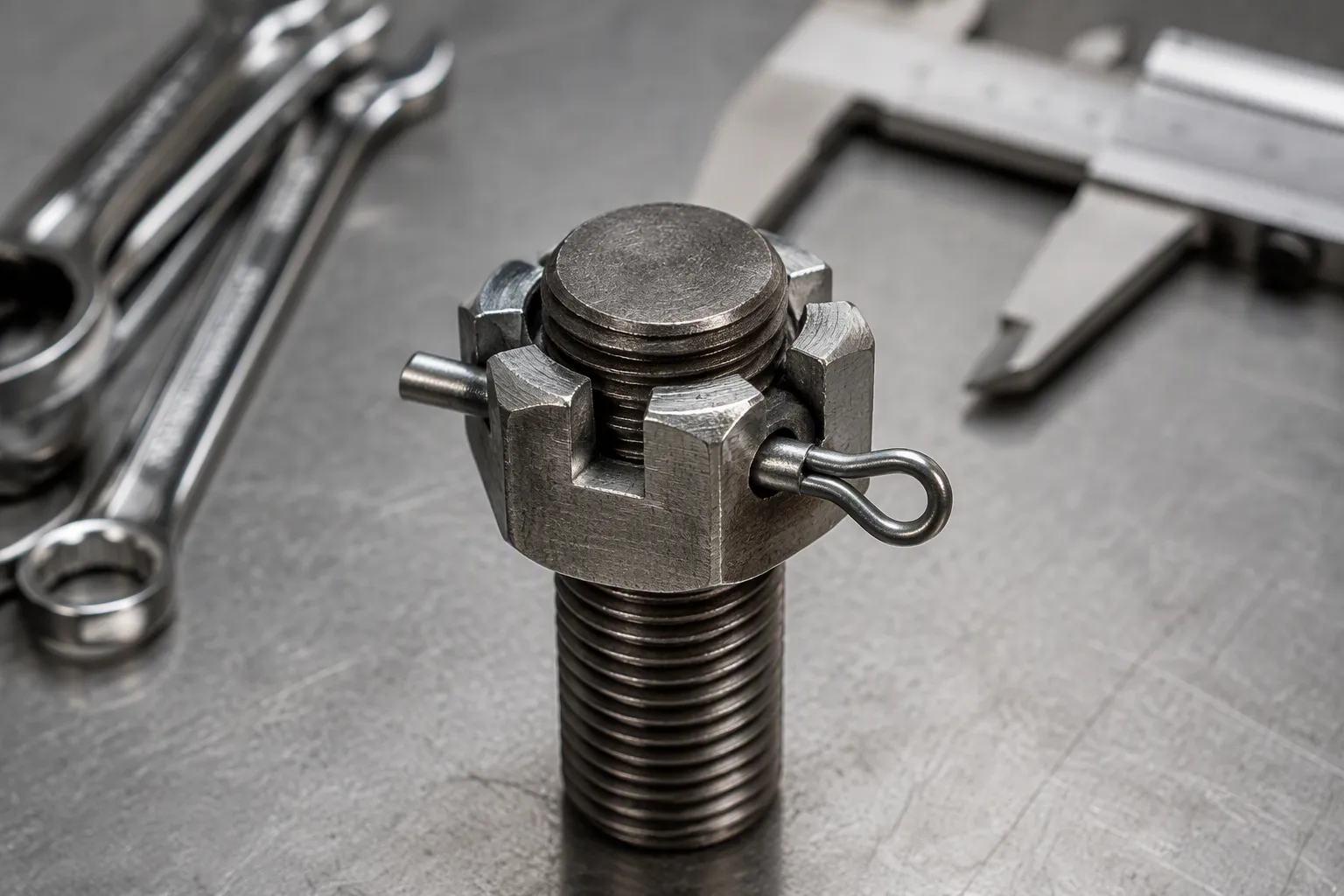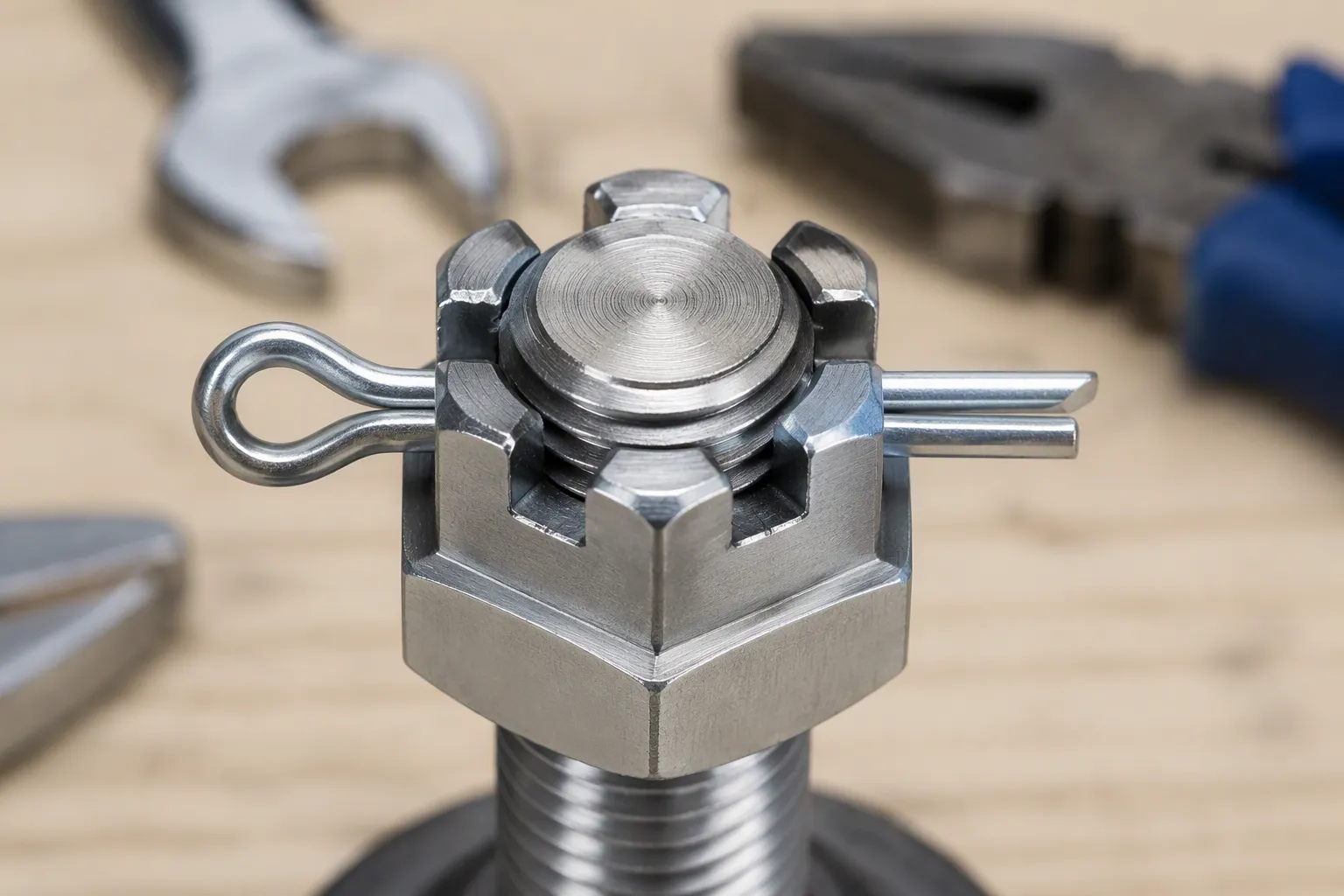
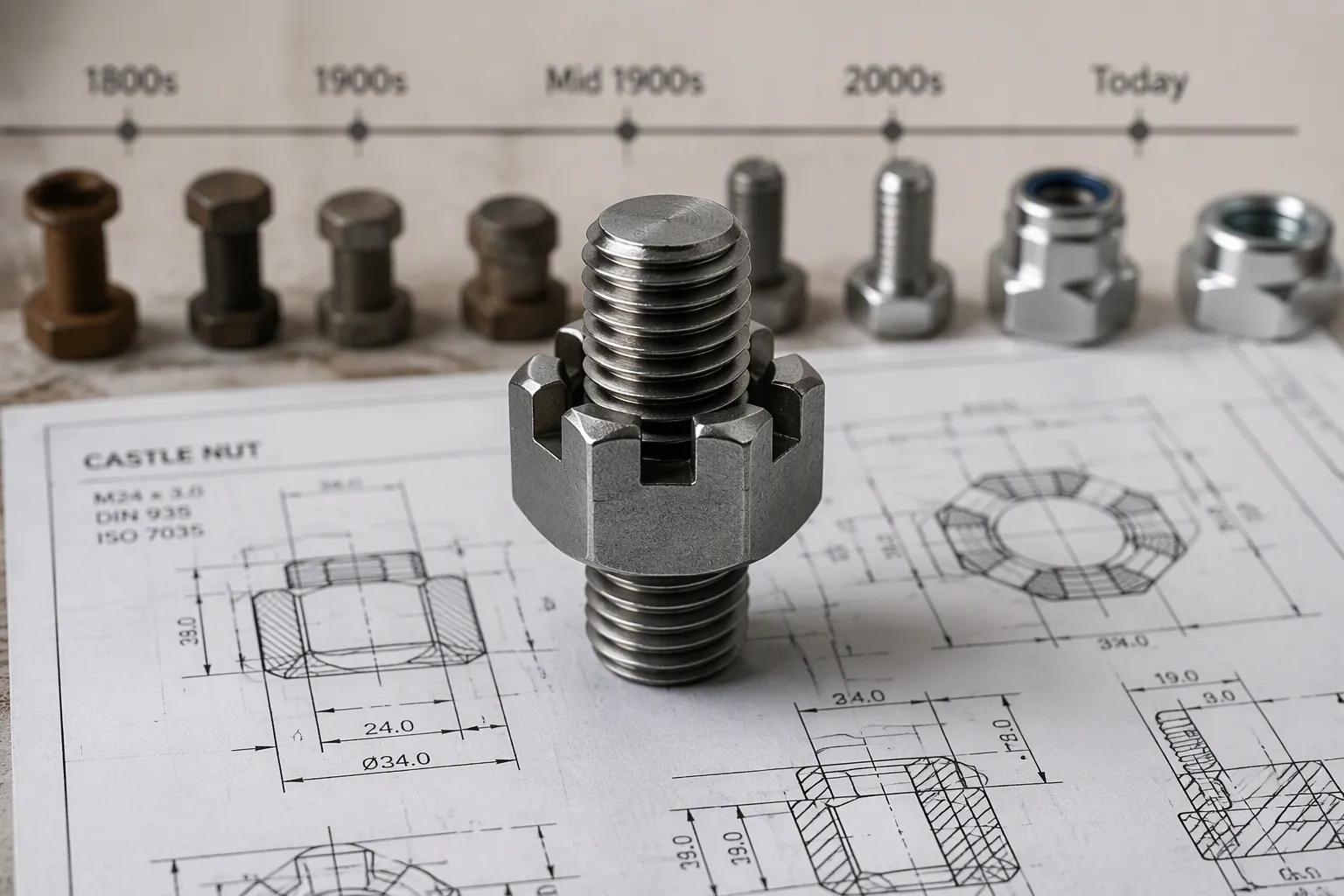
A Kronenmutter is a hex nut with slots, called castellations, machined into its top face. This castle nut in engineering serves one core purpose: preventing loosening under vibration and torque reversal. The locking mechanism works simply. A cotter pin passes through a cross-drilled hole in the bolt and the nut slots, blocking rotation. Engineers still specify the castle nut with a cotter pin today because positive mechanical locking remains visible and reliable. Among Schrauben und Muttern, few fasteners match this simplicity. A Hersteller von kundenspezifischen Verbindungselementen can produce these parts to exact specifications, and kundenspezifische Befestigungen continue to prove their worth in critical joints.
What Is a Castle Nut and Why It Exists
The Castellated Nut Defined
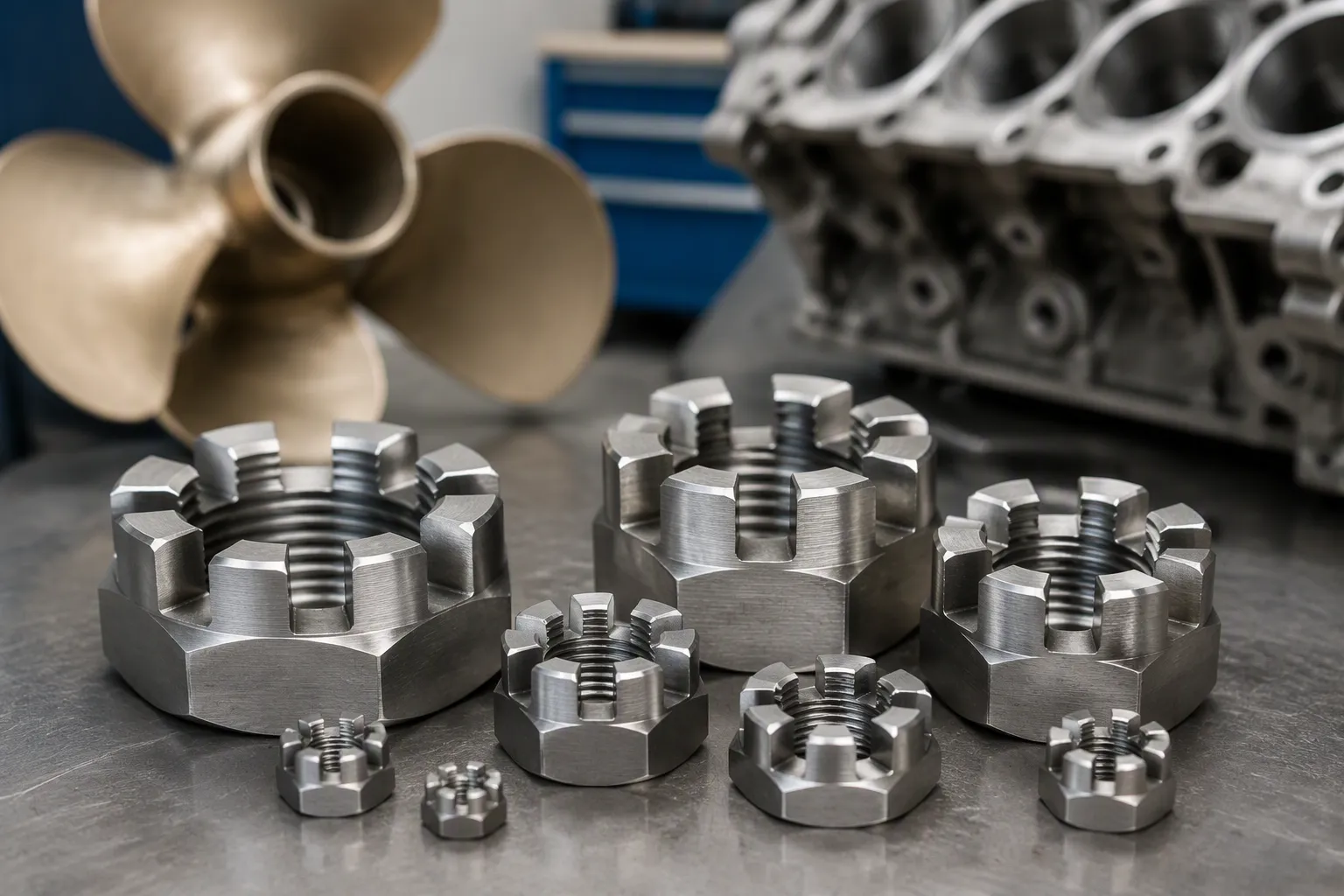
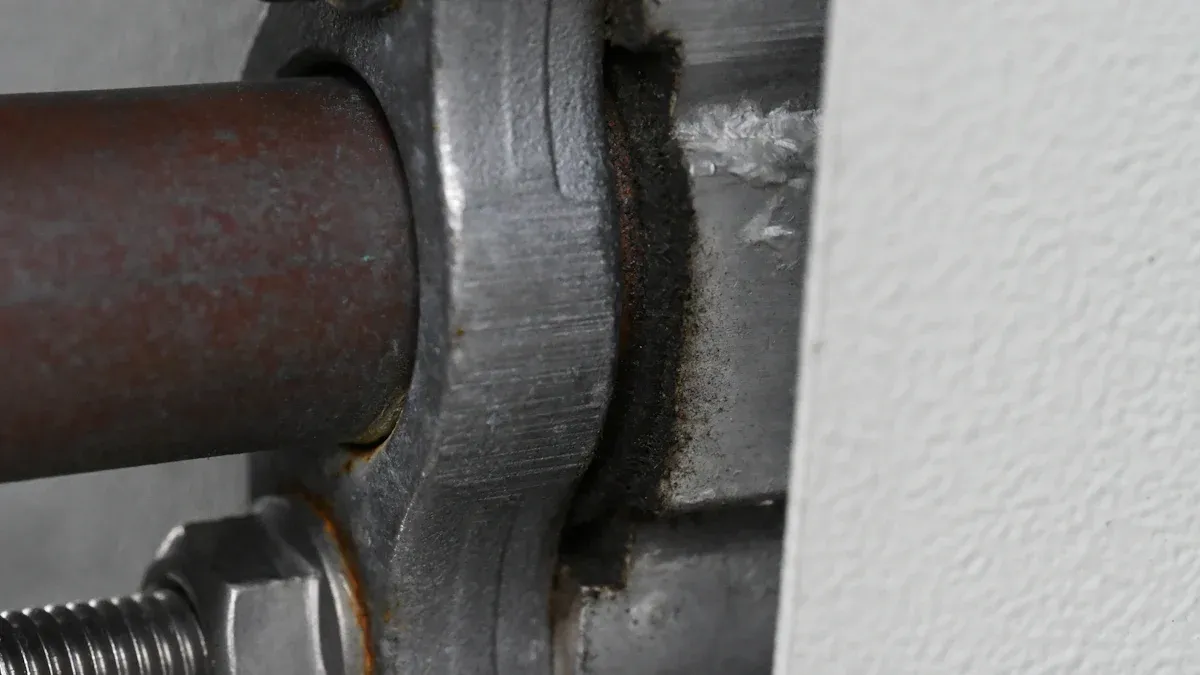
A castellated nut is a hex nut with a cylindrical crown at the top. Machinists cut narrow slots, or notches, straight down through this crown. The slots run parallel to the nut axis and break through the top face. Six slots are common on a standard hex nut, one above each flat. The result looks like the battlements of a castle tower, and that resemblance gives the fastener its name.
Slot Geometry and the Castle Resemblance
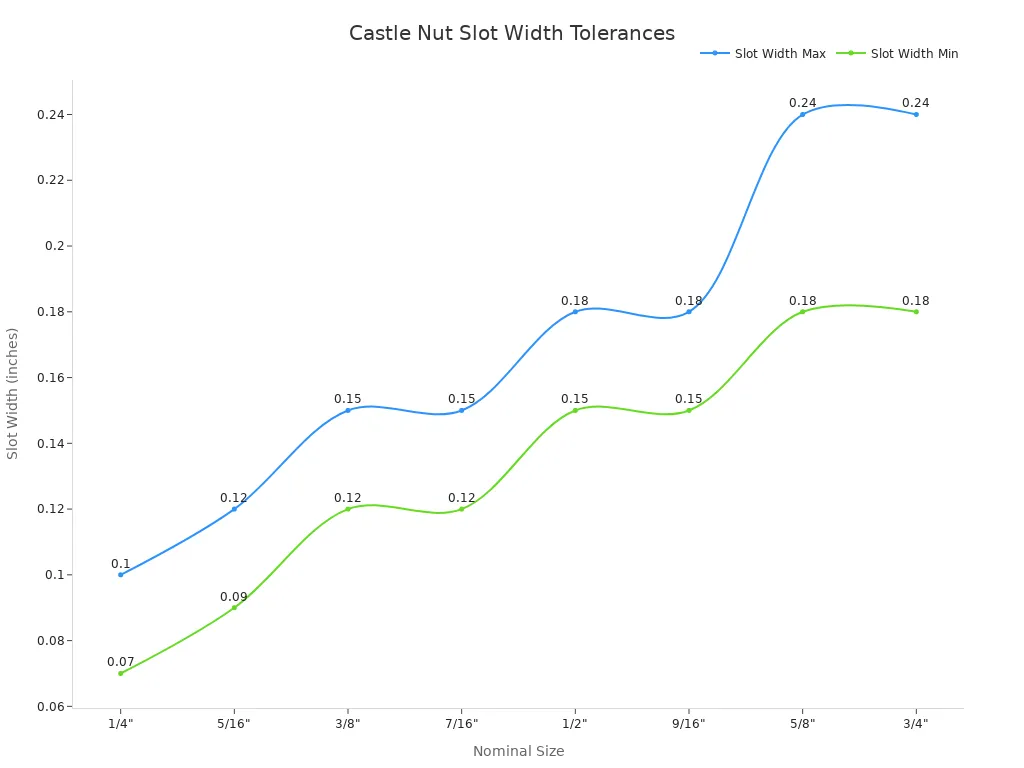
The slot geometry follows published standards so that pins, bolts, and nuts from different suppliers work together. ASME B18.2.2 sets the slot width for each nominal size. A 1/4″ nut carries a slot width of 0.078″, a 1/2″ nut measures 0.141″, and a 3/4″ nut reaches 0.203″. The table below shows the full tolerance band for common sizes.
| Nominal Size | Slot Width (W) Max | Slot Width (W) Min |
|---|---|---|
| 1/4″ | 0.100 | 0.070 |
| 5/16″ | 0.120 | 0.090 |
| 3/8″ | 0.150 | 0.120 |
| 7/16″ | 0.150 | 0.120 |
| 1/2″ | 0.180 | 0.150 |
| 9/16″ | 0.180 | 0.150 |
| 5/8″ | 0.240 | 0.180 |
| 3/4″ | 0.240 | 0.180 |
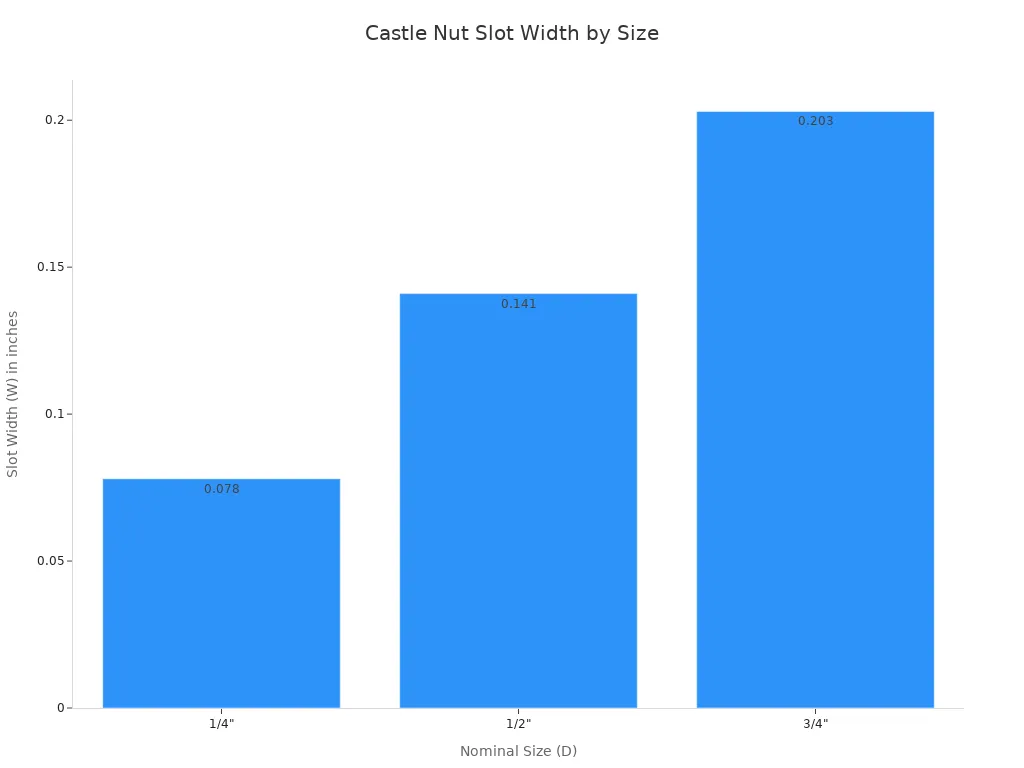
The tolerance band matters in practice. A slot that runs too narrow blocks the pin. A slot that runs too wide lets the pin shift and rattle. The chart below plots the maximum and minimum limits across the size range.
How the Cotter Pin Locks the Joint
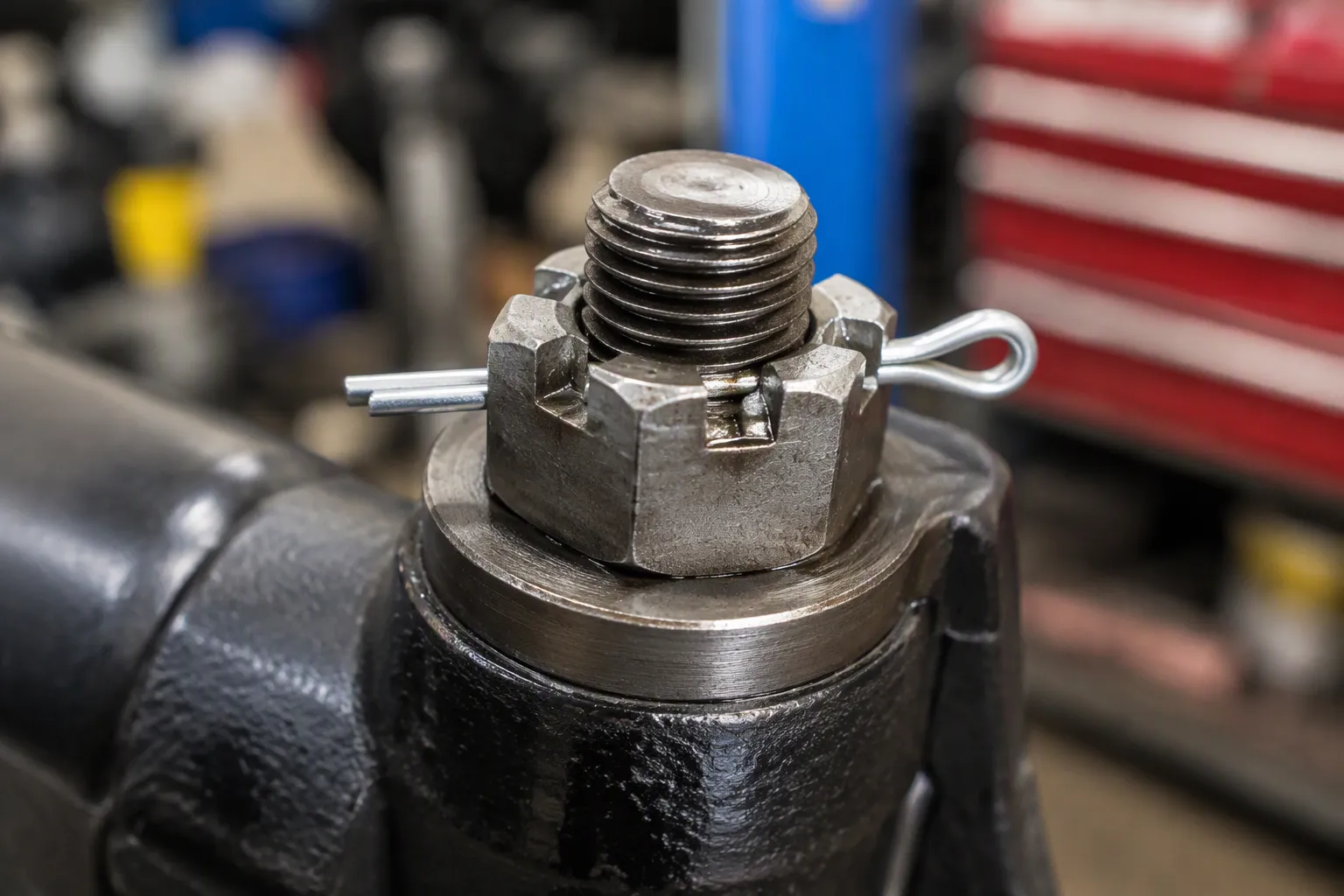
The locking action depends on a simple sequence. A technician drills the bolt shank with a hole drilled through its threaded end. The hole sits just below the nut seat. The technician threads on the nut and torques it to the specified preload. The hole then aligns with the nearest slot. A cotter pin slides through the slot and the bolt hole, and the installer bends the two prongs apart. The bent prongs form a wedge that holds the pin in place. The pin blocks rotation, so the joint cannot back off.
The installation follows a fixed order:
- A cotter pin (split pin) has a head on one end and two prongs that pass through a pre-drilled hole in a bolt or shaft.
- Once inserted, the two prongs are bent outward, away from each other, using pliers.
- This bending creates a wedge-like effect that firmly locks the pin in place and prevents it from backing out.
- Because the pin cannot back out, the nut (often a castle nut) is blocked from rotating, so components cannot loosen under vibration or movement.
A cotter pin through slotted crown hardware is a single-use part in most cases. The bending work-hardens the prongs, and straightening them for reuse weakens the metal. Technicians replace the pin at every disassembly. The rounded head stops the pin from slipping through the hole, and the opened legs stop it from traveling back out. The cotter pin through slots therefore acts as a safety lock that keeps the fastener secure under dynamic loads.
The Core Engineering Problem It Solves
Loosening Under Vibration and Shock
Threaded fasteners loosen when the joint sees vibration, shock, or torque reversal. Each cycle of transverse motion lets the nut rotate a tiny fraction of a turn. The rotation bleeds off clamp load, and the joint relaxes. A castle nut with a cotter pin defeats this process. The pin fills the slot and the bolt hole, so the nut has no room to rotate. The positive mechanical lock holds even when the clamp load drops. Only a force large enough to shear the pin can free the nut.
Why Friction-Based Locking Falls Short
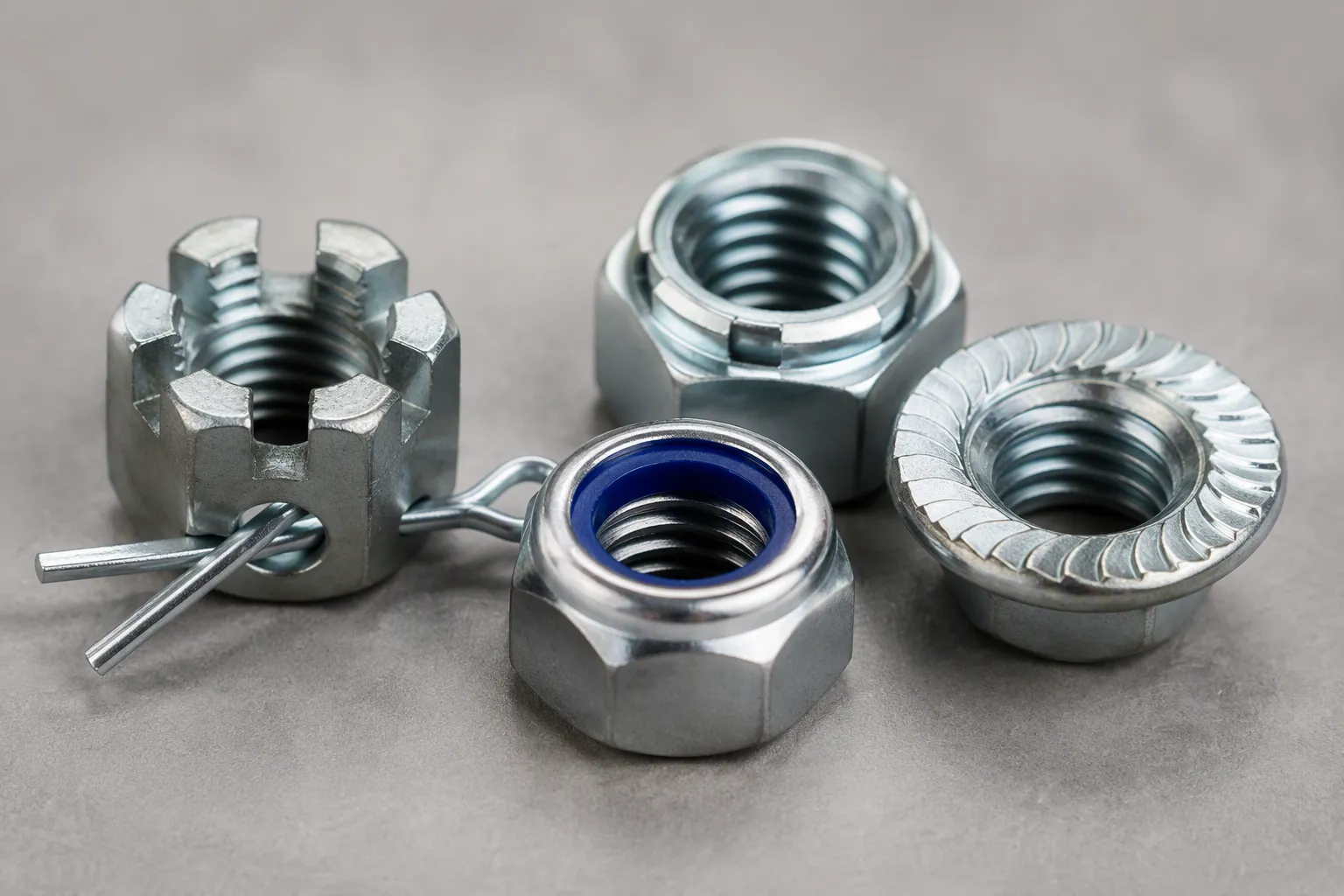
Friction-based methods rely on preload and thread friction to hold a joint. Lock washers, nylon inserts, and prevailing torque nuts all work this way. These methods perform well in many applications, and engineers still specify them where they fit. Friction alone has a limit, though. Vibration can overcome the friction budget, and the nut begins to walk. Temperature swings and relaxation reduce preload over time. A positive mechanical lock does not depend on friction. The pin provides a hard stop, and the lock stays visible after installation. That visibility lets an inspector confirm the lock with a glance. For critical joints, this combination of certainty and inspectability explains why the castle nut in engineering still earns a place on the drawing.
Origins of the Vibration-Resistant Fastener
Early Fastening Problems in Machinery
Loosening in Steam and Railway Equipment
Steam engines and early railways pushed fasteners harder than any machine before them. Pistons pounded, wheels hammered the rails, and every joint felt constant shock. Nuts backed off these joints with alarming speed. A loose nut on a connecting rod could throw a train from the track. Early maintenance records show crews retightening the same joints day after day. The problem was not poor workmanship. The problem was vibration, and no plain nut could resist it.
Vibration can cause fasteners to loosen over time, leading to component failure.
Railway rulebooks soon demanded more than tightness. They demanded a guarantee.
Fasteners (keys, nuts, etc.) shall be kept tight and shall have some means to prevent them from loosening or falling out of place.
Limitations of Friction-Based Locking
Early engineers tried friction first. They torqued nuts harder, added jam nuts, and experimented with spring washers. Each method helped a little. None survived the pounding of a steam locomotive for long. Friction depends on clamp load, and vibration bleeds clamp load away. Once the load drops, the nut walks free. A different principle was needed, one that did not rely on friction at all.
The First Slotted and Pinned Nuts
Early Railway and Steam Machinery Use
Nineteenth-century mechanics found the answer in a pin. They drilled a hole through the bolt end and cut slots in the nut crown. A split pin through both parts blocked rotation outright. Early slotted nuts appeared on locomotive rods, steam valves, and rolling stock axles. The design spread wherever vibration ruled.
The Cotter Pin as a Safety Lock
The cotter pin made the lock complete. Its head stopped one end, and its bent legs stopped the other. The pin could not fall out, so the nut could not turn. This small part turned a loose joint into a fail-safe joint. A worker could check the lock by eye in seconds.
Why the Castle Shape Emerged
Slot Geometry and Pin Access
Die castle shape arose from a practical engineering problem during the Industrial Revolution. Conventional nuts and bolts loosened under the continuous vibration and stress of machinery. Engineers developed locking mechanisms, and one early solution was the castle nut, a hexagonal nut with slots cut into its top. The slots exist to give the cotter pin access through the nut and the bolt hole. The battlements are a functional outcome of the locking principle, not a decorative choice.
Balancing Strength and Machinability
Each slot removes material from the crown, so the count and depth matter. Six slots give fine adjustment and easy pin alignment. Deeper slots ease pin insertion but weaken the crown. Early machinists settled on shallow, narrow slots as the balance point. That geometry kept the castellated nut strong while staying simple to cut. The same tradeoff still guides the castellated nuts and slotted nuts made today, and every castle nuts drawing reflects it. A slotted nut and a castle nut share this heritage, and each cotter pin in service carries it forward.
Key Historical Milestones
Patents and Standardization
Early Fastener Patents
Inventors filed early patents on locking fasteners during the nineteenth century. These filings described slotted crowns and cross-drilled bolts as a paired system. Patent drawings from the period show the familiar castle profile. Each patent claimed a specific slot arrangement or pin retention feature. The filings established the castle nut as a distinct fastener category.
Emergence of National Thread and Nut Standards
National standards soon followed the patents. Thread systems needed agreement before nuts and bolts from different makers could interchange. Standard committees defined thread pitches, hex dimensions, and slot widths. The castle nut in engineering gained consistent geometry across suppliers. Standardization turned a workshop specialty into a catalog item.
Adoption in Automotive Engineering
Steering and Suspension Joints
Automakers adopted the castle nut for steering linkages and suspension pivots. Tie rod ends and ball joints used a castellated nuts design with a cotter pin through the stud. The lock resisted the constant shock of road travel. A failed joint could cost a driver control, so the positive lock earned its place.
Wheel and Driveline Applications
Wheel retention became another major application. A castle nut proved ideal for holding a wheel bearing in place on the spindle. The slotted nut locked the bearing adjustment on the wheel bearing of the car wheel hub. Spindle and axle nuts on drive shafts used the same principle. Mechanics could set bearing preload and pin the nut at the exact position.
Adoption in Aerospace
Safety-Critical Joint Locking
Aircraft builders demanded locking methods with no dependence on friction. Castle nuts appeared on flight control linkages, landing gear, and engine mounts. Inspectors could verify the pin installation by sight before every flight. The lock offered certainty in joints where failure was unacceptable.
Military and Aviation Specifications
Military and civil aviation authorities wrote the fastener into their specifications. Standards defined pin materials, slot tolerances, and installation procedures. Suppliers had to certify every lot. Slotted nuts met these rules and stayed in the aviation supply chain. The castle nut became a standard part of safety-critical assembly practice.
Design Evolution of the Castle Nut
Slot Shape and Count Changes
Six-Slot Versus Other Configurations
Six slots became the default for the standard hex castle nut. One slot sits above each flat, so a pin finds an alignment point within a small rotation. Some designs use fewer slots for heavier crowns, and others use more for finer adjustment. Each configuration trades adjustment resolution against crown strength.
Slot Depth and Pin Alignment Tradeoffs
Slot depth controls how easily a cotter pin slides into place. Deep slots guide the pin quickly, yet they remove more material from the crown. Shallow slots keep the castellated nut strong, but they demand closer hole alignment. Designers balance these factors against bolt hole placement and expected vibration.
Material Progression
From Low-Carbon Steel to Alloy Steels
Early castle nuts used low-carbon steel. This material was cheap and easy to machine, but it limited load capacity. Alloy steels raised tensile strength and fatigue resistance. Grade 8 carbon steel now serves high-strength structural applications. Heat-treated alloy grades followed, and they let slotted nuts carry heavier preload in smaller sizes.
Corrosion-Resistant and Specialty Alloys
Corrosion resistance drove the next material shift. A2 (304) stainless steel performs well in moist, salty, or chemically exposed environments. A4 (316) stainless steel offers strong corrosion resistance for marine equipment, outdoor installations, food processing machinery, and chemical systems where rust prevention matters more than maximum load capacity. Grade 316 stainless steel suits marine or highly corrosive chemical environments, and ASTM A194 Grade 2H handles high-temperature piping.
| Environment | Recommended Castle Nut Material |
|---|---|
| Marine or highly corrosive chemical environments | Grade 316 stainless steel |
| High-temperature piping | ASTM A194 Grade 2H |
| High-strength structural applications | Grade 8 carbon steel |
Titanium offers an exceptional strength-to-weight ratio, corrosion resistance, and biocompatibility, making it suitable for aerospace, automotive, medical, and marine applications. Its ability to withstand extreme temperatures and pressures makes it a preferred material for high-stress environments. Titanium Grade 5 castle nuts serve critical, high-performance applications. They resist loosening under vibration, high-speed rotation, and temperature changes. Compared with steel, they reduce assembly weight by roughly 45% while offering better tensile strength and fatigue resistance.
Manufacturing Method Changes
From Manual Machining to Cold Forming and Broaching
Early machinists cut slots by hand with a hacksaw and file. Production moved to milling and then to broaching, which cuts all slots in one pass. Cold forming now shapes the hex body near net shape before slot cutting. These methods cut cost and hold tighter tolerances on every castellated nuts lot.
Heat Treatment and Surface Finishing
Heat treatment sets strength and hardness after forming. Quenching and tempering tune the castle nuts for their service load. Surface finishing adds the final layer of protection. Zinc plating, phosphate coating, and passivation each answer a specific corrosion threat. Together, these steps let a slotted nut meet both strength and durability targets.
Engineering Drivers Behind the Changes
Vibration and Fatigue Resistance
Positive Locking Versus Prevailing Torque
Engineers separate locking methods into two families. A positive locking device forbids rotation outright. A prevailing torque nut resists rotation through friction. Each approach answers a different threat, and the table below shows where they diverge.
| Aspekt | Positive locking (cotter pin) | Prevailing torque (friction-based) |
|---|---|---|
| Mechanism against rotation | Forbids rotation beyond a discrete step | Resists rotation via friction |
| Resistance to clamp-force loss | Cannot stop slow loss of clamp force | Ongoing friction can help retain load |
| Preload outcome | Fixed to whichever position the hole allows | Preload set by the installer is preserved |
| Key limitation | A nut that cannot rotate can still lose load | Depends on friction remaining intact |
Joint Relaxation and Preload Retention
A pinned nut that will not rotate but still loses clamp force can still come loose. The pinning only fixes the nut’s position, not the joint’s preload. Engineers therefore pair the castle nut with a cotter pin and a correctly torqued joint. The pin holds position, and the preload holds the load.
Safety and Inspection Requirements
Visual Verification of Pin Installation
Visual inspection gives the castle nut its edge in maintenance. A technician can confirm joint integrity without specialized test equipment. The correct procedure follows a fixed sequence:
- Inspect bolt hole integrity for burrs and deformation.
- Apply initial torque to the minimum specified value with a calibrated wrench.
- Check slot alignment and tighten slightly further if needed.
- Insert a new cotter pin of the correct diameter.
- Bend the prongs firmly and trim excess length.
Field Warning: The Alignment Trap — technicians often over-torque a nut just to align slots with the bolt hole, which can over-stress bolt threads. Always torque to the minimum specified value; if holes do not align, use shim washers or a different nut.
Fail-Safe Design Philosophy
The positive mechanical lock embodies a fail-safe philosophy. The lock stays visible after assembly, so an inspector confirms it at a glance. This visibility explains why the castle nut in engineering still earns a place on safety-critical drawings.
Standards and Regulatory Pressure
Fastener Standards and Specifications
Standards bodies define the geometry and performance of castellated nuts. The table below lists the main documents.
| Standard | Region / Scope | Governs |
|---|---|---|
| ASME B18.2.2 | North America (Imperial) | Dimensional tolerances, slot depths, material testing |
| DIN 935 | Europe / international (Metric) | Dimensions; mechanical properties and chemical composition |
| ISO 7035 | International | Dimensional tolerances, slot depths, material testing |
DIN 935 splits into three parts. DIN 935-1 covers hexagon slotted nuts and castle nuts with metric coarse and fine pitch threads. DIN 935-2 addresses hexagon head bolts from M42 to M160x6. DIN 935-3 covers hexagon slotted nuts with metric coarse pitch threads.
Traceability and Quality Control
Regulatory pressure pushes suppliers toward full traceability. Aviation and military buyers require certified lots with documented heat numbers. A manufacturer must prove every castle nut meets its specification before shipment. This paperwork chain lets engineers install a castle nut with a cotter pin and defend the choice years later.
Castle Nut vs Slotted Nut vs Jam Nut
Engineers face a crowded field when they select a locking fastener. Three options appear on many drawings: the castle nut, the slotted nut, and the jam nut. Each one solves a different problem, and each one carries distinct strengths. A clear comparison of castle nut vs slotted nut vs jam nut helps a designer pick the right part for the joint.
How the Three Fasteners Differ
Locking Method and Mechanism
The three fasteners lock through different principles. A castle nut uses slots cut into a rounded, reduced-diameter top. A cotter pin passes through these slots and a pre-drilled radial hole in the bolt. The installer bends the pin prongs to stop the nut from turning and to keep the pin from backing out. A slotted nut also uses slots, yet its outer diameter matches the wrenching area. The design has no reduced castellated top. A cotter pin or safety wire threads through the slot, the fastener hole, and out the other slot before bending. A jam nut works by a different route. It is not a lock nut by itself. Two jam nuts tighten against each other, and the threads shift to generate clamping force.
| Nut Type | Locking Mechanism | Reusability |
|---|---|---|
| Castle nut | Slots cut into a rounded, reduced-diameter top; a cotter pin passes through the slots and a pre-drilled radial hole in the bolt, then its prongs are bent to stop the nut turning and the pin from being removed. | The cotter pin can be removed and replaced, so the nut and pin assembly is reusable in principle; no separate reusability limit applies beyond the pin mechanism. |
| Slotted nut | Slots whose outer diameter equals the wrenching area (no reduced castellated top); a cotter pin or safety wire threads through the slot, the fastener’s pre-drilled hole, and out the other slot, then bends. Slightly shorter in height than a castle nut. | Same pin or wire-based mechanism, which can be removed and reused; no distinct reusability limit applies beyond the pin mechanism. |
| Jam nut | Not a lock nut by itself; used in pairs, tightened against each other so the threads shift and generate clamping force. | Described as not a lock nut; reusability is not explicitly addressed, only its paired jamming use. |
Reusability and Adjustment Behavior
Reusability separates the pinned fasteners from the jam nut. A technician can remove and replace the cotter pin on a castle nut or a slotted nut, so the assembly returns to service after maintenance. The pin itself is a single-use item in most cases, and the nut survives. A jam nut behaves differently. Its lock depends on the paired clamping force, and the adjustment position changes whenever a technician loosens the pair. The jam nut excels at setting a position on a threaded rod or an adjustable linkage. The pinned fasteners excel at holding a fixed, safety-critical joint.
Comparison Criteria
Technical Performance
Technical performance starts with the locking method. Castle and slotted nuts deliver a positive mechanical lock through a split pin that passes through a cross-drilled bolt. Jam nuts rely on a thin nut tightened against a standard nut to lock it in place. The primary function also differs. Castle and slotted nuts mechanically lock the joint. Jam nuts prevent loosening and set position on threaded rod and adjustable linkages. A designer should match thread size and pitch to the bolt or stud, then select a strength grade so the nut is at least as strong as the paired fastener.
| Comparison Criterion | Castle / Slotted Nuts | Jam Nuts |
|---|---|---|
| Locking method | Positive mechanical lock via split pin through cross-drilled bolt | Thin nut tightened against a standard nut to lock it in place |
| Primary function | Mechanical locking of the joint | Prevent loosening; set position on threaded rod and adjustable linkages |
| Typical applications | Axles, steering, wheel bearings, safety-critical joints where split-pin lock is mandatory | Threaded rod, adjustable linkages, position-setting |
| Standard / designation | DIN 935 / 937 | Thin lock nuts (DIN 439) |
| Selection driver | Safety-critical positive locking requirement | Position locking / thin-profile locking |
Application Fit
Application fit follows from the locking principle. A joint that demands a mandatory split-pin lock points to a castle nut or a slotted nut. A joint that needs a thin profile and an adjustable position points to a jam nut. The difference between a castle nut and a slotted nut often comes down to pin wrap. The castle nut carries a turned-down turret, so the cotter pin winds tightly around it without legs protruding. The slotted nut stays hexagonal along its full length, and its slots sit in the wrenching area. A designer weighs these details against the space around the joint.
Regulatory Compliance
Regulatory compliance narrows the field in safety-critical work. Castle and slotted nuts carry standard designations such as DIN 935 and DIN 937, and aviation and military specifications recognize the pinned lock. A jam nut follows thin lock nut standards such as DIN 439. An inspector can verify a pinned joint by sight, and that visibility supports the fail-safe design philosophy. A jam nut offers no such visual proof of lock, so regulated safety-critical joints rarely specify it alone.
Kosten
Cost shapes the final choice. A jam nut is a simple thin hex nut, and its manufacturing cost stays low. Castle and slotted nuts need slot cutting and often a turned-down turret, so they carry a higher unit cost. The cotter pin adds a small part and an installation step. A designer balances this cost against the value of a positive lock. In a safety-critical joint, the extra cost buys certainty and inspectability. In a position-setting application, the jam nut delivers the function at a lower price.
Where Each Fastener Fits Best
Automotive and Heavy Equipment
Automotive and heavy equipment rely on all three fasteners. Castle nuts hold wheel bearings, tie rod ends, and suspension pivots, where a split-pin lock is often mandatory. Slotted nuts serve similar joints where the hexagonal profile suits the surrounding space. Jam nuts set linkages, adjust clutch rods, and lock position on threaded adjusters. Each part does the job its geometry supports best.
Aerospace and Defense
Aerospace and defense favor the pinned fasteners for safety-critical joints. Castle nuts and slotted nuts appear on flight control linkages, landing gear, and engine mounts. Inspectors verify the pin installation before flight, and the positive lock meets military and aviation specifications. Jam nuts find a narrower role in non-critical adjustment points. The castle nut vs slotted nut choice in this sector often follows the drawing and the space around the joint.
Industrial and Consumer Equipment
Industrial and consumer equipment spreads across the full range. Pinned fasteners lock joints on pumps, conveyors, and outdoor machinery that face vibration. Jam nuts handle threaded rod, adjustable shelving, and linkage settings on consumer products. A manufacturer selects material and finish for the environment, such as zinc-plated steel indoors or A2 and A4 stainless for marine, outdoor, and hygienic use. The castellated nuts and slotted nuts share a pinned heritage, and the jam nut covers the position-setting niche. This comparison of castle nut vs slotted nut vs jam nut shows that no single part wins everywhere. Each fastener earns its place where its locking method, cost, and compliance profile match the job.
Future Outlook for the Castle Nut
Persistent Value of Mechanical Locking
Reliability in Critical Joints
Mechanical locking keeps the castle nut relevant in safety-critical work. Four advantages explain this staying power:
- The slot-and-pin system creates an absolute mechanical interference that resists rotational backing-off.
- Maintenance teams confirm joint integrity by sight, without specialized test equipment.
- The all-metal design holds its lock up to the temperature limit of the base metal, so it avoids the thermal degradation that affects nylon-insert locknuts.
- The physical stop outperforms friction-based methods in high-temperature and high-vibration environments, because it does not depend on friction or spring tension.
Simplicity and Inspectability
A cotter pin through a slotted crown needs no calibration and no power source. An inspector checks the bent prongs in seconds. That simplicity supports the fail-safe philosophy behind every critical joint drawing.
Evolving Materials and Manufacturing
Advanced Coatings and Alloys
Material research continues to raise the ceiling on castle nut performance. Stainless steel grades extend corrosion resistance and service life. Hot-dip galvanized finishes add oxidation protection in humid and marine settings. High-strength alloy steel and high-temperature stainless steel improve reliability in extreme environments. Optimized thread accuracy and surface treatments also help these fasteners retain preload in high-load components.
Automation in Production and Assembly
Smart manufacturing is reshaping how slotted nuts reach the market. Intelligent CNC equipment tightens thread machining and dimensional precision. Automated assembly and inspection lines keep mass production consistent, and real-time monitoring feeds data back to the process. The table below frames the market picture.
| Segment | Market Scenario | Key Trend | Outlook |
|---|---|---|---|
| Standard lock washers | Mature | Large, fragmented market; automotive drives about 28% of demand | Stable but commoditized |
| Castle nuts | Standardized | Highly standardized (DIN 935), low margins, sustained by automotive maintenance and repair | Stable; differentiate through bundling or niche fitment |
| Integrated locking kits | Emerging | EV and renewable energy demand; roughly 8% CAGR for wedge-locking styles | High-growth opportunity |
The broader industrial fasteners market should reach about USD 92.13 billion in 2026. Demand stays steady in traditional machinery, building structures, and electrical equipment. Electronics manufacturing, robotic assembly, and high-end machinery now pull in more high-precision nuts. The industry is trending toward standardization, high performance, and intelligence.
The castle nut began as a simple slotted nut that answered vibration problems in steam and railway machinery. Each design change met a specific challenge: vibration, safety, standards, and cost. This fastener endures in engineering because a positive mechanical lock stays simple, visible, and reliable. A cotter pin through the slots blocks rotation. An inspector confirms the lock by sight. Slotted nuts share this pinned heritage. New alloys and automated production will extend the reach of the castle nut in engineering. It will keep its place on critical drawings.
FAQ
What is a castle nut?
A castle nut is a hex nut with slots cut into a raised crown on its top face. The slots resemble castle battlements. A cotter pin passes through the slots and a cross-drilled bolt hole to block rotation.
How does a cotter pin lock a castle nut?
The installer torques the nut until a slot aligns with the bolt hole. A cotter pin slides through both openings. Bending the prongs apart wedges the pin in place. The pin then blocks nut rotation under vibration.
Can a technician reuse a cotter pin?
No. Bending work-hardens the prongs, and straightening them weakens the metal. Technicians replace the pin at every disassembly. The castle nut itself survives reuse, so only the pin carries a single-use limit.
What is the difference between a castle nut and a slotted nut?
A castle nut carries a reduced-diameter castellated top. A slotted nut keeps its full hex profile, and its slots sit in the wrenching area. Both accept a cotter pin or safety wire. The slotted nut runs slightly shorter in height.
When should an engineer choose a jam nut instead?
A jam nut suits position-setting tasks on threaded rod and adjustable linkages. Two jam nuts tighten against each other to generate clamping force. Safety-critical joints that demand a visible positive lock call for a castle nut instead.
Which materials suit a castle nut?
Grade 8 carbon steel serves high-strength structural joints. A4 (316) stainless steel suits marine and chemical environments. ASTM A194 Grade 2H handles high-temperature piping. Titanium Grade 5 fits aerospace work where weight matters.
Which standards govern castle nut dimensions?
ASME B18.2.2 covers imperial dimensions and slot widths in North America. DIN 935 governs metric castle nuts in Europe and internationally. ISO 7035 sets international dimensional tolerances and material testing requirements.
Why does the castle nut remain in use today?
Positive mechanical locking stays simple, visible, and reliable. An inspector confirms the pin installation by sight without test equipment. The all-metal design holds its lock at high temperatures, where nylon-insert locknuts degrade.