Square nuts feature a four-sided design that offers increased surface contact compared to hexagonal shapes. They resist loosening and provide reliable fastening in structures. Many industries select square nuts when they need strong connections or when working with flat wrenches. The square shape allows for easy alignment in channels and tight spaces. Square nuts remain a popular choice for custom fasteners, especially when a custom fasteners manufacturer must meet precise technical standards. Users often pair square nuts with bolts or washers in machinery, construction, and other critical applications where a single nut can make a difference.
Square nuts play a vital role in the world of nuts and bolts, supporting secure assemblies in many fields.
Technical Standards for Square Nuts
Overview of Industry Technical Standards
Manufacturers rely on technical standards to ensure square nuts meet consistent quality and performance requirements. These standards define dimensions, tolerances, mechanical properties, and material specifications. Global organizations such as DIN, ASME, SAE, and IS establish guidelines that help engineers select the right square nut for each application.
DIN Standards for Square Nuts
DIN standards play a crucial role in European manufacturing. DIN 557 specifies dimensions and tolerances for square nuts, ensuring compatibility with bolts and washers. DIN standards focus on precise measurements and uniformity, which supports reliable assemblies in machinery and construction.
ASME Standards for Square Nuts
ASME standards guide American manufacturers in producing square nuts. The ASME B18.2.2 specification defines requirements for square nuts in various materials and sizes. This standard covers aspects such as thread specifications, mechanical properties, and marking practices. Engineers use ASME standards to guarantee square nut sizes match bolt dimensions and maintain structural integrity.
SAE Standards for Square Nuts
SAE standards address automotive and industrial applications. These standards outline material grades, mechanical properties, and performance requirements for square nuts. SAE guidelines help manufacturers produce nuts that withstand high loads and harsh environments.
IS 2585 and Other International Standards
IS 2585 governs square nuts in India, specifying dimensions, tolerances, and material requirements. International standards such as ISO and ASTM also influence square nut production. ISO 965, ISO 965-1, and ISO 965-2 provide principles and basic data for thread specifications and tolerances. ASTM standards focus on mechanical properties and chemical composition, including ASTM A194, ASTM F594, and ASTM A563.
Technical standards ensure square nuts perform reliably in diverse industries and applications.
| Standard | Description |
|---|---|
| ASME B18.2.2 | Defines specifications for square nuts in various materials and sizes. |
| DIN 557 | Specifies dimensions and tolerances for square nuts. |
| Standard | Focus | Common Examples |
|---|---|---|
| ASTM | Mechanical properties and chemical composition | ASTM A194, ASTM F594, ASTM A563 |
| DIN | Precise dimensions and tolerances | DIN 934, DIN 985, DIN 6923 |
Standard Square Nut Sizes and Tolerances
Engineers select square nut sizes based on technical standards that specify width across flats, thickness, and thread dimensions. These standards ensure nuts fit properly with bolts and washers, preventing failures in assemblies.
Metric Specifications
Metric square nut sizes follow ISO and DIN guidelines. ISO 965 specifies tolerances for general purpose metric screw threads. ISO 965-1 provides principles and basic data for these tolerances. ISO 965-2 outlines limits of sizes for external and internal screw threads. DIN 557 defines standard metric dimensions for square nuts, including width across flats and thickness.
Inch Specifications
Inch square nut sizes adhere to ASME and SAE standards. ASME B18.2.2 specification lists standard dimensions for square nuts in inch units. SAE standards provide additional guidance for automotive and industrial applications. Engineers reference these standards to select nuts that match bolt sizes and maintain proper fit.
Square nut sizes and tolerances guarantee compatibility and performance in fastening systems.
Markings and Identification of Nuts
Manufacturers mark square nuts to indicate compliance with technical standards and specifications. Markings may include grade, manufacturer’s logo, and standard reference. These identifiers help engineers verify square nut quality and trace origin. Proper identification ensures nuts meet project requirements and support safe assemblies.
Markings on square nuts provide assurance of quality and adherence to technical standards.
Materials and Surface Treatments for Square Nut
Common Materials Used in Square Nuts
Manufacturers select materials for square nuts based on mechanical requirements and environmental conditions. The most common materials include steel, stainless steel, brass, and aluminum. Each material offers unique properties that influence performance and durability.
| Material | Properties |
|---|---|
| Steel | Strength, durability |
| Stainless Steel | Corrosion resistance |
| Brass | Conductivity, aesthetic appeal |
| Aluminum | Lightweight, corrosion resistance |
Carbon Steel
Carbon steel square nuts dominate the market due to their strength and versatility. Manufacturers categorize carbon steel into three grades: low carbon for general applications, medium carbon for structural uses, and high carbon for high-stress environments. Each grade balances strength and machinability, making carbon steel a reliable choice for square fasteners.
Stainless Steel
Stainless steel square nuts provide excellent corrosion resistance. The chromium content in stainless steel forms a passive oxide layer, protecting the nut from rust and chemical damage. Grades such as 304 and 316 offer varying levels of protection, with 316 preferred for harsh or marine environments.
Brass
Brass square nuts combine good corrosion resistance with low friction. Brass, an alloy of copper and zinc, delivers aesthetic appeal and electrical conductivity. These nuts often appear in electrical assemblies and decorative applications.
Alloy Steel and Other Materials
Alloy steel square nuts enhance strength and toughness by adding elements like manganese and chromium. Engineers use alloy steel in critical applications where high mechanical performance is essential. Aluminum square nuts offer lightweight construction and corrosion resistance, making them suitable for specialized uses.
Surface Finishes and Coatings for Nuts
Surface treatments extend the lifespan and improve the performance of square nuts. Manufacturers apply coatings to resist corrosion, prevent seizing, and enhance durability.
| Surface Treatment | Impact on Performance |
|---|---|
| Zinc Plating | Helps fight corrosion, especially for carbon steel nuts. |
| Zinc Flake | Prevents seizing and rusting, ideal for frequent disassembly. |
| Geomet | Provides anti-corrosion properties, enhancing durability. |
Zinc Plating
Zinc plating protects square nuts from corrosion. The zinc layer acts as a barrier, especially for carbon steel nuts used in outdoor or humid environments.
Black Oxide
Black oxide treatment creates a thin magnetite layer on the square surface. This finish produces a matte appearance and offers moderate corrosion resistance.
Galvanization
Galvanizing involves dipping steel square nuts into molten zinc. This process forms a robust protective layer, delivering excellent corrosion resistance and increased longevity for outdoor applications.
Phosphate and Other Surface Treatments
Phosphating induces a metal phosphate coating, providing temporary corrosion resistance and improving paint adhesion. Other treatments, such as powder coating, electroplating, and passivation, further enhance the durability and appearance of square nuts.
Corrosion Resistance Considerations
Corrosion resistance remains a critical factor when selecting square nuts for industrial environments. Stainless steel and brass offer natural resistance, while surface treatments like galvanization and zinc plating significantly extend the lifespan of carbon steel square nuts. Engineers evaluate the operating environment and choose materials and coatings that ensure reliable performance and safety.
Proper selection of materials and surface treatments guarantees that square nuts withstand demanding conditions and deliver long-term reliability.
Types and Classifications of Square Nut
By Manufacturing Method
Cold-Formed Square Nuts
Manufacturers produce cold-formed square nuts by shaping steel or other metals at room temperature. This process creates a quadrilateral nut with consistent dimensions and high production efficiency. Cold-forming improves mechanical properties, making these square nuts suitable for high strength square nuts applications. The method reduces material waste and supports large-scale manufacturing.
Machined Square Nuts
Machined square nuts result from precision cutting and shaping. Engineers select this method for custom or specialty nuts that require tight tolerances. Machining allows for unique thread profiles and complex locking features. These square nuts often appear in machinery where accuracy and reliability matter most.
By Application
Standard Square Nuts
Standard square nut types serve general fastening needs. Their square shape provides stability and prevents rotation during tightening. Engineers use standard square nuts in construction, furniture, and electrical assemblies.
Heavy Square Nuts
Heavy square nuts feature increased thickness and width. These nuts withstand greater loads and stresses. Structural engineering relies on heavy square nuts to ensure stability and durability in steel frameworks. The enhanced load-bearing capability prevents rotation and supports reliable assemblies.
Thin Square Nuts
Thin square nuts offer a compact profile for limited space applications. Their reduced thickness suits electrical equipment and light-duty machinery. Thin square nuts provide adequate locking performance where space constraints exist.
Weld Square Nuts
Weld square nuts include projections or features for welding onto metal surfaces. These nuts create permanent fastening points in automotive manufacturing and machinery. Weld square nuts contribute to vehicle safety and reliability by securing chassis and engine components.
High Strength Square Nuts and Specialty Types
High strength square nuts use alloy steel or advanced materials. These nuts deliver superior mechanical performance and resist deformation under heavy loads. Machinery and equipment manufacturers depend on high strength square nuts for precision and long-term performance. Specialty types include locking square nuts, which incorporate features to prevent loosening in vibration-prone environments.
Application-specific requirements influence the selection of square nuts in various industries:
- Structural engineering uses square nuts for stability and durability.
- Automotive manufacturing relies on square nuts for safety and reliability.
- Machinery and equipment benefit from square nuts’ precision and load distribution.
By Thread Type
Coarse Thread
Coarse thread square nuts feature wider and deeper threads. These nuts allow for quick assembly and disassembly. Coarse thread square nuts resist stripping and suit applications where speed matters.
Fine Thread
Fine thread square nuts provide tighter tolerances and greater locking performance. Engineers select fine thread square nuts for vibration resistance and precise adjustment. Locking square nuts often use fine thread profiles to enhance security.
The classification of square nuts by manufacturing method, application, and thread type ensures engineers can match the right nut to each project. High strength square nuts, locking square nuts, and specialty quadrilateral nut designs support demanding environments and deliver reliable fastening solutions.
Specifications and Performance Requirements for Nuts
Mechanical Properties of Square Nut
Strength Grades
Engineers classify square nuts by strength grades to ensure reliable performance in demanding applications. Manufacturers follow standards such as ASTM A194 and ISO 898 to assign grades based on tensile strength and yield strength. Higher grades indicate greater resistance to mechanical stress. Heavy-duty square nuts often feature elevated strength grades, making them suitable for structural and machinery assemblies. Strength grades help users select the right square for environments where load-bearing capacity is critical.
Hardness Requirements
Hardness requirements determine a square nut’s ability to resist deformation and wear. Testing methods like Rockwell and Brinell measure hardness levels. Standards specify minimum hardness values for each grade, ensuring square nuts maintain their shape under pressure. Hardness testing also verifies that the square surface can withstand repeated tightening and loosening cycles. Consistent hardness protects threads and supports long-term reliability.
Dimensional Requirements for Square Nut Sizes
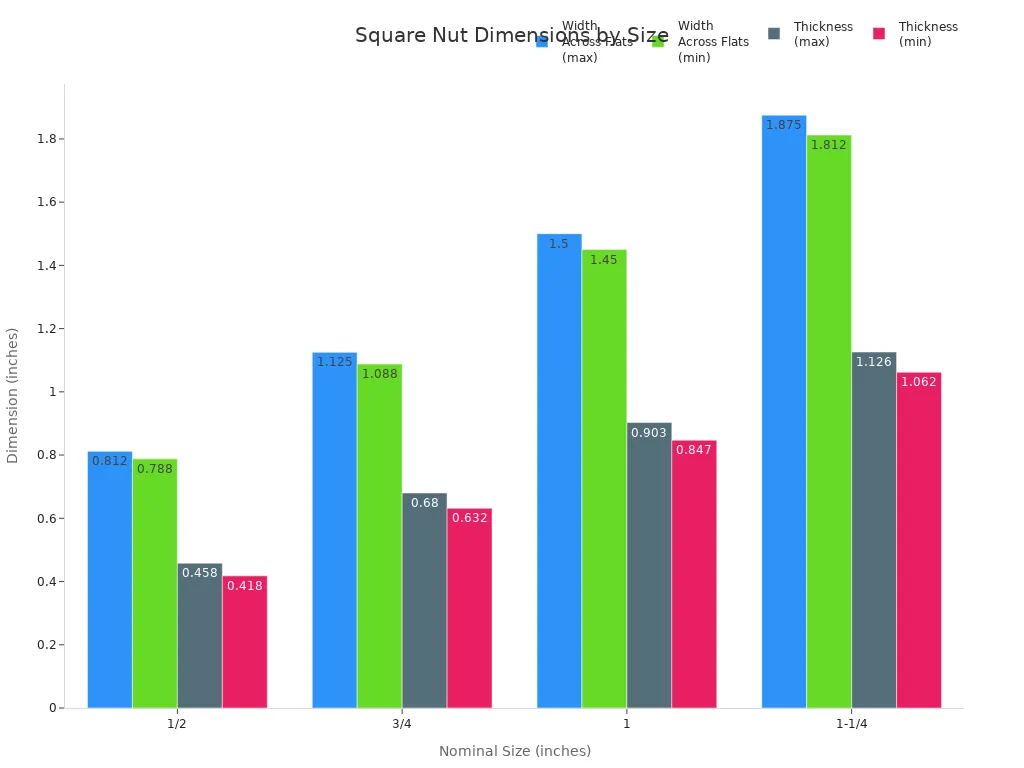
Dimensional specifications guarantee that square nuts fit properly with bolts and washers. Engineers reference standards such as ASME B18.2 and DIN 557 to confirm dimensions for width across flats, thickness, and thread size.
Width Across Flats
Width across flats defines the distance between two parallel sides of a square nut. This measurement ensures compatibility with wrenches and prevents slippage during installation. The table below shows standard values for common sizes:
| Nominal Size | Width Across Flats (F, basic/max/min) | Thickness (H, basic/max/min) |
|---|---|---|
| 1/2 | 13/16 / 0.812 / 0.788 | 7/16 / 0.458 / 0.418 |
| 3/4 | 1-1/8 / 1.125 / 1.088 | 21/32 / 0.680 / 0.632 |
| 1 | 1-1/2 / 1.500 / 1.450 | 7/8 / 0.903 / 0.847 |
| 1-1/4 | 1-7/8 / 1.875 / 1.812 | 1-3/32 / 1.126 / 1.062 |
Thickness
Thickness affects the load distribution and stability of square nuts. Proper thickness prevents thread stripping and supports secure fastening. Engineers check thickness values against specifications to ensure square nuts meet project requirements.
Thread Size
Thread size determines the compatibility between square nuts and bolts. Standards specify thread pitch and diameter for both metric and inch sizes. For example, an M6 square nut features a width across flats of 10 mm and a thread pitch of 1 mm. Accurate thread size ensures smooth assembly and prevents cross-threading.
Dimensional requirements provide assurance that square nuts will fit and function as intended in every application.
Testing and Quality Assurance
Manufacturers implement rigorous testing and quality assurance procedures to verify the reliability of square nuts. These procedures include:
- Tensile testing to measure strength and ductility.
- Hardness testing to assess resistance to deformation.
- Dimensional inspection to confirm tolerances and thread profiles.
- Non-destructive testing methods such as ultrasonic testing and magnetic particle inspection.
Standards like ASTM A194, ASME B18.2, SAE J995, and ISO 898 guide these processes. Quality assurance ensures that every square nut meets industry requirements and supports safe, durable assemblies.
Testing and inspection help engineers trust the performance of square nuts in critical applications.
Applications of Square Nut in Industry
Common Uses of Square Nuts
Square nuts serve as essential components in many industrial applications. Their square profile delivers reliable tightening and anti-loosening performance, making them ideal for connection points that require stability. Engineers select square nuts for fixing assemblies where vibration resistance and secure fastening are critical.
Construction
Construction professionals rely on square nuts for temporary structural fastening. Workers use these nuts to assemble demountable scaffolds, ensuring quick tightening and easy removal. The square shape allows for straightforward fixing with flat wrenches, supporting strong connection points in steel frameworks. Square nuts also lock into channels, providing anti-loosening benefits during repeated tightening cycles.
Machinery
Machinery manufacturers choose square nuts for historic equipment maintenance and agricultural machinery. In vintage machines from the 1920s, square nuts act as direct replacements, preserving original connection integrity. Agricultural machinery benefits from square nuts’ vibration resistance, withstanding engine frequencies between 20 and 50Hz. The square profile prevents rotation, maintaining fixing strength under mechanical stress.
Electrical Equipment
Electrical equipment designers use square nuts for fixing components in panels and enclosures. The square shape simplifies tightening in confined spaces, especially when anti-loosening is required. Square nuts provide stable connection points for mounting electrical devices, supporting safe and reliable operation.
Furniture Assembly
Furniture makers utilize square nuts for fixing joints and panels. The square design enables easy tightening with basic tools, ensuring strong connection points in wood and metal furniture. Square nuts offer anti-loosening properties, keeping assemblies secure during movement and transport.
Square nuts deliver versatile application solutions across construction, machinery, electrical equipment, and furniture assembly. Their square profile supports strong connection and reliable tightening in demanding environments.
| Application Type | Description |
|---|---|
| Historic equipment maintenance | Direct replacement for original square nuts in 1920s machinery |
| Cast iron pipe sealing | Square profile locks into pipe anti-rotation slots |
| Agricultural machinery vibration resistance | Withstands 20-50Hz engine vibration |
| Temporary structural fastening | Construction site demountable scaffolds |
Advantages and Limitations of Square Nut
Benefits of Square Nuts
Square nuts offer several advantages in industrial application settings. Their square shape provides increased surface contact, enhancing tightening and anti-loosening performance. Engineers value square nuts for their ability to maintain strong connection points, especially in vibration-prone environments. The square profile allows for easy fixing with flat tools, supporting quick assembly and disassembly. Square nuts excel in applications where stability and fixing strength are essential.
Potential Drawbacks
Despite their benefits, square nuts present some limitations in modern engineering:
- Square nuts can be challenging to install due to alignment issues, especially in tight spaces.
- They are more prone to cross-threading, which can damage bolts.
- Square nuts require more space than hexagonal nuts, which can be problematic in compact designs.
- Their larger surface area can complicate fitting components together in applications like printed circuit boards.
- The manufacturing process for square nuts is more complex, leading to higher costs.
- Lower market demand results in limited production, increasing the price per unit.
- Square nuts are less commonly stocked in hardware stores compared to hexagonal nuts.
- This can lead to delays in repairs if a square nut needs to be replaced quickly.
Engineers must weigh the advantages of square nuts against their limitations when selecting the best fixing solution for each application. The choice depends on connection requirements, tightening needs, and anti-loosening performance.
Selecting the Right Square Nut
Factors to Consider When Choosing Nuts
Load Requirements
Engineers must evaluate the forces that square nuts will experience in service. The nut must resist being pulled apart along the axis of the bolt. When lateral forces act perpendicular to the fastener axis, the nut and bolt must prevent unwanted movement. They should refer to engineering tables or manufacturer datasheets for load ratings based on size and grade. For high-load or critical applications, they should always follow manufacturer torque specifications to avoid under- or over-tightening. At least one full diameter of thread engagement ensures optimal strength. Flat washers help distribute load and protect surfaces, especially in soft materials. Regular inspection for signs of loosening, corrosion, or fatigue in critical joints remains essential. Pairing square nuts with bolts of equal or higher strength grade prevents weak points in assemblies.
Environmental Conditions
Environmental factors can significantly affect the performance and longevity of square nuts. The choice of material directly impacts durability, corrosion resistance, and strength. High-strength applications require materials that withstand stress, environmental exposure, and mechanical fatigue. For example, stainless steel works well in corrosive environments, while alloy steel offers high tensile strength for heavy-duty use.
| Environmental Condition | Recommended Material | Reason for Recommendation |
|---|---|---|
| Moisture | Stainless Steel (AISI 304/316) | Excellent resistance to rust and degradation |
| Chemicals | Bronze | Highly resistant to corrosion |
| Indoor/Dry | Carbon Steel | Cost-effective and durable with protective coatings |
Compatibility with Bolts and Washers
Selecting the right specifications for square nuts means ensuring compatibility with bolts and washers. The nut must match the thread size and pitch of the bolt. Flat washers distribute pressure and protect surfaces, especially when using square nuts on softer materials. Engineers should always pair nuts with bolts of the same or higher grade to maintain assembly integrity.
Tip: Always check for proper fit and engagement between the square nut, bolt, and washer before final installation.
Matching Technical Standards and Specifications
Engineers should match square nuts to the right specifications for each application. They must reference standards such as ASME, DIN, or ISO to confirm dimensions, tolerances, and material grades. These standards ensure that square nuts fit properly and perform reliably. Consulting manufacturer datasheets helps verify that the selected square nut meets all project requirements.
Installation Tips and Best Practices
- Clean all surfaces before installing square nuts to remove rust, dirt, or grease.
- Position the square nut so its flat sides align with the wrench or channel.
- Use flat washers to distribute load and prevent surface damage.
- Tighten the nut to the recommended torque value for the application.
- Inspect the assembly for proper thread engagement and alignment.
- For weld square nuts, ensure the base sits flush and use appropriate welding techniques.
- Remove any rough edges or spatter after installation to enhance safety.
Regular maintenance and inspection help ensure that square nuts continue to deliver reliable performance in demanding environments.
Maintenance and Handling of Square Nut
Proper Storage of Nuts
Proper storage plays a critical role in preserving the quality and performance of square nuts. Moisture and contaminants can cause corrosion, which weakens the square surface and threads. Facilities should store square nuts in dry, climate-controlled areas. Sealed containers or anti-corrosion packaging help prevent exposure to humidity during long-term storage. The following table outlines best practices for storing square fasteners:
| Recommendation | Description |
|---|---|
| Storage Environment | Store fasteners in a dry, controlled environment to prevent moisture exposure and corrosion |
| Packaging | Use sealed containers or anti-corrosion packaging to prevent moisture exposure during long-term storage |
Tip: Always keep square nuts off the floor and away from direct sunlight to avoid temperature fluctuations and condensation.
Inspection and Replacement of Square Nut
Routine inspection ensures that square nuts remain safe and reliable in service. Maintenance teams should check for signs of wear, thread damage, galling, or surface corrosion. Discoloration, pitting, or white deposits may indicate chloride residue or other chemical attack. The table below summarizes recommended inspection intervals and replacement criteria for safety-critical applications:
| Inspection Criteria | Replacement Criteria |
|---|---|
| Inspect periodically for signs of wear, thread damage, galling, or surface corrosion. Look for discoloration, pitting, or white deposits (chloride residue). | Replace any nut showing visible cracks, severe pitting, or stripped threads—do not attempt to repair. |
Square nuts that show any of these defects should be replaced immediately. Attempting to repair a damaged square can compromise the integrity of the assembly.
Regular inspection and timely replacement of square nuts help prevent unexpected failures in critical structures.
Common Issues and Troubleshooting
Square nuts can develop several common issues during use. Corrosion remains the most frequent problem, especially in humid or outdoor environments. Cross-threading may occur if the square does not align properly with the bolt, leading to stripped threads. Galling, or seizing of the threads, can result from insufficient lubrication or overtightening. To address these problems, maintenance teams should:
- Apply appropriate lubricants to threads before installation.
- Use correct tools to avoid damaging the square profile.
- Replace any square nuts that show signs of deformation or excessive wear.
- Store spare square nuts in proper conditions to prevent future corrosion.
Note: Early detection and correction of issues with square nuts extend the service life of assemblies and reduce downtime.
Square nuts provide reliable fastening solutions in construction, machinery, and electrical assemblies. Their square shape ensures easy alignment and strong connections. Industry standards such as ANSI/ASME B18.2.1, ISO 8617, and DIN 557 define square nut sizes and tolerances. Engineers should always select square nuts that match bolt threads and meet recognized standards. For best results, they should:
- Follow manufacturer torque values to avoid failures.
- Use open-end wrenches for proper installation in tight spaces.
- Choose recyclable steel square nuts for sustainability.
- Consider the long service life and cost efficiency of square nuts.
Selecting the right square nut supports safety, compliance, and long-term performance in every application.
FAQ
What distinguishes a square nut from other types of nuts?
A square nut features four flat sides, which provide greater surface contact with the workpiece. This design resists loosening and allows for easy tightening with simple tools.
Which industries commonly use square nuts?
Square nuts appear in construction, machinery, electrical equipment, and furniture assembly. These industries value their stability, anti-loosening properties, and compatibility with flat wrenches.
How do technical standards affect square nut selection?
Technical standards define dimensions, tolerances, and material requirements. Engineers reference these standards to ensure each nut fits properly and meets safety and performance criteria.
What materials offer the best corrosion resistance for square nuts?
Stainless steel and brass provide excellent corrosion resistance. Stainless steel suits harsh or marine environments, while brass works well in electrical and decorative applications.
How should users store square nuts to prevent damage?
Users should store square nuts in dry, climate-controlled areas. Sealed containers or anti-corrosion packaging help prevent moisture exposure and rust formation.
Can square nuts be reused after disassembly?
Square nuts can be reused if they show no signs of thread damage, deformation, or corrosion. Regular inspection ensures continued reliability and safety.
What tools work best for installing square nuts?
Flat wrenches or adjustable spanners fit square nuts well. These tools grip the flat sides securely, allowing for efficient tightening and loosening.