Nylock nuts play a critical role in modern engineering. These nuts use a nylon insert to create friction against threads, which prevents unwanted loosening. Engineers and manufacturers rely on nylock nuts for secure connections in demanding environments. The history of nylock nuts shows their impact on safety and reliability. Many industries, including custom fasteners manufacturer operations, select nylock nuts for their effectiveness. Today, nuts and bolts with nylon inserts remain a standard solution for custom fasteners.
What Are Nylock Nuts?
Definition and Basic Structure of Nuts
Nuts serve as essential fasteners in mechanical assemblies. They secure bolts and threaded rods, forming strong joints in machinery, vehicles, and structures. Among the many types of nuts, nylock nuts stand out due to their unique design. Unlike standard hex nuts, which rely solely on thread friction, nylock nuts incorporate a nylon insert that enhances their locking capability.
Nylon Insert Mechanism Explained
The nylon insert sits at the top of the nut. When a bolt threads into the nut, the nylon deforms slightly and grips the threads. This action creates tension and friction, making it difficult for the nut to loosen unintentionally. The nylon insert acts as a barrier, preventing the nut from spinning freely.
Nylock nuts include a nylon insert that provides resistance to loosening. The insert creates tension between the nut and the threads of the mating component. In contrast, a standard hex nut lacks this nylon insert and can spin freely without any locking mechanism.
How Nylock Nuts Prevent Loosening
Nylock nuts excel in environments where vibration or movement could cause fasteners to loosen. The nylon insert maintains pressure on the bolt threads, even when subjected to repeated motion. This self-locking feature reduces the risk of joint failure and enhances safety. Engineers often select nylock nuts for applications where reliability is critical, such as automotive, aerospace, and industrial machinery.
Comparison to Other Locking Nuts
Locking nuts come in several forms, each with distinct mechanisms and performance characteristics. Nylock nuts belong to the category of self-locking nuts, which use a physical feature to resist loosening. Other types of nuts, such as all-metal locknuts and prevailing torque nuts, employ different strategies.
Metal Locknuts vs. Nylock Nuts
The table below compares nylock nuts to all-metal locknuts, highlighting differences in locking mechanism, temperature tolerance, reusability, vibration resistance, manufacturing cost, and application suitability.
| Performance Aspect | Nylock Nuts | All-Metal Locknuts (e.g., Stover nuts) |
|---|---|---|
| Locking Mechanism | Nylon insert providing prevailing torque | Deformed threads or crimped edges |
| Temperature Tolerance | Up to ~250°F (121°C) due to nylon limitations | Can withstand over 500°F (260°C) |
| Reusability | Limited; nylon insert deforms with reuse | Greater reusability; more forgiving on repeated use |
| Vibration Resistance | Reliable in moderate environments | Superior durability in heavy vibration and high heat |
| Manufacturing Cost | More economical and easier to produce at scale | More complex due to thread deformation |
| Application Suitability | Better for removable joints and simpler assembly | Suitable for high-temperature, heavy-duty, and multiple-use applications |
Advantages of Nylon Inserts
Nylock nuts offer several advantages over other types of nuts. The nylon insert provides a cost-effective locking mechanism that does not require additional hardware. These nuts are readily available and easy to install. The table below summarizes the comparative advantages and disadvantages of nylon collar lock nuts and prevailing torque nuts.
| Nut Type | Advantages | Disadvantages |
|---|---|---|
| Nylon Collar Lock Nuts | Inexpensive, readily available, no additional hardware required | Susceptible to vibration loosening, not for heavy reuse, can be damaged by heat |
| Prevailing Torque Nuts | Strong mechanical connection, very good vibration resistance, reusable mil-spec versions | Less widely available, can be expensive, cheap versions may damage threads |
Nylock nuts remain a popular choice for removable joints and assemblies that require moderate vibration resistance. Their economical manufacturing and ease of use make them suitable for a wide range of applications. Engineers must consider temperature limitations and reusability when selecting nylock nuts for critical projects.
The History of Nylock Nuts: Invention and Early Development
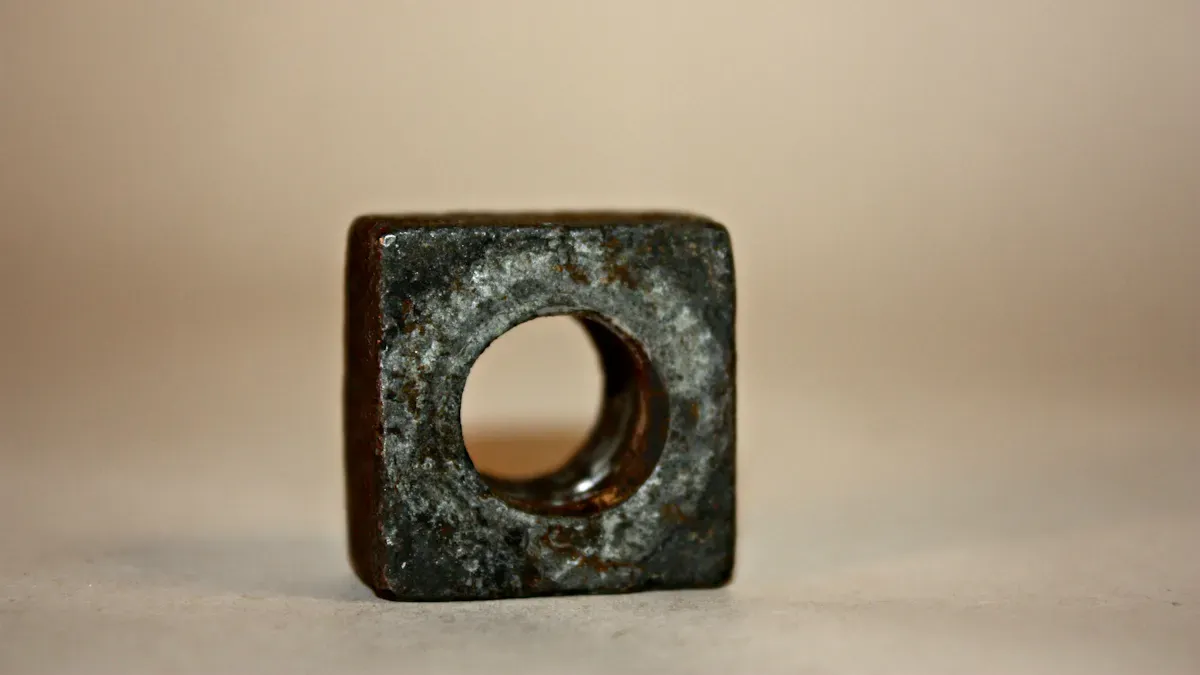
Early Challenges with Fasteners and Nuts
Vibration and Loosening Problems
The history of fasteners reveals that engineers faced persistent challenges with vibration and loosening. Machines and vehicles often operated under intense movement. These conditions caused traditional nuts to back off from bolts, leading to dangerous failures. Early in the history of nylock nuts, industries recognized the need for reliable locking mechanisms. The lack of secure fasteners resulted in frequent maintenance and safety risks. Many early machines required constant inspection because nuts could not withstand vibration. This problem drove innovation in the field of fasteners.
Predecessors to Nylock Nuts
Before the introduction of nylon inserts, inventors experimented with several types of locking fasteners. Some designs used split washers or spring washers to increase friction. Others relied on distorted threads or double-nut arrangements. These solutions offered limited success. Most predecessors failed to provide consistent performance in high-vibration environments. The history of fasteners shows that engineers continued searching for a more effective solution. The limitations of these early locking nuts set the stage for the development of the nylock nut.
Patent and First Production
Key Inventors and Companies
The history of nylock nuts changed dramatically in the early 20th century. Carl Arthur Swanstrom recognized the need for a better self-locking fastener. He founded the Elastic Stop Nut Corporation of America in the early 1930s. This company became one of the first to produce the Elastic Stop Nut, which served as a precursor to the modern nylock nut. The Elastic Stop Nut Corporation played a major role in the commercialization of self-locking fasteners. Their products gained rapid acceptance, especially in military equipment during World War II. Over time, Novaria Group acquired ESNA, continuing the legacy of manufacturing nylon lock nuts and other advanced fasteners.
The introduction of the Elastic Stop Nut marked a turning point in the history of fasteners. Engineers now had access to a reliable solution for vibration and loosening problems.
Timeline of Initial Development
The timeline below highlights key moments in the history of nylock nuts and related fasteners:
| Year | Milestone |
|---|---|
| Early 1900s | Engineers identify the need for improved locking fasteners. |
| 1931 | Carl Arthur Swanstrom establishes the Elastic Stop Nut Corporation of America. |
| 1930s | The company begins large-scale production of Elastic Stop Nuts. |
| 1940s | Military and industrial sectors adopt self-locking nuts for critical applications. |
| Post-WWII | The design evolves, leading to the widespread use of nylon-insert lock nuts. |
The history of nylock nuts demonstrates how innovation in fasteners transformed engineering practices. The introduction of nylon inserts provided a simple yet effective way to prevent loosening. This advancement influenced the history of fasteners across multiple industries. Today, the legacy of these early developments continues to shape the design and application of nuts and fasteners worldwide.
Key Historical Milestones in the History of Nylock Nuts
Adoption in Major Industries
Automotive Industry
Automotive manufacturers began using nylock nuts as vehicles became more complex and powerful. Engineers needed reliable fasteners to secure critical components exposed to constant vibration and dynamic loads. Nylock nuts provided a solution that reduced maintenance and improved safety. Their nylon insert prevented loosening, which protected drivers and passengers from mechanical failures. The history of nylock nuts in the automotive sector shows a shift toward higher standards for reliability. Manufacturers adopted these nuts for engine mounts, suspension systems, and wheel assemblies. Rigorous testing ensured that each nut met strict quality requirements, minimizing risks caused by impurities or uneven hardness.
Aerospace and Aviation
Aerospace and aviation industries demanded fasteners that could withstand extreme conditions. Nylock nuts became essential in aircraft construction, where vibration and temperature fluctuations threatened the integrity of connections. Engineers selected these nuts for their locking performance, which maintained safety and reliability in flight. The history of nylock nuts in aviation highlights their role in preventing catastrophic failures. Aircraft designers used them in engine assemblies, landing gear, and control surfaces. Testing protocols evolved to address material quality, ensuring that each nut performed consistently under stress. The adoption of nylock nuts in aerospace set new benchmarks for fastener reliability.
Nylock nuts are essential in high-load and vibration environments, such as automotive and aerospace applications, because they effectively prevent loosening due to vibrations. Their locking performance is critical for ensuring the reliability and safety of connections, which is particularly important in these industries. However, the effectiveness of these nuts can be compromised by factors like material impurities and uneven hardness, highlighting the need for rigorous testing to maintain their reliability.
Standardization and Global Spread of Nuts
International Standards
As demand for nylock nuts increased, international organizations established standards to ensure consistency and compatibility. Standardization allowed manufacturers to produce fasteners that met global requirements. The following table summarizes key standards for nylock nuts and their equivalent norms:
| Standard | Description | Equivalent Norms |
|---|---|---|
| DIN 982 | Prevailing torque nuts with nonmetallic insert | ISO 7040, CSN 21492, UNI 7473 |
| DIN 985 | Prevailing torque type hexagon thin nuts with nonmetallic insert | ISO 7040, CSN 21492, UNI 7474 |
These standards provided guidelines for dimensions, materials, and performance. Manufacturers followed these norms to ensure that fasteners could be used interchangeably across industries and countries.
Expansion to Global Markets
The history of nylock nuts includes their rapid spread to global markets. Manufacturers in Europe, Asia, and North America began producing standardized fasteners to meet international demand. Industries such as automotive, aerospace, and construction relied on these nuts for secure connections. Global expansion encouraged innovation in materials and manufacturing processes. Companies invested in automated production lines and advanced quality control systems. The widespread adoption of nylock nuts improved safety and reliability in countless applications, reinforcing their importance in the history of fasteners.
Technological Advancements in Nylock Nuts
Improvements in Materials and Design
Evolution of Nylon Compounds
Manufacturers have made significant progress in the materials used for nylock nuts. Early designs relied on basic nylon inserts, but modern versions use advanced nylon compounds. The introduction of nylon 6/6 stands out as a major improvement. This material offers enhanced durability and can withstand temperatures up to 250°F. These advancements allow nylock nuts to perform reliably in demanding environments, such as automotive and aerospace applications.
The table below highlights key improvements in materials and design:
| Improvement Type | Description |
|---|---|
| Nylon Formulations | Advancements in nylon formulations, particularly the use of nylon 6/6, enhance durability and temperature resistance up to 250°F. |
| Standardization | Key milestones in standardization in the 1970s and 1980s formalized dimensions and performance requirements, ensuring global consistency. |
| Design Evolution | Development of thin-profile variants and automated production techniques increased output and reduced costs for high-volume industries. |
| Material Composition | The body is typically made from low-carbon steel or stainless steel variants, providing strength and corrosion resistance suitable for various applications. |
Enhanced Durability and Temperature Resistance
Nylock nuts now feature improved resistance to wear and environmental stress. The use of stainless steel and low-carbon steel bodies increases their strength and corrosion resistance. These enhancements make the nuts suitable for a wide range of industries, from construction to electronics. Manufacturers have also developed thin-profile variants for assemblies with limited space. This evolution in design ensures that nylock nuts meet the needs of modern engineering.
- Development of thin-profile variants for space-constrained assemblies.
- Shift towards automated production techniques to enhance efficiency.
Manufacturing Innovations for Nuts
Automation in Production
Automation has transformed the production of nylock nuts. Modern factories use robotic systems to assemble and inspect each nut with high precision. Automated assembly lines ensure consistent quality and reduce manufacturing costs. This shift allows companies to produce large quantities of nuts quickly and efficiently.
Automated assembly systems rely on the consistent dimensions and properties of precision nuts and bolts to achieve target cycle times. Robotic installation equipment operates optimally when fasteners exhibit minimal variation in thread engagement force and torque requirements. This consistency allows for higher production rates without compromising quality standards.
Quality Control Advances
Quality control has become a central focus in the manufacturing of nylock nuts. Advanced inspection systems use sensors and cameras to detect defects during production. These technologies help maintain strict tolerances and ensure that every nut meets industry standards. As a result, engineers can trust the reliability of nylock nuts in critical applications.
Impact of Nylock Nuts on Engineering and Industry
Safety and Reliability Improvements
Reduced Maintenance Needs
Nylock nuts have transformed the way engineers approach maintenance in industrial environments. These fasteners deliver consistent performance in applications where vibration and movement are common. Facilities that use nylock nuts in equipment such as waste water mixers, masts, motor mounts, and jib booms report impressive results. Over nearly five decades, operators have not observed a single instance of these nuts vibrating loose. This reliability reduces the need for frequent inspections and retightening. Maintenance teams can allocate resources more efficiently, focusing on other critical tasks instead of constantly checking fasteners.
- Nylock nuts remain secure in high-vibration settings.
- Industrial users experience fewer shutdowns for fastener-related issues.
- Equipment downtime decreases, leading to higher productivity.
Increased Equipment Lifespan
The use of nylock nuts extends the operational life of machinery. When fasteners stay tight, components experience less wear and tear. Secure connections prevent misalignment and reduce the risk of mechanical failure. As a result, companies see longer intervals between repairs and replacements. This improvement in equipment lifespan supports better return on investment for industrial assets.
Reliable fasteners like nylock nuts help protect valuable machinery from premature damage. Their locking action preserves the integrity of joints, even under demanding conditions.
Influence on Design and Assembly of Nuts
Simplified Engineering Solutions
Engineers value nylock nuts for their ability to simplify complex assemblies. These fasteners eliminate the need for additional locking devices, such as washers or adhesives. Designers can create more streamlined products by specifying nylock nuts in their plans. This approach reduces the number of parts required and minimizes assembly steps. Teams can assemble equipment faster and with fewer errors.
- Fewer components lead to easier inventory management.
- Assembly lines operate more efficiently with standardized fasteners.
Cost and Efficiency Benefits
Nylock nuts contribute to cost savings throughout the product lifecycle. Their self-locking feature reduces the likelihood of fastener failure, which lowers warranty claims and repair expenses. Manufacturers benefit from lower production costs because they can automate the installation of these fasteners. The consistent quality of nylock nuts supports high-speed assembly processes and ensures reliable performance in the field.
| Benefit | Impact on Industry |
|---|---|
| Lower maintenance | Reduced labor and downtime |
| Streamlined assembly | Faster production and fewer errors |
| Fewer replacements | Lower long-term costs |
Nylock nuts have become a preferred choice for engineers who seek dependable, cost-effective solutions. Their influence on the design and assembly of fasteners continues to shape modern manufacturing practices.
Current Applications and Ongoing Relevance of Nylock Nuts
Modern Uses Across Industries
Nylock nuts remain essential in many modern industries. Their unique nylon insert mechanism provides reliable locking, making them a preferred choice for engineers who require secure fasteners in dynamic environments. The following table highlights common applications across key sectors:
| Industry | Application Description |
|---|---|
| Automotive | Nylock nuts are used in vehicle assembly to prevent loosening from vibrations. |
| Aerospace | They are utilized in aircraft components to ensure safety and reliability under stress. |
| Construction | Employed in structural applications to maintain integrity in high-vibration environments. |
Automotive and Transportation
Automotive manufacturers rely on nylock nuts for critical assemblies. These nuts secure wheel hubs, suspension systems, and engine components. The nylon insert prevents loosening caused by road vibrations and dynamic loads. This feature enhances vehicle safety and reduces the risk of mechanical failure. Nylock nuts also simplify maintenance, as technicians can trust that fasteners will remain tight over time.
Construction and Infrastructure
Construction projects demand fasteners that can withstand heavy machinery and constant movement. Nylock nuts help maintain the structural integrity of steel frameworks, bridges, and heavy equipment. Their vibration resistance ensures that connections stay secure, even in challenging environments. Contractors choose nylock nuts for their reliability and ease of installation.
Electronics and Consumer Goods
Manufacturers of electronics and consumer goods use nylock nuts to assemble devices that experience frequent handling or movement. These nuts prevent screws and bolts from backing out, which protects sensitive components. Products such as appliances, power tools, and fitness equipment benefit from the added security provided by nylock nuts.
Limitations and Considerations for Nuts
Nylock nuts offer many advantages, but they also have limitations that engineers must consider.
Temperature and Chemical Resistance
- Nylock nuts are sensitive to temperature and chemicals due to the non-metal material used.
- They can operate in temperatures up to approximately 248˚F (120˚C), but exposure to extremely high temperatures is not recommended.
- In extreme cold, the nylon insert can become brittle and may break.
These factors limit their use in high-temperature or chemically aggressive environments. Engineers must evaluate the operating conditions before selecting nylock nuts for a project.
Alternatives and Complementary Solutions
- Nyloc nuts are limited in high-temperature or high-preload applications.
- Alternatives like Loctite threadlockers provide stronger resistance in high-vibration or corrosive environments.
- Threadlockers require heat or special tools for removal, complicating rework.
When nylock nuts are unsuitable, engineers often turn to all-metal locknuts or chemical threadlockers. Each alternative offers unique benefits and challenges. The choice depends on the specific requirements of the application and the environment.
Nylock nuts continue to play a vital role in modern engineering, but understanding their limitations ensures optimal performance and safety. Their ongoing relevance reflects the evolution of fastening technology since the early history of the bolt.
Future Trends in the Development of Nylock Nuts
Emerging Materials and Technologies for Nuts
Advanced Polymers
Manufacturers continue to explore new materials to improve nylock nuts. Advanced polymers now offer greater strength and temperature resistance than traditional nylon. These polymers can withstand harsher environments and last longer in demanding applications. For example, engineers have started using high-performance plastics such as polyether ether ketone (PEEK) and polyamide-imide (PAI). These materials resist chemicals and maintain their properties at higher temperatures. As a result, nylock nuts made from advanced polymers can serve in aerospace, automotive, and energy sectors where standard nylon would fail.
A comparison of traditional and advanced polymers appears below:
| Material | Max Temperature | Chemical Resistance | Typical Use Cases |
|---|---|---|---|
| Nylon 6/6 | 250°F (121°C) | Moderate | General industry |
| PEEK | 480°F (250°C) | Excellent | Aerospace, oil & gas |
| PAI | 500°F (260°C) | Excellent | High-performance engines |
Smart Fastening Solutions
The future of nylock nuts includes smart technologies. Engineers now design fasteners with embedded sensors that monitor tension, vibration, and temperature. These smart nylock nuts can send real-time data to maintenance teams. This technology helps prevent failures before they occur. Smart fasteners also support predictive maintenance, which reduces downtime and extends equipment life. As digital manufacturing grows, smart nylock nuts will likely become standard in critical infrastructure and transportation systems.
Smart fastening solutions represent a major step forward in the history of the bolt, combining mechanical reliability with digital intelligence.
Sustainability and Environmental Impact
Recyclable Materials
Sustainability has become a priority in fastener production. Manufacturers now seek recyclable materials for both the metal body and the polymer insert. Some companies use recycled steel and develop nylon alternatives that break down more easily at the end of the product’s life. These efforts help reduce landfill waste and conserve resources. The industry expects future nylock nuts to feature higher recycled content and improved recyclability.
Eco-Friendly Manufacturing
Evolving environmental policies influence the production of nylon lock nuts. Companies emphasize sustainable sourcing and eco-friendly manufacturing practices. They invest in energy-efficient machinery and reduce emissions during production. Water usage and chemical waste receive close attention. Many manufacturers now publish environmental impact reports to demonstrate their commitment to sustainability.
- Use of renewable energy in factories
- Adoption of closed-loop water systems
- Reduction of volatile organic compounds (VOCs) in coatings
These trends show that the nylock nut industry adapts to meet both technical and environmental challenges. The next generation of nylock nuts will combine advanced materials, smart technology, and sustainable practices to support safer and greener engineering.
Nylock nuts continue to shape engineering and industry. Their innovative nylon insert mechanism delivers reliable performance in demanding environments. Engineers value these fasteners for their durability and ease of use. The evolution of materials and manufacturing techniques ensures ongoing relevance. As technology advances, nylock nuts will remain a key solution in the history of the bolt.
FAQ
What is a nylock nut?
A nylock nut is a type of locknut that uses a nylon insert to prevent loosening. The nylon ring increases friction on the bolt threads, which helps maintain a secure connection in vibrating or moving assemblies.
Can nylock nuts be reused?
Engineers recommend limited reuse of nylock nuts. The nylon insert loses its locking ability after repeated installations. For critical applications, they should always use a new nut to ensure safety and reliability.
Where are nylock nuts most commonly used?
Nylock nuts appear in automotive, aerospace, construction, and electronics industries. They secure components that experience vibration or movement. Their popularity comes from their ease of installation and reliable locking action.
What temperatures can nylock nuts withstand?
Standard nylock nuts operate up to 248°F (120°C). High temperatures can degrade the nylon insert, reducing its effectiveness. For higher temperature environments, engineers select all-metal locknuts or advanced polymer alternatives.
Are nylock nuts resistant to chemicals?
Nylock nuts offer moderate chemical resistance. The nylon insert can degrade when exposed to strong acids, bases, or solvents. For harsh chemical environments, engineers choose fasteners with specialized inserts or coatings.
How do nylock nuts compare to other locking nuts?
Nylock nuts provide a cost-effective and easy-to-install solution. All-metal locknuts perform better in high-temperature or heavy-vibration settings. The choice depends on the application’s requirements and environmental conditions.
Why are nylock nuts important in the history of the bolt?
Nylock nuts represent a major innovation in the history of the bolt. Their nylon insert mechanism solved persistent loosening problems, improving safety and reliability in many industries.
Tip: Always check manufacturer guidelines before selecting nylock nuts for high-stress or high-temperature applications.