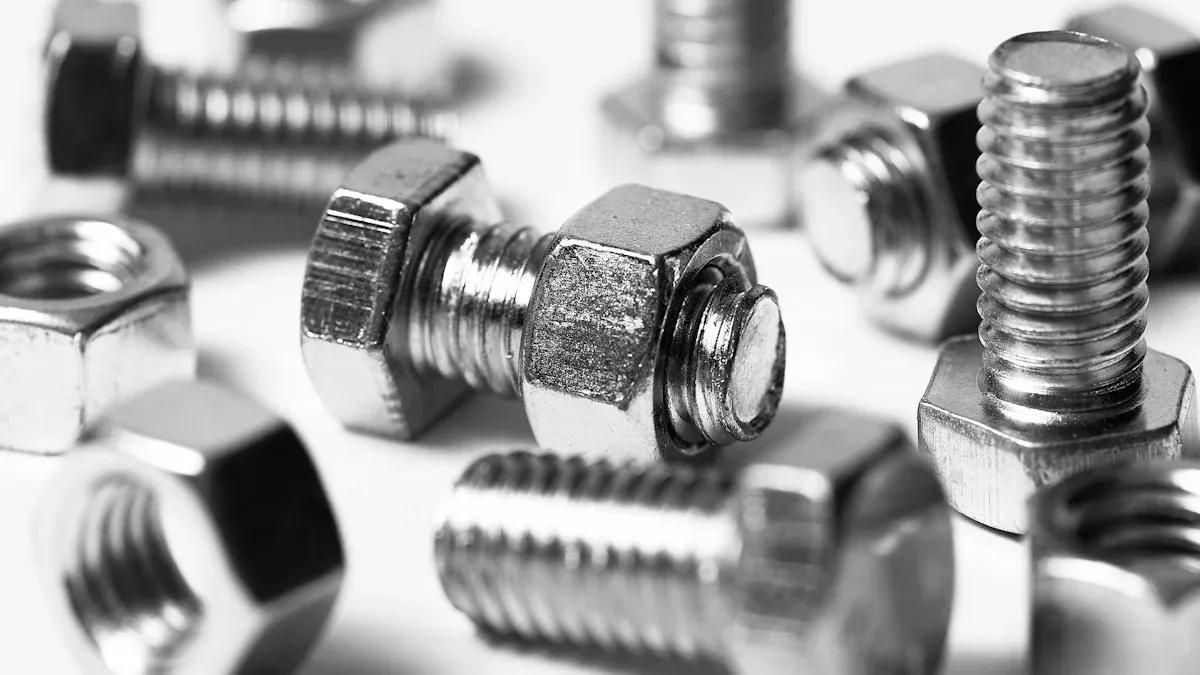
Square nuts and hex nuts differ in shape, grip, and application. Hex nuts dominate machinery and automotive markets due to their versatility, while square nuts are gaining popularity in construction for their grip and stability. The table below highlights key functional differences between these fasteners:
| Feature | Square Nuts | Hexagonal Nuts |
|---|---|---|
| Ease of Installation | More challenging to grip in tight spaces | Easier with a wrench, more contact points |
| Load Distribution | Concentrated load on corners | Even load across six sides |
| Applications | Traditional or aesthetic uses | High-torque, reliable connections |
A custom fasteners manufacturer often recommends square nuts for restoration or woodwork, while hex nuts suit most nuts and bolts tasks and custom fasteners needs.
Square Nuts: Pros and Cons
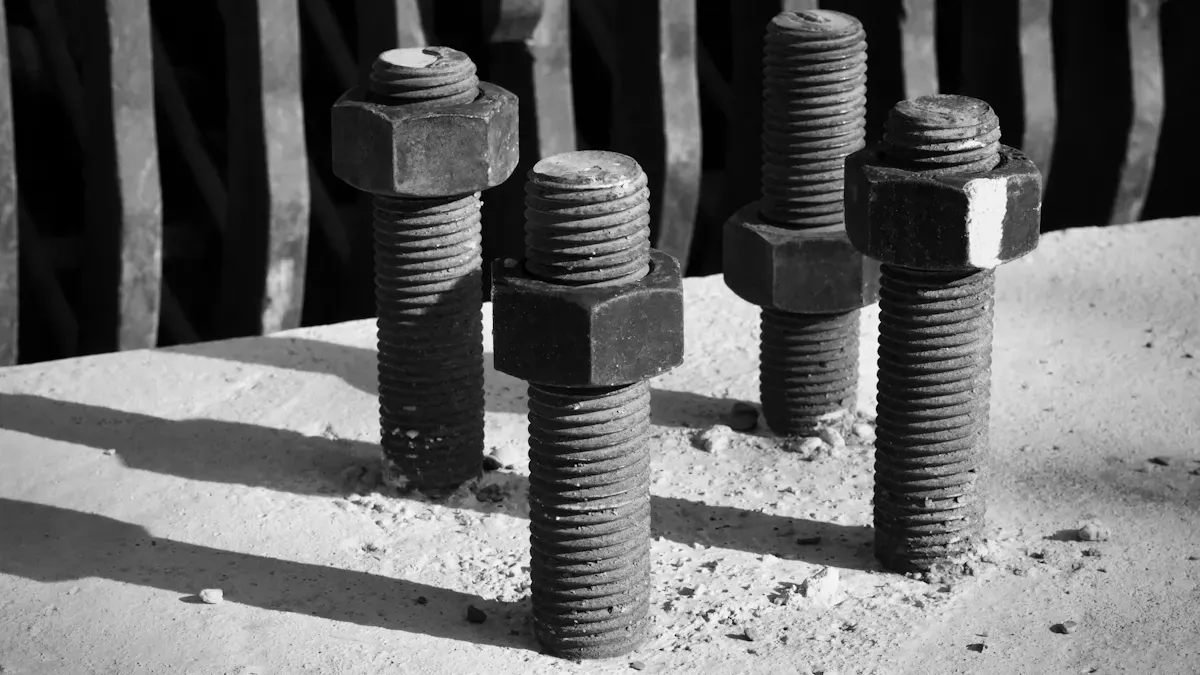
Square Nuts Advantages
Strong grip and resistance to loosening
Square nuts offer a strong grip due to their four flat sides. This design increases the contact area with the fastened part, which helps prevent loosening under vibration or movement. Many engineers prefer square nuts in situations where stability is critical. The greater surface contact also means that the nut can resist rotation more effectively than other shapes.
- Square nuts distribute load across four flat surfaces, enhancing stability on uneven surfaces compared to hex nuts.
- They provide a mechanical advantage due to larger gripping surfaces, allowing for better engagement with wrenches in confined spaces.
- Square nuts have a historical significance and are standardized under ISO 4033 and DIN 557, making them relevant in traditional construction and specialty machinery.
Easy installation in tight spaces
Installers often choose square nuts for projects with limited access. The large, flat sides allow for easier gripping with pliers or adjustable wrenches, even when space is restricted. This feature simplifies installation, especially in woodworking or restoration work where clearance is minimal. The shape also helps prevent the tool from slipping during tightening.
Effective with square-headed bolts
Square nuts pair well with square-headed bolts. This combination creates a secure and reliable connection, especially in older machinery or traditional construction. The matching shapes ensure proper alignment and reduce the risk of stripping threads during installation.
Larger surface area for load distribution
The four-sided design of square nuts provides a larger surface area compared to hex nuts. This characteristic spreads the load more evenly across the material, reducing the risk of damage or indentation. It proves especially useful when fastening softer materials like wood or plastic.
Square Nuts Disadvantages
Limited compatibility with standard wrenches
Most standard wrenches and sockets are designed for hexagonal shapes. Square nuts may require special tools or adjustable wrenches for proper installation and removal. This limitation can slow down assembly and increase the need for tool changes.
Less common and harder to source
Suppliers typically stock hex nuts in greater quantities. Square nuts are less common, which can make sourcing them more challenging for large projects or urgent repairs. The table below highlights key differences in availability and compatibility:
| Feature | Square Nuts | Hex Nuts |
|---|---|---|
| Shape | Four-sided | Six-sided |
| Surface Contact | Greater surface contact with the part being fastened | Standard surface contact |
| Resistance to Loosening | Greater resistance due to more contact area | Less resistance |
| Compatibility | Typically mated with square-headed bolts | Mated with hex-headed bolts |
Potential for snagging on materials
The sharp corners of square nuts can catch on clothing, wiring, or other materials during installation or maintenance. This risk increases in environments with frequent handling or movement around the fastener.
Increased wear on tools
Square nuts can cause more wear on tools, especially if installers use wrenches not designed for four-sided shapes. The corners may round off over time, making future installation or removal more difficult.
Best Uses for Square Nuts
Restoration of vintage machinery
Square nuts play a vital role in restoring vintage machinery. Many older machines were originally built with square fasteners, so using them preserves authenticity and ensures compatibility with existing components.
Woodworking and carpentry
Carpenters often select square nuts for woodworking projects. The large surface area prevents the nut from sinking into soft wood, and the shape allows for easy installation with basic hand tools.
Applications with square bolts
Square nuts are the preferred choice for use with square bolts. This pairing creates a secure fit and reduces the risk of slippage during tightening.
High-vibration environments
Installers choose square nuts for high-vibration environments. The increased resistance to loosening makes them ideal for machinery, construction, and equipment subject to constant movement.
Hex Nuts: Pros and Cons
Hex Nuts Advantages
Widespread availability and versatility
Hex nuts remain the most common fastener in modern construction, automotive, and industrial applications. Manufacturers produce them in a wide range of sizes and materials, making them easy to source for nearly any project. Their versatility allows engineers to select the best material for specific environments. For example, stainless steel hex nuts provide excellent corrosion resistance for outdoor or marine use, while carbon steel options offer high tensile strength for heavy-duty machinery.
| Material Type | Advantages |
|---|---|
| Stainless Steel | Excellent corrosion resistance; ideal for outdoor and marine environments. |
| Brass | Good corrosion resistance and electrical conductivity; used in plumbing and electrical fixtures. |
| Copper | Highly conductive; preferred in electrical systems and high-temperature applications. |
| Carbon or Alloy Steel | High tensile strength and durability; suitable for heavy-duty industrial uses. |
This broad selection ensures that hex nuts meet the demands of industries ranging from construction to aerospace.
Easy to tighten and loosen with standard tools
The six-sided design of hex nuts allows for quick and secure engagement with standard wrenches and sockets. Installers can easily access the nut from multiple angles, which speeds up both assembly and disassembly. This feature proves especially valuable in environments where time and efficiency matter, such as automotive repair shops or assembly lines. Most toolkits include wrenches and sockets designed specifically for hex nuts, reducing the need for specialized equipment.
Fast installation and removal
Hex nuts support rapid installation due to their shape and compatibility with power tools. Workers can use ratchets, impact drivers, or torque wrenches to tighten or loosen these nuts quickly. This efficiency benefits large-scale projects where hundreds or thousands of fasteners require secure connections. In automotive manufacturing, for example, fast installation of hex nuts helps maintain production speed and consistency.
Tip: Using power tools with hex nuts can further reduce installation time, but always follow torque specifications to prevent overtightening.
Compatible with most bolts and washers
Hex nuts fit seamlessly with standard bolts and washers, making them the default choice for most fastening tasks. Their widespread use in general construction, machinery, and automotive industries demonstrates their adaptability. According to recent industrial surveys, the automotive sector alone accounts for 40% of all fasteners used, with stainless hex nuts being the preferred type. Aerospace and construction industries also rely heavily on high-grade and standard hex nuts for critical assemblies.
| Industry | Percentage of Fasteners Used | Type of Hex Nuts Used |
|---|---|---|
| Automotive | 40% | Stainless hex nuts |
| Aerospace | 25% | High-grade stainless nuts |
| Construction | N/A | Standard hex nuts |
Hex Nuts Disadvantages
May loosen more easily under vibration
Hex nuts can loosen over time when exposed to vibration, especially if not paired with locking mechanisms. Vibration tests show that while hex nuts use friction-based anti-loosening principles, such as embedded nylon rings, they may not perform as well as square nuts in high-frequency, low-vibration environments. For critical applications, engineers often add lock washers or use self-locking hex nuts to maintain joint integrity.
| Nut Type | Anti-Loosening Mechanism | Vibration Adaptability |
|---|---|---|
| Hex Nuts | Friction anti-loosening principle with embedded nylon ring for continuous pressure. | Effective in various environments. |
| Square Nuts | Pre-tightening method to prevent slippage, suitable for high-strength connections. | Best for high-frequency, low-vibration. |
Harder to grip in tight or awkward spaces
Although hex nuts offer multiple contact points for tools, their six-sided shape can make gripping difficult in confined or awkward locations. Installers may struggle to position a wrench or socket if there is limited clearance around the nut. This challenge can slow down installation, especially in machinery with complex assemblies or in areas with obstructed access.
Can round off if overtightened
Overtightening hex nuts can cause the corners to round off, making future removal difficult. Rounded corners reduce the effectiveness of standard wrenches and may require extraction tools or replacement. Proper torque application during installation helps prevent this issue, but inexperienced installers may still encounter problems.
Less surface contact than square nuts
Hex nuts provide less surface area in contact with the fastened material compared to square nuts. This reduced contact can lead to higher localized pressure, increasing the risk of indentation or damage, especially on softer materials. For applications where load distribution is critical, square nuts may offer better performance.
Best Uses for Hex Nuts
General construction and assembly
Hex nuts serve as the standard choice for most construction and assembly projects. Their compatibility with a wide range of bolts and washers, along with fast installation, makes them ideal for framing, structural connections, and equipment mounting.
Automotive and machinery applications
Automotive and industrial machinery industries rely heavily on hex nuts for securing critical components. In vehicles, hex nuts fasten wheel hubs, suspension control arms, and engine mounts, ensuring long-term reliability and safety. Industrial machinery uses hex nuts to secure rotating components, drive shafts, and frame assemblies, preventing joint failure under cyclic loading.
| Application Area | Use Case Description | Key Benefit |
|---|---|---|
| Industrial Machinery | Securing rotating components, drive shafts, gears, and frame assemblies | Prevents joint failure in heavy-duty manufacturing equipment subjected to cyclic loading. |
| Automotive Industry | Fastening wheel hubs, suspension control arms, and engine mounts | Ensures long-term reliability and passenger safety in both consumer and commercial vehicles. |
| High-Performance Vehicles | Maintains clamping force under extreme acceleration and braking | Reduces thread stripping risks with extended thread engagement. |
- Used in high-torque applications like axle fastening and transmission assembly.
- Often coated with zinc or phosphate to resist corrosion from road salts and moisture.
- Must comply with OEM torque specifications to prevent loosening or fatigue failure.
Projects requiring frequent adjustments
Hex nuts excel in projects that demand regular assembly and disassembly. Their ease of use with standard tools and fast installation make them suitable for prototypes, temporary structures, and adjustable fixtures.
Use with power tools and ratchets
Installers often select hex nuts for use with power tools and ratchets. The six-sided design allows for quick engagement and efficient tightening or loosening, which speeds up installation in both workshop and field settings. This compatibility with modern tools further cements their role as the go-to fastener in many industries.
Square Nuts vs Hex Nuts: Side-by-Side Comparison
Key Features Compared
Shape and design differences
Square nuts feature four sides, while hex nuts have six sides. This distinction affects both the appearance and the mechanical properties of each fastener. The four-sided shape of square nuts allows for easier alignment in tight spaces. Hex nuts, with their six-sided design, require more rotational clearance but enable faster engagement with tools.
| Feature | Square Nuts | Hex Nuts |
|---|---|---|
| Shape | Four sides | Six sides |
| Installation Ease | Requires 90-degree wrench movement | Requires 60-degree wrench movement |
| Torque Application | Less torque due to fewer sides | More torque due to more sides |
| Load Distribution | Covers a larger surface area | Standard surface area |
Tool compatibility
Installers find that square nuts offer better engagement with tools in confined spaces. The flat sides provide a stable grip for adjustable wrenches and pliers. Hex nuts, on the other hand, work best with standard wrenches and sockets, allowing for quick tightening and loosening. The six-sided shape supports efficient use of power tools, making hex nuts ideal for high-volume assembly.
Availability and sourcing
Hex nuts dominate the market in terms of availability. Suppliers stock them in a wide range of sizes and materials. Square nuts are less common and often harder to source, especially for large projects or urgent repairs. Engineers may need to seek specialty suppliers when specifying square nuts for restoration or woodworking applications.
Resistance to loosening
Square nuts demonstrate superior resistance to loosening under dynamic loads. Their larger surface area and better torque distribution help maintain joint integrity. Hex nuts provide moderate resistance and often require additional locking mechanisms in high-vibration environments.
| Nut Type | Resistance to Loosening | Surface Area | Torque Distribution |
|---|---|---|---|
| Square Nuts | Superior | Larger | Better |
| Hex Nuts | Moderate | Smaller | Less |
Typical applications
Square nuts excel in restoration projects, woodworking, and high-vibration environments. Hex nuts serve as the standard choice for general construction, automotive, and machinery applications. Each nut type offers unique benefits depending on the project requirements.
Pros and Cons Summary
Quick reference for advantages
Square nuts:
- Easier alignment in tight spaces
- Better engagement with tools
- Superior resistance to loosening
- Larger surface area for load distribution
Hex nuts:
- Fast installation and removal
- Compatible with standard tools and power tools
- Widespread availability and versatility
- Supports higher torque application
Quick reference for disadvantages
Square nuts:
- Requires specialty tools for installation
- Less common and harder to source
- May snag on materials due to sharp corners
Hex nuts:
- Can loosen under vibration without locking mechanisms
- Harder to grip in confined spaces
- Less surface contact with fastened material
Note: The comparison highlights that each nut type suits specific scenarios. Engineers should assess project needs before selecting the appropriate fastener.
How to Choose Between Square Nuts and Hex Nuts
Application Requirements
Load and stress considerations
Engineers must evaluate the load and stress demands of each project before selecting a nut type. Square nuts ensure secure fastening that withstands environmental stresses and heavy usage. Their design reduces the risk of loosening, which helps maintain structural stability under load. These nuts perform well in seismic-resistant construction, where joint integrity during dynamic forces is critical. Understanding the load-bearing capacity of square nuts is essential for safety and performance. Material, size, and manufacturing quality all influence reliability in engineering projects.
Frequency of assembly and disassembly
The frequency of assembly and disassembly also influences nut selection. Hex nuts offer better compatibility with standard tools, which facilitates easier installation and removal. Projects that require frequent adjustments or maintenance benefit from the efficiency of hex nuts. In contrast, square nuts suit applications where long-term stability is more important than rapid installation or removal.
Environmental Factors
Exposure to vibration
Environmental conditions, such as vibration, play a significant role in fastener performance. High-vibration environments might need specialized locking features or thread designs. Square nuts provide a larger bearing surface, which helps distribute force evenly and reduces the likelihood of loosening under vibration. This characteristic makes them a preferred choice for machinery or structures exposed to constant movement.
Space and access constraints
Space and access constraints can affect installation. Installers often encounter tight or awkward spaces in machinery or restoration work. Square nuts allow for easier alignment and gripping in confined areas, especially when using pliers or adjustable wrenches. Hex nuts, while efficient in open spaces, may present challenges in restricted environments due to their shape and the need for more rotational clearance.
Tool and Resource Availability
Standard vs specialty tools
Tool compatibility remains a practical consideration. Hex nuts work with common tools such as wrenches and sockets, making installation straightforward for most users. Square nuts require specific tools for proper installation, which can slow down assembly and increase tool changes. The table below summarizes tool compatibility and performance:
| Type of Nut | Tool Compatibility | Surface Contact | Resistance to Loosening |
|---|---|---|---|
| Hex Nuts | Common tools (wrenches, sockets) | Standard | Moderate |
| Square Nuts | Specific tools required | Greater | High |
On-site vs workshop installation
The installation environment also matters. On-site projects often demand quick and efficient assembly, favoring hex nuts due to their compatibility with standard tools and fast installation. Workshop settings, where specialized tools are available, can accommodate square nuts, especially when stability and resistance to loosening are priorities.
Tip: Always match the nut type to the project’s unique requirements, considering design, installation ease, and long-term maintenance needs.
Cost and Sourcing
Price differences
Market analysis shows that square nuts generally cost more than hex nuts. Manufacturers produce square nuts in smaller quantities. This lower demand leads to less efficient manufacturing processes. Some square nuts also require higher-quality materials for specialized applications. These factors contribute to a higher price point for square nuts.
Hex nuts, on the other hand, benefit from widespread use in many industries. High demand drives mass production. Manufacturers can streamline processes and reduce costs. As a result, hex nuts usually have a lower price per unit. Buyers often find bulk pricing and discounts for hex nuts, especially when ordering large quantities.
Note: Project managers should consider the total cost of ownership. While square nuts may offer better performance in specific scenarios, their higher price can impact project budgets.
The table below summarizes the typical price differences:
| Nut Type | Average Price (per 100 units) | Market Demand | Manufacturing Efficiency |
|---|---|---|---|
| Square Nuts | Higher | Low | Less efficient |
| Hex Nuts | Lower | High | Highly efficient |
Local and online availability
Sourcing options for square nuts and hex nuts differ significantly. Most hardware stores and industrial suppliers stock hex nuts in a wide range of sizes and materials. Contractors and maintenance teams can usually find hex nuts locally without delay. This high availability supports fast project timelines and reduces downtime.
Square nuts, however, are less common in local stores. Many suppliers only carry limited sizes or materials. Buyers may need to visit specialty fastener shops or place custom orders. Online marketplaces expand sourcing options for square nuts. E-commerce platforms and industrial supply websites often list a broader selection. Customers can compare prices, check inventory, and arrange direct shipping.
Local sourcing:
- Hex nuts: Readily available at most hardware stores and distributors
- Square nuts: Limited selection; may require special orders
Online sourcing:
- Hex nuts: Wide variety, bulk discounts, fast shipping
- Square nuts: Greater selection, access to specialty suppliers, longer lead times possible
🛠️ Tip: For urgent repairs or high-volume needs, hex nuts provide the fastest and most reliable sourcing. For restoration or specialty projects, plan ahead when sourcing square nuts to avoid delays.
Project planners should assess both price and availability early in the design phase. This approach helps prevent unexpected costs and ensures timely completion.
Square nuts and hex nuts each offer unique strengths. Mechanical engineers highlight key differences:
| Advantage | Hex Nuts | Square Nuts |
|---|---|---|
| Accessibility | Easier access with a wrench from multiple angles | More difficult to access |
| Torque Distribution | Better torque distribution, less risk of rounding | Less efficient torque application |
| Space Efficiency | More space-efficient, can be closely packed | Less space-efficient |
| Standardization | More commonly standardized and available | Less standardized |
Industry experts recommend the following:
- Square nuts excel in high-torque and confined environments.
- They provide superior load distribution.
- Project-specific needs, such as environmental exposure and mechanical demands, should guide fastener selection.
Careful evaluation ensures the right choice for every application.
FAQ
What is the main difference between square nuts and hex nuts?
Square nuts have four sides, while hex nuts have six. This difference affects tool compatibility, load distribution, and resistance to loosening. Hex nuts work best with standard wrenches. Square nuts provide better grip in high-vibration environments.
Can you use square nuts with hex bolts?
Engineers do not recommend pairing square nuts with hex bolts. The shapes do not align properly, which can cause uneven load distribution and potential thread damage. Always match nut and bolt shapes for optimal performance.
Are square nuts stronger than hex nuts?
Square nuts offer greater resistance to loosening due to their larger surface area. However, hex nuts can handle higher torque because of their six-sided design. Strength depends on material, size, and application.
Where can you buy square nuts?
Most hardware stores stock hex nuts in many sizes. Square nuts are less common. Specialty fastener suppliers and online marketplaces usually offer a wider selection of square nuts.
Which nut is better for woodworking projects?
Carpenters often choose square nuts for woodworking. The larger surface area prevents the nut from sinking into soft wood. This feature helps maintain a secure connection.
Do hex nuts require special tools for installation?
Hex nuts fit standard wrenches and sockets. Most toolkits include these tools. No special equipment is necessary for installation or removal.
How do you prevent nuts from loosening under vibration?
Use lock washers, thread-locking compounds, or self-locking nuts. Square nuts naturally resist loosening better, but additional measures improve security for both types in high-vibration settings.