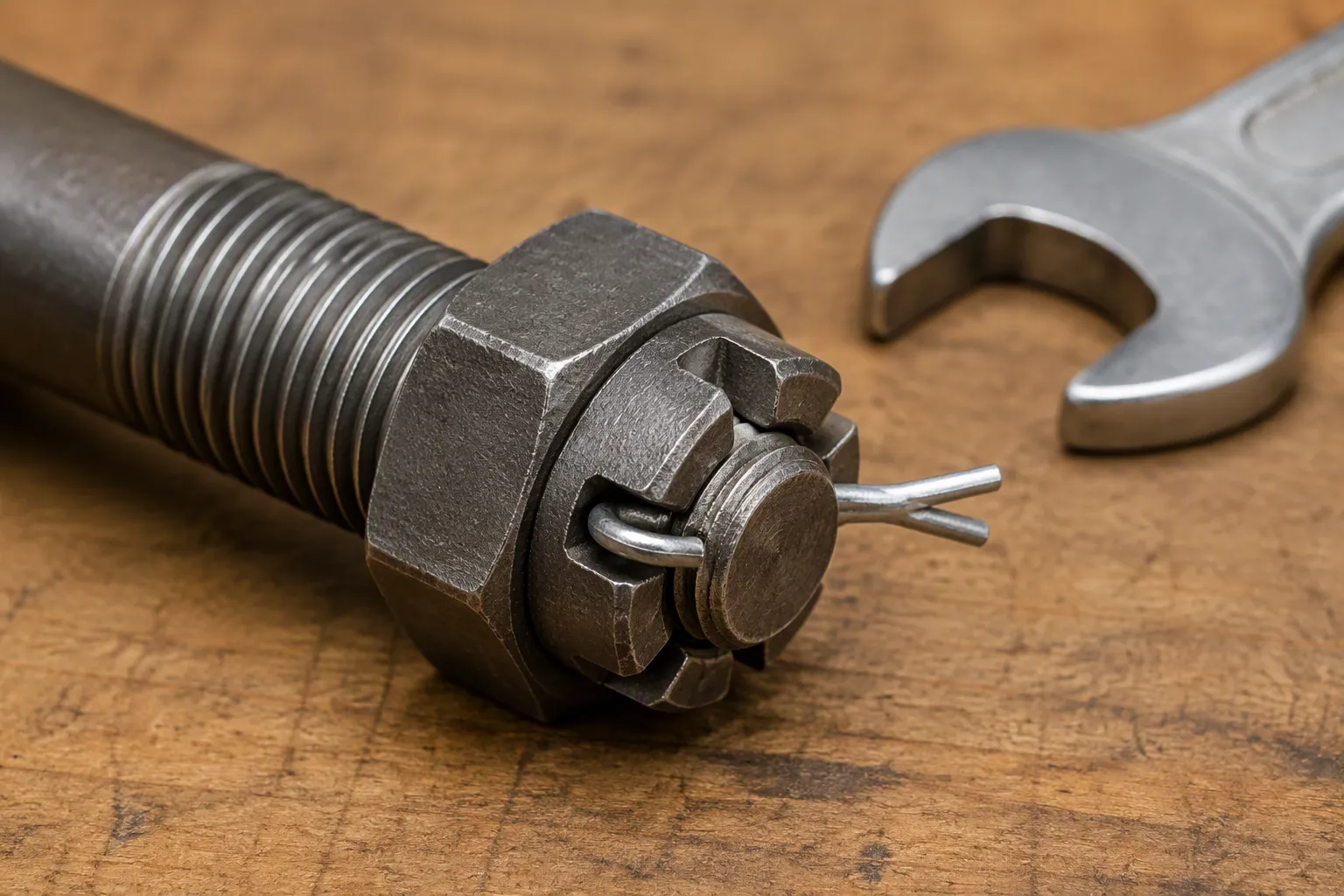

A wedge anchor is a heavy-duty mechanical expansion anchor engineered for fastening items to solid concrete. The anchor’s holding power comes from a simple but effective mechanism. When an installer tightens the nut, it pulls the anchor stud upward. This action forces an expansion clip at the base to expand, wedging tightly against the concrete and creating a secure frictional hold. The market for reliable wedge anchors and other Anchor Bolts is growing steadily.
Market Insight: Concrete Expansion Anchors 📈
- The market size is projected to grow from $2,226.6 million in 2025 to $3,500 million by 2035.
- This reflects an estimated compound annual growth rate (CAGR) of 4.6%.
Many projects require specific solutions, which is why a custom fasteners manufacturer can supply custom anchor bolts.
What is a Wedge Anchor? Anatomy and Components

A wedge anchor appears simple, but its effectiveness comes from three precisely engineered components working together. Each part has a distinct role in creating a secure connection within concrete. Understanding this anatomy is the first step to appreciating how these powerful fasteners function. The design ensures reliability for heavy-duty fastening jobs.
The Threaded Stud Body
The threaded stud is the main body of the wedge anchor. One end is tapered or conical, which is the end that enters the concrete first. The other end is threaded to accept a nut and washer. This long, solid shaft provides the anchor’s length and transfers the load from the fixture into the anchor assembly. Manufacturers produce these studs from various materials to suit different environmental conditions. Common material options include:
- Zinc Plated Carbon Steel
- Hot-Dipped Galvanized Carbon Steel
- Type 304 Stainless Steel
- Type 316 Stainless Steel
The choice of material is critical for ensuring long-term performance and corrosion resistance.
The Expansion Clip
The expansion clip is the heart of the anchor’s holding power. This small metal component wraps around the tapered end of the stud. It is designed to expand outward when the stud is pulled upward during installation. As the clip is forced against the tapered cone, it presses firmly against the walls of the drilled hole. This action creates the intense frictional force that locks the anchor in place. The clip’s design allows it to conform to the drilled hole, maximizing surface contact and ensuring a solid grip.
The Nut and Washer
The nut and washer are the final components that complete the assembly. Installers use the nut to set the anchor and secure the fixture. Tightening the nut pulls the threaded stud upward, which initiates the wedging action of the expansion clip. The washer serves an important purpose by evenly distributing the load from the nut across the surface of the fixture. This prevents damage to the fixture material and ensures a secure connection. High-quality wedge anchors are supplied with pre-assembled nuts and washers for immediate use.
Industry Standards Compliance ⚙️ Reputable manufacturers produce wedge anchors that conform to established industry standards like ASTM, DIN, and ISO. This ensures the materials and dimensions of the entire assembly, including the nut and washer, meet strict quality and performance requirements for safe installation.
How Concrete Wedge Anchors Work: A Mechanical Breakdown
The holding power of concrete wedge anchors comes from a straightforward yet powerful mechanical process. This process transforms the rotational energy of tightening a nut into immense frictional force inside the concrete. The sequence involves precise steps, from inserting the anchor to activating its expansion mechanism. Understanding this breakdown reveals why these fasteners are trusted for heavy-duty applications.
Insertion into the Hole
The installation process begins with the anchor’s insertion into a pre-drilled hole. The success of the entire installation hinges on the hole’s diameter. The drilled hole in the concrete must be the exact same diameter as the anchor being installed. For example, a 3/8” wedge anchor requires a 3/8” hole. This precise tolerance is not a suggestion; it is a fundamental requirement for achieving the anchor’s specified holding values. Installers use ANSI-standard carbide-tipped drill bits that are sized to match the anchor, ensuring the hole provides the necessary friction for the expansion clip to grip. An incorrectly sized hole is a common reason for installation failure.
Upward Pull from Tightening
Once the anchor is in place, an installer tightens the nut. This action creates a powerful upward pull on the threaded stud. The threads on the stud act as an inclined plane wrapped around a cylinder, providing a significant mechanical advantage. This principle allows a relatively small amount of rotational force (torque) applied to the nut to generate a much larger axial pulling force on the anchor body. The relationship between the applied torque and the resulting pull force can be described mathematically.
- The mechanical advantage (MA) is calculated with the formula: MA = π * D / P
- In this formula:
- D represents the thread diameter of the stud.
- P represents the thread pitch (the distance between threads).
- This mechanical advantage directly multiplies the force applied, creating the strong upward pull needed to set the anchor.
The Wedging Action
The upward pull on the stud is the catalyst for the final and most critical step: the wedging action. As the stud moves upward, its tapered cone-shaped end is pulled into the expansion clip. The clip cannot move upward with the stud because it is already in contact with the bottom of the hole. Instead, the tapered cone forces the expansion clip to expand outward. The clip presses with immense force against the interior walls of the concrete hole.
The Foundation of Strength: Friction 💡 The entire holding capacity of wedge anchors relies on this final step. The outward pressure from the expansion clip creates a massive frictional force between the anchor and the surrounding concrete. This friction is what locks the wedge anchor in place, preventing it from pulling out under heavy loads and creating a secure, reliable connection.
Creating Frictional Force
The wedging action directly generates the anchor’s holding power through immense frictional force. This force is the resistance created when the steel expansion clip presses against the rough interior surface of the hole in the concrete. The principle is simple: the harder the clip pushes outward, the greater the friction. This friction acts along the length of the clip, creating a powerful grip that resists any pull-out force applied to the anchor. The entire design of concrete wedge anchors is optimized to maximize this single, critical interaction.
The Physics of Grip: Normal Force and Friction ⚙️ The holding capacity is a product of the normal force (the outward pressure from the clip) and the coefficient of friction between steel and the base material. Higher installation torque creates a greater normal force, which in turn generates more frictional resistance.
Several factors directly influence the amount of frictional force an anchor can achieve:
- Concrete Compressive Strength: Harder, higher-strength concrete provides a more rigid surface for the clip to grip, allowing for greater frictional force. Softer or lower-strength concrete may not offer the same level of resistance.
- Hole Condition: A clean, dust-free hole is essential. Debris acts like a lubricant, reducing the coefficient of friction and severely compromising the anchor’s holding power.
- Proper Torque: Applying the manufacturer-specified torque is crucial. Under-torquing fails to expand the clip sufficiently, while over-torquing can damage the concrete or the anchor itself.
The Complete Wedge Anchor Installation Guide

Proper wedge anchor installation is critical for achieving the fastener’s maximum rated holding capacity. The process is methodical and requires attention to detail at every stage. Following the manufacturer’s published installation instructions (MPII) is not just a recommendation; it is a requirement for a safe and compliant connection. This guide breaks down the complete process into manageable steps.
Pre-Installation Checklist
Preparation is the foundation of a successful installation. Before any drilling begins, an installer must gather the correct tools and verify that all materials meet project specifications. This initial check prevents costly errors and ensures job site safety.
Required Tools and Materials
An installer should assemble all necessary items before beginning the work. A typical checklist includes:
- Rotary Hammer Drill: A standard drill lacks the power needed for drilling into concrete.
- ANSI-Standard Carbide Drill Bit: The bit diameter must exactly match the anchor diameter.
- Wire Brush and Compressed Air/Blower Bulb: For thoroughly cleaning the drilled hole.
- Calibrated Torque Wrench: Essential for applying the correct tightening force.
- Hammer: For tapping the anchor into place.
- Wedge Anchors: The correct diameter, length, and material for the application.
- Personal Protective Equipment (PPE).
Inspector Verification 🧐 A pre-installation inspection often involves verifying the anchor type, material, and size against the approved construction documents. Special inspectors may also confirm the drilling method and hole cleaning procedures align with the anchor’s evaluation report (e.g., ICC-ES ESR) and MPII.
Safety Precautions
The installation of concrete wedge anchors involves power tools and potential airborne debris. Adhering to safety protocols is non-negotiable.
- Eye Protection: Always wear safety glasses or goggles to protect against concrete dust and chips.
- Hearing Protection: A rotary hammer drill operates at high decibel levels.
- Dust Mask/Respirator: Inhaling crystalline silica dust from concrete is a serious health hazard.
- Gloves: Protect hands from abrasion and sharp edges.
The Installation Process
The installation process consists of five precise steps. Skipping or improperly executing any step will compromise the strength and reliability of the connection.
Step 1: Drill the Hole
An installer uses a rotary hammer and a correctly sized ANSI-standard carbide drill bit to drill a hole into the concrete. The hole’s diameter must be equal to the anchor’s diameter. The hole must be drilled to a specified depth, which is typically at least one anchor diameter deeper than the required embedment.
Cracked vs. Uncracked Concrete 🧱 The American Concrete Institute (ACI) provides criteria for anchor use in cracked versus uncracked concrete. Because factors like load stress and shrinkage can cause cracking, ACI 318 guidelines often treat cracked concrete as the default design assumption for maximum safety. Installers must use wedge anchors rated for the specific condition of the base material.
Step 2: Clean the Hole
A clean hole is absolutely essential for achieving the anchor’s holding power. Debris acts as a lubricant and prevents the expansion clip from making solid contact with the concrete. The most effective method is a sequence of blowing, brushing, and blowing again.
- Use compressed air or a blower bulb to force loose dust out of the hole.
- Scrub the interior walls of the hole with a properly sized wire brush to dislodge any remaining particles.
- Blow the hole out one final time to remove the loosened dust.
Step 3: Position the Fixture and Insert the Anchor
With the hole prepared, the installer positions the item being fastened over the hole. The wedge anchor, with its nut and washer attached, is then inserted through the fixture and into the hole. The nut should be turned just past the top of the anchor body.
Step 4: Set the Anchor
The installer gently taps the nut end of the anchor with a hammer. This action drives the anchor down into the hole until the washer and nut are snug against the surface of the fixture. This step ensures the expansion clip is properly positioned at the bottom of the hole before tightening begins.
Step 5: Tighten the Nut to Torque Specification
This final step activates the anchor. An installer uses a calibrated torque wrench to tighten the nut. The rotational force pulls the stud upward, forcing the clip to expand and wedge against the hole walls. It is crucial to apply the specific torque value listed in the MPII.
- Under-torquing results in insufficient expansion and a weak hold.
- Over-torquing can cause the concrete to fail or damage the anchor itself.
For projects requiring oversight, a special inspector will verify the final installation. They use a calibrated torque wrench to confirm the correct torque was applied. They may also check for a length identification code stamped on the anchor’s end to verify proper embedment depth for wedge anchors recognized for multiple embedments.
Common Applications: Where to Use Wedge Anchors
The strength and reliability of wedge anchors make them suitable for a wide range of fastening tasks in solid concrete. Their applications are broadly categorized into structural and non-structural, though both often involve heavy loads and demand a secure connection. From large-scale construction to industrial facility outfitting, these fasteners provide essential holding power.
Structural Applications
Structural applications involve fastening components that are integral to a building’s framework. In these scenarios, anchor failure could compromise the stability of the structure itself. Engineers specify wedge anchors in these critical connections for their proven performance and high load capacities.
Securing Steel Beams and Columns
Contractors frequently use wedge anchors to attach steel base plates for I-beams and support columns to concrete foundations. This creates a solid connection that transfers the building’s load directly to the footing. The anchor’s diameter and material are chosen based on engineering calculations to handle immense shear and tension forces. The principles of this technology extend to massive civil engineering projects, where barrel and wedge assemblies secure soil anchors and even support suspension bridge cables.
Typical Load Capacities for Steel Connections 📊 The following values are general guidelines for a single anchor in 2,000 PSI concrete. An engineer must always verify project-specific requirements.
Diameter Length Zinc-Plated Load Capacity (lbs) Stainless Steel Load Capacity (lbs) 1/4 inch 1-3/4 inches 500 450 3/8 inch 3 inches 1,200 1,100 1/2 inch 3-3/4 inches 2,000 1,800
Attaching Sill Plates
In both residential and commercial wood-frame construction, a wedge anchor is a common choice for securing sill plates. The sill plate is the first piece of lumber attached to the top of a foundation wall. Anchoring it properly prevents the wooden structure from shifting or lifting, especially in areas prone to high winds or seismic activity.
Non-Structural Applications
Non-structural applications involve securing items that are not part of the primary building frame but still require a strong, permanent hold. These applications are often just as critical for safety and operational efficiency.
Mounting Heavy Machinery
Factories and workshops rely on wedge anchors for mounting heavy industrial equipment to concrete floors. This includes machinery like lathes, presses, and CNC machines that generate significant vibration and dynamic loads. Proper mounting is essential for operational stability and safety. Selecting an anchor of insufficient size or strength can lead to failures such as steel failure, where the anchor body breaks, or anchor pull-out, where the fastener slips from the hole.
Installing Pallet Racking and Shelving
In warehouses and distribution centers, pallet racking systems must be securely anchored to the floor. The significant weight of stored goods creates a high risk of tipping if the racks are not fastened correctly. Installers use wedge anchors at the base of each upright to ensure the entire shelving system remains stable and safe for personnel.
Securing Handrails and Guardrails
Safety railings along walkways, mezzanines, and stairwells are critical for fall protection. A wedge anchor provides the robust connection needed to secure the base plates of these guardrails to the concrete substrate. The reliability of the anchor ensures the railing can withstand the required lateral forces specified in building codes.
Choosing the Right Wedge Anchor for Your Project
Selecting the appropriate wedge anchor is a critical decision that directly impacts the safety and longevity of an installation. An installer must consider the project’s environment, the load requirements, and the thickness of the material being fastened. Making the right choice ensures optimal performance and a secure connection.
Material Types and Environments
The surrounding environment is the primary factor in determining the correct anchor material. Each material offers a different level of corrosion resistance, making it suitable for specific conditions.
Zinc-Plated Carbon Steel
This is the most common and economical option for wedge anchors. A zinc plating provides a basic layer of corrosion resistance. Installers should use these anchors exclusively in dry, indoor environments where exposure to moisture is not a concern.
Hot-Dipped Galvanized Steel
Hot-dipped galvanized anchors have a much thicker zinc coating than their zinc-plated counterparts. This robust layer offers superior protection against corrosion. These are suitable for use in damp or humid indoor locations and some dry outdoor applications.
304 Stainless Steel
For applications involving moisture or water, 304 stainless steel is an excellent choice. It provides substantial corrosion resistance and is often specified for wet environments and areas with exposure to certain chemicals.
316 Stainless Steel
This material offers the highest level of corrosion protection. A 316 stainless steel wedge anchor is the premier choice for highly corrosive settings.
- Submerged freshwater or saltwater applications
- Coastal areas with salt spray
- Wastewater treatment plants
- Environments with industrial chemicals
Determining Correct Diameter and Length
The dimensions of the anchor—its diameter and length—determine its holding power and suitability for a specific task.
How Diameter Affects Holding Power
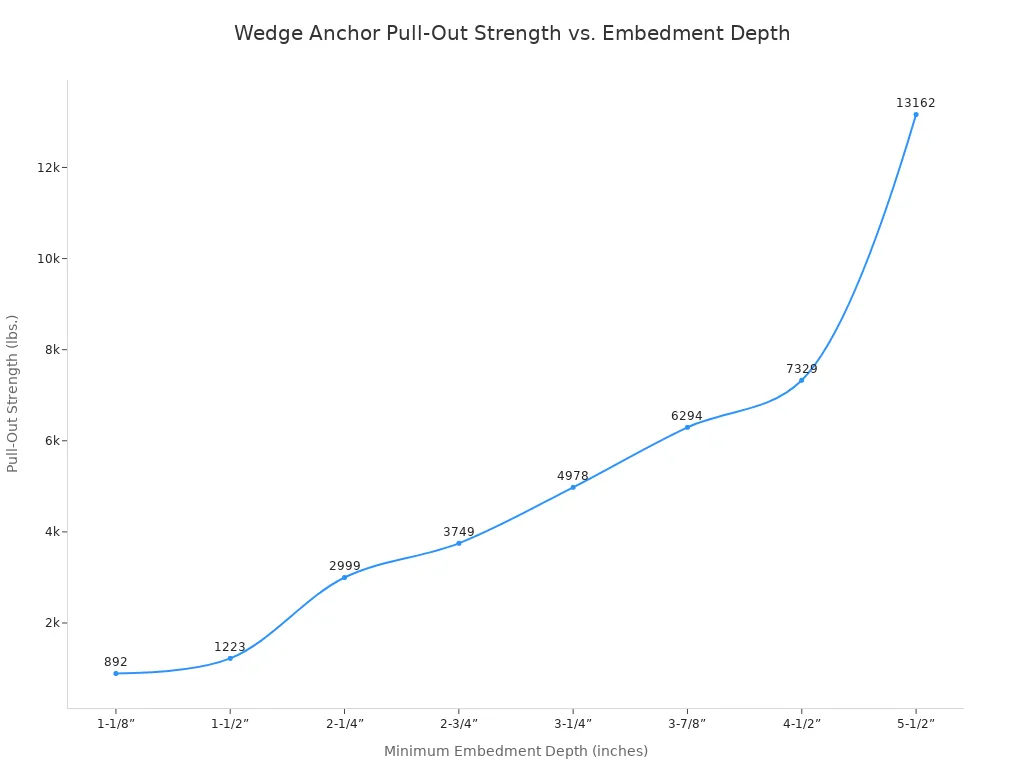
An anchor’s diameter has a direct relationship with its strength. A larger diameter anchor provides greater resistance to both tension (pull-out) and shear (side-to-side) forces. As the diameter increases, so does the required embedment depth, creating a significantly stronger hold in the concrete. The holding power increases exponentially with larger diameters.
Calculating Required Anchor Length
Choosing the correct size wedge anchor involves a simple calculation. The anchor must be long enough to pass through the fixture and achieve the required minimum embedment depth in the concrete base material.
Anchor Length Formula 📏
Fixture Thickness + Minimum Embedment Depth + Nut/Washer Height = Required Anchor Length
Deeper embedment significantly increases an anchor’s holding capacity. For example, a 1/2″ anchor embedded at 2-1/4″ has a lower ultimate tension load than the same anchor embedded at 3-3/4″ in the same strength concrete.
| Anchor Diameter | Embedment Depth | Ultimate Tension (lbs) @ 4,000 PSI Concrete |
|---|---|---|
| 1/2″ | 2-1/4″ | 3,084 |
| 1/2″ | 3-3/4″ | 4,587 |
| 5/8″ | 2-3/4″ | 6,054 |
| 5/8″ | 4-5/8″ | 9,155 |
An installer must always refer to manufacturer specifications to confirm the minimum embedment for the selected anchor.
Wedge Anchors vs. Other Concrete Fasteners
An installer has many fastener options for concrete applications. The choice depends on load requirements, base material, and whether the installation is permanent. Understanding the key differences between wedge anchors and other common fasteners is essential for selecting the correct component for the job. This ensures both safety and performance.
Wedge Anchor vs. Sleeve Anchor
A sleeve anchor functions similarly to a wedge anchor but uses a different expansion mechanism. While a wedge anchor expands a small clip at its base, a sleeve anchor expands a full-length sleeve along the anchor body. This design difference leads to distinct performance characteristics. Sleeve anchors are versatile for various base materials like brick or block, but wedge anchors provide superior strength in solid concrete.
Comparison: Wedge Anchor vs. Sleeve Anchor ⚙️ The primary differences are in their mechanism and resulting holding power.
Feature Wedge Anchor Sleeve Anchor Mechanism Expands a clip against the material Expands a sleeve against the material Holding Power High; suitable for heavy-duty applications Lower; suitable for lightweight applications Load Capacity Highest among mechanical anchors Less than wedge anchors
Wedge Anchor vs. Drop-In Anchor
A drop-in anchor is a female anchor, meaning it is internally threaded. Installation is a two-step process. First, an installer places the anchor in the hole and uses a setting tool to expand it. Then, a separate bolt or threaded rod is inserted to attach the fixture. This design is ideal for applications requiring a flush surface or the ability to remove the bolt. In contrast, wedge anchors are a single-unit male fastener that allows for through-fixture installation, making the process faster for many applications.
Wedge Anchor vs. Concrete Screw (Tapcon)
Concrete screws, often known by the brand name Tapcon, operate on a completely different principle. They do not use an expansion mechanism. Instead, these hardened screws cut their own threads directly into the concrete, creating a secure connection. While they do not match the ultimate holding power of a heavy-duty wedge anchor, concrete screws offer significant advantages in certain situations.
Installers often prefer concrete screws for applications that require:
- Temporary installations or potential removal: Screws can be easily uninstalled, leaving a clean hole. This is ideal for temporary bracing or fixtures that may be relocated.
- Ease of installation: The process simply involves drilling a hole and driving the screw, which can be faster for light-duty tasks.
- Versatility for various loads: They are suitable for a wide range of uses, from securing electrical boxes and conduit to mounting light fixtures.
Wedge Anchor vs. Adhesive Anchor
Adhesive anchors, also known as chemical anchors, represent a fundamentally different approach to fastening in concrete. Instead of relying on mechanical expansion, they use a two-part chemical resin to bond a threaded rod or rebar to the base material. This creates an incredibly strong, stress-free connection. The choice between a wedge anchor and an adhesive system depends heavily on the project’s specific demands, including load requirements and installation timeline.
The most significant difference is the time until the anchor can be loaded. A mechanical fastener like a wedge anchor is ready for immediate loading as soon as an installer tightens it to the correct torque. Adhesive systems require a specific cure time before they can bear any weight.
Curing Time Considerations for Adhesive Anchors ⏱️ The time it takes for the adhesive to fully harden is not constant. Several factors influence the curing process:
- Ambient Temperature: Colder temperatures significantly slow the chemical reaction, extending the required cure time. Warmer conditions speed it up.
- Resin Type: Different chemical compounds have different cure rates. Vinylester and polyester resins often cure in under an hour, while epoxy resins can take several hours or even more than a day to reach full strength.
- Manufacturer Specifications: An installer must always consult the manufacturer’s technical data for specific gel and cure times based on job site conditions.
While wedge anchors offer speed and simplicity, adhesive anchors provide distinct advantages in certain scenarios. Because they bond to the concrete without exerting outward pressure, they are an excellent choice for installations close to an edge or near other anchors. They can also achieve exceptionally high load capacities, often surpassing those of mechanical anchors, making them ideal for the most demanding structural applications and rebar doweling. However, for many heavy-duty applications in solid concrete where speed is a factor, the proven performance and immediate load capacity of wedge anchors make them the preferred solution.
Common Wedge Anchor Installation Mistakes to Avoid
A successful wedge anchor installation depends on precision. Even small errors can significantly reduce an anchor’s holding power and compromise safety. Installers can ensure a secure and reliable connection by avoiding a few common but critical mistakes. Following the correct procedure is essential for the performance of all wedge anchors.
Using an Incorrectly Sized Drill Bit
The relationship between the drill bit and the anchor diameter is non-negotiable. A wedge anchor requires a hole that is the exact same diameter as the anchor itself. Using a bit that is too large creates a gap between the expansion clip and the concrete. The clip cannot expand enough to create the necessary friction, causing the anchor to spin in the hole or pull out under a low load. Conversely, a bit that is too small prevents the anchor from being inserted into the hole at all, stopping the installation before it begins.
Failing to Clean the Hole Properly
Drilling into concrete generates a significant amount of dust and debris. Failing to clean the hole thoroughly is one of the most frequent causes of anchor failure. This dust acts like a layer of fine ball bearings between the expansion clip and the base material. It drastically reduces the coefficient of friction, preventing the clip from getting a solid grip. A compromised grip means a severely reduced holding capacity. The proper procedure involves blowing the hole out, scrubbing it with a wire brush, and blowing it out a final time to ensure a clean surface for contact.
Under-Torquing or Over-Torquing the Nut
Applying the correct torque is the final step that activates the wedge anchor. Both too little and too much torque lead to failure. Under-torquing the nut means the stud is not pulled upward enough to fully expand the clip, resulting in a weak hold. Over-torquing is equally dangerous and can cause several types of catastrophic failure.
The Importance of Calibration 🔧 An installer must use a calibrated torque wrench to apply the manufacturer’s specified torque value. Guessing or using a standard impact wrench invites failure and makes the installation unreliable.
Exceeding the recommended torque can overwhelm both the anchor and the base material. Potential consequences include:
- Steel failure of the anchor itself.
- Splitting or spalling of the surrounding concrete.
- The anchor pulling through the wedges.
- The entire anchor spinning in the hole, which indicates it is damaged and cannot be set.
Installing Too Close to an Edge or Another Anchor
A wedge anchor’s holding power comes from immense outward pressure. This force creates a cone-shaped area of stress in the concrete below the anchor. An installer must respect the physical limitations of the concrete base material. Placing an anchor too close to an unsupported edge or another anchor can cause these stress cones to overlap or to break out the side of the concrete. This failure mode, known as concrete breakout, is abrupt and can lead to a complete loss of holding power.
Engineers and manufacturers provide strict guidelines for minimum spacing and edge distances to prevent this type of failure. These distances are calculated based on the anchor’s diameter and are not optional. Adhering to these specifications is essential for ensuring the structural integrity of the connection.
Critical Spacing and Edge Distance Rules 📐 While an engineer must always approve project-specific requirements, general guidelines exist to prevent concrete failure:
- Minimum Spacing: The distance between two wedge anchors should be at least 10 times the anchor diameter.
- Minimum Edge Distance: The distance from an anchor to an unsupported concrete edge should be at least 5 times the anchor diameter.
- Vibration Considerations: An installer should increase the spacing between anchors if the application involves vibration or sudden impact loads.
The consequences of fastener instability can be catastrophic. In the L’Ambiance Plaza collapse, which resulted in 28 fatalities, a prominent theory points to the instability of wedges supporting a floor package. Investigators found that large gaps and other issues would have required an extremely high friction coefficient to hold the wedges in place. The failure of these small components is believed to have initiated the entire structural collapse, highlighting the immense importance of proper fastener installation and stability.
Even in non-structural applications, the costs of improper installation are significant. Failing to properly anchor pallet racks by not following spacing requirements can lead to catastrophic accidents, injuries, and major financial losses from damaged inventory. Similarly, attempting to remove improperly installed anchors often results in cracked concrete and damaged floors. These repairs can cost an estimated $15-25 per square foot and create ongoing operational hazards, demonstrating that correct installation from the start is the only acceptable method.
The wedge anchor is a powerful and reliable fastener for heavy-duty applications in solid concrete, from securing heavy machinery to structural steel. The strength of this wedge anchor comes from a simple yet effective wedging mechanism activated during installation. Achieving maximum holding power and safety in concrete requires precision. An installer must ensure correct hole size, cleanliness, and torque.
Quality Assurance ✅ For critical projects, specifying wedge anchors with certifications like ICC-ES or ETA ensures the product meets rigorous, tested performance standards.
FAQ
Can an installer reuse a wedge anchor?
An installer cannot reuse a wedge anchor. The removal process damages the anchor’s threads and expansion clip, rendering it unsafe for a new connection. A project always requires a new anchor for a secure installation.
Can wedge anchors be used in brick or block?
Wedge anchors are designed exclusively for solid concrete. The high expansion force they generate can easily crack or break weaker base materials like brick, hollow block, or cinder block. An installer must choose a different anchor type for those materials.
How do you remove a wedge anchor?
A wedge anchor creates a permanent connection. It cannot be removed intact. An installer must cut the anchor off flush with the surface of the concrete or fixture. A grinder with a cut-off wheel is the most effective tool for this task.
What is a “cracked concrete” rated anchor?
A “cracked concrete” rated anchor is engineered to maintain its hold even if the concrete cracks under load. Building codes often require these tested anchors for overhead and structural applications to ensure the highest level of safety.
Why drill the hole deeper than the required embedment?
Drilling a deeper hole creates a space for any remaining concrete dust to settle. This ensures the anchor reaches its full embedment depth. The expansion clip can then function properly without obstruction from drilling debris.
What should an installer do if the anchor spins in the hole?
A spinning anchor indicates an installation failure, often from an oversized hole or improper cleaning. The installer must abandon that anchor. They will need to drill a new hole and use a completely new wedge anchor.
How soon can a wedge anchor be loaded?
An installer can apply the full load to a wedge anchor immediately after tightening it to the specified torque. This immediate load capacity is a key advantage over adhesive anchor systems, which require a specific cure time.