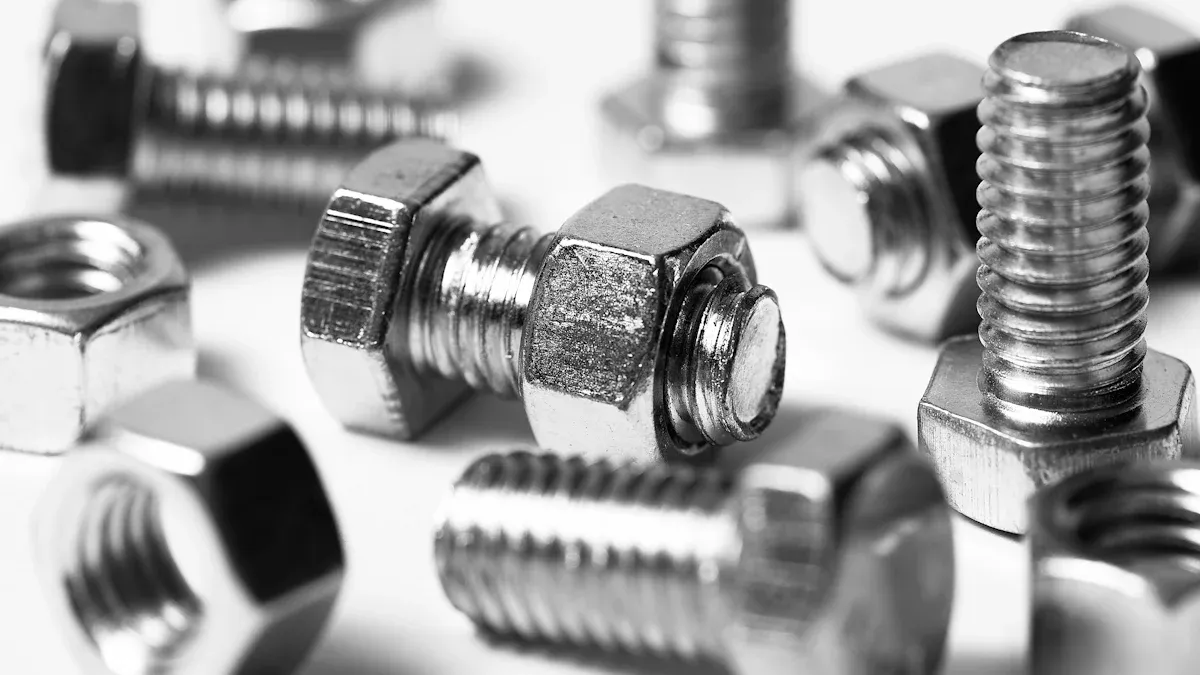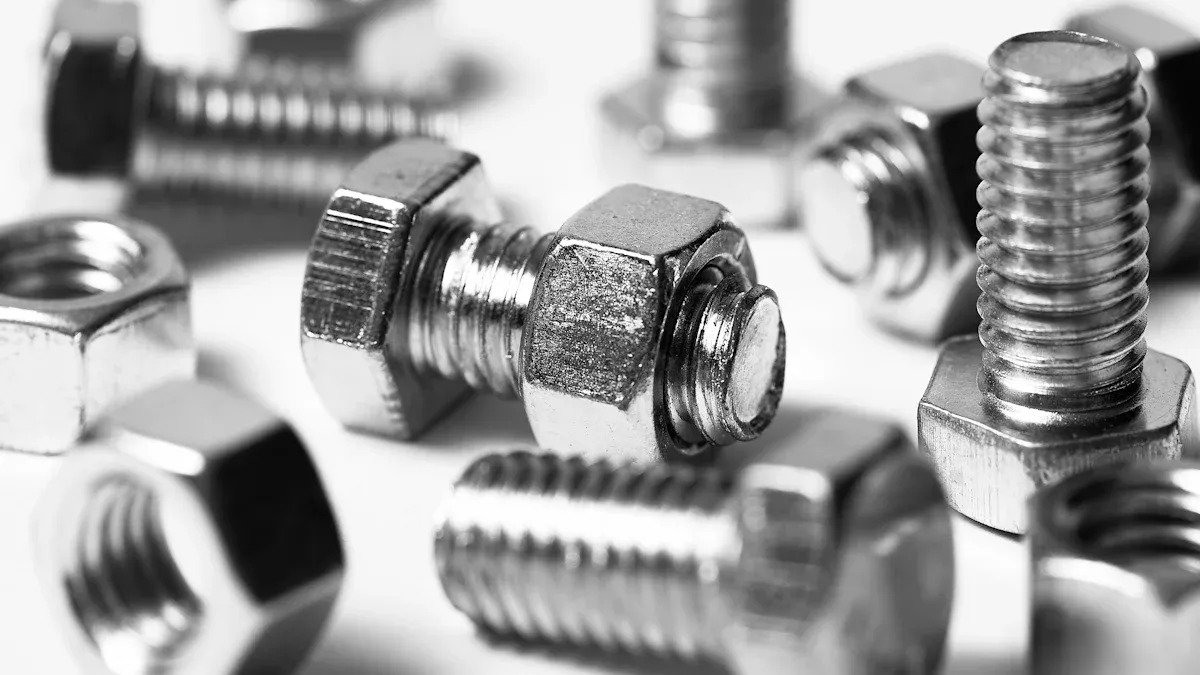
An anchor bolt is a fundamental component in construction and engineering. A concrete anchor bolt is a heavy-duty fastener. It securely attaches objects or structural elements to a concrete surface. The fundamental purpose of anchor bolts is to create a strong, reliable connection. This connection is achieved when the bolt expands against, bonds with, or threads into the concrete. This process facilitates effective load transfer into the solid base material. The global market for these essential concrete anchors reflects their importance. Projections show significant growth, underscoring their widespread use in various industries.
| Metric | Value |
|---|---|
| Market Size in 2025 | USD 3.91 Billion |
| Projected Market Size in 2034 | USD 5.65 Billion |
| CAGR Growth Rate (2025-2034) | 4.12% |
Many projects require custom anchor bolts. A reputable custom fasteners manufacturer can produce custom fasteners to meet specific project demands. These specialized Anchor Bolts ensure optimal performance and safety. The demand for concrete anchor bolts continues to rise with global construction.
What Are the Main Uses of a Concrete Anchor Bolt?
The applications of anchor bolts are vast, spanning nearly every sector of construction and industry. Their primary function is to create a secure connection to a concrete base, ensuring stability and safety for a wide range of structures and equipment. The specific anchor bolt uses depend on the load requirements and the nature of the object being fastened.
Structural and Foundation Applications
In large-scale construction, concrete anchor bolts provide the foundational strength necessary for building integrity. They are indispensable for securing structural supports and ensuring long-term stability.
Securing Foundation Sill Plates
A sill plate is the first piece of lumber attached to a building’s concrete foundation. An anchor bolt connects this plate to the concrete, effectively locking the entire wooden frame of the structure to its base. This connection is critical for resisting lateral forces like wind and seismic activity.
Anchoring Steel Columns and Beams
Modern buildings often use a steel skeleton for support. Large-diameter anchor bolts are cast into concrete footings. Steel columns are then positioned over these bolts and fastened securely. This process transfers the building’s massive weight directly into the foundation.
Fastening Pre-Cast Concrete Elements
Many projects use pre-cast structural elements like walls, stairs, and panels. These components are manufactured off-site and lifted into place. Engineers use anchors to connect these heavy pieces to each other and to the main structure, creating a unified and robust assembly.
Equipment and Machinery Mounting
Anchors play a vital role in industrial, commercial, and residential settings by safely securing heavy equipment to concrete floors and pads.
Anchoring Heavy Industrial Machinery
Factories and processing plants rely on anchors to hold down heavy machinery. This prevents equipment like CNC machines, presses, and mixers from moving or “walking” due to operational vibrations, which is essential for both safety and precision.
Securing HVAC Units and Generators
Outdoor equipment such as large air conditioning units, backup generators, and compressors must be anchored to their concrete pads. This secures them against high winds, theft, and operational vibration.
Mounting Workshop Equipment
In a workshop or garage, a concrete anchor bolt can secure equipment like bench grinders, drill presses, and vehicle lifts to the floor. This provides a stable and safe working environment.
Infrastructure and Public Works
Public infrastructure projects depend on concrete anchor bolts for safety, durability, and compliance with strict engineering codes.
Fastening Guardrails and Handrails
Safety is paramount for public walkways, stairwells, and balconies. Anchors secure guardrail and handrail posts directly to concrete surfaces. Installation must follow strict building codes to ensure reliability.
Code Compliance for Safety Anchors The 2012 International Building Code (IBC) provides clear mandates for these installations. It references ACI 355.4-11 standards, which detail specific testing and assessment criteria for anchors. These regulations often require:
- Greater concrete depth and edge distance
- Specific anchor embedment depths
- Larger mounting plate sizes
- Additional reinforcement in the concrete
Mounting Road Signs and Light Poles
Road signs and tall light poles must withstand significant wind loads. Anchors provide the necessary holding power to keep these structures upright and secure in their concrete footings.
Securing Bridge and Tunnel Components
In civil engineering, anchors fasten critical components like bearings, expansion joints, and safety barriers in bridges and tunnels. These heavy-duty applications demand the highest level of strength and reliability.
Residential and Commercial Fixtures
Concrete anchors are not limited to massive industrial or infrastructure projects. Installers find them essential for securing a wide variety of fixtures in both homes and businesses. These common anchor bolt uses ensure safety, stability, and long-term performance for everyday structures. From warehouse storage to backyard enhancements, the right anchor provides a reliable connection to concrete surfaces, preventing accidents and structural failures.
Installing Pallet Racking and Shelving
Warehouses, distribution centers, and retail backrooms rely on tall pallet racking systems to maximize vertical storage. The stability of these racks is a major safety concern. Anchors fasten the rack’s base plates securely to the concrete floor. This connection is critical for several reasons:
- It prevents the racks from tipping over under heavy or unbalanced loads.
- It provides resistance against accidental impacts from forklifts or other machinery.
- In seismically active regions, proper anchoring is a code requirement to prevent collapse during an earthquake.
Technicians typically use heavy-duty mechanical anchors, like wedge anchors, to achieve the necessary holding power for these demanding applications.
Attaching Awnings and Canopies
Awnings and canopies provide shade and shelter over windows, doorways, and patios. These structures must withstand significant environmental forces, particularly wind. A strong gust of wind can create a powerful upward lift, attempting to rip the canopy from the building.
An improperly secured awning poses a serious risk to property and people. The anchor bolts must transfer both downward loads (from snow or rain) and powerful uplift loads (from wind) directly into the building’s structural concrete or masonry.
Installers must select anchors that offer high tensile strength to counter this uplift. Chemical anchors are often preferred in these situations because they create a stress-free bond that is exceptionally strong and resistant to vibration.
Securing Fencing and Gates
Property owners often install fences and gates on or adjacent to concrete surfaces like driveways, sidewalks, or retaining walls. Concrete anchors provide a robust method for mounting the posts that support these structures. A secure anchor ensures the fence remains upright and that gate hinges can support the gate’s weight without sagging or failing over time. For this purpose, installers frequently use sleeve anchors or wedge anchors to fasten post flanges directly to the concrete slab. This creates a clean, durable installation that withstands weathering and daily use, keeping the perimeter secure and functional.
Understanding the Main Types of Concrete Anchors: Mechanical vs. Chemical

Choosing the right fastener is critical for a secure installation. The main types of concrete anchor bolts fall into two broad categories: mechanical and chemical. Each category includes different concrete anchor bolts designed for specific conditions and load requirements. Understanding their fundamental differences is the first step in selecting the proper component for any project. These two primary types of concrete anchors offer distinct methods for achieving a secure connection.
What Are Mechanical Anchors?
Mechanical anchors are a popular choice for many applications. They create a secure connection by physically expanding inside a pre-drilled hole. This expansion generates force against the walls of the concrete, providing the necessary holding power. There are several common types of anchor bolts within this group.
How Expansion Anchors Work
Expansion anchors are the most prevalent type of mechanical anchor. An installer places the anchor into a hole and tightens a nut or bolt. This action pulls a cone-shaped plug into an expansion sleeve, forcing the sleeve to press outward against the concrete. The anchor transfers loads to the base material through a combination of friction and bearing forces.
How Undercut Anchors Work
Undercut anchors offer a different approach to load transfer. These specialized concrete anchors require a two-step drilling process to create an “undercut” cavity at the bottom of the hole. The anchor then expands into this cavity.
This design creates a true mechanical interlock. Unlike expansion anchors that rely on friction, an undercut anchor transfers the load directly into the concrete through bearing, much like a headed stud cast directly into the concrete. This method provides exceptionally high pull-out resistance.
Pros and Cons of Mechanical Anchors
Mechanical anchors provide distinct advantages and disadvantages that influence their selection.
| Pros | Cons |
|---|---|
| Ready for immediate loading | Creates high stress in the concrete |
| Generally cost-effective | Less suitable for cracked concrete |
| Simple installation process | Can be problematic near edges |
| Reliable in good quality concrete | Performance depends on hole quality |
What Are Chemical (Adhesive) Anchors?
Chemical anchors, also known as adhesive anchors, use a two-part resin-based adhesive to bond a fastener to the concrete. These systems typically involve a threaded rod, a rebar, or a specialized sleeve.
How Adhesive Anchors Work
An installer first drills a hole and cleans it thoroughly to remove all dust and debris. Next, they inject a resin adhesive into the hole. The installer then inserts a threaded rod, twisting it to ensure full coverage. The adhesive cures and forms an incredibly strong bond between the anchor element and the concrete.
The Role of Epoxy and Resins
The adhesives used are typically epoxy, vinylester, or polyester resins. These compounds create a stress-free bond. This means they do not exert expansion forces on the surrounding concrete. This characteristic makes chemical anchors an ideal solution for applications close to edges or in brittle base materials.
Pros and Cons of Chemical Anchors
The unique properties of chemical anchors make them suitable for high-demand situations.
| Pros | Cons |
|---|---|
| Highest load-bearing capacity | Requires cure time before loading |
| Ideal for cracked concrete | More expensive than mechanical types |
| Can be installed near edges | Installation is sensitive to temperature |
| Waterproof and vibration resistant | Requires meticulous hole cleaning |
A Closer Look at Mechanical Types of Concrete Anchor Bolts
Mechanical anchors are workhorses in the construction industry, valued for their reliability and straightforward installation. These fasteners create a secure hold through physical expansion within the concrete. Exploring the different types of concrete anchor bolts reveals specific designs engineered for distinct applications and load requirements.
Wedge Anchors
Concrete wedge anchors are among the most popular and powerful mechanical fasteners available. They are designed for heavy-duty fastening into solid concrete and are not suitable for block or brick base materials.
Design and Installation
A wedge anchor consists of a threaded stud with a tapered cone at one end, an expansion clip, a washer, and a nut. The installation process is direct and creates an exceptionally strong connection.
- An installer first selects the correct anchor diameter for the load and drills a hole into the concrete using a carbide-tipped bit. The hole’s diameter must match the anchor’s diameter.
- After thoroughly cleaning all dust and debris from the hole, the installer drives the anchor through the fixture and into the hole until the nut and washer are snug against the surface.
- Using a torque wrench, the installer tightens the nut. This action pulls the stud upward, forcing the expansion clip down over the cone. The clip expands and wedges tightly against the walls of the hole, creating the anchor’s holding power.
Professional Tip: Proper torque is not just a recommendation; it is a requirement. Overtightening can stress the concrete and compromise the anchor’s integrity, while under-tightening will result in a weak connection that cannot support the intended load.
Best Uses for Heavy-Duty Loads
The design of concrete wedge anchors makes them ideal for applications requiring significant tensile and shear strength. Engineers and contractors specify these wedge anchor bolts for securing critical structural elements and heavy equipment. Common uses include:
- Anchoring structural steel columns and beams.
- Fastening heavy industrial machinery to factory floors.
- Securing pallet racking and industrial shelving in warehouses.
- Mounting large-scale commercial equipment.
Material and Environment Considerations
The material of a wedge anchor dictates its suitability for different environments. Zinc-plated steel is common for dry, indoor applications. For damp or corrosive environments, stainless steel is necessary. The load capacity of these concrete anchors is also influenced by the material and the concrete’s strength.
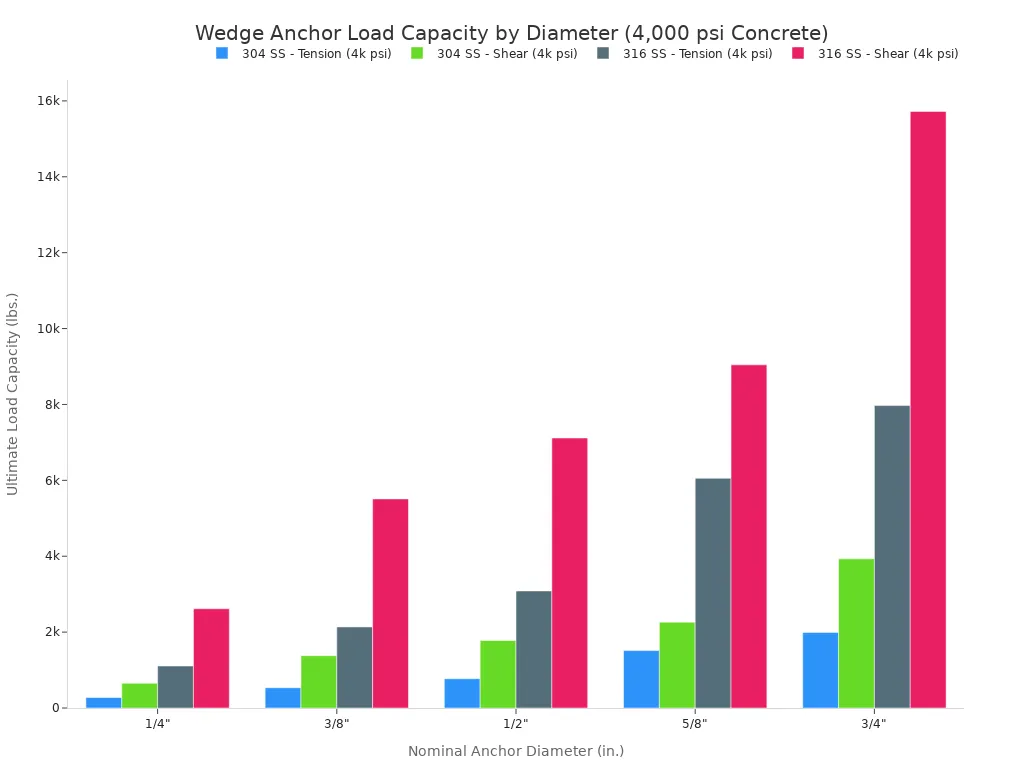
As the data shows, 316 stainless steel generally offers superior load capacity compared to 304 stainless steel, along with enhanced corrosion resistance, making it the preferred choice for harsh exterior or chemical exposure settings.
| Nominal Anchor Diameter (in.) | Minimum Embedment Depth (in.) | Concrete Compressive Strength (psi) | Ultimate Tension Load Capacity (lbs.) | Ultimate Shear Load Capacity (lbs.) |
|---|---|---|---|---|
| 304 Stainless Steel Wedge Anchor | ||||
| 1/2″ | 2-1/4″ | 4,000 | 771 | 1,779 |
| 1/2″ | 2-1/4″ | 6,000 | 873 | 1,779 |
| 3/4″ | 3-3/8″ | 4,000 | 1,993 | 3,931 |
| 3/4″ | 3-3/8″ | 6,000 | 1,849 | 3,931 |
| 316 Stainless Steel Wedge Anchor | ||||
| 1/2″ | 2-1/4″ | 4,000 | 3,084 | 7,116 |
| 1/2″ | 2-1/4″ | 6,000 | 3,492 | 7,116 |
| 3/4″ | 3-3/8″ | 4,000 | 7,971 | 15,723 |
| 3/4″ | 3-3/8″ | 6,000 | 7,397 | 15,723 |
Sleeve Anchors
Concrete sleeve anchors are versatile fasteners known for their adaptability to various base materials. They are a go-to choice for a wide range of medium-duty fastening jobs.
Design and Installation
A sleeve anchor is a pre-assembled fastener that includes a threaded bolt or stud, an expansion sleeve that covers most of the bolt, and a nut and washer. When an installer tightens the nut or the head of the bolt, it pulls the stud’s tapered end up through the sleeve. This action causes the sleeve to flare out and expand against the base material, creating a secure friction hold.
Best Uses for Medium-Duty Applications
The design of concrete sleeve anchors makes them suitable for a broad array of light to medium-duty tasks in residential and commercial settings. Their reliability and ease of use make them popular for projects such as:
- Securing handrails and guardrails to concrete patios or stairs.
- Mounting shelving units and storage racks in garages and workshops.
- Fastening window frames, door frames, and electrical junction boxes.
- Attaching light fixtures and signage to masonry walls.
Use in Concrete, Brick, and Block
A key advantage of sleeve anchors is their ability to function in multiple base materials. While they perform well in solid concrete, they can also be used in softer or hollow materials like brick and concrete block, where a wedge anchor would be unsuitable. However, their performance varies significantly.
| Material | Suitability for Sleeve Anchors | Performance Characteristics |
|---|---|---|
| Solid Concrete | Good | The sleeve expands to create a strong, reliable hold. They are effective for medium-duty loads. |
| Hollow Block | Limited | Performance is significantly reduced. The expansion force can crack the thin walls of the block, leading to a weak connection. Installers must use caution and select anchors specifically rated for hollow materials if possible. |
Drop-In Anchors
Drop-in concrete anchors are female-threaded fasteners designed for flush-mount applications, particularly in overhead scenarios. They provide a clean, finished appearance and offer unique installation advantages.
Design and Installation
A drop-in anchor consists of a cylindrical steel body with internal threads and a pre-inserted expansion plug. The installation of these drop-in anchor bolts requires a specific process.
- An installer drills a hole into the concrete to the specified depth.
- After cleaning the hole, they drop the anchor into place until it sits flush with or just below the concrete surface.
- The installer then uses a dedicated setting tool. They insert the tool into the anchor and strike it with a hammer. This drives the internal plug downward, expanding the anchor body to lock it into the concrete.
- A threaded rod or bolt can then be screwed into the drop-in concrete anchors.
Best Uses for Overhead Fastening
The female-threaded, flush-mount design makes drop-in anchor bolts exceptionally well-suited for overhead work. They are a top choice for suspending mechanical, electrical, and plumbing (MEP) systems from concrete ceilings. Key applications include:
- Hanging threaded rods for pipe supports and trapeze systems.
- Suspending HVAC ductwork and cable trays.
- Supporting fire sprinkler systems.
- Creating removable anchor points for temporary fixtures.
The internal threading allows for easy removal and replacement of bolts, providing reusability without disturbing the anchor itself.
Performance in Cracked vs. Uncracked Concrete
Like other expansion anchors, the performance of drop-in concrete anchors is affected by the condition of the concrete. The distinction between cracked and uncracked concrete is critical for safety and code compliance.
| Feature | Uncracked Concrete | Cracked Concrete |
|---|---|---|
| Load Capacity | Higher | Reduced load-bearing ability. |
| Anchor Approval | Standard drop-in anchor bolts are often sufficient. | Anchors must be specifically tested and approved for use in cracked concrete. |
| Definition | Concrete is in a state of compression; cracks are not expected to form. | Concrete is in a tensile zone where cracks can form under load. |
Engineers must specify drop-in concrete anchors that are rated for cracked concrete in any application where tensile stresses may occur, such as in seismically active zones or on the underside of flexing slabs.
Strike Anchors (Hammer-Set Anchors)
Strike anchors, often called hammer-set anchors, are a type of mechanical fastener prized for their rapid and simple installation. They are specifically engineered for light-duty fastening into solid concrete. Their design makes them an efficient choice for projects involving a high volume of repetitive attachments.
Design and Installation
A strike anchor is a one-piece fastener. It consists of a cylindrical body and an internal steel pin or nail. The body is designed to expand when the pin is driven into it. The installation process is exceptionally straightforward and fast.
- An installer drills a hole into the concrete. The hole diameter must match the anchor’s diameter.
- The installer cleans the hole of any dust and debris.
- They insert the anchor through the fixture and into the hole.
- Using a hammer, the installer strikes the head of the pin. This action drives the pin flush with the anchor head, forcing the anchor body to expand and create a secure friction hold against the concrete.
Installation Note: The simplicity of a strike anchor is its greatest strength. There is no need for torque wrenches or special setting tools. A correctly sized drill bit and a hammer are all that is required for proper installation.
Best Uses for Light-Duty Static Loads
Strike anchors are not designed for heavy or dynamic loads. Their holding power is suitable for static objects that do not vibrate or move. They excel in light-duty applications where speed and efficiency are top priorities. Common uses include:
- Fastening electrical conduit straps.
- Securing junction boxes and electrical fixtures.
- Attaching wood furring strips to concrete walls.
- Mounting lightweight signage.
Ideal Scenarios for Strike Anchors
The ideal scenario for a strike anchor involves repetitive fastening of lightweight items to solid concrete. Contractors often choose these concrete anchors for large-scale projects where hundreds or thousands of attachment points are necessary. Their performance is best in specific conditions.
| Scenario | Suitability for Strike Anchors | Reason |
|---|---|---|
| High-Volume Repetitive Tasks | Excellent | The hammer-in installation method is significantly faster than tightening nuts on wedge or sleeve anchors. |
| Lightweight Fixtures | Excellent | They provide sufficient holding power for static items like brackets, straps, and light framing. |
| Hollow Block or Brick | Not Recommended | The expansion force is concentrated and can easily crack or damage brittle or hollow base materials. |
| Heavy or Vibrating Loads | Not Recommended | They lack the high tensile and shear strength needed for structural connections or machinery mounting. |
Ultimately, an installer selects a strike anchor when the project demands speed and the load requirements are minimal and static.
Exploring Cast-In-Place and Chemical Anchor Bolt Options
Beyond post-installed mechanical anchors, two other major categories provide solutions for some of the most demanding fastening challenges: cast-in-place and chemical systems. Cast-in-place options are integrated into wet concrete, forming a monolithic connection. Chemical systems use powerful adhesives to bond fasteners into hardened concrete, offering unparalleled strength.
L-Shaped and J-Shaped Anchor Bolts
L-shaped and J-shaped bolts are the most traditional type of cast-in-place anchor. An installer embeds these fasteners into fresh concrete during the foundation pour. The bent portion provides a mechanical interlock once the concrete cures, offering exceptional resistance to pull-out forces.
Design and Installation Process
The design of these anchors follows strict industry standards to ensure structural integrity. The installation process is part of the initial construction phase, not a retrofit.
- Material Standards: Bent-bar anchors like L-bolts and J-bolts must conform to material requirements specified in ASTM A36/A36M.
- Effective Area: Engineers calculate strength based on the anchor’s effective net area, which accounts for the reduction caused by threading. For example, a ½-inch anchor has a net area of 0.142 in.².
- Embedment Length: The minimum effective embedment length is the greater of four bolt diameters (4db) or 2 inches. This length is measured from the concrete surface down to the bearing surface on the anchor’s bent end, minus one bolt diameter.
The installation involves setting the anchor bolt into the wet concrete at a precise location and depth, where it becomes a permanent part of the foundation.
Best Uses for New Concrete Pours
The primary application for L- and J-bolts is in new construction projects where foundation plans are set. Their placement requires meticulous planning before the concrete arrives. Using a template is the best practice for ensuring accuracy.
Precision is Paramount 🎯 The AISC Code of Standard Practice requires a field survey of as-installed anchor locations before steel delivery. Proper placement prevents costly and time-consuming remedial work. Assigning this task to a technically adept person, like a field engineer, is the best way to avoid misalignment.
To achieve the required precision, construction crews follow a careful process:
- Follow the anchor bolt plans from the engineer without deviation. All structural columns require a minimum of four bolts.
- Create a rigid plywood template with holes drilled to match the steel column’s base plate pattern.
- Fix the anchors into the template and fasten the entire assembly to the foundation formwork.
- Check and re-check the location and alignment. Bolts must be perpendicular to the foundation and meet tight tolerances, often within 1/8-inch of the specified location.
- Pour the concrete carefully, avoiding any disturbance to the set bolts.
Securing Structural Foundation Plates
The most common use for these cast-in-place concrete anchors is securing the foundation sill plates and structural steel columns of a building. After the concrete cures, the threaded ends of the bolts protrude from the foundation. Workers then lower the steel columns or wood sill plates over these bolts and fasten them with heavy-duty nuts and washers. This direct connection transfers the entire building load safely into the concrete footing.
Chemical (Epoxy) Anchors
Chemical anchors, also called adhesive anchors, create a bond between a fastener and concrete that is often stronger than the concrete itself. This system provides the highest possible load capacity among post-installed concrete anchor bolts.
Installation with Threaded Rods
The installation of chemical anchors requires careful attention to detail. An installer drills a hole, cleans it meticulously with a wire brush and compressed air, and then injects a two-part epoxy or resin adhesive. They then insert a threaded rod, twisting it to ensure complete adhesive coverage. The system must then cure for a specified time before any load can be applied.
Best Uses for Highest Strength Needs
Engineers specify chemical anchors for the most critical, high-load applications. Their immense bonding strength makes them ideal for:
- Anchoring heavy machinery subject to extreme vibration.
- Retrofitting structures for seismic upgrades.
- Securing structural steel connections in renovation projects.
- Fastening heavy-duty rebar for concrete extensions (rebar doweling).
Applications Near Edges or in Cracked Concrete
A major advantage of chemical anchors is their “stress-free” fastening. Unlike mechanical anchors that exert expansion forces, adhesives bond to the concrete without creating internal pressure. This characteristic makes them the superior choice for applications:
- Close to an edge: They will not crack or spall the concrete.
- In cracked concrete: The adhesive fills the crack and bonds with the surrounding material, maintaining high load capacity where a mechanical anchor would fail.
- Close to other anchors: Multiple anchors can be installed near each other without compromising the concrete’s integrity.
Adhesive Anchor Sleeves
Adhesive anchor sleeves are essential accessories when using chemical anchoring systems in hollow base materials, such as concrete masonry units (CMU) or hollow brick.
Use in Hollow Base Materials
In a solid base material, the drilled hole contains the epoxy. In a hollow block, the adhesive would simply fall into the void, resulting in a failed connection. An anchor sleeve is a perforated tube, often made of plastic or steel mesh, that solves this problem.
How They Contain the Adhesive
An installer places the sleeve into the drilled hole. They then inject the adhesive into the sleeve. The mesh-like design of the sleeve holds the epoxy in place while allowing it to extrude through the perforations. This process creates a solid “plug” of cured adhesive that interlocks with the internal structure of the hollow block.
| Sleeve Function | Benefit |
|---|---|
| Contains Adhesive | Prevents waste by stopping epoxy from falling into block voids. |
| Forms a Keyed Plug | Creates a solid mass of adhesive that interlocks with the masonry for a secure hold. |
| Enables Accurate Dosing | Allows for more precise and economical use of the adhesive. |
Pairing with Chemical Anchors for Masonry
By pairing a screen tube with a chemical anchoring system, installers can achieve a reliable, high-strength fastening in base materials that cannot support traditional expansion anchors. Once the sleeve is filled with adhesive, the installer inserts the threaded rod. The adhesive cures, bonding the rod to the sleeve and the sleeve to the block, creating a robust anchor point for securing fixtures to hollow masonry walls.
Key Factors for Selecting the Right Concrete Anchor Bolt
Choosing the best anchor for concrete involves more than just picking one off the shelf. A safe and durable installation requires a careful evaluation of three key areas: the load, the concrete itself, and the surrounding environment. An installer must consider these factors to select the proper anchor bolt for the job.
Assessing Load Requirements
The forces acting on an anchor bolt determine the strength required. Understanding these loads is the first step in making an informed choice.
Understanding Shear vs. Tensile Loads
Loads affect an anchor in two primary ways.
- Tensile Load: This is a pulling force that tries to pull the anchor straight out of the concrete. Hanging a heavy object from a ceiling anchor is an example of a tensile load.
- Shear Load: This is a side-to-side force that tries to slice the anchor bolt in half. A guardrail post bolted to a sidewalk experiences shear loads when someone leans against it.
Engineers calculate these forces to ensure proper load transfer. The process involves breaking down the applied force, determining the stress on each bolt, and accounting for any off-center (eccentric) loading.
Static vs. Dynamic (Vibratory) Loads
Loads can also be static or dynamic. A static load is constant and stationary, like a mounted shelf. A dynamic load involves movement, vibration, or shock, such as the force from a running motor. Dynamic loads are far more demanding.
- Vibrations can cause micro-damage in the concrete around the anchor.
- This damage reduces the anchor’s holding power over time.
- Continuous vibration can lead to fatigue and eventual failure.
Chemical concrete anchors or specialized mechanical anchors are often necessary for dynamic loads.
Calculating Required Anchor Strength
Every concrete anchor bolt has a specific load rating provided by the manufacturer. After determining the tensile and shear forces of the application, an installer must choose an anchor with a load rating that safely exceeds those calculated forces.
Evaluating the Concrete Condition
The strength and condition of the base material are just as important as the anchor itself. Not all concrete is the same.
Cracked vs. Uncracked Concrete
Concrete can develop fine cracks when under tension. An installer must know if the anchor will be in a “cracked” or “uncracked” zone. Standard expansion anchors can lose significant holding power in cracked concrete. For these situations, it is critical to use concrete anchors specifically tested and approved for cracked concrete applications.
Concrete Compressive Strength (PSI)
Concrete strength is measured in pounds per square inch (PSI). Higher PSI concrete is stronger and denser, which generally improves an anchor’s performance. As the data shows, an anchor’s tension capacity often increases with the concrete’s compressive strength.
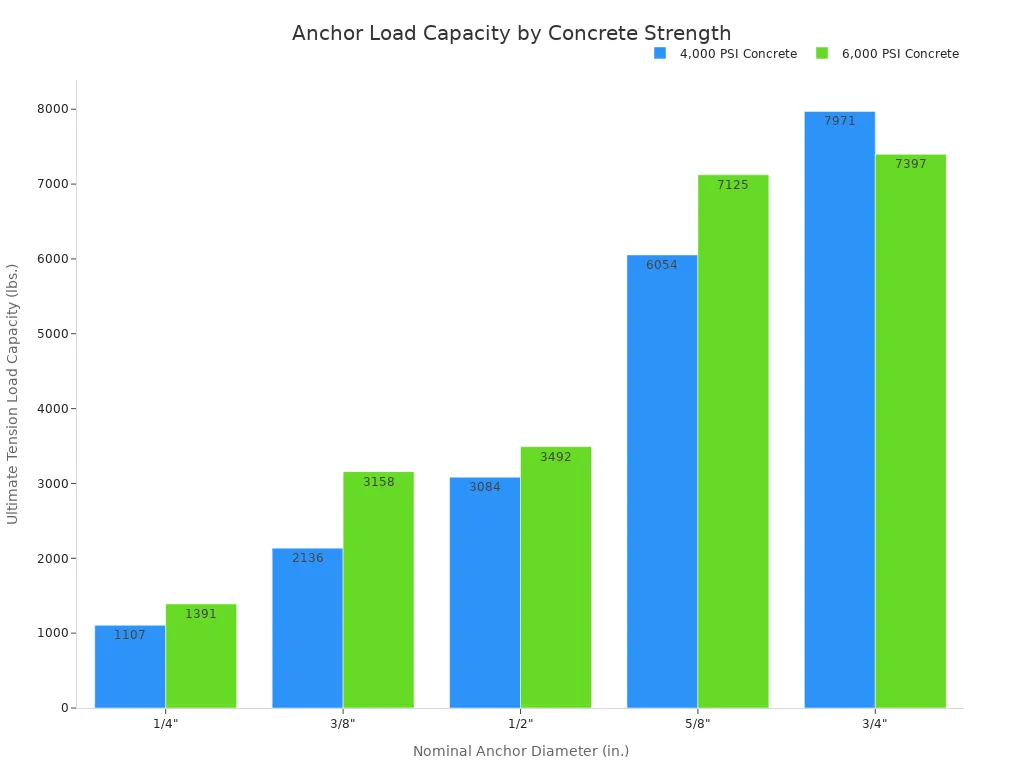
| Nominal Anchor Diameter (in.) | Minimum Embedment Depth (in.) | Concrete Compressive Strength (PSI) | Ultimate Tension Load Capacity (lbs.) |
|---|---|---|---|
| 1/4″ | 1-1/8″ | 4,000 | 1,107 |
| 1/4″ | 1-1/8″ | 6,000 | 1,391 |
| 3/8″ | 1-5/8″ | 4,000 | 2,136 |
| 3/8″ | 1-5/8″ | 6,000 | 3,158 |
| 1/2″ | 2-1/4″ | 4,000 | 3,084 |
| 1/2″ | 2-1/4″ | 6,000 | 3,492 |
Age and Quality of the Concrete
Older concrete may be weaker or have hidden damage. The quality of the initial pour also matters. An installer should always assess the concrete’s general condition before drilling.
Considering Environmental Factors
The environment where the anchor is installed will dictate the material it must be made from.
Interior vs. Exterior Applications
Indoor, dry environments are the least demanding. Exterior applications expose anchors to moisture, temperature swings, and sunlight, which requires more durable materials.
Corrosion Resistance (Zinc vs. Stainless Steel)
Corrosion is a major threat to an anchor’s longevity and safety. The material choice is critical for preventing rust and degradation.
| Material | Water Exposure | Saltwater Exposure | Chlorine Exposure |
|---|---|---|---|
| Galvanized Steel | Withstands | Not recommended | Not specified |
| 304 Stainless Steel | Withstands | Degrades | Degrades |
| 316 Stainless Steel | Withstands | Resists | Resists |
Exposure to Chemicals or Moisture
For applications exposed to saltwater, chlorine (like in pools), or industrial chemicals, 316 stainless steel is the superior choice. Its molybdenum content provides enhanced protection against corrosion, ensuring a safe and lasting connection.
Essential Installation Steps for Concrete Anchor Bolts
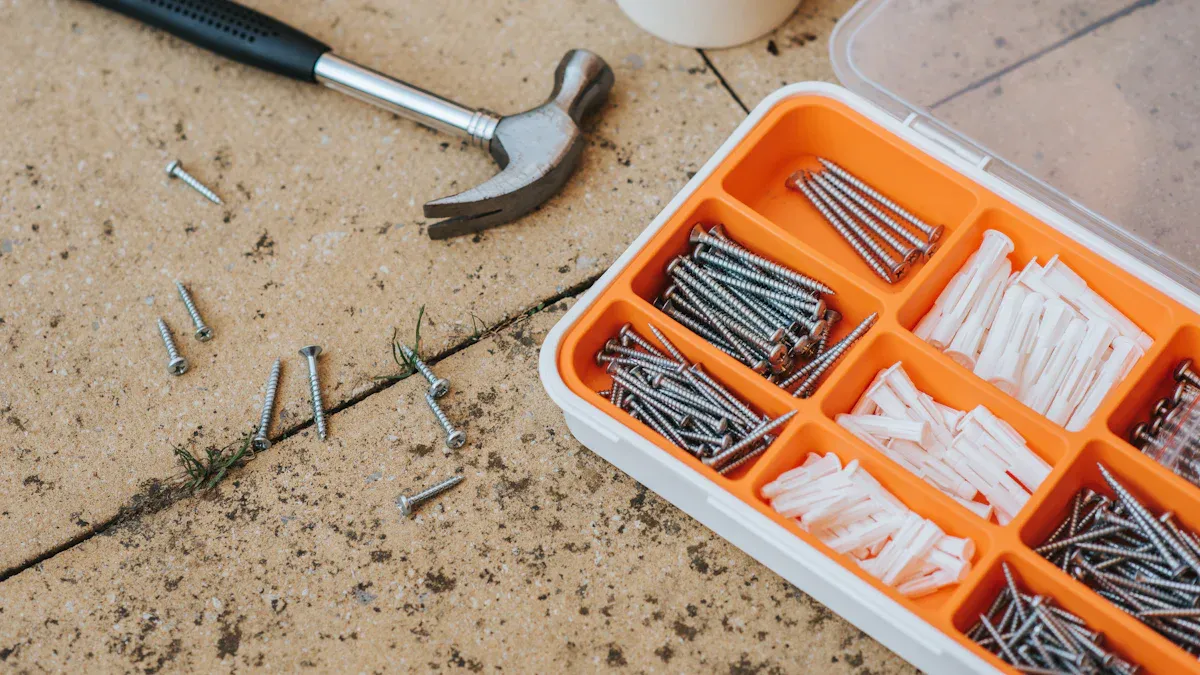
A successful anchor bolt installation depends on precision and adherence to established procedures. Following the correct steps ensures the fastener achieves its maximum holding power and provides a safe, reliable connection. The process can be broken down into site preparation, proper installation techniques, and awareness of common mistakes.
Preparing the Installation Site
Proper preparation of the concrete base is the foundation for a secure anchor. This initial phase is non-negotiable for achieving specified load capacities.
Drilling the Hole to Correct Depth and Diameter
An installer must drill a hole that precisely matches the manufacturer’s specifications for the chosen anchor. Rigorous inspection of the drill hole is essential. The diameter must allow for a proper fit, while the depth must accommodate the full length of the anchor. Any deviation can lead to an improper fitting and a significant reduction in the anchor’s effectiveness.
Cleaning the Hole of Dust and Debris
After drilling, the hole must be meticulously cleaned. Any remaining dust or debris will compromise the anchor’s performance. The standard industry procedure involves:
- Using a wire brush to scrub the inside walls of the hole.
- Blowing the hole clean with compressed air or a vacuum.
- Repeating this brush-and-blow process until no more dust emerges.
Why a Clean Hole is Critical for Anchor Performance
A clean hole is paramount for all concrete anchors, but it is especially critical for chemical (adhesive) systems. The adhesive must bond directly with the concrete, not with a layer of dust.
An improperly cleaned hole can lead to a catastrophic reduction in load capacity, sometimes by as much as 70%. This failure occurs because the anchor bonds to the loose dust instead of the solid base material, leading to uncontrolled displacement under load.
Proper Anchor Installation Techniques
With a clean hole prepared, the installer can proceed with setting the anchor. Each type requires a specific technique to ensure it functions as designed.
Setting the Anchor Correctly
The installer places the anchor into the prepared hole. For mechanical anchors like a wedge anchor, this involves hammering it into place. For a chemical anchor, the installer slowly inserts a threaded rod with a rotary movement to ensure the adhesive fully coats the threads and fills the void.
Applying the Correct Torque
For mechanical anchors, applying the correct torque is essential. Torque creates the clampload that activates the anchor’s expansion mechanism. An installer must use a calibrated torque wrench to tighten the nut to the manufacturer’s specified value. Under-torquing results in a weak hold, while over-torquing can damage the concrete or the anchor itself.
| Diameter (inches) | Clampload (ft-lbs) |
|---|---|
| 1/2 | 53 |
| 5/8 | 106 |
| 3/4 | 188 |
| 1 | 454 |
| 1 1/4 | 938 |
Observing Cure Times for Chemical Anchors
Chemical anchors require a specific amount of time to cure before any load can be applied. This cure time is highly dependent on the ambient temperature. Higher temperatures accelerate the chemical reaction, shortening the cure time. Conversely, cooler temperatures slow the process down, requiring a longer wait. An installer must always consult the product data sheet and wait for the full cure time to pass before loading the anchor.
Common Installation Mistakes to Avoid
Avoiding simple errors during installation is key to ensuring long-term safety and performance.
Over-Torquing or Under-Torquing
This is one of the most common mistakes. Using an impact wrench or guessing the tightness by feel often leads to incorrect torque values, compromising the entire connection.
Incorrect Hole Depth or Diameter
Drilling a hole that is too shallow, too deep, too wide, or too narrow will prevent the anchor from setting correctly and achieving its rated load capacity.
Installing Too Close to an Edge
Placing an expansion anchor too close to a concrete edge or corner can cause the concrete to crack and spall when the anchor is tightened. This outward pressure can break off a chunk of the concrete, resulting in complete anchor failure.
Comparing Popular Types of Concrete Anchors
Selecting the right fastener requires a direct comparison of the available types of anchor bolts. Understanding the key differences between popular options helps an installer make the best choice for safety and performance.
Wedge Anchor vs. Sleeve Anchor
Both wedge and sleeve anchors are common mechanical fasteners, but they serve different purposes. Their designs dictate their load capacity and the materials they can secure into.
Load Capacity Differences
Concrete wedge anchors are engineered for heavy-duty applications. They provide superior tensile and shear strength for securing structural elements and heavy machinery. Concrete sleeve anchors, in contrast, are designed for light to medium-duty tasks. Their holding power is sufficient for fixtures like handrails and shelving but not for significant structural loads.
Base Material Suitability
The primary distinction lies in their compatibility with different base materials. Wedge anchor bolts are suitable only for solid concrete. Their powerful expansion force can damage or crack softer materials.
| Anchor Type | Solid Concrete | Brick | Hollow Block |
|---|---|---|---|
| Wedge Anchor | ✅ Excellent | ❌ Not Recommended | ❌ Not Recommended |
| Sleeve Anchor | ✅ Good | ✅ Suitable | ✅ Suitable (with caution) |
Choosing for Your Project
An installer chooses concrete wedge anchors for high-strength connections in solid concrete. Concrete sleeve anchors offer greater versatility for medium-duty jobs across a range of masonry materials. The project’s load and base material will determine the correct choice.
Mechanical Anchor vs. Chemical Anchor
The choice between mechanical and chemical systems represents a fundamental decision in fastening technology. These two types of concrete anchors offer different benefits regarding strength, cost, and application.
Strength and Performance
Chemical anchors generally provide the highest possible load capacity. They create a stress-free bond that is often stronger than the concrete itself, making them ideal for cracked concrete or applications near an edge. Mechanical anchors are very strong but create high expansion forces within the concrete, which can be a limitation.
Installation Complexity and Cost
Mechanical anchors offer a simpler and faster installation. They are ready for immediate loading after torquing. Chemical systems are more complex.
Chemical Anchor Installation Steps:
- Drill the hole.
- Clean the hole meticulously (brush and blow).
- Inject the adhesive.
- Insert the threaded rod.
- Wait for the adhesive to cure. This process makes the installation more time-consuming and temperature-sensitive. Chemical anchors and their adhesives are also typically more expensive than their mechanical counterparts.
When to Choose One Over the Other
Choosing the best anchor for concrete depends on project demands.
- Choose Mechanical Anchors for: Speed, cost-effectiveness, and standard static loads in good-quality concrete.
- Choose Chemical Anchors for: Maximum strength, dynamic or vibratory loads, cracked concrete, or installations close to edges. A thorough evaluation of these different types of concrete anchor bolts ensures a secure and durable result for any application involving concrete anchors.
The primary function of an anchor bolt is to provide critical stability by securely fastening items to concrete. Selecting the correct anchor bolt is not a one-size-fits-all decision. The consequences of an incorrect choice are significant, especially in demanding projects.
- In one high-rise project, the use of Grade 55 bolts instead of the required Grade 105 bolts led to failure during a mild tremor.
A successful and safe installation ultimately depends on matching the right fastener to the load requirements, concrete condition, and environmental factors of a project.
FAQ
What is the strongest type of concrete anchor?
Chemical (adhesive) anchors generally offer the highest load capacity. They create a powerful bond with the concrete that is often stronger than the base material itself. This makes them ideal for the most demanding heavy-duty applications.
Can I install an anchor close to a concrete edge?
Installers must exercise caution near edges. Mechanical expansion anchors can crack the concrete if placed too close.
Chemical anchors are the best choice for applications near an edge because they bond without creating expansion stress, preventing spalling and failure.
Why is cleaning the drilled hole so important?
A clean hole ensures a secure connection. Dust and debris prevent the anchor from making full contact with the solid concrete. For chemical anchors, a dirty hole can reduce holding power by over 50%, leading to catastrophic failure.
Can I reuse a concrete anchor?
Most post-installed anchors are not reusable. Removing a mechanical anchor bolt damages its expansion mechanism. While the bolt in a drop-in anchor can be replaced, the anchor body itself remains permanently set in the concrete.
What happens if I over-tighten an anchor?
Over-tightening an anchor is dangerous. It creates excessive stress that can crack the concrete or damage the anchor’s steel components. An installer must always use a calibrated torque wrench to apply the manufacturer’s specified torque value for a secure installation.
How do I choose an anchor for cracked concrete?
An installer must select an anchor specifically tested and approved for use in cracked concrete. Chemical anchors perform exceptionally well in these conditions. Many specialized mechanical anchors are also rated for cracked concrete, so always check the product specifications.
What is the difference between a J-bolt and an L-bolt?
The primary difference is the shape of the embedded end. A J-bolt has a curved hook, while an L-bolt has a 90-degree bend. Both are cast-in-place anchors that provide strong mechanical interlock once the concrete cures.