The global market for concrete fasteners, including Anchor Bolts, continues to expand. Projections show significant growth, reflecting the construction industry’s ongoing demand for reliable anchoring solutions. A skilled custom fasteners manufacturer can even produce custom anchor bolts for unique jobs.
| Metric | Value |
|---|---|
| Projected Market Size (by 2033) | USD 8.1 Billion |
| Compound Annual Growth Rate (CAGR) (2026-2033) | 6.0% |
| Market Size (2024) | USD 5.2 Billion |
Professionals require the best anchors for securing fixtures into concrete. The top 5 sleeve anchors for 2026 are:
- Hilti HSL-3 Sleeve Anchor – Best Overall Performance
- Red Head Dynabolt Sleeve Anchor – Best for Heavy-Duty Applications
- Powers Fasteners Sleeve-All – Best Value for Money
- Simpson Strong-Tie Sleeve-All (Stainless Steel) – Best for Corrosive Environments
- CONFAST Flat Head Sleeve Anchor – Easiest to Install
1. Hilti HSL-3 Sleeve Anchor – Best Overall Performance
The Hilti HSL-3 earns its top spot as the best overall performer for 2026. This heavy-duty sleeve anchor provides an exceptional combination of strength, reliability, and advanced features. It is the go-to choice for professionals tackling critical fastening jobs in both cracked and uncracked concrete. Its engineering ensures safety and durability in demanding structural applications.
Key Specifications
Hilti provides comprehensive technical data for the HSL-3. This allows engineers and contractors to specify the correct anchor with confidence. The specifications demonstrate its suitability for heavy-duty tasks.
| Feature | Specification |
|---|---|
| Material | Carbon steel, zinc-plated (min. 5 µm) |
| Diameters | 8 mm, 10 mm, 12 mm, 16 mm, 20 mm, 24 mm |
| Lengths | 60 mm to 280 mm |
| Max Tensile Load | Up to 44.9 kN (24mm in C50/60 concrete) |
| Max Shear Load | Up to 67.4 kN (24mm in C50/60 concrete) |
Material Composition
The anchor consists of high-strength carbon steel. A zinc plating of at least 5 micrometers provides moderate corrosion resistance for indoor applications.
Available Diameters
A wide range of diameters from 8 mm to 24 mm is available. This selection covers a broad spectrum of load requirements.
Available Lengths
Lengths vary from 60 mm up to 280 mm. This accommodates different fixture thicknesses and embedment depth needs.
Maximum Tensile Load
The HSL-3 boasts impressive tensile (pull-out) strength, reaching up to 44.9 kN for the largest diameter.
Maximum Shear Load
Its shear capacity is even more remarkable, handling loads up to 67.4 kN, making it ideal for resisting lateral forces.
Primary Use Cases
The HSL-3 excels in safety-critical applications where failure is not an option. Its design is optimized for transferring significant loads into concrete.
Note: The HSL-3 meets stringent building codes, making it a trusted choice for engineers. Key approvals include:
- ICC-ES (International Code Council) – ESR-1545
- Qualification under an NQA-1 nuclear quality program
Securing Heavy Machinery
This anchor provides the stability needed to fasten large industrial machines, pumps, and motors, resisting vibrations and operational forces.
Structural Steel Connections
It is specifically designed for anchor plate solutions. The anchor’s shear sleeve provides extra capacity, making it perfect for connecting steel beams and columns.
Racking System Installation
The HSL-3’s high load capacity ensures the safe and secure installation of heavy-duty pallet racking and industrial shelving systems.
Pros
The advantages of the HSL-3 anchor make it a market leader for professional use.
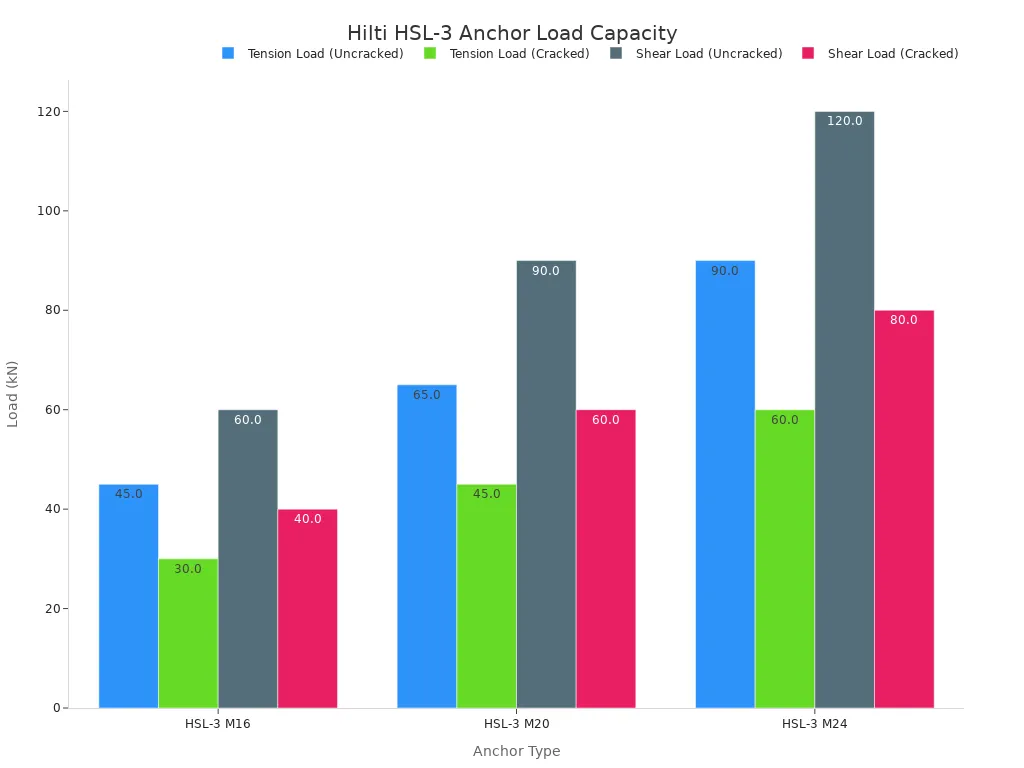
Exceptional Load Capacity
This anchor delivers a very high load capacity in both tension and shear. It provides a robust solution for the most demanding jobs.
High-Performance in Cracked Concrete
Many anchors lose significant strength in cracked concrete. The HSL-3, however, is engineered to maintain impressive performance, ensuring safety where tensile stresses might cause cracking.
Easy Installation Process
Hilti designed the HSL-3 with a torque limitation nut. This feature prevents over-tightening or under-tightening, which simplifies the installation process and guarantees correct anchor setting every time.
Cons
While the Hilti HSL-3 stands out for its performance, professionals must consider its specific requirements and cost. These factors are not necessarily drawbacks but trade-offs for its superior engineering and reliability. Understanding these considerations ensures the anchor is selected for the right applications where its benefits justify the investment.
Premium Price Point
The most significant consideration for many projects is the HSL-3’s premium price. This anchor sits at the higher end of the market, reflecting its advanced design, extensive research and development, and stringent quality control. The cost is a direct result of its high-performance capabilities and the numerous certifications it holds.
Factors contributing to its higher cost include:
- Advanced Engineering: The unique expansion mechanism and torque-control nut are patented features that guarantee performance.
- Superior Materials: Use of high-grade carbon steel and a quality zinc coating adds to the manufacturing expense.
- Extensive Testing: The HSL-3 undergoes rigorous testing to earn approvals for use in cracked concrete and seismic zones, a process that adds considerable overhead.
For small-scale or non-critical applications, the cost may be prohibitive. Project managers must perform a cost-benefit analysis. They need to weigh the anchor’s price against the safety requirements and long-term security of the connection. The investment is often justified for applications where failure could have catastrophic consequences.
Requires Precise Hole Drilling
The HSL-3’s exceptional load ratings are contingent upon precise installation. The anchor’s engineering tolerances leave little room for error. Installers must drill the hole to the exact diameter and depth specified in the technical data sheet. Any deviation can compromise the anchor’s holding power and overall performance. Using a worn drill bit or creating an oversized hole will prevent the sleeve from engaging the concrete correctly.
Furthermore, hole cleanliness is paramount. The hole must be completely free of dust and debris before anchor insertion. This often requires more than a simple blow-out bulb.
Professional Tip: For best results and to meet technical specifications, always use a hollow drill bit connected to a Hilti vacuum system. This method cleans the hole during the drilling process, ensuring a perfect surface for the anchor to grip and saving significant time on the job site.
This requirement for precision means that installation may take longer compared to more forgiving anchor types. It also necessitates a higher skill level from the installer and the use of proper, well-maintained tools.
2. Red Head Dynabolt Sleeve Anchor – Best for Heavy-Duty Applications
The Red Head Dynabolt has built a formidable reputation in the construction industry. It stands as a benchmark for heavy-duty sleeve anchors. Professionals choose the Dynabolt for its raw power and unwavering reliability in critical structural connections. Its robust design provides immense holding strength, making it the premier choice for applications where safety and load-bearing capacity are paramount. This anchor is a true workhorse for demanding jobs.
Key Specifications
Red Head provides a comprehensive range of options for the Dynabolt. This allows for precise matching to project requirements. The anchor is tested to meet ASTM E488 criteria, ensuring it performs as specified.
| Specification | Detail |
|---|---|
| Material Options | Zinc-Plated Carbon Steel, 304 Stainless Steel |
| Head Styles | Hex Nut, Flat Head, Round Head, Acorn Nut |
| Anchor Diameters | 1/4″ to 3/4″ |
| Overall Lengths | 5/8″ to 6-1/4″ |
Material Composition
The Dynabolt is available in two primary materials. Zinc-plated carbon steel offers excellent strength for interior applications. For projects requiring corrosion resistance, 304 stainless steel is the ideal selection.
Available Diameters
A wide array of diameters is available, from 1/4″ up to 3/4″. This range accommodates everything from medium-duty fixtures to massive structural elements.
Available Lengths
Lengths span from a short 5/8″ to a long 6-1/4″. This versatility ensures a proper fit for various fixture thicknesses and embedment depth requirements in concrete.
Maximum Tensile Load
The Dynabolt delivers impressive pull-out resistance. Larger diameters can achieve ultimate tensile loads well over 10,000 lbs in high-strength concrete.
Maximum Shear Load
Shear capacity is where the Dynabolt truly excels. Its design provides superior resistance to lateral forces, often exceeding its tensile strength.
Primary Use Cases
The Dynabolt’s strength profile makes it suitable for the most challenging fastening tasks.
Pro Tip: 💡 When installing Dynabolts, always use a torque wrench to tighten the nut to the manufacturer’s specified value. This ensures the anchor achieves its full expansion and rated load capacity.
Attaching Support Ledgers
It provides the necessary shear and tensile strength to securely fasten wood or steel ledgers to concrete foundation walls.
Seismic and Wind Bracing
Engineers frequently specify Dynabolts for seismic retrofits and wind bracing. The anchor’s ability to handle dynamic loads makes it a trusted component in these life-safety systems.
Fastening Motors and Pumps
The anchor’s durability and strength make it perfect for securing heavy, vibrating machinery like industrial motors and pumps to factory floors.
Pros
The Dynabolt offers several key advantages for heavy-duty work.
Unmatched Shear Strength
The Dynabolt is renowned for its exceptional shear values. Its sleeve design engages the base material fully, providing a solid connection that resists side-to-side forces effectively.
Reliable in Cracked and Uncracked Concrete
While some anchors are limited to uncracked conditions, the Dynabolt performs reliably in both cracked and uncracked concrete, offering greater design flexibility.
Versatile Head Styles
It comes in multiple head configurations, including hex, flat, round, and acorn. This versatility allows installers to choose the right finish for any application, from industrial machinery to architectural fixtures.
Cons
The Red Head Dynabolt’s reputation for strength comes with specific considerations. Professionals should understand these factors to ensure they select this anchor for the appropriate job. The anchor’s design prioritizes power, which influences its installation requirements and cost-effectiveness for certain tasks.
May Require Specialized Setting Tools
Achieving the Dynabolt’s maximum rated load capacity demands precision during installation. While a standard wrench can tighten the anchor, professionals rely on a calibrated torque wrench. Applying the manufacturer’s specified torque is critical for proper expansion and holding power. Failure to do so can result in an under-torqued anchor that will not meet its load rating or an over-torqued anchor that can damage the threads or the concrete base material.
For certain diameters and critical applications, Red Head offers a specialized setting tool. This tool ensures the sleeve expands correctly within the drilled hole. It provides a uniform setting action that a simple wrench cannot replicate.
Installation Note: Using the correct setting tool and a torque wrench moves the installation from a simple fastening task to a precise, engineered connection. This requirement ensures safety but adds a layer of complexity and potential tool cost that other anchors may not have.
This need for specific tools and adherence to torque values makes the installation process less forgiving than that of general-purpose anchors.
Overkill for Light-Duty Tasks
The Dynabolt is engineered for immense strength. This makes it an inefficient and uneconomical choice for light-duty applications. Its power is simply unnecessary for tasks like securing electrical conduit, fastening lightweight signage, or mounting small shelving units. Using a heavy-duty anchor for these jobs is like using a sledgehammer to hang a picture frame.
There are several reasons why it is not ideal for minor jobs:
- Cost: The price per anchor is significantly higher than that of light-duty fasteners like nylon nail-ins or smaller wedge anchors.
- Installation Effort: Drilling a larger, deeper hole and properly torquing a Dynabolt requires more time and effort than a simple light-duty anchor.
- Expansion Force: The powerful expansion force generated by a Dynabolt, especially in larger diameters, can create high stress in the base material. This force could potentially crack or spall thinner concrete slabs or installations near an unsupported edge.
Professionals save time and money by matching the anchor’s capacity to the application’s load requirements. The Dynabolt’s power is best reserved for jobs that truly demand it.
3. Powers Fasteners Sleeve-All – Best Value for Money
The Powers Fasteners Sleeve-All anchor carves out its niche as the best value proposition for 2026. It strikes an optimal balance between reliable performance and affordability. This anchor is the workhorse for countless general-purpose projects where premium, high-load specifications are unnecessary. Contractors and serious DIYers appreciate its straightforward design and dependable holding power for medium-duty applications. It delivers solid results without straining the project budget.
Key Specifications
The Sleeve-All comes in common sizes and materials suitable for a wide range of everyday fastening jobs. Its specifications provide consistent performance for general fixture mounting.
- Material Composition: Zinc-plated carbon steel bolt, sleeve, and cone.
- Available Diameters: 1/4″ to 3/4″
- Available Lengths: 1-1/2″ to 6″
- Head Styles: Hex Nut, Flat Head, Round Head
Material Composition
The anchor is constructed from carbon steel components. A standard zinc plating provides basic corrosion protection for dry, indoor environments.
Available Diameters
A versatile range of diameters makes it easy to match the anchor to the fixture’s hole size and load requirement.
Available Lengths
With lengths extending up to 6 inches, the Sleeve-All can accommodate various material thicknesses while achieving proper embedment in the concrete.
Maximum Tensile Load
It offers respectable tensile (pull-out) strength for medium-duty tasks. The load capacity is more than sufficient for securing shelving, brackets, and handrails.
Maximum Shear Load
The anchor provides good shear resistance. This makes it reliable for applications that experience lateral forces, such as guardrails.
Primary Use Cases
The Sleeve-All excels in common, non-structural applications where cost-effectiveness is a key consideration.
Did You Know? Many versions of this anchor, including heavy-duty variants, are code-listed (ICC-ES) for use in both cracked and uncracked concrete, showcasing their reliable engineering.
Fastening Handrails and Guardrails
It provides the necessary strength to securely mount handrail posts and safety guardrails to concrete floors and walkways.
Securing Shelving Units
This anchor is an excellent choice for installing medium-duty commercial or garage shelving systems that do not carry extreme loads.
General Fixture Mounting
Its primary role is general fastening. This includes securing brackets, conduit straps, junction boxes, and other lightweight to medium-weight fixtures.
Pros
The Sleeve-All’s popularity stems from its practical advantages for a broad audience.
Excellent Performance-to-Cost Ratio
This is the anchor’s main selling point. It provides dependable holding power that meets the needs of most common applications at a fraction of the cost of high-performance anchors.
Widely Available in Hardware Stores
Installers can easily find the Sleeve-All at most hardware stores and construction suppliers. This accessibility makes it a convenient choice for planned projects and last-minute needs.
Good for General Purpose Use
With its simple design and reliable performance, the Sleeve-All is a versatile and forgiving fastener. It is an ideal go-to anchor for a toolbox, ready for a wide variety of fastening jobs.
Cons
While the Powers Fasteners Sleeve-All offers excellent value, contractors must understand its limitations. These trade-offs are a direct result of its cost-effective design. Recognizing these factors ensures professionals use the anchor in appropriate scenarios, preventing misapplication in demanding jobs.
Lower Load Ratings Than Premium Options
The primary trade-off for the Sleeve-All’s affordability is its load capacity. It does not possess the same ultimate tensile and shear strength as premium, engineered anchors like the Hilti HSL-3 or Red Head Dynabolt. The design and materials are optimized for medium-duty applications, not for critical structural connections.
This lower rating makes it unsuitable for:
- Securing heavy industrial machinery subject to vibration.
- Fastening structural steel beams or columns.
- Applications in seismic zones requiring extensive engineering approvals.
- Any overhead application where failure could lead to serious safety risks.
Professionals must always consult the manufacturer’s technical data sheets. They should compare the anchor’s load values against the project’s specific requirements. Using this anchor for a heavy-duty task is a significant safety risk. It is essential to select a fastener rated for the specific load it will bear.
Standard Zinc Plating Offers Limited Rust Protection
The Sleeve-All anchor typically features a standard zinc-plated carbon steel construction. This coating provides a basic level of protection against corrosion. It is perfectly adequate for dry, climate-controlled indoor environments. However, this thin layer of zinc offers very limited defense against moisture.
Environmental Warning: ⚠️ Do not use standard zinc-plated anchors for outdoor projects, in basements prone to dampness, or in areas with high humidity. Exposure to moisture will cause the zinc coating to break down, allowing the steel to rust.
Rust compromises the anchor’s structural integrity over time. It can reduce the anchor’s diameter and weaken its holding power within the concrete. For any application involving potential exposure to weather, water, or corrosive chemicals, installers must choose an anchor with superior protection. Options like hot-dip galvanized or stainless steel anchors provide the long-term durability needed for harsh conditions. The initial cost savings of a zinc-plated anchor are quickly lost if it fails prematurely due to corrosion.
4. Simpson Strong-Tie Sleeve-All (Stainless Steel) – Best for Corrosive Environments
When a project demands uncompromising durability against the elements, the Simpson Strong-Tie Sleeve-All in stainless steel is the definitive choice for 2026. This anchor is specifically engineered for longevity in harsh environments where standard zinc-plated fasteners would quickly fail. Its superior material composition provides maximum protection against rust and corrosion. This makes it an essential component for ensuring long-term safety and structural integrity in challenging conditions.
Key Specifications
Simpson Strong-Tie offers this anchor in materials designed to withstand moisture and chemical exposure. The specifications reflect its focus on durability over raw strength.
- Material Composition: Type 304 or Type 316 Stainless Steel
- Available Diameters: 1/4″ to 3/4″
- Available Lengths: 1-3/4″ to 6-1/4″
- Head Styles: Hex Nut, Flat Head, Round Head
Material Composition
The anchor is available in Type 304 stainless steel for general atmospheric corrosion resistance and Type 316 stainless steel for superior protection in marine or chemical environments.
Available Diameters
A full range of diameters from 1/4″ to 3/4″ allows for versatile use in various fixture and load requirements.
Available Lengths
Lengths up to 6-1/4″ accommodate different fixture thicknesses and ensure proper embedment depth in the concrete base material.
Maximum Tensile Load
It provides strong tensile performance. The values are slightly lower than carbon steel counterparts but more than sufficient for securing fixtures in corrosive settings.
Maximum Shear Load
The anchor delivers reliable shear capacity, ensuring a stable connection that resists lateral forces even after prolonged environmental exposure.
Primary Use Cases
This anchor excels in applications where moisture, chemicals, or salt spray are a constant threat.
Material Tip: 💡 Choose Type 316 stainless steel for projects within a few miles of the coast or in direct contact with de-icing salts for the best long-term performance.
Outdoor Deck and Patio Installations
It is the ideal fastener for securing ledger boards and support posts for decks and patios to a concrete foundation, preventing rust stains and degradation.
Coastal Area and Marine Projects
The stainless steel construction is essential for docks, seawalls, and buildings in coastal regions where salt-laden air accelerates corrosion.
Chemical Plant and Industrial Applications
Professionals use this anchor in facilities where chemical exposure is a concern. It is recommended for use in:
- Exterior environments with rain and humidity.
- Areas with exposure to chemicals like fertilizers, acidic soil, or acid rain.
- Wet settings where the installation involves preservative or fire-retardant treated wood.
Pros
The benefits of the stainless steel Sleeve-All are centered on its exceptional resilience.
Maximum Rust and Corrosion Resistance
This is the anchor’s primary advantage. The chromium content in stainless steel creates a passive layer that protects the steel from rust, ensuring the connection remains secure.
Long-Term Durability in Harsh Conditions
This anchor is a “set it and forget it” solution for tough environments. It resists degradation from moisture and chemicals, providing peace of mind for decades.
Maintains Structural Integrity Over Time
Corrosion can weaken an anchor and compromise its load-bearing capacity. This stainless steel anchor maintains its strength, ensuring the concrete fastening point remains safe and reliable over the life of the structure.
Cons
The superior corrosion resistance of the Simpson Strong-Tie stainless steel Sleeve-All comes with specific trade-offs. Professionals must weigh these factors against the long-term benefits for projects in harsh environments. The anchor’s material properties directly influence its cost and mechanical performance.
Significantly More Expensive
The most significant factor for project managers is the anchor’s high price point. Stainless steel is inherently more costly than carbon steel. This price difference is not arbitrary but is based on several key factors.
- Raw Material Costs: Stainless steel alloys contain expensive elements like chromium and nickel. These materials provide corrosion resistance but dramatically increase the base material cost.
- Manufacturing Process: Working with stainless steel is more challenging than working with carbon steel. It requires specialized tooling and slower manufacturing speeds, which adds to the production expense.
- Market Demand: Stainless steel fasteners are a specialty item compared to their zinc-plated counterparts. Lower production volumes mean fewer economies of scale.
This higher cost makes the anchor an impractical choice for standard indoor applications. Its use is justified only when environmental conditions demand maximum protection against rust and degradation.
Slightly Lower Strength Than Carbon Steel
A critical engineering consideration is the material’s inherent strength. Stainless steel, while incredibly durable, typically has slightly lower ultimate tensile and shear strength ratings than equivalent-sized, high-strength carbon steel anchors. This is a fundamental metallurgical trade-off. The alloying elements that provide excellent corrosion resistance also result in a metal that is slightly softer and less brittle than hardened carbon steel.
An engineer must account for this difference during the design phase. They will consult the manufacturer’s technical data to ensure the specified stainless steel anchor meets the calculated load requirements for the fixture and the concrete base material.
This minor reduction in strength is rarely an issue for the intended applications. The fixtures being secured in corrosive environments usually do not demand the absolute maximum load capacity of a heavy-duty structural anchor. The priority is longevity and preventing failure due to corrosion, not achieving the highest possible load rating. The anchor still provides more than enough strength for securing railings, posts, and equipment in these settings.
5. CONFAST Flat Head Sleeve Anchor – Easiest to Install
For projects where speed and simplicity are the top priorities, the CONFAST Flat Head Sleeve Anchor is the leading choice for 2026. This anchor earns its title as the easiest to install due to its straightforward, pre-assembled design and forgiving nature. It is the perfect solution for DIY enthusiasts and professionals performing quick, non-structural fastening tasks. Its countersunk head provides a clean, flush finish, making it ideal for applications where aesthetics matter.
Key Specifications
CONFAST provides these versatile anchors in materials suited for both indoor and outdoor use. The specifications are tailored for light to medium-duty applications in various base materials, including concrete.
| Specification | Detail (Example: 3/8″ x 5″ Stainless) |
|---|---|
| Material Options | Zinc Plated Steel, 304 Stainless Steel |
| Head Type | Flat Countersunk Phillips |
| Pull-Out Strength | 1,406 lbs. (in 2000 PSI Concrete) |
| Shear Strength | 3,082 lbs. (in 2000 PSI Concrete) |
| Minimum Embedment | 1-1/4″ |
Material Composition
The anchor is available in two versions. A zinc-plated option provides protection for dry, indoor use, while the 304 stainless steel model offers excellent rust resistance for wet environments.
Available Diameters
Common diameters such as 1/4″, 5/16″, and 3/8″ are readily available to match various fixture requirements.
Available Lengths
A range of lengths accommodates different fixture thicknesses, ensuring a secure fit for many common jobs.
Maximum Tensile Load
It offers reliable pull-out strength for light-duty tasks, easily supporting items like shelving and brackets.
Maximum Shear Load
The anchor provides good shear capacity, making it dependable for fastening items that may experience some lateral force.
Primary Use Cases
The CONFAST Flat Head anchor is designed for versatility and a clean finish. Its ability to sit flush with the fixture surface makes it a favorite for many applications.
Versatility Note: This anchor’s broad expansion mechanism makes it effective not only in solid concrete but also in lighter base materials like hollow block and brick.
DIY Garage and Basement Projects
Homeowners find this anchor ideal for securing workbenches, tool cabinets, and storage shelving to garage floors or basement walls.
Attaching Temporary Fixtures
Its simple installation and removal process make it perfect for temporary bracing, event signage, or other fixtures that are not permanent.
Non-Structural Attachments
Professionals use it to fasten items like door frames, window bucks, and electrical junction boxes where a high load rating is not the primary concern.
Pros
The anchor’s popularity is rooted in its user-friendly design and efficiency.
Simple Pre-Assembled Design
The anchor comes fully assembled and ready to use right out of the box. This eliminates the need to handle separate nuts and washers, streamlining the entire workflow.
Forgiving of Minor Hole Imperfections
Its wide expansion range makes it less sensitive to slight variations in hole diameter, a common issue with worn drill bits. This forgiving nature helps ensure a secure grip.
Ideal for Quick Fastening Tasks
The combination of a pre-assembled body and a simple setting process makes this anchor perfect for rapid-fire fastening jobs, saving valuable time on site.
Cons
The CONFAST Flat Head Sleeve Anchor’s focus on simplicity and speed comes with important limitations. Professionals must recognize these trade-offs to ensure safe and appropriate use. The anchor is designed for a specific niche, and using it outside of that scope can lead to poor performance or failure.
Not for High-Load or Critical Applications
This anchor’s primary drawback is its limited load capacity. It is engineered for light to medium-duty tasks. The design prioritizes quick installation over the immense holding power found in heavy-duty structural anchors. Installers must not use this fastener for applications that bear significant weight or are critical to structural integrity.
Unsuitable uses include:
- Securing structural steel beams or columns.
- Anchoring heavy industrial machinery.
- Supporting pallet racking systems with high load ratings.
- Any application where failure could cause significant property damage or injury.
The anchor provides adequate strength for its intended purpose. However, its pull-out and shear values in concrete are substantially lower than those of premium, engineered fasteners. Always consult the manufacturer’s technical data to verify that the load requirements of the fixture are well within the anchor’s published capacity.
Not Suitable for Overhead Use
A critical safety warning applies to this anchor. Professionals should never use sleeve-type anchors for overhead applications where the load is in direct tension. This is a standard industry-wide precaution. The expansion mechanism of a sleeve anchor is less reliable under constant tensile stress compared to other anchor types like wedge anchors or adhesive anchors.
Safety Warning: ⚠️ Using sleeve anchors for overhead fastening creates a significant safety hazard. The anchor could loosen over time due to vibrations or load cycling, leading to a sudden and catastrophic failure. Always select an anchor specifically rated and designed for overhead use in these situations.
This limitation is not unique to the CONFAST anchor but applies to the entire category of sleeve anchors. The risk of an object falling from the ceiling is too great to justify its use in such scenarios.
Limited Size and Material Options
The CONFAST anchor is tailored for the most common light-duty jobs. This focus results in a more limited selection of sizes and materials compared to brands that serve a broader industrial market. While it covers the basics with common diameters and lengths, finding very large diameters or extra-long anchors for thick fixtures can be difficult.
The material options are typically restricted to standard zinc-plated steel and Type 304 stainless steel. This range is sufficient for many projects. However, it lacks options for highly corrosive environments that would require a more robust material. For marine applications or exposure to harsh industrial chemicals, professionals would need to source an anchor made from Type 316 stainless steel or another specialized alloy, which this product line generally does not offer.
Understanding Sleeve Anchor Fundamentals
Choosing the right anchor requires a basic understanding of how it works and what it is made of. Sleeve anchors are a popular choice for fastening into concrete because of their reliable expansion mechanism and straightforward installation. This section breaks down the core principles, components, and materials that define these versatile fasteners.
How Do Sleeve Anchors Work?
The effectiveness of sleeve anchors lies in a simple yet powerful mechanical principle. They create a secure connection by expanding within the pre-drilled hole.
The Expansion Mechanism
A sleeve anchor’s holding power in concrete is generated through a mechanical expansion process. When an installer tightens the nut or bolt head, it pulls the threaded stud upwards. This action draws a cone-shaped expander at the bottom of the anchor up into the sleeve. The sleeve is then forced to expand outwards against the walls of the drilled hole.
Friction and Holding Power
This expansion creates significant pressure and friction against the interior surface of the hole in the concrete. The immense friction generated between the expanded sleeve and the base material is what provides the anchor’s holding power. This firm grip allows the anchor to resist both tensile (pull-out) and shear (side-to-side) forces effectively.
Key Components of a Sleeve Anchor
All sleeve anchors consist of four primary parts that work together to create a secure fastening. Understanding the function of each component helps in appreciating the anchor’s design.
- The Anchor Body (Sleeve): This is the main cylindrical metal sleeve. It expands during installation to press firmly against the sides of the hole, creating the primary grip.
- The Threaded Bolt or Stud: A threaded bolt or stud passes through the sleeve. It holds the fixture being mounted and is the component that is tightened to activate the expansion.
- The Nut and Washer: These components are used on stud-type anchors to secure the fixture. Tightening the nut provides the force needed to set the anchor and clamp the fixture in place.
- The Conical Expander: This is a tapered piece at the bottom of the bolt. As the bolt is tightened, the cone is pulled into the sleeve, forcing it to expand and create the wedging effect.
Common Materials and Coatings
The material of an anchor determines its strength, durability, and suitability for different environments. Choosing the correct material is critical for long-term safety and performance.
Material Selection is Key: The environment is the most important factor when choosing a material. A standard indoor anchor will fail quickly outdoors, while a marine-grade anchor may be too expensive for a dry, indoor project.
Zinc-Plated Carbon Steel
This is the most common and affordable option. The anchor is made of steel and coated with a thin layer of zinc. The zinc plating functions by sacrificing itself to protect the steel, meaning it corrodes away first. This provides adequate protection for dry, indoor applications but is unsuitable for outdoor or wet conditions.
Hot-Dip Galvanized Steel
Hot-dip galvanized anchors offer a significant upgrade in corrosion resistance over standard zinc plating. This process involves dipping the steel anchor in molten zinc, creating a much thicker and more durable protective layer. These anchors are suitable for many outdoor applications where moderate moisture is expected.
304 Stainless Steel
This material contains chromium, which forms a passive, rust-resistant layer on the surface of the steel. It offers excellent corrosion resistance for outdoor applications in non-coastal areas. While historically more expensive, the price gap has narrowed, making it a viable choice for long-term durability.
316 Stainless Steel
For the harshest conditions, 316 stainless steel is the superior choice. It contains more nickel and an element called molybdenum, which makes it significantly more resistant to pitting corrosion from chlorides found in saltwater and de-icing salts. This makes it the ideal material for marine, coastal, and chemical plant applications.
| Feature | Hot-Dip Galvanized | Stainless Steel (304/316) |
|---|---|---|
| Protection | Thick zinc coating acts as a sacrificial layer. | Chromium forms a self-repairing passive layer. |
| Best Use | General outdoor construction, fencing. | Marine, coastal, and chemical environments. |
| Appearance | Dull, matte gray finish. | Bright, metallic finish. |
| Cost | More affordable than stainless steel. | Premium price for maximum protection. |
How to Choose the Right Sleeve Anchors for Your Project
Selecting the correct fastener is critical for a safe and durable installation. Professionals evaluate several key factors before choosing sleeve anchors for a project. This process ensures the anchor’s performance matches the application’s demands.
Assess Your Load Requirements
The weight and type of force an anchor must resist are primary considerations. Loads are generally categorized into three levels.
Light-Duty Loads
These applications involve minimal weight and stress. Examples include fastening conduit straps, lightweight signage, or small brackets. Basic, smaller-diameter anchors are usually sufficient for these tasks.
Medium-Duty Loads
Medium-duty loads involve more substantial weight. Common applications include securing handrails, shelving units, and non-structural wall fixtures. These jobs require anchors with dependable, published load values.
Heavy-Duty and Critical Loads
These loads involve significant weight, vibration, or life-safety implications. Professionals must calculate the specific tensile (pull-out) and shear (side-to-side) forces.
According to standards like ACI 318, engineers must verify multiple criteria for a secure connection. These checks include the anchor’s steel strength, the concrete breakout strength, and the pull-out resistance to prevent failure.
Evaluate the Concrete Condition
The state of the base material dramatically affects anchor performance. Concrete is classified as either uncracked or cracked.
Fastening into Uncracked Concrete
Uncracked concrete exists in areas under compression where tensile stresses are not expected. While this condition offers a stable base, it is not the default assumption for design.
Fastening into Cracked Concrete
Most building codes, including the IBC, consider cracked concrete the standard for design. Cracks can form from structural loads or shrinkage, and they can reduce an anchor’s ultimate load capacity. Professionals must select anchors specifically tested and approved for use in cracked concrete for most structural applications.
Consider the Environmental Exposure
The anchor’s environment determines the necessary material and coating for long-term durability.
Indoor and Dry Conditions
For indoor projects protected from moisture, standard zinc-plated carbon steel anchors provide adequate corrosion protection at an economical price point.
Outdoor and Wet Conditions
Outdoor installations face rain, humidity, and temperature fluctuations. These conditions require corrosion-resistant fasteners, such as hot-dip galvanized or stainless steel, to prevent rust and ensure structural integrity.
Marine or Chemical Exposure
Coastal regions and industrial facilities present the harshest environments. The presence of salt spray or chemicals mandates the use of high-grade stainless steel, such as Type 316, for maximum protection against degradation.
Determine Required Embedment Depth
The anchor’s embedment depth is a critical factor that directly influences its holding power. Proper depth ensures the anchor can develop its full load-bearing capacity within the concrete base material. Installers must calculate this depth correctly for a safe and stable connection.
Standard Embedment for Optimal Loads
Achieving optimal load capacity requires sufficient embedment. For heavy-duty bolts, a common guideline suggests a minimum embedment depth of 10 times the bolt diameter. Deeper embedment generally provides greater resistance to both pull-out and shear forces. As anchor size and embedment increase, the load capacity rises significantly.
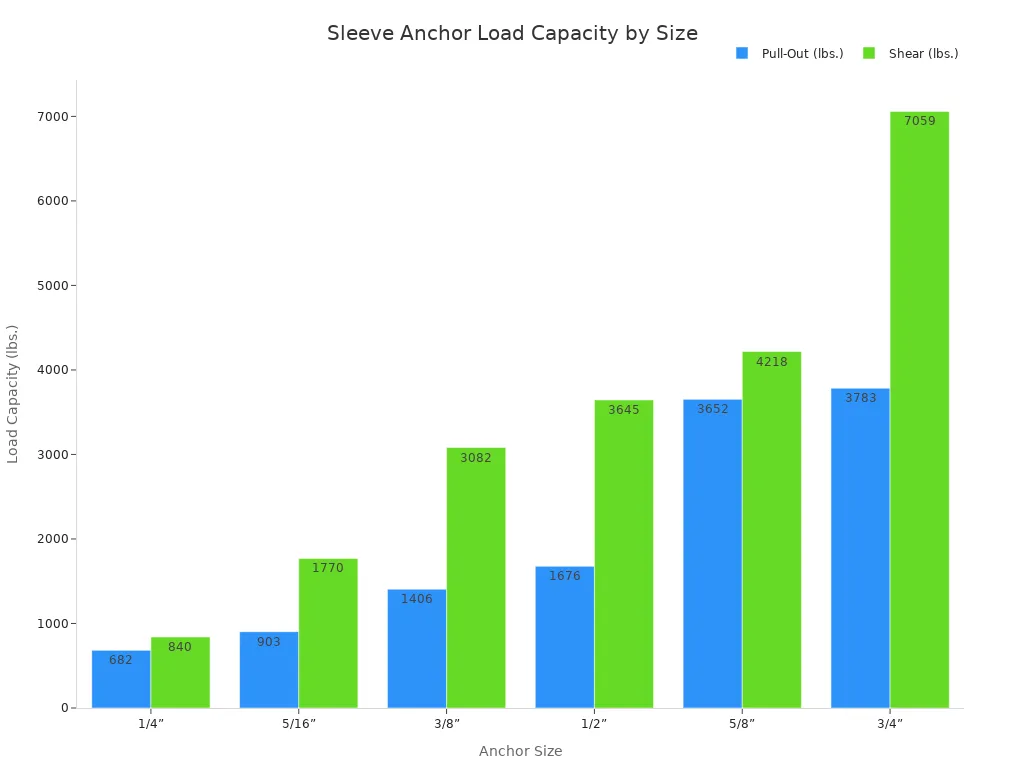
Research indicates there is an ‘optimum anchorage embedment depth.’ At this point, the anchor’s shear capacity is maximized. Increasing the depth beyond this optimum point does not provide additional shear strength.
Shallow Embedment Considerations
Sometimes, project constraints like thin concrete slabs limit the possible embedment depth. In these cases, installers must understand the performance trade-offs. Even a small increase in embedment can dramatically improve holding power.
To calculate the required anchor length, professionals use a simple formula:
Anchor Length = Fixture Thickness + Minimum Embedment + Nut/Washer Thickness
The hole drilled into the concrete must be slightly deeper than the anchor’s embedment to accommodate dust and cuttings.
Match the Anchor Head Style to the Application
The head style of a sleeve anchor affects both the installation method and the final appearance of the fixture. Professionals select a head style that matches the project’s functional and aesthetic requirements.
Hex Head
The hex head is the most common and versatile style. It allows for high torque application using a standard wrench or socket, making it ideal for industrial and structural applications where clamping force is paramount.
Flat Head (Countersunk)
The flat head, or countersunk, style features a tapered top that sits flush with the surface of the material being fastened. This provides a clean, smooth finish, which is essential for applications like installing door frames or when objects must pass over the anchor without obstruction.
Round Head
A round head offers a low-profile, finished appearance. It is less obtrusive than a hex head but does not sit completely flush. This style is a good compromise for general-purpose fastening where aesthetics are a consideration.
Acorn Head
The acorn head provides both safety and a decorative finish. It features a domed nut that covers the end of the threaded stud. This design prevents snagging on exposed threads and offers a clean, polished look for architectural applications.
Selecting the right fastener is crucial for project success. A summary of top choices can guide professionals.
- For most concrete applications, the Hilti HSL-3 offers the best balance of strength and reliability.
- When maximum strength is the priority, the Red Head Dynabolt remains the industry-standard choice.
- For budget-conscious projects, the Powers Fasteners Sleeve-All provides dependable performance.
Always match your anchor choice to the specific load, environmental, and concrete conditions. A safe and durable installation depends on this selection and following best practices, such as wearing safety glasses and using the correct drill bits.
FAQ
Can you reuse a sleeve anchor?
Professionals should never reuse a sleeve anchor. The installation process permanently deforms the sleeve. A used anchor loses its certified holding power and creates a significant safety risk. Reusing fasteners compromises the integrity of the connection.
How close to a concrete edge can you install a sleeve anchor?
Installers must maintain a minimum edge distance to prevent concrete breakout. A general rule is five anchor diameters from an unsupported edge.
Important: Always consult the manufacturer’s technical data sheet for the specific anchor’s requirements to ensure a safe installation.
What is the minimum spacing between two sleeve anchors?
Proper spacing prevents overlapping stress zones in the concrete. A safe guideline is ten anchor diameters between fasteners. This ensures each anchor can achieve its full load-bearing capacity without compromising its neighbor.
What is the difference between a sleeve anchor and a wedge anchor?
A sleeve anchor expands along its body, making it suitable for block or brick. A wedge anchor expands only at its base, providing immense strength in solid concrete. Wedge anchors typically have higher load ratings for structural jobs.
Can you use a sleeve anchor in brick or hollow block?
Yes, sleeve anchors are often a good choice for brick and hollow block. The sleeve’s wide expansion provides a better grip in these softer or hollow base materials. Load capacity will be lower than in solid concrete.
How do you remove a sleeve anchor?
Removing a sleeve anchor is a destructive process. An installer can unthread the nut, then drive the anchor body into the hole below the surface. Alternatively, they can cut the anchor flush with the surface using an angle grinder.