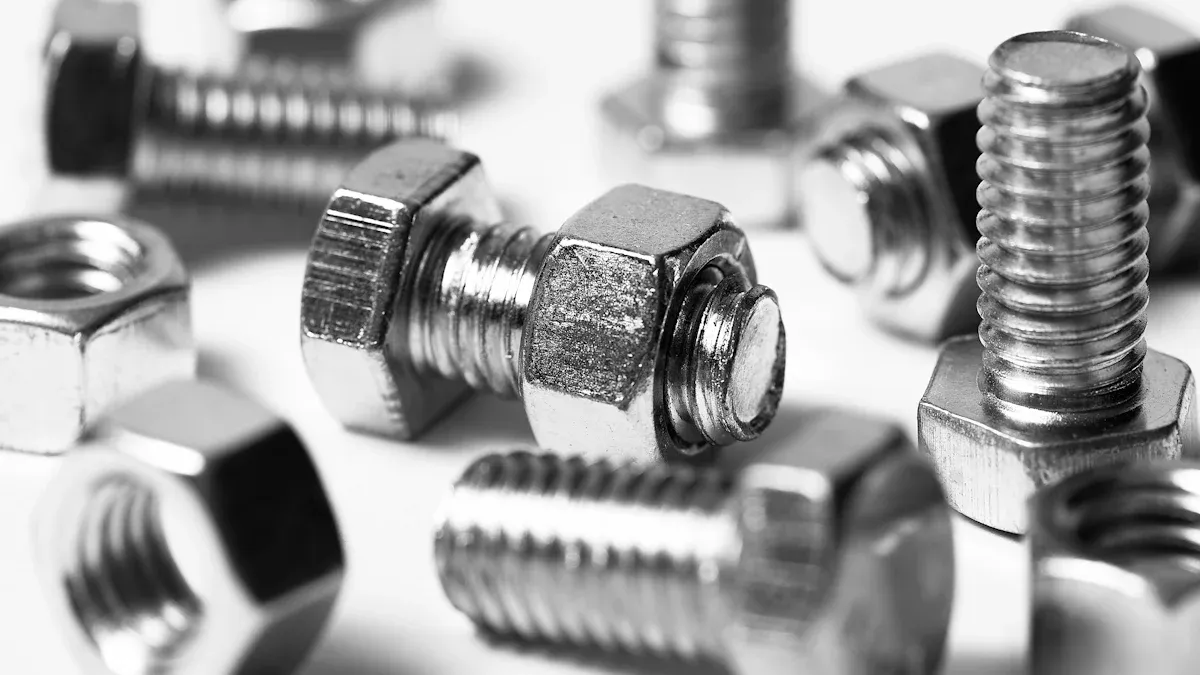
The top-rated overall downloadable Flange Bolt chart for 2026 is the ASME/ANSI B16.5 and B16.47 resource from Engineering ToolBox. This resource excels due to its comprehensive coverage of ASME standards and clear presentation. It clarifies key differences, such as how B16.47 Series B flanges use a greater number of a smaller bolt compared to Series A.
While these standard flange bolt charts cover most applications, projects requiring unique bolt casting may need a custom fasteners manufacturer to supply specialized custom fasteners.
Top 3 Printable Flange Bolt Charts for Quick Field Reference
Engineers and technicians in the field require immediate access to accurate dimensional data. Printable flange bolt charts serve this purpose perfectly. They eliminate the need for an internet connection and provide a durable, physical reference for critical measurements. The following three charts are the top choices for 2026, each tailored to a specific field environment.
The Ultimate Pocket Guide: Portland Bolt’s ASME Flange Chart
Portland Bolt offers a compact, laminated card that is the quintessential pocket reference. Its design prioritizes durability and quick access to the most frequently needed information for standard flange connections.
Key Specifications and Features
This guide condenses essential ASME B16.5 data onto a double-sided, credit-card-sized reference. Its lamination protects it from moisture, grease, and wear, ensuring it remains legible in harsh field conditions. The information is presented in a clear, tabular format.
| Flange Size | Pressure Class | # of Bolts | Bolt Diameter | Length (RF) |
|---|---|---|---|---|
| 2″ | 150# | 4 | 5/8″ | 3″ |
| 4″ | 300# | 8 | 3/4″ | 4″ |
| 6″ | 600# | 12 | 7/8″ | 5″ |
Note: The table above shows a sample of the data structure. The actual chart covers a full range of sizes and classes.
Best Use Case: On-the-Go Field Work
This pocket guide is indispensable for pipe fitters, inspectors, and field engineers who move between job sites. Its small size allows it to be stored in a wallet or tool vest for instant verification of bolt counts and dimensions. It is particularly valuable for maintenance and shutdown work in industries where speed and accuracy are paramount.
- Oil & Gas
- Chemical Processing
- Power Generation
- Pulp & Paper
Download Link and Format Details
- Link: [Placeholder for Portland Bolt’s Flange Chart Download Page]
- Format: The resource is available as a printable PDF file, designed to be printed and laminated for maximum durability.
The Workshop Wall Reference: Texas Flange’s Large-Format Chart
Texas Flange provides a comprehensive, large-format wall chart designed to be a central point of reference in a workshop or engineering office. Its high visibility makes it an excellent tool for team collaboration and quick checks during fabrication and assembly.
Key Specifications and Features
This chart is a high-resolution, single-page document that consolidates data for ASME B16.5 and B16.47 Series A & B flanges. Its design emphasizes readability from a distance.
- Large Font Size: Key dimensions are easily visible from several feet away.
- Color-Coded Sections: Different pressure classes or standards are often distinguished by color, speeding up data location.
- Comprehensive Data: It includes bolt quantity, diameter, and length for a wide range of flange sizes up to 60 inches.
Best Use Case: Workshop and Fab Shop Walls
This chart is ideal for permanent installation in fabrication shops, quality control stations, and project staging areas. It serves as a constant, reliable source of information for the entire team, reducing errors and saving time.
These charts assist engineers and pipe fitters in calculating fasteners, making a shared wall reference an invaluable asset for preventing costly mistakes during the assembly process.
Download Link and Format Details
- Link: [Placeholder for Texas Flange’s Wall Chart Resource Page]
- Format: The chart is offered as a high-resolution PDF, optimized for printing on large-format plotters (e.g., 24″ x 36″ or larger).
The All-in-One Clipboard Chart: Mactech’s Flange and Bolt Chart
Mactech’s chart strikes a balance between the portability of a pocket guide and the comprehensiveness of a wall poster. It is designed as a standard letter-sized (8.5″ x 11″) document, making it a perfect companion for a technician’s clipboard.
Key Specifications and Features
This resource often includes more than just basic dimensions. It frequently adds supplementary data that is critical for proper flange assembly, making it a true all-in-one field tool.
- Standard Page Size: Fits perfectly in binders and on clipboards.
- Added Information: May include recommended torque values, gasket types, and flange facing details.
- Clear Layout: Organizes data by pressure class for straightforward navigation.
Best Use Case: Technicians’ Clipboards
This chart is best suited for maintenance technicians, bolting specialists, and quality assurance inspectors who require detailed information at the point of work. It can be easily slipped into a plastic sleeve and carried with work orders and inspection reports, providing all necessary data for completing a job correctly.
Download Link and Format Details
- Link: [Placeholder for Mactech’s Flange Chart Download Page]
- Format: Available as a standard PDF document, ready for immediate printing on any office or home printer.
Best Interactive and Digital Flange Bolt Charts for 2026
While printable guides are essential for field use, the modern engineering office thrives on dynamic, interactive tools. Digital flange bolt charts offer calculation capabilities, customization, and integration that static documents cannot match. These tools reduce manual error and streamline project workflows, from initial design to final torque calculations. For 2026, three categories of digital tools stand out for their specific applications.
The Customizable Spreadsheet: Excel-Based Flange Bolt Calculator
For engineers requiring granular control over calculations, an Excel-based spreadsheet is the ultimate tool. It moves beyond simple data lookup to become a powerful analytical asset for specific bolted flange connections.
Key Features and Functionality
These calculators require specific input parameters to deliver accurate results. While some open-source templates exist, many are deprecated or unsupported. Professional-grade spreadsheets, sometimes requiring a subscription like XLC Pro, offer robust and validated calculations. Key inputs often include:
- Standard (e.g., ASME B16.5)
- NPS (Nominal Pipe Size)
- Pressure Class
- Bolt Quantity and Diameter
- Fastener Yield Strength (ksi)
- Target % Yield
- K-Factor / Nut Factor
- Flange and Gasket Thickness
Best Use Case: Project-Specific Calculations
Spreadsheets are ideal for engineers performing detailed joint analysis. They are essential when dealing with non-standard materials, unique gasket properties, or specific pre-load requirements that fall outside the scope of standard charts. This tool is perfect for desktop use during the detailed engineering phase of a project.
Download Link and System Requirements
- Link: [Placeholder for a Curated List of Excel Bolt Calculators]
- System Requirements: Microsoft Excel. Advanced spreadsheets may require specific versions or paid add-ins for full functionality.
The Instant Web App: Engineering ToolBox Online Flange Calculator
Engineering ToolBox provides a leading web-based calculator that prioritizes speed and accessibility. This tool is designed for quick, on-the-fly data retrieval without any software installation.
Key Features and Functionality
The primary feature of a web app is its simplicity. Users select the flange standard, size, and class from dropdown menus. The application instantly returns the required bolt quantity, diameter, and length. The interface is typically optimized for both desktop and mobile browsers, ensuring a seamless experience on any device.
Best Use Case: Quick Mobile Access
This tool is invaluable for engineers and managers who need immediate answers away from their primary workstation. It is perfect for verifying dimensions during a site walk-down, in a project meeting, or when reviewing supplier documentation on a tablet.
Link to Web Application
- Link: [Placeholder for Engineering ToolBox Online Calculator]
The Integrated CAD Plugin: SolidPlant 3D Flange Tools
For designers and drafters, efficiency and accuracy within the CAD environment are paramount. Integrated plugins like SolidPlant 3D bring flange data directly into the design model, eliminating manual data transfer.
Key Features and Functionality
These plugins function as part of a larger piping design suite within CAD software. The tool automatically populates 3D models with the correct flange and bolt assembly based on the selected pipe specification. This ensures that every component, from the gasket to the last nut, is dimensionally accurate and correctly accounted for in the Bill of Materials (BOM).
Best Use Case: Design and Drafting Integration
CAD plugins are essential for design firms and engineering departments focused on creating detailed, error-free 3D models and fabrication drawings. They streamline the design process, enforce project standards, and significantly reduce the risk of modeling errors.
Download and Installation Guide
- Link: [Placeholder for SolidPlant 3D Website/Download Page]
- Installation: Typically involves running an installer and activating the plugin within the host CAD software (e.g., AutoCAD Plant 3D, SolidWorks).
Essential Charts for Specific ASME and API Standards

General flange bolt charts are useful, but many projects demand adherence to a specific governing standard. Engineers must use charts dedicated to ASME B16.5, ASME B16.47, or API 6A to ensure compliance and safety. Each standard addresses unique applications, materials, and pressure ratings.
ASME B16.5: Pipe Flanges and Flanged Fittings Bolt Size Chart
Standard Scope and Importance
The ASME B16.5 standard is the foundational document for pipe flanges and flanged fittings in nominal pipe sizes (NPS) from ½” through 24″. It is the most frequently referenced standard in industrial piping. Its widespread adoption ensures interchangeability and reliability across numerous sectors. Key industries relying on this standard include:
- Power Generation
- Oil and Gas Processing
- Chemical and Petrochemical Plants
- Water and Wastewater Treatment
- Food and Beverage Manufacturing
Chart Details and Coverage (Classes 150-2500)
A dedicated ASME B16.5 bolt size chart provides dimensional data for seven pressure classes: 150, 300, 400, 600, 900, 1500, and 2500. These charts detail the required number of bolts, their diameters, and lengths for both Raised Face (RF) and Ring Type Joint (RTJ) flanges.
Important Update: The 2025 edition of ASME B16.5 introduced significant changes to pressure-temperature ratings. Engineers must ensure their charts reflect these latest revisions to maintain compliance.
Download Link for Dedicated B16.5 Chart
- Link: [Placeholder for a Dedicated ASME B16.5 Chart]
ASME B16.47: Large Diameter Steel Flanges Chart
Differentiating Series A and Series B
ASME B16.47 governs large diameter steel flanges from NPS 26″ through 60″. The standard is split into two distinct series.
- Series A: These flanges are thicker, heavier, and can withstand more external loading. They are often specified for new pipeline construction and critical equipment connections.
- Series B: These flanges are thinner and lighter, requiring more but smaller fasteners. They are a practical choice for replacements or system retrofits where lower weight and cost are factors.
Chart Details and Coverage
A combined B16.47 chart lists the standard bolt sizes for both Series A and Series B flanges across pressure classes 75 through 900. The chart clearly specifies the quantity, diameter, and length for each bolt, highlighting the differences between the two series for a given pipe size and class.
Download Link for Combined B16.47 Chart
- Link: [Placeholder for a Combined ASME B16.47 Chart]
API 6A: Wellhead and Christmas Tree Equipment Chart
Standard Scope for Oil and Gas
The American Petroleum Institute (API) 6A standard specifies requirements for high-pressure equipment used in oil and gas drilling and production. This includes wellheads, Christmas trees, and choke manifolds. Unlike ASME standards, API 6A is designed for extreme pressure containment.
Chart Details and Coverage
API 6A flange bolt charts cover pressure ratings from 2,000 to 20,000 psi. The bolt size chart for this standard is fundamentally different from ASME charts, reflecting the higher tensile strength materials and greater pre-load requirements. These specialized charts are critical for ensuring the integrity of well control equipment.
Download Link for API 6A Flange Chart
- Link: [Placeholder for an API 6A Flange Chart]
Specialized Flange Bolt Charts for Materials and Conditions
Standard flange bolt charts are excellent general references. However, specific operating conditions and material choices demand specialized data. Factors like material corrosion, extreme temperatures, and gasket types require charts that go beyond basic dimensions to ensure joint integrity and safety.
Stainless Steel Bolt Strength Chart and Flange Bolting
Considerations for 304/316 Stainless Steel
Engineers often select 304 and 316 stainless steel for their corrosion resistance. However, these materials are highly susceptible to Chloride Stress Corrosion Cracking (SCC). This failure mechanism can be catastrophic and occurs rapidly with little to no visible warning. SCC requires a combination of tensile stress (from bolt tightening), chloride ions, and a susceptible temperature range, typically between 50°C and 120°C. The alloys can fail in very short periods, even when stressed to only a fraction of their yield strength.
Chart Details and Torque Notes
A dedicated stainless steel bolt strength chart provides crucial data on tensile strength and recommended torque values. These charts account for the material’s lower tensile strength compared to common carbon steel bolts like A193 B7.
Warning: Applying torque values intended for carbon steel bolts to stainless steel fasteners can cause them to stretch or fail. Always use a chart specific to the stainless steel grade.
Download Link for Stainless Steel Chart
- Link: [Placeholder for a Stainless Steel Bolting Chart]
High-Temperature and Cryogenic Service Bolting
Material Selection for B7/L7 Studs
Material selection is critical for services operating outside of ambient temperatures. ASTM A193 B7 and ASTM A320 L7 studs are common choices for extreme temperature applications. Each has a specific operating range.
| Bolt Type | Temperature Range |
|---|---|
| ASTM A193 B7 | Ambient up to approximately 800°F (427°C) |
| ASTM A320 L7 | Down to -150°F (-101°C) |
Chart Details and Application Notes
Extreme temperature charts specify the appropriate bolt material based on the design temperature. They also provide notes on how temperature affects a material’s tensile strength and performance, ensuring the selected fastener maintains its integrity under operational stress.
Download Link for Extreme Temperature Chart
- Link: [Placeholder for an Extreme Temperature Bolting Chart]
Gasket-Specific Bolting Charts
The Role of Gasket Type in Bolting
The gasket is a critical component that directly influences bolting requirements. Different gasket materials require different levels of compressive stress to create an effective seal. A soft elastomer gasket seals with low stress, while a hard metallic gasket needs much higher stress. The required bolt load must be sufficient to seat the gasket and maintain a seal against internal pressure.
Chart for Spiral Wound Gasket Seating Stress
Charts specific to gasket types, like spiral wound gaskets, provide necessary seating stress values. These guides help engineers determine the correct torque to achieve the target bolt load without crushing the gasket or exceeding the fastener’s limits. Key considerations include:
- Minimum Torque: Achieves minimum gasket stress and bolt load.
- Maximum Torque: Avoids exceeding the maximum strength of the flange, gasket, or bolt.
Download Link and Usage Guide
- Link: [Placeholder for a Gasket-Specific Bolting Chart]
Understanding Key Chart Parameters
A flange bolt chart contains critical data, but its value depends on an engineer’s ability to interpret it correctly. Proper use prevents costly errors and ensures joint integrity. This guide breaks down the process and highlights common pitfalls.
How to Read a Standard Flange Bolt Chart
Knowing how to read the bolt size chart is a fundamental skill for any piping professional. The process is straightforward and involves locating the correct intersection of rows and columns.
Identifying Flange Size and Pressure Class
Engineers begin by locating the correct chart for the specified pressure class (e.g., Class 150, Class 300). On the chart, they find the Nominal Pipe Size (NPS) in the first column, which defines the row. Across this row, columns list essential data such as the number of bolts, diameter of bolts, and diameter of bolt holes.
Locating Bolt Quantity and Diameter
With the correct NPS row identified, the user simply follows it across to the corresponding columns. These columns clearly state the required quantity of fasteners and the standard bolt sizes for that specific flange. This cross-referencing action quickly provides the core dimensional data needed for procurement and assembly.
Understanding Bolt Length Specifications
Bolt length is a frequently misunderstood parameter. It is not simply the thickness of the two flanges. The correct length calculation must account for:
- The thickness of both flanges
- The compressed gasket thickness
- The height of two nuts
- A required protrusion of 2-3 threads past the nut
Notes on Raised Face (RF) vs. Ring Type Joint (RTJ)
Important Note Note: Technicians must recognize that RTJ flanges require different considerations. The deep groove for the metallic ring gasket often means a longer bolt is necessary compared to an equivalent RF flange to achieve proper thread engagement.
Common Mistakes to Avoid in 2026
Accuracy is paramount in flange assembly. Avoiding these common mistakes in 2026 will help teams maintain safety and compliance.
Confusing Bolt Diameter with Stud Diameter
For threaded studs, the bolt diameter and stud diameter are the same. However, users must ensure they are referencing the correct specification and not confusing it with the bolt hole diameter, which is always larger.
Misinterpreting Bolt Length Requirements
A common error is grabbing fasteners based only on flange thickness. This mistake leads to studs that are too short for proper nut engagement, creating a dangerous connection. Always calculate the full length required.
Ignoring Material and Torque Specifications
A bolt size chart provides dimensions, not mechanical properties. Using the correct standard bolt sizes is useless without applying the correct torque for the specified material (e.g., A193 B7 vs. A320 L7).
Using Outdated or Non-Standard Chart Versions
Standards evolve. Using an outdated chart can lead to non-compliance and unsafe assemblies. Always verify that the chart aligns with the latest editions of ASME B16.5 or other relevant project standards.
In 2026, engineers must use the correct flange bolt chart for safety and compliance. The best choice depends on the application, whether a printable PDF for the field or an interactive tool for the office. Always verify charts against the latest ASME and API standards. As the industry evolves, so does bolting technology.
Future trends to watch include:
- Advanced Materials: Adoption of new corrosion-resistant alloys.
- Industry 4.0: AI-driven quality control for bolt integrity.
- Sustainability: Focus on eco-friendly products and manufacturing.
The Comprehensive ASME Chart from Engineering ToolBox remains a top recommendation. Bookmark this guide for quick access to these essential resources.
FAQ
What is the difference between ASME B16.5 and B16.47?
ASME B16.5 covers pipe flanges from NPS ½” to 24″. ASME B16.47 governs large diameter flanges from NPS 26″ to 60″. Engineers must use the correct standard based on the pipe size for their project to ensure proper fit and compliance.
Why is torque different for stainless vs. carbon steel bolts?
Stainless steel has different mechanical properties than carbon steel. It is generally less strong and more prone to stretching. Applying carbon steel torque values to stainless steel bolts can cause them to fail. Always use a material-specific torque chart.
How do engineers calculate the correct bolt length?
A proper bolt length calculation includes several factors.
- The thickness of two flanges
- The compressed gasket thickness
- The height of two nuts
- An extra 2-3 threads of protrusion
Tip Tip: Simply measuring flange thickness is a common mistake that leads to bolts being too short for a secure connection.
What does “NPS” mean on a flange chart?
NPS stands for Nominal Pipe Size. It is a North American set of standard sizes for pipes used for high or low pressures and temperatures. Engineers use the NPS value to find the correct row of data on a flange bolt chart.
Is a digital chart better than a printed one?
The best chart depends on the task.
- Printed charts are ideal for quick field reference without needing power or internet.
- Digital tools offer interactive calculations and CAD integration for office-based design work.
Why does ASME B16.47 have a Series A and Series B?
Series A flanges are thicker and heavier, designed for higher external loads. Series B flanges are lighter and use more, smaller bolts. This provides engineers with design flexibility for new construction versus system retrofits where weight may be a concern.
What happens if I use an outdated flange chart?
Using an outdated chart creates significant risk. Standards like ASME B16.5 are updated periodically. An old chart may specify incorrect dimensions or materials, leading to non-compliance, connection failures, and serious safety hazards on the job site.