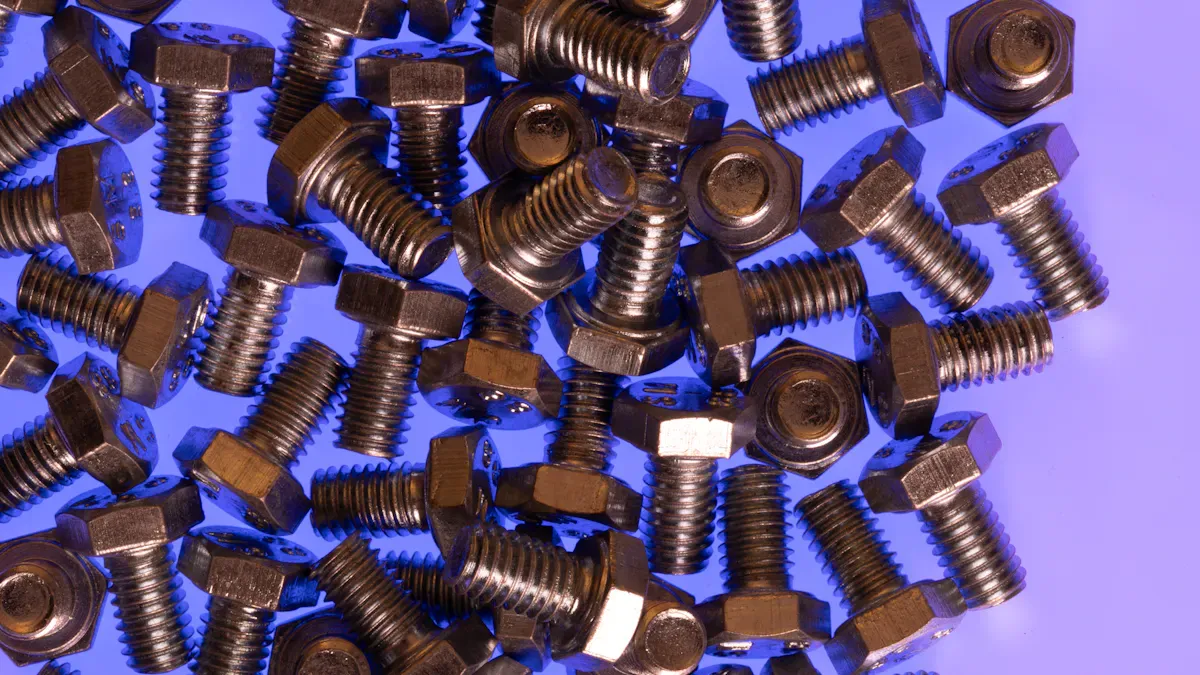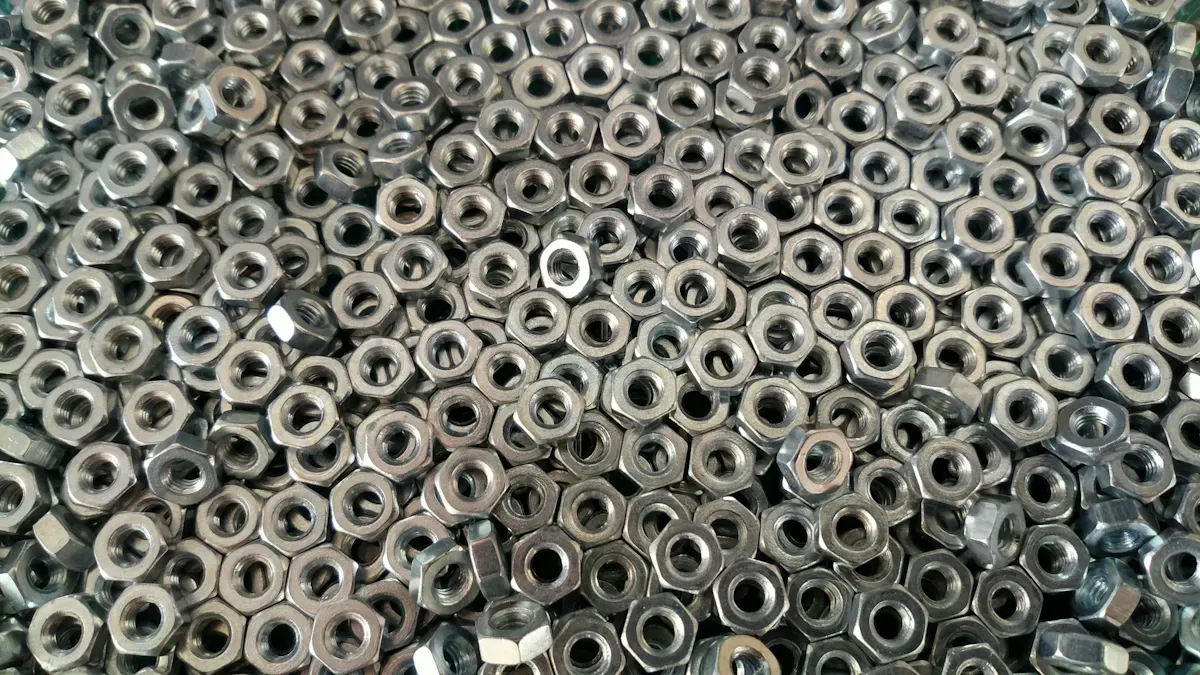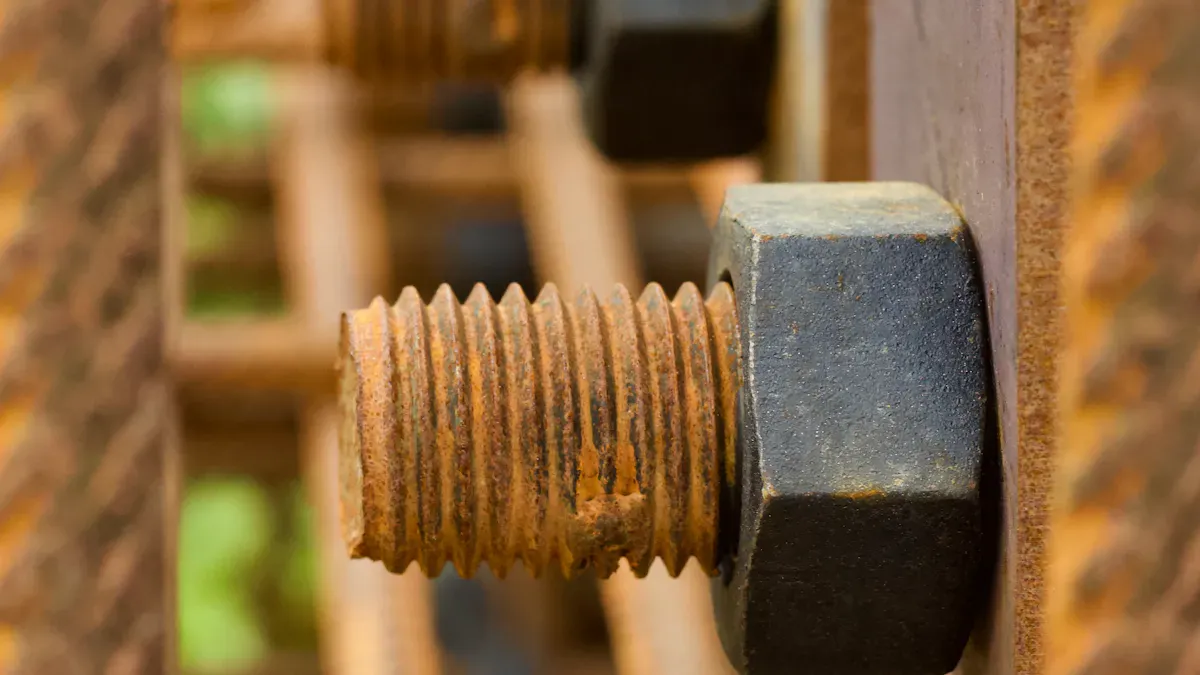
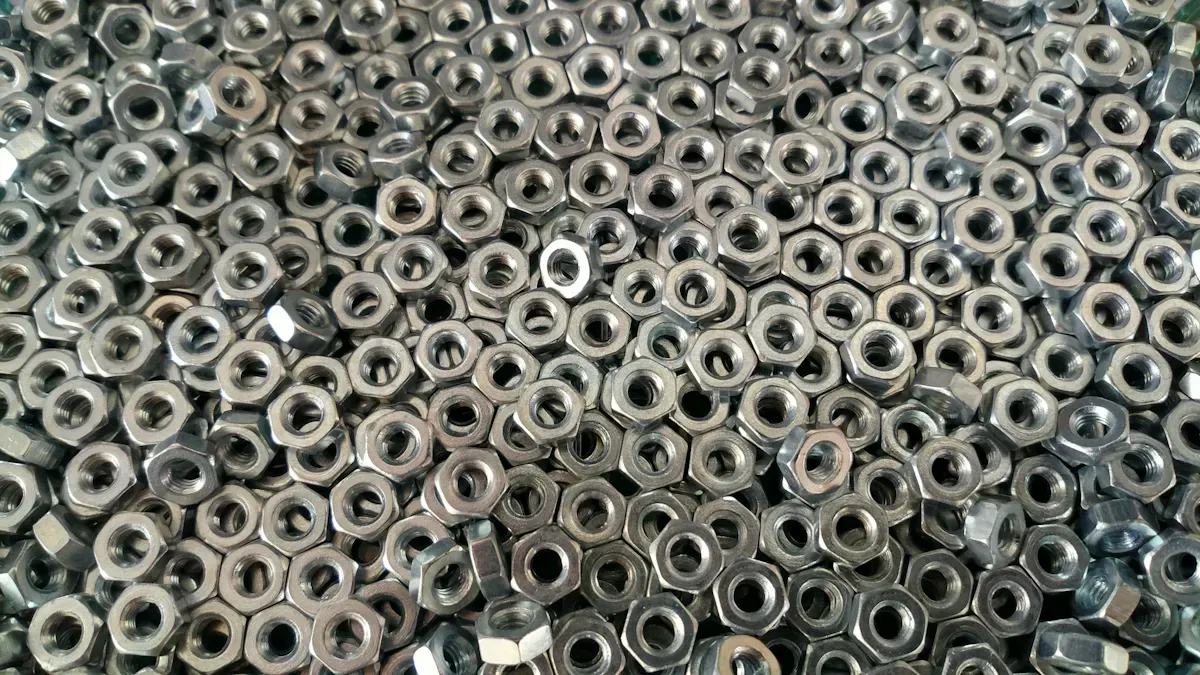
A Контргайка с нейлоновым кольцом uses a nylon insert to secure гаек и болтов in place. The nylon insert creates friction against the threads, which prevents the nut from loosening during vibration or movement. Many engineers and нестандартные крепежные элементы manufacturers rely on nylock nuts for durable connections in custom fasteners.
Nylock nuts provide a reliable solution for applications demanding resistance to loosening.
Nylock Nut Locking Mechanism
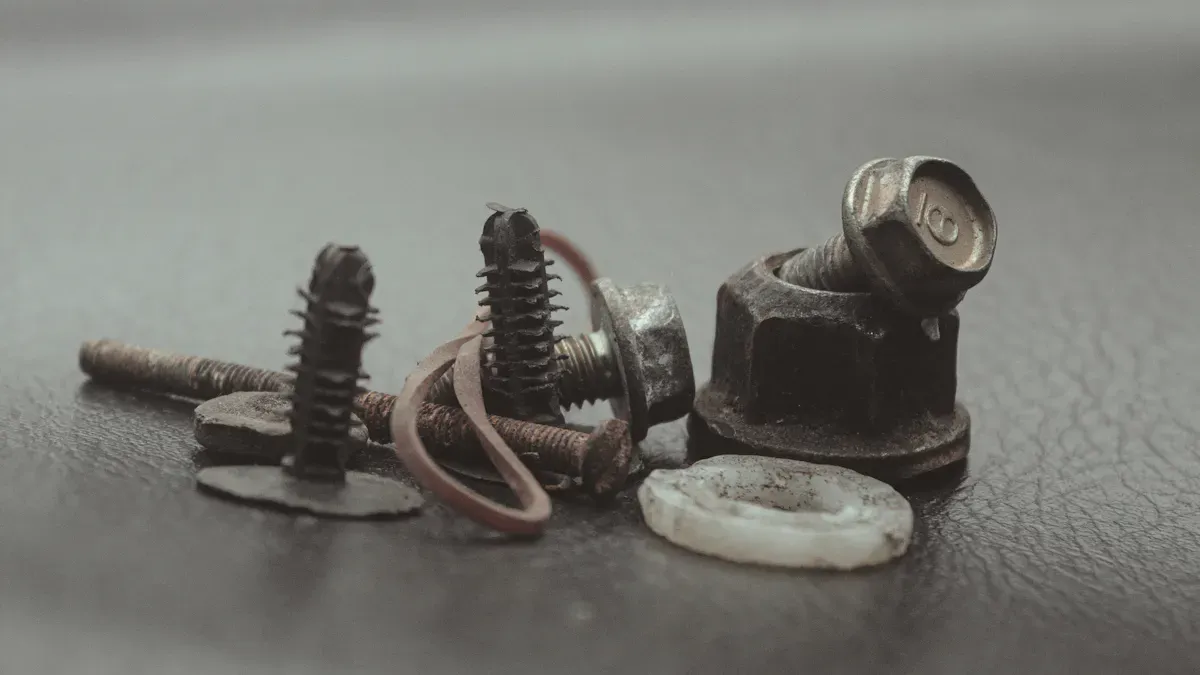
Nylon Insert Function
Friction and Thread Engagement
A lock nut relies on a unique nylon insert to deliver its self-locking properties. The nylon insert nut features a polymer ring at the top of the nut. When a technician threads the nut onto a bolt, the threads cut into the nylon, creating a tight grip. This process generates friction between the nylon and the bolt threads. The friction resists rotation and holds the nut in place, even when external forces act on the assembly.
Scientific studies show that this friction, known as prevailing torque, plays a critical role in preventing self-loosening. The nylon insert maintains consistent pressure on the threads, which helps the lock nut resist movement. Unlike standard nuts, the nylon insert nut does not depend solely on the clamp load for security. Instead, the nylon ring continues to provide resistance, even if the clamp load decreases due to vibration or thermal expansion.
Note: The nylon insert’s grip can wear down after repeated installations. For optimal locking performance, users should replace the nut if the nylon shows signs of wear.
How Locking Prevents Loosening
The locking mechanism in a lock nut works by maintaining friction and thread engagement. As the nylon insert deforms around the bolt threads, it creates a barrier that resists loosening. This barrier remains effective under dynamic loads and vibration. The lock nut eliminates the need for additional locking devices, such as washers or adhesives, in many applications.
Research demonstrates that the nylon insert continues to hold the nut in place, even when the assembly experiences vibration or movement. This feature makes the lock nut a preferred choice in environments where fasteners face constant stress. The locking action ensures that critical components remain secure, reducing the risk of mechanical failure.
Устойчивость к вибрации
Why Standard Nuts Loosen
Standard nuts often fail in high-vibration environments. Vibration can cause the threads of a regular nut and bolt to slip against each other. This slippage reduces friction and allows the nut to rotate, eventually leading to self-loosening. In automotive and industrial machinery, this phenomenon can result in dangerous equipment failures.
How Nylock Nuts Maintain Locking
A nylock nut addresses this challenge with its self-locking design. The nylon collar inside the lock nut provides a secure grip on the bolt threads. This grip resists the effects of vibration, thermal expansion, and mechanical stress. The lock nut maintains its position, even when subjected to constant movement.
- Nylock nuts are essential in industrial fastening systems where vibration resistance is critical.
- They feature a nylon collar that provides a secure locking mechanism against loosening under dynamic loads.
- Their durability makes them suitable for high-vibration applications.
In the automotive industry, heavy-duty lock nuts secure components that face continuous vibration and temperature changes. The self-locking feature eliminates the need for additional locking mechanisms, streamlining assembly and maintenance. Nylock nuts effectively prevent spontaneous loosening caused by road vibrations and temperature fluctuations, making them ideal for automotive and industrial applications.
Key Features of Nylock Nut
Design and Materials
Nylon Collar Construction
Engineers design the lock nut with a nylon collar positioned at the top of the nut. This collar deforms around the bolt threads during installation. The deformation creates a prevailing torque, which resists loosening under vibration and dynamic loads. The nylon collar acts as a barrier, preventing unintentional back-off and reducing the need for additional fasteners or adhesives. Users can often reuse the lock nut several times without losing its locking capability, although inspection remains important for safety.
Common Materials Used
Manufacturers produce lock nuts from a variety of materials to suit different mechanical and environmental requirements. The following table summarizes the most common materials and their properties:
| Материал | Механические свойства | Наилучшее применение |
|---|---|---|
| Сталь | Exceptional tensile strength, durability, and load-bearing capacity. | High-stress applications requiring maximum strength and moderate corrosion protection. |
| Латунь | Natural resistance to corrosion, good machinability, lower tensile strength than steel. | Marine, chemical, and decorative applications where corrosion resistance and aesthetics matter. |
| Aluminium | Lightweight, naturally corrosion-resistant, lower mechanical strength than steel. | Weight-sensitive applications in aerospace, automotive, and outdoor equipment. |
| Титан | High strength-to-weight ratio, excellent corrosion resistance. | High-performance, weight-critical, and extreme-environment applications. |
| Медь | Outstanding electrical conductivity, resistance to atmospheric corrosion. | Electrical grounding, RF shielding, and specialized conductive systems. |
Lock nuts also follow strict design standards to ensure consistent performance. The table below outlines the most widely used standards:
| Диапазон размеров | Стандарты |
|---|---|
| Metric: M1.6 to M100 | ISO 2341 – Standard for self-locking nuts |
| Imperial: 1/4″ to 1-1/2″ | ASME B18.2.4.1 – American standard for nylon insert nuts |
| DIN 985 – German standard for prevailing torque type lock nuts | |
| ISO 7040 – International standard for hexagon nylon-insert nuts |
Benefits of Lock Nut Design
Enhanced Security
Lock nuts provide reliable resistance to loosening under vibration or torque. They maintain long-term security in assemblies, even in high-vibration environments such as engines and industrial machinery. Their built-in locking mechanism eliminates the need for washers or adhesives, streamlining assembly and reducing maintenance. High-strength materials give lock nuts durability and resistance to wear, temperature, and corrosion. These features increase safety and reliability by ensuring that critical assemblies remain secure and operational.
Tip: Lock nuts help reduce the risk of mechanical failure by preventing accidental loosening, especially in demanding applications.
Versatility in Applications
The lock nut design adapts to a wide range of industrial and commercial uses. Its ability to maintain clamping force under stress makes it suitable for harsh environments, including manufacturing, transportation, and outdoor equipment. Lock nuts accommodate various fasteners, which enhances their adaptability in different settings. Their versatility reduces the need for multiple fastener types, simplifying inventory and maintenance for engineers and technicians.
Reusability and Limitations of Nylock Nut
Reusing Nylock Nuts
Effects of Multiple Installations
A lock nut relies on the integrity of its nylon insert to maintain its self-locking function. Each time a technician installs and removes a lock nut, the nylon insert experiences wear. This wear reduces the friction that holds the nut in place. Over time, repeated installations weaken the locking mechanism.
- Nylock nuts weaken with each reuse.
- In critical safety applications, they should not be reused.
Lock nuts perform best when used in situations where safety and reliability matter. Engineers recommend replacing the lock nut after removal in permanent outdoor settings or high-stress environments. This practice ensures optimal locking performance and reduces the risk of mechanical failure.
Note: For non-critical applications, users may reuse a lock nut, but they must inspect the nylon insert for visible wear or deformation.
When to Replace a Nylock Nut
Technicians must evaluate the condition of the nylon insert before reusing a lock nut. If the nylon appears worn, flattened, or damaged, the nut should be replaced. Assemblies that require high safety standards, such as automotive or industrial machinery, demand new lock nuts after each removal. This guideline prevents unexpected loosening and maintains the integrity of the fastening system.
A lock nut that has lost its prevailing torque cannot provide reliable resistance against vibration or movement. Replacement ensures that the assembly remains secure and functional.
Temperature and Chemical Resistance
Performance in High Temperatures
The nylon insert in a lock nut determines its temperature resistance. Standard nylon inserts maintain their locking function up to 120°C (248°F). High-temperature variants withstand up to 250°C (482°F). The table below summarizes these limits:
| Type of Nylon Insert | Maximum Temperature (°C) | Maximum Temperature (°F) |
|---|---|---|
| Standard Nylon | 120 | 248 |
| High-Temperature | 250 | 482 |
Assemblies exposed to temperatures above these thresholds risk losing the locking effect. The nylon softens or degrades, causing the lock nut to lose its grip. Engineers select high-temperature lock nuts for environments such as engines, turbines, or industrial ovens.
Resistance to Corrosive Environments
Lock nuts offer moderate resistance to corrosion, depending on the material used for the nut body. The nylon insert itself resists many chemicals, but prolonged exposure to solvents or acids can degrade its structure. Brass, stainless steel, and titanium lock nuts provide enhanced corrosion resistance for marine or chemical applications. Technicians must choose the appropriate lock nut material and nylon insert type based on the environmental conditions.
Tip: Always match the lock nut to the application’s temperature and chemical exposure to ensure long-term performance.
Comparing Nylock Nut to Other Lock Nut Types
All-Metal Lock Nut vs. Nylock Nut
Differences in Locking Mechanism
All-metal lock nuts and nyloc nuts use distinct mechanisms to secure fasteners. All-metal lock nuts rely on mechanical features such as deformed threads or integrated washers to create resistance. These features generate a consistent locking force and withstand repeated use. Nyloc nuts use a nylon insert that clamps onto the bolt threads. The nylon insert creates friction, which prevents loosening caused by vibration or movement. Both types serve as effective solutions for maintaining secure assemblies, but their locking methods differ in material and performance.
Pros and Cons of Each Type
Industry testing reveals unique advantages and disadvantages for each lock nut type. The table below summarizes these findings:
| Type of Nut | Преимущества | Disadvantages |
|---|---|---|
| All-Metal Lock Nuts | Integrated washer simplifies assembly and provides consistent locking force. Suitable for a wide range of applications where vibration is a concern. Reusable, but the attached washer may wear out over time, reducing its effectiveness. | May not provide as much vibration resistance as nylon insert nuts. Performance can degrade if the washer wears out. |
| Nylock Nuts | Effective for reducing loosening due to vibration. Simple to install and remove without special tools. Can be reused multiple times without losing locking properties, although performance may degrade over time. Offers some corrosion resistance. | Nylon can soften at higher temperatures, reducing locking effectiveness. Certain chemicals can degrade the nylon material. Limited reusability as repeated use can wear down the nylon insert. |
Tip: Engineers select the appropriate lock nut based on the operating environment, vibration levels, and temperature requirements.
Other Locking Solutions
Lock Washers
Lock washers provide an additional layer of security for fasteners. They use spring tension or serrated surfaces to resist rotation. Lock washers work well in light-duty applications, but they may not offer the same vibration resistance as a nyloc nut or all-metal lock nut. Technicians often use lock washers in furniture assembly and small machinery.
Thread-Locking Compounds
Thread-locking compounds serve as adhesives for securing threads. These fluids fill the gaps between bolt and nut threads, preventing loosening from vibration or thermal expansion. Thread-locking compounds offer flexibility and ease of application. They work best in situations where mechanical locking is not feasible. However, removal can require special solvents or tools.
Other common locking solutions include:
- Effective torque lock nuts maintain constant torque under dynamic loads.
- Double-lock nuts use a helical thread design for stronger locking force.
- Serrated flange lock nuts suit sheet metal applications.
- Wedge lock nuts generate strong locking force for heavy loads.
Each solution addresses specific fastening challenges. Engineers evaluate the requirements of the assembly before selecting the optimal locking method.
Note: Nyloc nuts remain a popular choice for vibration resistance and ease of installation, but alternative solutions may offer advantages in specialized environments.
Common Uses for Nylock Nut

Automotive and Machinery Applications
Vehicle Fastening Points
Automotive engineers rely on the lock nut to secure critical vehicle components. This fastener resists loosening under vibration and dynamic loads, which occur frequently in engines, suspensions, and chassis assemblies. The lock nut ensures that bolts remain tight, even when exposed to constant road movement. Mechanics use these nuts to fasten wheels, brake systems, and steering linkages. This practice enhances safety and reliability for drivers and passengers.
Industrial Equipment
Manufacturers in heavy machinery, electronics, and renewable energy sectors use the lock nut to maintain structural integrity and operator safety. The following table highlights common applications and benefits across various industries:
| Industry/Sector | Application/Benefit | Specific Uses |
|---|---|---|
| Automotive | Resists loosening under vibration and dynamic loads | Fastening components in vehicles, ensuring safety |
| Aerospace | Critical for assembling flight structures | Used in wings, fuselages, landing gear, avionics enclosures |
| Heavy Machinery | Essential for structural integrity and operator safety | Secure high-torque components in excavators, bulldozers |
| Electronics | Provides secure fastening while preserving electrical continuity | Mounting motors, securing circuit breaker panels |
| Marine | Resists corrosion and failure in harsh environments | Fastening marine engines, deck fittings |
| Renewable Energy | Ensures long-term reliability with minimal maintenance | Used in wind turbines, solar panel mounting frames |
Operators in these industries select the lock nut for its ability to maintain secure connections under stress. The nylon insert design prevents accidental loosening, which is vital for equipment that experiences vibration or heavy loads.
Home and DIY Locking Needs
Furniture Assembly
Homeowners and DIY enthusiasts use the lock nut to assemble furniture that must withstand daily use. The nylon insert deforms over the bolt threads, creating friction that locks the nut in place. This feature helps resist loosening caused by movement or vibration. As a result, furniture joints remain stable and safe over time. The lock nut also reduces the risk of accidental disassembly, which is important for items like beds, tables, and chairs.
Outdoor and Garden Equipment
Lock nuts play a key role in outdoor and garden equipment. They secure moving parts in lawnmowers, swings, and patio furniture. The nylon insert resists loosening from vibration, wind, and weather changes. This design enhances the durability of outdoor assemblies and maintains joint integrity. Users benefit from fewer maintenance checks and longer-lasting equipment.
- Стандарт DIN 933: объяснение nylon insert creates friction that locks the nut in place.
- This design resists loosening due to vibrations, improving durability.
- Secure connections prevent accidental disassembly of furniture and outdoor equipment.
Tip: For any project where vibration or movement could cause fasteners to loosen, a lock nut provides a reliable solution.
Choosing the Right Nylock Nut
Selecting the correct Контргайка с нейлоновым кольцом ensures the safety and longevity of any fastening system. Engineers and technicians must evaluate both mechanical and environmental factors before making a decision. The right choice prevents premature failure and maintains the integrity of the assembly.
Sizing and Compatibility
Matching to Bolts and Screws
Proper sizing remains essential for secure fastening. A nylock nut must match the bolt or screw in both diameter and thread pitch. This compatibility guarantees a tight fit and optimal load distribution. When selecting a lock nut, technicians consider the grade of the bolt to ensure strength and reliability. The following table outlines standard guidelines for matching nut grades to bolt grades:
| Bolt Grade | Required Nut Grade(s) |
|---|---|
| Класс 2 | Grade 2 or higher |
| Класс 5 | Grade 5 or Grade 8 |
| Grade 8 | Grade 8 only |
| Metric Class 8.8 | Class 8 or Class 10 |
| Metric Class 10.9 | Class 10 or Class 12 |
A mismatch between nut and bolt grades can compromise the fastening system. For example, using a lower-grade nut with a high-strength bolt may lead to thread stripping or failure under load.
Several factors influence the selection process:
- Material: Determines the nut’s strength and durability.
- Size and thread pitch: Ensures proper fit and load distribution.
- Grade and strength rating: Confirms the nut can handle the expected stress.
Technicians also assess the mechanical loads the assembly will experience. The table below summarizes key considerations:
| Фактор | Описание |
|---|---|
| Mechanical Loads | Understanding the loads the nut will experience is crucial for selecting the right size. |
| Environmental Exposure | Consideration of environmental factors ensures durability and reliability. |
| Long-term Reliability | Evaluating long-term performance helps in maintaining strength and security. |
Tip: Always verify that the lock nut complies with industry standards to ensure safety and reliability.
Environmental Considerations
Использование внутри и снаружи помещений
Environmental exposure plays a significant role in nylock nut selection. For indoor applications, standard steel or zinc-plated nuts often provide sufficient protection. Outdoor environments introduce challenges such as moisture, temperature fluctuations, and UV exposure. In these cases, stainless steel or coated nuts offer better resistance to rust and degradation.
Corrosive and High-Temperature Settings
Assemblies exposed to harsh conditions require special attention. The table below highlights important environmental factors:
| Environmental Factor | Consideration |
|---|---|
| Temperature | Nylon insert lock nuts are unsuitable for high temperatures. |
| Moisture | Essential to assess for outdoor applications. |
| Corrosion | Stainless steel or corrosion-resistant finishes are recommended for coastal applications. |
Technicians should assess moisture levels, evaluate chemical exposure, consider temperature variations, and identify exposure to corrosive elements. For high-temperature environments, standard nylon inserts may fail. In these cases, alternative locking solutions or high-temperature variants should be used.
Note: Choosing the right lock nut for the environment extends the life of the assembly and reduces maintenance needs.
Installation Tips for Nylock Nut Locking
Proper Tightening Techniques
Recommended Tools
Selecting the right tools ensures the integrity of the nylock nut’s locking function. Technicians achieve optimal results by following these best practices:
- Use a calibrated torque wrench for final tightening. This tool applies precise clamping force, which protects the nylon insert from damage.
- Choose sockets that fit the nut snugly. Well-maintained sockets prevent rounding of the nut corners and maintain the locking mechanism.
- Avoid excessive lubrication on the threads. Lubricants can reduce friction, leading to under-torquing and compromising the locking effect.
A torque wrench remains the preferred tool for nylock nut installation. It allows the user to apply the manufacturer’s specified torque value, which varies by nut size, material, and finish. For example, an M8 nylock nut may require 9 Nm for zinc-plated versions and up to 18 Nm for mechanical galvanized types. The nylon insert provides initial resistance, typically around 3 Nm for an M8 nut during first use. The total applied torque should account for this resistance to avoid over-tightening.
Avoiding Over-Tightening
Over-tightening can damage both the nylon insert and the threads, reducing the nut’s locking performance. To prevent this, technicians should:
- Always adhere to the manufacturer’s torque specifications.
- Factor in the initial resistance from the nylon insert when tightening.
- Stop tightening once the specified torque is reached, even if the nut feels slightly resistant due to the nylon.
Tip: Over-tightening not only weakens the locking feature but may also deform the fastener, leading to premature failure.
Ensuring Long-Term Lock Nut Performance
Regular Inspection
Routine inspection helps maintain the effectiveness of the locking system. Technicians should hand-start nylock nuts to avoid cross-threading and check for signs of wear, such as stripped nylon inserts or cracked material. The following table outlines recommended inspection intervals:
| Состояние | Inspection Frequency |
|---|---|
| Outdoor, humid, or corrosive | Annually |
| Применение в условиях сильной вибрации | Every 6 to 12 months |
| Frequent stress/load cycles | Closely monitored |
| Signs of visible wear | Immediate replacement needed |
Regular checks ensure that the locking mechanism remains reliable, especially after initial installation or thermal cycling.
Replacement Guidelines
In high-performance or safety-critical systems, treat nylock nuts as single-use fasteners. Replace any nut showing visible wear or loss of prevailing torque. Store unused nuts in a cool, dry place away from direct sunlight to preserve the nylon insert. Avoid prolonged exposure to solvents, fuels, or strong acids, as these can degrade the nylon and compromise locking.
Note: In extreme vibration environments, consider combining nylock nuts with secondary locking methods for added security.
A nylock nut uses a nylon insert to create friction and prevent loosening. Industry studies show that this friction-based design improves primary locking and delivers reliable performance in high-vibration environments.
| Evidence Type | Описание | Effectiveness |
|---|---|---|
| Friction-based design | Jack bolt nuts showed an 8.5% improvement in primary locking | High effectiveness in preventing loosening |
| Dynamic testing | Junker test machine confirmed superior resistance to loosening | Reliable performance in high-vibration |
- Nylock nuts maintain bolt tension through frictional forces.
- They deform elastically to lock fasteners and reduce bolt loosening by over 50% in demanding settings.
Engineers use these nuts in construction, power generation, and transportation to ensure safety and reliability. For best results, users should match the nut to the application and inspect it regularly.
Частые вопросы
What is the main advantage of using a nylock nut?
A nylock nut provides superior resistance to loosening caused by vibration or movement. The nylon insert maintains friction on the bolt threads, which ensures a secure and reliable fastening in demanding environments.
Can a nylock nut be reused?
Technicians can reuse a nylock nut a limited number of times. However, each installation wears the nylon insert. For critical applications, they should always replace the nut after removal to maintain optimal locking performance.
What temperature can a standard nylock nut withstand?
A standard nylock nut operates effectively up to 120°C (248°F). High-temperature variants can handle up to 250°C (482°F). Exceeding these limits causes the nylon insert to degrade, which reduces the locking effect.
Are nylock nuts suitable for outdoor use?
Nylock nuts perform well outdoors when made from corrosion-resistant materials like stainless steel. The nylon insert resists moisture, but technicians should select the nut material based on exposure to weather and chemicals.
How does a nylock nut differ from a regular nut?
A nylock nut contains a nylon insert that creates friction with the bolt threads. This feature prevents loosening. A regular nut lacks this insert and may loosen under vibration or dynamic loads.
Do nylock nuts require special tools for installation?
Standard hand tools, such as wrenches or sockets, work for installing nylock nuts. For precise torque, technicians should use a calibrated torque wrench. No specialized equipment is necessary.
What applications commonly use nylock nuts?
Engineers specify nylock nuts for automotive, aerospace, machinery, and outdoor equipment. These nuts secure assemblies exposed to vibration, movement, or thermal cycling. Their reliability makes them a preferred choice in safety-critical systems.