
This guide helps professionals choose eye bolt specifications for any project. The first question to address is the lift’s direction. The angle of the load is the primary factor to select the right eye bolt. It determines if shouldered or non-shouldered eye bolts are appropriate.
Critical Distinction: For a straight, vertical lift, non-shouldered eye bolts are an option. For any angled lift, shouldered eye bolts are mandatory to prevent failure.
The quality of the bolt casting and the material’s load limit are also crucial. A custom fasteners manufacturer can produce custom fasteners and specialty Eye Bolt designs.
Step 1: Determine Your Lift Type to Choose the Right Eye Bolt
The first decision to choose eye bolt specifications involves analyzing the lift’s geometry. A lift is either vertical (in-line) or angled. This single factor dictates the fundamental type of eye bolt required for a safe operation. Using the wrong type of eye bolts for the application can lead to catastrophic equipment failure and serious injury.
Vertical (In-Line) Lifts
A vertical lift occurs when the lifting force is applied in a perfectly straight line, 90 degrees to the load’s surface. The force pulls directly along the shank of the eye bolt. This is the only scenario where certain types of eye bolts are appropriate.
When to Use Non-Shouldered Eye Bolts
Riggers can use non-shouldered eye bolts, also known as plain pattern eye bolts, exclusively for vertical lifts. These eye bolts lack a shoulder at the base of the eye. Their design handles tensile stress along the shank. They are not designed to withstand any bending forces. Any deviation from a straight, vertical pull introduces dangerous side loading.
Proper Alignment for Plain Pattern Eye Bolts
Proper alignment is non-negotiable for plain pattern eye bolts. The lifting sling must pull perfectly in-line with the threads. Even a slight angle can introduce a bending moment that the bolt is not rated to handle. The user must ensure the lifting hook and sling create a direct, vertical pull to prevent component failure.
Angled Lifts
An angled lift is any lift where the force is applied at an angle other than 90 degrees. This includes lifts using multi-leg bridle slings or any side-pull scenario. These situations create complex forces that require specialized hardware.
Why Shouldered Eye Bolts Are Mandatory
Shouldered eye bolts are mandatory for all angled lifts. They feature a forged shoulder between the eye and the threads. This shoulder braces the bolt against the load’s surface. It effectively transfers the bending forces from the eye into the load itself, preventing the shank from bending or breaking.
ASME B30.26 Standards Industry safety standards are clear on this point. The American Society of Mechanical Engineers (ASME) B30.26 standard explicitly prohibits using non-shouldered eye bolts for any angular lift. For angled loading, regulations require that:
- Only shoulder eye bolts are permitted.
- The shoulder must be flush and securely tightened against the load surface.
- The working load limit must be reduced based on the lift angle.
The Dangers of Misusing Plain Eye Bolts for Angled Lifts
Using plain pattern eye bolts in an angled lift is extremely dangerous. The angular force creates a strong bending moment at the base of the eye where the threads begin. These eye bolts have no structural support to resist this force. This can cause the bolt to bend or shear off suddenly, even when lifting a load well below the bolt’s rated vertical capacity. This risk makes the correct selection of eye bolts a critical safety procedure.
Step 2: Calculate the Required Working Load Limit
After identifying the lift type, the next step is to confirm the eye bolt’s weight capacity. Every lifting component has a maximum load it can safely handle. Exceeding this limit risks catastrophic failure. Riggers must calculate the total load and account for forces introduced by lift angles.
Understanding the Working Load Limit (WLL)
The Working Load Limit (WLL) is the most critical safety rating for any piece of rigging hardware, including eye bolts.
What is the WLL?
The Working Load Limit is the maximum safe force that a piece of equipment can carry. According to the ASME B30.26 standard, the WLL is the “maximum allowable working load established by the rigging hardware manufacturer.” This value is not the breaking strength. Manufacturers calculate the Working Load Limit using a safety factor, which is typically 5:1 for forged eye bolts. This means the bolt’s minimum breaking strength is five times its rated Working Load Limit. A rigger must never exceed this established limit.
Locating the WLL on Eye Bolts
Reputable manufacturers permanently mark their eye bolts with essential information. A user can typically find the Working Load Limit, nominal size, and material grade forged or stamped directly onto the eye bolt. Always verify this information before use. If the markings are illegible, the eye bolt should be removed from service.
How Lift Angle Drastically Affects the Load Limit
The rated load capacity of an eye bolt applies only to a perfectly vertical lift. Any angular pull significantly reduces its effective Working Load Limit.
The 45-Degree Rule of Thumb
As a general rule, the capacity of a shouldered eye bolt decreases dramatically as the lift angle moves away from vertical. At a 45-degree angle, the eye bolt’s load capacity is reduced by approximately 75%. This sharp drop in the safe working load limit highlights the danger of underestimating angular forces.
Using a Capacity Reduction Chart
Manufacturers provide charts to determine the precise reduction in capacity at various angles. A rigger must consult these charts to ensure the selected eye bolt can handle the load at the intended angle.
Example Capacity Reduction for a Shouldered Eye Bolt | Angle of Pull from Vertical | Reduced Working Load Limit | | :— | :— | | 90° (Vertical) | 100% of Rated WLL | | 45° | 25% of Rated WLL | | 30° | 20% of Rated WLL |
Calculating Load in Multi-Leg Bridle Slings
When using a multi-leg sling, the tension on each leg is greater than the total load divided by the number of legs.
How Sling Angle Increases Tension
As the angle between the sling legs widens, the tension on each leg increases to support the same load. This multiplier effect places a much higher load on each individual eye bolt. Failing to account for this increased tension is a common cause of rigging failures.
Formula for Calculating Load Per Eye Bolt
To find the actual load on each eye bolt, use a tension factor formula. First, divide the total load by the number of legs. Then, multiply that result by a load factor based on the sling angle.
Load per Leg = (Total Load / Number of Legs) x Load Factor
The table below shows how the load on each leg increases for a 1,000 lb load as the angle changes.
| Angle Between Legs | Load Factor | Load on Each Leg (1,000 lb load) |
|---|---|---|
| 90° | 1.414 | 707 lbs |
| 120° | 2.000 | 1,000 lbs |
This calculation shows that each eye bolt must have a working load limit that meets or exceeds this calculated tension, not just a simple fraction of the total load.
Step 3: Select the Right Eye Bolt Material and Finish
Choosing the correct materials and finishes is essential for the longevity and safety of an eye bolt. The operating environment dictates whether the primary concern is strength, corrosion resistance, or temperature tolerance. Each material offers distinct advantages for specific applications.
Carbon Steel Eye Bolts
Carbon steel is a common and economical choice for many general-purpose lifting operations. Its primary advantage is its high strength-to-cost ratio.
Forged vs. Unforged: A Critical Distinction
Forging is a manufacturing process that shapes steel using compressive forces. Forged steel eye bolts have a continuous grain structure that follows the shape of the part. This process eliminates internal voids and creates a product with superior strength and fatigue resistance compared to unforged or cast parts. For any overhead lifting, only forged steel eye bolts are acceptable.
Common Applications for General Lifting
Standard carbon steel eye bolts are ideal for indoor manufacturing, fabrication shops, and general maintenance tasks. They provide excellent strength in controlled environments where moisture and corrosive elements are not a significant concern.
Stainless Steel Eye Bolts
Stainless steel is the premier choice for applications requiring corrosion resistance. However, users must recognize a trade-off. Stainless steel eye bolts typically have a lower working load limit, sometimes 40-50% less, than a carbon steel bolt of the same dimension.
Type 304 for General Corrosion Resistance
Type 304 stainless steel offers good corrosion resistance for general applications. It performs well in food processing industries and environments with intermittent exposure to moisture or mild chemicals. This type of steel provides a reliable balance of performance and cost.
Type 316 for Marine and Chemical Environments
Type 316 stainless steel contains molybdenum, an element that significantly boosts its defense against corrosion. This makes it the mandatory choice for harsh conditions.
- The added molybdenum provides superior resistance to chlorides, making Type 316 steel the ‘marine-grade’ standard.
- It excels in chemical processing plants where exposure to industrial solvents, acids, and cleaning agents is common.
- Its enhanced strength against pitting and crevice corrosion ensures reliability in saltwater and chemical-rich settings.
Alloy Steel Eye Bolts
For the most demanding jobs, alloy steel provides the highest level of performance. This material is engineered for maximum strength and durability.
Superior Strength for Heavy-Duty Lifts
Alloy steel eye bolts are heat-treated to achieve a much greater strength than both carbon and stainless steel. This makes them essential for critical lifts involving extremely heavy machinery, large structural components, and other high-stress rigging scenarios where maximum load capacity is the top priority.
Performance in Extreme Hot and Cold Temperatures
Quenched and tempered alloy steel maintains its mechanical properties across a wide temperature range. This makes it suitable for use in foundries, forges, and cold-weather environments. Application-specific engineering codes often define the precise operating limits.
Note on Temperature Limits The maximum service temperature for alloy steel can vary based on bolt diameter and any protective coatings. Always consult manufacturer specifications and relevant codes like ASME B31.1.
| Bolt Diameter | Max Service Temp (Uncoated) |
|---|---|
| Up to 2-1/2” | 700°F |
| >2-1/2” to 4” | 700°F |
| >4” to 7” | 750°F |
Understanding Protective Finishes
Beyond the base metal, a protective finish provides a critical barrier against environmental degradation. The selection of appropriate materials and finishes ensures the long-term integrity and safety of the lifting hardware. A finish is not merely cosmetic; it is a functional layer that extends the service life of an eye bolt by protecting it from corrosion and abrasion. The environment where the lift will occur dictates the necessary level of protection.
Hot-Dip Galvanized for Outdoor and Harsh Conditions
Hot-dip galvanizing is a robust finishing process for maximum corrosion resistance. Manufacturers immerse the entire steel component in a bath of molten zinc. This creates a thick, metallurgically bonded alloy coating that is highly durable and abrasion-resistant. This finish is the standard for demanding applications.
- Outdoor Construction: It protects against rain, snow, and atmospheric moisture.
- Coastal and Marine Areas: The thick zinc layer offers superior defense against saltwater spray.
- Industrial Plants: It withstands exposure to many process chemicals and corrosive atmospheres.
Important Consideration: Thread Fit The hot-dip galvanizing process adds a significant thickness to the threads of eye bolts. A user must ensure that the tapped hole or nut is also oversized or retapped to accommodate this coating. A failure to ensure proper thread engagement can compromise the connection’s strength.
Zinc Plating for Dry, Indoor Environments
Zinc plating, also known as electro-galvanizing, involves applying a thin layer of zinc through an electrochemical process. This finish provides a bright, shiny appearance and offers a moderate level of corrosion protection. Its primary function is to prevent rust in controlled, low-moisture settings.
Zinc-plated eye bolts are a cost-effective solution for indoor applications, such as:
- Warehouse and factory rigging
- Machinery assembly
- General-purpose shop lifts
However, this thin coating is not a substitute for hot-dip galvanizing. It will quickly fail when exposed to outdoor weather or corrosive chemicals. A rigger must never use zinc-plated hardware in applications that require robust environmental protection. The minimal layer offers insufficient defense against aggressive elements, leading to premature rust and potential failure.
Step 4: Match Thread and Shank Specifications

A secure connection depends on the physical compatibility between the eye bolt and the load. After determining the correct material, a rigger must match the thread and shank specifications to the attachment point. An incorrect size or thread type can compromise the entire lifting assembly.
Understanding Thread Standards
Thread standards ensure that bolts and tapped holes are interchangeable and create a strong, reliable connection. The American Society of Mechanical Engineers (ASME) B1.1 standard defines the specifications for Unified Inch Screw Threads, ensuring consistency across manufacturers.
UNC (Unified National Coarse) Threads
Unified National Coarse (UNC) threads are the most common thread type for general-purpose eye bolts. They have deeper, more pronounced threads that are less likely to cross-thread or strip during installation. This robust design makes them ideal for frequent assembly and disassembly in materials like steel and cast iron.
UNF (Unified National Fine) Threads
Unified National Fine (UNF) threads have more threads per inch than their coarse counterparts. This finer pitch provides greater tensile stress area and allows for more precise adjustments. UNF threads offer superior strength and are less likely to loosen under vibration, making them suitable for precision machinery and critical attachment points.
Measuring Shank Diameter and Length
The shank is the unthreaded or threaded portion of the bolt between the eye and the end. Correctly measuring its diameter and length is crucial for a safe fit. The nominal size of eye bolts corresponds to the shank’s diameter.
The Importance of Full Thread Engagement
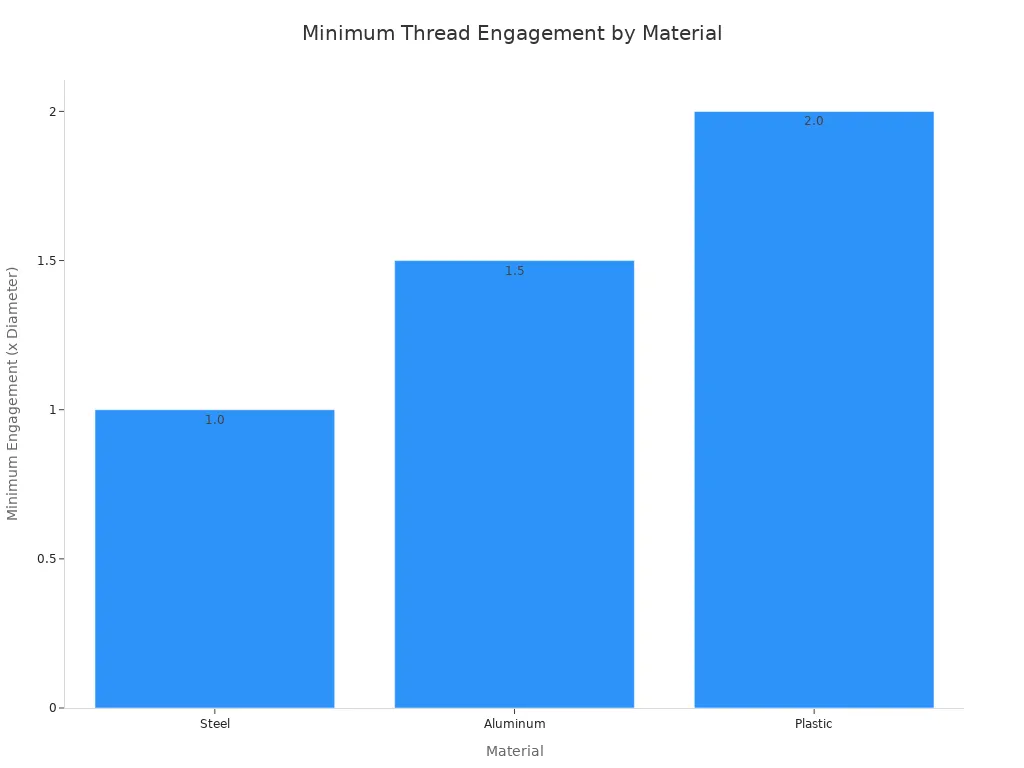
Full thread engagement is necessary to distribute the load’s force across all available threads. An insufficient attachment can cause the threads to strip, leading to catastrophic failure. The minimum required engagement length depends on the material of the tapped hole.
How to Avoid Bottoming Out the Shank
A rigger must ensure the eye bolt’s shank is not too long for a blind tapped hole. If the shank hits the bottom of the hole before the shoulder is seated, it “bottoms out.” This prevents a flush fit, creating a dangerous gap that compromises the strength of the shouldered eye bolt. The hole must be drilled deeper than the bolt’s thread length.
Tapped Holes vs. Thru-Holes
Eye bolts can be installed in two types of holes: tapped holes, which are threaded directly into the load, or thru-holes, which pass completely through the load.
Thread Depth Requirements for Tapped Holes
For a tapped hole, the thread depth must be sufficient to handle the load. A common rule is to have a minimum thread engagement of 1.0 times the bolt diameter in steel and 1.5 times the diameter in softer materials like aluminum. This ensures the attachment point is strong enough to support the lift.
Using Nuts and Washers with Thru-Holes
When using a thru-hole, the eye bolt passes through the load and is secured on the opposite side with a heavy hex nut and hardened washer. This method creates a strong, verifiable connection. Best practice dictates that at least one to three full threads should be visible beyond the nut to confirm full thread engagement. This visual check provides confidence in the security of the attachment.
Step 5: Ensure Proper and Safe Installation

Correct installation is the final, critical step in ensuring a safe lift. Even a perfectly specified eye bolt can fail if installed improperly. A rigger must follow a strict inspection and installation protocol to guarantee the integrity of the connection. Adhering to these general safety precautions prevents equipment failure and protects personnel.
Pre-Lift Inspection Checklist
A thorough pre-lift inspection is a non-negotiable part of rigging safety. Riggers should check every eye bolt before it is attached to a load. This simple review can identify common but dangerous mistakes.
Checking for Bends, Cracks, or Thread Damage
A visual and tactile inspection can reveal fatal flaws. A rigger must remove any eye bolt from service if it shows signs of wear or damage. Common issues to look for include:
- Ignoring Load Capacity: The working load limit is not verified.
- Incorrect Angle of Lift: The setup creates an angle that overstresses the hardware.
- Improper Installation Depth: The bolt is too shallow or bottoms out in the hole.
- Using Damaged Eye Bolts: The component has visible cracks, corrosion, or bends.
- Incorrect Thread Engagement: The threads are mismatched or not fully engaged.
Verifying Markings and WLL Integrity
Legible markings are essential for confirming an eye bolt’s specifications. A rigger must verify the manufacturer’s identification and the stamped working load limit. If these markings are missing, painted over, or unreadable, the eye bolt is considered compromised and must be discarded immediately.
Installation Technique for Shouldered Eye Bolts
Shouldered eye bolts require precise installation to handle angular loads correctly. The shoulder is the key structural feature that transfers forces, and it must be installed perfectly.
Seating the Shoulder Completely Flush
The underside of the shoulder must sit completely flush and tight against the load surface. Any gap between the shoulder and the surface prevents the proper transfer of bending forces. This gap can cause the bolt to bend or shear under an angular load.
Correct Use of Shims and Hardened Washers
Riggers can use precision-machined, hardened flat washers as shims to eliminate any gap under the shoulder.
- Washers help ensure the shoulder makes firm contact with the load surface.
- They can also help orient the eye in the direction of the pull.
- When using shims, a rigger must ensure at least 90% of the threads are engaged in the receiving hole.
Aligning the Eye Parallel to the Sling Direction
The plane of the eye must be aligned with the direction of the sling pull. A tolerance of ±5 degrees is generally acceptable. Misalignment applies a dangerous side load to the eye, which it is not designed to withstand. These safety tips are crucial for the performance of shouldered eye bolts.
Installation Technique for Non-Shouldered Eye Bolts
Plain pattern eye bolts are only for vertical lifts. Their installation is simpler but has no margin for error.
Ensuring Full Shank and Thread Engagement
The shank must be fully threaded into the receiving hole to achieve its full strength. The rigger must verify the hole is deep enough and the threads match perfectly.
Hand-Tightening and Alignment Procedures
A rigger should screw the eye bolt down until it is fully seated and then tighten it by hand. Tools should not be used to tighten plain pattern eye bolts, as this can induce unnecessary stress on the component.
Step 6: Know When to Use an Alternative to Standard Eye Bolts
Standard eye bolts are effective for many lifts, but they have inherent limitations. Certain rigging applications demand hardware with greater flexibility or strength. A rigger must recognize when a project requires an alternative lifting point to ensure maximum safety and efficiency for a given load.
Swivel Hoist Rings
For Loads that Pivot, Swivel, or Rotate
A swivel hoist ring, sometimes called a swivel eye bolt, is an advanced lifting point designed for dynamic loads. Unlike a fixed eye bolt, a hoist ring can pivot 180 degrees and swivel a full 360 degrees. This range of motion allows it to automatically adjust to the sling angle. It is the ideal solution for lifting a load that may tilt, rotate, or shift during movement.
Safety and Capacity Benefits Over Eye Bolts
The primary advantage of a swivel hoist ring is safety. It maintains its full rated load capacity at any angle, from 0 to 90 degrees. This feature eliminates the dangerous capacity reduction that affects shouldered eye bolts during angular lifts. Using a hoist ring removes the need for complex calculations when dealing with an angled load. This provides a much larger safety margin and simplifies the rigging process for a complex load. The hardware’s full capacity is always available.
Lifting Lugs
Welded vs. Bolted Lugs
Lifting lugs are engineered attachment points, typically made of steel plate, that are attached directly to a heavy load. They can be either welded for a permanent connection or bolted for temporary use. These are not off-the-shelf components. Engineers design them specifically for the object being lifted.
Custom-Fabricated Solutions for Unique Loads
Professionals use custom-fabricated lugs for unique or extremely heavy loads where standard hardware is insufficient. The design and fabrication process is highly controlled. For instance, the Structural Welding Code for Steel, AWS D1.1, is a governing standard for welding procedures. This ensures the lug can safely handle the intended load without failure.
Pad Eyes
Common Uses in Marine and Structural Rigging
Pad eyes are fixed-ring attachment points welded or bolted to a surface. They serve a variety of functions in different industries.
- Marine Settings: Pad eyes are common attachment points for lifelines and safety harness jacklines.
- Industrial Plants: They act as permanent structural connection points for attaching chain hoists and other rigging equipment to handle a load.
Understanding Directional Load Limitations
A pad eye is designed to handle a load from a specific direction. It does not swivel. Facility engineering teams must establish a written maximum working load limit and define any angular limitations for each pad eye. A qualified welder must perform the installation. The pad eye must then be clearly marked with its maximum rated capacity. Riggers must inspect the pad eye before and after every use to ensure its structural integrity for the next load. This careful management ensures the pad eye can safely support the designated load.
A rigger must choose eye bolt specifications with precision to guarantee operational safety. This final checklist helps a user select the right eye bolt.
- Confirm the lift angle to determine the required eye bolt type.
- Verify the working load limit meets the calculated load. The load capacity decreases as the angle increases, so the working load limit is a critical limit.
- Select the correct material for the environment.
- Ensure proper installation, seating the shoulder flush for any angled load.
The rated capacity of eye bolts has a strict limit. The working load limit is not a suggestion. For any complex load, professionals mitigate risks by ensuring the working load limit and capacity limit are respected.
FAQ
What is the first step to choose eye bolt specifications?
A rigger first determines the lift type. A vertical lift allows for non-shouldered eye bolts. An angled lift, however, mandates the use of shouldered eye bolts. This initial decision is critical for the safety of the entire operation.
Why does the working load limit (WLL) decrease with angled lifts?
Angular forces create a bending moment on the bolt. A shouldered eye bolt transfers this stress to the load surface. This transfer is less efficient than a straight pull, significantly reducing the hardware’s effective capacity. Always consult a capacity reduction chart.
Can a user substitute stainless steel for carbon steel eye bolts of the same size?
No, this is unsafe. Stainless steel eye bolts typically have a much lower Working Load Limit than carbon steel bolts of the same dimension. A user must always verify the WLL for the specific material being used.
What happens if a shouldered eye bolt’s shoulder is not flush?
A gap between the shoulder and the load surface is extremely dangerous. It prevents the proper transfer of angular forces. This can cause the bolt to bend or shear off, even when lifting a load below the rated capacity.
When should a rigger select the right eye bolt alternative?
A rigger should consider alternatives like swivel hoist rings for loads that pivot or rotate. Hoist rings maintain their full WLL at any angle, eliminating the capacity reduction required for standard eye bolts and increasing the safety margin.
What should a rigger do with a damaged eye bolt?
Any eye bolt showing signs of damage must be removed from service immediately and destroyed.
- Bends or cracks
- Damaged or stripped threads
- Illegible WLL markings
Using a compromised component risks catastrophic failure. A professional must always choose eye bolt hardware that is in perfect condition.