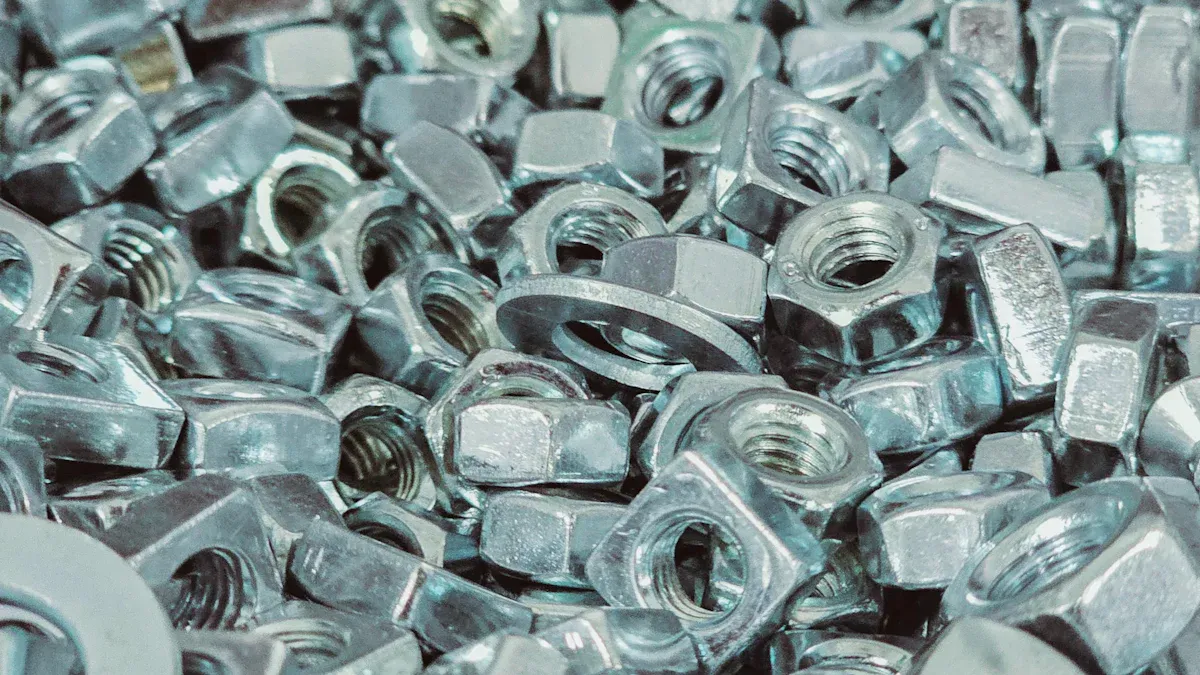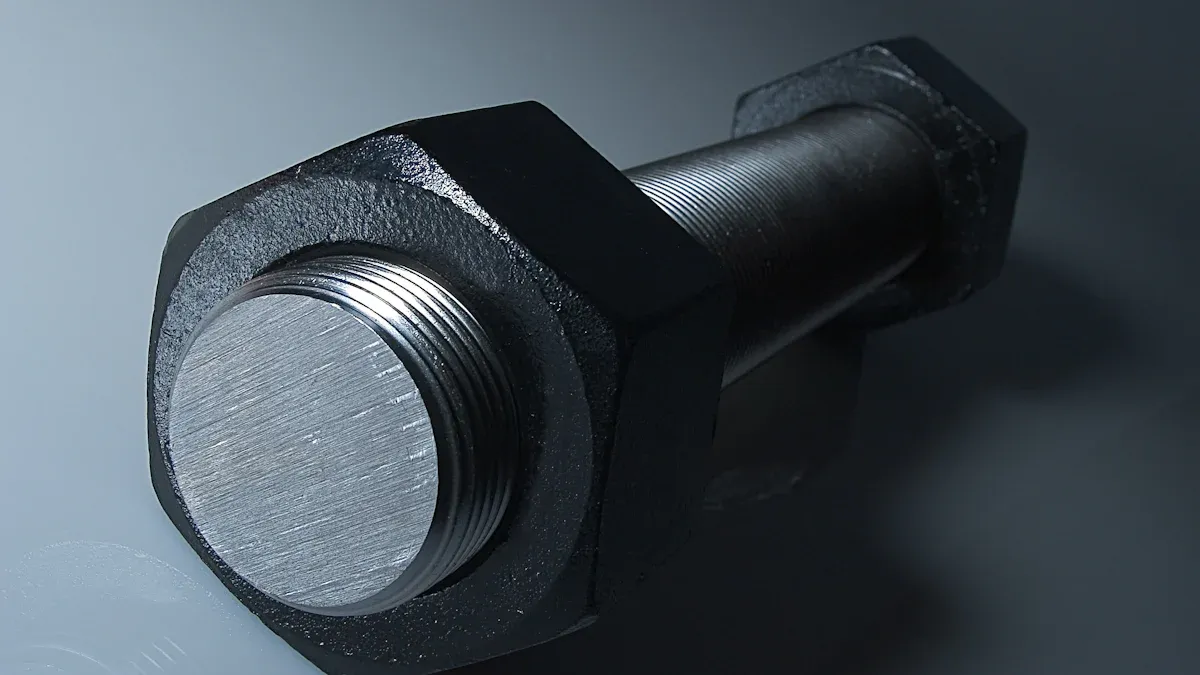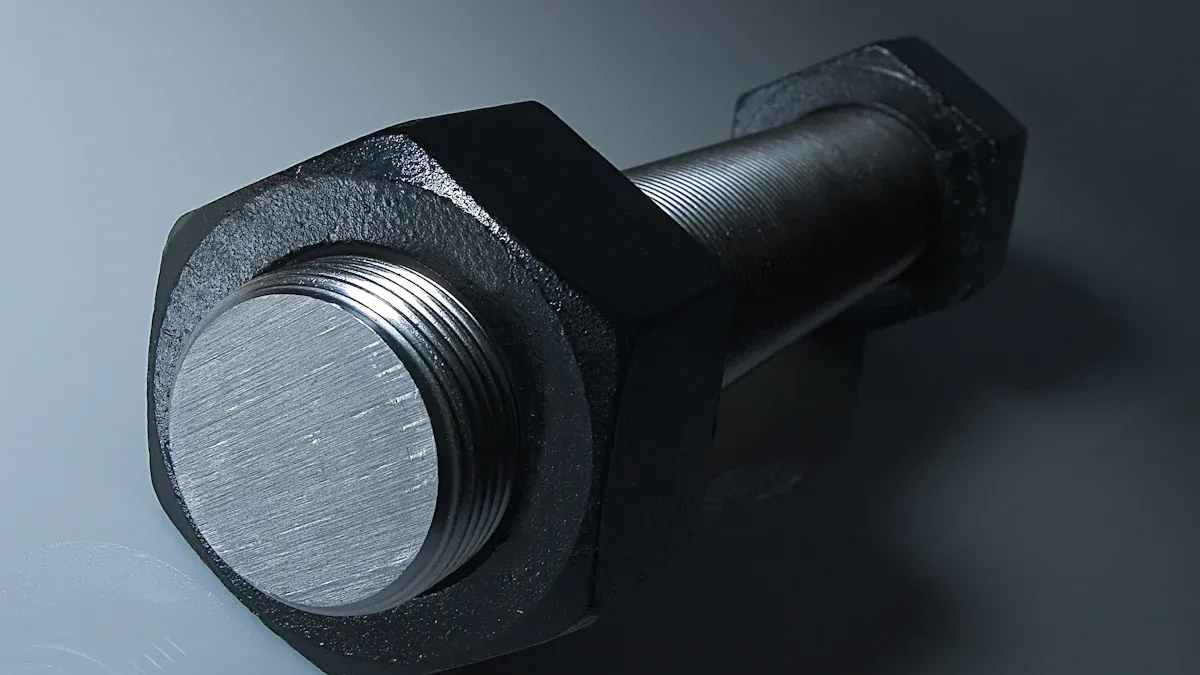
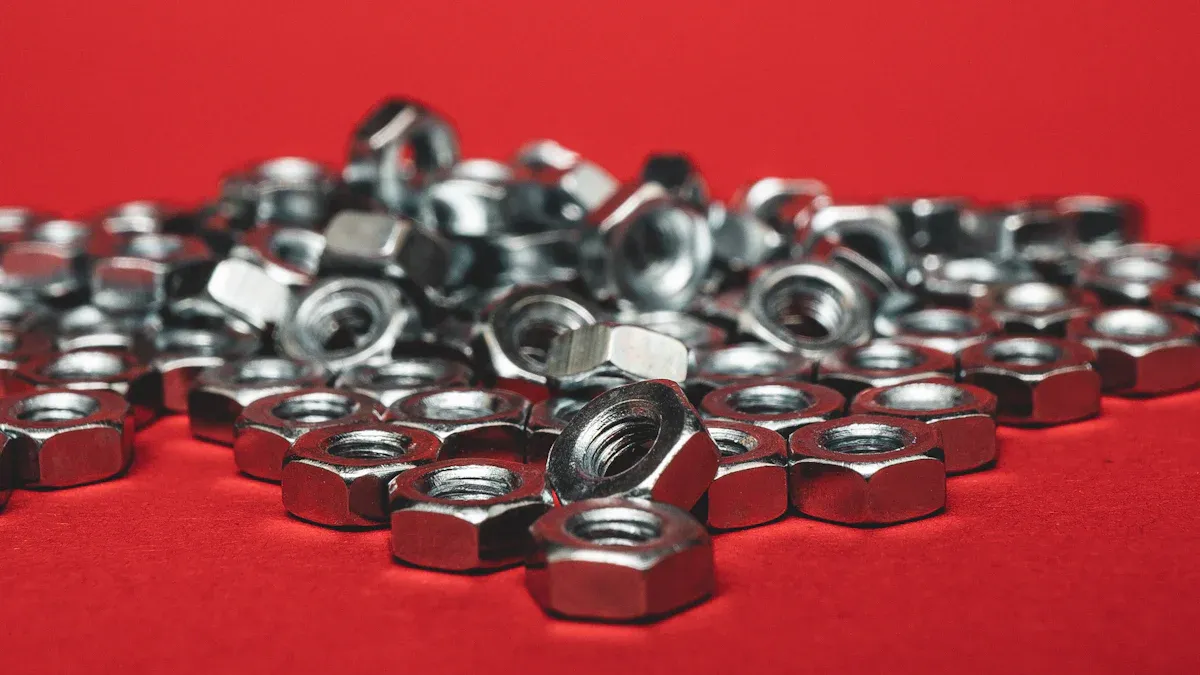
Hex nuts serve as essential six-sided, internally threaded metal fasteners. Their hexagonal shape allows for easy tightening with standard tools, while the internal threading ensures a secure fit with bolts. Industries rely on hex nuts to fasten machinery, support construction projects, and assemble vehicles. The global market for nuts and bolts continues to expand, with a projected value rising from USD 29.5 billion in 2023 to USD 45.2 billion by 2032. This growth reflects increased demand for custom fasteners and the expertise of every custom fasteners manufacturer.
| Sector | 2024 Value (USD Million) | 2035 Projected Value (USD Million) | Growth Drivers |
|---|---|---|---|
| Construction | 800 | 1,250 | Strong infrastructure projects and urbanization trends |
| Automotive | N/A | N/A | Rising automotive production rates |
| Aerospace | N/A | N/A | Advancements in aviation technology |
| Marine | N/A | N/A | Increased shipping and offshore construction activities |
Hex nuts provide reliable fastening in a variety of applications, making them indispensable in the world of custom fasteners. Every hex nut offers compatibility with a wide range of bolts and adapts to many environments.
Types of Hex Nuts and Hex Coupling Nuts
Standard hex nuts
Features
Standard hex nuts represent the most common hexagon nut type found in fastening applications. They feature a six-sided design that allows for easy installation with wrenches or sockets. The compact size of this type makes it suitable for general-purpose use. Standard hex nuts offer reliable internal threading, which ensures a secure fit with bolts. Manufacturers produce these nuts in a wide range of materials and finishes to meet diverse requirements.
- Standard hex nuts are more compact than heavy hex nuts.
- This type provides a balance between strength and ease of use.
- The design supports quick assembly and disassembly in routine maintenance.
Common applications
Standard hex nuts serve as the default choice for many industries. They appear in machinery, construction, and automotive assemblies. Installers use this type when moderate strength and straightforward installation are priorities. The common hexagon nut remains a staple in both commercial and residential projects.
Heavy hex nuts
Features
Heavy hex nuts differ from standard hex nuts in several key ways:
- Heavy hex nuts are larger and thicker, which increases their strength and durability.
- The broader width of this type allows for more torque during installation, reducing the risk of rounding off edges.
- Heavy hex nuts distribute load more effectively, making them suitable for high-stress environments.
This type of nut is often manufactured from high-strength materials to withstand demanding conditions. The increased thickness provides additional thread engagement, which enhances performance under heavy loads.
Common applications
Heavy hex nuts are preferred in industrial settings that require superior load distribution and high strength. These nuts are commonly used in structural steel connections, heavy machinery, and infrastructure projects. Installers select this type for applications where safety and reliability are critical, such as bridges, power plants, and large-scale construction.
Tip: Heavy hex nuts provide enhanced durability and are ideal for environments where vibration or heavy loads are present.
Jam hex nuts
Features
Jam hex nuts have a thinner profile compared to standard and heavy hex nuts. This type allows for use in confined spaces where a full-size nut would not fit. Jam hex nuts often serve as a secondary locking mechanism when paired with a standard nut. They engage fewer threads, so they do not carry the full load independently.
| Feature | Jam Hex Nuts | Lock Hex Nuts |
|---|---|---|
| Height/Profile | Thinner, allowing use in confined spaces | Standard height, suitable for general applications |
| Function | Serves as a secondary locking mechanism | Incorporates built-in features to resist loosening |
| Thread Engagement | Fewer threads engaged, not for full load independently | Designed to carry full load and resist rotation |
| Typical Use Cases | Automotive suspensions, machinery mounts | Automotive powertrains, shock absorbers, wheel hubs |
Common applications
Jam hex nuts are widely used in automotive suspensions, machinery mounts, and structural applications. Installers use this type to prevent loosening in assemblies subject to vibration. Jam hex nuts also appear in situations where space constraints limit the use of standard nuts. Their slim profile makes them a practical choice for double-nut locking arrangements.
Hex coupling nuts, another important type, connect two pieces of threaded rod or extend the length of threaded fasteners. This type is essential in applications that require joining rods or bolts for structural or mechanical purposes. Hex coupling nuts provide a secure and adjustable connection, making them valuable in construction, machinery, and repair work.
Lock hex nuts
Features
Lock hex nuts incorporate specialized mechanisms that resist loosening caused by vibration or torque. This type often includes a nylon insert, deformed threads, or serrated flanges. The nylon insert creates friction against the bolt threads, which prevents rotation. Deformed threads grip the bolt tightly, increasing resistance to movement. Serrated flanges bite into the surface, providing additional holding power. Manufacturers design lock hex nuts for environments where assemblies experience frequent movement or vibration.
- Nylon insert lock nuts provide reliable resistance to loosening.
- Deformed thread lock nuts offer enhanced grip without additional components.
- Serrated flange lock nuts increase surface contact and holding strength.
Note: Lock hex nuts do not require extra washers or locking devices, which simplifies installation and maintenance.
Common applications
Lock hex nuts appear in automotive powertrains, shock absorbers, and wheel hubs. Engineers specify this type for machinery that operates under dynamic loads. Construction teams use lock hex nuts in structural connections exposed to vibration. The aerospace industry relies on lock hex nuts to secure critical components. This type ensures safety and reliability in assemblies where movement could compromise fastening integrity.
Specialty hex nuts
Features (e.g., flange hex nuts, slotted hex nuts, reverse thread hex nuts)
Specialty hex nuts address unique fastening challenges. Flange hex nuts feature an integrated washer-like base that distributes load and reduces surface damage. Slotted hex nuts include slots on the top, allowing the use of a cotter pin for extra security. Reverse thread hex nuts possess threads that turn in the opposite direction, which prevents loosening in specific applications.
| Specialty Hex Nut Type | Distinctive Feature | Typical Use Case |
|---|---|---|
| Flange hex nuts | Built-in washer base | Automotive, machinery |
| Slotted hex nuts | Slots for cotter pin | Suspension, steering systems |
| Reverse thread hex nuts | Opposite thread direction | Rotating assemblies, safety locks |
- Flange hex nuts reduce the need for separate washers.
- Slotted hex nuts enhance security with mechanical locking.
- Reverse thread hex nuts protect against accidental loosening.
Tip: Specialty hex nuts solve problems that standard types cannot address, making them essential for custom fasteners.
Common applications
Specialty hex nuts find use in automotive assemblies, machinery, and safety-critical systems. Flange hex nuts secure components in engines and transmissions. Slotted hex nuts appear in suspension and steering systems, where a cotter pin prevents rotation. Reverse thread hex nuts protect rotating assemblies from loosening. Engineers select this type when standard nuts do not meet performance requirements.
Hex coupling nuts
Features
Hex coupling nuts connect two pieces of threaded rod or extend the length of fasteners. This type features a long, hexagonal body with internal threads throughout. The extended length allows for deep thread engagement, which increases connection strength. Hex coupling nuts accommodate both coarse and fine thread pitches. Manufacturers produce this type in various materials, including steel, stainless steel, brass, and aluminum.
- Hex coupling nuts provide secure connections for threaded rods.
- The hex shape enables easy tightening with standard tools.
- Extended length supports adjustable and customizable assemblies.
Callout: Hex coupling nuts offer versatility in joining and extending fasteners, making them indispensable for custom fasteners manufacturers.
Common applications
Hex coupling nuts serve in construction, machinery, and repair work. Installers use this type to join threaded rods in structural frameworks. Maintenance teams rely on hex coupling nuts to extend fasteners during equipment upgrades. Electricians employ hex coupling nuts in conduit installations. This type ensures reliable connections in projects that require flexibility and adjustability.
Dimensions and Sizing of Hex Nuts

Understanding the dimensions of hex nuts is essential for selecting the right fastener for any application. These measurements determine compatibility with bolts, the strength of the connection, and the overall performance of the assembly.
Across flats measurement
The “across flats” measurement refers to the distance between two opposite sides of a hex nut. This value determines the wrench size required for installation and removal.
Standard sizes
In the United States, standard hex nuts follow imperial sizing. The most common sizes range from 1/4 inch to 1-1/2 inches across flats. These sizes align with ASME B18.2.2 standards, ensuring consistency in manufacturing and application. Installers can select the appropriate hex nut based on the bolt diameter and the required wrench size.
Metric sizes
Metric hex nuts use millimeter-based measurements. Sizes typically range from M1.6 to M100, as specified by ISO 4032 and DIN 934 standards. The metric system provides precise control over fit and compatibility, which is important for machinery and construction projects worldwide.
| Size Range | Standards |
|---|---|
| Metric: M1.6 to M100 | ISO 4032 – Standard for hexagonal nuts with coarse thread |
| Imperial: 1/4″ to 1-1/2″ | ASME B18.2.2 – American standard for hex nuts |
| DIN 934 – German standard for hexagon nuts |
Thickness
The thickness of a hex nut affects its strength and load-bearing capacity. Industry standards distinguish between standard and heavy hex nuts.
Standard thickness
Standard hex nuts feature a compact profile, making them suitable for general-purpose fastening. Their thickness provides adequate thread engagement for most applications.
Heavy thickness
Heavy hex nuts offer increased thickness for enhanced durability and strength. These nuts are larger and heavier than standard types, which allows them to handle higher loads and resist deformation.
| Feature | Heavy Hex Nuts | Standard Hex Nuts |
|---|---|---|
| Thickness | Thicker than standard hex nuts | Standard thickness |
| Weight | Heavier than standard hex nuts | Lighter weight |
| Diameter Across Flats | Wider diameter | Standard diameter |
| Load Strength | Higher load strength | Lower load strength |
Note: Heavy hex nuts provide extra strength for demanding environments, such as structural steel connections and heavy machinery.
Thread pitch
Thread pitch describes the distance between adjacent threads on a hex nut. This measurement influences how quickly the nut engages with a bolt and the overall holding power of the connection.
Coarse thread
Coarse threads allow for quick assembly and strong grip. These threads are common in general-purpose fastening and industrial assembly. Coarse thread hex nuts are easier to install and less likely to cross-thread, making them ideal for field work.
Fine thread
Fine threads provide higher tensile strength and more precise load transfer. These threads are preferred in aerospace, automotive, and heavy machinery applications. Fine thread hex nuts offer better resistance to vibration and allow for more accurate tensioning.
| Thread Type | Description | Application |
|---|---|---|
| Coarse Thread (UNC/Metric) | Ensures quick engagement and strong grip | General-purpose fastening, industrial assembly |
| Fine Thread (UNF/Metric Fine) | Provides higher tensile strength & precise load transfer | Aerospace, automotive, heavy machinery |
| Fully Threaded Hex Nuts | Allows maximum engagement with bolts & studs | Structural applications, bridge construction |
| Partially Threaded Hex Nuts | Offers better clamping force & vibration resistance | Automotive, railway, power transmission |
Tip: Selecting the correct thread pitch ensures proper fit and prevents loosening under load.
Tolerances
Manufacturing tolerances
Manufacturers set precise tolerances for hex nuts to ensure consistent quality and reliable performance. Tolerances define the allowable variation in dimensions, such as width across flats, thickness, and thread pitch. These limits guarantee that each hex nut will fit its intended bolt and function as designed.
Production teams use advanced measuring tools to check every batch of hex nuts. They compare each nut to industry standards, such as ASME B18.2.2, ISO 4032, or DIN 934. These standards specify the maximum and minimum values for each critical dimension. For example, a standard M10 hex nut must have an across flats measurement within a narrow range, usually ±0.2 mm. This tight control prevents issues during assembly and ensures that tools can grip the nut securely.
Note: Tight manufacturing tolerances reduce the risk of product failure and improve safety in critical applications.
A table below shows typical tolerance values for common hex nut sizes:
| Nut Size (Metric) | Across Flats Tolerance | Thickness Tolerance |
|---|---|---|
| M6 | ±0.13 mm | ±0.15 mm |
| M10 | ±0.20 mm | ±0.24 mm |
| M16 | ±0.26 mm | ±0.30 mm |
Fit and compatibility
Fit and compatibility describe how well a hex nut matches with its corresponding bolt. Proper fit ensures that the nut threads onto the bolt smoothly and holds securely under load. Engineers classify fits as “loose,” “normal,” or “tight,” depending on the application.
A loose fit allows for easy assembly, even if there is minor dirt or damage on the threads. This type works well in construction or field repairs. A normal fit balances ease of assembly with holding strength. Most machinery and automotive applications use this fit. A tight fit provides maximum holding power and resists vibration, but it requires precise manufacturing and clean threads.
- Loose fit: Quick assembly, less risk of cross-threading
- Normal fit: Standard for most industrial uses
- Tight fit: High resistance to loosening, used in critical joints
Tip: Always match the nut and bolt according to the same standard and thread pitch. Mixing different standards can cause poor fit, stripped threads, or joint failure.
Fit and compatibility also depend on thread tolerances. Manufacturers use classes such as 6H for metric nuts or 2B for inch-series nuts. These classes define how tightly the threads engage. Selecting the correct tolerance class ensures that the hex nut performs as expected in its application.
Materials Used in Hex Nuts and Hex Coupling Nuts
Hex nuts and hex coupling nuts rely on a variety of materials to deliver strength, durability, and performance. Manufacturers select materials based on mechanical requirements, environmental conditions, and industry standards.
Steel
Steel remains the most widely used material for hex nuts. It offers high tensile strength and versatility.
Carbon steel
Carbon steel hex nuts provide robust mechanical properties. They suit applications where strength and cost efficiency matter most. Manufacturers often apply zinc or galvanized coatings to carbon steel nuts to improve corrosion resistance. Carbon steel hex nuts appear in construction, automotive, and machinery assemblies.
- Carbon steel delivers reliable performance in structural connections.
- Zinc-plated carbon steel resists rust in indoor environments.
Alloy steel
Alloy steel hex nuts incorporate elements such as chromium, nickel, or molybdenum. These additions enhance hardness, toughness, and fatigue resistance. Alloy steel nuts withstand extreme loads and high temperatures. Engineers specify alloy steel hex nuts for heavy machinery, power plants, and demanding industrial projects.
Tip: Alloy steel hex nuts excel in high-stress environments where standard carbon steel may fail.
Stainless steel
Stainless steel hex nuts offer exceptional resistance to corrosion and oxidation. They perform reliably in harsh environments, including marine and heavy-duty applications.
Grades
Manufacturers produce stainless steel hex nuts in several grades. Grade 304 provides general corrosion resistance and suits most outdoor installations. Grade 316 contains molybdenum, which improves resistance to chlorides and chemicals. Grade 410 offers increased hardness for mechanical applications.
| Stainless Steel Grade | Key Feature | Typical Use Case |
|---|---|---|
| 304 | General corrosion resistance | Outdoor, machinery |
| 316 | Enhanced chemical resistance | Marine, chemical plants |
| 410 | High hardness | Mechanical assemblies |
Corrosion resistance
Stainless steel hex nuts outperform brass and aluminum hex nuts in corrosion resistance. They resist oxidation and maintain integrity in wet, salty, or chemically aggressive environments.
- Stainless steel hex nuts: Superior corrosion and oxidation resistance, ideal for marine and heavy-duty applications.
- Brass hex nuts: Good corrosion resistance, particularly in dry and mildly humid conditions.
Note: Stainless steel hex nuts remain the preferred choice for projects exposed to moisture, chemicals, or saltwater.
Brass
Brass hex nuts combine aesthetic appeal with functional benefits. They contain copper and zinc, which provide a distinctive golden color and moderate strength.
Properties
Brass hex nuts resist corrosion in dry and mildly humid environments. They offer excellent machinability and electrical conductivity. Brass remains non-magnetic and does not spark, making it suitable for sensitive installations.
- Brass hex nuts maintain their appearance over time.
- Machinability allows for precise threading and customization.
Applications
Brass hex nuts appear in plumbing, electrical, and decorative projects. Installers use brass nuts for fixtures, valves, and terminals. Designers select brass hex nuts for visible assemblies where appearance matters.
Callout: Brass hex nuts deliver both function and style, making them popular in architectural and specialty applications.
Aluminum
Properties
Aluminum hex nuts offer a unique combination of light weight and strength. They resist corrosion naturally because of a thin oxide layer that forms on their surface. This property makes them suitable for outdoor and marine environments. Aluminum also conducts electricity and heat efficiently. Manufacturers can machine aluminum easily, which allows for precise threads and custom shapes.
Key properties of aluminum hex nuts include:
- Low density: Aluminum weighs less than steel or brass, which reduces the overall weight of assemblies.
- Corrosion resistance: The oxide layer protects against rust and chemical attack.
- Non-magnetic: Aluminum does not interfere with sensitive electronic equipment.
- Good machinability: Production teams can create complex or custom designs with minimal effort.
Tip: Aluminum hex nuts provide an excellent balance between strength and weight, making them ideal for applications where reducing mass is critical.
Applications
Engineers select aluminum hex nuts for projects that require lightweight components. The transportation industry uses these nuts in aircraft, bicycles, and automotive parts. Builders choose aluminum hex nuts for outdoor structures, such as railings and signage, because they withstand weathering. Electronics manufacturers rely on aluminum for enclosures and mounting hardware due to its non-magnetic nature.
| Application Area | Reason for Use |
|---|---|
| Aerospace | Weight reduction, corrosion resistance |
| Marine equipment | Resistance to saltwater corrosion |
| Outdoor structures | Weatherproof performance |
| Electronics | Non-magnetic, lightweight |
Note: Aluminum hex nuts should not be used in high-stress or high-temperature environments, as they may deform under extreme loads.
Plastic
Properties
Plastic hex nuts offer several advantages in specialized applications. They resist corrosion from water, chemicals, and many solvents. Plastic nuts do not conduct electricity, which makes them safe for electrical installations. They weigh less than metal nuts and do not spark, which improves safety in hazardous environments. Manufacturers produce plastic hex nuts in materials such as nylon, polypropylene, and PVC.
Key properties include:
- Corrosion resistance: Plastic does not rust or corrode, even in harsh chemicals.
- Electrical insulation: Plastic hex nuts prevent electrical conduction.
- Lightweight: These nuts reduce the overall mass of assemblies.
- Non-sparking: Plastic improves safety in explosive or flammable environments.
Callout: Plastic hex nuts provide a cost-effective solution for non-structural and specialty applications.
Applications
Plastic hex nuts appear in plumbing, electrical, and laboratory equipment. Installers use them in water treatment systems, chemical processing plants, and electronic devices. Furniture manufacturers select plastic nuts for lightweight assemblies. The food and beverage industry relies on plastic hex nuts because they do not contaminate products.
- Plumbing fixtures and valves
- Electrical panels and circuit boards
- Laboratory and medical devices
- Lightweight furniture and consumer goods
Tip: Plastic hex nuts should not be used in high-load or high-temperature applications, as they may deform or lose strength.
Classifications and Grades of Hex Nuts
Hex nuts fall into several classifications and grades, each defined by industry standards. These grades indicate mechanical strength, material composition, and intended application. Engineers rely on these distinctions to select the right fastener for every project.
SAE grades
SAE grades represent a widely recognized system for hex nut classification in North America. The Society of Automotive Engineers (SAE) assigns grades based on mechanical properties and performance.
Grade 2
Grade 2 hex nuts meet the lowest strength requirements among SAE grades. Manufacturers use mild steel to produce these nuts. Grade 2 hex nuts suit non-critical applications, such as household repairs or light-duty machinery. They offer basic reliability where high strength is not necessary.
Grade 5
Grade 5 hex nuts provide increased strength and durability. Manufacturers use medium carbon steel and apply heat treatment to enhance performance. Grade 5 hex nuts appear in automotive, military, and machinery applications. These nuts withstand moderate loads and resist deformation.
Grade 8
Grade 8 hex nuts deliver the highest strength in the SAE system. Manufacturers use alloy steel and apply rigorous heat treatment. Grade 8 hex nuts support heavy machinery and aerospace assemblies. They resist extreme loads and maintain integrity under stress.
| SAE Grade | Tensile Strength (psi) | Common Applications |
|---|---|---|
| Grade 2 | 60,000 – 74,000 | Non-critical applications (e.g., household repairs) |
| Grade 5 | 105,000 – 120,000 | Automotive, military, and machinery applications |
| Grade 8 | Up to 150,000 | Heavy machinery and aerospace applications |
Tip: Engineers should always match the grade of the hex nut to the demands of the assembly for safety and performance.
ASTM classifications
ASTM standards provide another layer of classification for hex nuts. The American Society for Testing and Materials (ASTM) defines requirements for material, mechanical properties, and intended use.
ASTM A563
ASTM A563 covers carbon and alloy steel hex nuts. This standard applies to general structural and mechanical uses. The mechanical properties vary by grade, ranging from mild to high-strength. Manufacturers follow this standard to ensure consistency in production.
ASTM A194
ASTM A194 specifies requirements for medium carbon, alloy steel, and stainless steel hex nuts. This standard targets high-strength applications, such as pressure vessels and piping systems. ASTM A194 defines proof load stress and hardness values for each grade.
| Standard | Material Type | Application | Mechanical Properties |
|---|---|---|---|
| ASTM A563 | Carbon and Alloy Steel | General structural and mechanical use | Varies by grade, from mild to high-strength |
| ASTM A194 | Medium Carbon and Alloy Steel, Stainless | High-strength applications | Specific grades with defined proof load stress and hardness values |
Note: ASTM standards ensure that hex nuts meet strict requirements for safety and reliability in demanding environments.
ISO and DIN standards
International standards play a crucial role in hex nut classification. ISO and DIN standards define dimensions, thread types, and tolerances for global compatibility.
ISO 4032
ISO 4032 specifies requirements for regular hex nuts with coarse threads. This standard ensures uniformity in dimensions and performance across international markets. Manufacturers use ISO 4032 to produce hex nuts that fit bolts from different regions.
DIN 934
DIN 934 covers a broader range of hex nut sizes. This standard includes both coarse and fine thread types. The height of the nut varies slightly between DIN 934 and ISO 4032 for many sizes. DIN 934 provides flexibility for engineers who need specialized fasteners.
- DIN 934 covers a wider range of sizes compared to ISO 4032.
- DIN 934 includes both coarse and fine thread types, while ISO 4032 focuses on regular hex nuts.
- The height of the nut has slight variations across many sizes between the two standards.
Callout: Selecting the correct standard ensures compatibility and performance in international projects.
Standards and Compliance for Hex Nuts
Hex nuts must meet rigorous standards to ensure safety, reliability, and compatibility across industries. Manufacturers and engineers rely on these standards to guarantee that each nut performs as expected in critical applications.
American standards
ASME B18.2.2
ASME B18.2.2 sets the benchmark for hex nut dimensions, thread types, and tolerances in the United States. This standard ensures that hex nuts fit bolts precisely and withstand demanding conditions. Engineers specify ASME B18.2.2 for structural, mechanical, and high-pressure connections.
| Specification Type | Details |
|---|---|
| Thread Type | UNC or UNF |
| Thread Series | 8 Thread Per Inch for sizes 1″ and larger |
| Thread Class | Class 2B (Inch series) or 6H (Metric series) |
- Minimum thread engagement equals the bolt’s nominal diameter.
- Critical connections require at least 1.5 times the bolt diameter for thread engagement.
- Heavy hex nuts provide proper wrenching and load distribution in high-stress environments.
Tip: ASME B18.2.2 compliance ensures that hex nuts maintain integrity under vibration and heavy loads.
ANSI standards
The American National Standards Institute (ANSI) supports the development of fastener standards, including hex nuts. ANSI standards align with ASME specifications, promoting consistency in manufacturing and installation. Engineers trust ANSI standards to verify product quality and compatibility.
International standards
ISO standards
ISO standards unify hex nut specifications worldwide. ISO 4014, ISO 4032, and ISO 3506 define dimensions, tolerances, and material requirements for hex nuts and bolts.
| Standard | Description |
|---|---|
| ISO 4014 | Specifies dimensions and tolerances for hex bolts and nuts, ensuring compatibility across industries. |
| ISO 4032 | Further defines specifications for hex nuts. |
| ISO 3506 | Outlines requirements for stainless steel fasteners, ensuring performance in harsh environments. |
- ISO standards improve quality, safety, and reliability in manufacturing.
- They enhance interoperability between products from different manufacturers.
- These standards facilitate global trade by lowering entry barriers.
ISO, established in 1947, standardized technical rules across countries. This approach simplifies the exchange of goods and removes trade barriers globally.
DIN standards
DIN standards, developed in Germany, complement ISO specifications. DIN 934 remains a widely used standard for hex nuts, covering both coarse and fine thread types. Engineers select DIN-compliant nuts for projects requiring precise fit and international compatibility.
Markings and identification
Grade markings
Grade markings indicate the mechanical strength and intended application of hex nuts. Manufacturers stamp these markings on the nut’s surface for easy identification.
- Grade 2 suits general-purpose applications with low stress requirements.
- Grade 5 represents medium-strength fasteners, commonly used in automotive assemblies.
- Grade 8 offers the highest strength among standard grades, essential for heavy machinery and high-stress connections.
- Class 8.8 provides a minimum tensile strength of 800 MPa, used in automotive and construction.
- Class 10.9 delivers a minimum tensile strength of 1000 MPa, specified for heavy machinery and structural steelwork.
Manufacturer identification
Manufacturers mark hex nuts with unique symbols or codes. These markings trace the product’s origin and verify compliance with industry standards. Engineers use manufacturer identification to ensure accountability and quality control throughout the supply chain.
Note: Proper markings help installers select the right hex nut for each application and maintain safety in critical assemblies.
Applications and Selection Criteria for Hex Nuts and Hex Coupling Nuts
Common uses
Machinery
Machinery manufacturers rely on hex nuts and hex coupling nuts to secure moving parts and maintain alignment. These nuts provide the necessary clamping force to hold gears, shafts, and frames in place. Hex coupling nuts allow technicians to join threaded rods, making adjustments or repairs straightforward. In high-vibration environments, lock nuts or prevailing torque nuts prevent loosening and maintain safety.
Construction
Construction projects demand nuts that deliver durability and stability. Hex nuts anchor steel beams, secure scaffolding, and fasten structural components. Hex coupling nuts play a critical role in anchoring systems and suspended ceilings, where material strength and stability are essential. Selecting the correct nut size and thread pitch prevents failures and ensures compliance with building codes.
| Mistake Type | Description |
|---|---|
| Incorrect Sizing | Can lead to insufficient load-bearing capacity, risking failure under stress. |
| Mismatched Threading | Causes complications like cross-threading, damaging both the nut and bolt. |
| Improper Installation Tools | Using wrong tools can result in over-tightening or under-tightening, leading to safety hazards. |
| Incompatible Materials | Risks of galvanic corrosion from dissimilar materials, especially in moist environments. |
Automotive
Automotive engineers specify hex nuts and hex coupling nuts for assemblies exposed to vibration and dynamic loads. These nuts secure engine components, suspension systems, and chassis parts. Precision and reliability remain critical, as improper nut selection can compromise vehicle safety. Fine thread nuts and lock nuts often appear in powertrain and wheel assemblies to resist loosening.
| Industry | Specific Requirements |
|---|---|
| Construction | Need for material durability and stability in anchoring systems and suspended ceilings. |
| Manufacturing | Require adaptability for assembling frames and machinery parts, allowing for adjustments post-installation. |
| Automotive | Demand for precise mechanical performance and reliable connections under vibration and stress. |
| Aerospace | Similar to automotive, with a focus on fine-tuning rod lengths in limited spaces. |
| DIY/Home Improvement | Use for building furniture and structures, emphasizing ease of assembly without complex techniques. |
| Agriculture | Need for corrosion resistance in harsh environments when assembling equipment. |
| Marine | Require materials that resist corrosion from moisture and saltwater exposure. |
Selecting the right hex nut
Based on material
Material selection determines the nut’s performance and longevity. Stainless steel nuts resist corrosion in marine and food processing environments. Brass nuts suit plumbing and electrical applications due to their conductivity and resistance to tarnish. Aluminum nuts offer weight savings for aerospace and transportation. Plastic nuts provide electrical insulation and chemical resistance for laboratory and electronic devices.
Based on grade
The grade of a nut directly affects its load-bearing capacity. Grade 2 nuts serve light-duty applications. Grade 5 nuts provide medium strength for machinery. Grade 8 nuts deliver high strength for heavy industrial use. Heavy hex nuts offer superior strength and reliability for industrial applications. Their design enhances load-bearing capabilities and distributes forces evenly, reducing material fatigue. Higher grades, such as Grade 10 and Grade 12, support extremely demanding applications.
- Heavy hex nuts have superior strength and reliability for industrial applications.
- Their design enhances load-bearing capabilities compared to standard nuts.
- The increased surface area distributes forces evenly, reducing material fatigue.
- They allow for higher preload values, ensuring optimal performance under dynamic loads.
- Grade 2: Light-duty applications.
- Grade 5: Medium strength for machinery.
- Grade 8: High strength for heavy industrial use.
- Grade 8: Suitable for moderate strength applications.
- Grade 10: Stronger than Grade 8, ideal for higher reliability.
- Grade 12: The strongest, used in extremely demanding applications.
Based on size and thread
Proper sizing ensures the nut matches the bolt and meets load requirements. Larger nuts provide better load distribution and reduce the risk of overstressing fasteners. Finer thread pitches increase the contact area, enhancing load-bearing capacity and precision. For high-vibration machinery, engineers often select nylon insert lock nuts, prevailing torque nuts, or standard nuts with split lock washers. Thread-locking compounds add extra security in critical assemblies.
- Use nylon insert lock nuts (Nylock)
- Use prevailing torque nuts
- Consider a standard nut with a split lock washer
- Use thread-locking compounds for critical applications
Larger hex nuts are recommended for high-vibration machinery because they provide better load distribution due to their increased size, which results in a larger contact area with the bolt. This helps prevent over-stressing of the fastener. Additionally, finer thread pitches are beneficial as they enhance load-bearing capacity by increasing the contact area between the nut and the bolt, making them suitable for precision applications.
Environmental considerations
Corrosion resistance
Corrosion resistance remains a top priority in marine, chemical, and outdoor applications. Stainless steel nuts withstand moisture and saltwater exposure. Brass and aluminum nuts resist tarnish and oxidation in less aggressive environments. Plastic nuts excel in chemical processing and water treatment, where metal fasteners may corrode.
Temperature tolerance
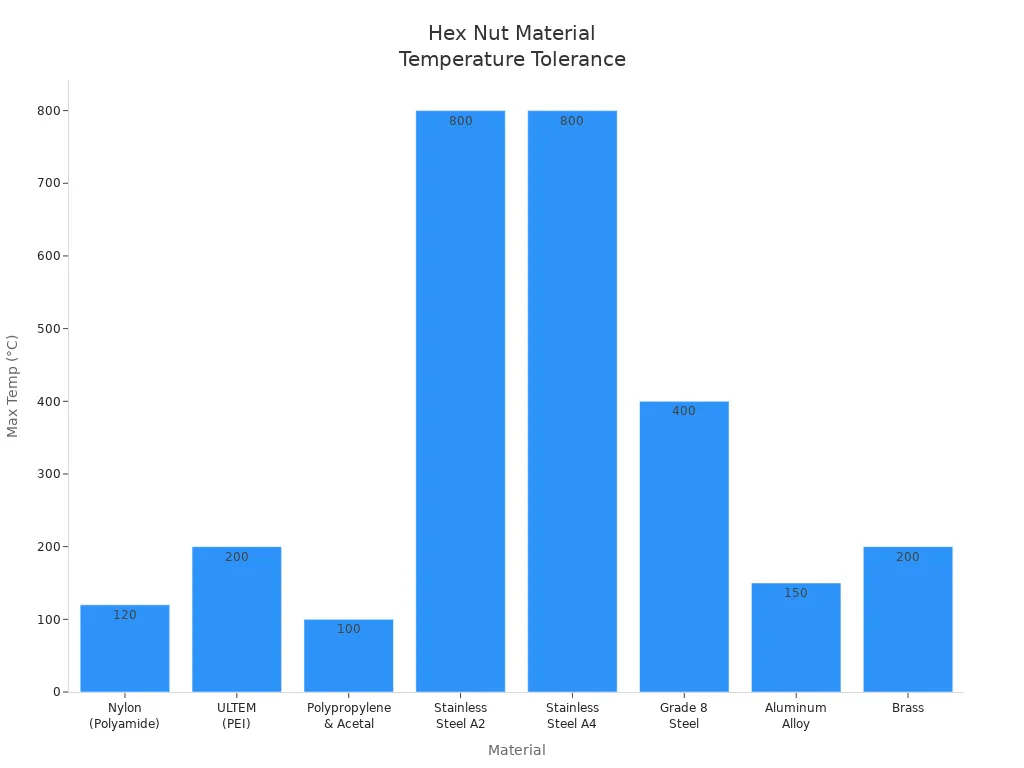
Temperature tolerance varies by material. Stainless steel nuts operate at temperatures up to 800°C, making them suitable for high-heat environments. Grade 8 steel nuts withstand up to 400°C, while aluminum nuts tolerate up to 150°C. Nylon nuts function continuously at 120°C, with short peaks at 150°C. Polypropylene and acetal nuts remain stable below 100°C.
| Material | Max Temp (°C) | Applications |
|---|---|---|
| Nylon (Polyamide) | 120 (continuous), 150 (short peaks) | Automotive, Industrial |
| ULTEM (PEI) | 200 | Aerospace, Medical Sterilization |
| Polypropylene (PP) & Acetal (POM) | 90-100 | General Use |
| Stainless Steel (A2/AISI 304) | 800 | Marine, Food Processing |
| Stainless Steel (A4/AISI 316) | 800 | Chemical Plants |
| Grade 8 Steel | 400 | Heavy Equipment |
| Aluminum Alloy | 150 | Aerospace |
| Brass | 200 | Plumbing, Electrical |
Tip: Always match the nut material and grade to the application’s environmental and mechanical demands. This practice ensures safety, reliability, and long-term performance for every assembly.
Hex nuts play a vital role in mechanical assemblies, with their performance shaped by precise specifications. Understanding these specifications ensures engineers select the right material, grade, and finish for each application. Proper selection prevents joint failure and extends service life.
Choosing the correct hex nut or hex coupling nut improves safety, reliability, and cost efficiency.
Key takeaways for proper selection:
- Ensure full thread engagement for even load distribution.
- Match or exceed the bolt’s strength grade.
- Verify compliance with ASTM or ISO specifications.
| Benefit | Description |
|---|---|
| Extended Service Life | Coatings protect against corrosion, reducing the frequency of replacements. |
| Improved Safety | Corrosion-resistant nuts maintain clamping force, minimizing the risk of joint failure. |
FAQ
What is the difference between a hex nut and a hex coupling nut?
A hex nut fastens a bolt or screw. A hex coupling nut connects two threaded rods or extends fasteners. Hex coupling nuts have a longer body and internal threads throughout.
How do engineers choose the correct hex nut size?
Engineers match the nut size to the bolt diameter and thread pitch. They check standards like ASME or ISO for compatibility. Proper sizing ensures secure fit and prevents joint failure.
Which materials offer the best corrosion resistance for hex nuts?
Stainless steel provides the highest corrosion resistance. Brass and aluminum resist tarnish and oxidation in less aggressive environments. Plastic hex nuts excel in chemical processing and water treatment.
Can hex nuts be reused after removal?
Hex nuts can be reused if threads remain undamaged and the nut shows no signs of wear. Lock nuts with nylon inserts should not be reused, as the insert loses effectiveness.
What markings identify hex nut grade and manufacturer?
Manufacturers stamp grade markings and unique codes on the nut’s surface. These markings indicate mechanical strength and trace the product’s origin. Engineers use them for quality control and compliance.
Are hex nuts suitable for high-temperature applications?
Stainless steel and Grade 8 steel hex nuts withstand high temperatures. Aluminum and plastic nuts tolerate lower heat. Engineers select materials based on the application’s temperature requirements.
Why do some hex nuts have a flange or slots?
Flange hex nuts distribute load and reduce surface damage. Slotted hex nuts allow the use of a cotter pin for extra security. Specialty designs address unique fastening challenges.
What is the purpose of a lock hex nut?
Lock hex nuts resist loosening caused by vibration or torque. They use nylon inserts, deformed threads, or serrated flanges to maintain fastening integrity in dynamic environments.