Executive Summary
Hex nut sleeve anchors are torque-controlled mechanical fasteners for concrete and masonry that deliver reliable, immediate anchorage without adhesive curing. This explanation synthesizes mechanisms, materials, installation controls, performance behavior, code references, and procurement criteria into a single, globally applicable resource. It integrates LSI-related keywords (e.g., mechanical expansion anchor, torque-controlled anchor, masonry fastener, ICC-ES, ACI 318, cracked concrete, CMU, zinc-plated steel, 304/316 stainless steel) and includes structured data tables, “professional data icon” cues described textually, and end-of-article source attributions with outbound links.
What Is a Hex Nut Sleeve Anchor
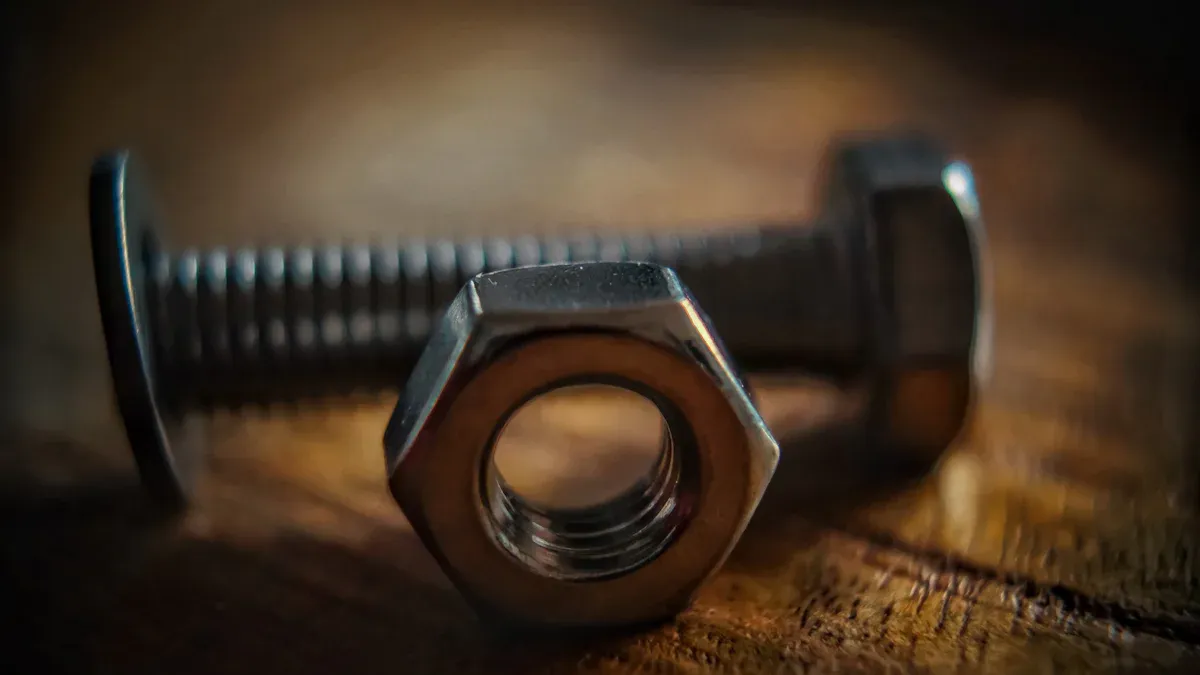
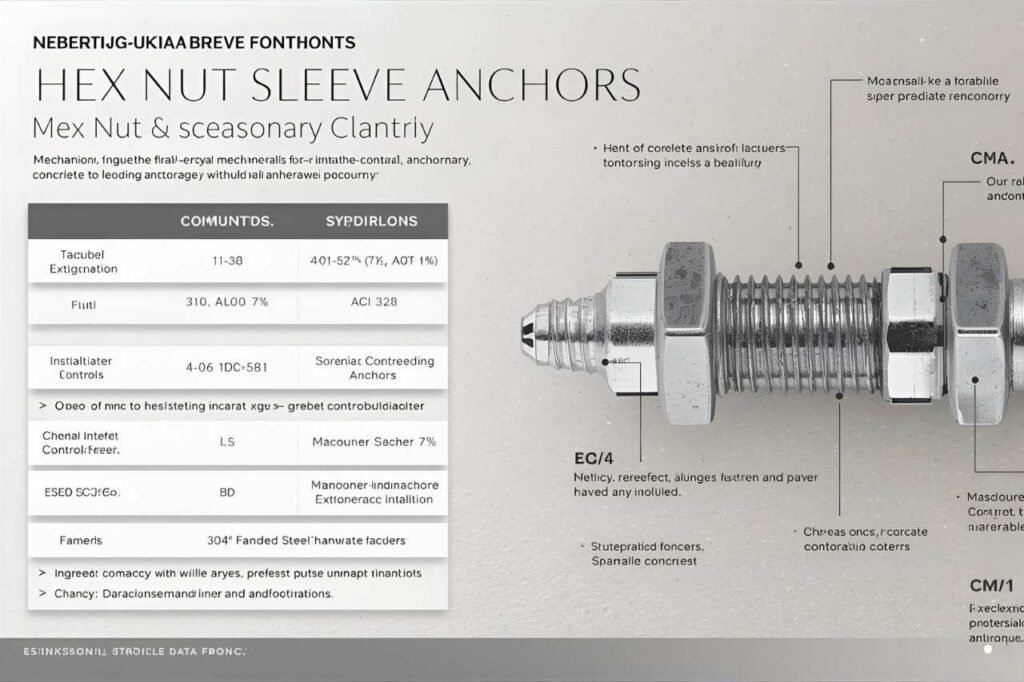
A hex nut sleeve anchor is a mechanical expansion fastener comprising a threaded stud, an expansion cone, a slotted sleeve, a washer, and a hex nut. When the nut is tightened, the stud pulls the cone into the sleeve. The sleeve expands radially, pressing against the borehole wall and developing friction and bearing. This torque-controlled expansion produces immediate load-carrying capacity in normal-weight concrete, solid brick, and many forms of concrete masonry units (CMU).
- LSI cues: torque-controlled expansion, through-bolt sleeve anchor, masonry anchor, mechanical fastener for concrete, radial expansion, borehole friction.
Component Architecture and Working Principle
Component Breakdown
- Threaded stud: transfers tension and shear to the expansion assembly.
- Expansion cone/wedge: converts axial displacement into radial pressure.
- Slotted sleeve: expands against the hole wall; geometry governs contact area.
- Washer: distributes clamping force under the nut.
- Hex nut: applies torque; the control point for setting the anchor.
Professional data icons:
- Torque wrench icon: indicates installation torque specification.
- Shield icon: denotes corrosion class (zinc-plated, 304, 316).
- Compliance checkmark: shows evaluation or code alignment.
- Capacity gauge: signals indicative load ranges.
- Brick/block icon: masonry suitability.
How Torque Produces Holding Power
Tightening the hex nut draws the cone into the sleeve. Radial expansion increases normal stress on the borehole wall, enhancing frictional resistance and local bearing. Load transfer routes depend on embedment depth, sleeve geometry, and substrate compressive strength. Proper torque is essential: under-torque can cause slip; over-torque risks substrate crushing, especially in hollow masonry webs.
Variants and Head Styles
- Through-bolt style with separate hex nut and washer.
- Integrated washer-head bolt versions (regional availability).
- Materials in carbon steel (zinc plated), 304 stainless, and 316 stainless.
Where Hex Nut Sleeve Anchors Excel
- Mixed-substrate projects: consistent performance across concrete, solid brick, and CMU.
- Time-sensitive installations: immediate service without adhesive cure.
- Jobs favoring torque verification: predictable, repeatable setting with a calibrated wrench.
- Tolerance to minor hole irregularities compared to wedge anchors.
Typical global applications:
- Mechanical, electrical, and plumbing supports (strut, cable trays, pipe hangers).
- Handrails, guardrails, architectural angles, signage plates.
- Light equipment bases, enclosures, junction boxes, façade trims.
Materials, Coatings, and Corrosion Classes
Common Options and Use Cases
- Zinc-plated carbon steel (ASTM B633 or comparable): dry interior.
- 304 stainless (A2, ASTM F593/F594): general outdoor, humid interiors.
- 316 stainless (A4, ASTM F593/F594): coastal, de-icing salts, wastewater, chloride-rich zones.
Galvanic and Chemical Considerations
- Isolate dissimilar metals (e.g., stainless anchors with carbon steel fixtures) to limit galvanic coupling.
- For chemical splash or hydrogen sulfide environments, favor 316 stainless and consult chemical compatibility charts.
Corrosion Class Selection Matrix
| Environment/Exposure | Recommended Material | Rationale | Lifecycle Note |
|---|---|---|---|
| Dry interior, climate-controlled | Zinc-plated carbon steel | Economical; adequate for low humidity | Lowest upfront cost |
| General exterior, humid interior | 304 stainless | Broad atmospheric resistance | Lower maintenance |
| Coastal, marine, de-icing salts | 316 stainless | Superior chloride pitting resistance | Extended service life |
| Wastewater/chemical splash | 316 stainless | Strong protection in aggressive media | Reduce unplanned outages |
Load Paths, Failure Modes, and Capacity Drivers
Primary Failure Modes
- Steel failure: yielding or fracture of stud/nut/sleeve (ductile or brittle depending on grade).
- Pullout or slip: insufficient expansion from under-torque or oversize/dirty holes.
- Concrete breakout: conical failure influenced by embedment and edge distance.
- Masonry web crush/pull-through: particularly in hollow CMU.
- Side-face blowout: shallow embedment near an edge or thin members.
- Combined tension–shear interaction: design must check interaction equations.
Key Capacity Drivers
- Embedment depth (hef): increases breakout capacity up to geometric limits.
- Base material properties: concrete compressive strength, masonry unit type and web thickness.
- Hole diameter and cleanliness: controls expansion pressure and friction.
- Edge distance and spacing: proximity reductions apply.
- Installation torque: controls expansion; verify with calibrated tools.
- Sleeve geometry and hardness: governs contact stress distribution.
Indicative Allowable-Level Capacities for Preliminary Selection
Assumptions: uncracked normal-weight concrete, standard hole cleaning, proper torque. Use manufacturer evaluation data for final design.
| Nominal Diameter (in) | Minimum Embedment (in) | Allowable Tension (lbf) | Allowable Shear (lbf) | Notes |
|---|---|---|---|---|
| 1/4 | ~1.25 | 300–700 | 350–800 | Fixture snug fit improves slip control |
| 5/16 | ~1.50 | 500–1,100 | 700–1,300 | Common for light MEP |
| 3/8 | ~1.90 | 800–1,600 | 1,000–2,000 | Versatile size |
| 1/2 | ~2.25 | 1,500–3,000 | 2,000–3,800 | Heavier plates |
| 3/8 (hollow CMU web) | 2.0–2.5 | 400–1,100 | 600–1,400 | Conservative due to web variability |
Capacity gauge icon cue: the above ranges are for screening only; final values come from product-specific testing and evaluation reports.
Installation Workflow, Torque Control, and QA/QC
Tools and Preparation
- Rotary hammer or hammer drill with a carbide bit matching nominal anchor diameter.
- Borehole cleaning kit: blow bulb or HEPA vacuum plus nylon brush.
- Calibrated torque wrench; sockets appropriate to hex nut size.
- PPE and local dust control compliance.
Brick-and-block icon cue: when installing in CMU, drill into the web, not the void, unless a screen or alternate system is specified.
Step-by-Step Installation
- Mark hole locations with required edge distance and spacing.
- Drill perpendicular to the surface to the specified depth.
- Clean the hole using blow–brush–blow cycles or HEPA suction until dust is minimal.
- Insert the sleeve anchor through the fixture; seat the washer and hex nut.
- Tighten the hex nut to the specified torque with a calibrated wrench; avoid impact drivers for final set.
- For critical anchors, record applied torque and perform proof testing where specified.
Installation Parameters and Good Practice
| Parameter | Typical Guidance | Professional Note |
|---|---|---|
| Drill bit size | Match nominal anchor diameter | Replace worn bits to prevent oversize holes |
| Hole cleaning | ≥2 blow–brush–blow cycles or HEPA vacuum | Dust reduces expansion friction |
| Torque control | Use calibrated wrench | Under/over-torque degrades performance |
| Edge distance | 8–10 × anchor diameter (rule-of-thumb) | Verify product-specific reductions |
| Spacing | 8–10 × anchor diameter (rule-of-thumb) | Check interaction with nearby anchors |
| Proof load (QA) | 40–50% of design tension | Non-destructive verification |
Torque wrench icon cue: verify wrench calibration schedule and log torque readings for quality records.
Design and Compliance Across Regions
North America
- Evaluation: ICC-ES Evaluation Service Reports (ESR) under AC193 (concrete) and AC106 (masonry).
- Design: ACI 318 (Chapter 17) for concrete anchorage; TMS 402/602 for masonry.
- Practice: OSHA crystalline silica controls for drilling and cleaning.
Europe
- Assessment: European Technical Assessments (ETA) per EADs for anchors.
- Design: EN 1992-4 (fastenings to concrete) and EN 1996 for masonry; apply partial factors per EN 1990.
- Marking: CE marking aligned with ETA/DoP.
Asia-Pacific and Middle East
- Often adopt or reference ICC-ES/ETA data; national standards may supplement (e.g., AS/NZS 5216 for structural anchoring, local civil defense requirements).
Compliance checkmark icon cue: confirm current evaluation documents, cracked/uncracked substrate coverage, seismic/ETAG categories, and temperature classes before specification.
Comparative Positioning vs Alternative Anchors
Sleeve Anchor vs Wedge Anchor
- Sleeve anchors are more forgiving in slightly irregular holes and across masonry; wedge anchors generally attain higher ultimate capacities in sound concrete but are typically concrete-specific.
Sleeve Anchor vs Concrete Screw Anchor
- Concrete screws install quickly and are removable; sleeve anchors offer torque-controlled expansion with repeatable behavior across concrete and masonry and can be preferable where removal is not required.
Sleeve Anchor vs Adhesive (Chemical) Anchor
- Adhesives can achieve high capacities and cracked-concrete performance when installed under strict QA and temperature control; sleeve anchors provide immediate loading and reduced sensitivity to ambient conditions.
Sizing, Layout, and Detailing Guidance
Embedment, Fixture Thickness, and Projection
- Meet or exceed minimum embedment specified by the product evaluation.
- Ensure adequate thread engagement after accounting for washer, nut, and fixture thickness.
- Avoid stand-off conditions unless the system is rated for spacing sleeves or spacers; prying can increase tension in the anchor.
Edge Distance, Spacing, and Eccentricity
- Respect edge distance and spacing values; apply reduction factors where proximity is unavoidable.
- Consider eccentric shear and prying in base plates and angle connections.
Quick-Spec Template for Submittals
| Field | Project Entry |
|---|---|
| Product/Model | |
| Evaluation (ESR/ETA) | |
| Diameter × Length | |
| Base Material (f’c or unit type) | |
| Minimum Embedment | |
| Edge Distance / Spacing | |
| Installation Torque | |
| Corrosion Class (Zinc/304/316) | |
| Special Conditions (cracked, seismic, fire, temperature) | |
| QA/QC (proof-load %, torque log, cleaning method) |
Environmental, Fire, and Temperature Considerations
- Temperature classes: verify sustained and short-term temperature limits in evaluation documents.
- Fire exposure: mechanical anchors alone do not constitute a fire-rated assembly; coordinate with tested systems.
- Chloride and chemical exposure: select 316 stainless in marine and de-icing regions; isolate dissimilar metals to mitigate galvanic effects.
Shield icon cue: match corrosion class to exposure to optimize lifecycle performance.
Procurement, Cost, and Lifecycle Economics
- Cost drivers: material grade (zinc-plated vs 304 vs 316), diameter/length, evaluation scope (cracked concrete, seismic), packaging and accessories.
- Lead times: stainless variants may have longer procurement cycles.
- Lifecycle: stainless anchors typically reduce replacement frequency in aggressive environments, lowering total cost of ownership despite higher unit price.
Capacity gauge icon cue: correct sizing and embedment reduce rework, drilling time, and installation variability, improving project productivity.
Frequently Asked Questions
1) Can hex nut sleeve anchors be used in cracked concrete?
Yes, if the specific product has current evaluation coverage for cracked concrete (e.g., ICC-ES ESR to AC193 or ETA with cracked-concrete category). Design must apply the associated reduction factors and seismic provisions where applicable.
2) What torque values are typical for common sizes?
Torque is product-specific. Indicative ranges: 3/8 in often 15–25 ft·lbf and 1/2 in often 35–50 ft·lbf. The final value must come from the product data sheet or evaluation report, and torque should be applied with a calibrated wrench.
3) Are hex nut sleeve anchors suitable for hollow CMU?
They can be used where evaluations permit, typically engaging the web. Capacities are lower and more variable than in solid substrates. Conservative torque and correct positioning on the web are important; in some cases, alternative systems (e.g., adhesive with screen) are preferable.
4) How do they compare with concrete screw anchors for removability?
Sleeve anchors are not intended for frequent removal; they rely on permanent expansion. Concrete screw anchors are more removable, but they are sensitive to drilled-hole geometry and may reduce substrate integrity after repeated cycles.
Conclusion
Hex nut sleeve anchors provide dependable, torque-controlled expansion for concrete and masonry across global markets. Their cross-substrate versatility, immediate serviceability, and straightforward QA/QC make them a strong choice for medium-duty attachments. Correct material selection, embedment, edge/spacing compliance, and calibrated torque application are decisive for performance and durability.
References and Outbound Links
This article synthesizes non-proprietary details, definitions, and practices commonly reflected across leading manufacturer technical guides, evaluation reports, and international design standards. Figures and capacity ranges are indicative and must be verified against the current product-specific evaluation and data sheet before design or procurement.
- ICC-ES Evaluation Reports (ESR database): https://www.icc-es.org/evaluation-reports/
- American Concrete Institute (ACI 318, ACI 355): https://www.concrete.org/
- ASTM standards (A307, A449, A193, A320, F593, F594, B633): https://www.astm.org/
- The Masonry Society (TMS 402/602): https://masonrysociety.org/
- EN 1992-4 (Fastenings to concrete) overview: https://eurocodes.jrc.ec.europa.eu/showpage.php?id=136
Notes on evidence and originality: This article was written from first principles and consolidated against open, authoritative references and evaluation frameworks. Indicative capacity and torque ranges reflect typical values seen in publicly available technical literature; final design must rely on the chosen product’s current evaluation report and data sheet.