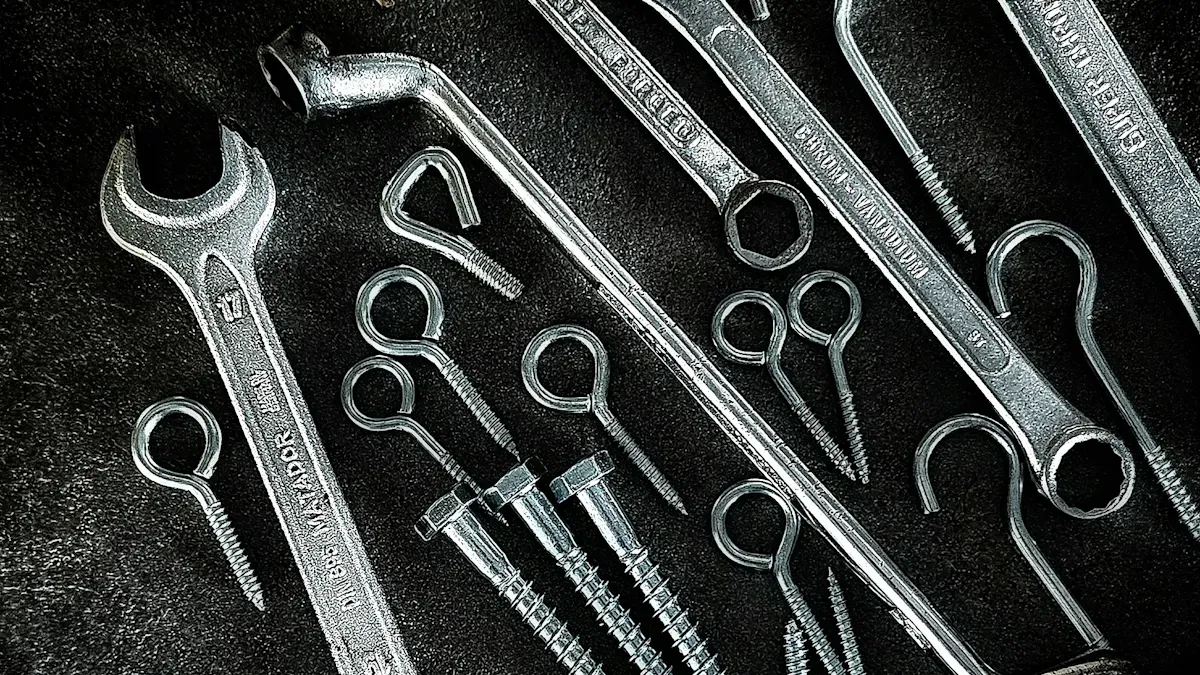
An Eye Bolt is a fastener with a looped head, or “eye,” on one end and threads on the other. Its primary function is creating a strong, reliable attachment point for lifting, pulling, or securing objects. The demand for reliable eye bolt anchors is growing, with a custom fasteners manufacturer often using advanced bolt casting to produce custom fasteners. Key sectors relying on these anchors include:
- Construction
- Marine and Rigging
- Automotive and Agricultural
- Warehouses and Industrial settings
The industrial fastener market reflects this importance, with significant projected growth.
| Metric | 2023 (USD) | 2032 (USD) | CAGR (2023-2032) |
|---|---|---|---|
| Global Industrial Bolt Market | 35 Billion | 55 Billion | 5.2% |
What Is an Eye Bolt Anchor? A Beginner’s Guide
To use eye bolt anchors safely and effectively, a user must first understand their fundamental design and intended purpose. Each part of an eye bolt has a specific role. The combination of these parts creates a versatile tool for countless applications.
The Anatomy of an Eye Bolt
An eye bolt consists of three primary components. Each part contributes to its overall strength and function.
The Eye (Loop)
The eye is the looped head of the bolt. It serves as the connection point for hooks, shackles, or ropes. The construction of this loop is critical. For example, a simple bent wire eye is not load-rated for lifting. It can fail by straightening under excessive force.
Critical Failure Point: A non-forged eye bolt can straighten unexpectedly. In one documented case, a 1/4-inch eye bolt straightened “like a piece of spaghetti” with as little as 120 pounds of force, leading to system failure. This highlights why selecting the correct type is essential for safety.
The Shank (Body)
The shank is the smooth or threaded shaft connecting the eye to the end of the bolt. Its diameter and length determine the bolt’s reach and contribute significantly to its strength. Manufacturers produce eye bolts according to strict industry standards to ensure reliability and interchangeability. These standards define precise dimensions for components like the shank.
Key international standards include:
| Standard | Organization |
|---|---|
| DIN 444 / DIN 580 | German Institute for Standardization (German) |
| ASME B18.15 | American Society of Mechanical Engineers (American) |
| UNI 6058 / UNI 2947 | Italian National Unification Body (Italian) |
The Threads
The threads are the helical ridges at the end of the shank. They allow the bolt to grip a material. A user can screw the bolt into a tapped hole in metal, a pilot hole in wood, or pass it through a hole and secure it with a nut. The thread type—coarse or fine—affects its holding power and resistance to vibration.
The Main Purpose: Creating a Secure Anchor Point
The primary function of all anchor eye bolts is to establish a secure point for attaching other hardware. This simple purpose serves several distinct applications.
For Lifting and Rigging
In industrial environments, workers use shouldered eye bolts for lifting heavy loads. They attach them to machinery, engines, or large components. This allows cranes and hoists to safely lift and move objects weighing many tons.
For Tying Down and Securing
Eye bolts provide excellent tie-down points. People use them to secure cargo on truck beds, anchor tarps over equipment, or brace outdoor structures against wind. Their reliability makes them ideal for applications where tension and stability are necessary.
For Guiding Wires and Ropes
An eye bolt also functions as a guide. It can direct a wire for a plant trellis, create a path for a rope barrier, or support a tensioned cable in a suspension system. In these roles, the eye bolt manages the line of force and prevents cable sag.
The Two Fundamental Categories: Forged vs. Bent Eye Bolts
Understanding the two primary types of eye bolts is crucial for project safety and success. The manufacturing process directly determines an eye bolt’s strength and its appropriate application. These categories are forged eye bolts and bent eye bolts. Each serves a very different purpose.
Forged Eye Bolts for Heavy-Duty Lifting
Forged eye bolts are the industry standard for overhead lifting and handling heavy loads. Their construction provides superior strength and reliability for critical applications.
What “Forged” Means for Strength
Manufacturers create forged eye bolts by heating a single piece of steel and shaping it with a die. This process aligns the metal’s internal grain structure, making it continuous and unbroken. The result is a component with exceptional tensile strength and resistance to shock and fatigue. A forged eye is a solid, one-piece loop that will not open under its rated load.
The Critical Role of a Shoulder
Many forged lifting eye bolts feature a “shoulder.” This is the flat surface located directly underneath the eye. The shoulder serves a vital function: it braces the bolt against the mounting surface. This design allows the bolt to handle angular loads (pulls from the side) safely.
Safety Tip: An eye bolt without a shoulder must only be used for perfectly straight, in-line pulls. Applying an angular load to a non-shouldered bolt can bend or break it.
When to Use Forged Eye Bolts
A user should always select forged eye bolts for any overhead lifting or rigging task. Their strength and design make them the only safe choice for these jobs.
- Lifting heavy machinery or engine blocks.
- Securing critical loads for transport.
- Creating anchor points in industrial rigging systems.
- Suspending equipment or structures.
Bent (Formed) Eye Bolts for Light-Duty Tasks
Bent eye bolts, also called wire eye bolts, are a common and economical hardware choice. However, they are strictly for light-duty, non-critical applications.
How They Are Made from Bent Rods
These types of eye bolts are made by simply bending a steel rod or wire into a loop. The end of the rod may be welded to the shank to close the eye, but often a small gap remains. This manufacturing method is quick and inexpensive, but it creates a significant structural weak point where the eye could straighten or open.
Why They Are for Light, Straight-Line Pulls Only
The bent eye design cannot withstand significant force, especially from an angle. An angular pull concentrates stress on the unwelded or lightly welded part of the eye, causing it to open easily. For this reason, a user must never use bent eye bolts for lifting or for any application where failure could cause injury or property damage.
Common Uses for Bent Eye Bolts
Bent eye bolts are suitable for static loads or light-duty tensioning where the force is applied in a straight line with the shank.
- Anchoring a guy wire for a small tree or antenna.
- Creating a tie-down point for a tarp.
- Guiding ropes for a decorative barrier.
- Hanging lightweight signs or decorations.
Exploring the Different Types of Eye Bolts and Their Uses
While eye bolts fall into two main categories, several distinct designs exist for specific materials and jobs. Understanding the different types of eye bolts helps a user select the correct hardware for both safety and performance. Each design offers unique features tailored to its intended application.
Machinery Eye Bolts (Shouldered)
Machinery eye bolts are the premier choice for heavy-duty lifting and rigging. They are engineered for maximum strength and reliability in demanding industrial settings.
Key Features and Design
These bolts are always forged from a single piece of steel, creating a solid, unbroken grain structure. Their most important feature is the shoulder, which sits flush against the mounting surface to support angular loads. Manufacturers produce these components to exacting standards, such as ASME B18.15, which dictates precise dimensions for every part of the bolt.
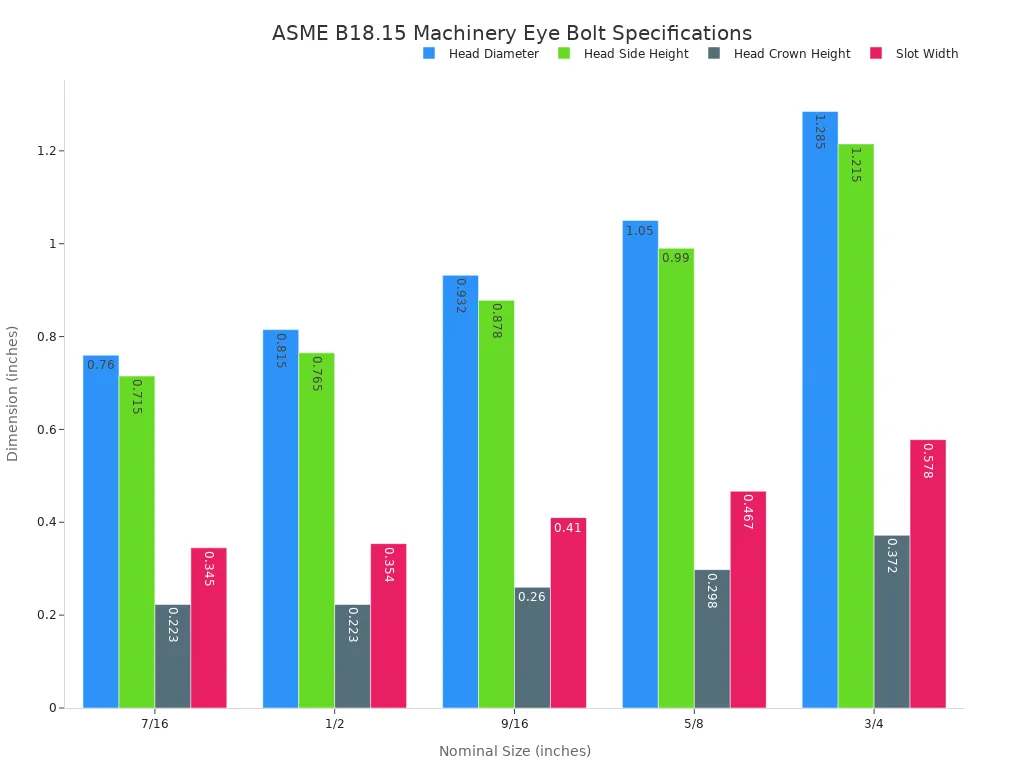
To suit various operating environments, machinery eye bolts are available with numerous protective coatings. Common options include:
- Zinc Plated
- Hot Dip Galvanized
- Cadmium Plated
- Black Phosphated
- Ceramic Coated
- PTFE Coated
Typical Applications in Machinery
Professionals use machinery eye bolts almost exclusively for overhead lifting. Their robust, shouldered design makes them the only safe option for hoisting heavy and valuable equipment. Common applications include lifting motors, dies, and other large machine components for installation or maintenance.
Nut Eye Bolts
Nut eye bolts are a versatile fastener designed for through-hole applications. They provide a strong anchor point when a user can access both sides of the mounting surface.
Key Features and Design
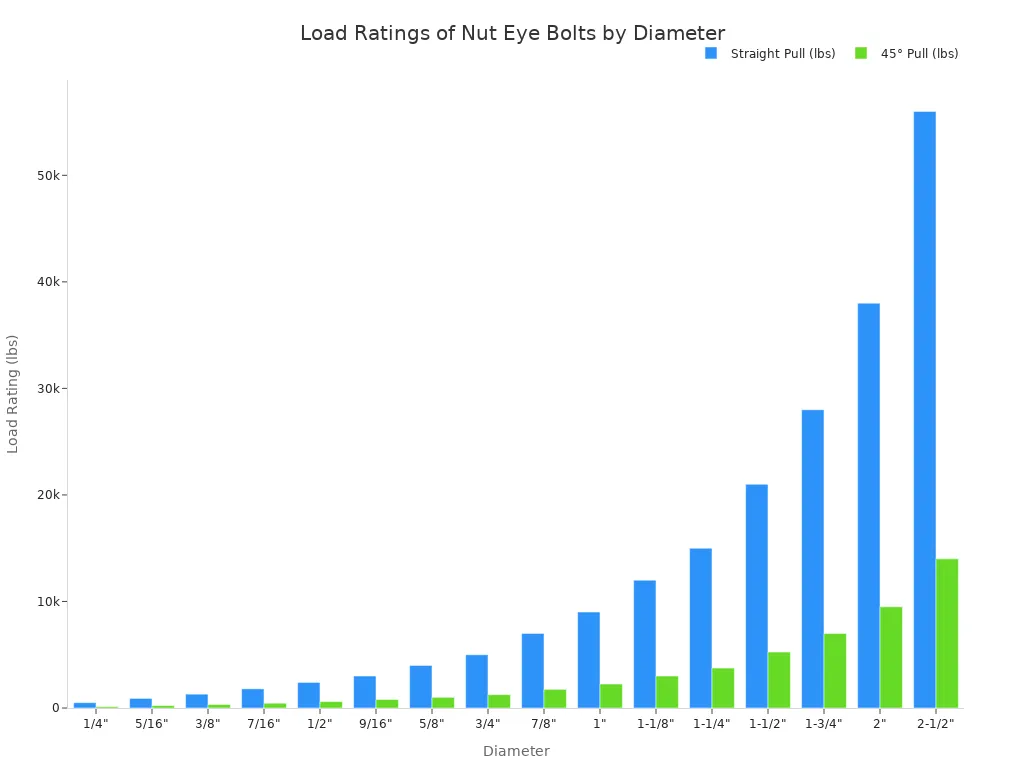
A nut eye bolt has a fully threaded shank that passes completely through a pre-drilled hole. A user secures it on the opposite side with a washer and nut. These types of eye bolts come in both shouldered and non-shouldered (plain pattern) varieties. The shouldered version is essential for any angular loading. As the load angle increases, the bolt’s capacity decreases dramatically.
Important Load Information: Working load limits are based on a straight vertical lift with a 5-to-1 safety factor. Angular lifts drastically reduce these limits. A user must use a properly seated shoulder pattern bolt for any angular pull, and the load must never exceed a 45-degree angle from the bolt shank.
The table below illustrates how significantly an angular pull reduces the safe working load.
| Diameter | Straight Pull (lbs) | 45° Pull (Shoulder Only) (lbs) |
|---|---|---|
| 1/4″ | 500 | 125 |
| 3/8″ | 1,300 | 325 |
| 1/2″ | 2,400 | 600 |
| 3/4″ | 5,000 | 1,250 |
| 1″ | 9,000 | 2,250 |
| 1-1/2″ | 21,000 | 5,250 |
Typical Applications for Through-Holes
Installers use nut eye bolts to create anchor points on posts, beams, and plates. They are ideal for securing loads, attaching guy wires, or creating tie-downs where the bolt can pass through the material and be fastened securely from the back.
Lag Eye Bolts (Screw Eye Bolts)
Lag eye bolts, sometimes called screw eye bolts, are designed for anchoring directly into wood or into masonry using a lag shield.
Key Features and Design
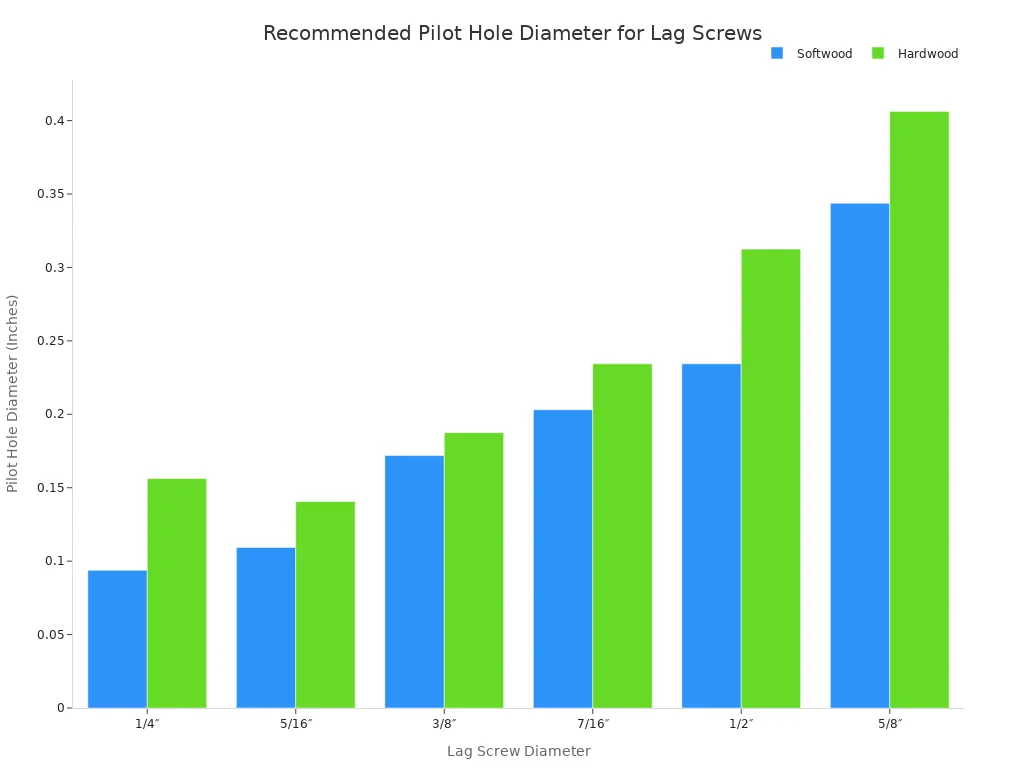
The defining feature of a lag eye bolt is its threading. It has coarse, tapered threads like a wood screw, which allows it to bite firmly into wood fibers. For a secure installation that prevents wood from splitting, a user must drill a pilot hole first. The correct pilot hole diameter depends on the bolt size and the wood’s hardness.
Installation Tip: People often use the terms ‘lag screw’ and ‘lag bolt’ interchangeably. A lag screw typically has a hex head and threads that bite into wood. Drilling the correct pilot hole is critical. A good rule is to drill a hole about two-thirds of the screw’s diameter in softwood and nearly the full core diameter in hardwood.
| Lag Screw Diameter | Pilot Hole in Softwood | Pilot Hole in Hardwood |
|---|---|---|
| 1/4″ | 3/32″ | 5/32″ |
| 5/16″ | 7/64″ | 9/64″ |
| 3/8″ | 11/64″ | 3/16″ |
| 1/2″ | 15/64″ | 5/16″ |
Typical Applications in Wood
Lag eye bolts are excellent for creating light to medium-duty anchor points in wooden structures. Common uses for these different types of eye bolts include securing shade sails to posts, anchoring gate hardware, hanging heavy plants from beams, or creating tie-down points on wooden decks and walls.
Screw Eyes
Screw eyes represent the lightest-duty option among the different types of eye bolts. They are a common piece of hardware found in residential and craft settings, but a user must understand their significant limitations.
Key Features and Design
A screw eye is essentially a piece of wire bent into a loop with a threaded, pointed shank. The design is simple and economical.
- Construction: They are formed from a bent wire, not forged. The eye is often not fully closed, creating a gap that can easily open under load.
- Threads: The shank has sharp, tapered threads similar to a wood screw, designed to be twisted directly into wood or other soft materials.
- Load Capacity: Screw eyes have no official load rating. They are not designed for lifting or supporting any significant weight. Applying force can cause the eye to unbend or the screw to pull out of the material.
Safety Warning: A user must never use a screw eye for any load-bearing or safety-critical application. Their design is intended only for static, lightweight decorative purposes. Failure under a minimal load is common and expected.
Typical Applications for Residential Use
Screw eyes are suitable only for tasks where the load is minimal and failure would not result in injury or damage. Their utility lies in their ease of installation for light-duty jobs around the home.
Common uses include:
- Hanging very light picture frames or artwork.
- Creating attachment points for craft projects.
- Guiding thin strings for indoor decorations.
- Running small-gauge wire for hobbyist electronics.
Toggle Wing Eye Bolts
Toggle wing eye bolts are a specialized solution for anchoring into hollow materials like drywall, plaster, or hollow-core doors. They are one of the more ingenious types of eye bolts for modern construction.
Key Features and Design
These fasteners solve the problem of mounting objects where no solid stud is available. The design consists of two main parts: the eye bolt and a spring-loaded toggle mechanism.
- The Eye Bolt: This is a standard bolt with an eye at one end and machine threads on the other.
- The Toggle Wing: This is a metal bar with a threaded hole in the center. It is attached to the bolt and is spring-loaded to fold flat.
The installation process is unique. A user drills a hole large enough for the folded toggle to pass through. The user then pushes the toggle through the hole. Once inside the hollow cavity, the spring forces the wings to open, creating a wide brace against the back of the wall material. Tightening the eye bolt pulls this brace firmly against the interior surface, creating a secure anchor.
Typical Applications in Hollow Walls
Toggle wing eye bolts provide a surprisingly strong anchor point in materials that would otherwise not support a fastener. They distribute the load over a wider area on the back of the wall, preventing the bolt from pulling through. Understanding these different types of eye bolts allows for secure mounting on otherwise unusable surfaces.
Typical applications include:
- Suspending lightweight plants or light fixtures from a drywall ceiling.
- Mounting shelves or brackets onto plaster walls.
- Securing mirrors or heavy pictures to hollow-core doors.
- Anchoring fixtures in commercial spaces with metal stud and drywall construction.
Key Factors for Choosing the Right Eye Bolt Anchor
Selecting the correct hardware is critical for safety and project success. A user must evaluate several key factors before choosing eye bolt anchors. These factors include the load’s weight, the pull’s direction, and the environmental conditions.
Understanding Working Load Limit (WLL)
The most important safety specification for any lifting hardware is its Working Load Limit (WLL). This rating is the foundation of safe rigging and lifting practices.
What is WLL?
The Working Load Limit is the maximum mass or force that a piece of equipment can safely handle. Manufacturers determine this limit. They calculate the Working Load Limit by dividing the hardware’s minimum breaking strength by a safety factor. For most eye bolts, this safety factor is 5:1. For example, a bolt that breaks at 10,000 pounds has a Working Load Limit of 2,000 pounds.
Why You Must Never Exceed It
Exceeding the Working Load Limit is extremely dangerous. Overloading is a primary cause of equipment failure, which can lead to severe injury or death. Regulatory bodies establish strict guidelines to prevent such accidents.
- ASME B30.26 requires a minimum 5:1 design factor for rigging hardware.
- OSHA 1926.251 mandates that equipment must be used within its rated capacity.
- ANSI E1.4-1 specifies an 8:1 design factor for certain overhead components.
Where to Find the WLL Rating
Manufacturers typically stamp or mark the Working Load Limit directly onto forged, load-rated eye bolts. A user can also find this information on the product’s packaging or in the manufacturer’s technical data sheets. If the WLL is not marked, the bolt is not rated for lifting.
Load Direction: Angular vs. Straight-Line Pull
The direction of force dramatically affects an eye bolt’s capacity. A user must consider whether the pull will be straight or at an angle.
Defining Straight-Line (Axial) Loads
A straight-line or axial load pulls parallel to the bolt’s shank. This is the ideal loading condition, allowing the bolt to support its full rated capacity.
Defining Angular (Shear) Loads
An angular or shear load pulls from the side, at an angle to the shank. This type of load introduces bending forces that significantly reduce the bolt’s strength.
Which Bolts Handle Which Loads
Only shouldered eye bolts are suitable for angular loads. The shoulder must be seated flush against the mounting surface to provide support. Even with a shoulder, the bolt’s capacity decreases as the angle increases.
| Angle of Pull (Degrees) | Weight Capacity Reduction |
|---|---|
| 5° | 0% (Full capacity) |
| 15° | 20% |
| 30° | 35% |
| 45° | 70% |
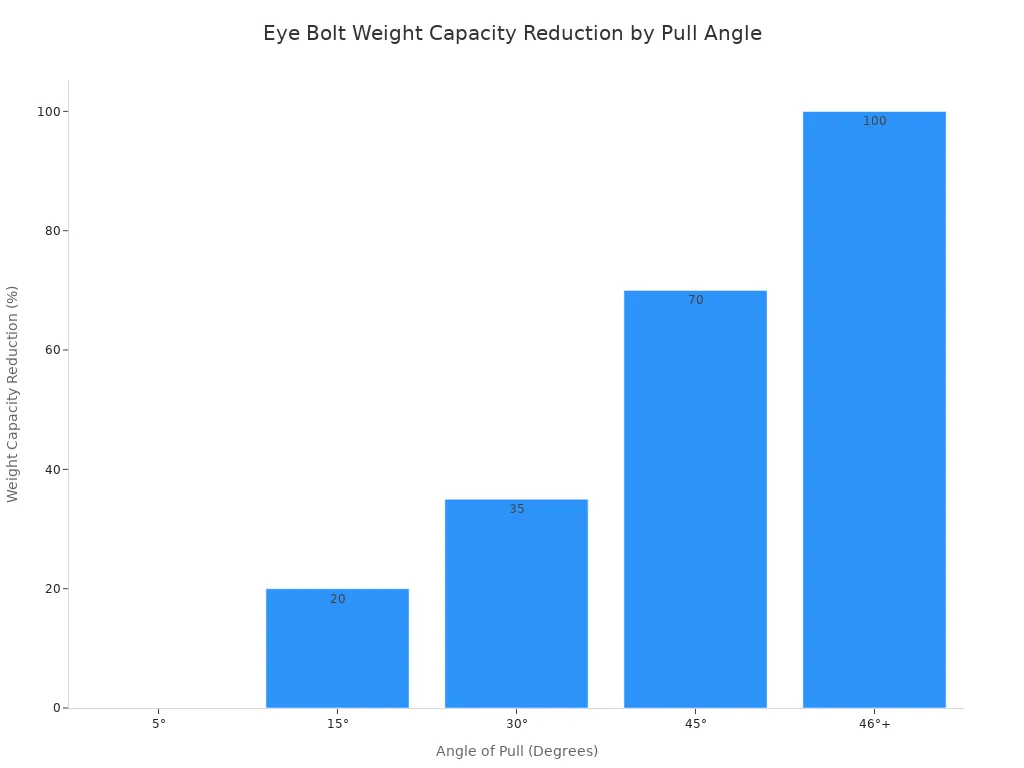
Critical Note: Pulling at an angle greater than 45 degrees is unsafe. For such applications, a user should consider a hoist ring instead.
Material and Finish Selection
The bolt’s material and finish determine its resistance to corrosion and its suitability for different environments.
Stainless Steel for Corrosion Resistance
Stainless steel offers excellent protection against rust. For marine or chemical environments, 316 “marine grade” stainless steel is superior to the standard 304 type due to its molybdenum content, which resists chloride corrosion.
| Feature | 304 Stainless Steel | 316 Stainless Steel |
|---|---|---|
| Corrosion Resistance | Good | Superior in salt water |
| Common Name | 18/8 stainless | Marine grade |
| Cost | Less expensive | More expensive |
Zinc-Plated Steel for Dry Environments
Zinc plating provides a thin, protective layer suitable for indoor or dry applications. It offers minimal corrosion resistance and is not intended for outdoor use.
Hot-Dipped Galvanized Steel for Outdoor Use
Hot-dipped galvanizing creates a much thicker, more durable zinc coating. This process provides long-lasting protection against the elements, making it the standard choice for outdoor and industrial construction. A galvanized coating can last over 60 years in some environments.
Basic Installation Guidelines for Eye Bolt Anchors
Proper installation is just as important as selecting the right hardware. A correctly installed fastener ensures maximum strength and safety. The installation method varies significantly depending on the base material: wood, metal, or concrete.
Installing into Wood
Wood provides a solid base for lag-style eye bolts when a user follows the correct procedure. This process prevents splitting the wood and ensures a secure grip.
How to Drill a Pilot Hole
Drilling a pilot hole is a mandatory first step. A pilot hole clears a path for the bolt, preventing the wood from cracking under pressure. The hole’s diameter should be slightly smaller than the bolt’s shank to allow the threads to bite firmly. For an eye bolt anchor for wood, the pilot hole size depends on whether the wood is hard or soft.
Driving the Lag Eye Bolt Correctly
A user should thread the lag eye bolt into the pilot hole by hand to start. To finish, the user can insert a screwdriver or steel rod through the eye for leverage and turn the bolt until the shank is fully embedded. The bolt’s holding power depends on factors like wood type and embedment depth, though industry standards do not provide a universal rule for depth.
Installing into Metal
Metal applications require precision. A user can install eye bolts into a pre-tapped hole or through a hole with a nut and washer.
Using a Pre-Tapped Hole
For solid metal plates, a user must first drill and tap a hole. Tapping creates threads inside the hole that match the bolt’s threads. For a secure connection, professionals follow best practices.
- Drill the Correct Hole: The tap often specifies the required drill size. The goal is to achieve about 70% thread engagement for optimal strength.
- Apply Cutting Oil: A light coating of cutting oil on the tap reduces friction and helps create cleaner threads.
- Tap the Hole: A user inserts the tap perpendicularly and turns it slowly to cut the threads. This creates a secure base for machinery eye bolts.
Using a Through-Hole with a Nut
The simplest method for metal sheets or plates is a through-hole. A user drills a hole slightly larger than the bolt’s diameter, passes the bolt through, and secures it on the other side with a washer and nut. This is the standard method for installing nut eye bolts.
Installing into Masonry or Concrete
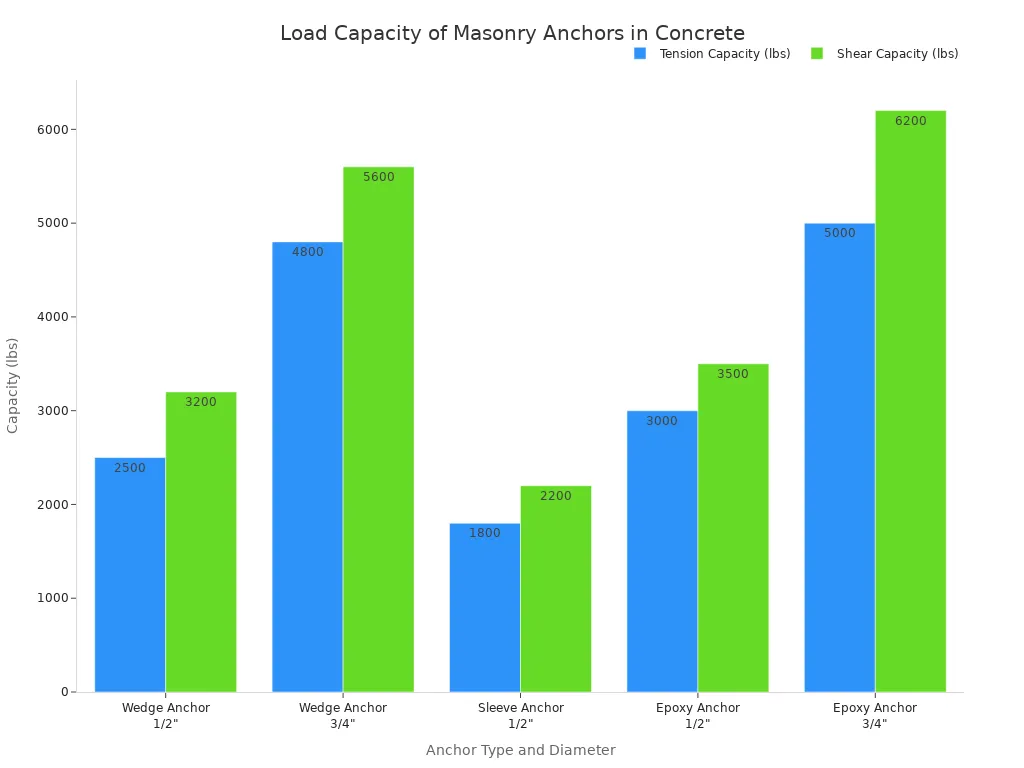
Concrete and masonry are strong but brittle, requiring specialized eye bolt anchors to create a secure point. Common solutions include mechanical anchors and chemical adhesives.
Using a Lag Shield Anchor
For light to medium-duty applications, a user can pair a lag eye bolt with a lag shield. These eye bolt shield anchors are metal sleeves inserted into a pre-drilled hole. As the lag bolt threads into the shield, the shield expands and presses firmly against the walls of the hole. Installers often use eye bolt shield anchors in brick or block.
Using an Epoxy Anchor System
For the highest load capacity, an epoxy anchor system is the best choice. This method uses a two-part adhesive to bond a threaded rod or an eye bolt anchor for concrete directly to the masonry.
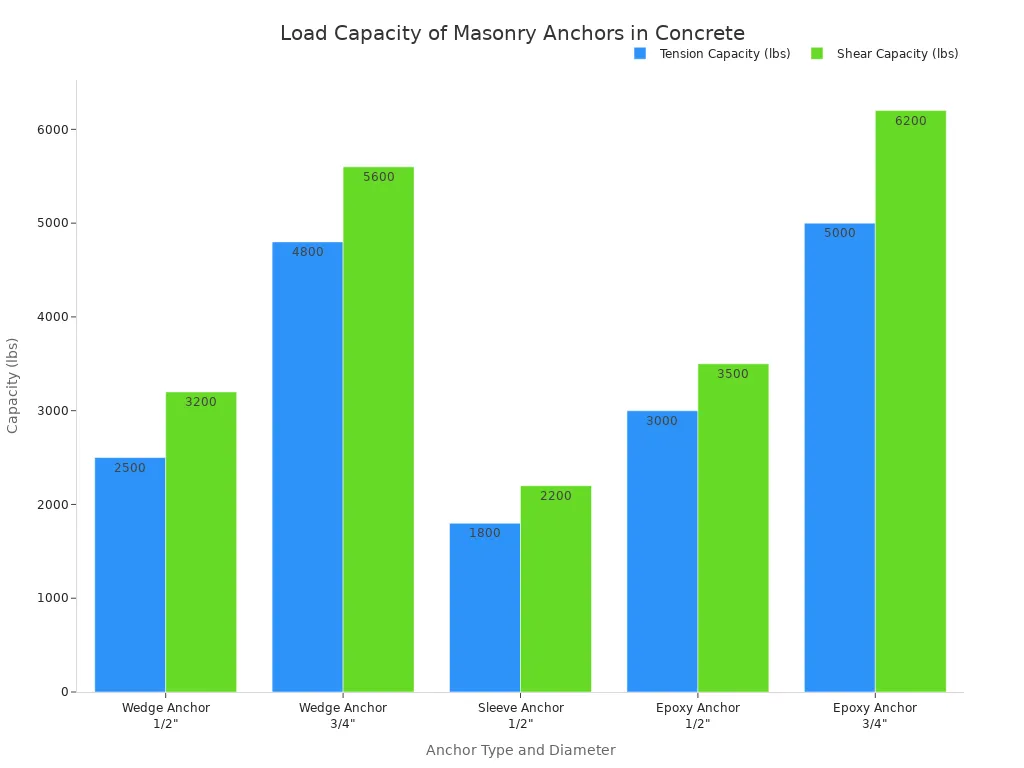
Pro Tip: Always follow the manufacturer’s instructions for epoxy installation, as cure times and procedures can vary. A clean hole is critical for a strong bond.
A typical installation involves these steps:
- Drill a hole to the specified diameter and depth.
- Clean the hole thoroughly with a wire brush and compressed air to remove all dust and debris.
- Dispense the two-part epoxy into the hole, filling it about halfway from the bottom up.
- Slowly turn the threaded rod or bolt as you insert it to the bottom of the hole.
- Allow the epoxy to cure completely before applying any load.
Critical Safety Rules for Using All Types of Eye Bolts
Using eye bolts safely goes beyond correct selection and installation. A user must adopt a safety-first mindset. Adhering to strict safety protocols protects personnel, prevents equipment damage, and ensures project integrity. These rules apply to all different types of eye bolts.
Always Inspect Before Use
A visual inspection before every use is a non-negotiable safety step. Damage can occur during storage or previous use, compromising the bolt’s integrity.
Checking for Bends, Cracks, or Wear
A user should carefully examine the entire eye bolt for any signs of physical damage. Look for nicks, gouges, or cracks, especially in the eye and shank areas. Any bending or elongation of the eye indicates overloading, and the bolt must be discarded. Regulatory standards from organizations like OSHA and ASME B30.26 support these practices. These eye bolt testing regulations mandate that rigging equipment must be inspected before use on each shift. If a user finds any defect, they must remove the equipment from service immediately.
Inspecting Threads for Damage
The threads are critical for a secure connection. A user must inspect them for stripping, corrosion, or other damage. Damaged threads can prevent proper seating or fail under load. A bolt with compromised threads cannot achieve its rated capacity and poses a significant risk.
Never Modify an Eye Bolt
An eye bolt is an engineered component. Any unauthorized alteration will void its load rating and create a dangerous weak point.
How Welding or Grinding Affects Strength
Welding or applying excessive heat to a forged eye bolt destroys its internal grain structure. This alteration makes the metal brittle and unpredictable. Grinding away material to make a bolt fit also reduces its cross-sectional area, which directly lowers its strength and load-bearing capacity.
The Dangers of Unauthorized Alterations
Modifying certified lifting equipment carries severe consequences. A user who alters a bolt creates a hazardous situation with significant legal and financial exposure.
Warning: Potential Consequences of Modification ⚠️
- Compromised Integrity: The bolt’s structure is weakened, leading to unexpected failure.
- Voided Warranties: The manufacturer is no longer responsible for the product’s performance.
- Legal Liability: In case of an accident, the person who made the alteration may face lawsuits and even criminal prosecution.
- Regulatory Fines: OSHA can issue substantial fines for using modified equipment, with penalties for willful violations reaching over $165,000.
When in Doubt, Consult a Professional
Recognizing the limits of one’s own knowledge is a key part of safety. For complex or critical applications, professional guidance is essential.
Knowing Your Limits as a Beginner
A beginner should handle only straightforward, non-critical tasks. If a situation involves heavy loads, angular lifts, or unfamiliar conditions, it is time to stop and seek expert advice. Guesswork in rigging can have catastrophic results.
Why to Consult an Engineer for Critical Lifts
For any overhead lift involving valuable equipment or potential risk to human life, a user must consult a qualified engineer. An engineer can calculate load forces, specify the correct hardware, and design a safe lifting plan that complies with all industry standards.
A user’s choice of eye bolt anchors hinges on two key factors: the weight of the load and the direction of the pull. Understanding the different types of eye bolts is critical for safety.
Remember the fundamental rule: Forged, shouldered bolts handle heavy or angled lifts. Bent eye bolts are only for light, straight-line pulls.
A user must always prioritize safety. This involves checking the working load limit (WLL) and inspecting hardware before each use. Correct hardware selection ensures project success and protects everyone involved.
FAQ
What is a shouldered eye bolt?
A shouldered eye bolt has a flat surface beneath the eye. This shoulder braces against the mounting surface, allowing the bolt to handle angular loads safely. A user must only use non-shouldered bolts for straight, in-line pulls.
Can a user reuse lifting eye bolts?
Yes, but only after a thorough inspection. A user must check for any bending, cracks, or thread damage. If any defect is found, they must discard the bolt immediately. Safety standards mandate inspection before every lift.
What does WLL mean?
WLL stands for Working Load Limit. It is the maximum safe force a piece of hardware can handle, as determined by the manufacturer. A user must never exceed the WLL to prevent equipment failure and ensure safety.
Why is a pilot hole important for lag eye bolts?
A user drills a pilot hole into wood before installing a lag eye bolt. This hole creates a path for the bolt’s threads. It prevents the wood from splitting during installation and ensures the bolt achieves a secure grip.
Can a bent eye bolt be used for lifting? 🚫
No. A user must never use a bent (or wire) eye bolt for lifting. Its eye can easily straighten and fail under a load. These bolts are only for light-duty, non-critical tasks like guiding ropes or hanging decorations.
How does a toggle wing eye bolt work?
A user pushes the folded toggle wings through a hole in a hollow wall. The wings spring open inside the wall cavity. Tightening the bolt pulls the wings against the interior surface, creating a strong anchor point.
Which material is better: stainless steel or galvanized?
The best material depends on the environment.
Stainless Steel: Offers superior corrosion resistance, making it ideal for marine or chemical settings. Hot-Dipped Galvanized: Provides durable protection for general outdoor and industrial construction projects.