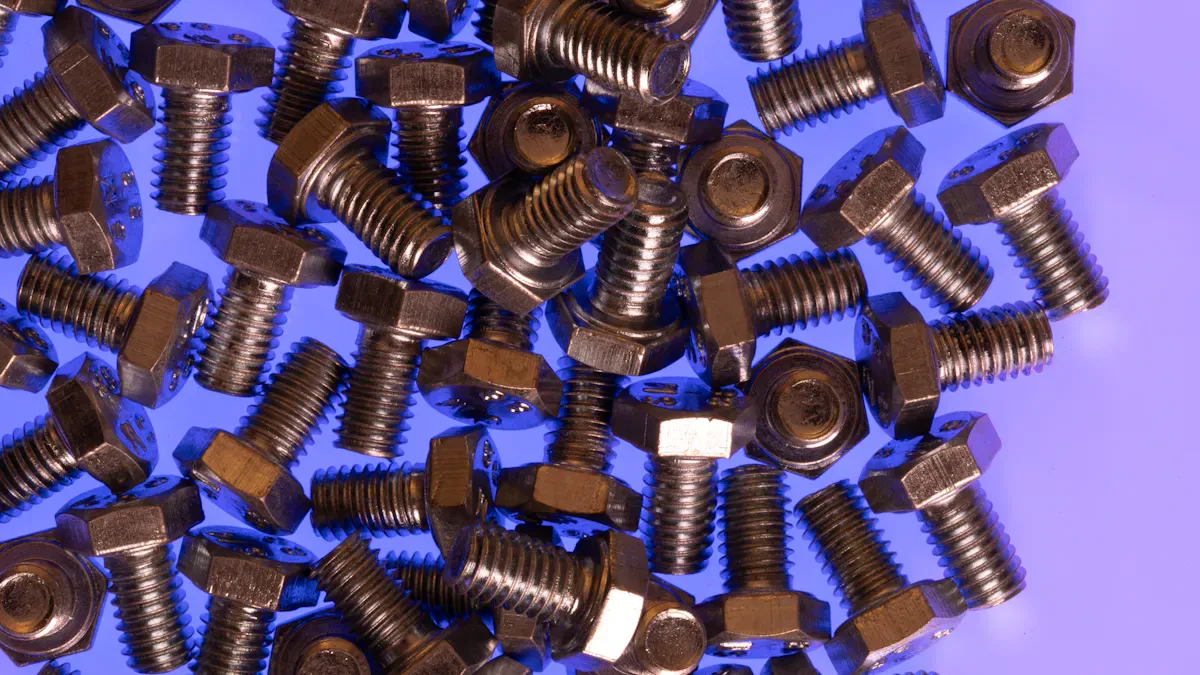
A carriage bolt is a fastener with a smooth, domed head and a square neck. This unique design creates a secure connection when fastening wood. The square neck grips the material, preventing the bolt from turning as its nut is tightened. These bolts are integral to the automotive and construction industries. The market for industrial fasteners, including carriage bolts, is projected to grow significantly. This growth reflects trends in bolt casting and demand for custom fasteners from any custom fasteners manufacturer.
What Defines Carriage Bolts? An Anatomical Breakdown
A carriage bolt’s effectiveness stems from three distinct anatomical features: its head, neck, and shank. Each component serves a specific purpose, contributing to the fastener’s unique combination of security, safety, and ease of use. Understanding this anatomy reveals why these bolts are a superior choice for many applications.
The Smooth, Domed Head
The most recognizable feature of a carriage bolt is its large, smooth, dome-shaped head. This design is not merely for appearance; it is a critical element of its function and safety profile.
Design for Safety and Aesthetics
The primary advantage of the domed head is safety. Its smooth, rounded surface lacks the sharp corners found on hexagonal or square bolts. This design significantly reduces the risk of snags or injuries, making it ideal for applications where people might come into contact with the fastener.
Safety First! 👷♀️ In public structures, safety is paramount. The design of carriage bolts directly addresses this need:
- It eliminates sharp edges, preventing cuts and scrapes on playgrounds, benches, and railings.
- The low profile reduces the chance of clothing getting caught.
- It creates a tamper-resistant finish, as the head cannot be gripped by a standard wrench or pliers.
This focus on safety makes carriage bolts a requirement for many public projects, especially playground equipment, where children could be injured by contact with sharp hardware. The clean, finished look also provides a pleasing aesthetic for furniture and architectural woodwork.
Countersunk and Flat Head Variations
While the domed head is standard, manufacturers also produce variations for specific needs.
- Flat Head Carriage Bolts: These bolts feature a flat top surface with a countersunk design. They sit flush with the material’s surface, providing an even lower profile than a domed head.
- Countersunk Head Bolts: Similar to flat heads, these are designed to be completely flush, making them ideal for applications where no part of the bolt should protrude, such as decking or flooring.
The Square Neck: The Anti-Spin Feature
Directly beneath the head lies the square neck, the defining functional component of all carriage bolts. This small section is the key to the bolt’s simple, one-person installation.
How It Grips Wood and Metal
The square neck provides a crucial anti-rotation function. When a user installs the bolt into a pre-drilled hole in wood, a hammer tap sets the square neck into the wood fibers. This action creates a mechanical lock that prevents the entire bolt from spinning. An installer can then tighten the nut from the opposite side without needing a wrench to hold the bolt head. In metal applications, these bolts fit into a pre-punched square hole, achieving the same non-rotating result.
The dimensions of the square neck are standardized to ensure a reliable fit. Industry specifications, such as those from ASME, dictate the precise tolerances for the neck’s width and depth relative to the bolt’s diameter.
| Nominal Size or Basic Bolt Diameter | Square Width (Max) | Square Width (Min) | Square Depth (Max) | Square Depth (Min) |
|---|---|---|---|---|
| 1/4 | 0.260 | 0.245 | 0.156 | 0.125 |
| 5/16 | 0.324 | 0.307 | 0.187 | 0.156 |
| 3/8 | 0.388 | 0.368 | 0.219 | 0.188 |
| 1/2 | 0.515 | 0.492 | 0.281 | 0.250 |
| 3/4 | 0.768 | 0.741 | 0.406 | 0.375 |
*Dimensions shown in inches, based on ASME B18.5 standards.*

Ribbed Neck Alternatives
Some specialized carriage bolts feature a ribbed or finned neck instead of a square one. These ribs perform the same anti-spin function, digging into the material to lock the bolt in place. Ribbed neck bolts are often preferred for use in softer woods, as they can provide a secure grip without the risk of splitting the material that a square neck might pose.
The Shank and Threading
The shank is the body of the bolt, extending from the neck to the end. Its dimensions and threading determine the bolt’s strength and application suitability.
Understanding Shank Dimensions
The diameter of the shank is the bolt’s nominal size (e.g., 1/4″, 3/8″, 1/2″). This dimension is critical, as it dictates the size of the pilot hole and the overall strength of the fastener. Head dimensions are also directly proportional to the shank diameter, ensuring the bolt has adequate bearing surface and strength. Key industry standards governing the dimensions of these bolts include:
- ASME B18.5 (Inch Series)
- ASME B18.2.3.6M (Metric)
- ISO 7412 (Metric)
The following table details standard head dimensions for common inch-series carriage bolts.
| Nominal Size | Head Diameter (W) Max | Head Diameter (W) Min | Head Height (H) Max | Head Height (H) Min |
|---|---|---|---|---|
| 1/4 | .594 | .563 | .145 | .125 |
| 5/16 | .719 | .688 | .176 | .156 |
| 3/8 | .844 | .782 | .208 | .188 |
| 1/2 | 1.094 | 1.032 | .270 | .250 |
| 3/4 | 1.594 | 1.469 | .406 | .375 |
All dimensions are in inches.

Partial vs. Full Threading
Carriage bolts are available with two main threading styles:
- Partially Threaded: These bolts have an unthreaded upper shank portion. This design provides superior shear strength, as the smooth shank can bear lateral loads more effectively than threads can. It is ideal for joints where alignment and resistance to shear forces are critical.
- Fully Threaded: These bolts have threads running the entire length of the shank. This style offers maximum grip and adjustability, making it suitable for applications where the materials being joined are thin or where the exact grip length is uncertain.
Most carriage bolts use Unified National Coarse (UNC) threads, which are ideal for wood and general construction. However, Unified National Fine (UNF) threads are available for specialized applications requiring higher tensioning and vibration resistance.
| Criteria | UNC Thread (Unified National Coarse) | UNF Thread (Unified National Fine) |
|---|---|---|
| Thread Spacing | More widely spaced, larger threads. | Closer together, finer threads. |
| Suitable Materials | Soft materials (e.g., wood, aluminum). | Hard materials (e.g., steel, tough metals). |
| Ease of Installation | Faster and less risk of seizing. | Requires more precision during installation. |
| Vibration Resistance | Less efficient against vibrations. | Better hold in vibrant environments. |
| Main Applications | Construction, general assemblies. | Automotive, aeronautics, mechanical equipment. |
The History of Carriage Bolts: From Wagons to Modern Construction

The carriage bolt’s journey from a niche component to a construction staple is a story of innovation. Its design directly addressed the challenges of 19th-century transportation. The Industrial Revolution then propelled it into widespread use. This history reveals how a simple fastener helped build the modern world.
19th Century Origins
The story of carriage bolts begins on the rough, unpaved roads of the early 1800s. Wagons and carriages were the primary modes of transport. Their wooden frames endured constant shaking and stress. The fasteners of the day, simple nails and screws, often failed under these conditions. A new solution was necessary to ensure vehicle integrity and passenger safety.
Invented for Carriage and Wagon Building
A Connecticut blacksmith provided the answer. He developed a new type of fastener specifically for vehicle construction. This invention is credited to one individual.
- Inventor: Micah Rugg, a blacksmith from Marion, Connecticut.
- Date: 1818.
Rugg designed these specialized bolts to secure the iron braces and wooden panels of carriages. The design was simple yet brilliant. It allowed a single worker to assemble parts quickly and securely, a significant improvement over previous methods.
Solving Vibration and Security Issues
Early carriage makers faced two major problems: structural failure from vibration and the danger posed by protruding hardware. Standard bolts would loosen on bumpy roads, and their hexagonal heads could snag clothing or cause injury. The new design solved both issues at once.
A Revolutionary Fix 🐴 The carriage bolt’s design was a direct response to the era’s engineering challenges. The square neck bit into the wooden frame, locking the bolt in place and preventing it from loosening due to constant vibration. The smooth, low-profile head created a non-snagging, tamper-proof surface. This made travel safer and the vehicles themselves more durable.
These innovative bolts ensured the carriage frame remained tightly assembled. This double-component fixing became the gold standard for building strong, reliable horse-drawn vehicles.
The Industrial Revolution’s Impact
The Industrial Revolution transformed fastener production from a craft into a large-scale industry. Before this period, bolts were largely handmade, making them expensive and inconsistent. The new era of manufacturing made strong, standardized carriage bolts available for countless new applications.
Mass Production and Standardization
The revolution in manufacturing introduced machinery that could produce threaded bolts with incredible speed and precision. This shift was critical for industrial growth. Henry Maudslay’s invention of the screw-cutting lathe in 1797 was a pivotal moment. It enabled the creation of uniform threads. Later, in 1864, William Sellers proposed a standardized thread system in the United States, which became a precursor to modern standards.
These advancements were essential for other industries. Standardized bolts became the foundation of Henry Ford’s assembly line, enabling the use of interchangeable parts for mass automobile production. This lowered costs and made products more reliable.
| Key Advancement | Impact on Manufacturing |
|---|---|
| Screw-Cutting Lathe | Enabled the creation of consistent, uniform threads on bolts. |
| Cold Forming Machinery | Allowed for the high-speed, mass production of bolt heads and shanks. |
| Thread Standardization | Created interchangeable parts, revolutionizing assembly and repair. |
Expansion into Timber Framing and Barrel Making
The newfound availability and affordability of carriage bolts led to their adoption far beyond the wagon workshop. Builders and artisans recognized their value in other wood-based applications. In large-scale construction, these bolts were perfect for joining heavy timbers in barns, bridges, and early factories. Their shear strength and anti-spin feature made them ideal for creating robust structural joints.
The fastener also found a home in more specialized trades. Coopers, or barrel makers, used carriage bolts to secure the metal hoops around large wooden casks. The smooth head would not damage the wood, and the secure fastening ensured the barrels remained watertight and strong. This expansion cemented the carriage bolt’s reputation as a versatile and indispensable fastener.
How to Properly Install and Remove Carriage Bolts
Properly installing and removing carriage bolts ensures a secure joint and prevents damage to materials. The unique design of these fasteners requires specific techniques for both tasks. Following the correct installation process guarantees a strong, lasting connection.
Step-by-Step Installation Guide
A successful installation depends on careful preparation and execution. Each step plays a critical role in creating the anti-spin lock that defines these bolts.
Preparing the Pilot Hole
An installer first drills a pilot hole through the materials. The drill bit diameter should match the shank diameter of the bolt. A hole that is too wide will prevent the square neck from gripping the wood, causing the bolt to spin freely. The hole must be straight and clean for a proper fit.
Seating the Square Neck
With the hole prepared, the installer inserts the bolt. The method for seating the square neck varies based on wood density.
- Softwoods (Pine, Cedar): A gentle tap with a hammer or mallet is usually enough to start the seating process. The wood fibers compress easily as the nut is tightened.
- Hardwoods (Oak, Maple): These dense woods resist compression. An installer may need to use a small chisel to carefully carve a shallow square recess. This allows the neck to sit flush without excessive force that could split the wood.
Tightening the Nut and Washer
The final step secures the connection. An installer places a washer and nut onto the threaded end of the bolt. Tightening the nut with a wrench pulls the square neck firmly into the wood, locking the bolt in place.
Pro Tip: Avoid Overtightening! 💡 Excessive force can damage the wood. An installer should tighten the nut until the washer begins to compress the wood fibers slightly. Further tightening offers no additional strength and can crush the wood, weakening the joint.
Techniques for Removal
Removing old carriage bolts can sometimes be challenging, especially if corrosion or wood decay is present. Special techniques may be necessary when bolts do not come out easily.
Dealing with Stripped or Spinning Bolts
A common issue during removal is a spinning bolt. This happens when the wood around the square neck has decayed or the hole has become enlarged. To counter this, an installer can grip the smooth head with a pair of locking pliers. This provides the necessary leverage to hold the bolt stationary while loosening the nut. For severely stripped or rusted bolts, cutting the bolt off with an angle grinder may be the only option.
Tools for Extraction
Having the right tools simplifies removal. A standard toolkit for this job includes:
- A ratchet or spanner to turn the nut.
- Locking pliers to grip a spinning head.
- A hammer and chisel for stubborn bolts.
- An angle grinder or reciprocating saw for destructive removal.
Exploring Modern Types and Materials of Carriage Bolts
The effectiveness of carriage bolts depends heavily on their material composition and strength. Modern manufacturing offers a wide array of options. A project’s success hinges on selecting the right material and grade for its specific environment and structural demands.
Material Selection
Material choice directly impacts a bolt’s lifespan and performance. The primary consideration is exposure to moisture and corrosive elements.
Stainless Steel for Corrosion Resistance
Stainless steel is the premier choice for preventing rust. It contains chromium, which forms a passive, corrosion-resistant layer on the surface of the bolts. Two common types of stainless steel offer different levels of protection.
Choosing the Right Stainless Steel ⚙️ The addition of molybdenum in 316 stainless steel provides superior protection against chlorides, found in saltwater and de-icing salts.
| Feature | 304 Stainless Steel | 316 Stainless Steel |
|---|---|---|
| Composition | 18% Chromium, 8% Nickel | 16% Chromium, 10% Nickel, 2% Molybdenum |
| Corrosion Resistance | Good, but susceptible to pitting from chlorides | Excellent, especially against chlorides |
| Cost | Generally less expensive | Generally more expensive |
| Applications | General use, architectural trim | Marine environments, coastal areas |
Zinc-Plated Steel for General Use
Zinc-plated steel bolts are a cost-effective solution for indoor applications. A thin layer of zinc provides minimal corrosion protection. This coating is primarily aesthetic and is not suitable for outdoor or high-moisture environments where rust is a concern.
Hot-Dip Galvanized Steel for Outdoor Durability
For maximum outdoor durability, builders turn to hot-dip galvanized steel. This process involves dipping the bolts in molten zinc, creating a thick, protective coating. Hot-dip galvanizing offers far superior corrosion resistance compared to standard zinc plating. The resulting finish is rougher and adds thickness, but this is a minor trade-off for decades of protection.
| Feature | Hot-Dip Galvanizing | Zinc Plating |
|---|---|---|
| Coating Thickness | Minimum 45 μm | Typically 5-25 μm |
| Durability | Lasts decades outdoors | Shorter lifespan in corrosive environments |
| Corrosion Resistance | Significantly better | Lower, offers some rust protection |
Grades and Strength Ratings
Beyond material, the grade of a bolt indicates its strength. Higher grades signify stronger bolts capable of withstanding greater tension and stress.
Understanding Grade 2, 5, and 8 Bolts
Industry standards classify bolts into grades based on their tensile strength.
- Grade 2: A standard, low-strength hardware grade for light-duty applications with minimal load requirements.
- Grade 5: A medium-strength grade hardened for increased durability. These bolts are common in automotive and structural applications.
- Grade 8: A high-strength grade that has been quenched and tempered for maximum hardness. These bolts are used in high-stress situations like vehicle suspensions.
Choosing the Right Grade for Your Project
Selecting the correct grade is critical for safety and structural integrity. A builder must match the bolt’s strength to the project’s demands. While Grade 2 carriage bolts are sufficient for a garden bed, a load-bearing deck beam requires the superior strength of Grade 5 bolts to ensure a safe and lasting connection.
Common Applications for Carriage Bolts Today

The unique design of carriage bolts makes them suitable for a vast range of projects. Their blend of strength, safety, and aesthetics ensures their place in both heavy-duty construction and fine woodworking. These common applications highlight the fastener’s versatility across different environments.
Outdoor and Structural Projects
Builders frequently choose these bolts for outdoor structures. The smooth head and anti-spin neck provide a secure and safe connection that withstands the elements.
Decking, Fencing, and Docks
These fasteners are ideal for connecting wooden components in outdoor environments. Their use in decks, fences, and docks offers several key advantages.
- The smooth, domed head creates a safe surface with no sharp edges to snag clothing or skin.
- The square neck bites into the wood, preventing the bolt from loosening due to vibrations or wood expansion.
- When using galvanized or stainless steel options, these bolts provide excellent corrosion resistance against moisture.
Playground Equipment and Outdoor Furniture
Safety is the top priority in public and residential play areas. The design of carriage bolts directly addresses this need, making them a standard for assembling playground equipment and outdoor furniture.
Safety by Design 🌳 The low-profile, rounded head of the bolt minimizes the risk of injury. It leaves no sharp corners for children to get caught on, making it an essential component for building safe swings, slides, and climbing structures.
Indoor and Decorative Uses
Beyond their structural strength, these fasteners offer a distinct visual appeal. Many common applications leverage the bolt’s appearance as a design element.
Timber Framing and Exposed Beams
Architects and builders use these bolts in timber framing projects. The distinctive round, domed head serves as a decorative element. This feature enhances the visual appeal of wooden structures. It makes them a preferred choice in projects where both function and aesthetics are important. The visible hardware adds a touch of classic craftsmanship to exposed beams and trusses.
Rustic Furniture and Gate Hardware
The bolts contribute significantly to specific design styles. In modern furniture design, designers intentionally use exposed carriage bolt heads. This choice imparts a rustic or industrial aesthetic. It demonstrates their role in contributing to the visual style of wooden constructions. This is also true for gate hardware, where the visible bolts add to a sturdy, traditional look while providing a secure fastening.
Carriage Bolts vs. Other Fasteners
Choosing the right fastener is critical for a project’s success. While carriage bolts are versatile, other bolts offer distinct advantages in specific scenarios. Understanding these differences helps a builder select the optimal fastener for the job.
Comparison with Hex Bolts
Hex bolts are one of the most common fasteners, but their design serves a different purpose than that of carriage bolts.
Head Design and Wrenching Access
The most obvious difference is the head. A hex bolt has a six-sided head designed for a wrench, requiring access to both sides of the fastener for tightening. In contrast, a carriage bolt’s smooth, domed head and square neck create a self-locking mechanism in wood. This feature offers several advantages:
- It allows for a one-person, one-tool installation.
- The smooth head provides a safer, more finished appearance.
- The locked neck offers excellent resistance to vibration.
Application Differences
Hex bolts are the standard for many heavy-duty applications, especially those involving metal-to-metal connections. Their design is ideal for situations requiring high tensile strength, such as building construction and machinery assembly. An installer can apply significant torque to a hex head, creating a very tight connection. These bolts are essential for structural work where maximum clamping force is the priority.
Comparison with Lag Bolts
Lag bolts, or lag screws, are another common choice for wood construction, but they function very differently.
Threading and Installation Method
A lag bolt is essentially a large wood screw with a hex or square head. It has coarse, sharp threads that tap directly into wood, requiring only a pilot hole. It does not use a nut. This allows for single-sided installation, which is useful when the back of the material is inaccessible. These bolts are driven with a wrench.
Structural Load Considerations
Lag bolts provide superior pull-out resistance compared to other bolts. Their aggressive threads grip wood fibers firmly, making them ideal for heavy-duty applications where forces pull directly against the fastener, like attaching a deck ledger board to a house. While strong in shear, carriage bolts do not match the pull-out strength of lag bolts.
Comparison with Plow Bolts
Plow bolts are specialized fasteners designed for high-abrasion environments and are often mistaken for carriage bolts.
Head Profile and Intended Use
A plow bolt features a flat, countersunk head that sits flush with the material surface. This design is crucial for heavy-duty applications where a protruding head would cause obstruction or wear. The flush profile allows material to slide over the fastener without snagging, which is essential for equipment like plows and grader blades.
Application in Heavy Equipment
Plow bolts are manufactured from high-strength steel for the most demanding heavy-duty applications. Installers use them to attach cutting edges and wear parts on agricultural and construction machinery.
Built for Tough Jobs 🚜 These specialized bolts are indispensable for heavy-duty applications. You will find them on:
- Bulldozers and excavators
- Farm plows and tillers
- Road graders and scrapers
Their robust construction withstands the extreme impact and abrasion common in these heavy-duty applications.
The unique design of carriage bolts, featuring a smooth head and an anti-spin square neck, provides a secure connection. This design offers safety, security, and a clean finish. Their journey from 19th-century wagon building to modern construction showcases a simple yet timeless effectiveness. This fastener remains a premier choice for projects that demand a strong, tamper-resistant joint, particularly in wood applications.
FAQ
Can you use carriage bolts in metal?
Yes, an installer can use carriage bolts with metal. The bolt requires a square hole that matches the neck’s dimensions. This pre-punched square hole serves the same anti-spin function as the bolt’s grip in wood, ensuring a secure, locked connection.
Why is the head of a carriage bolt smooth?
The smooth, domed head provides safety and security. Its design prevents snagging on clothing or skin, making it ideal for public furniture and playgrounds. The lack of a drive recess also makes the fastener tamper-resistant, as a wrench cannot grip it.
Do you need a washer with a carriage bolt?
A user should always place a washer under the nut. The washer distributes the clamping force over a wider area. This action prevents the nut from pulling into the wood or damaging the material’s surface when tightened, ensuring a stronger joint.
How do you stop a carriage bolt from spinning during removal?
A spinning bolt often indicates worn wood around the square neck. An installer can grip the smooth head firmly with locking pliers. This provides the necessary counter-torque to hold the bolt stationary while a wrench loosens the nut from the other side.
What is the main difference between a carriage bolt and a lag bolt?
The primary difference is their installation method. A carriage bolt passes through the material and is secured with a nut. A lag bolt, which is a heavy-duty screw, threads directly into the wood and does not require a nut.
Key Distinction 🔩
- Carriage Bolt: Uses a nut for fastening.
- Lag Bolt: Taps its own threads into wood.
Which carriage bolt material is best for outdoor use?
For outdoor projects, hot-dip galvanized or stainless steel bolts are the best choices. Both materials offer excellent corrosion resistance. Stainless steel provides a cleaner look, while hot-dip galvanizing offers robust, long-lasting protection in harsh environments, including coastal areas.