Flange nuts play a crucial role in mechanical assemblies, offering unique features suited for various environments. Manufacturers select different types based on performance requirements and specific applications. The table below highlights common flange nut varieties and their primary uses:
| Type of Flange Nut | Description |
|---|---|
| Non-Serrated Flange Nuts | Used in automotive and machinery for easy installation. |
| Serrated Flange Nuts | Designed for vibration resistance with increased friction. |
| Nylon Insert Flange Nuts | Employed in machinery and automotive to prevent loosening from vibration. |
| Steel Flange Nuts | Chosen for heavy-duty fastening where strength and durability matter. |
Choosing the right flange nut depends on factors such as load distribution, vibration resistance, and the requirements for nuts and bolts in custom fasteners. A custom fasteners manufacturer often considers fatigue life improvements, with some configurations showing over 1,000% enhancement. The flange design ensures reliable performance in demanding conditions.
Overview of Flange Nuts
Definition and Purpose
What is a flange nut?
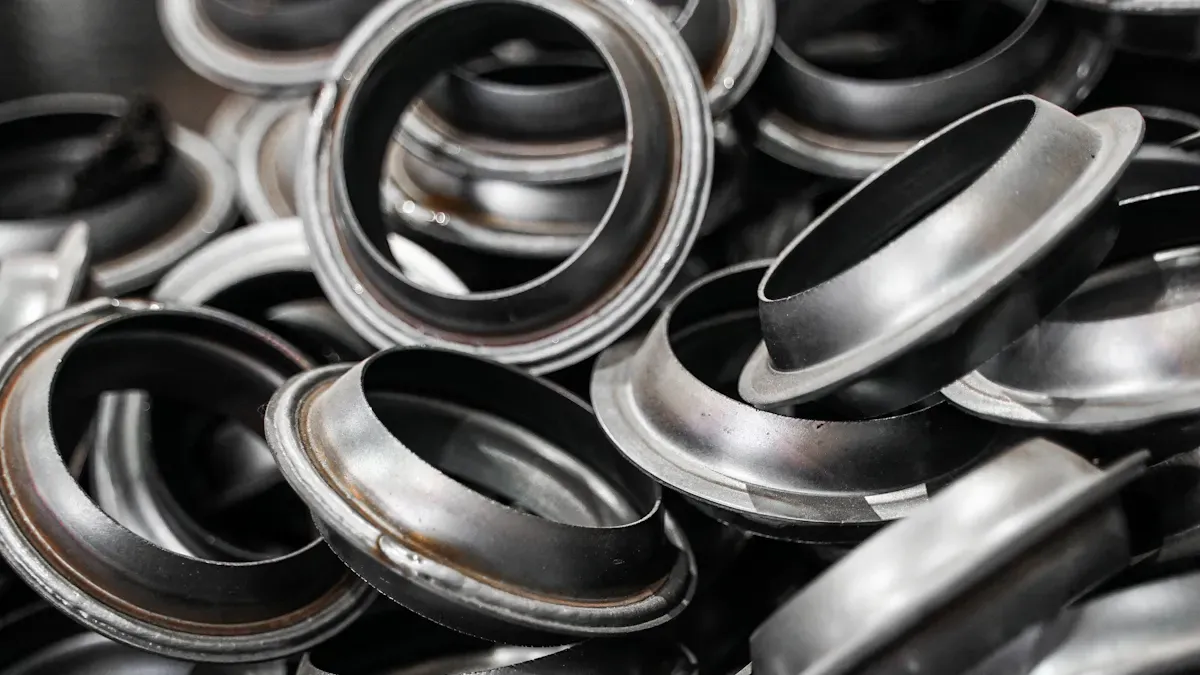
A flange nut belongs to a specialized category of fasteners. Engineers design these nuts with a wide, washer-like base called a flange. This flange extends beyond the nut’s body, providing a larger surface area. The main purpose of this design is to distribute pressure evenly across the connected material. Flange nuts offer enhanced stability and reduce the risk of damage to surfaces during tightening. They serve as a reliable solution in mechanical assemblies where consistent load distribution is essential.
Why use a flange nut?
Manufacturers choose flange nuts for their ability to simplify assembly and improve joint integrity. The integrated flange eliminates the need for a separate washer, saving time and reducing parts count. Flange nuts also help maintain stability in environments subject to vibration or movement. The table below summarizes the primary functions of flange nuts in mechanical assemblies:
| Function | Description |
|---|---|
| Pressure Distribution | Flange nuts have a built-in washer-like flange that helps distribute pressure, ensuring stability and integrity in mechanical assemblies. |
Tip: Flange nuts are ideal for applications where vibration resistance and pressure distribution are critical.
Key Features of Flange Nuts
Integrated flange design
The integrated flange stands out as the most important feature. This design acts as a built-in washer, spreading pressure evenly and protecting materials from damage. Flange nuts also resist loosening in vibrating environments, making them suitable for machines and vehicles. The flange simplifies installation by removing the need for additional washers. The table below highlights features that differentiate flange nuts from other nut types:
| Feature | Description | Importance |
|---|---|---|
| Built-in Flange | Flange nuts have a built-in flange that acts like a washer. | Spreads pressure evenly and protects materials from damage. |
| Vibration Resistance | Flange nuts stay tight in vibrating environments. | Prevents loosening during constant movement, ideal for machines and vehicles. |
| Easy Installation | The flange eliminates the need for separate washers. | Reduces assembly time and simplifies the installation process. |
Material and finish options
Flange nuts come in a variety of materials and finishes. Carbon steel offers moderate corrosion resistance and strength, while stainless steel provides excellent durability in humid or marine environments. Zinc and nickel plating enhance corrosion resistance and aesthetics. Phosphating and Dacromet coatings deliver high-performance anti-corrosion properties. The table below outlines common materials and finishes for flange nuts:
| Material/Finish | Corrosion Resistance | Strength Level |
|---|---|---|
| Carbon Steel | Moderate, can rust without treatment | Varies by grade (Grade 8 to Grade 12) |
| 304 Stainless Steel | Excellent, suitable for humid conditions | Good |
| 316 Stainless Steel | Superior, ideal for marine and chemical use | Very good |
| Zinc Plating | Good, protects against rust | Enhances carbon steel |
| Nickel Plating | Good, improves aesthetics and corrosion | Enhances carbon steel |
| Phosphating | Good, anti-rust and anti-wear properties | Enhances carbon steel |
| Dacromet Coating | Excellent, high-performance anti-corrosion | Enhances carbon steel |
Flange nuts provide versatility for a wide range of applications. Engineers select the appropriate material and finish based on environmental conditions and strength requirements. The flange nut’s design and features ensure reliable performance in demanding settings.
Types of Flange Nuts
Standard Flange Nuts
Design characteristics
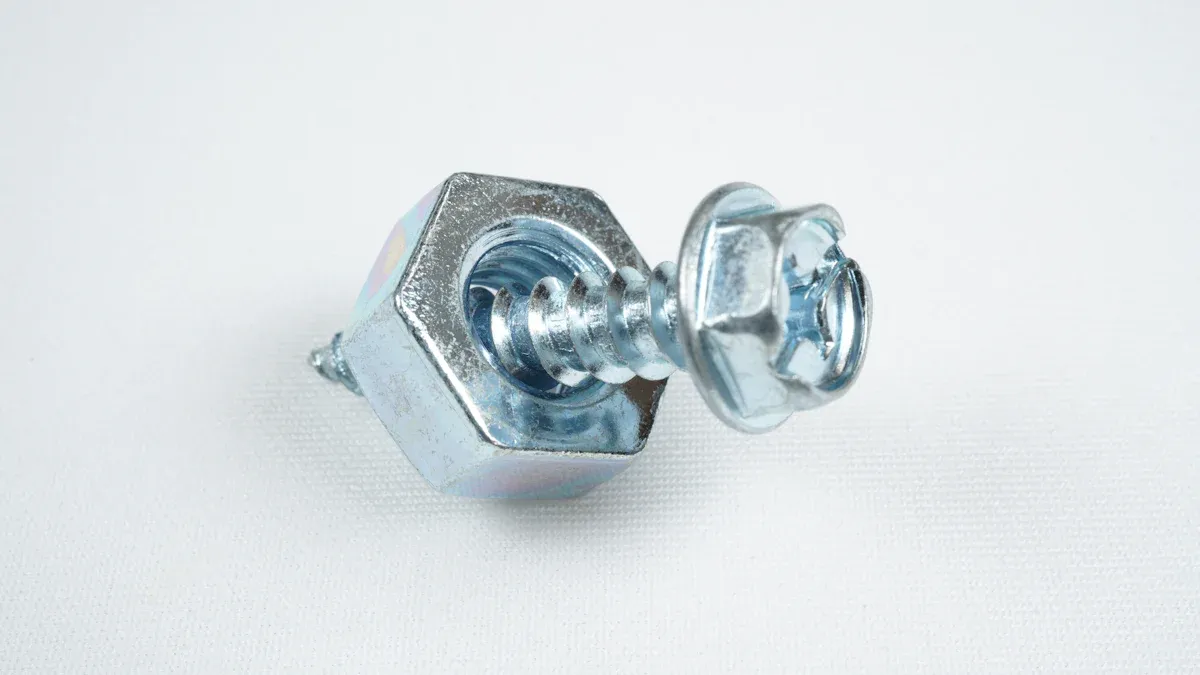
Standard flange nuts feature a hexagonal body with an integrated flange at the base. The flange extends outward, creating a washer-like surface that increases contact area. This design allows for better load distribution across the joint. Engineers often select standard flange nuts for their simplicity and versatility. The integrated flange eliminates the need for a separate washer, streamlining assembly and reducing the number of components. Manufacturers produce these nuts in various materials, including carbon steel and stainless steel, to suit different environments.
Note: The integrated flange design helps protect surfaces from damage during tightening and ensures consistent load distribution.
Typical uses
Standard flange nuts serve a wide range of industries. Their reliability and ease of installation make them a preferred choice for many applications. The table below highlights the most frequent uses based on market data:
| Industry/Application | Description |
|---|---|
| Automotive | Commonly used in vehicle assembly |
| Construction | Essential for structural integrity |
| Aerospace | Critical for safety and performance |
| Industrial Machinery | Used in various machinery applications |
| Electronics | Important for electronic device assembly |
| Manufacturing | Broad usage across production processes |
| Oil & Gas | Utilized in drilling and extraction |
| Energy & Power | Key components in energy systems |
| Marine | Used in shipbuilding and repairs |
| Telecommunications | Important for infrastructure support |
Standard flange nuts provide stability in automotive, construction, and aerospace projects. Their design ensures better load distribution and reduces the risk of joint failure.
Serrated Flange Nuts
Serration design
Serrated flange nuts incorporate grooves or serrations under the flange. These serrations grip the mating surface during tightening. The design increases friction, which enhances vibration resistance and prevents loosening. Serrated flange nuts lock into place by scoring the surface, creating a secure fit. The grooves distribute pressure evenly, maintaining tightness even in high-vibration environments.
- Serrated flange nuts feature serrations that score the mating surface during tightening, creating a locking fit.
- This design increases friction, which enhances grip and resistance to loosening.
- The serrations help distribute pressure evenly, preventing damage and maintaining tightness against vibrations.
- The grooves or serrations under the flanges of serrated flange nuts provide a strong grip on the surface.
- These serrations help in properly distributing pressure, which is crucial for preventing loosening due to vibrations.
- The design effectively locks the nut in place, making it more reliable than non-serrated types.
Advantages and limitations
Serrated flange nuts excel in environments where vibration resistance is critical. Their unique surface geometry increases friction, making them ideal for machinery and automotive applications. However, the serrations can mark or damage the surface, which may not be suitable for projects where appearance matters.
| Advantages | Limitations |
|---|---|
| Excellent resistance to vibration | Can mark or damage the surface |
| Ideal for automotive and machinery | Best used where appearance isn’t critical |
- Designed to prevent loosening due to vibrations
- Unique surface geometry increases friction
- Prevents loosening due to vibrations
- Increases friction for a secure fit
Serrated flange nuts offer superior vibration resistance and secure fastening. Their design provides differences compared to standard flange nuts, especially in high-vibration environments.
Locking Flange Nuts
Locking mechanism
Locking flange nuts utilize specialized mechanisms to prevent loosening. Manufacturers incorporate features such as nylon inserts, deformed threads, and serrations for enhanced grip. These mechanisms provide excellent vibration resistance and maintain joint integrity under stress. The locking flange nut requires higher installation torque, ensuring a tight fit. Compared to standard hex nuts, locking flange nuts offer better grip and stability.
| Feature | Lock Nut | Hex Nut |
|---|---|---|
| Design | Includes nylon insert, deformed thread, and serrations for grip | Standard six-sided nut without locking feature |
| Vibration Resistance | Excellent resistance to loosening under vibration | Poor resistance; may loosen without additional devices |
| Reusability | Reusable except for nylon types | Fully reusable |
| Cost | Slightly more expensive | Cost-effective |
| Ease of Use | Higher installation torque | Easier and quicker to install |
| Grip | Best grip under stress | Moderate grip, dependent on installation |
Locking flange nuts deliver superior vibration resistance and secure fastening. Their mechanisms ensure that the nut remains tight, even in demanding conditions.
Application scenarios
Locking flange nuts play a vital role in automotive and construction industries. They provide stability in heavy equipment such as excavators and cranes, preventing costly equipment failure and maintenance. Automotive applications rely on locking flange nuts to reduce loosening from vibrations and maintain safety.
| Application Scenario | Description |
|---|---|
| Heavy Equipment and Construction | Locking flange nuts are essential for stability in excavators, cranes, and other machinery, preventing costly equipment failure and maintenance. |
| Automotive | Flange nuts are used in various automotive applications, providing secure fastening and reducing loosening due to vibrations. |
- Locking flange nuts are crucial in heavy equipment like excavators and cranes for stability.
- They are commonly used in automotive applications to prevent loosening from vibrations.
Locking flange nuts also find use in plumbing and metalworking projects. Their integrated flange design helps distribute pressure evenly, ensuring reliable performance in diverse environments.
Prevailing Torque Flange Nuts
Unique features
Prevailing torque flange nuts stand out due to their specialized locking mechanism. Unlike standard locking nuts, these nuts generate frictional resistance by deforming their threads against the bolt threads during installation. This deformation creates a consistent prevailing torque, which helps maintain tightness even in environments with continuous vibration and shock. The hexagonal shape of the nut, combined with a wide, flat flange at the base, provides a larger bearing surface. Serrations on the flange enhance grip on the joint surface, further improving the locking capability. Engineers often select prevailing torque flange nuts for critical applications in industries such as automotive and heavy machinery, where maintaining joint integrity under dynamic conditions is essential. The differences between prevailing torque flange nuts and other locking types lie in their ability to resist loosening without relying on additional locking devices or adhesives.
Specific applications
Prevailing torque flange nuts find use in a variety of demanding environments. Their design ensures secure fastening where vibration resistance and reliability are crucial. The table below highlights key application areas and the reasons for their preference:
| Application Area | Reason for Preference |
|---|---|
| Aerospace | Ideal for weight control and safety; compact design eliminates need for additional locking parts. |
| Construction Machinery | Prevents loosening from shocks and vibrations; withstands demanding environments. |
| Consumer Products | Ensures parts remain secure during use and rough handling without complex fastening systems. |
In aerospace, the compact design of the flange nut reduces weight and eliminates the need for extra locking components. Construction machinery benefits from the nut’s ability to withstand shocks and vibrations, maintaining secure joints in harsh conditions. Consumer products use these nuts to ensure parts stay secure during everyday use and rough handling, without requiring complex assembly.
Note: Prevailing torque flange nuts provide a reliable solution for applications where maintaining tightness under vibration and shock is critical.
Nylon Insert Flange Nuts
Design and function
Nylon insert flange nuts combine a traditional hexagonal nut with a built-in flange and a nylon insert. The flange acts as a washer, increasing the contact area and providing better load distribution across the joint. When tightened onto a bolt, the nylon insert deforms and creates friction against the bolt threads. This friction resists loosening caused by vibration or rotational forces. The elastic nature of the nylon insert allows it to flex over the threads, adding extra resistance to any twisting motion that could cause the nut to back out. This design ensures that the nut remains securely fastened, even in high-vibration environments.
Application areas
Nylon insert flange nuts deliver reliable performance in industries where secure fastening and vibration resistance are essential. The flange compresses against the surface, enhancing sealing and preventing moisture or contaminants from entering the joint. The table below outlines common application areas and the performance benefits provided by these nuts:
| Application Area | Performance Benefits |
|---|---|
| Automotive Industry | Used in engine mounts, suspension systems, and braking assemblies; resistant to vibration and torque loosening. |
| Aerospace Industry | Utilized to secure components in aerospace interiors, reducing maintenance needs by up to 15%. |
| Construction Industry | Secures steel structures, bridges, and roadways, providing strength and durability. |
| Industrial Machinery | Used in moving parts subjected to continuous vibrations, ensuring secure fastening. |
| Oil and Gas Industry | Secures pipelines and tanks, maintaining integrity under pressure. |
| Marine Industry | Secures ship components and mooring systems, ensuring reliability in harsh environments. |
| Electrical Industry | Secures electrical panels and transformers, enhancing safety and performance. |
Nylon insert flange nuts offer several key advantages:
- Vibration resistance: The nylon insert provides friction that resists loosening due to vibrations.
- Secure fastening: Maintains a tight connection in high-vibration environments, reducing equipment failure risk.
- Enhanced sealing: The flange compresses against surfaces to prevent moisture and contaminants.
- Improved load distribution: Larger contact area reduces stress concentration, enhancing longevity.
- Ease of installation: Self-locking feature eliminates the need for additional locking mechanisms.
Engineers in the automotive, aerospace, and construction industries rely on nylon insert flange nuts to maintain secure connections and extend the service life of assemblies. The combination of a flange and nylon insert ensures both better load distribution and superior vibration resistance, making these nuts a preferred choice for critical fastening tasks.
Comparison of Flange Nut Designs
Design Differences in Flange Nuts
Flange size and shape
Flange nuts display a range of flange sizes and shapes, each tailored for specific mechanical requirements. The flange, which acts as an integrated washer, increases the contact area between the nut and the material. Larger flanges provide better load distribution and surface protection, especially in applications where material damage must be minimized. Serrated flange nuts feature grooves on the base, which grip the material surface and enhance vibration resistance. This design eliminates the need for additional washers, streamlining assembly in industrial fastening solutions and machinery settings.
Thread types
Thread types also distinguish one flange nut from another. Standard flange nuts use regular threads compatible with most bolts. Nylon insert lock nuts, often called NYLOC nuts, contain a nylon ring that deforms around the bolt threads, creating frictional resistance. This feature proves valuable in applications where maintenance occurs infrequently, such as automotive or aerospace assemblies. Prevailing torque lock nuts use deformed threads to grip the bolt, providing a mechanical locking action that resists loosening. The DIN 6923 flange nut, for example, matches hex head bolts and flange bolts with the same thread size and pitch, ensuring optimal clamping and reducing the risk of loosening.
| Nut Type | Design Feature | Mechanism of Action |
|---|---|---|
| Nylon Insert Lock Nut | Contains a nylon ring that deforms around bolt threads | Friction-Based Locking |
| Serrated Flange Nut | Features serrations on the base to grip the surface | Mechanical Locking |
| Prevailing Torque Nut | Has deformed threads for a tight fit | Mechanical Locking |
Performance Benefits of Flange Nuts
Load distribution
Flange nuts offer significant performance advantages over standard hex nuts, especially in terms of load distribution. The wide flange at the base acts as an integrated washer, spreading the load over a larger surface area. This design reduces pressure on the material, minimizing the risk of damage and enhancing stability under shear forces. The table below compares flange nuts to standard hex nuts:
| Feature | Flange Nut | Standard Hex Nut |
|---|---|---|
| Load Distribution | Excellent due to integrated flange | Requires additional washer for improvement |
| Surface Protection | Wide flange prevents damage | Dependent on washer and torque |
Vibration resistance
Vibration resistance remains a key benefit of flange nuts. The flange design increases the surface area, which can reduce nut loosening by as much as 50%. Serrated flange nuts, in particular, use grooves to grip the surface and distribute pressure, preventing loosening from vibrations. These features make them ideal for automotive and machinery applications where stability is critical. Serrated flange lock nuts excel in metal-to-metal connections, while nylon insert lock nuts are preferred in safety-critical assemblies.
Limitations and Drawbacks of Flange Nuts
Reusability concerns
Despite their advantages, flange nuts present some limitations. They may not suit long threaded assemblies, as the locking feature can wear out when traveling along extended threads. This wear reduces their effectiveness in maintaining a secure connection over time. In addition, the displacement method used for a tight fit can distort coated surfaces, increasing the risk of corrosion.
| Limitation | Description |
|---|---|
| Unsuitable for long assemblies | Locking feature can wear out, reducing effectiveness |
| Risk of corrosion | Distortion of coated surfaces increases corrosion risk |
Installation challenges
Flange nuts can introduce challenges during installation and maintenance. Excessive preload may stretch bolts, diminishing the clamping force needed for a secure connection. Improper tightening sequences can lead to uneven gasket compression, resulting in leaks. Corrosion and galling complicate disassembly, especially in harsh environments. Misalignment of bolt holes and flanges can create stress concentrations, leading to structural weaknesses. Regular inspections help maintain the integrity of flange connections in industrial fastening solutions.
Tip: For critical assemblies, technicians should follow proper installation procedures and conduct routine inspections to ensure long-term reliability.
Performance Factors for Flange Nut Selection
Load Distribution Capabilities
How flange nuts spread force
Flange nuts play a vital role in distributing force across a joint. The flange, which acts as a built-in washer, increases the contact area between the nut and the connected material. This design reduces the risk of material deformation and helps maintain the integrity of the assembly. Wide flange nuts provide greater surface coverage, which lowers the chance of pull-through in softer materials. Serrated flange nuts offer excellent load distribution and add self-locking features, making them suitable for high-stress applications. Narrow flange nuts fit tight spaces but offer less load distribution. The table below compares common flange nut types in terms of load distribution and joint integrity:
| Flange Nut Type | Load Distribution Capability | Joint Integrity Features |
|---|---|---|
| Serrated Flange Nut | Excellent | Self-locking, high vibration resistance |
| Standard Flange Nut | Even | Relies on friction, less effective in vibrations |
| Narrow Flange Nut | Less | Suited for tight spaces, less load distribution |
| Wide Flange Nut | Better | Greater surface coverage, lower risk of pull-through |
Impact on joint integrity
A well-designed flange nut improves joint integrity by spreading force and reducing localized stress. This feature becomes essential in automotive and machinery applications, where joint failure can lead to costly repairs. The built-in flange helps maintain clamping force, even under dynamic loads. Engineers often select flange nuts for critical fasteners to ensure long-term reliability and strength.
Vibration Resistance in Flange Nuts
Serrated vs. smooth flange nuts
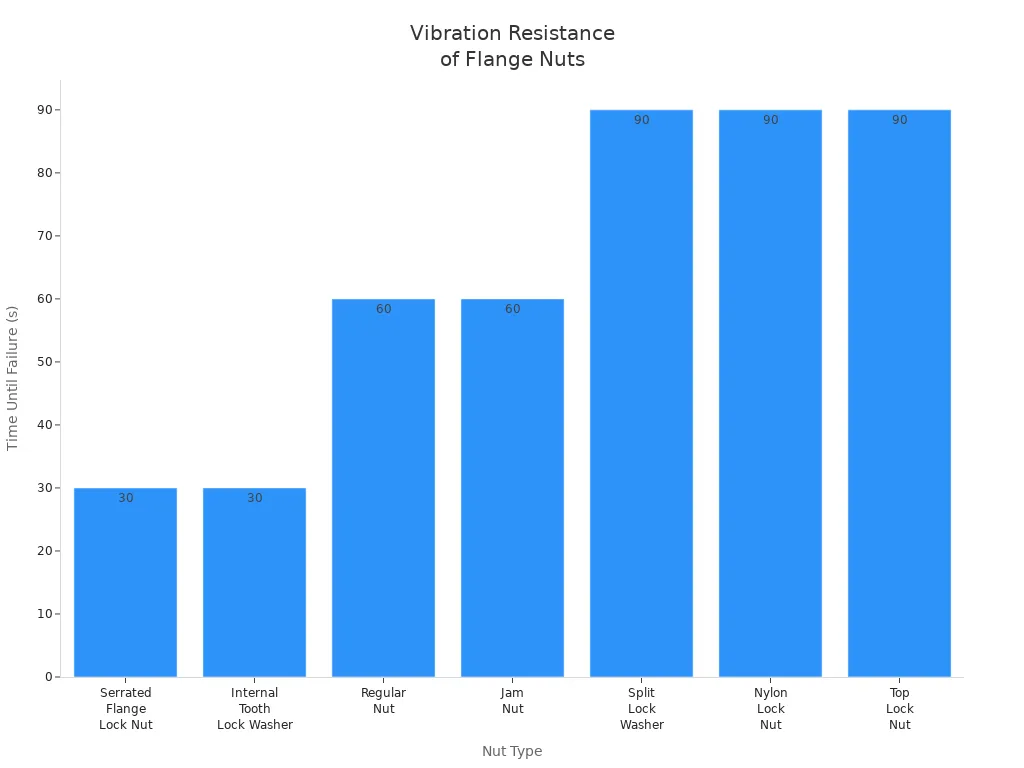
Vibration resistance sets certain flange nuts apart as anti-vibration fasteners. Serrated flange nuts use grooves on the flange base to grip the mating surface, which prevents loosening in high vibration environments. Smooth flange nuts rely on friction alone and may not perform as well under constant movement. Test data shows that serrated flange lock nuts and internal tooth lock washers fail quickly under vibration, often in less than 30 seconds. Regular nuts and jam nuts also fail in under 60 seconds. In contrast, split lock washers, nylon lock nuts, and top lock nuts survive for over 90 seconds. The chart below illustrates these differences:
Locking features
Locking features enhance the performance of flange nuts in demanding settings. Nylon inserts, deformed threads, and serrations all contribute to anti-loosening properties. These features make flange nuts ideal for use in high vibration environments, such as automotive assemblies and heavy machinery. Locking mechanisms provide extra security, ensuring that fasteners remain tight even when exposed to shocks and repeated movement.
Reusability and Maintenance of Flange Nuts
Wear and tear
Flange nuts experience wear and tear over time, especially when used in assemblies that require frequent removal. Locking features, such as nylon inserts, may degrade after repeated use. Standard flange nuts offer good reusability but should undergo inspection during maintenance. Lock nuts with advanced locking mechanisms often require replacement after removal to maintain their anti-loosening properties.
| Feature | Flange Nut | Lock Nut |
|---|---|---|
| Anti-loosening | Moderate | High (due to locking mechanisms) |
| Reusability | Good, but may require inspection | Limited, often needs replacement |
| Maintenance Frequency | Lower in stable conditions | Higher in high-vibration environments |
| Applications | General use | Extreme conditions (e.g., aerospace) |
Removal and replacement
Technicians must consider ease of removal and replacement during installation and maintenance. Flange nuts with locking features may require more effort to remove, especially after exposure to vibration or harsh conditions. In critical applications, such as aerospace or automotive, replacing lock nuts after each removal ensures continued joint strength and safety. Regular inspection and timely replacement of worn fasteners help maintain the reliability of mechanical assemblies.
Application Scenarios for Flange Nuts
Automotive Fastening Solutions
Engine and chassis connections
Engineers rely on flange nuts for critical engine and chassis connections in automotive fastening solutions. The integrated flange increases the contact area, which helps maintain tightness and prevents leaks in engine cylinder block assemblies. High-strength flange nuts ensure proper sealing and resist loosening, even under thermal expansion and contraction. Automotive fastening solutions often require nuts that can withstand both high torque and exposure to oil or coolant. The following table outlines common uses and performance criteria for flange nuts in automotive applications:
| Application Area | Performance Criteria |
|---|---|
| Suspension system | Withstands large vibration and impact loads |
| Braking system | Ensures safety and reliability during driving |
| Engine cylinder block connection | High strength ensures sealing and tightness |
| Prevents leakage of coolant/oil | Durability and resistance to environmental factors |
Vibration-prone areas
Automotive fastening solutions frequently address vibration-prone areas, such as suspension and braking systems. Flange nuts with serrated designs provide enhanced grip, reducing the risk of loosening from constant movement. These nuts deliver reliable performance in environments where safety and stability are paramount. Automotive engineers select flange nuts for their ability to maintain joint integrity, even when exposed to continuous vibration and shock.
Industrial Applications of Flange Nuts
Machinery assembly
Industrial fastening solutions often specify flange nuts for machinery assembly. The integrated flange assists in alignment and distributes load evenly, which is essential for maintaining secure connections. Flange nuts are favored in automotive, construction, and heavy machinery sectors. Their design provides vibration resistance and simplifies installation, making them a preferred choice for assembling complex equipment.
- Automotive
- Construction
- Heavy machinery
Flange nuts help prevent loosening in moving parts and ensure that machinery operates safely and efficiently.
Heavy-duty fastening
Heavy-duty fastening in industrial settings demands components that can handle high stress and repeated use. Flange nuts excel in these applications due to their robust construction and ability to resist loosening under dynamic loads. The flange increases the bearing surface, reducing the risk of material deformation and enhancing the longevity of the joint. Industrial machinery often relies on flange nuts to maintain performance in harsh environments.
Construction and Structural Uses
Steel frameworks
Construction professionals use flange nuts extensively in steel frameworks. The flange provides a larger contact area, which helps distribute clamping force and reduces the risk of pull-through. Several considerations guide their use:
- The distance between extreme fasteners on one side of a flange splice exceeding 50 inches reduces bolt shear resistance by 20%.
- Threads may be excluded from the shear plane if the minimum splice plate thickness is greater than 5/8 inches.
- Bolt shear resistance must be sufficient to withstand loads at the Strength-I limit state.
- In bolted slip-critical connections, shear load transfers by friction, which depends on clamping force and the coefficient of friction.
These factors ensure that flange nuts contribute to the structural integrity of steel frameworks.
Outdoor installations
Outdoor installations benefit from the corrosion resistance and durability of flange nuts. Construction crews select materials and finishes that withstand weather and environmental exposure. The flange design helps maintain tightness over time, even when subjected to temperature changes and moisture. Flange nuts provide reliable fastening for outdoor structures, signage, and equipment mounts, making them a staple in construction applications.
Specialized Applications of Flange Nuts
Electronics assembly
Electronics manufacturers depend on precise and reliable fastening solutions. They often select a flange nut for printed circuit board (PCB) mounting and enclosure assembly. The integrated flange increases the contact area, which helps distribute clamping force and prevents damage to delicate surfaces. This feature proves essential when working with thin metals or plastics found in electronic housings.
Engineers value the compact design of these nuts. The flange eliminates the need for separate washers, which reduces assembly time and minimizes the risk of lost components. In high-density electronics, space constraints require fasteners that provide both strength and a low profile. Flange nuts meet these requirements by offering secure joints without adding bulk.
Note: Electronics assembly environments often involve sensitive components. The wide flange helps prevent stress concentrations that could lead to cracks or failures in fragile materials.
Manufacturers also choose corrosion-resistant finishes for these nuts. Stainless steel and zinc-plated options protect against oxidation, which extends the lifespan of electronic devices. In automated assembly lines, the consistent shape and size of flange nuts support efficient robotic installation.
Aerospace fastening
Aerospace engineers face demanding application scenarios. They must ensure that every fastener maintains integrity under extreme conditions, such as vibration, temperature changes, and pressure fluctuations. Flange nuts play a critical role in securing structural panels, engine components, and interior assemblies in aircraft.
The aerospace industry often specifies prevailing torque or nylon insert types. These designs provide extra resistance to loosening, which is vital for safety in flight. The flange increases the bearing surface, reducing the risk of pull-through in lightweight alloys and composite materials. This feature supports the use of thinner, lighter materials without sacrificing joint strength.
Aerospace applications require fasteners that resist corrosion and maintain performance over long service intervals. Engineers select materials like 316 stainless steel or apply advanced coatings to meet these needs. The table below highlights key requirements for aerospace fastening:
| Requirement | Benefit Provided by Flange Nut |
|---|---|
| Vibration resistance | Maintains tightness in flight |
| Lightweight construction | Supports use of thin materials |
| Corrosion protection | Extends service life |
| High reliability | Reduces maintenance frequency |
Tip: Aerospace technicians should always verify torque specifications and inspect flange surfaces for wear during scheduled maintenance.
Flange nuts support mission-critical assemblies in both electronics and aerospace sectors. Their unique design features and material options make them indispensable for specialized applications.
Selection Criteria and Recommendations for Flange Nut Use
Key Factors to Consider
Load requirements
Engineers must evaluate load requirements before selecting a flange nut. The expected force on the joint determines the necessary strength and size of the fastener. High-load applications, such as heavy machinery or structural connections, demand nuts with higher grades and robust materials. In contrast, lighter assemblies may use smaller or lower-grade options. The flange distributes pressure, reducing the risk of material deformation and improving joint longevity. Proper assessment of load ensures that the fastener maintains integrity throughout its service life.
Environmental conditions
Environmental factors play a significant role in fastener selection. Corrosive environments, such as marine or chemical processing facilities, require nuts made from stainless steel or those with specialized coatings. Temperature extremes can affect material performance, so engineers must choose materials that withstand both heat and cold. Moisture, dust, and exposure to chemicals also influence the choice. Selecting the right finish or material protects the joint and extends the lifespan of the assembly.
The table below summarizes how flange nuts compare to washers in key selection factors:
| Factor | Flange Nuts | Washers |
|---|---|---|
| All-in-one component | Yes | No |
| Anti-rotation | Yes | No |
| Weight savings | Yes | No |
| Corrosion resistance | Yes | No |
| Flexibility | No | Yes |
| Cost | No | Yes |
| Space constraints | No | Yes |
| Damage resistance | No | Yes |
| Thread protection | No | Yes |
| Reusability | No | Yes |
Tip: Flange nuts excel in high-vibration, weight-sensitive, and corrosion-prone environments, while washers offer advantages in cost-sensitive or space-constrained projects.
Expert Recommendations for Flange Nut Selection
Choosing the right flange nut
Industry experts recommend matching the flange nut to the specific demands of the application. For high vibration or soft joining surfaces, a serrated or nylon insert type provides superior resistance to loosening. Stainless steel options suit corrosive settings, while carbon steel works well in dry, indoor environments. When weight savings matter, the integrated design of a flange nut eliminates the need for separate washers, reducing assembly complexity. Engineers should always verify compatibility with the bolt and ensure the selected nut meets the required load and environmental standards.
Common mistakes to avoid
Mistakes in flange nut selection or installation can compromise joint performance. The most frequent errors include improper bolt handling and incorrect torque application. These issues may cause leaks, gasket damage, or even bolt failure. The table below outlines common mistakes and strategies to prevent them:
| Mistake | Consequences | Prevention Strategy |
|---|---|---|
| Improper Bolt Handling and Torque | Leaks, gasket damage, flange/valve damage, bolt failure | Use a calibrated torque wrench, follow manufacturer specs, tighten in star pattern, inspect components, avoid unapproved lubricants |
Note: Always follow manufacturer guidelines for torque values and tightening patterns. Inspect all fasteners before installation to ensure safety and reliability.
By considering load, environment, and proper installation practices, engineers can maximize the performance and lifespan of their assemblies with the correct flange nut.
Flange nuts offer distinct advantages based on their design, material, and locking features. Engineers evaluate flange nut types by considering load requirements, environmental conditions, and vibration resistance.
- Serrated, nylon insert, and prevailing torque designs address specific challenges in automotive, industrial, and aerospace applications.
Experts recommend regular inspection and proper installation to maximize joint reliability and performance.
FAQ
What is the main advantage of using a flange nut?
A flange nut provides a built-in washer. This feature distributes load evenly and protects surfaces from damage. Engineers prefer flange nuts for assemblies that require stability and vibration resistance.
Can flange nuts be reused after removal?
Most standard flange nuts allow reuse. Locking types, such as nylon insert or prevailing torque nuts, may lose effectiveness after removal. Technicians recommend replacing these nuts for critical applications.
Which flange nut type offers the best vibration resistance?
Serrated flange nuts deliver superior vibration resistance. The serrations grip the surface and prevent loosening. Nylon insert flange nuts also perform well in high-vibration environments.
Are flange nuts suitable for outdoor installations?
Flange nuts with stainless steel or corrosion-resistant coatings work well outdoors. These materials withstand moisture and harsh weather. Construction crews often select flange nuts for outdoor structures.
How do engineers choose the right flange nut material?
Engineers assess environmental conditions and load requirements. Stainless steel suits corrosive environments. Carbon steel fits dry, indoor settings. Specialized coatings enhance durability and corrosion resistance.
Do flange nuts eliminate the need for washers?
The integrated flange replaces separate washers. This design simplifies assembly and reduces parts count. Assemblers save time and improve joint reliability by using flange nuts.
What installation mistakes should technicians avoid?
Technicians must use proper torque and follow tightening patterns. Incorrect installation can cause leaks, damage, or joint failure. Experts recommend inspecting fasteners and using calibrated tools.