
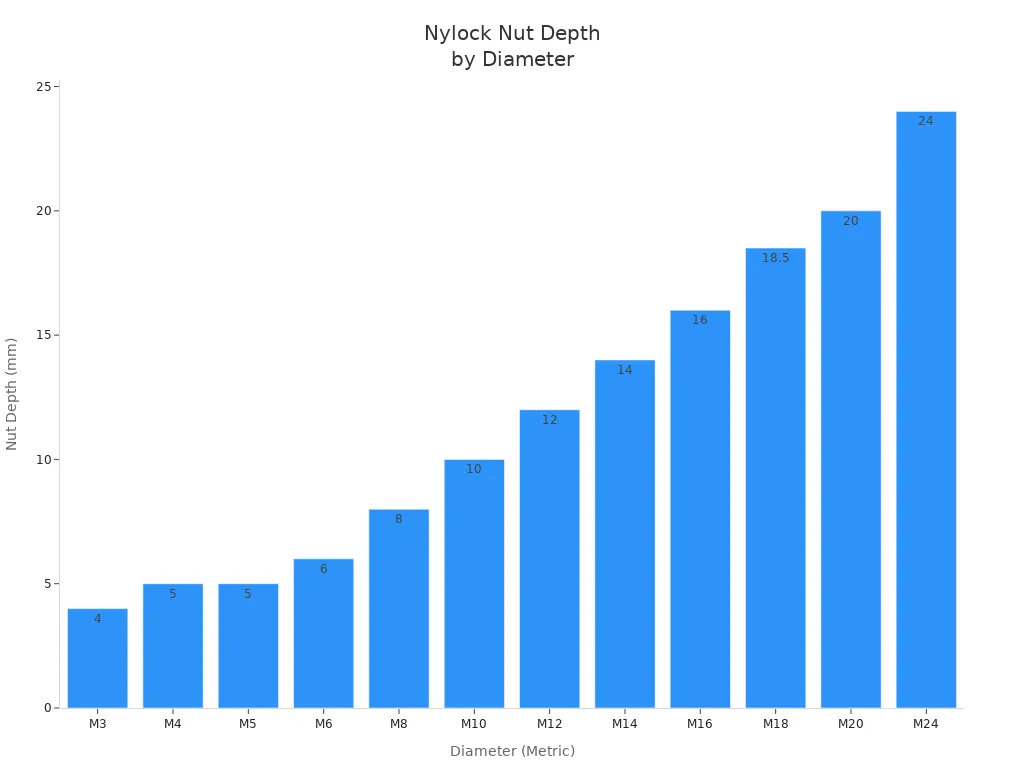
Nylock nuts represent a critical component in many fastening systems. Engineers select from a range of types and sizes to match mechanical demands. The table below shows common metric sizes used in industrial and consumer applications:
| Diameter | Pitch | Depth of Nut (h) | S |
|---|---|---|---|
| M3 | 0.5mm | 4mm | 5.5mm |
| M4 | 0.7mm | 5mm | 7mm |
| M5 | 0.8mm | 5mm | 8mm |
| M6 | 1.0mm | 6mm | 10mm |
| M8 | 1.25mm | 8mm | 13mm |
| M10 | 1.5mm | 10mm | 17mm |
| M12 | 1.75mm | 12mm | 19mm |
| M14 | 2mm | 14mm | 22mm |
| M16 | 2mm | 16mm | 24mm |
| M18 | 2.5mm | 18.5mm | 27mm |
| M20 | 2.5mm | 20mm | 30mm |
| M24 | 3.0mm | 24mm | 36mm |
The locking mechanism in a nylock nut combines a metal body with a polymer insert, which provides reliable vibration resistance. Selecting the right nuts and bolts depends on the application’s temperature, load, and custom fasteners requirements. A custom fasteners manufacturer considers these factors to ensure optimal performance and reliability.
Overview of Nylock Nut Types
Standard Nylock Nuts
Features
Standard nylon insert lock nuts use a nylon ring as the locking mechanism. The nylon insert creates friction against the bolt threads, preventing loosening from vibration or movement. These lock nuts offer a self-locking function, which means they resist rotation even under dynamic loads. The design allows for easy installation and removal without damaging the threads.
Typical Applications
Standard nylon insert lock nuts appear in automotive, machinery, and general engineering projects. Engineers select these lock nuts for assemblies that require moderate vibration resistance and reliable fastening. The self-locking feature makes them suitable for repeated use in maintenance operations.
Pros and Cons
| Feature | Nylock Nuts | All-Metal Lock Nuts |
|---|---|---|
| Locking Mechanism | Nylon insert creates friction | Mechanical interference |
| Ease of Installation | Easy to install and reusable | More complex installation |
| Vibration Resistance | Good resistance to vibration | Varies, generally strong |
| Temperature Suitability | Moderate temperatures | High-temperature applications |
| Typical Use Cases | Automotive, machinery | High-stress environments |
Standard nylon insert lock nuts provide reliable vibration resistance and simple installation. They perform well in moderate temperature environments. However, the nylon insert limits their use in high-temperature applications, where all-metal lock nuts may offer better performance.
Thin Nylock Nuts
Features
Thin nylon insert lock nuts have a reduced profile compared to standard types. The compact design allows them to fit in tight spaces where clearance is limited. Despite their smaller size, these lock nuts retain the self-locking capability provided by the nylon insert. The locking mechanism ensures secure fastening even in applications with frequent movement.
Typical Applications
Thin nylon insert lock nuts serve industries that require space-saving solutions. Automotive engineers use them in engine mounts, suspension systems, and braking assemblies. Machinery manufacturers rely on these lock nuts for moving parts and assemblies exposed to continuous vibrations. High-strength applications benefit from their durability and resistance to loosening.
| Industry/Application | Reason for Preference |
|---|---|
| Automotive | Used in engine mounts, suspension systems, and braking assemblies due to vibration resistance. |
| Machinery | Ideal for moving parts and assemblies subjected to continuous vibrations. |
| High-Strength Applications | Provides durability and prevents loosening from vibrations. |
Pros and Cons
Thin nylon insert lock nuts offer a space-efficient solution for self-locking needs. They provide strong vibration resistance and durability. The reduced profile may limit their load capacity compared to standard lock nuts. Engineers must consider the application’s mechanical demands before selecting thin lock nuts.
Flange Nylock Nuts
Features
Flange nylon insert lock nuts feature an integrated washer-like flange at the base. This flange increases the contact surface area, improving load distribution across the joint. The nylon insert delivers a self-locking function, maintaining secure fastening under vibration.
Typical Applications
Flange nylon insert lock nuts are common in automotive chassis, machinery frames, and assemblies where load distribution is critical. The flange design allows these lock nuts to be used with softer materials, reducing the risk of deformation.
Pros and Cons
Flange nylon insert lock nuts have a larger contact surface area than standard nylon insert lock nuts. This increased surface area facilitates better load distribution and reduces the risk of joint failure due to stress concentration.
- Standard nylon insert lock nuts concentrate reaction forces across a smaller contact area, leading to higher surface bearing stress.
- Flange nylon insert lock nuts extend the contact area significantly, which reduces surface bearing stress.
- This reduction in stress allows flange nylon insert lock nuts to be used with softer materials without causing deformation.
Flange nylon insert lock nuts provide enhanced load distribution and vibration resistance. The flange design simplifies installation and eliminates the need for a separate washer. However, the larger size may not suit applications with strict space constraints.
Other Variants of Nylock Nuts
Heavy-Duty Nylock Nuts
Heavy-duty nylon insert lock nuts serve demanding applications where high strength and durability are essential. Manufacturers design these lock nuts with thicker walls and a larger nylon insert. This construction increases resistance to vibration and prevents loosening under heavy loads. Heavy-duty nylon insert lock nuts often appear in construction equipment, agricultural machinery, and industrial assemblies. Engineers select them for joints exposed to shock, impact, or fluctuating forces. The robust design ensures reliable performance even in harsh environments.
- Heavy-duty nylon insert lock nuts provide enhanced clamping force.
- The larger nylon insert maintains locking action after repeated use.
- These lock nuts resist deformation and thread stripping.
However, the increased size may limit their use in compact assemblies. Installers must verify that the joint can accommodate the larger profile.
Stainless Steel Nylock Nuts
Stainless steel nylon insert lock nuts offer superior corrosion resistance compared to standard steel variants. Manufacturers typically use austenitic grades such as 304 or 316. The chromium content in these alloys forms a protective oxide layer on the surface. This layer self-repairs when scratched, ensuring long-term durability. Stainless steel nylon insert lock nuts require minimal maintenance and do not need additional coatings. These lock nuts perform exceptionally well in marine, chemical, and outdoor environments.
Stainless steel nylon insert lock nuts maintain their integrity in harsh and corrosive conditions. Saltwater, humidity, and industrial chemicals do not compromise their performance. Engineers rely on these lock nuts for applications where rust and corrosion pose significant risks. The combination of a stainless steel body and a nylon insert delivers both mechanical strength and chemical resistance.
Brass Nylock Nuts
Brass nylon insert lock nuts provide moderate corrosion resistance and excellent electrical conductivity. Brass resists tarnishing and oxidation better than standard steel. However, in aggressive environments, brass may require extra protective measures to maintain effectiveness. These lock nuts often appear in electrical assemblies, plumbing systems, and decorative hardware. The non-magnetic properties of brass make these nylon insert lock nuts suitable for sensitive electronic equipment.
- Brass nylon insert lock nuts prevent galvanic corrosion when paired with copper or brass fasteners.
- The nylon insert ensures a secure fit and resists loosening from vibration.
- These lock nuts offer a visually appealing finish for exposed joints.
Brass nylon insert lock nuts may not withstand heavy mechanical loads as well as steel or stainless steel variants. Engineers must consider the specific requirements of each application.
Specialty Nylock Nuts (Type P, Type T, prevailing torque, high-temperature)
Specialty nylon insert lock nuts address unique engineering challenges. Type P and Type T variants feature modified profiles or inserts for specific locking characteristics. Prevailing torque lock nuts use a deformed thread or enhanced nylon insert to maintain consistent locking force. High-temperature specialty nylon insert lock nuts incorporate heat-resistant polymers or metal inserts. These lock nuts retain clamping force in environments where standard nylon would degrade.
Specialty nylon insert lock nuts excel in extreme environments. Temperature changes can alter the clamping force of fastened joints. In high-temperature settings, metal components expand, which may reduce preload and increase the risk of loosening. In cold conditions, materials contract, leading to stress or brittleness. Specialty nylon insert lock nuts address these challenges with advanced materials and designs.
The table below compares the performance of different lock nut types in extreme environments:
| Nut Type | Performance in Extreme Environments |
|---|---|
| Standard Nuts | May gradually loosen in high-vibration settings due to micro-movements and fatigue. |
| Prevailing Torque Lock Nuts | Provide consistent locking force and resist loosening under heavy or fluctuating loads, making them suitable for high-load applications. |
| High-Temperature Specialty Nuts | Designed to withstand thermal expansion effects, maintaining clamping force in high-temperature environments. |
Specialty nylon insert lock nuts support critical applications in aerospace, power generation, and heavy industry. Engineers select these lock nuts for assemblies exposed to thermal cycling, intense vibration, or chemical exposure. The right specialty lock nut ensures safety and reliability in the most demanding conditions.
Nylock Nuts Size Comparison
Common Size Ranges
Metric Sizes (M4, M6, M8, M10, etc.)
Nylon insert lock nuts come in a broad range of metric sizes, making them suitable for many engineering and construction applications. The most widely available metric sizes range from M1.6 to M100, as defined by ISO 2341. These sizes cover everything from miniature electronics to heavy industrial machinery. M4, M6, M8, and M10 represent the most common choices for general assembly, offering a balance between strength and ease of installation. Each metric size corresponds to a specific thread diameter and pitch, which determines the nut’s compatibility with bolts and its mechanical performance.
Imperial Sizes (1/4″, 5/16″, 3/8″, etc.)
In regions using imperial measurements, nylon insert lock nuts are available in sizes from 1/4 inch up to 1-1/2 inch, following the ASME B18.2.4.1 standard. The most frequently used imperial sizes include 1/4″, 5/16″, and 3/8″. These sizes appear in automotive, industrial, and home improvement projects. The imperial system allows for easy matching with standard bolts and threaded rods commonly found in North American markets.
| Size Range | Standards |
|---|---|
| Metric: M1.6 to M100 | ISO 2341 – Standard for self-locking nuts |
| Imperial: 1/4″ to 1-1/2″ | ASME B18.2.4.1 – American standard for nylon insert nuts |
How Size Affects Performance
Load Capacity
The size of a nylon insert lock nut directly influences its load-bearing capacity. Larger diameters provide higher tensile strength and can handle greater mechanical loads. The thread pitch also plays a role. Fine threads, with a smaller pitch and more threads per inch, increase thread engagement and distribute the load more evenly. This design improves both tensile strength and the ability to resist loosening under stress. Coarse threads allow for faster assembly but offer lower vibration resistance and reduced tensile strength for a given diameter. Engineers select the appropriate size and thread type based on the expected load and safety requirements of the assembly.
Vibration Resistance
Nylon insert lock nuts excel in environments with constant movement or vibration. The nylon insert creates friction with the bolt threads, preventing the nut from backing off. Fine-threaded lock nut sizes enhance vibration resistance by increasing the number of contact points between the nut and bolt. In high-vibration applications, such as automotive or aerospace, these nuts can reduce machinery failure rates by up to 35%. Prevailing torque lock nuts, a specialized variant, can further improve resistance to loosening by approximately 50% under dynamic loads. Selecting the correct size and thread type ensures optimal performance in demanding conditions.
Space Constraints
Space limitations often dictate the choice of nylon insert lock nut size in compact assemblies. The nut must conform to precise dimensional requirements to ensure the nylon insert engages effectively with the bolt. Specifications require the insert to sit 1.5-2.0mm below the nut’s upper surface, maximizing the locking effect. In tight spaces, every millimeter counts. An oversized lock nut may not fit, while an undersized nut may fail to provide adequate friction, increasing the risk of loosening. Engineers must balance the need for secure fastening with the physical constraints of the assembly.
Tip: Always verify the available space before selecting a lock nut size for compact or enclosed assemblies. Proper fit ensures the nylon insert maintains its locking function and prevents premature loosening.
Application Suitability by Size
Automotive Uses
Automotive engineers rely on specific nylon insert lock nut sizes for critical assemblies. Common choices include M6, M8, 1/4″, and 3/8″. These sizes provide the necessary strength and vibration resistance for components exposed to constant movement, such as suspension systems, engine mounts, and brake assemblies. The use of the correct lock nut size ensures both safety and long-term performance in vehicles.
Industrial Uses
Industrial applications demand reliable fastening in dynamic environments. Larger nylon insert lock nut sizes, such as M10, M12, and 1/2″, offer the load capacity required for heavy machinery, conveyor systems, and structural assemblies. These nuts maintain joint integrity under fluctuating loads and harsh operating conditions, enhancing operational efficiency and reducing maintenance needs.
DIY and Home Projects
For DIY enthusiasts and home improvement projects, nylon insert lock nuts in sizes like M4, M6, 1/4″, and 5/16″ offer versatility and ease of use. These sizes suit furniture assembly, shelving, and light fixtures. The self-locking feature eliminates the need for additional washers or locking mechanisms, making them a convenient choice for secure fastening in a variety of household tasks.
| Application Type | Reasons for Preference |
|---|---|
| Automotive | Essential for assembly of components exposed to vibrations, ensuring safety and performance. |
| Industrial | Reliable fastening in dynamic environments, enhancing operational efficiency. |
| DIY | Versatile and easy to use for various projects, providing secure fastening without additional mechanisms. |
- Nylock nuts can reduce machinery failure rates by up to 35% in high-vibration environments.
- In aerospace applications, prevailing torque nuts can enhance resistance to loosening by approximately 50% under dynamic loads.
Direct Comparison Table for Nylock Nuts
Summary Table of Types and Sizes
Types
Nylock nuts come in several distinct types. Engineers select standard, thin, flange, heavy-duty, stainless steel, brass, and specialty lock nut variants based on mechanical requirements and environmental conditions. Each type offers unique features that address specific challenges in fastening systems.
Sizes
Lock nut sizes range from small metric (M4, M6) and imperial (1/4″, 5/16″) to large metric (M24) and imperial (1-1/2″). Smaller sizes suit electronics and light assemblies. Larger sizes provide strength for heavy machinery and structural applications. The size directly affects load capacity, vibration resistance, and suitability for confined spaces.
Typical Uses
- Standard lock nut: Automotive, machinery, general engineering
- Thin lock nut: Compact assemblies, moving parts, suspension systems
- Flange lock nut: Chassis, frames, softer materials
- Heavy-duty lock nut: Construction equipment, industrial machinery
- Stainless steel lock nut: Marine, food processing, chemical environments
- Brass lock nut: Electrical, plumbing, decorative hardware
- Specialty lock nut: Aerospace, power generation, high-temperature assemblies
Pros
Engineers value lock nut designs for their self-locking function, vibration resistance, and ease of installation. Stainless steel lock nut variants provide high corrosion resistance. Flange lock nut types distribute load efficiently. Heavy-duty lock nut options withstand high mechanical stress.
Cons
- Standard lock nut: Limited temperature tolerance
- Thin lock nut: Reduced load capacity
- Flange lock nut: Larger footprint, may not fit tight spaces
- Heavy-duty lock nut: Bulky, not suitable for compact assemblies
- Stainless steel lock nut: Higher cost, moderate mechanical strength
- Brass lock nut: Lower mechanical strength, may require extra protection
- Specialty lock nut: Specialized use, higher price
Comparative Table of Mechanical Properties and Application Suitability
| Lock Nut Type | Material Grade | Tensile Strength | Yield Strength | Hardness | Corrosion Resistance | Temperature Range | Typical Applications |
|---|---|---|---|---|---|---|---|
| Stainless Steel A2 | 304 Stainless Steel | 500–700 MPa | 200–300 MPa | 70–90 HB | High | -50°C to +400°C | Food processing, marine, industrial |
| Stainless Steel A4 | 316 Stainless Steel | 550–750 MPa | 250–350 MPa | 75–95 HB | Very High | -50°C to +450°C | Offshore, chemical, wastewater |
| Carbon Steel | Medium-High Carbon | 800–1000 MPa | 600–800 MPa | 25–35 HRC | Low (coated) | -30°C to +300°C | Construction, automotive, machinery |
| Alloy Steel B7 | B7 Alloy Steel | ≥860 MPa | ≥760 MPa | 32–38 HRC | Moderate (coated) | -50°C to +400°C | Heavy-duty industrial |
This table shows how lock nut types differ in mechanical strength, corrosion resistance, and temperature tolerance. Engineers match lock nut properties to the demands of each application, ensuring safety and reliability.
Quick Reference: Pros and Cons by Type
- Standard lock nut
- ✅ Easy installation, reusable, good vibration resistance
- ❌ Not suitable for high temperatures
- Thin lock nut
- ✅ Fits tight spaces, maintains locking function
- ❌ Lower load capacity
- Flange lock nut
- ✅ Distributes load, protects softer materials
- ❌ Larger size may limit use
- Heavy-duty lock nut
- ✅ High strength, resists deformation
- ❌ Bulky, not for compact assemblies
- Stainless steel lock nut
- ✅ Excellent corrosion resistance
- ❌ Moderate mechanical strength, higher cost
- Brass lock nut
- ✅ Good conductivity, prevents galvanic corrosion
- ❌ Lower strength, may need extra protection
- Specialty lock nut
- ✅ Designed for extreme environments
- ❌ Specialized, expensive
Engineers should review this comparison table when selecting lock nut types and sizes for their projects. Proper selection improves performance and extends service life.
How to Choose the Right Nylock Nut
Factors to Consider
Load Requirements
Engineers must determine the right size of nylock nut based on the expected load. Larger nuts provide greater tensile strength and distribute force more effectively. Industry standards, such as DIN 985 and ISO 7040, specify minimum requirements for load capacity and performance. These guidelines help maintain safety and reliability in critical assemblies. Reusability limitations also affect performance, as the locking mechanism can degrade after repeated installations.
Environmental Conditions
Selecting the proper nylock nut involves evaluating environmental factors. Moisture, UV exposure, and chemicals can impact the nylon insert and nut material. Hot-dip galvanization offers maximum protection against rust and environmental degradation. HDG nylock nuts can last over ten years in controlled environments. The nylon insert maintains vibration resistance, even in harsh conditions. Chemical resistance ensures reliability when exposed to salt spray or moderate chemical contact.
| Characteristic | Description |
|---|---|
| Corrosion Resistance | Hot-dip galvanization provides durable zinc layer for rust protection. |
| Longevity | HDG nylock nuts last 10+ years in controlled environments. |
| Vibration Resistance | Nylon insert maintains locking capability under dynamic loads. |
| Chemical Resistance | Resistant to UV, moisture, salt spray, and moderate chemicals. |
Material Compatibility
Engineers must choose the right material for both the nut and bolt. Matching materials prevents corrosion and maintains joint strength. Stainless steel, brass, and carbon steel each offer unique benefits. Stainless steel resists corrosion, brass provides electrical conductivity, and carbon steel delivers high mechanical strength. Material compatibility ensures the nut performs reliably in its intended environment.
- Material compatibility prevents galvanic corrosion.
- Nylon insert temperature rating must match operating conditions.
- Environmental resistance is essential for outdoor or marine applications.
- Nut size and thread compatibility affect performance and load distribution.
- Cost versus quality influences long-term reliability.
- Engineers must check thread type for proper fit.
Thread Type and Pitch
Thread type and pitch play a crucial role in performance. Engineers must check thread type to ensure the nut matches the bolt exactly. Fine threads provide better vibration resistance, while coarse threads allow faster assembly. Incorrect thread selection can cause damage or loosening. Proper sizing and thread compatibility help determine the right size for each application.
| Mistake | Explanation |
|---|---|
| Thread Compatibility | Ensure the Nylock nut matches the bolt’s thread pitch and diameter exactly to avoid damage. |
| Chemical Exposure | Avoid prolonged contact with solvents, fuels, or strong acids that can degrade nylon. |
| Vibration Levels | In extreme vibration environments, consider secondary locking methods or all-metal lock nuts. |
| Storage | Store unused Nylock nuts in a cool, dry place away from sunlight to prevent aging of the nylon. |
| Inspection | Regularly check for signs of loosening after installation or thermal cycling. |
Tip: Engineers should always check thread type and determine the right size before installation. Proper storage and regular inspection extend the service life of nylock nuts.
Application Examples for Nylock Nuts
Automotive Assembly
Automotive manufacturers use nylock nuts in engine and chassis manufacturing. These nuts provide secure fastening and resist vibration. Engineers determine the right size for each component to ensure safety and performance.
Machinery and Equipment
Machinery designers rely on nylock nuts for electrical and computer equipment. The locking mechanism prevents loosening in dynamic environments. Material selection depends on exposure to chemicals and vibration levels.
Home Improvement Projects
Home improvement enthusiasts use nylock nuts to assemble tools and fixtures. These nuts enhance stability and safety. Choosing the right material and size ensures reliable performance in household applications.
Electrical and Marine Applications
Marine engineers fix pipelines and equipment on ships using nylock nuts. Stainless steel variants resist corrosion in harsh environments. Electrical assemblies benefit from brass nylock nuts, which provide conductivity and prevent galvanic corrosion.
- Automotive: Used in engine and chassis manufacturing for secure fastening.
- Machinery: Commonly found in electrical and computer equipment to connect various components.
- Marine: Essential for fixing pipelines and equipment on ships, providing corrosion resistance in harsh environments.
- Home Improvement: Utilized in assembling tools and fixtures to enhance stability and safety.
Engineers must determine the right size and choose the right material for each application. The locking mechanism ensures reliability in demanding environments.
Nylock nuts differ in type and size, each offering unique benefits for specific engineering and DIY tasks. The locking mechanism ensures vibration resistance and secure fastening. Material, environmental conditions, and load requirements influence selection. Experts recommend matching nut size to bolt size, avoiding over-tightening, using a torque wrench for critical assemblies, replacing worn nuts, and storing unused nuts properly.
- Automotive: Secures engine and suspension components.
- Construction: Fixes structural machinery.
- Electronics: Keeps delicate parts stable.
- Furniture: Provides reliable joints.
FAQ
What is the main advantage of using a nylock nut?
A nylock nut provides strong vibration resistance. The nylon insert grips the bolt threads, which prevents loosening. This feature makes nylock nuts ideal for dynamic or high-vibration environments.
Can nylock nuts be reused?
Engineers recommend limited reuse. Each installation wears the nylon insert, which reduces locking strength. For critical applications, always use a new nylock nut to ensure safety and reliability.
Are nylock nuts suitable for high-temperature environments?
Standard nylock nuts do not perform well above 120°C (248°F). The nylon insert can degrade at high temperatures. For elevated temperatures, select specialty high-temperature nylock nuts or all-metal lock nuts.
How do I choose the correct size nylock nut?
Select a nylock nut that matches the bolt’s diameter and thread pitch. Always verify compatibility with the application’s load requirements. Refer to manufacturer charts for guidance.
Do nylock nuts resist corrosion?
Stainless steel and brass nylock nuts offer excellent corrosion resistance. Standard carbon steel variants may require coatings for protection in harsh environments.
What tools are needed to install a nylock nut?
Installers use standard wrenches or sockets. No special tools are required. For precise torque, a torque wrench ensures proper clamping force without damaging the nylon insert.
Can nylock nuts be used with all bolt materials?
Nylock nuts work with most bolt materials. For best results, match nut and bolt materials to prevent galvanic corrosion. Use stainless steel nuts with stainless bolts in corrosive environments.