A successful project requires a secure installation with long-term durability. Choosing the right expansion bolt is a critical step for this outcome. Professionals must match the fastener to specific project needs. This involves a careful assessment of three key factors:
- The base material
- The project’s load requirements
- The surrounding environment
Effectively using expansion bolts guarantees safety and proper expansion. This principle applies to all Anchor Bolts, from standard expansion bolts to custom anchor bolts from a custom fasteners manufacturer, ensuring reliable expansion.
Step 1: Assess the Base Material for a Solid Foundation
The performance of any expansion anchor depends directly on the base material it is set into. A strong anchor in a weak base material will inevitably fail. A professional’s first step is always a thorough assessment of the installation surface to ensure it can support the intended loads.
Identifying Common Base Materials
Different materials have unique properties that affect an anchor’s holding power.
Solid Poured Concrete
This is the strongest and most reliable base material for heavy-duty applications. Its dense, consistent nature provides excellent grip for concrete anchor bolts. It is the ideal substrate for structural connections and machinery mounting.
Concrete Masonry Units (CMU) or Block
CMUs, or cinder blocks, can be hollow or grout-filled. The holding capacity of an anchor is significantly lower in the hollow sections. Installers must identify the solid sections or use an anchor specifically designed for hollow base materials.
Solid and Hollow Brick
Brick density and quality vary widely. Solid brick offers a good anchoring surface, but it is generally weaker and more brittle than concrete. Hollow brick presents significant challenges and requires specialized anchors that can bridge the internal voids without cracking the brick.
Natural Stone and Hard Masonry
Materials like granite and hard stone offer excellent strength, but they can be brittle. Careful drilling is necessary to prevent cracking. Softer stones, like sandstone, have lower compressive strength and require a larger anchor or deeper embedment to achieve desired loads.
Why Material Strength and Condition Matter
The age and condition of the base material are as important as its type.
Understanding Compressive Strength
Compressive strength measures a material’s resistance to crushing forces. Concrete is rated by its Pounds per Square Inch (PSI). A higher PSI indicates a stronger material that can support higher anchor load limits.
The Impact of Porosity and Aggregate
The porosity and aggregate composition of the base material influence an anchor’s performance. Weathering, for instance, directly impacts the load-bearing capacity. Increased weathering, sometimes visible as discoloration, leads to reduced failure loads for an anchor. Professionals can use rebound value tests to estimate the quality of the construction material in advance.
Checking for Cracks and Spalling
Installers must inspect the surface for existing cracks, spalling (flaking), or other signs of degradation. Placing an anchor too close to a crack can compromise its holding power or even cause the crack to expand.
Simple Field Tests for Material Assessment
While major construction projects rely on formal standards like ASTM E488 for static tension testing, simple field tests can provide a quick assessment.
The Drill Test: Gauging Resistance and Dust
Drilling a small test hole reveals valuable information.
- Consistent resistance and fine, light-gray dust suggest solid concrete.
- Sudden drops in resistance indicate hollow sections in block or brick.
- Dark, coarse dust may point to lower-quality cinder block or aged concrete.
Using a Hammer to Test for Soundness
Tapping the surface with a hammer helps identify internal voids. A solid, ringing sound indicates a dense base, while a dull thud suggests a hollow spot or compromised material.
How to Differentiate Hollow vs. Solid Sections
Use a small drill bit or a piece of wire to probe the depth of a test hole. If the probe drops significantly after the initial surface penetration, the section is hollow. This check is critical when planning an anchor installation in CMU or brick construction.
Step 2: Determine Load Requirements to Prevent Failure
After assessing the base material, a professional must determine the project’s load requirements. An anchor’s success depends on its ability to resist all applied forces. Ignoring load limits is a common mistake that can lead to catastrophic failure. A careful calculation of all potential forces is essential for long-term safety and stability.
Understanding the Forces at Play
An anchor experiences different types of forces. Installers must understand these forces to select the appropriate fastener.
Tensile Loads (Pull-Out Force)
Tensile load is the force that tries to pull an anchor straight out of its hole. This is a primary consideration for overhead applications, such as hanging pipes or light fixtures.
Shear Loads (Side-to-Side Force)
Shear load is a sideways force that attempts to cut or snap an anchor. This occurs when fastening an object to a vertical surface, like a heavy shelf or a handrail bracket.
Combined and Dynamic Loads
Most applications involve a combination of tensile and shear forces. Dynamic loads add another layer of complexity. These are forces that change, such as vibrations from machinery, wind gusts, or seismic activity.
Load Type Definition Example in Fastening Tensile Load Force attempting to pull a fastener apart along its length. A bolt holding a ceiling fan bracket. Shear Load Force resisting sliding that tries to cut a fastener across its body. A lag screw holding a heavy wall-mounted television.
How to Calculate Your Project’s Load
A precise calculation ensures the chosen anchor can handle the demand.
Determining Static (Dead) Loads
Static load is the constant weight of the object being fastened. An installer can determine this by finding the object’s specified weight or weighing it directly.
Estimating Dynamic (Live) and Vibrational Loads
Dynamic loads are variable and harder to calculate. They include forces from people, wind, snow, or equipment vibration. For complex construction projects, a structural engineer often provides these calculations.
The Critical Role of a Safety Factor
Professionals never design to an anchor’s maximum load capacity. They apply a safety factor, typically multiplying the expected load by four. This creates a crucial buffer, accounting for unforeseen forces and variations in the base material.
How to Choose the Right Size and Embedment
The anchor’s dimensions directly impact its holding power. Installers must choose the right size and embedment depth for the specific load requirements.
Reading Manufacturer Load Capacity Charts
Manufacturers provide charts detailing the performance of their concrete anchor bolts. These charts list the ultimate tensile and shear load capacities for a specific anchor size in different base materials.
The Relationship Between Diameter and Strength
A larger anchor diameter generally provides greater strength. However, the anchor’s material strength is not always the limiting factor. In many cases, the shear strength of the surrounding concrete dictates the connection’s ultimate capacity. The anchor size must be appropriate for the construction material.
Why Embedment Depth is Crucial for Grip
Embedment depth is perhaps the most critical factor for pull-out resistance. Deeper embedment dramatically increases an anchor’s holding power. Research shows that the pull-out capacity increases exponentially with depth, following a formula where embedment is raised to the power of 1.5 (h_ef^1.5). For example, increasing the embedment of one type of anchor from 50 mm to 150 mm can boost its ultimate tensile load from 97 kN to over 660 kN.
Step 3: A Guide to Choosing the Right Expansion Bolt Type

Once an installer understands the base material and load requirements, the next task is selecting the correct fastener. The market offers many types of concrete anchor bolts, each engineered for specific situations. Choosing the right expansion bolt from this variety is crucial for a successful installation. This guide covers the most common expansion anchors, detailing their mechanics, best uses, and limitations.
Heavy-Duty Concrete Anchor Bolts: Wedge Anchors
Wedge anchors are the industry standard for high-strength fastening in solid concrete. Professionals specify these concrete anchor bolts for applications that demand maximum holding power and reliability.
How They Create a Powerful Hold
A wedge anchor functions through a simple and effective mechanical action. As an installer tightens the nut, the anchor body pulls up through a metal clip at its base. This action forces the clip outward, wedging it tightly between the anchor and the walls of the drilled hole. This focused expansion creates immense frictional force, providing exceptional resistance to tensile (pull-out) loads. The strength of these concrete anchor bolts is directly related to their diameter and embedment depth.
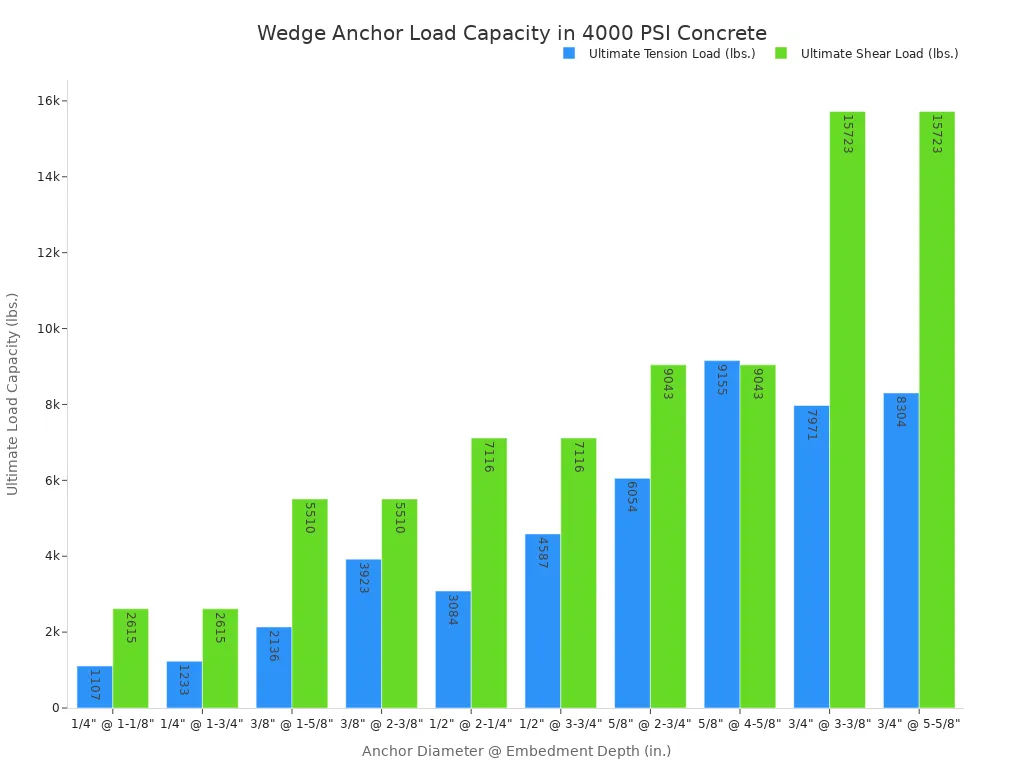
| Nominal Anchor Diameter (in.) | Minimum Embedment Depth (in.) | Ultimate Tension Load (lbs.) in 4000 psi concrete | Ultimate Shear Load (lbs.) in 4000 psi concrete |
|---|---|---|---|
| 1/4″ | 1-1/8″ | 1,107 | 2,615 |
| 3/8″ | 1-5/8″ | 2,136 | 5,510 |
| 1/2″ | 2-1/4″ | 3,084 | 7,116 |
| 5/8″ | 2-3/4″ | 6,054 | 9,043 |
| 3/4″ | 3-3/8″ | 7,971 | 15,723 |
Important Load Considerations
- Ultimate load values require a minimum safety factor of 4.0 to determine the safe, allowable working load.
- Life-safety applications, such as overhead fixtures, may demand a safety factor of 10 or higher.
- These values are for an anchor installed in solid, uncracked concrete with a minimum specified compressive strength.
Best Applications: Racking, Machinery, Structural
The high load capacity of wedge anchors makes them the top choice for heavy-duty jobs. Installers use these concrete anchor bolts for critical connections. Common applications include:
- Anchoring structural support beams and columns
- Securing heavy industrial machinery to floors
- Fastening pallet racking and shelving systems
- Mounting railing systems and safety barriers
Limitations in Soft or Hollow Materials
A wedge anchor’s strength is also its primary limitation. The intense, focused pressure from the expansion clip requires a solid, dense base material. Using a wedge anchor in soft or hollow materials like CMU block or brick will likely cause the base material to crack, spall, or break out, leading to anchor failure. These concrete anchor bolts are engineered exclusively for solid masonry.
Versatile Fastening: Sleeve Anchors
Sleeve anchors offer a more versatile solution suitable for a wider range of base materials. They are an excellent choice for medium-duty applications where the base material may not be solid concrete.
The Mechanics of the Expanding Sleeve
A sleeve anchor consists of a threaded bolt, a flared cone-shaped nut, and a full-length expansion sleeve. When an installer tightens the bolt head, it pulls the cone into the sleeve. This action causes the entire sleeve to expand outward along its length, creating pressure against the inside of the drilled hole. This distributed pressure makes the anchor suitable for less dense materials.
Ideal Uses in Brick, Block, and Concrete
Sleeve anchors provide a distinct advantage in hollow materials. Their full-length expansion allows the sleeve to bridge internal voids in CMU or hollow brick, creating a secure grip against the material’s inner and outer walls. While they perform adequately in solid concrete, their primary strength lies in their effectiveness in hollow block and brick. This makes them one of the most adaptable types of concrete anchor bolts available.
When to Choose a Sleeve Anchor Over a Wedge Anchor
An installer should choose a sleeve anchor over a wedge anchor in several scenarios. The decision often comes down to the base material and load requirements.
- Base Material Versatility: Sleeve anchors are the correct choice for brick, block, and other unknown or variable masonry materials.
- Lighter Loads: They are ideal for medium-duty applications like attaching signs, handrails, light fixtures, and shelving.
- Installation Efficiency: Sleeve anchors are often faster and easier to install, sometimes requiring a shallower hole than a comparable wedge anchor. This makes them a more cost-effective choice for many projects.
Flush-Mounting Solutions: Drop-In Anchors
Drop-in anchors are female, or internally threaded, fasteners designed for a flush-mount finish in solid concrete. They are ideal for applications requiring a removable bolt or for suspending threaded rod.
Understanding the Internally Threaded Design
A drop-in anchor is a metal shell with an internal cone-shaped plug and internal threads. The entire anchor is placed into a pre-drilled hole so its top sits flush with or just below the concrete surface. This design leaves a clean, flat surface after installation, with no protruding studs.
Perfect for Overhead Applications and Threaded Rod
The internally threaded design makes the drop-in anchor perfect for overhead work. Installers use them to suspend electrical conduit, cable trays, HVAC ductwork, and fire sprinkler pipes with threaded rod. The ability to simply screw a bolt in and remove it later also makes them useful for temporary fixtures or machinery that may need to be relocated.
Essential Setting Tools for Proper Installation
Proper expansion of a drop-in anchor is not automatic. It requires a specific setting tool. After placing the anchor in the hole, the installer inserts the setting tool and strikes it firmly with a hammer. This drives the internal plug downward, flaring the anchor body and locking it into the concrete. Using the correct setting tool is mandatory for achieving the anchor’s rated holding power.
| Size | Minimum Embedment | Max. Torque | Drill Bit | Pull-Out (lbs.) |
|---|---|---|---|---|
| 1/4” | 1” | 5 ft./lbs. | 3/8” | 939 |
| 3/8” | 1-9/16” | 10 ft./lbs. | 1/2” | 1560 |
| 1/2” | 2” | 20 ft./lbs. | 5/8” | 3105 |
| 5/8” | 2-1/2” | 30 ft./lbs. | 7/8” | 3323 |
| 3/4” | 3-3/16” | 40 ft./lbs. | 1” | 6678 |
A Note on Safe Loads: The pull-out values shown are ultimate loads in lab conditions. Professionals apply a safety factor of 4:1 (or 25% of the ultimate load) to determine a safe working load for any anchor.
Other Common Expansion Anchors
Beyond the primary three, professionals have other specialized expansion anchors at their disposal. These alternative types of concrete anchor bolts offer unique benefits for specific, often lighter-duty, scenarios. Understanding these options allows an installer to select the most efficient and effective fastener for any task.
Strike Anchors (Hammer-Set Anchors)
Strike anchors are impact-expansion concrete anchor bolts designed for fast, permanent installations in solid concrete. Their one-piece design includes a pin that, when struck with a hammer, drives down and expands the anchor body. This expansion creates a secure hold within the concrete.
These concrete anchor bolts are made from carbon steel with a yellow dichromate zinc plating, making them suitable for dry, interior environments. An installer must use them exclusively in solid concrete; they are not designed for block or brick. A 5/16″ x 2-3/4″ strike anchor, for example, requires a minimum embedment of 1-1/4″ and provides an ultimate pull-out load of 1050 lbs in 2000 PSI concrete. The simple installation makes this anchor a go-to choice for repetitive fastening tasks.
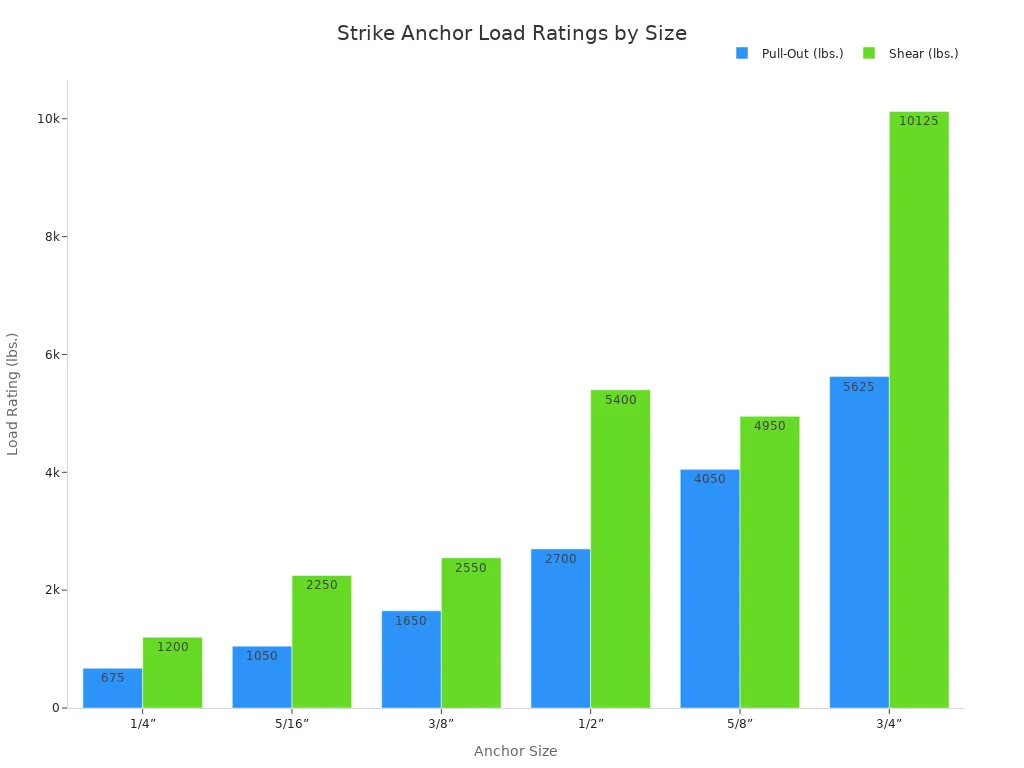
The following table details the ultimate load capacities for these concrete anchor bolts in solid concrete.
| Size | Pull-Out (lbs.) | Shear (lbs.) |
|---|---|---|
| 1/4” | 675 | 1200 |
| 5/16” | 1050 | 2250 |
| 3/8” | 1650 | 2550 |
| 1/2” | 2700 | 5400 |
| 5/8” | 4050 | 4950 |
| 3/4” | 5625 | 10125 |
Installation Tip: A strike anchor is a permanent, non-removable anchor. Professionals should confirm the fixture location is final before setting this type of anchor.
Lag Shield Anchors for Lag Screws
Lag shield anchors are two-part fasteners designed to accept a lag screw. They provide a reliable anchoring point in a variety of masonry materials, including concrete, brick, and block.
- The anchor consists of a pre-assembled, two-part expandable shield.
- Installers use them in concrete and the mortar joints of block or brick walls.
- Short-style shields work best in hard masonry, reducing drilling time.
- Long-style shields provide better strength in softer base materials.
When an installer tightens the lag screw, it draws into the shield, forcing the shield’s ribbed sides to expand. This expansion presses firmly against the walls of the drilled hole, creating a secure anchor point.
Proper installation of this anchor follows a clear process:
- Drill a hole to the correct diameter and depth using a carbide-tipped bit. The hole should be 1/2 inch deeper than the anchor length to allow room for debris.
- Clean all dust and debris from the hole with compressed air, a vacuum, or a wire brush. A clean hole is essential for proper expansion.
- Insert the lag shield anchor into the hole, tapping it with a hammer until it is flush with the surface.
- Place the fixture over the hole, insert the lag screw, and tighten it until snug. An installer must avoid over-tightening, which can cause the anchor to spin in the hole.
Split Drive Anchors for Light-Duty Use
Split drive anchors are one-piece, light-duty concrete anchor bolts. They are known for their simple and rapid installation. These concrete anchor bolts feature a split at the base of the shaft. When an installer drives the anchor into a pre-drilled hole of the same diameter, the two halves of the split end are compressed. The outward pressure from this compression creates the holding force.
These concrete anchor bolts are suitable only for static, light-duty applications in solid concrete, such as fastening signs, electrical boxes, or furring strips. Like strike anchors, they are permanent fasteners. Their simplicity and speed make them a cost-effective choice for projects with many light-duty attachment points. These are some of the most basic types of concrete anchor bolts available.
Step 4: Get the Material Right for Long-Term Durability
A professional must get the material right to ensure a fastener’s long-term performance and safety. The anchor’s composition and coating must withstand the environmental conditions of the project. Choosing the wrong material can lead to premature corrosion and failure, compromising the entire installation. This step focuses on matching the anchor to its environment for maximum durability.
Matching the Bolt Material to the Environment
The installation environment dictates the required level of corrosion resistance.
For Dry, Interior Applications
In controlled, dry indoor settings, corrosion is a minimal concern. A standard zinc-plated carbon steel anchor provides sufficient protection. This option is cost-effective and suitable for most interior construction projects.
For Humid or Damp Environments
Areas with high humidity, moisture, or occasional condensation require a higher level of protection. Hot-dip galvanized (HDG) steel offers significantly better corrosion resistance than zinc plating due to its much thicker protective coating.
For Exterior, Wet, and Corrosive Conditions
Exterior applications expose fasteners to rain, snow, and temperature fluctuations. For these conditions, or for environments with chemical or saltwater exposure, stainless steel is the required material. It provides the best defense against aggressive corrosion.
A Breakdown of Common Materials and Coatings
Each material and coating offers a different level of protection and service life.
Zinc-Plated Carbon Steel
This is the most basic level of corrosion protection. A thin layer of zinc is electroplated onto a carbon steel anchor. While aesthetically pleasing, the coating is very thin and offers limited protection. It is only suitable for dry, interior use.
Hot-Dip Galvanized (HDG) Carbon Steel
HDG provides a much more robust coating. The anchor is submerged in molten zinc, creating a thick, durable, and metallurgically bonded layer.
HDG coatings are roughly 10 times thicker than zinc plating. This thickness gives them a significantly longer service life in outdoor and damp environments. They are the standard for rural or light industrial exposures.
Type 304 Stainless Steel
Type 304 stainless steel contains 18% chromium and 8% nickel, offering excellent corrosion resistance in many environments. It is a great choice for outdoor applications and humid areas but is susceptible to corrosion from chlorides, like salt.
Type 316 (Marine-Grade) Stainless Steel
Type 316 stainless steel includes molybdenum, which dramatically increases its resistance to chlorides and industrial solvents. This makes it the superior choice for durability.
- Marine Environments: Its robustness against saltwater makes it the only suitable option for coastal and marine applications.
- Chemical Plants: It withstands aggressive chemicals and frequent caustic cleaning, making it ideal for industrial facilities.
Avoiding Corrosion for a Lasting Installation
Understanding corrosion mechanisms is key to preventing fastener failure.
What is Galvanic Corrosion?
Galvanic corrosion occurs when two different metals are in contact in the presence of an electrolyte, like moisture. The more reactive metal corrodes at an accelerated rate. For example, if an installer uses carbon steel bolts to attach a stainless steel railing, the bolts will corrode rapidly and fail. The fastener should always be the more noble (less reactive) metal.
Considerations for Chemical and Saltwater Exposure
Chemicals and salt create highly aggressive environments. An installer must select an anchor specifically designed for these conditions. Type 316 stainless steel is the industry standard for these applications, preventing pitting and ensuring the structural integrity of the connection.
Step 5: The Critical Steps for a Perfect Installation

Selecting the right fastener is only half the battle. A proper installation is just as critical for safety and performance. Even the best anchor will fail if installed incorrectly. Professionals follow a systematic process to ensure every anchor achieves its maximum holding power, resulting in a solid and reliable installation.
Preparing the Hole for the Anchor
The foundation of a secure anchor is a perfectly prepared hole. This initial step sets the stage for the entire installation.
Selecting the Correct ANSI-Standard Drill Bit
An installer must use a carbide-tipped drill bit that meets ANSI standard B212.15. This standard ensures the bit drills a hole with the correct tolerance for concrete anchor bolts. Using a non-compliant or worn bit can create an oversized hole, preventing the anchor from achieving proper expansion and grip.
| Diameter of Drill Bit | Minimum Diameter | Maximum Diameter |
|---|---|---|
| 1/4” | .260” | .268” |
| 3/8” | .390” | .398” |
| 1/2” | .520” | .530” |
| 5/8” | .582” | .592” |
Drilling to the Proper Depth and Diameter
Professionals must pre-drill with precision. They drill the hole to the diameter and minimum embedment depth specified in the manufacturer’s instructions. A hole that is too shallow will prevent the anchor from being set correctly, severely reducing its load capacity.
Why You Must Clean Debris from the Hole
Concrete dust and debris left in the hole act as a barrier. This debris prevents the anchor from making full contact with the base material. It can stop the expansion mechanism from working correctly, leading to a loose fit and drastically reduced pull-out strength.
Techniques for Hole Cleaning: Brushes and Air
A clean hole is non-negotiable. The standard procedure involves using a wire brush and compressed air.
- Brush the inside of the hole to loosen all dust.
- Blow the debris out with compressed air or a hand pump.
- Repeat this brush-and-blow cycle until the hole is completely clean.
Setting the Anchor Correctly
With a clean hole, the installer can proceed with setting the anchor. This phase requires attention to detail to ensure a secure connection.
Following Manufacturer Torque Specifications
Every expansion anchor has a required installation torque value.
Warning: Incorrect torque leads to failure.
- Under-torquing results in insufficient expansion, allowing the anchor to slip under load.
- Over-torquing can break the anchor, strip the threads, or crack the surrounding concrete. An installer must use a calibrated torque wrench to tighten the concrete anchor bolts to the exact specification. It is critical to follow the installation instructions provided by the manufacturer.
Common Installation Mistakes to Avoid
Installers must avoid common errors like using a worn-out drill bit, failing to clean the hole, or guessing the torque value. Another mistake is hitting the anchor too hard during insertion, which can damage the threads or the expansion mechanism before it is even tightened.
How to Verify a Secure and Proper Set
Professionals verify a secure set by applying the specified torque with a calibrated torque wrench. For critical applications, they may perform proof loading. This involves applying a test load to the installed anchor to confirm it can sustain the required forces without moving.
Spacing and Edge Distance Rules
The location of the anchor is as important as the installation itself. Concrete anchor bolts exert immense outward pressure.
Minimum Distance from Concrete Edges
Placing an anchor too close to an unsupported edge can cause the concrete to break out. Manufacturers provide minimum edge distance requirements for their concrete anchor bolts. Adhering to these guidelines is essential to prevent edge failure.
Minimum Spacing Between Anchors
Installing concrete anchor bolts too close to each other causes their expansion forces to overlap. This creates a cone of influence in the concrete. If these cones intersect, the holding capacity of the entire group is reduced.
How Spacing Affects Load Capacity
The load capacity of an anchor group depends on proper spacing. When anchors are spaced too closely, the overlapping stress zones can lead to a single large concrete breakout failure at a much lower load than the sum of the individual anchor capacities. Following the specified spacing ensures each anchor can support its intended share of the load.
A successful project relies on a systematic method for choosing the right expansion bolt. Professionals achieve safety and durability by assessing the base material, load requirements, and fastener type. A correct installation is just as critical as selecting the proper fasteners. This guide to choosing the right expansion bolt helps ensure project safety and long-term performance.
FAQ
Can an installer reuse an expansion anchor?
Professionals should not reuse expansion anchors. The removal process often damages the anchor’s expansion mechanism. A new anchor ensures the connection meets its specified load capacity and safety standards for a reliable hold.
What should a professional do if the hole is drilled too big?
An oversized hole prevents proper anchor expansion. The installer must abandon that hole and drill a new one. The new hole must meet the minimum spacing requirements from the old one to maintain structural integrity.
How does concrete strength (PSI) affect anchor choice?
Higher PSI concrete provides a stronger base for higher load capacities. Manufacturers’ load charts specify performance based on concrete PSI. An installer must verify the base material’s strength to ensure a safe installation.
Is a wedge anchor or sleeve anchor better for a diy garage shelf project?
The choice depends on the wall material. An installer should use a wedge anchor for solid concrete walls. A sleeve anchor is the correct choice for walls made of concrete block (CMU) or brick.
Why is cleaning the hole so important?
Debris in the hole obstructs the anchor’s expansion mechanism. This prevents full contact with the base material. A clean hole is essential for the anchor to achieve its rated holding power and prevent failure.
Can an installer use an impact wrench to tighten expansion bolts?
Professionals should avoid using impact wrenches. These tools can easily over-torque the anchor, leading to fastener breakage or concrete failure. A calibrated torque wrench ensures precise and safe installation according to manufacturer specifications.