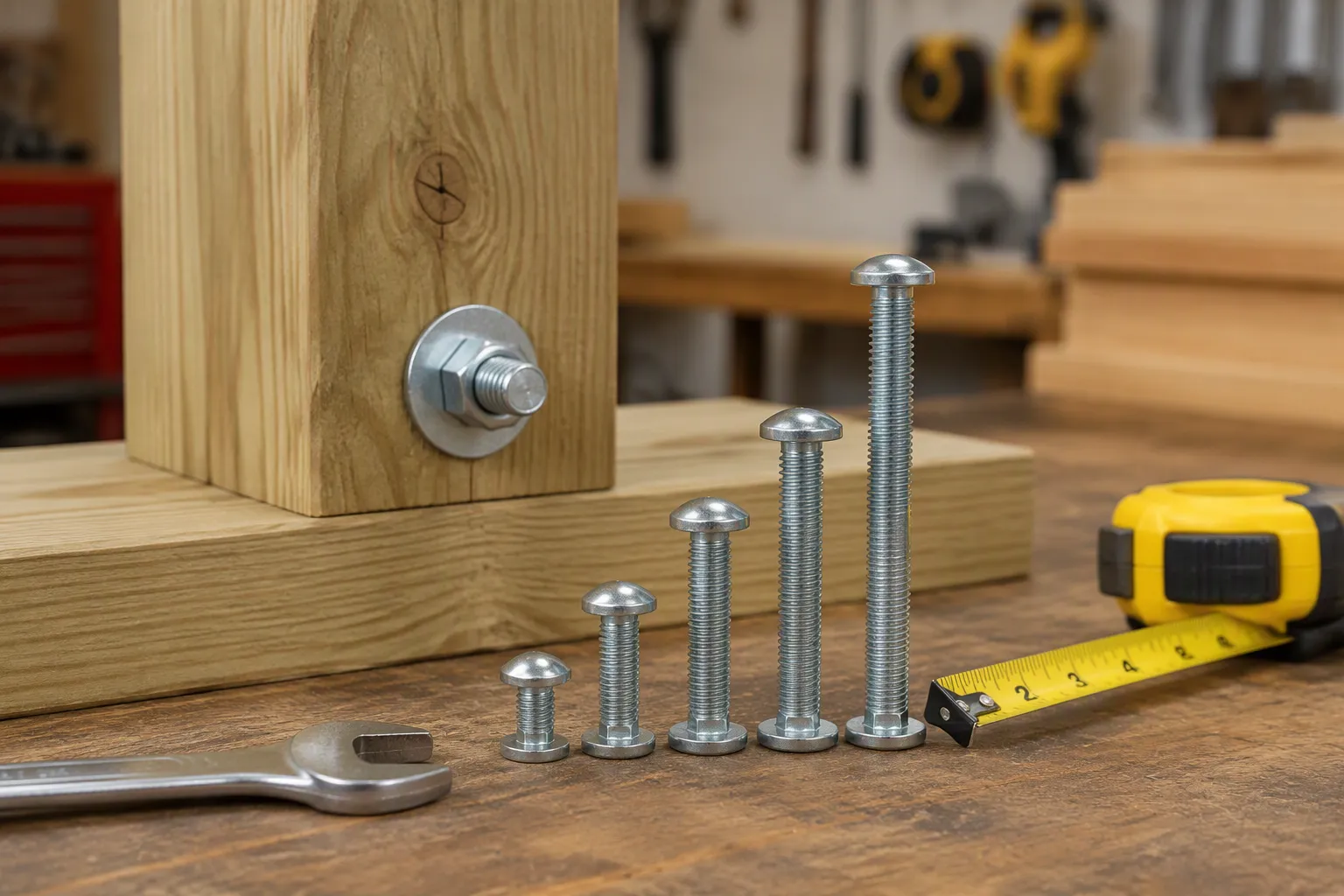
The most common carriage bolt sizes for 4×4 post connections are 3/8″ and 1/2″ in diameter. Typical lengths range from 4″ to 6″, depending on what the builder attaches. The final choice depends on the specific application, load requirements, and material thickness. A carriage bolt with the wrong dimensions weakens the joint. Builders should verify bolt casting quality from a reputable custom fasteners manufacturer. Correct sizing ensures structural integrity and safety. Many professionals order custom fasteners for demanding projects.
Understanding Carriage Bolt Sizes
Bolt Diameter Explained
Common Diameters for 4×4 Posts
Carriage bolts come in many standard imperial diameters. The table below shows the full range available from most suppliers.
| Standard Imperial Diameter Sizes for Carriage Bolts |
|---|
| #8 |
| #10 |
| #12 |
| 1/4″ |
| 5/16″ |
| 3/8″ |
| 7/16″ |
| 1/2″ |
| 9/16″ |
| 5/8″ |
| 3/4″ |
| 7/8″ |
| 1″ |
| 1-1/8″ |
| 1-1/4″ |
| 1-1/2″ |
For 4×4 post connections, the 3/8″ and 1/2″ diameters dominate. A 3/8″ bolt handles most railing and fence work. A 1/2″ bolt suits heavier structural joints.
How Diameter Affects Strength
A larger diameter bolt carries more load. The cross-sectional area grows with the square of the diameter. A 1/2″ bolt provides roughly 78 percent more shear area than a 3/8″ bolt. This difference matters for load-bearing connections.
Bolt Length Explained
Measuring for the Correct Length
According to industry standards GB/T 12 and DIN 603, the official length of a carriage bolt is the under-head length. Manufacturers measure from the bearing face directly below the square neck to the end of the shank. This measurement excludes the dome head. The overall length equals the under-head length plus the head height. This convention ensures that bolt length matches the stack thickness of the materials being fastened.
The Role of the Unthreaded Shank
The unthreaded shank sits inside the wood members. This smooth section bears the shear load. Threads can crush wood fibers under load. A proper shank length places the threads outside the joint. Builders should select a bolt with a shank long enough to span the full thickness of the connected materials.
Thread Pitch and Head Style
Standard Coarse Threads
Carriage bolts use standard coarse threads. Coarse threads resist cross-threading and handle the slight movement common in wood connections. Fine threads offer no advantage here.
The Function of the Domed Head and Square Neck
The domed head sits flush against the wood surface. The square neck bites into the wood when the nut tightens. This design prevents the bolt from spinning during installation. A builder needs only one wrench to tighten the nut. The smooth dome also provides a finished appearance.
Factors That Determine the Right Carriage Bolt Size
Load Requirements
Light-Duty vs. Heavy-Duty Applications
A light-duty connection carries minimal weight and movement. Deck railings and garden fences fall into this category. A 3/8″ bolt handles these jobs well. Heavy-duty connections support significant structural weight. Pergola beams and porch ledgers demand a 1/2″ bolt or larger. The builder must estimate the total load before selecting a bolt.
Shear Strength vs. Withdrawal Strength
Shear strength resists forces that cut across the bolt axis. Withdrawal strength resists forces that pull the bolt straight out of the wood. Carriage bolts excel at shear resistance because the unthreaded shank bears the load. Withdrawal resistance depends on the nut, washer, and wood fibers. A larger diameter improves both properties. A longer shank improves shear performance specifically.
Type of Wood
Softwoods vs. Hardwoods
Softwoods like pine and fir compress easily under load. They require larger washers to spread pressure. Hardwoods like oak and maple resist compression. They hold bolts tighter and resist withdrawal better. A hardwood connection may use a slightly smaller diameter bolt than a softwood connection under the same load.
The Impact of Treated Lumber
Pressure-treated lumber contains chemicals that accelerate corrosion. Builders must use hot-dip galvanized or stainless steel bolts with treated wood. The treatment process also makes wood fibers more brittle. Over-tightening a bolt in treated lumber can crush the surrounding fibers. A builder should tighten gradually and stop at snug contact.
Connection Type
Post-to-Beam Connections
Post-to-beam connections carry vertical loads. The bolt passes through the beam and the post. A 1/2″ diameter bolt with a 6″ length suits most 4×4 post-to-beam joints. The bolt must span the full beam width plus the post width.
Post-to-Rail or Post-to-Joist Connections
Post-to-rail connections carry lighter lateral loads. A 3/8″ bolt with a 4″ or 5″ length works for most rail attachments. Post-to-joist connections support floor or deck framing. These joints often need a 1/2″ bolt to handle the combined live and dead loads. The builder should match the bolt length to the combined thickness of both members. Selecting among the many carriage bolt sizes requires careful attention to these connection details.
Building Codes and Regulations
When to Consult Local Codes
Building codes protect public safety. They set minimum standards for structural connections. A builder should consult local codes before starting any structural project. This step applies to decks, porches, pergolas, and load-bearing walls. Many jurisdictions adopt the International Residential Code (IRC) or the International Building Code (IBC). These model codes provide baseline rules. Local amendments often add stricter requirements. A homeowner association may impose additional rules. A professional engineer can review plans for complex jobs. Inspectors verify compliance at several stages. A failed inspection costs time and money. Early consultation prevents these problems.
Common Code Requirements for Bolted Connections
Codes specify bolt diameter minimums for different connections. The IRC requires 1/2″ diameter bolts for ledger board attachments to rim boards. Deck railing connections often accept 3/8″ bolts. Codes also set edge distance rules. An edge distance is the space from the bolt hole center to the wood edge. A typical rule requires at least 1-3/4″ from the edge for a 1/2″ bolt. Insufficient edge distance causes splitting. Codes also govern bolt spacing along a joint. Proper spacing distributes the load across the connection.
A common code rule states that bolt holes must be no larger than 1/16″ greater than the bolt diameter.
This rule limits movement inside the joint. A loose hole weakens the connection. Codes also require washers under both the head and the nut. Some codes mandate hot-dip galvanized hardware for exterior use. Builders should verify the specific edition of the code in their area. Code editions change every few years. A connection that passed inspection five years ago may fail today. Local building departments publish free guides and checklists. These resources simplify the compliance process. A builder should keep approved plans on site. Inspectors may request them at any time.
Recommended Carriage Bolt Sizes for Common Applications
Deck Railing Connections
Attaching Rails to Posts
Builders attach deck rails to posts with carriage bolts. The standard choice is a 3/8″ diameter bolt. Length typically reaches 4″ or 5″. A 2×6 rail measures 1.5″ thick. A 4×4 post measures 3.5″ thick. The combined thickness equals 5″. A 5″ bolt provides enough length for a washer and nut. Some builders use a 4″ bolt for a 2×4 rail. The square neck seats into the post. The dome head faces outward for a clean appearance. Two bolts per rail end provide stability. One bolt allows the rail to rotate over time.
Securing Balusters
Carriage bolts secure balusters in some railing designs. The bolts pass through the rail and the baluster. A 3/8″ diameter bolt works for standard balusters. Length depends on the baluster thickness plus the rail thickness. A 2×2 baluster measures 1.5″ thick. A 2×6 rail measures 1.5″ thick. The combined thickness is 3″. A 3.5″ or 4″ bolt provides proper engagement. Builders should ensure the unthreaded shank spans the full stack thickness. The threads should engage only in the nut and washer area. This placement prevents thread damage to the wood.
Fence Construction
Joining Fence Posts to Horizontal Rails
Fence construction requires strong post-to-rail connections. A 3/8″ diameter carriage bolt suits most residential fence work. Length ranges from 5″ to 6″. A 4×4 post provides a 3.5″ thickness. A 2×4 rail provides a 1.5″ thickness. The combined thickness reaches 5″. A 5″ bolt fits this stack. Some designs place the rail between two posts. The bolt must then span both post faces and the rail. A 6″ bolt accommodates this configuration. Builders should drill a square hole for the bolt neck. This hole prevents spinning during tightening.
Gate Frame Assembly
Gates experience more stress than standard fence sections. The weight of the gate creates leverage on the frame connections. A 3/8″ diameter bolt handles gates up to 4 feet wide. Wider or heavier gates require a 1/2″ diameter bolt. The bolt length must match the combined member thickness. A gate frame often uses 2×4 lumber. The bolt passes through the frame and the brace. A 4″ bolt works for a single 2×4 thickness. A diagonal brace adds another layer. A 5.5″ or 6″ bolt accommodates the extra material. Builders should use two bolts at each corner joint. This practice prevents racking and sagging over time. The selection of appropriate carriage bolt sizes prevents connection failure under gate loads.
Structural and Load-Bearing Connections
Pergolas and Gazebos
Pergolas and gazebos carry substantial dead loads and wind loads. A 1/2″ diameter carriage bolt serves as the standard choice. Length typically reaches 6″ for a 4×4 post connection. A 4×4 post measures 3.5″ thick. A 2×6 or 4×6 beam adds 1.5″ to 3.5″ of thickness. The bolt must span both members completely. A 6″ bolt accommodates a 4×4 post plus a double 2x beam. Builders often use two bolts per connection. This redundancy adds safety margin. The bolt pattern should follow manufacturer specifications or engineering plans. The square neck prevents rotation. The dome head provides a finished, professional appearance.
Porch and Deck Ledger Boards
The ledger board connection ranks among the most critical structural joints in deck construction. The ledger fastens the deck to the house framing. Building codes specify minimum bolt diameters for this connection. The IRC requires 1/2″ diameter bolts for ledger attachment. Some jurisdictions require 5/8″ or 3/4″ bolts for larger decks. The bolt length must pass through the ledger board, the sheathing, and into the band joist. Standard ledger boards use 2×8 or 2×10 lumber. The combined thickness ranges from 4″ to 6″. A 6″ bolt suits most ledger connections. Builders must use hot-dip galvanized or stainless steel bolts for exterior exposure. The bolt spacing follows code requirements. Typical spacing reaches 32″ on center with 1/2″ bolts. The bolt placement must maintain proper edge distances. A bolt too close to the ledger edge causes splitting. Builders should consult the local code edition for specific requirements.
Quick Reference Comparison Table
The following table consolidates the recommendations from this guide into a single reference point. Builders can use this table to select the appropriate carriage bolt sizes for common 4×4 post connections. The table lists the application, recommended diameter, recommended length, and critical notes for each scenario.
| Application | Recommended Diameter | Recommended Length | Notes |
|---|---|---|---|
| Deck railing to post | 3/8″ | 4″ to 5″ | Use two bolts per rail end. The square neck seats into the post. |
| Baluster to rail | 3/8″ | 3.5″ to 4″ | Match the bolt length to the combined baluster and rail thickness. |
| Fence post to horizontal rail | 3/8″ | 5″ to 6″ | A 6″ bolt accommodates rails sandwiched between two posts. |
| Gate frame assembly | 3/8″ or 1/2″ | 4″ to 6″ | Choose 1/2″ for gates wider than 4 feet. Use two bolts per corner. |
| Pergola beam to post | 1/2″ | 6″ | Use two bolts per connection for added safety margin. |
| Porch or deck ledger board | 1/2″ minimum | 6″ | Check local codes. Some jurisdictions require 5/8″ or 3/4″ bolts. |
| Post-to-beam structural joint | 1/2″ | 6″ | Verify the bolt spans the full beam width plus the post width. |
| Light-duty post-to-joist | 3/8″ | 5″ | Suitable for non-load-bearing attachments only. |
| Heavy-duty post-to-joist | 1/2″ | 6″ | Required for floor and deck framing that supports live loads. |
The table provides a starting point for most residential projects. Builders should verify each selection against the specific material thickness on site. A 4×4 post measures 3.5 inches in actual thickness. A 2×6 board measures 1.5 inches. The combined stack determines the minimum bolt length. The unthreaded shank must span the full stack thickness. Threads should engage only in the nut and washer area.
The diameter choice depends on the load path. A 3/8″ bolt suits light-duty connections with minimal weight and movement. A 1/2″ bolt handles structural joints that carry significant dead loads and wind loads. Builders should never substitute a smaller diameter bolt to save cost. The connection strength drops dramatically with a reduced cross-section.
The table also highlights the importance of proper installation hardware. Every connection requires a flat washer under the nut. The washer distributes the clamping force across the wood surface. A lock washer or nylon insert nut prevents loosening from vibration. Builders should use hot-dip galvanized or stainless steel hardware for exterior exposure. Treated lumber accelerates corrosion on standard steel fasteners.
Edge distance rules apply to every bolted connection. The bolt hole center must sit at least 1-3/4 inches from the wood edge for a 1/2″ bolt. A 3/8″ bolt requires a minimum edge distance of 1-1/2 inches. Insufficient edge distance causes splitting under load. Builders should measure carefully before drilling.
The table serves as a practical guide for common scenarios. Complex projects may require engineering review. A professional engineer can calculate exact load requirements and specify precise bolt patterns. Local building codes may impose stricter requirements than the table recommends. Builders should always consult the applicable code edition before proceeding.
The selection of carriage bolt sizes ultimately depends on the specific connection. The table simplifies this decision for standard applications. Builders who follow these recommendations achieve safe, durable connections for their 4×4 post projects.
Installation Tips for Carriage Bolts in 4×4 Posts
Drilling the Pilot Hole
Selecting the Correct Drill Bit Size
A builder must drill a pilot hole before inserting any carriage bolt. The drill bit size should match the bolt diameter exactly. A 3/8″ bolt requires a 3/8″ drill bit. A 1/2″ bolt requires a 1/2″ drill bit. This precision ensures a snug fit without excess movement. A hole that is too large weakens the connection. A hole that is too small prevents proper insertion. Builders should mark the hole location carefully before drilling. The hole must pass straight through both wood members.
The Importance of a Square Hole for the Neck
The square neck of a carriage bolt requires a square hole. A standard round drill bit creates a round hole. The square neck cannot bite into round wood fibers properly. Builders should use a mortising chisel or a square hole saw to create the square opening. This step allows the neck to seat firmly into the wood. The square hole prevents the bolt from spinning during tightening. A properly seated neck also keeps the dome head flush against the surface.
Using Washers and Nuts
The Necessity of a Flat Washer
A flat washer is mandatory for every carriage bolt connection. The washer distributes the clamping force across a wider area. Without a washer, the nut digs into the wood surface. This damage weakens the joint over time. The washer also prevents the nut from pulling through soft wood fibers. Builders should place the washer between the nut and the wood surface.
Lock Washers vs. Nylon Insert Nuts
Builders can choose between lock washers and nylon insert nuts. A lock washer features split ends that grip the nut surface. This design resists loosening from vibration. A nylon insert nut contains a nylon ring that grips the bolt threads. This type provides superior resistance to vibration. Both options work well for 4×4 post connections. Nylon insert nuts offer better performance in outdoor applications.
Tightening and Final Checks
How to Tighten Without Damaging the Wood
Builders should tighten the nut gradually with a wrench. Over-tightening crushes wood fibers and weakens the connection. The goal is snug contact, not maximum torque. A socket wrench provides better control than an open-end wrench. Builders should stop tightening when the washer presses firmly against the wood.
Never use an impact driver to tighten carriage bolts in wood. The high torque can strip the nut or crush the wood fibers instantly.
Checking for a Flush Fit
The dome head must sit flush against the wood surface after installation. A gap between the head and the wood indicates an improper fit. Builders should check the square neck engagement. The neck must sit fully inside the square hole. A flush fit provides a clean appearance and maximum strength. Builders should also verify that the bolt extends past the nut by at least two full threads. This extension ensures proper thread engagement. A final inspection confirms that all carriage bolt sizes match the application requirements.
Common Mistakes to Avoid
Using the Wrong Bolt Diameter
The Risk of Using Bolts That Are Too Small
A bolt that is too small cannot carry the intended load. The cross-sectional area of a 1/4″ bolt is less than half that of a 3/8″ bolt. This reduced area leads to premature failure under shear or withdrawal forces. A small bolt also creates a loose hole in the wood. The connection may wobble and loosen over time. Builders should never substitute a smaller diameter bolt to save money. The safety risk far outweighs the minor cost savings.
The Problem with Oversized Bolts
An oversized bolt introduces its own set of problems. A 5/8″ bolt in a 4×4 post leaves very little wood around the hole. This reduced edge distance causes splitting under load. The large hole also removes a significant amount of wood fiber. The post loses structural capacity at the connection point. Builders should match the bolt diameter to the load requirement and the post dimensions. A 1/2″ bolt is the practical maximum for most 4×4 post connections.
Incorrect Bolt Length
Bolts That Are Too Short
A short bolt creates multiple failure risks. The bolt length must cover the total clamped thickness, washer thickness, nut height, and sufficient thread protrusion. When the protrusion is too little, incomplete thread engagement occurs. This condition leads to several problems:
- Spinning
- Incomplete neck seating
- Wood crushing
- Thread stripping
- Corrosion
- Galling
- Insufficient thread engagement
- Loss of clamp load
Each of these issues weakens the connection and compromises safety. A builder should always measure the full stack thickness before selecting a bolt length.
Bolts That Are Too Long
An excessively long bolt leaves too many threads exposed past the nut. The unthreaded shank may not span the full joint thickness. This placement forces the threads to bear the shear load inside the wood. Threads crush wood fibers and reduce connection strength. A long bolt also creates a snag hazard and looks unprofessional. Builders should select a bolt length that leaves only two or three threads exposed past the nut.
Improper Installation
Forgetting the Washer
A missing washer concentrates the clamping force on a small area. The nut digs into the wood surface under load. This damage allows the connection to loosen over time. A flat washer distributes the force across a wider area. Builders must place a washer under every nut in a carriage bolt connection.
Over-Tightening and Stripping the Wood
Over-tightening crushes wood fibers around the bolt hole. The hole enlarges and the bolt loses its grip. The square neck may strip through the wood and spin freely. Builders should tighten the nut gradually with a socket wrench. The goal is snug contact, not maximum torque. A nylon insert nut or lock washer prevents loosening without excessive tightening.
The 3/8″ and 1/2″ diameters remain the standard carriage bolt sizes for most 4×4 post connections. Bolt length depends on the total thickness of the joined materials. Most projects need a 4″ to 6″ bolt. The specific application and load requirements ultimately determine the correct choice. Builders should prioritize safety on every project. They should consult a professional or local building codes for structural work.
FAQ
What size carriage bolt works best for a 4×4 post?
A 3/8″ or 1/2″ diameter bolt suits most 4×4 post connections. The 3/8″ size handles light-duty jobs like railings and fences. The 1/2″ size supports heavy structural loads. The builder must match the bolt to the application.
How long should a carriage bolt be for a 4×4 post?
Length depends on the total thickness of the joined materials. Most 4×4 post connections need a 4″ to 6″ bolt. The unthreaded shank must span the full stack. The threads should sit outside the wood members.
Can a builder use a 1/4″ carriage bolt for a 4×4 post?
A 1/4″ bolt is too small for most 4×4 post connections. Its cross-sectional area cannot carry significant shear or withdrawal loads. The small diameter also creates a loose hole. Builders should avoid this size for structural work.
Does treated lumber require a special carriage bolt?
Yes. Pressure-treated lumber contains corrosive chemicals. Builders must use hot-dip galvanized or stainless steel bolts. Standard steel bolts corrode quickly in treated wood. The corrosion weakens the connection over time.
What washer goes on a carriage bolt?
A flat washer is mandatory under the nut. It distributes the clamping force across a wider area. A lock washer or nylon insert nut prevents loosening from vibration. Builders should use galvanized hardware for exterior projects.
How many carriage bolts does a 4×4 post connection need?
Most connections require at least two bolts. Two bolts prevent the joint from rotating or racking. Heavy structural joints may need more. The builder should follow engineering plans or local codes.
Can a builder over-tighten a carriage bolt?
Yes. Over-tightening crushes wood fibers around the hole. The hole enlarges and the bolt loses grip. The square neck may strip through the wood. Builders should tighten gradually and stop at snug contact.
Do building codes specify carriage bolt sizes?
Yes. The IRC requires 1/2″ diameter bolts for ledger board attachments. Deck railing connections often accept 3/8″ bolts. Local codes may impose stricter rules. Builders should always verify the applicable code edition.