Engineers seeking the best u-bolts for heavy duty projects in 2026 rely on premium Grade 8 and alloy steel options. National Hardware Grade 8 U-Bolt, Hillman Alloy Steel U-Bolt, and Simpson Strong-Tie Galvanized U-Bolt deliver outstanding performance. These u-bolts meet rigorous ASTM and ISO standards, as shown below:
| Standard | Description |
|---|---|
| ASTM A453 | Grade 660 U Bolt Dimensional Standards |
| ISO 3506-5 | Standard for stainless steel bolts |
National Hardware Grade 8 U-Bolt stands out for high load capacity and reliability. Many custom fasteners manufacturers recommend this u bolt for bolt casting and custom fasteners applications.
Key Criteria for Selecting the Best U-Bolts for Heavy-Duty Applications
Selecting the right u-bolts for heavy-duty applications requires a careful evaluation of several critical factors. Industry experts emphasize the importance of material, size, load capacity, and protective coatings. The following table summarizes the main criteria:
| Criteria | Description |
|---|---|
| Material | Choosing materials like carbon steel or stainless steel based on environmental conditions and corrosion resistance. |
| Size and Dimensions | Ensuring proper fit by selecting U bolts with the correct thread size, diameter, and length. |
| Load Capacity | Matching U bolt grade and strength rating to the expected load to prevent failures. |
| Coatings and Finishes | Selecting coatings like galvanization to enhance corrosion resistance and extend lifespan. |
U-Bolt Strength and Load Capacity
Tensile Strength Ratings
Tensile strength determines how much pulling force a u-bolt can withstand before breaking. Grade 8 u-bolts, commonly used in heavy-duty settings, offer a tensile strength of 150,000 psi and a yield strength of 130,000 psi. These ratings ensure reliable performance under high-stress conditions. Engineers should always match the u-bolt’s strength rating to the anticipated load to prevent structural failures.
Shear Resistance
Shear resistance measures the ability of a u-bolt to withstand forces that attempt to slide the bolt across its axis. Heavy-duty applications often involve dynamic forces, making high shear resistance essential. Proper selection based on load and stress analysis helps maintain safety and integrity in demanding environments.
U-Bolt Material and Construction
Stainless Steel vs. Alloy Steel U-Bolts
Stainless steel u-bolts excel in environments exposed to moisture, chemicals, or saltwater. Their chromium content forms a protective oxide layer, delivering exceptional corrosion resistance and durability. Alloy steel u-bolts provide high strength but lack the same level of corrosion protection, making them better suited for dry, controlled environments.
Galvanized and Coated U-Bolts
Galvanized u-bolts feature a zinc coating that offers moderate corrosion resistance, ideal for HVAC or outdoor installations. Coated u-bolts, including those with epoxy finishes, reduce friction and further enhance resistance to rust and wear. These options extend the service life of the hardware in challenging conditions.
U-Bolt Corrosion Resistance
Environmental Suitability
Environmental factors play a significant role in u-bolt selection. Stainless steel remains the preferred choice for marine or chemical exposure due to its superior rust resistance. Galvanized steel provides a cost-effective solution for moderately corrosive settings, while alloy steel should be reserved for non-corrosive environments.
Longevity in Harsh Conditions
Stainless steel, especially 316 grade, offers the highest corrosion resistance, making it approximately 200 times more resistant than metals without chromium. Galvanized coatings can degrade over time, reducing long-term protection. Selecting the appropriate material and finish ensures the u-bolt maintains its integrity and performance throughout its service life.
U-Bolt Certifications and Standards
ASTM and ISO Compliance
U-bolts for heavy-duty applications must meet strict standards to ensure safety and reliability. The American Society for Testing and Materials (ASTM) and the International Organization for Standardization (ISO) set the benchmarks for quality and performance. Manufacturers design and test u-bolts according to these standards to guarantee consistent results.
Tip: Always check for ASTM or ISO markings on u-bolt packaging or product datasheets. These markings confirm that the product has passed rigorous testing.
The most relevant standards for heavy-duty u-bolts include:
- ASTM A307: Covers carbon steel bolts and studs, including u-bolts, for general applications.
- ASTM A193: Specifies alloy and stainless steel bolts for high-temperature or high-pressure service.
- ASTM A453: Defines requirements for high-temperature fasteners, often used in pressure vessels.
- ISO 898-1: Details mechanical properties for steel fasteners.
- ISO 3506-1: Focuses on stainless steel fasteners, including corrosion resistance.
The table below summarizes key standards:
| Standard | Application Area | Key Requirement |
|---|---|---|
| ASTM A307 | General construction | Minimum tensile strength |
| ASTM A193 | High-pressure, high-temp | Alloy/stainless steel |
| ASTM A453 | Pressure vessels | High-temperature use |
| ISO 898-1 | Steel fasteners | Mechanical properties |
| ISO 3506-1 | Stainless steel fasteners | Corrosion resistance |
Compliance with these standards ensures that u-bolts can handle demanding loads and harsh environments. Engineers and procurement teams should always verify compliance before selecting hardware for critical projects.
Industry-Specific Certifications
Certain industries require additional certifications for u-bolts beyond general ASTM and ISO standards. These certifications address unique safety, performance, and environmental needs.
- DOT (Department of Transportation): U-bolts for transportation infrastructure must meet DOT specifications. These requirements ensure safe use in bridges, guardrails, and highway structures.
- AISC (American Institute of Steel Construction): Steel construction projects often require AISC-certified fasteners. This certification confirms that the u-bolts meet structural steel standards.
- API (American Petroleum Institute): Oil and gas applications demand API-certified u-bolts. These fasteners withstand extreme pressures and corrosive environments.
- NSF (National Sanitation Foundation): Food processing and water treatment facilities use NSF-certified u-bolts. This certification guarantees that the hardware will not contaminate products or water supplies.
Note: Industry-specific certifications often appear on technical datasheets or product labels. Always request documentation from suppliers to confirm compliance.
By understanding and verifying these certifications, buyers can select u-bolts that meet both general and industry-specific requirements. This approach reduces risk and ensures long-term performance in critical applications.
Top 5 Best U-Bolts for Heavy-Duty Applications in 2026
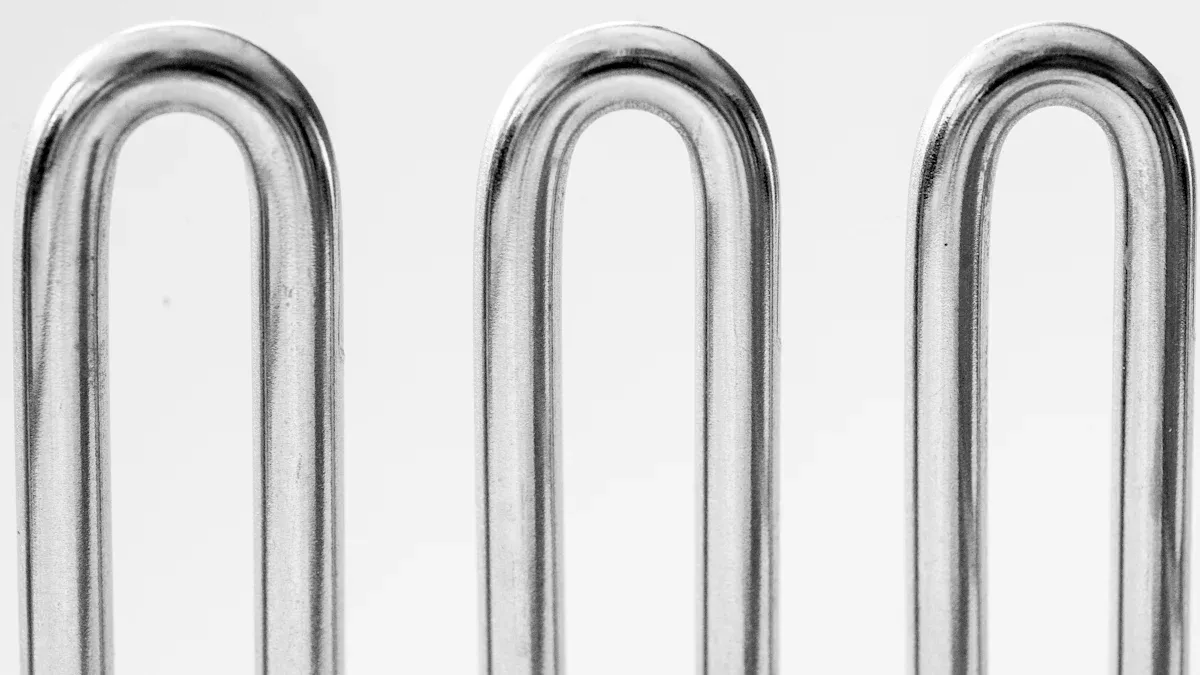
National Hardware Grade 8 U-Bolt
Pros
National Hardware Grade 8 U-Bolt stands out as one of the best u-bolts for heavy-duty projects in 2026. This model features robust construction and advanced corrosion resistance, making it a preferred choice for demanding environments. The following table highlights its key features and specifications:
| Feature/Specification | Description |
|---|---|
| Construction Material | Manufactured from steel wire for durability. |
| Installation | Easily installs with included plate and nuts. |
| Applications | Suitable for automotive, plumbing, and other home and industrial applications, including marine. |
| Weather Resistance | Coated with WeatherGuard™ Protection to withstand harsh weather and prevent corrosion. |
| Corrosion Resistance | Proven to be 3x more resistant to corrosion compared to competitors. |
| Warranty | National Hardware’s Limited Lifetime Warranty. |
Users appreciate the straightforward installation and the product’s ability to withstand harsh conditions. The WeatherGuard™ coating delivers superior protection, extending the lifespan of the u-bolt in outdoor and marine settings.
Cons
- Higher price point compared to standard u-bolts.
- May require specific sizing for custom applications.
- Limited availability in some local hardware stores.
Ideal Use Cases
- Automotive suspension and exhaust systems
- Marine and coastal installations
- Industrial piping and heavy machinery
- Construction projects requiring long-term durability
Hillman Alloy Steel U-Bolt
Pros
Hillman Alloy Steel U-Bolt offers high tensile strength and reliability for structural and industrial applications. The alloy steel composition provides excellent load-bearing capacity, making it suitable for environments where strength is critical. Users report consistent performance in construction and manufacturing settings.
- High load capacity for heavy-duty fastening
- Reliable performance in dry, controlled environments
- Available in a range of sizes for versatile use
Cons
- Lower corrosion resistance compared to stainless or galvanized options
- Not recommended for marine or chemical exposure
- May require additional coatings for outdoor use
Ideal Use Cases
- Structural steel connections in construction
- Industrial equipment assembly
- Automotive and transportation infrastructure
- Applications where maximum strength is required and corrosion risk is minimal
Simpson Strong-Tie Galvanized U-Bolt
Pros
Simpson Strong-Tie Galvanized U-Bolt ranks among the best u-bolts for versatility and value. This model adapts to both round and oval conduits and resists vibration and shock loads. The galvanized finish provides moderate corrosion resistance, making it suitable for many outdoor and industrial applications. The following table summarizes its main advantages and disadvantages:
| Advantages | Disadvantages |
|---|---|
| Versatile for round and oval conduits | Improper sizing leads to slippage or crushing |
| Resistant to vibration and shock loads | Uncoated carbon steel corrodes quickly outdoors |
| Reusable and adjustable with proper maintenance | Requires access to both sides for tightening |
| Available in various materials and finishes | Not ideal for very high-temperature environments unless specified |
| Cost-efficient for large-scale installations | Can loosen over time without locknuts or threadlocker |
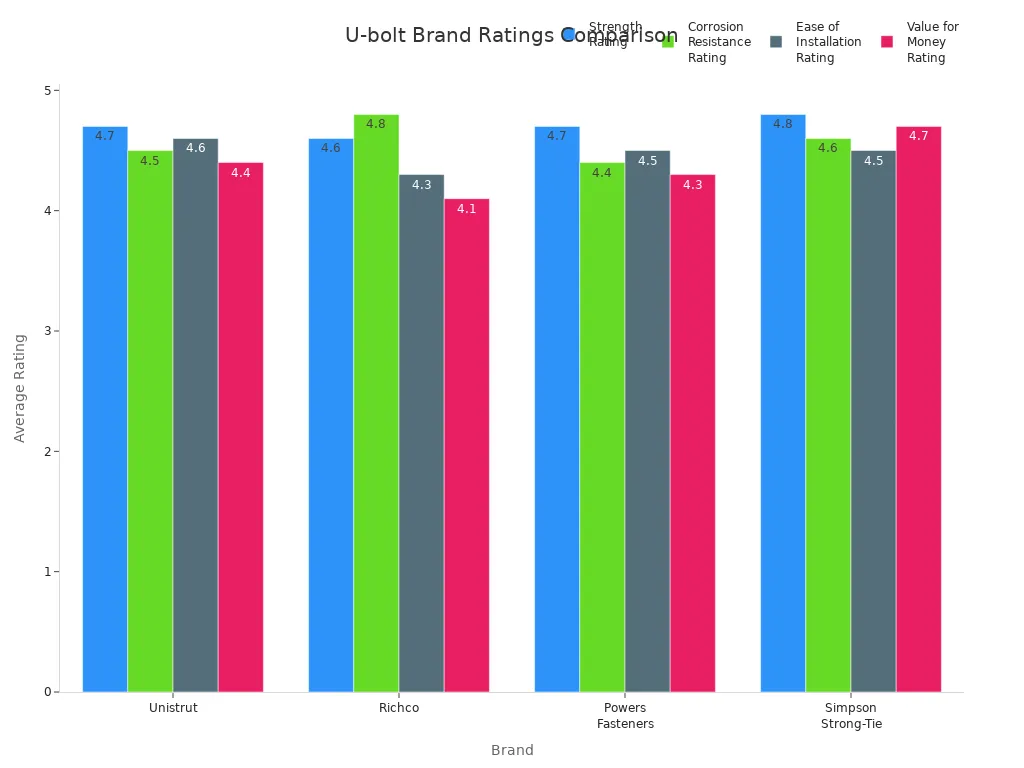
Recent customer reviews highlight Simpson Strong-Tie’s durability and structural integrity. The brand receives high marks for strength, corrosion resistance, and value for money, as shown in the chart below:
Users note that proper sizing and installation are essential to prevent slippage or loosening over time.
Cons
- Sizing errors can cause slippage or damage to conduits
- Requires access to both sides for secure tightening
- Not recommended for extreme temperature environments unless specified
Ideal Use Cases
- Construction and infrastructure projects
- Industrial and manufacturing applications
- Automotive and transportation systems
- Large-scale installations where cost efficiency is important
Tip: For maximum reliability, always verify sizing and consider using locknuts or threadlocker to prevent loosening in high-vibration environments.
PowerTec Stainless Steel U-Bolt
Pros
PowerTec Stainless Steel U-Bolt consistently ranks among the best u-bolts for projects that demand both strength and corrosion resistance. The manufacturer uses cold rolled steel for the clamping bodies, which ensures a robust and reliable structure. This model features a non-corrosive zinc plating that provides long-term durability, even in environments with high moisture or chemical exposure. The secure clamping action supports loads up to 2000 lbs, making it suitable for a wide range of heavy-duty applications.
| Feature | Description |
|---|---|
| Corrosion Resistance | Non-corrosive zinc plating for extended service life |
| Strength | Secure clamping action with a 2000 lbs load capacity |
| Construction | Cold rolled steel clamping bodies for enhanced reliability |
Users appreciate the PowerTec model for its ease of installation and consistent performance in both indoor and outdoor settings. The combination of stainless steel and zinc plating offers a dual layer of protection, which helps prevent rust and degradation over time.
Cons
- Higher cost compared to standard u-bolts due to premium materials
- May not fit all custom or oversized applications without modification
- Limited availability in some regional markets
Ideal Use Cases
- Marine and dock installations where saltwater exposure is common
- Industrial piping systems that require long-term corrosion resistance
- Outdoor construction projects exposed to harsh weather
- Agricultural equipment and machinery that operate in wet environments
Tip: For maximum lifespan, regularly inspect and clean the u-bolt, especially in environments with high salt or chemical content.
Fastenal High-Performance U-Bolt
Pros
Fastenal High-Performance U-Bolt stands out as one of the best u-bolts for demanding industrial and structural applications. The manufacturer uses advanced alloy steel, which delivers exceptional tensile and shear strength. This model often features a hot-dip galvanized or epoxy-coated finish, providing robust protection against corrosion and wear. Engineers value the consistent quality control and adherence to ASTM and ISO standards, which ensures reliable performance in critical installations.
- Superior load-bearing capacity for heavy machinery and infrastructure
- Multiple finish options for tailored corrosion resistance
- Wide range of sizes and thread types for diverse applications
- Backed by Fastenal’s rigorous quality assurance and technical support
Cons
- Premium pricing compared to basic u-bolts
- Heavier weight may require reinforced mounting hardware
- Some finishes may not be suitable for food-grade or sanitary environments
Ideal Use Cases
- Bridge and highway construction where safety and durability are paramount
- Oil and gas facilities that demand high-strength, corrosion-resistant fasteners
- Heavy equipment manufacturing and repair
- Structural steel connections in commercial buildings
Note: Always verify the finish and certification requirements for your specific industry before selecting a Fastenal High-Performance U-Bolt.
Comparison Table of the Best U-Bolts for Heavy-Duty Applications
Selecting the right U-bolt for heavy-duty projects requires a clear understanding of each product’s strengths and limitations. The following table provides a side-by-side comparison of the top five U-bolts reviewed above. This overview helps engineers and procurement teams make informed decisions based on critical performance factors.
| U-Bolt Model | Strength & Load Rating | Material & Finish | Corrosion Resistance | Certifications | Price Range |
|---|---|---|---|---|---|
| National Hardware Grade 8 U-Bolt | Up to 150,000 psi | Grade 8 Steel, WeatherGuard™ | Excellent (3x standard) | ASTM, ISO | $$$ |
| Hillman Alloy Steel U-Bolt | Up to 140,000 psi | Alloy Steel | Low (unless coated) | ASTM, ISO | $$ |
| Simpson Strong-Tie Galvanized U-Bolt | Up to 120,000 psi | Carbon Steel, Galvanized | Moderate | ASTM, ISO | $ |
| PowerTec Stainless Steel U-Bolt | Up to 130,000 psi | Stainless Steel, Zinc Plated | Superior | ASTM, ISO | $$$ |
| Fastenal High-Performance U-Bolt | Up to 160,000 psi | Alloy Steel, Hot-Dip Galv./Epoxy | Excellent | ASTM, ISO | $$$$ |
Strength and Load Ratings
Strength and load ratings determine the maximum force a U-bolt can handle without failure. Fastenal High-Performance U-Bolt leads with a load rating up to 160,000 psi, making it suitable for the most demanding structural applications. National Hardware Grade 8 U-Bolt also offers impressive strength, supporting up to 150,000 psi. Simpson Strong-Tie and PowerTec models provide reliable performance for most construction and industrial needs, while Hillman Alloy Steel U-Bolt excels in high-stress environments where maximum strength is required.
Tip: Always match the U-bolt’s load rating to the specific requirements of your project to ensure safety and longevity.
Material and Finish
The material and finish of a U-bolt play a crucial role in its performance and suitability for different environments. Each type offers unique advantages:
- Carbon Steel U-bolts: Strong and affordable, ideal for general-purpose use in non-corrosive settings such as construction and automotive industries.
- Zinc-plated U-bolts: Provide enhanced corrosion resistance, making them suitable for indoor environments with occasional moisture.
- Hot-dip Galvanized U-bolts: Deliver superior corrosion resistance, perfect for outdoor, marine, and industrial applications exposed to harsh weather.
- Stainless Steel U-bolts: Offer high corrosion resistance and strength, making them the best choice for marine, pharmaceutical, and food processing industries where durability and hygiene matter.
- Galvanized Steel U-bolts: Feature a zinc coating for improved corrosion resistance, commonly used in outdoor and industrial settings.
- Alloy Steel U-bolts: Provide higher strength and toughness, suitable for heavy-duty and high-stress environments.
Selecting the right material and finish ensures the U-bolt will perform reliably in its intended environment.
Corrosion Resistance
Corrosion resistance remains a key factor for U-bolts used in challenging conditions. Stainless steel U-bolts, such as the PowerTec model, deliver the highest level of protection against rust and chemical exposure. Hot-dip galvanized and WeatherGuard™ coated U-bolts, like those from Fastenal and National Hardware, offer excellent resistance for outdoor and marine applications. Zinc-plated and standard galvanized options provide moderate protection, suitable for less aggressive environments. Alloy steel U-bolts require additional coatings if used outdoors or in corrosive settings.
Engineers should always consider the operating environment and select U-bolts with the appropriate corrosion resistance to maximize service life and safety.
Certifications
Certifications play a critical role in the selection of U-bolts for heavy-duty applications. Manufacturers that hold recognized certifications demonstrate a commitment to quality and safety. These credentials often serve as a deciding factor for engineers and procurement teams, especially in regulated industries.
- Top-rated U-bolt manufacturers, such as National Hardware and Fastenal, maintain ISO 9001 certification. This standard verifies that the company follows a rigorous quality management system.
- Many leading brands also carry the CE mark. This certification confirms that the product meets European safety, health, and environmental protection requirements.
- Certifications like ISO 9001 and CE increase acceptance in industries with strict regulations, including construction, transportation, and energy.
Note: Certified U-bolts provide assurance that each unit meets consistent standards. This reliability reduces the risk of failure in critical installations.
Industry professionals often require documentation of these certifications before approving a product for use. They understand that certified U-bolts help projects pass inspections and comply with local and international codes. When selecting hardware for bridges, pipelines, or public infrastructure, teams prioritize products with visible certification marks.
Price and Value
Price and value remain important considerations when choosing U-bolts for heavy-duty projects. Buyers must balance upfront costs with long-term performance and reliability. The following table summarizes the price range and value proposition for each top-rated U-bolt:
| U-Bolt Model | Price Range | Value Proposition |
|---|---|---|
| National Hardware Grade 8 | $$$ | Superior strength, advanced corrosion resistance |
| Hillman Alloy Steel | $$ | High load capacity, best for dry environments |
| Simpson Strong-Tie Galvanized | $ | Cost-effective, versatile for many applications |
| PowerTec Stainless Steel | $$$ | Premium corrosion resistance, long service life |
| Fastenal High-Performance | $$$$ | Maximum strength, industry-leading certifications |
Buyers often find that higher-priced U-bolts deliver better value over time. Products with advanced coatings or stainless steel construction resist corrosion and reduce maintenance costs. Certified models, while more expensive, help avoid costly failures and downtime.
Engineers recommend evaluating total cost of ownership, not just initial price. Investing in quality U-bolts can extend the lifespan of critical infrastructure and improve safety.
Procurement teams should compare specifications, certifications, and warranty terms before making a final decision. They recognize that the right U-bolt offers both performance and value, supporting the success of demanding projects.
Buying Guide: How to Choose the Right U-Bolt for Heavy-Duty Applications

Assessing Your Application Needs for U-Bolts
Load Requirements
Engineers must evaluate the load requirements before selecting a U-bolt. They should consider the weight of the pipes or components and the stresses that will occur during operation. Matching the U-bolt’s inside diameter to the pipe’s outside diameter ensures a secure fit. Measuring with calipers or micrometers provides the most accurate results. For heavy-duty applications, consulting a reliable U-bolt torque chart helps determine the correct torque values. When standard U-bolts do not meet unique requirements, experts recommend custom solutions.
Environmental Factors
Environmental conditions play a significant role in U-bolt selection. Exposure to moisture, chemicals, or saltwater demands corrosion-resistant materials such as stainless steel or galvanized finishes. In dry, controlled environments, alloy steel may suffice. The table below outlines key considerations for common application types:
| Application Type | Key Considerations |
|---|---|
| Trailer and Vehicle Suspension | Requires high torque, matches axle tube diameter and spring pack height, corrosion resistance recommended |
| Plumbing and Mechanical Piping | Focus on inside width and leg length to match pipe OD, stainless steel preferred in corrosive environments |
| Industrial and Structural Installations | May need specific torque values, custom bending often required for beam-based clamping |
| Custom U-Bolts | Essential for unusual dimensions, special loads, or harsh environments; provide full specifications when ordering |
Matching U-Bolt Specifications to Your Project
Sizing and Fit
Proper sizing ensures the U-bolt performs as intended. Engineers should always choose the correct dimensions for their application. Mixing sizes or torque values across assemblies can lead to misalignment and failure. Consistency in measurement systems—imperial or metric—prevents installation errors. When in doubt, consulting with industry experts or suppliers can help identify the best fit.
Material Selection
Material selection impacts both performance and longevity. Stainless steel offers superior corrosion resistance, making it ideal for marine or chemical environments. Galvanized U-bolts provide moderate protection for outdoor use. Alloy steel delivers high strength but requires additional coatings in corrosive settings. The choice of material should align with both the load requirements and environmental factors.
Common Mistakes to Avoid When Choosing U-Bolts
Underestimating Load
One frequent mistake involves underestimating the load a U-bolt must support. Selecting a fastener without considering the actual weight and operational stresses can result in premature failure. Engineers should always refer to load charts and torque specifications to ensure safety.
Ignoring Corrosion Risks
Another common error is ignoring environmental factors that contribute to corrosion. Using the wrong material in a corrosive environment shortens the lifespan of the U-bolt. Professionals recommend corrosion-resistant materials for any application exposed to moisture, chemicals, or extreme temperatures.
Tip: Use a torque wrench during installation to apply the correct amount of force. This practice prevents both over-tightening and under-tightening, maintaining joint integrity.
By following these guidelines, engineers and procurement teams can select U-bolts that deliver reliable performance and long-term value in heavy-duty applications.
Where to Buy the Best U-Bolts in 2026
Trusted Suppliers
Selecting a reliable supplier remains essential for engineers and procurement teams who demand high-quality U-bolts. Reputable suppliers offer consistent quality, technical support, and a wide range of options for heavy-duty applications. The following table highlights some of the most respected suppliers in 2026, each known for their commitment to excellence and customer satisfaction:
| Supplier Name | Key Features |
|---|---|
| Leland Industries | Extensive product range, innovative solutions, high-quality standards, personalized service. |
| Nucor Fastener | Comprehensive product line, superior strength, strict quality control, excellent customer service. |
| Portland Bolt | Custom U-bolts, high-quality construction, precision engineering, tailored solutions for projects. |
| Anvil International | Strong reputation, advanced manufacturing processes, diverse selection, exceptional customer support. |
Leland Industries stands out for its innovative approach and broad inventory. Nucor Fastener maintains strict quality control and offers products with superior strength. Portland Bolt specializes in custom U-bolts, providing precision engineering for unique project requirements. Anvil International has built a strong reputation through advanced manufacturing and exceptional support.
Tip: Engineers should request material certifications and test reports from suppliers. These documents verify compliance with industry standards and ensure the U-bolts meet project specifications.
Online vs. Local Stores
The choice between online and local purchasing channels depends on project needs, lead times, and the level of technical support required. Online suppliers provide convenience and access to a broader selection. Many engineers prefer online platforms for their detailed product specifications, quick price comparisons, and the ability to order custom sizes. Leading suppliers often maintain user-friendly websites with live chat support and downloadable datasheets.
Local stores offer immediate access to standard U-bolts and personalized service. Buyers can inspect products before purchase and consult with knowledgeable staff. Local distributors may also provide faster turnaround for urgent orders or small quantities.
Advantages of Online Suppliers:
- Wide selection of sizes, materials, and finishes
- Easy access to technical documentation and certifications
- Convenient ordering and delivery tracking
Advantages of Local Stores:
- Immediate product availability for standard items
- In-person support and hands-on inspection
- Potential for same-day pickup or emergency fulfillment
Note: For large-scale or specialized projects, engineers often combine both channels. They source standard U-bolts locally and order custom or certified products online from trusted suppliers.
Careful evaluation of supplier reputation, product quality, and service options ensures that every project receives the best U-bolts available in 2026.
Innovations and Trends in U-Bolts for 2026
Advanced Materials in U-Bolts
Composite and Hybrid U-Bolts
Manufacturers have started to introduce composite and hybrid U-bolts to meet the demands of modern infrastructure. These U-bolts combine traditional metals with advanced polymers or fiber-reinforced materials. The result is a fastener that offers both high strength and reduced weight. Engineers value these hybrid designs for their ability to resist fatigue and vibration, especially in transportation and heavy machinery. Composite U-bolts also provide electrical insulation, which benefits sensitive installations.
Enhanced Coatings
Enhanced coatings represent a major trend in U-bolt innovation. Companies now use multi-layer coatings that combine zinc, epoxy, and ceramic finishes. These coatings extend the lifespan of U-bolts by providing superior resistance to corrosion, abrasion, and chemicals. Many manufacturers have adopted these advanced finishes to support infrastructure projects in coastal or industrial environments. The use of enhanced coatings reduces maintenance costs and improves safety.
Smart U-Bolts and Monitoring Technology
Integrated Sensors
Smart U-bolts have emerged as a game-changer in 2026. Engineers can now specify U-bolts with embedded sensors that monitor stress, temperature, and vibration. These sensors transmit real-time data to maintenance teams, allowing for predictive maintenance and early detection of potential failures. Industries such as oil and gas, transportation, and energy have started to adopt these smart fasteners to improve reliability and reduce downtime.
Real-Time Load Tracking
Real-time load tracking technology enables engineers to monitor the exact force applied to each U-bolt during operation. This innovation helps prevent overloading and ensures structural integrity. Maintenance teams receive instant alerts if a U-bolt approaches its maximum load capacity. As a result, companies can extend the service life of critical infrastructure and avoid costly repairs.
Sustainability and Eco-Friendly U-Bolt Options
Recycled Materials
Sustainability has become a significant focus in U-bolt manufacturing. Many companies now use recycled metals and bio-based materials to produce eco-friendly fasteners. This shift reduces carbon emissions and energy consumption. In fact, bio-based materials can cut carbon emissions by up to 30%. The anchor fastener industry reports that half of all companies now prioritize sustainable practices.
Green Manufacturing Practices
Green manufacturing practices continue to gain traction. New technologies help reduce waste generated by traditional production methods. Companies have adopted corrosion-resistant materials and innovative techniques to minimize environmental impact. The following list highlights key trends in sustainable U-bolt production:
- Increased use of recycled and bio-based materials
- Adoption of energy-efficient manufacturing processes
- Focus on reducing waste and emissions
- Development of corrosion-resistant, long-lasting products
The heavy-duty U-bolt market continues to grow as infrastructure development and industrial modernization accelerate. Emerging economies drive demand for scalable, cost-efficient fastening solutions. Technological advancements and sustainability initiatives ensure that U-bolts remain essential components in construction and industry.
Selecting the right u-bolt for heavy-duty applications requires careful attention to strength, material, and corrosion resistance. Top picks like National Hardware Grade 8, PowerTec Stainless Steel, and Fastenal High-Performance models deliver proven reliability.
- Carbon steel options offer strength but need coatings for outdoor use.
- Galvanized and stainless steel u-bolts provide enhanced durability in harsh environments.
- Consulting industry professionals helps match the correct fastener to specific load and environmental demands.
For optimal results, evaluate project requirements and source from reputable suppliers.
FAQ
What is the difference between Grade 8 and stainless steel U-bolts?
Grade 8 U-bolts offer higher tensile strength, making them ideal for heavy loads. Stainless steel U-bolts provide superior corrosion resistance. Engineers select Grade 8 for strength-critical projects and stainless steel for environments with moisture or chemicals.
How can someone determine the correct U-bolt size for their project?
They should measure the diameter of the pipe or object being secured. Selecting a U-bolt with an inside width slightly larger than the object ensures a proper fit. Consulting manufacturer sizing charts helps avoid errors.
Are galvanized U-bolts suitable for marine environments?
Galvanized U-bolts resist corrosion better than plain steel. However, stainless steel U-bolts perform best in marine environments due to their enhanced rust resistance. Galvanized options may corrode over time when exposed to saltwater.
Can U-bolts be reused after removal?
Reusing U-bolts is not recommended for critical applications. Threads may deform during installation or removal. For safety, engineers should use new U-bolts when reassembling heavy-duty structures.
What certifications should buyers look for when purchasing U-bolts?
Buyers should check for ASTM and ISO certifications. Industry-specific certifications, such as DOT or API, may also be required. Certification ensures the U-bolt meets safety and performance standards.
How does one prevent U-bolts from loosening in high-vibration environments?
They should use locknuts, threadlocker, or double-nut methods. Regular inspection and maintenance also help maintain tightness. Proper installation torque is essential for long-term reliability.
Where can someone buy high-quality U-bolts in 2026?
Engineers can purchase high-quality U-bolts from trusted suppliers like Leland Industries, Nucor Fastener, and Portland Bolt. Online platforms and local distributors both offer certified products and technical support.