The Toggler Snaptoggle is the superior choice among drywall anchors for securing heavy items. Its design features a metal channel that braces against the drywall, creating exceptional holding power. This mechanism distributes weight broadly, ensuring reliable holding power for heavy objects. This single drywall anchor provides more holding power than many standard Anchor Bolts. While a custom fasteners manufacturer can create custom anchor bolts, the Snaptoggle offers the best performance among readily available hollow wall anchors.
Our Top Picks: The Best Drywall Anchors for Heavy Loads
Choosing the right hardware is critical for safely mounting items on hollow walls. After extensive review, we have identified the best drywall anchors available for demanding applications. These selections balance strength, ease of use, and overall value to provide a secure foundation for your projects.
Best Overall: Toggler Snaptoggle BA
The Toggler Snaptoggle BA earns its top spot through superior design and exceptional strength. These heavy-duty toggle bolts are the gold standard for securing valuable or heavy items. The anchor’s core is a robust metal channel connected to plastic setting straps. This design provides unmatched holding power by bracing against a large surface area behind the drywall. It offers “2X The Holding Power of Ordinary Wing Toggles,” making it a reliable choice for professionals and DIYers alike.
Independent tests confirm the impressive performance of these drywall anchors. The BA model demonstrates a pull-out strength that far exceeds many competitors, giving users confidence when hanging mirrors, televisions, or cabinetry.
| Anchor Type | Holding Capacity in ½-inch Drywall |
|---|---|
| Toggler Snaptoggle BA | 238 pounds |
| Toggler Snaptoggle BB | 265 pounds |
| Hillman 370054 Toggle Bolts | Conflicting ratings (85, 55, or 40 pounds) |
What We Like
- Exceptional Strength: The metal channel design provides industry-leading holding power, supporting up to 238 lbs in standard 1/2″ drywall.
- Reliable Installation: The plastic straps allow for a precise and secure installation before the bolt is inserted, preventing the anchor from falling behind the wall.
- Reusable Bolt: Users can remove and reinsert the bolt multiple times without compromising the anchor’s integrity.
What We Don’t Like
- Larger Pilot Hole: Installation requires a 1/2-inch hole, which is larger than what many other drywall anchors need.
- Higher Cost: These premium drywall anchors come at a higher price point per unit compared to traditional options.
Key Specifications
- Anchor Type: Strap-style toggle
- Wall Thickness Compatibility: 3/8″ to 3-5/8″
- Required Hole Size: 1/2″
- Max Load (1/2″ Drywall): 238 lbs (tension)
Easiest Installation: E-Z Ancor Toggle Lock
The E-Z Ancor Toggle Lock offers a compelling blend of strength and user-friendly installation. This anchor simplifies the process by combining a self-drilling tip with a toggle mechanism. Users can drive the anchor directly into the drywall with a screwdriver, eliminating the need for a separate drill bit in many cases. Once installed, the toggle bar flips into place behind the wall, providing solid holding power for moderately heavy loads. These drywall anchors are an excellent choice for projects where speed and simplicity are priorities.
What We Like
- Drill-Free Installation: The self-drilling tip allows for quick installation using only a Phillips head screwdriver.
- Immediate Use: The anchor is ready for the bolt immediately after being driven into the wall.
- Good Holding Power: It provides reliable strength suitable for shelving, curtain rods, and other common household items.
What We Don’t Like
- Lower Weight Limit: Its holding power is less than that of heavy-duty toggle bolts, making it unsuitable for the heaviest applications.
- Drywall Damage Risk: The self-drilling action can sometimes tear the paper face of the drywall if not done carefully.
Key Specifications
- Anchor Type: Self-drilling toggle
- Wall Thickness Compatibility: Up to 5/8″
- Required Hole Size: None (self-drilling)
- Max Load (1/2″ Drywall): 75 lbs (tension)
Best Value Kit: The Hillman Group Heavy-Duty Toggle Bolt Assortment
For those who need a variety of options, The Hillman Group’s Heavy-Duty Toggle Bolt Assortment delivers excellent value. This kit includes a range of classic winged toggle bolt anchors in different lengths and diameters. A traditional toggle bolt provides good strength by spreading the load with its spring-loaded wings. This assortment ensures you have the right size on hand for multiple projects, from hanging pictures to installing light fixtures. While not the strongest option available, these heavy-duty drywall anchors are a cost-effective solution for many tasks.
Note: The holding capacity of a standard toggle bolt can vary significantly based on its size and the manufacturer. Always verify the specific rating for the bolt you are using.
What We Like
- Excellent Value: The kit provides a large quantity of assorted drywall anchors at a low cost per piece.
- Versatility: Having multiple sizes makes it easy to match the right anchor to different project needs.
- Proven Design: The winged toggle is a time-tested design that offers reliable performance for moderate loads.
What We Don’t Like
- Inconsistent Ratings: Published weight ratings can be unclear and vary between sizes, requiring careful verification.
- Installation Can Be Tricky: The bolt must be passed through the item being mounted before the wings are inserted into the wall, which can be cumbersome.
Key Specifications
- Anchor Type: Winged toggle bolt
- Wall Thickness Compatibility: Varies by bolt length
- Required Hole Size: Varies by toggle size
- Max Load (1/2″ Drywall): Varies (e.g., a 3/16″ toggle is often rated for ~50 lbs)
Best Reusable Option: The Hillman Group Molly Bolt
The Hillman Group Molly Bolt, a classic sleeve-type anchor, stands out for its reusability and secure grip. These heavy-duty drywall anchors function by expanding behind the wall. As the user tightens the screw, the anchor’s slotted sleeve compresses and flares out, creating a strong, spider-like brace against the back of the drywall. This mechanism provides excellent holding power for items like towel bars, small cabinets, and decorative shelves.
What truly sets these drywall anchors apart is their two-part design. Once the sleeve is set, the internal machine screw can be removed and reinserted as needed. This feature is invaluable for items that require occasional removal for cleaning or maintenance. The Molly bolt is one of the best drywall anchors for situations demanding both strength and flexibility. Its reliable performance makes it a staple in many toolkits. These heavy-duty drywall anchors offer a permanent fixture point in the wall.
Pro Tip: For a perfect installation, consider using a Molly bolt setting tool. This tool pulls the screw head outward, evenly expanding the anchor’s legs without placing stress on the front of the drywall.
What We Like
- Reusable Fastening Point: The primary advantage is the ability to remove the bolt without losing the anchor inside the wall.
- Strong Holding Power: The expanded sleeve distributes the load effectively, making these drywall anchors suitable for moderately heavy-duty tasks.
- Flush Finish: Pointed-tip Molly bolts can be tapped flush with the wall, creating a clean look. The anchor head is also low-profile.
What We Don’t Like
- Installation Can Be Complex: Setting the anchor correctly requires care. Over-tightening the screw can damage the drywall or strip the anchor itself.
- Difficult to Remove: While the bolt is removable, the anchor body is a permanent fixture. Removing the sleeve itself will leave a larger, more noticeable hole.
- Wall Thickness Dependent: Users must purchase the correct length of Molly bolt to match their wall’s thickness for the anchor to expand properly. These are not one-size-fits-all drywall anchors.
Key Specifications
- Anchor Type: Sleeve-type expansion anchor (Molly bolt)
- Wall Thickness Compatibility: Varies by size (e.g., 1/2″ to 3/4″)
- Required Hole Size: Varies by anchor diameter (e.g., 5/16″ for a 1/8″ bolt)
- Max Load (1/2″ Drywall): ~50 lbs (tension)
These drywall anchors are a top choice. Many consider them some of the best drywall anchors for their specific use case. The final set of drywall anchors provides a secure mount.
How to Choose the Right Hollow Wall Anchors
Selecting the correct hardware is a critical step for any mounting project. A systematic approach ensures the chosen drywall anchors provide a secure and lasting installation. This process involves evaluating the item, the wall, and the type of stress the anchor will endure.
Step 1: Determine Your Item’s Weight and Your Wall Type
The foundation of a secure mount begins with understanding the object and the wall itself. These two factors directly influence the required strength of the drywall anchors.
Finding the Item’s Weight
First, a user must determine the exact weight of the object. Manufacturers often list this information in the product manual or on their website. For items without listed specifications, a standard bathroom scale provides an accurate measurement.
The “Double It” Rule for Safety
A crucial safety principle is to select drywall anchors with a weight capacity that far exceeds the item’s actual weight. A common industry safety factor is 4:1, meaning an anchor rated for 100 pounds should support a 25-pound load. For simplicity, users should at least double the item’s weight when choosing an anchor. This margin of safety accounts for unexpected stress and ensures long-term holding power.
Identifying Your Wall Material (Drywall vs. Plaster)
The wall material dictates which drywall anchors are appropriate. Most modern homes use drywall, while older buildings may have lathe-and-plaster walls.
- Drywall consists of gypsum plaster pressed between thick sheets of paper.
- Plaster is a harder, more brittle material applied over a lath framework, resulting in a different thickness and density.
Step 2: Match the Anchor to Your Wall Thickness
The effectiveness of many drywall anchors depends on their ability to grip the back of the wall material. An incorrect match between the anchor and wall thickness compromises the holding power.
How to Measure Your Drywall Thickness
Users can measure wall thickness easily. Drill a small pilot hole, insert a bent paperclip until it hooks the back of the wall, mark the paperclip at the wall’s surface, and then measure the hooked portion. Standard residential drywall thicknesses include:
- 5/8-inch: Often used for ceilings and fire-rated walls.
- 1/2-inch: The most common thickness for interior walls.
- 3/8-inch & 1/4-inch: Thinner panels used for overlays or curved surfaces.
Checking the Anchor’s Grip Range
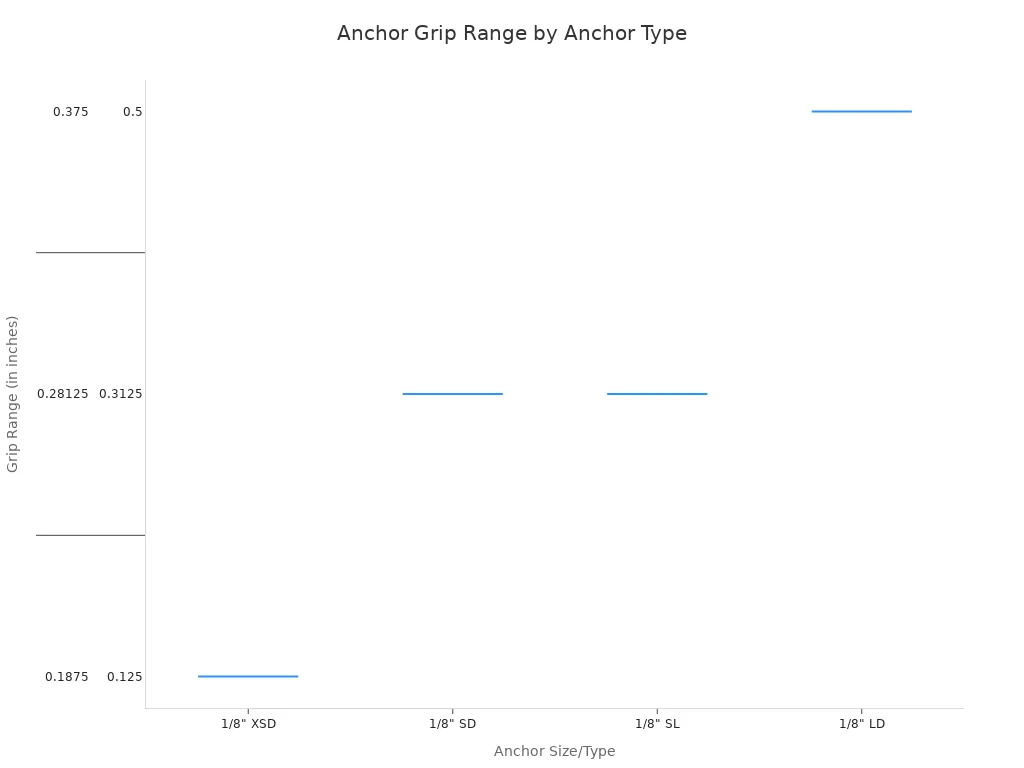
Every package of drywall anchors specifies a “grip range,” which is the wall thickness the anchor is designed for. Matching this range to the wall measurement is essential for proper expansion and maximum holding power.
| Anchor Size/Type | Grip Range (Wall Material Thickness) |
|---|---|
| 1/8″ XSD (Extra Short Drive) | 3/16″ – 3/8″ |
| 1/8″ SD (Standard Drive) | 1/8″ – 1/2″ |
| 1/8″ SL (Short Drive) | 1/8″ – 13/16″ |
| 1/8″ LD (Long Drive) | 5/8″ – 3/4″ |
Step 3: Consider the Load Type
The type of force applied to the anchor significantly impacts the required weight capacity. Loads are categorized as either static or dynamic.
Static Load (e.g., Mirror, Picture)
A static load is a constant, unchanging force. A hanging mirror or picture frame applies a consistent downward pull. For these applications, a safety factor of 4:1 for the anchor’s weight capacity is a reliable standard.
Dynamic Load (e.g., Shelf, Towel Bar)
A dynamic load involves movement, vibration, or shock. Items like shelves, grab bars, or coat racks experience changing forces. These applications demand a higher safety factor and a stronger anchor to prevent failure. The increased stress requires a higher weight capacity to ensure safety.
Understanding Different Types of Heavy-Duty Drywall Anchors
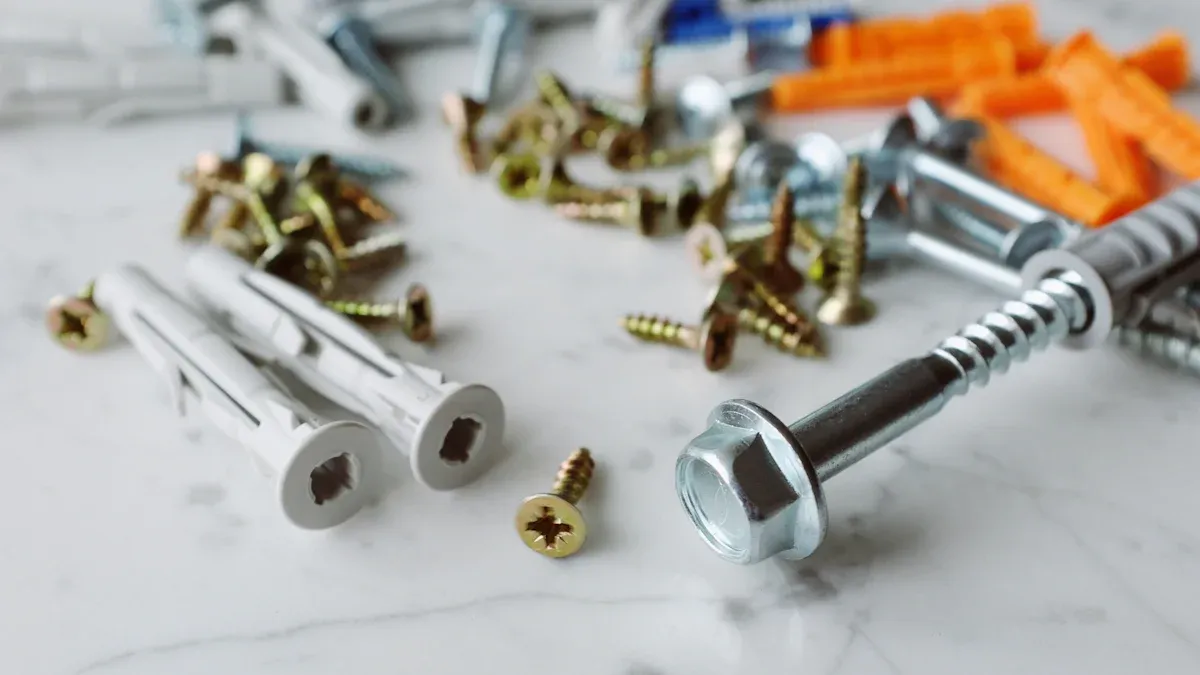
Choosing the right hardware requires understanding how different drywall anchors function. Each type offers a unique balance of strength, installation complexity, and application suitability. This guide breaks down the three main categories of heavy-duty drywall anchors.
Toggle Bolts (Strap and Winged Toggles)
Toggle bolts are the champions of holding power in hollow walls. They come in two primary forms: traditional winged (butterfly-style toggle bolts) and modern strap-style toggles.
How They Work
Both types of toggle bolt operate on a simple, effective principle. A user drills a hole and inserts a metal bar or channel through it. This component then springs open or flips into position, bracing flat against the back of the drywall. Tightening the bolt pulls this brace firmly against the wall, distributing the load over a wide surface area. This mechanism provides exceptional holding power.
Pros and Cons
- Pros: Unmatched strength for heavy-duty applications. The design creates the most secure grip possible in drywall.
- Cons: They require a relatively large pilot hole. Traditional butterfly-style toggle bolts can be cumbersome, as the bolt must pass through the fixture before the anchor goes into the wall.
Best Use Cases for Heavy Items
Heavier-duty toggle bolts are the go-to solution for mounting the most demanding items. Use a toggle bolt for securing large mirrors, flat-screen TVs, heavy shelving, and kitchen cabinets. Their superior strength provides peace of mind.
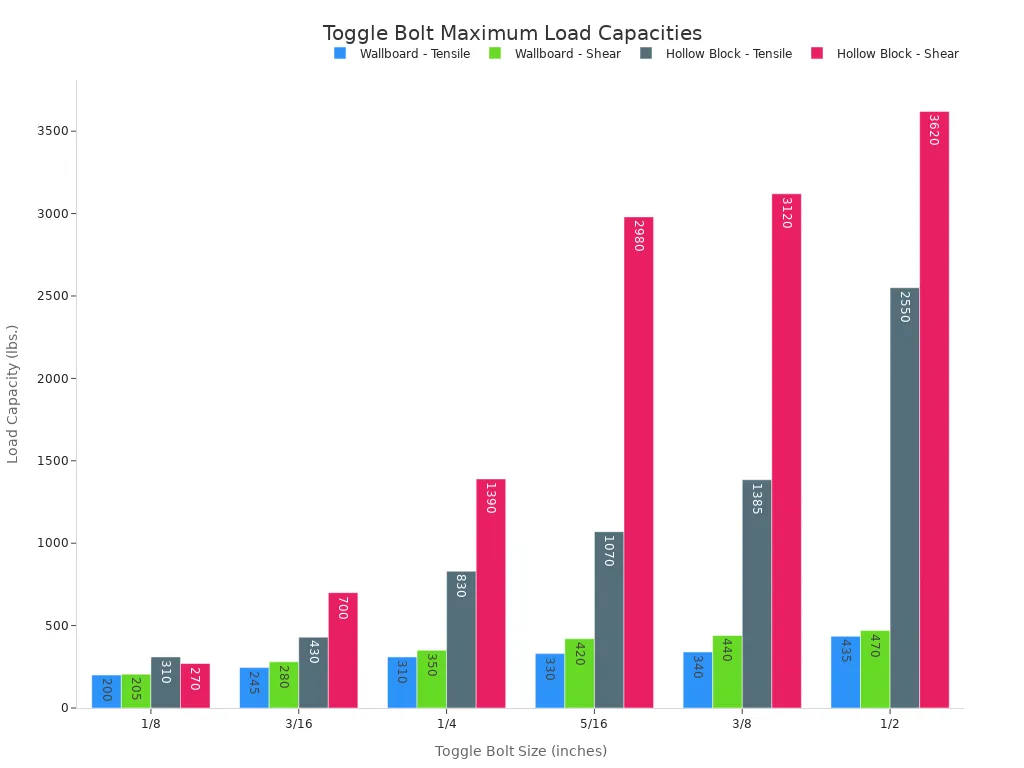
Important Safety Note: The listed ultimate load capacities for a toggle bolt are not the safe working load. Professionals recommend using a 4:1 safety factor. An anchor rated for 200 lbs should safely hold a 50 lb object.
| Toggle Bolt Size | In 1/2″ Wallboard – Tensile (lbs.) | In 1/2″ Wallboard – Shear (lbs.) |
|---|---|---|
| 1/8″ | 200 | 205 |
| 3/16″ | 245 | 280 |
| 1/4″ | 310 | 350 |
| 3/8″ | 340 | 440 |
| 1/2″ | 435 | 470 |
Molly Bolts (Sleeve-Type Anchors)
Molly bolts are a type of sleeve-style expansion anchor that offers a great combination of strength and convenience. They are excellent heavy-duty drywall anchors for many common household tasks.
How They Work
A Molly bolt consists of a machine screw inside a slotted metal sleeve. As a user tightens the screw, it pulls the end of the sleeve inward. This action forces the slotted sides to expand and collapse, forming a spider-like brace that grips the back of the drywall. These expansion anchors create a very secure mount.
Pros and Cons
- Pros: They create a permanent, threaded fixture in the wall. A user can remove the bolt without the anchor falling away, a key advantage over a toggle bolt.
- Cons: The anchor body is difficult to remove without causing more wall damage. Users must select the correct length for their specific wall thickness.
When to Choose a Molly Bolt
Choose these drywall anchors for items that may need occasional removal. They are perfect for towel bars, curtain rods, and small cabinets that require servicing or cleaning.
Self-Drilling and Threaded Anchors
Self-drilling anchors offer the fastest installation, but they come with significant trade-offs in strength. They are best suited for light to medium-duty tasks.
How They Work
These drywall anchors feature a coarse, wide thread and a sharp tip that bores directly into drywall. A user simply drives the sturdy screw-in drywall anchor into the wall with a screwdriver or drill. The wide threads are designed to bite into the soft gypsum core, providing holding power. Some heavy-duty versions combine this with a toggle mechanism for added security.
Pros and Cons
- Pros: Extremely fast and easy to install, often without a pilot hole.
- Cons: Self-drilling anchors have the lowest holding power of the heavy-duty options. They can fail if they don’t bite properly or if the drywall crumbles during installation.
Weight Limitations for Heavy Items
Most self-drilling anchors are rated for loads between 25 and 75 pounds. While some heavy-duty self-drilling anchors claim higher capacities, they are not recommended for truly heavy objects. They can become loose or spin out, especially under dynamic loads. For any significant weight, heavy-duty toggle bolts or other expansion anchors are a safer choice. These hollow wall anchors are not for every job.
Step-by-Step Guide: Installing Heavy-Duty Hollow Wall Anchors
Proper installation is just as important as selecting the right hardware. Following a precise method ensures that heavy-duty drywall anchors achieve their maximum holding power. This guide provides a clear, professional process for a secure and reliable mount.
Tools You’ll Need for the Job
Assembling the correct tools before starting streamlines the installation process. A user will need a few basic items to install most heavy-duty drywall anchors correctly. Having these on hand prevents delays and ensures a professional result.
Power Drill with Assorted Drill Bits
A power drill is essential for creating the pilot hole. The bit size must match the specific requirements of the chosen drywall anchors.
Screwdriver (Phillips or Flathead)
A screwdriver is necessary for driving the machine screw or bolt that secures the item to the anchor.
Tape Measure
This tool ensures accurate placement of the anchor on the wall.
Pencil or Marker
A pencil allows a user to mark the precise drilling location.
Stud Finder
This electronic device is critical for locating and avoiding wall studs, which would prevent the use of hollow wall anchors.
Level
A level guarantees that shelves, mirrors, and other items are mounted perfectly straight.
Installation Steps for a Toggler Snaptoggle
The Toggler Snaptoggle is a premier choice for heavy-duty applications. Its installation is straightforward and creates an incredibly strong fastening point. The following steps detail how to install these powerful heavy-duty toggle bolts.
Step 1: Mark Your Location and Check for Studs
First, a user must determine the mounting location. They should use a tape measure and level to position the item correctly, then mark the spot for the hole with a pencil. Next, they must use a stud finder to scan the area. These drywall anchors are designed for hollow sections of the wall, so avoiding studs is crucial for a successful installation.
Step 2: Drill the Pilot Hole
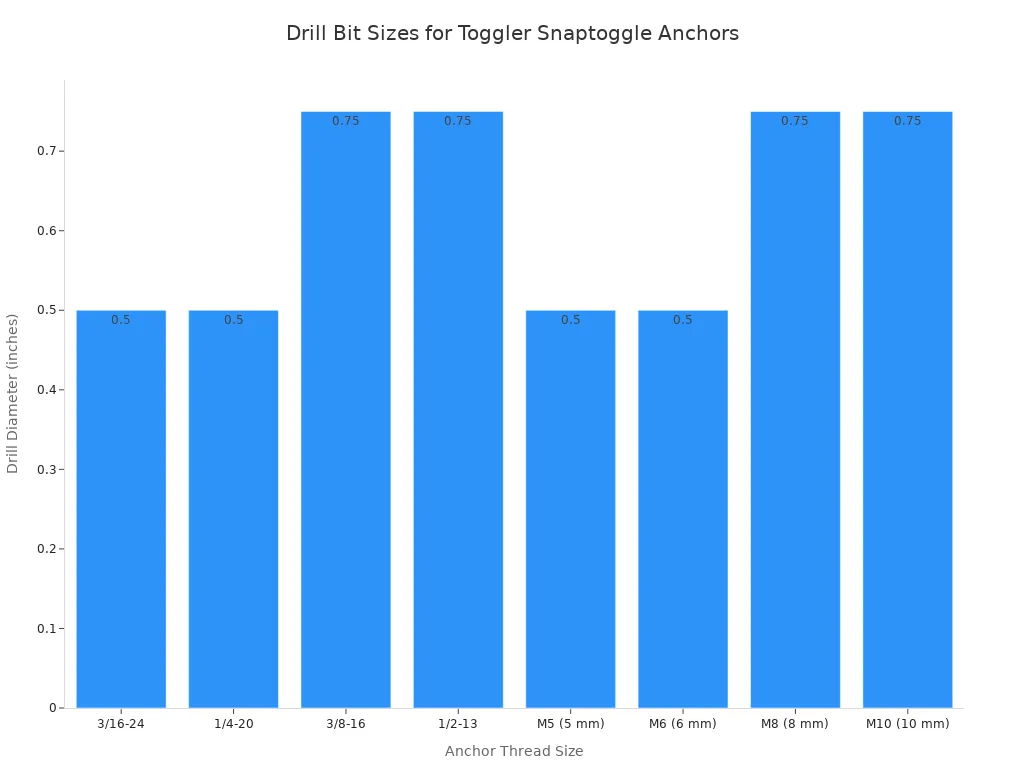
A user drills a hole at the marked location. The drill bit size is critical and depends on the specific toggle bolt being used. The packaging for the drywall anchors will specify the required diameter. For Toggler Snaptoggles, the hole size is typically either 1/2″ or 3/4″.
Pro Tip: Always consult the manufacturer’s instructions. Using the wrong size drill bit can compromise the anchor’s strength.
The required drill diameter varies based on the thread size of the heavy-duty toggle bolts.
| Thread Size | Drill Diameter (in.) |
|---|---|
| 3/16-24 | 1/2 |
| 1/4-20 | 1/2 |
| 3/8-16 | 3/4 |
| 1/2-13 | 3/4 |
| M5 (5 mm) | 1/2 |
| M6 (6 mm) | 1/2 |
| M8 (8 mm) | 3/4 |
| M10 (10 mm) | 3/4 |
Step 3: Insert the Snaptoggle Channel
The user takes the Snaptoggle anchor and holds the metal channel parallel with the plastic straps. They insert the channel through the drilled hole. Once inside the wall cavity, the metal channel will flip down, perpendicular to the straps. These heavy-duty drywall anchors are now ready for the next step.
Step 4: Set the Anchor
The user pulls the plastic straps outward, away from the wall. This action brings the metal channel flat and firm against the back of the drywall. While holding the straps taut, they slide the plastic cap down the straps until its flange is flush with the wall surface. This sets the heavy-duty anchor in place. The user then snaps the straps off level with the flange. The installation of these drywall anchors is almost complete.
Step 5: Mount Your Item
Finally, the user places the item over the anchor’s cap. They insert the included machine screw or bolt through the fixture’s mounting hole and into the threaded metal channel. They tighten the bolt with a screwdriver until it is snug. The item is now securely mounted using one of the strongest drywall anchors available. This heavy-duty toggle bolt provides exceptional peace of mind.
Common Mistakes to Avoid When Using Anchors in a Hollow Wall
Even the best drywall anchors can fail if installed incorrectly. A user can avoid common pitfalls by understanding the limits of the hardware and the wall material. Proper technique is essential for a secure mount in any hollow wall.
Mistake #1: Ignoring the Anchor’s Weight Capacity
Why It’s a Critical Problem
Every package of drywall anchors lists a maximum weight capacity. Ignoring this rating is a direct path to failure. An overloaded anchor will pull out of the wall, potentially causing damage to the wall, the floor, and the item it was holding. This is the most critical mistake a user can make.
How to Always Get It Right
A user must always verify the item’s weight before selecting a drywall anchor. They should then apply a safety factor. A professional standard is 4:1, but a simple rule is to choose drywall anchors with a weight capacity at least double the object’s weight. This safety margin accounts for unexpected forces and ensures long-term stability. Checking the weight capacity is a non-negotiable step.
Mistake #2: Drilling the Wrong Size Hole
The Consequences of an Improper Hole Size
The pilot hole diameter is not a suggestion; it is a requirement. An improperly sized hole renders many drywall anchors useless.
- Hole Too Large: The anchor will not have enough material to grip. It may spin in place or fail to expand correctly, offering little to no holding power.
- Hole Too Small: Forcing an anchor into a small hole can damage the drywall’s paper face and crush the gypsum core. This weakens the surrounding area.
How to Avoid This Mistake
A user can easily avoid this issue. The packaging for all drywall anchors specifies the exact drill bit size needed for proper installation. Always use the recommended bit for a snug, secure fit.
Note: A quick check of the manufacturer’s instructions prevents a major installation headache and ensures the drywall anchors perform as designed.
Mistake #3: Over-tightening the Screw
Why This Damages the Drywall
Drywall is a relatively soft material. When a user over-tightens the screw, the back of the anchor can crush the gypsum. This action creates a cone-shaped failure point inside the wall. The anchor loses its firm backing, severely reducing its holding power. Many drywall anchors fail because of excessive force during this final step.
The Right Way to Tighten
A user should tighten the screw until it feels snug. At that point, they should stop. The goal is to pull the anchor firmly against the back of the wall, not to compress the wall itself. For sleeve-type drywall anchors, a user should feel a distinct increase in resistance as the sleeve fully expands.
Mistake #4: Hitting a Stud Unexpectedly
A user may carefully measure and mark a location, only to have their drill bit meet solid resistance. This common scenario indicates the presence of a wooden stud behind the drywall. While frustrating at the moment, this discovery is actually a fortunate event for anyone hanging a heavy item. It presents an opportunity for an even stronger installation, but it requires a change in hardware and approach. Attempting to force the original plan will lead to failure.
Why a Hollow Wall Anchor Won’t Work
Hollow wall anchors are specifically engineered for empty spaces. Their entire function depends on having room behind the drywall to expand, toggle, or flare out. A toggle bolt needs to flip open, and a molly bolt needs to collapse into a spider-like brace. A solid wood stud completely obstructs this essential action. The anchor has nowhere to go.
Forcing an anchor into a stud will have one of two outcomes:
- The anchor, especially a plastic or thin metal one, will break or deform.
- The anchor will get stuck without engaging, providing no holding power whatsoever.
These fasteners are simply the wrong tool for this situation. They cannot grip solid wood effectively. Using one would be like trying to use a boat anchor on dry land; the mechanics are fundamentally incompatible with the environment.
What to Do Instead
Discovering a stud is a positive development. A wood stud provides a far more secure mounting point than any section of hollow wall. A user should abandon the anchor and take advantage of this superior structural support. The process is straightforward and results in a much stronger hold.
Good News! Hitting a stud means you can create a stronger mount than originally planned. You no longer need a specialized anchor.
A user should follow these steps for a secure installation into a stud:
- Confirm the Stud’s Center: The user should use their stud finder to locate both edges of the stud. They can then mark the center point to ensure maximum wood engagement for the screw.
- Select the Right Fastener: They must switch from an anchor to a standard wood screw or, for very heavy items like a TV mount, a lag bolt. The screw should be long enough to penetrate at least 1 to 1.5 inches into the stud itself.
- Drill a Pilot Hole: The user drills a small pilot hole into the center of the stud. The hole should be slightly smaller than the screw’s diameter. This step prevents the wood from splitting when the screw is driven in.
- Drive the Screw: The user can now drive the screw directly through their item’s mounting bracket and into the stud. The result is an incredibly secure connection, anchored directly to the home’s frame.
For maximum security with heavy items in a hollow wall, the Toggler Snaptoggle is the superior choice. Its exceptional weight capacity makes it the most reliable anchor for demanding jobs. Users must remember the golden rule for safety:
Always select hollow wall anchors with a weight capacity at least double the item’s weight.
Choosing the right hardware is critical, but correct installation is equally essential. Proper technique ensures the hardware achieves its full weight capacity and provides a secure result.
FAQ
What is the strongest type of hollow wall anchor?
Toggle bolts, especially strap-style versions like the Toggler Snaptoggle, offer the highest holding power. Their metal channel design distributes weight over a large area behind the drywall. This mechanism provides superior strength for the heaviest items, making them the most reliable choice for demanding applications.
Can a user reuse a toggle bolt?
❌ No. A traditional winged toggle bolt falls inside the wall cavity upon screw removal. 👍 Yes. A strap-style toggle or a Molly bolt allows screw removal. The anchor body remains in the wall, creating a reusable fastening point for maintenance or cleaning.
What happens if a user skips using a stud finder?
A user risks drilling into a wood stud, which prevents a hollow wall anchor from working. They also might drill into plumbing or electrical wiring. A stud finder is a critical safety tool that ensures a user selects a truly hollow and safe location for installation.
Why is the drill bit size so important?
The specified drill bit size creates a hole that perfectly fits the anchor.
- Too large: The anchor will spin and fail to grip.
- Too small: Forcing the anchor can damage the drywall. Using the correct bit size is essential for maximum holding power.
Can a user install hollow wall anchors in a ceiling?
Yes, a user can install anchors in a drywall ceiling. However, they must consider that gravity applies a direct, constant pulling force (tension). For ceiling applications, it is critical to use the strongest possible anchors, like toggle bolts, and strictly adhere to safety margins.
How does a user remove a Molly bolt?
The screw is removable, but the anchor body is permanent. To remove the body, a user can drill it out or tap it flush with the wall and spackle over it. Complete removal will leave a larger hole that requires more significant patching and repair work.