A technician must install a flange nut with precision to ensure a secure connection in many assemblies. They select the correct hardware from a custom fasteners manufacturer and clean every surface. The process to properly install flange nuts involves several installation steps that protect both nuts and bolts from premature wear. When they install flange nut components, they consider material compatibility, especially when using custom fasteners. Reliable results require careful alignment and proper torque control during install flange nuts applications.
Note: Correct installation reduces the risk of failure and extends the service life of flange nut joints.
Tools and Materials to Install a Flange Nut
Essential Tools for Step-by-Step Installation
Wrenches and Sockets
Technicians rely on wrenches and sockets to install a flange nut with accuracy. Adjustable wrenches and socket wrenches fit most standard flange sizes. These tools grip the nut securely and allow for smooth turning during installation. Flange alignment tools help position the nut and bolt correctly, reducing the risk of misalignment. Measuring tools, such as calipers or tape measures, confirm that the flange nut matches the bolt or threaded rod. Safety equipment, including gloves and safety glasses, protects hands and eyes during the process.
Tip: Always select a wrench or socket that matches the flange nut size to prevent rounding off the corners.
Torque Wrench
A torque wrench ensures that the flange nut receives the correct amount of force. This tool prevents over-tightening, which can damage threads or deform the flange. Under-tightening may cause the connection to loosen over time. Industry standards recommend using a torque wrench for critical flange applications, especially in automotive or industrial settings. Gasket installation tools and welding equipment may also be necessary for specialized flange assemblies, such as weld flat flanges.
Materials Needed to Properly Install Flange Nuts
Flange Nuts
Flange nuts come in several materials to suit different applications. Medium carbon steel, such as 35# and 45# steel, is common for grade 8 flange nuts. Low carbon steel, known as A3 steel, is used for grade 4.8 flange nuts. Alloy steel, which contains elements like chromium and molybdenum, offers higher strength and durability. Technicians select the flange nut material based on the demands of the assembly and the environment.
Bolts or Threaded Rods
Bolts and threaded rods must match the flange nut in size and thread pitch. Medium carbon steel bolts pair well with grade 8 flange nuts, while low carbon steel bolts suit grade 4.8 flange nuts. Alloy steel bolts, such as those made from SCM435, provide extra strength for heavy-duty flange connections. Proper pairing ensures a secure and long-lasting joint.
Optional Supplies for Flange Nut Installation
Lubricants or Anti-Seize Compounds
Lubricants and anti-seize compounds reduce friction during flange nut installation. These products help prevent galling and make future removal easier. Technicians apply a thin layer to the threads before tightening the flange nut.
Thread Lockers
Thread lockers add extra security to flange assemblies. These adhesives fill the gaps between threads and resist vibration, which can loosen the flange nut over time. Use thread lockers in applications where the flange will experience movement or stress.
Note: Optional supplies like lubricants and thread lockers improve the reliability of flange installations, especially in demanding environments.
Preparing to Install Flange Nuts
Inspecting Components Before Installation
Checking Flange Nut Condition
Technicians begin by examining each flange nut for visible defects. They look for dents, scratches, corrosion, or warping on the flange face. These imperfections can compromise the integrity of the joint. They keep protective covers on the flange nut until just before assembly to prevent contamination. Before proceeding, they verify that the nut matches the required size and material grade. They also confirm that torque tools and tensioning equipment have proper calibration. This attention to detail ensures a reliable installation.
Examining Bolt or Threaded Rod
Before installation, technicians inspect the nut and bolt together. They check the bolt or threaded rod for straightness and cleanliness. They confirm that the threads are free from damage or excessive wear. Proper alignment is essential, so they verify axial, radial, and angular alignment according to tolerance. They ensure that the stud protrudes at least one thread beyond the nut after tightening. This step helps maintain the strength and safety of the connection.
Tip: Always inspect the nut and bolt as a pair to catch mismatches or defects before assembly.
Cleaning and Preparing Surfaces
Removing Dirt and Debris
Clean surfaces are critical for a secure flange nut installation. Technicians use solvent degreasers to remove oil, grease, and other contaminants from both the nut and bolt. Stiff brushes help scrub away stubborn debris. For heavy contamination, they may use low-pressure water jets to wash off scale and rust. They avoid aggressive grinding, which can damage the flatness of the sealing surface.
Ensuring Dryness
After cleaning, technicians allow all components to dry completely. Moisture can lead to corrosion or improper seating of the flange nut. They may apply rust inhibitors or temporary coatings to protect cleaned surfaces if there is a delay before assembly.
Selecting the Right Flange Nut for the Job
Matching Size and Thread Pitch
Selecting the correct flange nut requires careful measurement. Technicians consult product specifications to confirm the correct thread pitch. If uncertainty exists, they measure the thread pitch with a gauge. They always use high-quality fasteners that meet the application’s requirements. This practice prevents installation errors and ensures long-term reliability.
Material Compatibility
Material compatibility plays a vital role in flange nut performance. Technicians match the nut material to the bolt and the application environment. For example, they pair alloy steel nuts with alloy steel bolts in high-stress assemblies. They consider factors such as corrosion resistance and temperature tolerance. This approach prevents premature failure and extends the service life of the joint.
Step-by-Step Installation Guide for Flange Nuts
Positioning and Aligning the Flange Nut
Aligning with the Bolt or Rod
Technicians begin the installation process by focusing on positioning and alignment. They inspect the flange and all components for corrosion, cracks, and flatness. Clean flange faces prevent leaks and ensure a tight seal. Selecting the correct gasket based on operating conditions maintains joint integrity. Technicians align the flanges so they are parallel, using alignment tools when necessary. They insert and lubricate the bolts to distribute load evenly. This step-by-step installation approach reduces the risk of misalignment and ensures a reliable connection.
- Inspect flanges and components for damage.
- Clean flange faces to remove oil, dust, and debris.
- Select the correct gasket for the application.
- Align flanges so they are parallel.
- Insert and lubricate bolts for even load distribution.
Tip: Proper alignment prevents leaks and extends the service life of the assembly.
Ensuring Proper Orientation
Technicians ensure the flange nut sits flush against the flange surface. They check that the nut’s flange face contacts the mating surface evenly. Misorientation can cause uneven pressure and compromise the seal. They verify that the nut’s threads match the bolt or rod, then thread the nut onto the bolt by hand to confirm proper fit. This careful orientation supports a secure joint and reduces the risk of damage during tightening.
Hand-Tightening to Start the Installation
Initial Thread Engagement
Technicians start the installation process by hand-tightening the nut. They engage the threads gently, avoiding excessive force. This step allows them to detect any resistance or misalignment early. They use a crisscross pattern when tightening multiple flange nuts, which distributes pressure evenly across the flange. This method holds the flange in position and prepares it for final tightening.
| Best Practice | Description |
|---|---|
| Start with a bolt and criss-cross | Distributes pressure evenly across the flange. |
| Lubricate threads and washers | Reduces friction unless specified otherwise. |
| Check flange alignment | Ensures proper fit before final tightening. |
Avoiding Cross-Threading
Cross-threading can damage both the nut and bolt, leading to costly repairs. Technicians avoid cross-threading by aligning the nut carefully and turning it slowly. They never use impact wrenches unless specifications permit. Lubricating threads and washers reduces friction and helps prevent thread damage. For high-temperature applications, they re-torque after heat-up to maintain joint integrity.
| Best Practice | Description |
|---|---|
| Use calibrated torque tools | Ensures accuracy in tightening. |
| Avoid impact wrenches | Prevents damage unless permitted by specifications. |
| Re-torque after heat-up | Necessary for high-temperature applications. |
Note: Hand-tightening allows technicians to detect thread issues before applying final torque.
Final Tightening of the Flange Nut
Using the Correct Tool
Technicians select the appropriate tool for tightening. They use a torque wrench to apply precise force. This tool prevents over-tightening and ensures the nut reaches the specified torque. They avoid tightening the nut in a single pass. Instead, they use a star or crisscross pattern to compress the gasket evenly and achieve a leak-free seal. This method maintains the integrity of the flange and prevents uneven pressure.
Applying Proper Torque
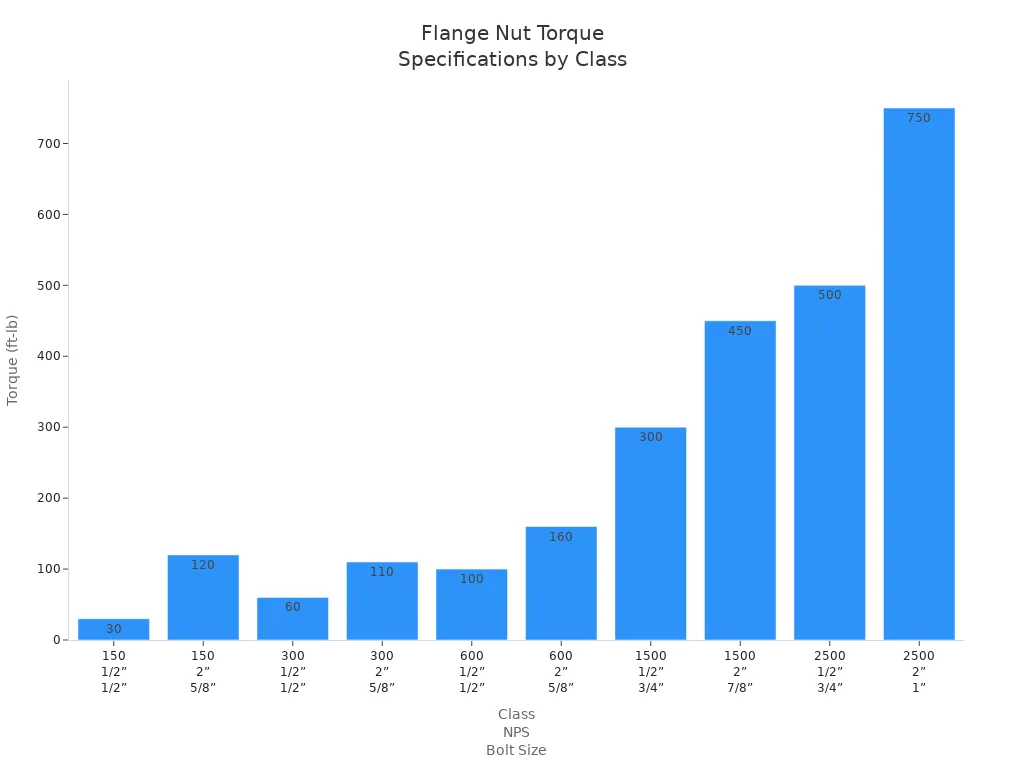
Torque specifications vary based on flange class, pipe size, and bolt size. Technicians consult manufacturer guidelines to determine the correct torque for each application. They gradually tighten the nut, checking alignment and fit throughout the process. Applying proper torque ensures a secure connection and prevents leaks or joint failure. The table below shows recommended torque values for different flange nut sizes and grades.
| Class | NPS (Pipe Size) | Bolt Size | Torque (ft-lb) | Torque (Nm) |
|---|---|---|---|---|
| 150 | 1/2” | 1/2” | 30 | 41 |
| 150 | 2” | 5/8” | 120 | 163 |
| 300 | 1/2” | 1/2” | 60 | 81 |
| 300 | 2” | 5/8” | 110 | 149 |
| 600 | 1/2” | 1/2” | 100 | 136 |
| 600 | 2” | 5/8” | 160 | 217 |
| 1500 | 1/2” | 3/4” | 300 | 407 |
| 1500 | 2” | 7/8” | 450 | 610 |
| 2500 | 1/2” | 3/4” | 500 | 678 |
| 2500 | 2” | 1” | 750 | 1017 |
Alert: Always follow the manufacturer’s torque recommendations to avoid over-tightening or under-tightening. Proper torque ensures the flange nut remains secure throughout its service life.
Technicians complete the installation process by verifying the final torque and inspecting the flange for proper contact. They confirm that the nut is secure and the flange is free from gaps or misalignment. This attention to detail guarantees a reliable and durable connection when they install a flange nut.
Verifying the Flange Nut Installation
After completing the tightening process, technicians must verify that the flange nut installation meets all safety and performance standards. This step ensures the joint will withstand operational stresses and environmental factors.
Checking for Secure Fit
A secure fit remains essential for the integrity of any assembly. Technicians follow a systematic approach to check the tightness of each flange nut:
- They use a calibrated torque spanner to confirm that every nut reaches the specified torque value. This tool provides accurate readings and helps prevent both over-tightening and under-tightening.
- They tighten bolts in a crosswise pattern, moving in several stages. This method distributes the load evenly across the flange and reduces the risk of leaks or distortion.
- They begin by tightening all nuts and bolts finger-tight. Gradually, they increase the torque in increments, checking alignment and fit at each stage.
Tip: Always record the final torque values for each nut. This documentation supports future maintenance and troubleshooting.
Technicians also inspect the exposed threads. At least one full thread should extend beyond the nut after tightening. This visual check confirms that the nut has engaged the bolt or rod completely.
Inspecting Flange Contact
Proper flange contact ensures that the load transfers evenly and the seal remains intact. Technicians look for the following indicators:
- The flange nut sits flush against the mating surface, with no visible gaps.
- The flange face shows uniform contact around its entire circumference.
- There are no signs of deformation, warping, or misalignment.
If technicians detect any irregularities, they loosen the nut and repeat the alignment and tightening process. They may also inspect the gasket for proper compression, as uneven gasket seating can compromise the seal.
A well-executed inspection process helps identify potential issues before the assembly enters service. When technicians install a flange nut, they prioritize these verification steps to ensure long-term reliability and safety.
Note: Regularly check the tightness of flange nuts during scheduled maintenance. Early detection of loosening or misalignment can prevent costly failures.
Key Considerations to Properly Install Flange Nuts
Importance of Proper Torque When You Install Flange Nut
Preventing Over-Tightening
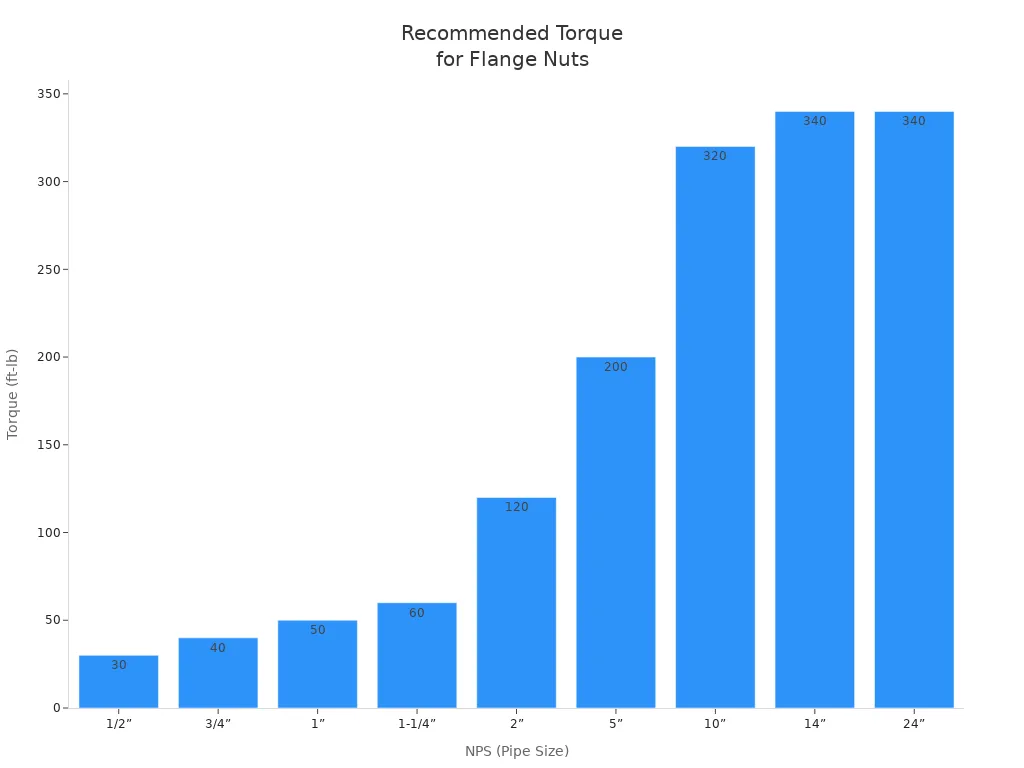
Technicians must apply the correct torque to flange nuts to avoid over-tightening. Excessive force can deform threads, damage the flange face, and compromise the seal. Over-tightening also increases the risk of mechanical failure during operation. Industry guidelines recommend using calibrated torque wrenches and following manufacturer specifications. The table below shows recommended torque ranges for common flange nut sizes and materials:
| NPS (Pipe Size) | Bolt Size | Torque (ft-lb) |
|---|---|---|
| 1/2” | 1/2” | 30 |
| 3/4” | 1/2” | 40 |
| 1” | 1/2” | 50 |
| 1-1/4” | 1/2” | 60 |
| 2” | 5/8” | 120 |
| 5” | 3/4” | 200 |
| 10” | 7/8” | 320 |
| 14” | 1” | 340 |
| 24” | 1-1/4” | 340 |
Tip: Always tighten in stages and use a crosswise pattern to distribute load evenly.
Avoiding Under-Tightening
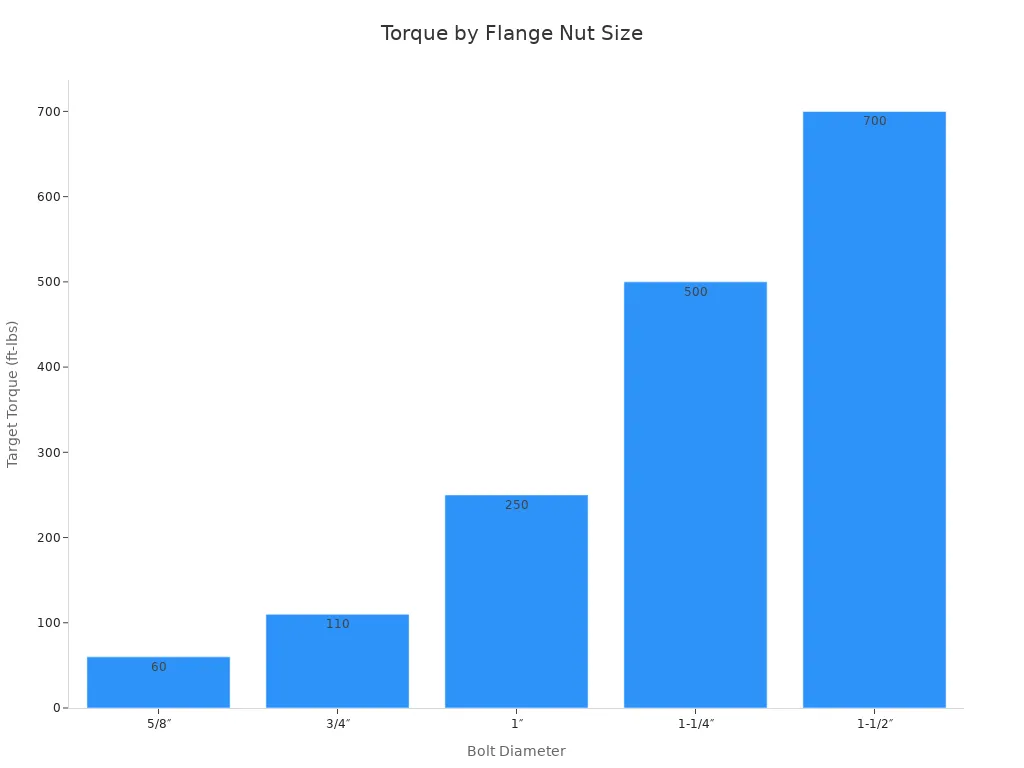
Under-tightening leaves the flange nut vulnerable to loosening under vibration or pressure. Insufficient torque can cause leaks and reduce the lifespan of the assembly. Technicians check torque values with calibrated tools and verify that the nut sits flush against the mating surface. The table below highlights target torque for lubricated bolts:
| Bolt Diameter | Target Torque (Lubricated) |
|---|---|
| 5/8″ | 60 ft-lbs |
| 3/4″ | 110 ft-lbs |
| 1″ | 250 ft-lbs |
| 1-1/4″ | 500 ft-lbs |
| 1-1/2″ | 700 ft-lbs |
Material and Surface Compatibility for Flange Nut Installation
Preventing Galvanic Corrosion
Material compatibility plays a critical role in flange nut performance. Mismatched metals can accelerate corrosion rates by fivefold, leading to premature failure. Technicians select insert nuts that match the substrate material to prevent galvanic corrosion. The table below summarizes optimal pairings:
| Substrate Material | Optimal Insert Nut | Key Benefit |
|---|---|---|
| Marine-grade aluminum | 316 stainless steel | Saltwater resistance (0.03mm/yr corrosion rate) |
| Outdoor timber | Brass | Galvanic compatibility with wood pH |
| Chemical-exposed steel | Epoxy-coated carbon steel | Acid barrier (withstands pH 2–12) |
Stainless steel inserts in oak maintain thread integrity for ten years, demonstrating the importance of proper material selection.
Using Washers if Needed
Washers help distribute load and protect surfaces from damage. Technicians use washers when the flange nut contacts softer materials or when surface irregularities exist. This practice reduces the risk of deformation and ensures a stable connection.
Environmental Factors Affecting Flange Nut Installation
Exposure to Moisture
Moisture exposure increases the risk of corrosion and affects flange nut longevity. Technicians apply protective coatings and select corrosion-resistant materials for installations in humid or wet environments.
Temperature Considerations
Operating conditions such as pressure and temperature significantly impact flange nut performance. High temperatures decrease the viscosity of fluids, increasing leakage risks. Technicians monitor environmental factors and choose flange nuts designed for easy recyclability and compliance with regulations like RoHS.
Note: Manufacturers now prioritize sustainability by using recycled materials and reducing energy consumption in flange nut production.
Common Mistakes When You Install Flange Nuts and How to Avoid Them
Cross-Threading During Step-by-Step Installation
Causes and Prevention
Cross-threading remains one of the most frequent errors during flange nut installation. This issue occurs when the nut does not align properly with the bolt or threaded rod, causing the threads to cut across each other. Technicians often encounter cross-threading when they rush the process or use excessive force to start the nut. Misalignment, dirty threads, or using mismatched components can also contribute to this problem.
To prevent cross-threading, technicians should always start threading the nut by hand. They must ensure the nut and bolt align perfectly before applying any tool. Clean threads and proper lubrication further reduce friction and help the nut seat smoothly. Technicians should avoid using impact tools unless the manufacturer specifically allows it. If resistance is felt during hand-tightening, they should stop and inspect the threads for damage or debris.
Tip: Always hand-start flange nuts and check alignment before tightening with a wrench.
Over-Tightening or Under-Tightening Flange Nuts
Recognizing Signs
Applying the wrong amount of torque to flange nuts can lead to serious consequences. Over-tightening may deform threads, damage the flange face, or weaken the joint. Under-tightening leaves the connection loose, increasing the risk of leaks and fastener failure. Both mistakes compromise the safety and performance of the assembly.
Technicians can recognize improper torque by observing several warning signs:
- Leaking fluids or gases around bolted components
- Decreased component performance
- Vibrations from bolted connections
- Discoloration or corrosion near the joint
- Reduced system efficiency
- Increased noise levels
Under-torque results in loose connections and potential failure, while over-torque causes uneven flange load and weakens the joint. To avoid these issues, technicians should use a calibrated torque wrench, tighten in a criss-cross pattern, and perform a re-torque check after pressurization.
| Mistake | Description | How to Fix / Avoid It |
|---|---|---|
| Incorrect Torque on Bolts | Uneven or wrong bolt tightening can lead to weak spots and potential leakage. | Use a calibrated torque wrench, tighten in a criss-cross pattern, and re-torque after pressurization. |
Using the Wrong Size or Type When You Install Flange Nut
Identifying Correct Specifications
Selecting the wrong size or type of flange nut can cause misalignment, leaks, or even catastrophic failure. Technicians must identify the correct specifications for each application. They begin by checking the flange standard, size, and pressure class using project drawings or documentation. Next, they evaluate service conditions, including temperature, fluid type, and environmental exposure. Matching the bolt-nut material grade and verifying dimensions against sizing charts ensures compatibility.
A checklist for identifying the correct flange nut includes:
- Identify flange standard, size, and pressure class from drawings.
- Evaluate operating temperature, fluid type, and environment.
- Match bolt-nut material grade and verify dimensions with sizing charts.
Technicians also consider factors such as nominal pipe size, flange class, bolt diameter, number of bolts, bolt circle diameter, and bolt length. Careful attention to these details prevents installation errors and supports long-term reliability.
Note: Always cross-reference specifications before installation to avoid costly mistakes.
Ignoring Surface Preparation Before Flange Nut Installation
Consequences and Solutions
Neglecting surface preparation before installing a flange nut often leads to serious problems in mechanical assemblies. Technicians who skip this step risk compromising the integrity and longevity of the joint. Surface contaminants such as dirt, oil, rust, or old sealant can interfere with proper seating and torque application.
Common Consequences of Poor Surface Preparation:
- Reduced Clamping Force: Contaminants prevent the flange nut from sitting flush, which reduces the effective clamping force. This can cause the joint to loosen under vibration or load.
- Increased Corrosion Risk: Moisture and debris trapped between surfaces accelerate corrosion. Rust weakens both the nut and the bolt, leading to premature failure.
- Leakage: In piping or pressure vessel applications, improper surface preparation often results in leaks. Gaskets may not seal correctly if surfaces are dirty or uneven.
- Thread Damage: Debris in the threads increases friction during tightening. This can strip threads or make future removal difficult.
- Inconsistent Torque Readings: Dirty or lubricated surfaces can cause inaccurate torque measurements. Technicians may over-tighten or under-tighten the nut, risking joint failure.
⚠️ Alert: Ignoring surface preparation can void manufacturer warranties and lead to costly repairs or downtime.
Effective Solutions for Proper Surface Preparation:
Technicians can prevent these issues by following a systematic cleaning and inspection process:
- Clean All Surfaces: Use a wire brush or solvent to remove dirt, grease, and corrosion from both the flange nut and mating surfaces.
- Dry Components Thoroughly: Ensure all parts are completely dry before assembly. Moisture can promote corrosion and affect gasket performance.
- Inspect for Damage: Check for pitting, scratches, or warping on the flange face and threads. Replace any damaged components.
- Apply Lubricant or Anti-Seize (if specified): Use only approved products to reduce friction and prevent galling. Avoid over-application, which can attract more debris.
- Verify Cleanliness: Wipe surfaces with a lint-free cloth. A visual inspection should confirm that no contaminants remain.
| Step | Tool/Material | Purpose |
|---|---|---|
| Cleaning | Wire brush, solvent | Remove dirt and grease |
| Drying | Clean cloth, air dry | Prevent moisture-related issues |
| Inspection | Visual, magnifier | Detect damage or irregularities |
| Lubrication | Anti-seize compound | Reduce friction, prevent galling |
| Final Verification | Lint-free cloth | Ensure complete cleanliness |
Tip: Always document the cleaning and inspection process. This practice supports quality control and helps with future troubleshooting.
Technicians who prioritize surface preparation achieve more reliable, longer-lasting flange nut installations. Clean, dry, and damage-free surfaces ensure proper torque, reduce maintenance needs, and improve overall safety.
Advanced Tips for Step-by-Step Installation of Flange Nuts
Using Flange Nuts with Locking Features
Flange nuts with locking features provide extra security in demanding environments. These nuts help prevent loosening caused by vibration or movement. Technicians often choose them for automotive, machinery, and structural applications.
Nylon Insert Flange Nuts
Nylon insert flange nuts contain a nylon ring inside the nut. This ring grips the threads of the bolt, increasing resistance to vibration. The nylon insert also helps seal the joint against moisture and contaminants. Technicians use nylon insert flange nuts when assemblies require frequent inspection or when exposure to vibration is high. These nuts work best in moderate temperature ranges, as extreme heat can degrade the nylon.
Serrated Flange Nuts
Serrated flange nuts feature a series of angled serrations on the flange face. These serrations bite into the mating surface, increasing friction and preventing the nut from backing off. Serrated flange nuts eliminate the need for separate washers, which simplifies assembly and reduces the number of parts. The table below summarizes the main advantages of using flange nuts with locking features in high-vibration environments:
| Advantage | Description |
|---|---|
| Simplified Assembly | Eliminates the need for a separate washer, reducing complexity during installation. |
| Resistance to Loosening | Serrated flanges increase friction, preventing loosening under vibration. |
| Enhanced Mechanical Integrity | The flange protects surfaces while ensuring the nut remains securely tightened. |
| Better Vibration Resistance | The design allows for improved resistance to rotational vibrations compared to standard nuts. |
| Cost-Effectiveness | Reduces lifecycle costs by minimizing maintenance needs and downtime. |
| Easier Inspection and Replacement | Simplifies maintenance processes, saving time and reducing unexpected breakdown risks. |
Tip: Serrated flange nuts should not be used with surfaces that require a smooth finish, as the serrations may cause damage.
Installing Flange Nuts in Hard-to-Reach Areas
Technicians often face challenges when installing flange nuts in confined or obstructed spaces. Proper tool selection and technique adjustments can make the process more efficient and reliable.
Tool Selection
Specialty tools help technicians access tight spaces. Deep sockets, flex-head ratchets, and crowfoot wrenches allow for better reach and leverage. Magnetic nut drivers can hold the nut in place during installation, reducing the risk of dropping hardware.
Technique Adjustments
Technicians may start threading the nut by hand, then switch to a tool for final tightening. Using extension bars or universal joints helps reach around obstacles. They often use mirrors or inspection cameras to verify alignment and fit in areas with limited visibility.
Note: Always check torque values after installation in hard-to-reach areas, as tool extensions can affect applied force.
Maintenance and Re-Tightening After You Install Flange Nuts
Proper maintenance ensures the long-term reliability of flange nut assemblies. Technicians follow a routine to check and re-tighten nuts as needed.
Periodic Checks
- Develop a fastening plan with appropriate torque settings.
- Review bolt and nut strength, gasket sealing pressure, and working pressure.
- Prevent breakage and loss of gasket elasticity from excessive tightening.
- Establish a routine to inspect the condition of flange nuts and surrounding components.
- Perform necessary adjustments or replacements to extend assembly life.
Signs of Loosening
- Conduct regular inspections to identify rust or damage.
- Replace components if surfaces appear rough or worn.
- Use proper tools to ensure a tight fit without over-tightening.
Regular maintenance and timely re-tightening help prevent unexpected failures and extend the service life of flange nut assemblies.
Troubleshooting Flange Nut Installation Issues
Flange Nut Won’t Thread On During Installation
Diagnosing the Problem
When a flange nut refuses to thread onto a bolt or rod, technicians must identify the root cause before proceeding. They begin with a visual inspection of the joint, looking for signs of thread damage, contamination, or misalignment. Reviewing the bolt pattern and flange-face condition helps reveal any irregularities. Technicians also assess the gasket for under-compression or physical damage. Checking for chemical attack or debris on the threads ensures that no foreign material obstructs the installation. A careful inspection of the bolt’s condition and tension confirms whether the issue stems from the hardware itself.
Solutions
Technicians have several strategies to resolve threading issues:
- Use a larger tap to clean or slightly enlarge internal threads, ensuring a smoother fit.
- Apply anti-seize compound or grease to the threads to reduce friction and facilitate easier threading.
- Consider coupling nuts if a looser fit is acceptable for the application.
- Modify the nut or bolt, such as lightly filing or chasing the threads, to improve compatibility.
Tip: Always clean and lubricate threads before attempting reinstallation. This simple step often resolves minor threading problems.
Flange Nut Loosens After Installation
Causes
Flange nuts may loosen after installation due to several factors:
- Uneven bolt fastening from improper tightening procedures can create uneven compression and leaks.
- Damage or contamination of flange faces, such as dirt or corrosion, prevents proper sealing.
- Excessive piping system stresses, often from poor support locations, can gradually loosen connections.
- Thermal shock from rapid temperature changes may deform flanges and compromise joint integrity.
- High vibration levels in the environment can shake bolts loose over time.
Preventive Measures
Technicians can prevent loosening by following these best practices:
- Use correct bolting procedures, tightening bolts in a crosswise pattern to ensure even compression.
- Maintain a clean installation environment to avoid contamination of flange faces.
- Inspect and support piping systems properly to minimize external stresses.
- Apply insulation materials to flanges exposed to temperature fluctuations.
- Install vibration-absorbing supports in high-vibration areas.
Note: Regular inspections and maintenance checks help detect early signs of loosening and prevent costly failures.
Damaged Threads When You Install Flange Nut
Repair Options
When technicians discover damaged threads during installation, they can choose from several repair methods:
- Install thread repair inserts such as Heli-Coil, which are affordable and widely available.
- Use Time-Sert inserts for a more robust and permanent repair, especially in critical applications.
- Restore threads with a forming tap, which reshapes rather than cuts the metal, preserving strength.
- For severe damage, bore out the hole and weld a new flanged nut onto the axle flange.
Replacement Guidelines
If thread repair proves unfeasible, technicians should consider replacing the affected components:
- Replace the damaged axle flange or rear axle when thread integrity cannot be restored.
- Seek professional assistance from a dealership or qualified repair shop for complex replacements.
⚠️ Alert: Never reuse severely damaged nuts or bolts. Proper repair or replacement ensures the safety and reliability of the entire assembly.
Technicians achieve safe and durable results when they install a flange nut by following essential steps. Preparation, correct tool selection, and proper torque application remain critical. Key takeaways include:
- Avoid over-tightening or under-tightening by using a torque wrench.
- Ensure material compatibility to prevent corrosion.
- Conduct regular maintenance checks.
Best practices involve thorough inspections, proactive replacement of degraded fasteners, and maintaining detailed installation records. Scheduled maintenance and crew training support ongoing security and reliability.
FAQ
What is a flange nut used for?
A flange nut secures components in mechanical assemblies. The wide flange distributes pressure, which helps prevent damage to connected surfaces. Technicians use flange nuts in automotive, plumbing, and machinery applications.
How does a flange nut differ from a regular nut?
A flange nut features an integrated washer-like base. This flange spreads the load and reduces the need for a separate washer. Regular nuts lack this feature and may require additional hardware.
Can technicians reuse flange nuts?
Technicians should avoid reusing flange nuts in critical applications. Reuse can compromise thread integrity and clamping force. Always inspect for wear or damage before considering reuse.
What tools work best for installing flange nuts?
A torque wrench, socket wrench, and alignment tools provide the best results. Technicians select tools based on nut size and application. Proper tool selection ensures accurate torque and prevents damage.
How can someone prevent flange nut loosening?
Technicians use locking flange nuts, thread lockers, and proper torque procedures to prevent loosening. Regular maintenance checks also help detect early signs of loosening.
Are lubricants always necessary during installation?
Lubricants reduce friction and prevent galling. Technicians apply them when manufacturer guidelines recommend. In some cases, dry installation is required for safety or performance reasons.
What should someone do if a flange nut will not thread on?
Tip: Inspect threads for damage or debris. Clean both nut and bolt. If problems persist, use a thread chaser or tap to restore threads before attempting installation again.