Ordering custom fasteners from a custom fasteners manufacturer demands precise specifications and clear communication. Accuracy in defining u-bolt dimensions, materials, and finishes directly impacts the success rate of the order. The following table shows how dimensional accuracy, functionality, and safety influence outcomes in bolt casting and u bolt production:
| Aspect | Impact on Order Success Rates |
|---|---|
| Dimensional Accuracy | Ensures fasteners fit precisely within designated holes, preventing assembly issues and failures. |
| Functionality and Performance | Guarantees fasteners can handle intended loads, reducing the risk of failure during use. |
| Safety and Reliability | Prevents structural failures that could lead to serious consequences, especially in critical applications. |
When customers follow each step carefully, they achieve reliable results with their order custom fasteners.
Define Requirements for Custom U-Bolt Fasteners
Specify U-Bolt Dimensions
Measuring Length, Width, and Thread Size
Accurate measurements form the foundation of any successful order custom fasteners. When specifying a u-bolt, the manufacturer expects clear details about the length, width, and thread size. These measurements determine how the bolt fits within the assembly and whether it meets performance requirements. Many manufacturers report that ambiguous or incomplete dimensional specifications often lead to mismatches in fastener geometry. To avoid these issues, customers should use precise measuring tools and document each value carefully.
Tip: Always indicate the wire diameter on technical drawings to ensure clarity.
A typical industrial application requires strict dimensional tolerances. The table below outlines common requirements:
| Feature | Tolerance/Specification |
|---|---|
| Minimum distance | Not less than 1.5 X diameter of round stock |
| Preferred distance | 2 X the u-bolt diameter |
| Flat contact area | Thickness or width should be not less than +/- .025″ |
| Dimensioning | Indicate relative size (wire diameter) on drawings |
| Precision applications | More extensive dimensions and tolerances may be required |
Determining Bend Radius and Leg Length
The bend radius and leg length play a critical role in the performance of a u-bolt. These factors affect how the bolt distributes load and fits around pipes or structural elements. Loose tolerances can compromise assembly precision and lead to failures. Customers should specify both the inside and outside bend radius, as well as the exact leg length, to ensure compatibility with their application.
Select Materials for U-Bolt Applications
Common Material Options for U-Bolts
Material selection impacts the durability and reliability of a u-bolt. Manufacturers frequently use austenitic stainless steel (304SS) for its superior corrosion resistance, especially in harsh environments. Galvanized steel offers moderate protection and is common in less demanding settings. 40Cr steel performs poorly in marine conditions and is not recommended for corrosive environments.
- Austenitic stainless steel (304SS): Preferred for corrosive environments.
- Galvanized steel: Suitable for general use, but less effective against corrosion.
- 40Cr steel: Least effective in marine applications.
Environmental and Load Considerations
The environment and load requirements dictate which material suits the application. For outdoor or marine installations, stainless steel provides the best protection. Ignoring material properties can result in failures under load. Customers should also reference applicable industry standards to ensure compatibility and consistent quality.
Choose Finishes and Coatings for U-Bolts
Corrosion Resistance and Durability
Finishes and coatings extend the life of a u-bolt and enhance its performance. Hot-dip galvanizing offers excellent corrosion resistance and is ideal for outdoor use. Electro-galvanizing provides a thinner layer, suitable for indoor or less severe conditions. Powder coating delivers good protection and aesthetic appeal, while black oxide serves mainly decorative purposes.
| Finish Type | Description | Corrosion Resistance | Suitable Applications |
|---|---|---|---|
| Hot-Dip Galvanizing | U bolts are submerged in molten zinc, forming a thick coating. | Excellent | Outdoor applications exposed to elements. |
| Electro-Galvanizing | A thin layer of zinc is deposited using electric current. | Moderate | Indoor applications or less severe conditions. |
| Powder Coating | A dry powder is applied and fused to create a continuous film. | Good | Aesthetic applications in automotive/architecture. |
| Black Oxide | A chemical conversion coating that provides a black finish. | Limited | Decorative or indoor mechanical assemblies. |
Functional and Aesthetic Finishes
Customers may select finishes based on functional needs or visual preferences. Hot-dip galvanizing remains affordable and reliable for outdoor fasteners. Powder coating offers color options for architectural or automotive uses. Not specifying required testing or certification can lead to subpar fasteners that do not meet specifications. Proper documentation and traceability support quality assurance and compliance.
Determine Quantities for Your Order
Minimum Order Quantities for Custom Fasteners
Manufacturers set minimum order quantities to optimize production and maintain cost efficiency. When a customer requests a custom u-bolt, the manufacturer often requires a minimum purchase. This policy ensures that setup and material costs remain manageable. Many suppliers do not publish exact numbers, but industry sources indicate that minimums apply to most custom fastener orders. For example, some manufacturers specify a minimum order value of $200 for custom eye bolts and u-bolts.
Note: Minimum order requirements may vary depending on the complexity of the bolt design and the materials selected.
Customers should review the manufacturer’s terms before placing an order custom fasteners. The following list highlights common practices:
- Minimum order quantities typically apply to custom u-bolt fasteners.
- Some manufacturers require a minimum dollar amount, such as $200 per order.
- The minimum may increase for specialty materials or unique finishes.
A clear understanding of these requirements helps customers avoid delays and ensures that the order meets production standards.
Planning for Future Needs
Accurate forecasting of future needs supports efficient purchasing and reduces costs. Customers should assess their project timelines and maintenance schedules before finalizing quantities. Ordering extra bolts can prevent shortages and minimize downtime during installation or repairs. Manufacturers recommend that customers consider both immediate and long-term requirements when placing a custom u-bolt order.
A simple table can help customers estimate the right quantity:
| Project Phase | Estimated Quantity | Purpose |
|---|---|---|
| Initial Installation | 100 | Assembly and setup |
| Maintenance | 20 | Replacement parts |
| Expansion | 50 | Future upgrades |
Customers who plan ahead benefit from bulk pricing and reduced shipping costs. They also avoid the risk of running out of fasteners during critical phases. When ordering custom u-bolt fasteners, buyers should communicate their anticipated needs to the manufacturer. This practice allows the supplier to schedule production efficiently and maintain inventory levels.
Tip: Always keep a buffer stock of bolts for emergency repairs or unexpected project changes.
Research and Select U-Bolt Manufacturers
Finding Reputable U-Bolt Manufacturers
Using Online Directories and Industry Associations
Industry professionals often rely on online directories and trade associations to identify reputable u-bolt manufacturers. These resources provide verified company profiles, contact information, and product catalogs. Many directories allow users to filter manufacturers by region, certification, or specialization. Trade associations, such as the Industrial Fasteners Institute, maintain lists of members who adhere to industry standards. This approach helps buyers find suppliers who can meet specific requirements for bolt size, material, and finish.
Evaluating Recommendations and Reviews
Buyers should also consider recommendations from industry peers and customer reviews. Feedback from previous clients offers valuable insights into a manufacturer’s reliability, communication, and product quality. Many companies display testimonials on their websites, but independent review platforms often provide more objective assessments. A consistent record of positive reviews signals that a manufacturer delivers accurate u-bolt orders and maintains high standards throughout the production process.
Tip: Always request references from the manufacturer before placing a large order.
A table below summarizes the most important criteria for evaluating reputable manufacturers:
| Criteria | Description |
|---|---|
| Material | Choosing materials like carbon steel or stainless steel based on environmental conditions and corrosion resistance. |
| Size and Dimensions | Ensuring proper fit by selecting U bolts with the correct thread size, diameter, and length. |
| Load Capacity | Matching U bolt grade and strength rating to the expected load to prevent failures. |
| Coatings and Finishes | Selecting coatings like galvanization to enhance corrosion resistance and extend lifespan. |
Assess Manufacturer Capabilities for Custom Fasteners
Experience with Custom U-Bolt Orders
A manufacturer’s experience with custom u-bolt orders plays a critical role in project success. Companies with a proven track record understand the technical requirements and common challenges in custom bolt fabrication. They can offer guidance on material selection, thread specifications, and finishing options. Experienced manufacturers also anticipate potential issues and suggest solutions before production begins.
Production Capacity and Lead Times
Production capacity and lead times determine whether a manufacturer can deliver bolts on schedule. Buyers should ask about the supplier’s equipment, workforce, and average turnaround times for custom orders. High-capacity facilities can handle large volumes and urgent requests. Reliable manufacturers provide clear timelines and communicate any delays promptly. This transparency helps buyers plan installations and avoid costly project overruns.
Review Quality Standards for U-Bolt Production
Certifications and Compliance Requirements
Quality standards and certifications ensure that u-bolt fasteners meet industry requirements for safety and performance. Leading manufacturers comply with international standards such as ISO 9001 for quality management and ISO 14001 for environmental responsibility. Construction projects often require bolts that meet ISO 898 for mechanical properties and ISO 10683 or ISO 4042 for corrosion-resistant coatings.
| ISO Standard | Description |
|---|---|
| ISO 9001 | Quality Management Systems (QMS) requirements for ensuring product quality and customer satisfaction. |
| ISO 14001 | Environmental Management Systems (EMS) requirements focusing on sustainability and environmental performance. |
| ISO 45001 | Occupational Health and Safety Management requirements to ensure workplace safety. |
| ISO 898 | Mechanical Properties of Fasteners requirements for material specifications and testing. |
| ISO 10683 | Non-Electrolytically Applied Zinc Flake Coatings requirements for durability and corrosion resistance. |
| ISO 4042 | Electroplated Coatings on Fasteners requirements for coating uniformity and corrosion protection. |
Quality Control and Inspection Processes
Manufacturers who follow strict quality control and inspection processes deliver consistent results. They use calibrated measuring tools to verify bolt dimensions and conduct material tests to confirm compliance with specifications. Many companies document each step of the production process to ensure traceability. Buyers should request information about inspection protocols and ask for test reports with their order custom fasteners. This practice reduces the risk of receiving defective or non-compliant products.
Submit Specifications to Order Custom Fasteners
Preparing Detailed Drawings and Descriptions
Essential Elements in Technical Drawings
Technical drawings serve as the foundation for any successful custom fastener order. A clear drawing should display all critical dimensions, including the inside width, leg length, thread length, and bend radius of the u-bolt. Each drawing must indicate tolerances, material type, and finish requirements. Manufacturers rely on these details to ensure the bolt fits the intended application. Drawings should also include notes about thread pitch, diameter, and any special features such as locking mechanisms or torque requirements.
Tip: Always label each view and dimension clearly to prevent confusion during the production process.
Providing Clear Written Specifications for U-Bolts
Written specifications complement technical drawings by outlining requirements that may not appear visually. A comprehensive specification should list the bolt’s material, strength grade, finish, and any necessary certifications. Customers should specify torque values, locking preferences, and environmental conditions. Including these details at the request-for-quote stage helps manufacturers deliver accurate quotes and reduces the risk of errors. Written specifications also support batch traceability and quality control, which are essential for industries that require documentation such as DFARS or MIL‑SPEC compliance.
Communicate Requirements for Custom U-Bolt Orders
Using Standard Terminology and Avoiding Ambiguity
Clear communication with the manufacturer prevents misunderstandings and costly mistakes. Customers should use standard industry terminology when describing bolt features and requirements. Avoiding ambiguous language ensures that both parties interpret specifications the same way. Quick response times and effective communication build trust and streamline the order custom fasteners process. Establishing a single point of contact within the manufacturer’s team can further enhance responsiveness and support.
A checklist for effective communication includes:
- Use standard terms for dimensions, threads, and finishes.
- Confirm all measurements and tolerances.
- Provide reference samples or prototypes if available.
Sharing Application and Environmental Details
Manufacturers need to understand the intended application and environment for the u-bolt. Sharing information about load requirements, exposure to chemicals, temperature extremes, or outdoor conditions allows the supplier to recommend suitable materials and finishes. Customers should also discuss any planned fit or test runs to validate the bolt before full-scale production. This step ensures the fastener performs as expected and meets safety standards.
Note: Saving technical drawings and batch records simplifies future orders and supports field replacements.
By following these practices, customers and manufacturers can work together to achieve a smooth and accurate production process for custom u-bolt fasteners.
Request and Review Quotes for Custom U-Bolt Fasteners
How to Request Accurate Quotes from Manufacturers
Information Needed for U-Bolt Quotes
Manufacturers require detailed information to provide accurate quotes for custom u-bolt fasteners. They expect buyers to specify material types, thread dimensions, inside diameter, height, and intended use. Custom options, such as metric or imperial sizes and unique diameters, must be included. The following table summarizes the essential specifications manufacturers need:
| Specification Type | Details |
|---|---|
| Material Types | Aluminum, Zinc Plated Steel, Galvanized Steel |
| Thread Dimensions | Various sizes, including NC rolled threads |
| Inside Diameter | Specific to application, varies by U-bolt type |
| Height | Varies by U-bolt type, up to 6 inches for square U-bolts |
| Common Uses | Securing pipes, lines, beams, automotive components |
| Custom Options | Available in metric and imperial sizes, custom diameters up to 1 inch |
Buyers who provide complete specifications streamline the quote process and reduce the risk of errors during the production process.
Requesting Quotes from Multiple Suppliers
Requesting quotes from several suppliers allows buyers to compare pricing, lead times, and service levels. Each manufacturer may offer different minimum order quantities and pricing structures. Buyers should send identical specifications to each supplier to ensure fair comparisons. This practice helps identify the best value and ensures that the selected manufacturer can meet project requirements.
Compare Quotes for U-Bolt Orders
Price Breakdown, Payment Terms, and Lead Times
Manufacturers present price breakdowns based on unit cost, minimum order quantity, and payment terms. Lead times vary depending on production capacity and order complexity. The table below illustrates price ranges and minimum order requirements from various manufacturers:
| Manufacturer | Price Range (per unit) | Minimum Order Quantity |
|---|---|---|
| Ningbo Yi Pian Hong Fastener Co., Ltd. | $0.20 – $0.50 | 100 pieces |
| Wuxi Bayard International Trade Co., Ltd. | $0.01 – $0.10 | 50,000 pieces |
| DOEZ INTERNATIONAL CO., LTD. | $0.35 | 300 pieces |
| Xi’an Tongwo Trading Co., LTD. | $0.01 – $0.03 | 500 pieces |
| Beijing Jh Bolt Co., Ltd. | $0.01 – $0.03 | 1000 pieces |
| Taizhou Yixing Metal Products Factory | $0.06 – $0.15 | 10 pieces |
| Handan Hangfan Metal Products Co., Ltd. | $0.01 – $0.03 | 100 pieces |
| Hebei Heiniu Electric Power Fitting Co., Ltd. | $1.20 | 10 pieces |
| Shenzhen Dingshuo Precision Hardware Co., Ltd. | $0.05 – $0.19 | 100 pieces |
| Ningbo Huaxianglian Hardware Co., Ltd. | $0.15 | 1000 pieces |
| Handan Wangxuan Fastener Manufacturing Co., Ltd. | $0.04 – $0.07 | 200 pieces |
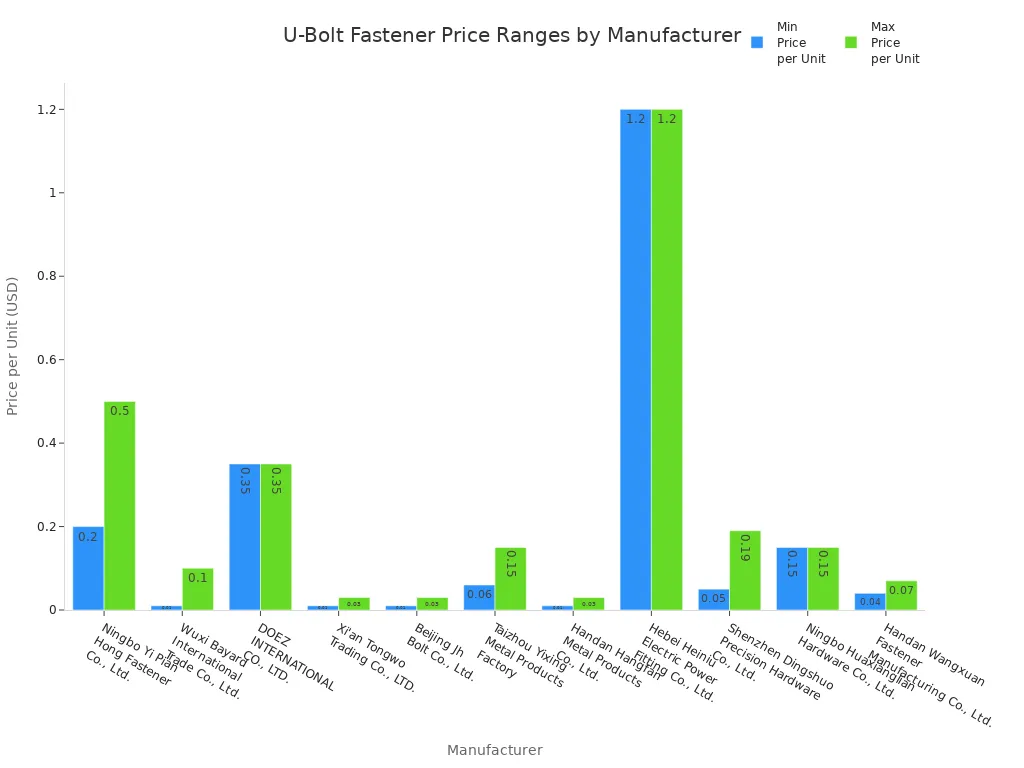
Buyers should review payment terms, such as deposits and final payments, and confirm lead times before placing an order custom fasteners.
Delivery Schedules and Shipping Options
Delivery schedules and shipping options affect project timelines. Manufacturers coordinate shipments within a specified period, but delivery times may not be guaranteed. Buyers should ask about available carriers, tracking options, and estimated arrival dates. Reliable suppliers provide clear information about logistics and address any potential delays promptly.
Assess Terms and Conditions for Custom Fastener Orders
Warranty, Return Policies, and Support
Order agreements include terms for warranty, returns, and customer support. Manufacturers guarantee products will be free of defects and outline procedures for inspection and claims. Buyers have a limited period to inspect delivered bolts and must report issues within this timeframe. Return requests require products to be in original condition, and restocking fees may apply. Support teams assist with replacements and resolve discrepancies.
| Term | Description |
|---|---|
| Warranty | Products guaranteed to be free of defects; liability limited for misuse or installation issues. |
| Inspection of Product | Buyers have 7 days to inspect products and notify seller of any issues. |
| Return & Exchange Policy | Return requests within 30 days; products must be in original condition; restocking fee may apply. |
| Claims | Claims must be made in writing within 7 days of delivery. |
Shipping, Handling, and Additional Costs
Shipping terms specify coordination timelines and delivery responsibilities. Pricing excludes delivery fees, taxes, and surcharges. Buyers must review all additional costs before finalizing the order. Manufacturers collect sales tax as required by law and may charge handling fees. Clear understanding of these terms prevents unexpected expenses and ensures a smooth transaction.
| Term | Description |
|---|---|
| Shipping Terms | Shipment coordinated within 2 business days; delivery times not guaranteed. |
| Pricing | Prices exclusive of delivery costs and taxes; subject to change. |
| Taxes and Other Surcharges | Sales tax collected as required by law; additional fees may apply. |
| Minimum Order Requirements | Minimum purchase amount of $100 required for all orders. |
Tip: Buyers should always review the full contract and clarify any uncertainties before confirming their u-bolt order.
Confirm Order Details for Custom U-Bolt Fasteners
Finalize Specifications and Approve Drawings
Reviewing Manufacturer Drawings and Blueprints
Manufacturers provide detailed drawings and blueprints for every custom u-bolt order. These documents display thread size, head type, material requirements, surface treatment, dimensional tolerances, and strength grade. Engineers and buyers examine each drawing to verify accuracy. They check that all measurements match the original specifications. Reviewing these blueprints ensures the bolt will fit the intended application and perform as expected. Many teams use a checklist to confirm that every technical detail appears on the drawing.
Tip: Always compare the manufacturer’s blueprint with the original technical drawing before approval.
Approving Samples or Prototypes if Needed
Some projects require samples or prototypes before full-scale production. Manufacturers produce a small batch or a single unit to demonstrate fit and function. Buyers inspect these samples for dimensional accuracy and surface finish. They test the bolt in its intended environment to confirm performance. If the sample meets all requirements, the buyer gives approval for mass production. This step reduces the risk of errors during the production process and ensures the final product matches expectations.
Steps to finalize specifications and approve drawings:
- Create a precise technical drawing with all necessary details.
- Select a manufacturer with relevant experience and industry compliance.
- Submit the drawing and specifications, including quantity and application environment.
- Confirm feasibility, lead time, and cost with the manufacturer.
- Request a sample or prototype if needed.
- Start production and perform quality control checks.
- Handle shipping, documentation, and after-sales support.
Address Questions and Clarifications with Manufacturer
Maintaining Open Communication
Open communication between buyer and manufacturer supports a smooth ordering process. Teams ask questions about materials, dimensions, and finishes. They clarify any uncertainties before production begins. Manufacturers respond quickly to requests for information. This ongoing dialogue prevents misunderstandings and ensures both parties share the same expectations.
Note: Establishing a single point of contact streamlines communication and speeds up response times.
Documenting Agreed Changes and Updates
Every change or update to the order must be documented. Buyers and manufacturers record adjustments to specifications, quantities, or delivery schedules. Written confirmation ensures accountability and traceability. Teams store these records for future reference. Proper documentation protects both parties and supports quality assurance throughout the production process.
Place the Order for Custom U-Bolt Fasteners
Complete the Purchase Agreement for U-Bolts
Reviewing the Sales Contract and Order Confirmation
A successful custom order begins with a thorough review of the sales contract and order confirmation. Buyers examine every detail to ensure the agreement matches the approved specifications and drawings. The contract outlines the responsibilities of both parties, including quality standards, delivery expectations, and risk management. Each section of the agreement addresses a critical aspect of the transaction. The following table summarizes the typical documentation required to complete a purchase agreement for custom fasteners:
| Section | Description |
|---|---|
| Formation | The order becomes a binding contract when accepted by the supplier. |
| Quality Management System | Supplier must maintain quality assurance records and provide certificates of conformance. |
| Delivery | Specifies delivery quantities and timelines, with consequences for delays. |
| Title/Risk of Loss | Title passes upon delivery, and supplier bears risk until acceptance. |
| Invoice and Payment | Separate invoices for each delivery, payment terms defined. |
Buyers confirm that all terms align with their project requirements. They check for clear language regarding delivery schedules, quality documentation, and liability. This careful review prevents disputes and ensures both parties understand their obligations.
Confirming Payment Methods and Schedules
After reviewing the contract, buyers confirm the payment methods and schedules with the supplier. Payment terms often depend on the size and complexity of the order. Manufacturers may require a deposit before starting production, with the balance due upon delivery or after inspection. Buyers should verify the timing of each payment milestone and ensure that the schedule supports their project timeline. Clear communication about payment expectations helps maintain a positive business relationship.
Make Payment for Custom Fastener Orders
Accepted Payment Options and Milestones
Manufacturers support several payment methods for custom orders. The most common options include Letters of Credit (L/C), Telegraphic Transfer (T/T), Western Union, and direct payment in USD. The table below outlines these accepted payment methods:
| Payment Method | Conditions |
|---|---|
| L/C | Accepted |
| T/T | Accepted |
| Western Union | Accepted |
| USD | Supported |
Buyers select the method that best fits their company’s financial procedures. They coordinate with their finance team to ensure timely processing and avoid production delays.
Managing Deposits and Final Payments
Most suppliers require an initial deposit to secure materials and schedule production. The deposit amount varies but typically ranges from 20% to 50% of the total order value. Buyers pay the remaining balance after the supplier completes the order and provides the necessary documentation. They review the invoice for accuracy and confirm that all terms have been met before releasing the final payment. This process ensures that the supplier fulfills all contractual obligations and delivers the correct u-bolt fasteners.
Tip: Buyers should keep records of all payments and correspondence for future reference and quality audits.
Track Production and Delivery of U-Bolt Orders
Monitor Production Progress for Custom Fasteners
Receiving Regular Updates from Manufacturer
Manufacturers keep buyers informed throughout the production process. They send progress reports at key milestones, such as material procurement, machining, and finishing. These updates help buyers anticipate completion dates and prepare for delivery. Many companies use email notifications or online portals to share production status. Buyers review these reports to verify that the manufacturer follows the approved specifications and schedule.
Tip: Buyers should request a production timeline at the start of the order. This document outlines each phase and expected completion date.
A typical production update includes:
- Current stage of manufacturing (e.g., bending, threading, coating)
- Estimated completion date for each phase
- Any changes to specifications or materials
- Quality control checkpoints
Addressing Delays or Production Issues
Production delays can occur due to material shortages, equipment failures, or unexpected technical challenges. Manufacturers notify buyers immediately when issues arise. Buyers assess the impact on project timelines and request solutions. Manufacturers may offer alternative materials or expedited processing to minimize delays. Open communication ensures both parties address problems quickly and maintain trust.
A table below summarizes common production issues and recommended actions:
| Issue | Manufacturer Response | Buyer Action |
|---|---|---|
| Material shortage | Source alternative materials | Approve substitution |
| Equipment breakdown | Repair or reschedule | Adjust project plan |
| Specification change | Notify buyer for approval | Review and confirm |
| Quality control failure | Rework affected batch | Inspect replacement |
Note: Buyers should document all communications regarding delays or changes for future reference.
Coordinate Shipping and Logistics for U-Bolts
Choosing Shipping Methods and Carriers
Manufacturers offer several shipping options based on order size, urgency, and destination. Buyers select methods such as air freight, sea freight, or ground transport. Each carrier provides different transit times and costs. Buyers evaluate carriers for reliability, tracking capabilities, and insurance coverage. Manufacturers recommend trusted logistics partners to ensure safe and timely delivery.
A list of common shipping methods:
- Air freight: Fastest option for urgent orders
- Sea freight: Cost-effective for large shipments
- Ground transport: Suitable for regional deliveries
Tip: Buyers should confirm packaging requirements to prevent damage during transit.
Tracking Shipments and Delivery Status
Buyers track shipments using carrier-provided tracking numbers or manufacturer portals. Real-time updates show the location and estimated arrival date of each order. Buyers monitor delivery status to coordinate installation or inventory management. Manufacturers assist with customs clearance and address any shipping issues promptly.
A simple code block demonstrates how buyers track shipments:
Order Number: UBOLT2024
Carrier: FedEx
Tracking Number: 1234567890
Status: In Transit
Estimated Delivery: June 15, 2024
Buyers review delivery reports upon arrival and inspect packages for damage or discrepancies. Timely tracking and communication ensure a smooth transition from production to installation.
Receive and Inspect Custom U-Bolt Fasteners

Inspect Delivered U-Bolts for Quality and Accuracy
Checking Dimensions, Materials, and Finishes
When the shipment arrives, the receiving team begins by checking each fastener against the original order specifications. They measure the length, width, thread size, and bend radius using calibrated tools. These measurements confirm that the fasteners match the technical drawings and fit the intended application.
The team also inspects the material and finish. They verify that the manufacturer used the correct grade of steel or alloy. For example, stainless steel provides corrosion resistance, while carbon steel offers higher strength. The finish must meet the requirements for durability and appearance. Hot-dip galvanizing, powder coating, or black oxide should appear uniform and free of defects.
A checklist for initial inspection includes:
- Confirming all dimensions match the approved drawings
- Verifying the material type and grade
- Inspecting the finish for consistency and coverage
- Checking for visible defects such as cracks, burrs, or incomplete threads
Tip: Teams should document all findings with photos and notes for traceability.
Assessing Compliance with Specifications
After the initial inspection, the team compares the fasteners to the full list of specifications. They review certificates of compliance and test reports provided by the manufacturer. These documents confirm that the fasteners meet industry standards and project requirements.
Key inspection criteria include:
- Material selection that matches the order for performance and longevity
- Customization capabilities, such as correct thread sizes and coatings
- Proper labeling and batch traceability
If the fasteners pass all checks, the team approves them for use in the project.
Handle Discrepancies or Defects in U-Bolt Orders
Reporting Issues Promptly to Manufacturer
If the team finds any discrepancies or defects, they report the issues to the manufacturer immediately. They provide detailed descriptions, photographs, and reference the purchase order number. Quick reporting helps the supplier investigate and resolve the problem without delay.
A typical report includes:
- Description of the defect or nonconformance
- Affected quantities and batch numbers
- Supporting images and measurement data
Note: Timely communication ensures warranty claims remain valid.
Working Toward Resolution and Replacements
The manufacturer reviews the report and proposes solutions. They may offer replacements, repairs, or credit for defective items. The team coordinates with the supplier to arrange return shipping or on-site inspection if required. Both parties document the resolution process to maintain accountability.
A simple workflow for resolving issues:
- Identify and document the problem
- Notify the manufacturer with supporting evidence
- Agree on corrective action or replacement
- Track the resolution until completion
This process ensures that the project receives high-quality fasteners and maintains safety and reliability.
Ordering custom u-bolt fasteners involves several critical steps. Buyers define requirements, select reputable manufacturers, submit clear specifications, and review quotes. They confirm order details, track production, and inspect deliveries. Industry resources offer checklists to guide buyers:
- List bolt types and quantities
- Check quality control and certifications
- Review production and delivery capacity
- Evaluate customer service
Clear communication and thorough quality checks ensure reliable results. Following this process helps buyers secure fasteners that meet project needs and industry standards.
FAQ
What information does a manufacturer need to quote a custom u-bolt fastener?
Manufacturers require dimensions, material type, finish, quantity, and application details. Providing technical drawings or sketches helps clarify requirements. Accurate information ensures a precise quote and reduces the risk of production errors.
How long does it take to produce custom u-bolt fasteners?
Production times vary by order complexity and manufacturer capacity. Most custom u-bolt orders take 2–6 weeks from approval to delivery. Expedited options may be available for urgent projects.
Can a manufacturer supply small quantities of custom u-bolts?
Many manufacturers set minimum order quantities for custom fasteners. Some accept small orders, but costs per unit may increase. Buyers should confirm minimums before placing an order.
What materials are best for outdoor or corrosive environments?
Stainless steel, especially 304SS or 316SS, offers excellent corrosion resistance. Hot-dip galvanized steel also performs well outdoors. Material choice depends on exposure to moisture, chemicals, and temperature extremes.
How does a buyer ensure the quality of custom u-bolt fasteners?
Buyers should request certifications, inspection reports, and material test results. Reviewing manufacturer quality standards and verifying compliance with industry certifications helps ensure product reliability.
What should a buyer do if delivered u-bolts do not meet specifications?
Buyers should document discrepancies with photos and measurements. They must contact the manufacturer immediately, referencing the order number. Most suppliers offer replacements or corrective actions for verified issues.
Are custom u-bolt fasteners available in both metric and imperial sizes?
Manufacturers produce custom u-bolts in both metric and imperial units. Buyers should specify the preferred measurement system when submitting drawings and order details.