
Engineers design ASME B16.5 flanges for general industrial piping systems. In contrast, API 6A flanges serve high-pressure oil and gas production. These two standards create flanges that are not interchangeable. Some dimensions may appear similar, but critical differences in material specifications and pressure ratings exist. Flange connection failures, including those from incorrect selection, cause billions of dollars in industrial losses annually. Selecting the wrong type of flanges can lead to catastrophic failures and severe safety hazards. The asme and api flange bolt charts further detail these critical distinctions, which a custom fasteners manufacturer must understand for proper bolt casting and custom fasteners production. This makes choosing the correct Flange Bolt essential. The differences between ASME B16.5 (also known as ASME/ANSI B16.5) and API standards are fundamental.
Flange Standards Comparison: ASME vs. API Philosophies
The American Society of Mechanical Engineers (ASME) and the American Petroleum Institute (API) developed their flange standards with fundamentally different goals. This flange standards comparison reveals a contrast between general-purpose versatility and specialized high-pressure integrity. The ASME B16.5 standard provides a framework for safe, interchangeable components across numerous industries. The API 6A standard, however, focuses exclusively on the demanding and hazardous conditions of oil and gas production.
The ASME B16.5 Standard for General Applications
The ASME/ANSI B16.5 standard is a cornerstone of modern industrial piping. Its philosophy prioritizes broad applicability and safety through a flexible design approach. The standard’s development began in the 1920s to unify components for various pressures and temperatures, evolving over decades to enhance public safety and engineer productivity.
Pressure-Temperature Dependent Ratings
A key feature of ASME B16.5 is its use of pressure-temperature dependent ratings. A flange’s maximum allowable working pressure is not a single, fixed value. Instead, the pressure rating decreases as the service temperature increases. This system allows engineers to select a cost-effective flange that safely meets the specific operating conditions of a system. These pressure and temperature ratings, first incorporated in the 1939 edition for alloy steels, give the B16.5 standards their signature flexibility.
Broad Material Flexibility
The ASME B16.5 standard permits the use of a wide array of materials. This includes various grades of carbon steel, stainless steel, and alloy steels. This flexibility allows designers to choose materials based on process conditions like corrosion resistance, temperature, and fluid type. This approach makes B16.5 flanges suitable for everything from water treatment plants to petrochemical facilities, ensuring a common system for manufacturing and global interchangeability.
The API 6A Standard for High-Pressure Service
The API standard governs equipment for the high-stakes world of oil and gas. Its philosophy is one of absolute containment and verified performance under extreme pressure. These flanges are not designed for general use; they are specialized components for a high-risk industry.
Fixed, High-Pressure Ratings
Unlike ASME, API 6A flanges have fixed, designated pressure ratings. These ratings, such as 5000, 10000, or 15000 psi, represent the maximum working pressure at any temperature within the material’s operating range. This non-variable approach simplifies selection for high-pressure service where temperature fluctuations have less impact on the overall design margin. These high ratings are necessary for handling unrefined crude oil and high-energy gases safely.
Strict Material and Quality Mandates
API standards demand strict adherence to material strength and quality verification. Equipment must be built with traceable, certified materials and undergo rigorous pressure testing and functional verification. This focus on performance ensures integrity under real-world conditions. ASME, in contrast, governs the safe design and fabrication of equipment, focusing more on design calculations and safety factors. API requires high-strength steels, such as AISI 4130 for 10000 psi ratings and above, to guarantee performance.
Comparing Dimensions and Pressure Ratings: A Fundamental Divide
A deep dive into comparing dimensions and pressure ratings reveals the core differences between ASME and API standards. While some flange dimensions may overlap, their pressure containment philosophies are fundamentally distinct. This divergence in design principles makes the two standards incompatible for most applications. Engineers must understand these differences to ensure system integrity and safety.
ASME Pressure Classes Explained
The ASME B16.5 standard uses a flexible pressure rating system. This system allows for broad application across various industries by linking a flange’s capability directly to its material and operating temperature.
Understanding Classes 150 through 2500
ASME organizes flanges into seven primary pressure classes: 150, 300, 400, 600, 900, 1500, and 2500. These class numbers are dimensionless designations. They do not directly represent a maximum pressure in psi. Instead, each class corresponds to a specific pressure-temperature curve for a given material group. A higher class number indicates a flange with greater pressure-retaining capability and more robust dimensions.
The Role of Temperature De-rating
A defining feature of the ASME B16.5 standard is temperature de-rating. A flange’s maximum allowable working pressure decreases as its service temperature increases. This relationship is critical for safe design. For example, an ASME B16.5 Class 1500 flange made from A105 carbon steel can handle a much higher pressure at ambient temperature than it can near its maximum temperature limit. The following table and chart illustrate this principle clearly for A105 carbon steel flanges.
| Temp (°C) | Class 150 (bar) | Class 300 (bar) | Class 600 (bar) | Class 900 (bar) | Class 1500 (bar) | Class 2500 (bar) |
|---|---|---|---|---|---|---|
| -29 to 38 | 19.6 | 51.1 | 102.1 | 153.2 | 255.3 | 425.5 |
| 100 | 17.7 | 46.6 | 93.2 | 139.8 | 233.0 | 388.3 |
| 200 | 13.8 | 43.8 | 87.6 | 131.4 | 219.0 | 365.0 |
| 300 | 10.2 | 39.8 | 79.6 | 119.5 | 199.1 | 331.8 |
| 400 | 6.5 | 34.7 | 69.4 | 104.2 | 173.6 | 289.3 |
| 500 | 2.8 | 11.8 | 23.5 | 35.3 | 58.8 | 97.9 |
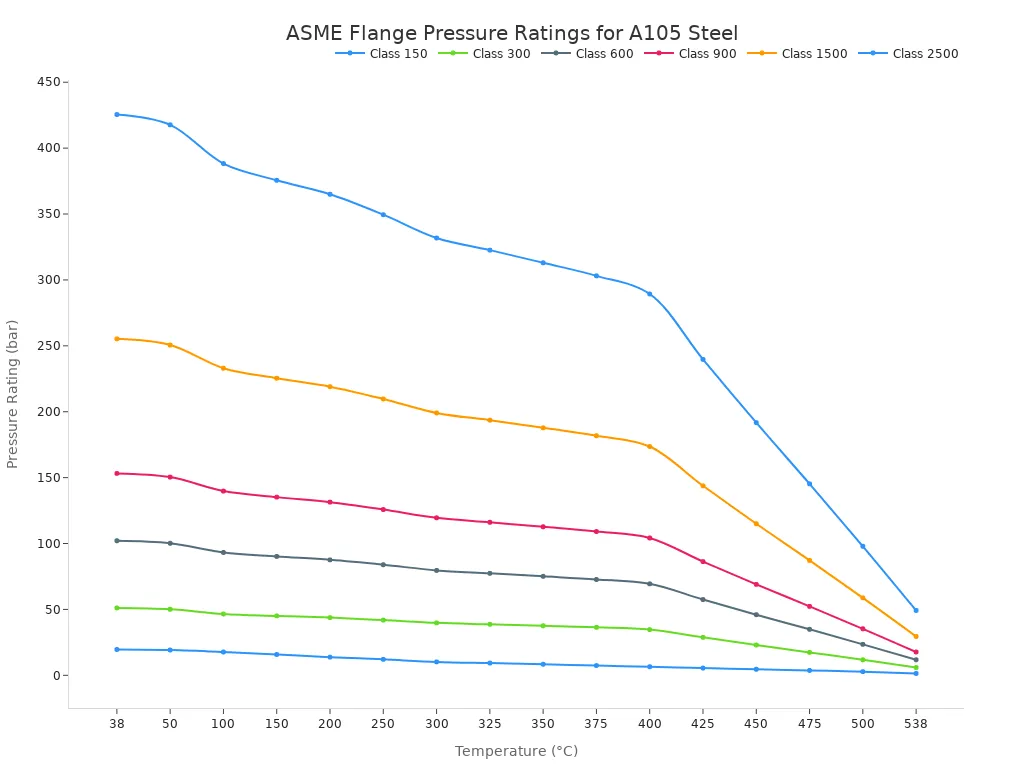
This de-rating mechanism gives designers the flexibility to select the most economical flange that safely meets the specific operating conditions of a piping system.
API Pressure Ratings Explained
The API standard takes a more rigid approach to pressure ratings, reflecting the extreme and hazardous conditions of oil and gas production. This system prioritizes absolute containment with fixed, high-pressure capabilities.
Understanding Ratings from 2000 to 20000 psi
API 6A specifies flanges with fixed working pressure ratings. These ratings are not dependent on temperature within the material’s operational range. The standard ratings include:
- Type 6B Flanges: Designed for pressure classes of 2,000, 3,000, and 5,000 psi.
- Type 6BX Flanges: Engineered for higher pressure classes of 5,000, 10,000, 15,000, and 20,000 psi.
These values represent the maximum allowable working pressure the component can handle. This straightforward system simplifies equipment selection for high-pressure wellhead and drilling operations.
Working Pressure vs. Test Pressure
A critical distinction in the API standard is the difference between working pressure and test pressure.
Note: The working pressure is the maximum pressure the equipment is rated for during normal operation. The hydrostatic test pressure, however, is significantly higher—typically 1.5 to 2 times the working pressure. Every API-rated component must pass this rigorous test before certification, verifying its integrity and providing a crucial safety margin.
Why API and ASME/ANSI Flanges Are Not Interchangeable
Despite occasional similarities in bolt patterns, API and ASME/ANSI flanges are not interchangeable. Using an ASME flange in an API application, or vice versa, is a dangerous practice that can lead to catastrophic failure. The design, material, and testing protocols are fundamentally different.
ASME Class 1500 vs. API 5000 psi Example
A common point of confusion is the comparison between an ASME Class 1500 flange and an API 5000 psi flange. While their bolt circles and bolt hole counts may be identical for certain nominal sizes, their capabilities are vastly different.
- An ASME/ANSI B16.5 Class 1500 flange has a pressure class rating of 1500. Its actual working pressure for A105 carbon steel is approximately 3705 psi at ambient temperature, and this rating drops significantly as temperature rises.
- An API 6A 5000 psi flange has a fixed working pressure of 5000 psi across its entire operating temperature range.
Substituting a Class 1500 ASME flange for a 5000 psi API flange would mean using a component with a lower pressure capacity, creating an immediate and severe safety risk.
The Impact of Pressure on Design
The immense pressure in API applications dictates more robust flange dimensions. API flanges are generally thicker, have larger hub diameters, and are made from higher-strength, strictly controlled materials compared to their ASME counterparts. This increased bulk is necessary to handle the extreme forces without yielding or failing. While some flange dimensions may seem to align, the overall design of API flanges is engineered for a level of containment far beyond the scope of the general-purpose B16.5 standard.
Material Specifications: Flexibility vs. Strictness
The material specifications for ASME and API standards highlight their different design philosophies. The ASME standard offers broad versatility for various industries. In contrast, the API standard mandates strict material strength and quality for high-risk applications.
ASME Material Groups and Versatility
The ASME B16.5 standard provides engineers with significant flexibility in material selection. This approach allows for the design of cost-effective and safe piping systems across a wide range of process conditions.
Common Carbon and Stainless Steel Grades
The ASME standard permits an extensive list of materials. This includes numerous grades of carbon, alloy, and stainless steels. This variety ensures that designers can select a material with the right properties for a specific application, from basic water service to high-temperature chemical processing. The table below shows a sample of common materials permitted for ASME flanges.
| Material Category | Nominal Designation | Forgings | Castings | Plates |
|---|---|---|---|---|
| Carbon Steel | C-Si | A105 | A216 Gr. WCB | A515 Gr. 70 |
| C-Mn-Si | A350 Gr. LF2 | A216 Gr. WCC | A516 Gr. 70 | |
| Alloy Steel | 1¼Cr-½Mo | A182 Gr. F11 Cl. 2 | – | A387 Gr. 11 Cl. 2 |
| 2¼Cr-1Mo | A182 Gr. F22 Cl. 3 | A217 Gr. WC9 | A387 Gr. 22 Cl. 2 | |
| Stainless Steel | 18Cr-8Ni | A182 Gr. F304/F304L | A351 Gr. CF8/CF3 | A240 Gr. 304/304L |
| 16Cr-12Ni-2Mo | A182 Gr. F316/F316L | A351 Gr. CF8M/CF3M | A240 Gr. 316/316L |
Material Selection for Process Conditions
Engineers select ASME materials based on specific process conditions. They must consider the system’s maximum operating temperature and pressure. The material must also be compatible with the fluid to prevent corrosion or degradation. The ASME pressure-temperature rating tables guide this selection, ensuring the chosen flange can safely handle the operational demands. This systematic approach guarantees both safety and longevity for the piping system.
API Material Requirements and Strength
The API 6A standard enforces strict material requirements to ensure absolute integrity in high-pressure oil and gas environments. This approach prioritizes strength, toughness, and verified quality over material flexibility.
Designated Material Strength Levels (45K, 60K, 75K)
API specifies materials based on their minimum yield strength, designated in thousands of psi (ksi). Common material strength levels include 45K, 60K, and 75K. This method directly links the material to its mechanical performance capability, simplifying the selection of components for extreme pressure containment.
Product Specification Levels (PSL)
API uses Product Specification Levels (PSL) to define different tiers of quality control. PSL-1 represents a standard quality level, while PSL-2 and PSL-3 impose more rigorous requirements.
Note: PSL-2 is a higher quality level than PSL-1. It mandates stricter controls on chemical composition, requires mandatory Charpy V-notch impact testing for toughness, and demands extensive non-destructive testing (NDT). PSL-2 also requires full material traceability, ensuring greater accountability and reliability for critical service equipment.
NACE MR0175 Compliance for Sour Service
For applications involving sour gas (containing hydrogen sulfide, H₂S), API equipment must comply with NACE MR0175. This standard places strict limits on material hardness and chemical composition to prevent sulfide stress cracking. Compliance is non-negotiable for ensuring the safety and integrity of equipment in these highly corrosive and dangerous environments.
A Detailed Look at Flange Dimensions and Design
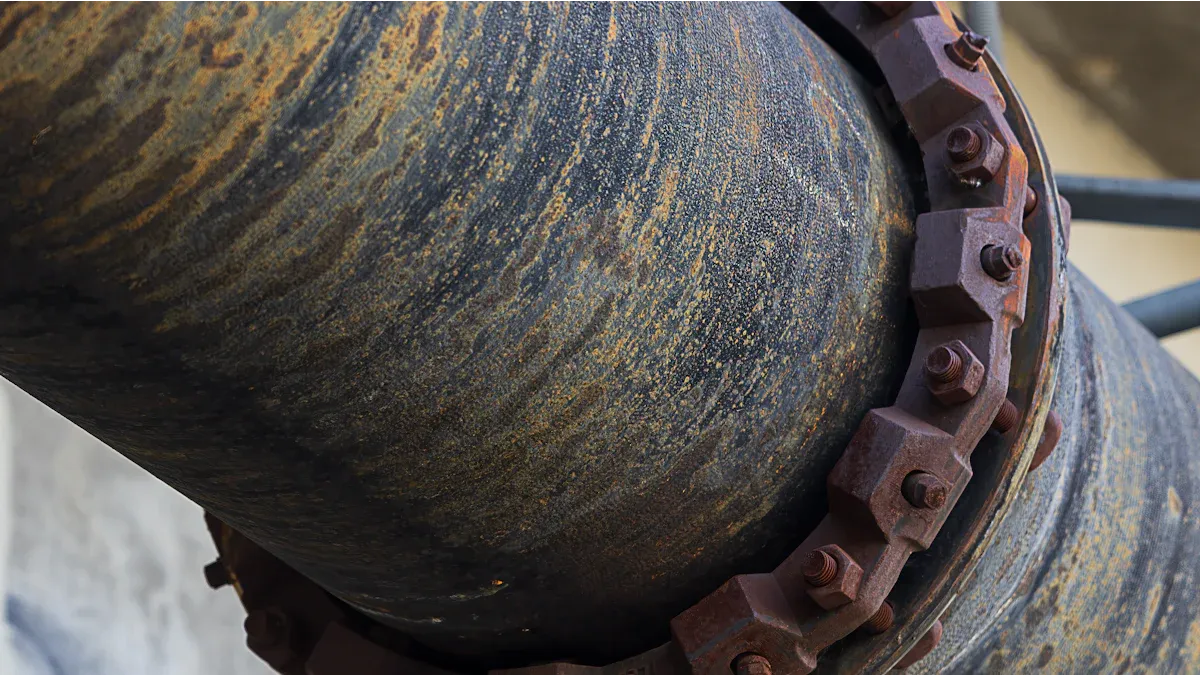
The physical dimensions and design features of ASME and API flanges reveal their distinct engineering purposes. Examining the flange face, joint types, and overall dimensions highlights why these components are not interchangeable. These differences in flange dimensions are critical for ensuring proper sealing and system integrity.
Comparing Flange Face Types
The flange face is the primary sealing surface. Its design dictates the type of gasket used and the mechanism for creating a leak-proof seal. The ASME and API standards specify fundamentally different face types.
ASME Raised Face (RF) and Flat Face (FF)
The ASME B16.5 standard commonly specifies a Raised Face (RF) design. This design concentrates bolt load pressure on a smaller gasket area, improving the seal’s performance. The height of the raised face depends on the pressure class. Flat Face (FF) flanges are also available under the ASME standard, typically for lower-pressure applications where the full face of the gasket makes contact.
API Type R and RX Ring Grooves
API flanges utilize a Ring-Type Joint (RTJ) face. This design features a precisely machined groove that holds a metallic ring gasket. The sealing action occurs as the bolts are tightened, forcing the soft metal gasket to deform and create an intense metal-to-metal seal. This method is far more robust for the high-pressure services common in oil and gas.
| Feature | ASME Raised Face (RF) | API Type R Ring Groove (RTJ) |
|---|---|---|
| Surface Design | A raised portion around the bore for the gasket. | A precision-machined groove for a metallic ring. |
| Sealing Method | Compresses a soft or semi-metallic gasket. | Deforms a metallic ring into the groove for a metal-to-metal seal. |
| Pressure Suitability | Good for moderate to fairly high pressures. | Excellent for high-pressure and high-temperature service. |
| Cost & Complexity | Lower initial cost and simpler installation. | Higher cost due to precise machining and more complex installation. |
Comparing Ring Type Joint (RTJ) Flanges
Both standards include RTJ designs, but their specifications are not the same. This difference is a major source of incompatibility.
ASME B16.5 RTJ Design
The ASME B16.5 standard specifies RTJ flanges designed to accommodate Style R and RX gaskets. These gaskets and their corresponding grooves are standardized for use across various pressure classes within the ASME B16.5 framework.
API 6A Type BX Ring Grooves
The API standard specifies Type 6BX flanges for its highest pressure ratings (5,000 to 20,000 psi). These flanges are engineered exclusively for use with Type BX gaskets, which have a unique profile. The BX gasket is designed to create a pressure-energized seal, where the contained pressure forces the gasket more tightly into the groove.
Gasket Incompatibility Issues
Warning: A Type BX gasket must never be used with an ASME/ANSI B16.5 RTJ flange, even if the nominal size is similar. The designs are incompatible for several reasons:
- BX gaskets are designed for face-to-face flange contact, while ASME RTJ flanges are not.
- The BX gasket has a slightly larger pitch diameter than its groove, creating a pre-load that ASME B16.5 flanges are not designed to handle.
- BX gaskets include a pressure balance hole to prevent pressure lock, a feature not accounted for in the B16.5 design.
Dimensional Analysis of Similar Flanges
A visual comparison of the dimensions of ASME and API flanges reveals the robust nature of the API design.
Bolt Circle Diameter (BCD) Comparison
For some nominal sizes, the bolt circle diameter and number of bolts may appear identical between an ASME and an API flange. This similarity is misleading and dangerous. It does not imply any level of interchangeability.
Flange Thickness and Hub Diameter Differences
The most obvious visual difference is in the bulk of the flanges. To contain extreme pressures, API flanges are significantly thicker and have larger hub diameters than their ASME counterparts. These increased dimensions provide the necessary strength to prevent deformation and failure under immense operational loads.
ASME and API Flange Bolt Charts: A Head-to-Head Comparison
The bolting in a flanged connection provides the critical clamping force needed to create and maintain a seal. A detailed review of the asme and api flange bolt charts reveals that the requirements for fasteners are as distinct as the flanges themselves. These differences in material strength, quantity, and size are fundamental to each standard’s design philosophy and are non-negotiable for ensuring joint integrity.
Bolting Requirements for ASME Flanges
The ASME standard offers a flexible framework for bolting, allowing engineers to select appropriate materials based on service conditions like temperature and pressure. This approach provides versatility for a wide range of industrial applications.
Common Stud and Nut Materials (A193 B7/A194 2H)
ASME B16.5 permits a broad spectrum of bolting materials, which it organizes into strength categories. While many options exist, one combination stands out for its widespread use in standard service conditions.
Industry Standard: The combination of ASTM A193 Grade B7 studs and ASTM A194 Grade 2H heavy hex nuts is the workhorse for a vast number of ASME flange applications. This high-strength carbon alloy steel pairing offers excellent mechanical properties for temperatures up to 450°C (840°F).
The standard classifies bolting materials into several groups:
- High-Strength Bolting: These materials, including the common A193 B7, have allowable stresses comparable to or greater than B7. They are suitable for the full range of pressure classes.
- Intermediate-Strength Bolting: This category includes materials like A193 B7M and various stainless steel grades. Engineers often specify them for moderate service conditions or where specific corrosion resistance is necessary.
- Low-Strength Bolting: Materials like ASTM A307 Grade B have a minimum yield strength not exceeding 30 ksi. The ASME standard restricts their use to low-pressure Class 150 and 300 joints and at temperatures between -29°C and 200°C (-20°F and 400°F).
Standard Bolt Counts and Diameters
The asme and api flange bolt charts specify the exact number and diameter of bolts required for each flange size and class. For ASME flanges, the bolt quantity and diameter increase with both the nominal pipe size and the pressure class. This ensures sufficient clamping force is available to compress the gasket and withstand the hydrostatic end forces generated by the system pressure.
The following table illustrates this principle for common low-to-mid pressure classes.
| Nominal Pipe Size (in) | Class 150 (# / Dia) | Class 300 (# / Dia) | Class 600 (# / Dia) |
|---|---|---|---|
| 2 | 4 / 0.63″ | 8 / 0.63″ | 8 / 0.63″ |
| 3 | 4 / 0.63″ | 8 / 0.75″ | 8 / 0.75″ |
| 4 | 8 / 0.63″ | 8 / 0.75″ | 8 / 0.88″ |
| 6 | 8 / 0.75″ | 12 / 0.75″ | 12 / 1.00″ |
| 8 | 8 / 0.75″ | 12 / 0.88″ | 12 / 1.13″ |
| 12 | 12 / 0.88″ | 16 / 1.00″ | 20 / 1.25″ |
Bolting Requirements for API Flanges
The API 6A standard takes a much stricter, more prescriptive approach to bolting. It mandates high-strength materials and robust designs to guarantee containment in the extreme-pressure environment of oil and gas production.
Higher Strength Material Mandates
Unlike the flexibility of the ASME standard, API 6A specifies a limited list of high-strength bolting materials with tightly controlled mechanical properties. The standard directly links material grades to minimum yield strength requirements. For example, for non-sour service up to 10,000 psi, the standard commonly requires ASTM A193 Grade B7 studs, which must meet a minimum yield strength of 105 ksi for diameters up to 2.5 inches. For sour service (H₂S) applications, materials like A193 Grade B7M are required due to their lower hardness, which provides resistance to sulfide stress cracking.
| Pressure Rating (psi) | Non-exposed Bolting Material | Non-exposed Yield Strength (ksi) | H₂S-Exposed Bolting Material | H₂S-Exposed Yield Strength (ksi) |
|---|---|---|---|---|
| 2000 – 10000 | A193 Gr. B7 (≤ 2.5″) | 105 | A193 Gr. B7M (≤ 4.0″) | 80 |
| 2000 – 10000 | A193 Gr. B7 (> 2.5″) | 95 | A320 Gr. L7M (≤ 2.5″) | 80 |
Increased Bolt Count and Size for Pressure Containment
To contain immense working pressures, API flanges utilize more bolts, larger diameter bolts, or both when compared to ASME flanges of a similar nominal size. This increased cross-sectional area of steel generates the massive clamping force necessary to properly seat the metallic ring gaskets and prevent leaks under loads that can reach tens of thousands of psi. The design leaves no room for ambiguity; the bolting must be strong enough to handle the full test pressure without yielding.
Key Differences in Bolting Charts
Comparing the asme and api flange bolt charts side-by-side highlights the fundamental incompatibility between the two systems. The differences go far beyond a simple count of bolt holes.
Why Bolt Patterns May Appear Similar but Differ
A dangerous point of confusion arises when an ASME flange and an API flange share the same bolt circle diameter and number of bolts. For example, a 12″ Class 900 ASME flange and a 12″ API 3000 psi flange both use 12 bolts. However, the ASME flange specifies 1.25″ diameter bolts, while the API flange requires much larger 1.375″ diameter bolts. This seemingly small difference results in a significant increase in clamping force capability for the API connection. Assuming interchangeability based on a bolt count is a critical error.
The Critical Role of Bolt Material Strength
The single most important factor in bolting is material strength. The entire design of an API joint relies on the high yield strength of its specified fasteners to achieve the necessary bolt preload. Substituting a lower-strength bolt, even one that is dimensionally identical, compromises the integrity of the entire connection.
Warning: Never use standard ASME B16.5 bolting materials in an API 6A flange connection unless they explicitly meet the API material specification for strength, chemistry, and quality verification. Using a common A307 bolt in an API flange, for instance, would lead to immediate bolt failure under load, resulting in a catastrophic blowout. The material strength specified in the bolting charts is an absolute requirement for safety.
Application Guide: Selecting the Correct Flanges
Selecting the correct flange standard is a critical decision that directly impacts system safety and operational integrity. The choice between ASME and API standards depends entirely on the application’s pressure, temperature, and regulatory environment. Understanding where each standard applies is essential for engineers and procurement specialists.
When to Use ASME B16.5 Flanges
The ASME B16.5 standard governs flanges for a vast array of industrial piping systems. Its flexibility in materials and pressure-temperature ratings makes it the default choice for general-purpose applications.
Refineries and Petrochemical Plants
Engineers extensively use ASME B16.5 flanges throughout oil and gas processing facilities. These components are vital for connecting piping networks that handle everything from crude oil to refined chemical products. Key applications include:
- Stress Absorption: Weld neck flanges are preferred on drilling platforms and in refinery piping to manage stress.
- Critical Sealing: The precise surfaces defined by ASME B16.5 ensure the safe containment of hazardous and corrosive fluids in reactor piping.
- High-Pressure Manways: Heavy-duty blind flanges seal high-pressure vessel openings, a common requirement in refining.
Power Generation and Water Treatment
The ASME standard is fundamental in utility sectors. In power generation, ASME B16.5 flanges connect high-pressure boiler systems and turbine components. In water and wastewater treatment, they are essential for assembling large-scale water distribution networks and connecting pumps and tanks in processing plants.
General Industrial Piping Systems
Beyond specialized sectors, the ASME/ANSI B16.5 standard is the backbone of general industrial piping. Its versatility makes it suitable for manufacturing plants, food and beverage processing, and HVAC systems where moderate pressures and temperatures are typical.
When to Use API 6A Flanges
The American Petroleum Institute (API) developed the API 6A standard exclusively for the extreme conditions of oil and gas production. These flanges are not for general use; they are specialized for high-pressure containment.
Wellhead and Christmas Tree Assemblies
API 6A is the mandatory standard for all components of wellhead and Christmas tree assemblies. This equipment controls pressure at the surface of an oil or gas well. Every pressure-containing part, from the casing head housing and tubing head spools to the gate valves and top connectors, must use API-rated flanges.
High-Pressure Manifold Systems
Engineers use high-pressure manifold systems to collect and distribute fluid flow from multiple wells. These systems operate under immense pressure, mandating the use of robust API flanges to connect valves, chokes, and flowlines safely.
Drilling and Production Equipment
All equipment on the high-pressure side of oil and gas drilling and production operations falls under the API standard. This includes blowout preventers (BOPs), choke and kill lines, and other critical safety and production components.
The Dangers of Misapplication
Using the wrong flange type is a critical error with severe consequences. The dimensional similarities between some ASME and API flanges can be dangerously misleading.
Safety Risks and Failure Modes
Substituting an ASME B16.5 flange in an API application creates an immediate risk of catastrophic failure. The lower pressure rating and material strength of the ASME flange cannot withstand the extreme forces, leading to blowouts, fires, and significant safety hazards for personnel.
Regulatory and Compliance Consequences
Regulatory bodies incorporate API standards into federal and local laws. Non-compliance can lead to severe legal liabilities and financial penalties. In 2022 alone, total industry penalties for non-compliance reached nearly $4 billion, highlighting the immense cost of failing to adhere to required standards.
The ASME B16.5 standard governs general-purpose industrial piping, using a pressure rating that varies with temperature. In contrast, the API standard is exclusively for high-pressure oil and gas, defined by fixed ratings and stringent material requirements. Misleading similarities in flange dimensions exist, but the asme and api flange bolt charts confirm these flanges are not interchangeable. Correct selection based on these distinct ASME and API standards is non-negotiable for ensuring safety and compliance in all piping. The ASME B16.5 and B16.5 standards are clear.
FAQ
Can an API flange be used in an ASME piping system?
No. Engineers design API flanges for specific high-pressure service. Their material and quality mandates differ from ASME standards. Using them in a general piping system is an improper and unsafe application.
What is the key difference in pressure ratings?
ASME pressure ratings are temperature-dependent, decreasing as heat rises. API ratings are fixed maximum working pressures. This highlights the core difference between ASME’s flexibility and API’s focus on absolute containment.
Why are API bolting requirements so strict?
API flanges handle extreme pressures. They require higher-strength bolts to generate the necessary clamping force and prevent failure. Using lower-grade bolts compromises the joint’s integrity and creates a severe safety hazard.
Are ASME and API ring type joint (RTJ) gaskets interchangeable?
No. The gasket designs are incompatible. High-pressure API flanges use BX gaskets for a pressure-energized seal. ASME RTJ flanges use R or RX gaskets. Mismatching them will cause the connection to leak.
How can someone visually identify an API flange?
Quick Tip: API flanges are visibly more robust. They are significantly thicker and have larger hub diameters compared to an ASME flange of a similar nominal size. This added mass is necessary for high-pressure service.
Where are API 6A flanges primarily used?
Engineers use API 6A flanges exclusively in high-pressure oil and gas production. Key applications include wellhead assemblies, Christmas trees, and high-pressure manifold systems where failure is not an option.