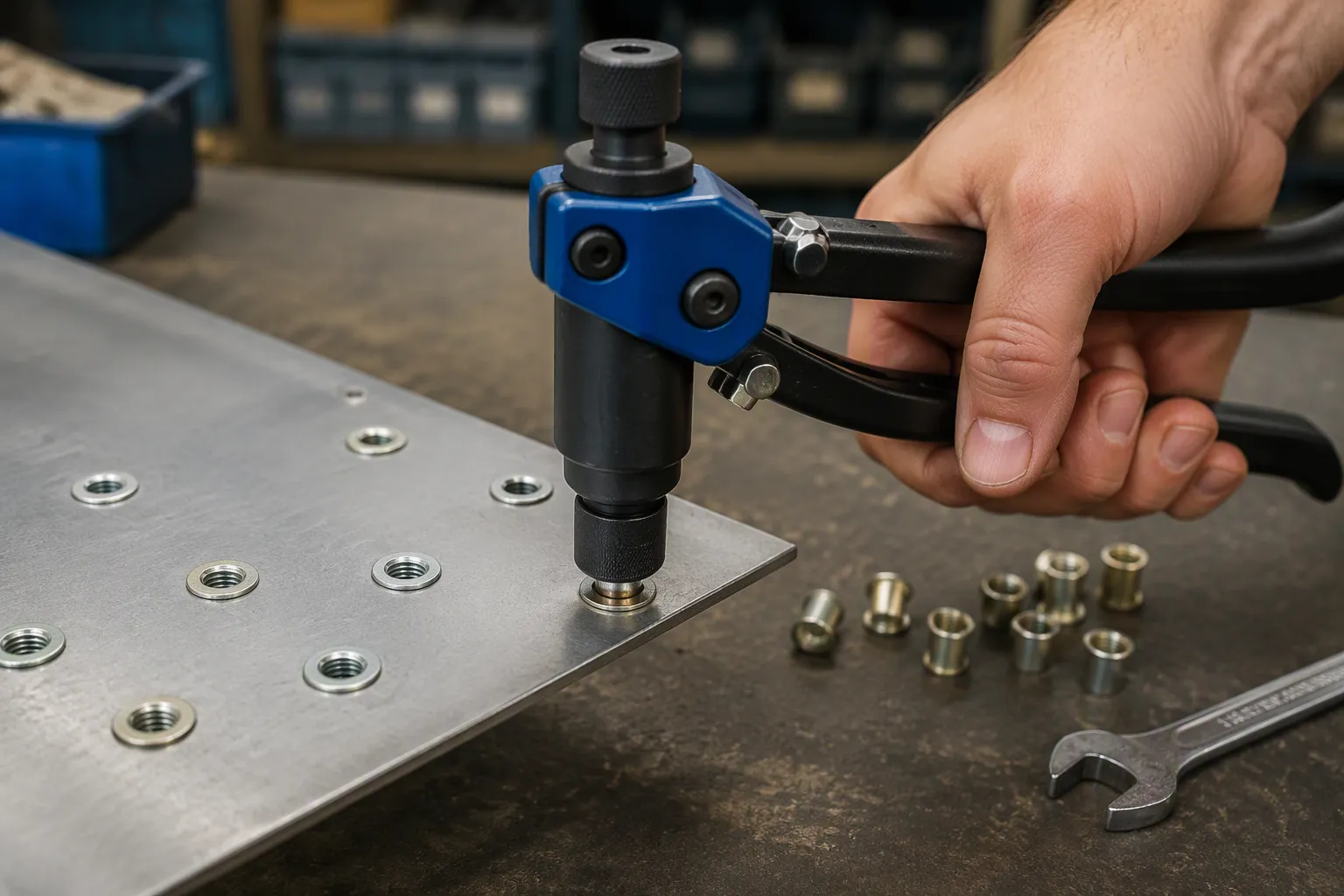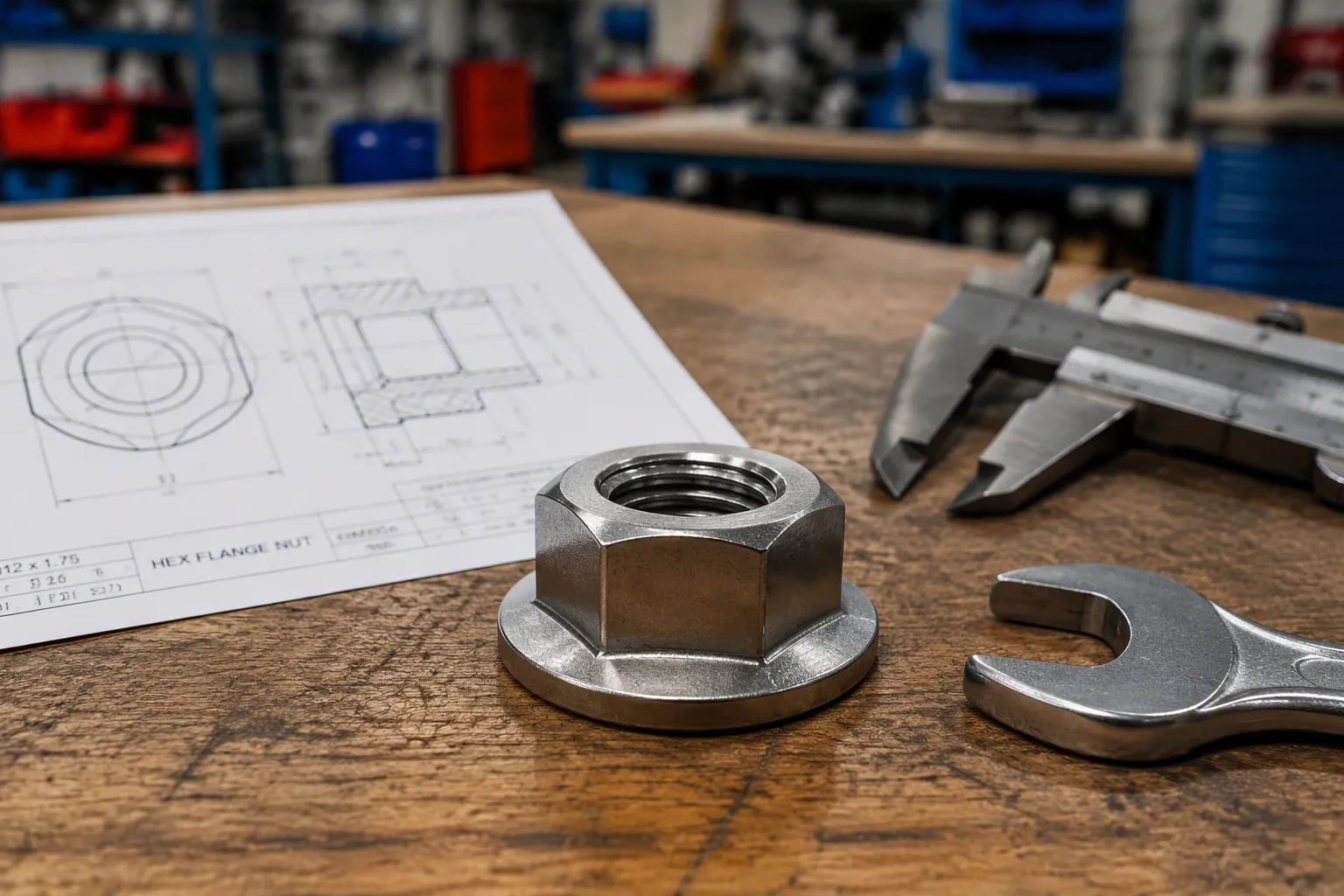
A brass swivel eye bolt is a key component in specialized rigging and lifting operations. This Eye Bolt features a threaded shank, a supportive collar, and a looped head that rotates 360 degrees. The global industrial fasteners market, which includes these specialized eyebolts, is projected to reach approximately USD 131.45 billion by 2030. The swivel capability of these brass swivel eye bolts allows them to act as dynamic secure attachment points. They safely manage angular lifting and prevent the twisting of attached lines. The brass alloy construction offers superior corrosion resistance, making these bolt casting eye bolts ideal for marine environments. As a leading custom fasteners manufacturer, we specialize in producing high-quality custom fasteners to meet diverse industrial needs.
Component Anatomy and Material Composition of Brass Swivel Eye Bolts
Understanding the design of brass swivel eye bolts requires a look at their individual parts and material makeup. Each component serves a distinct purpose. The material choice directly influences the performance and application of these essential fasteners. The various types and variations of eye bolts are designed for specific operational demands.
Breakdown of Core Components
Four primary components form the structure of these specialized eyebolts. Each part contributes to the overall strength and functionality of the assembly.
The Eye Loop
The eye loop is the rounded head of the bolt. It provides a secure attachment point for hooks, shackles, or lifting slings. Its internal diameter is a critical dimension for ensuring compatibility with rigging hardware.
The Swivel Mechanism
This mechanism is the defining feature of these eye bolts. It allows the eye loop to rotate a full 360° independently of the body. This rotation prevents the twisting of attached lines and enables the alignment of the eye with the load direction.
The Collar or Shoulder
The collar, or shoulder, is a flat flange located at the base of the eye. It sits between the eye and the threaded shank. This component transfers the load to the mounting surface, making these eyebolts suitable for angular lifts.
The Threaded Shank
The threaded shank is the body of the bolt. It screws into a tapped hole in a piece of machinery or a structure. The thread type and length must match the receiving hole to ensure a secure and safe installation for all eyebolts.
Material Analysis: Brass Alloys
The selection of a specific brass alloy is critical for performance. Different copper-zinc ratios yield distinct mechanical and chemical properties, making certain grades ideal for specific environments.
Common Brass Grades (C360, C464)
Manufacturers often use C360 (Free-Cutting Brass) and C464 (Naval Brass) for these eye bolts. C360 offers exceptional machinability due to its lead content. C464 provides superior strength and corrosion resistance, especially in marine settings.
Copper-Zinc Ratios and Their Impact
The proportion of copper to zinc directly influences the alloy’s characteristics.
- Strength: A higher zinc content generally increases the strength of the brass.
- Ductility: More zinc also makes the alloy more pliable and easier to shape.
- Corrosion: While brass is corrosion-resistant, high zinc levels can sometimes lead to dezincification, where zinc leaches from the alloy.
Properties of Marine-Grade Brass
Naval Brass (C464) is a prime example of marine-grade material for eyebolts. Its composition is engineered to resist dezincification and saltwater corrosion effectively.
| Brass Grade | Copper (%) | Zinc (%) | Strength | Corrosion Resistance |
|---|---|---|---|---|
| C26000 | ~70 | ~30 | Good | Excellent (wet environments) |
| C46400 | ~60 | ~39 | High | Excellent (marine conditions) |
Finishing and Plating Options (Nickel, Chrome)
Some brass swivel eye bolts receive additional surface treatments. Nickel or chrome plating can be applied to the eyebolts. These finishes enhance surface hardness and provide an extra layer of protection against wear and corrosion.
Critical Technical Specifications for Eyebolts
Selecting the correct brass swivel eye bolts involves a detailed review of their technical specifications. These parameters define the component’s performance limits and ensure safe operation. Key areas include load ratings, dimensional standards, and thread types. A thorough understanding of these details is essential for any rigging and lifting application.
Load Capacity and Ratings
The load capacity of eye bolts is the most critical safety specification. Manufacturers provide clear ratings to prevent equipment failure and ensure personnel safety. These ratings are determined through rigorous testing and engineering calculations.
Working Load Limit (WLL)
The Working Load Limit (WLL) defines the maximum load that eye bolts can safely handle during normal use. This rating is not the breaking point. It is the certified maximum load capacity for routine lifting operations. Exceeding the WLL compromises the structural integrity of the eyebolts and introduces significant risk.
Breaking Strength (Ultimate Load)
Breaking Strength, or Ultimate Load, represents the absolute maximum force an eye bolt can withstand before it fails or fractures. This value is determined during destructive testing. It is used exclusively for engineering calculations and is never a target for actual lifting operations.
Understanding Safety Factors
A safety factor provides a crucial margin of strength to account for unforeseen forces or minor material imperfections. For lifting hardware, safety factors typically range from 4:1 to 7:1. The WLL is calculated by dividing the Minimum Breaking Strength (MBL) by this safety factor.
Calculation Example: An eye bolt with a Minimum Breaking Strength of 10,000 pounds and a 5:1 safety factor has a WLL of 2,000 pounds (10,000 lbs / 5 = 2,000 lbs). This buffer ensures reliable performance.
The Effect of Angular Loading on WLL
A primary advantage of swivel eye bolts is their ability to handle angular loads. Unlike standard eyebolts that require significant de-rating as the lift angle increases, swivel eye bolts maintain their full rated capacity. The swivel mechanism allows the eye to pivot and align perfectly with the load direction, even at angles up to 90 degrees. This feature eliminates the complex de-rating calculations needed for fixed eyebolts and ensures the maximum load capacity is available for a wider range of lifting scenarios.
Dimensional Standards
Standardized dimensions ensure that eye bolts are compatible with mating hardware and mounting surfaces. These measurements are governed by industry standards like ASME B18.15.
Eye Diameter (Inner and Outer)
The inner diameter of the eye must accommodate the hook or shackle used for lifting. The outer diameter relates to the overall strength and clearance requirements of the eye bolts.
Shank Diameter and Length
The shank diameter determines the bolt’s strength and the size of the required tapped hole. The shank length must be sufficient to achieve proper thread engagement in the mounting material without bottoming out or protruding excessively.
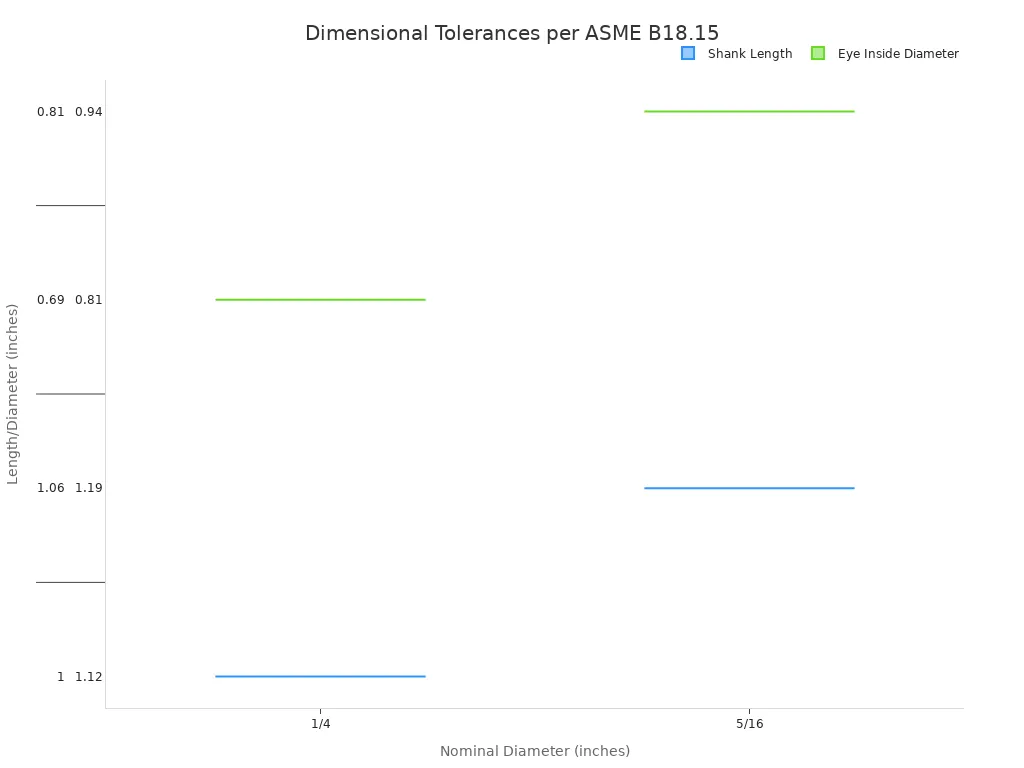
The table below, based on ASME B18.15, shows typical dimensional tolerances for forged eyebolts.
| Nominal Diameter | Shank Length (Min) | Shank Length (Max) | Eye Inside Diameter (Min) | Eye Inside Diameter (Max) |
|---|---|---|---|---|
| 1/4″ | 1.00″ | 1.06″ | 0.69″ | 0.81″ |
| 3/8″ | 1.25″ | 1.38″ | 0.94″ | 1.06″ |
| 1/2″ | 1.50″ | 1.62″ | 1.12″ | 1.25″ |
| 5/8″ | 1.75″ | 1.88″ | 1.31″ | 1.44″ |
Overall Component Height
The overall height of the eyebolts is important for applications with limited overhead clearance. This measurement includes the eye, swivel body, and collar.
Collar Dimensions
The collar’s diameter and thickness are critical. The collar distributes the load onto the mounting surface. A larger collar provides a greater bearing surface, which is essential for supporting the rated load.
Thread Specifications
The thread of the eyebolts ensures a secure connection to the base material. Using the correct thread type and ensuring proper engagement are non-negotiable for a safe installation.
Unified Thread Standard (UNC/UNF)
In the United States, eyebolts commonly use the Unified Thread Standard.
- UNC (Unified National Coarse): Coarse threads are more common, install faster, and are more tolerant of minor thread damage. Common sizes include 1/4″-20 and 3/8″-16.
- UNF (Unified National Fine): Fine threads offer higher tensile strength and better resistance to loosening from vibration.
Metric Thread Standard (M-Profile)
The metric thread standard is used globally and is designated by an “M” followed by the nominal diameter in millimeters (e.g., M8, M10, M12). Metric eyebolts are available in a wide range of sizes, from M6 up to M36 for heavy-duty applications.
Thread Engagement Depth Requirements
Proper thread engagement is vital for the eyebolts to achieve their full load capacity. The required depth depends on the material into which the bolt is threaded. Insufficient engagement can cause the threads to strip under load.
- Brass or Cast Iron: Minimum engagement should be 1.5 to 2.0 times the bolt’s nominal diameter.
- Steel: Minimum engagement should be 1.0 to 1.5 times the bolt’s nominal diameter.
- Aluminum: Minimum engagement should be 2.0 to 2.5 times the bolt’s nominal diameter.
Following these guidelines ensures the connection is strong enough to handle the intended load.
Performance Characteristics of Brass Eye Bolts
The performance of brass swivel eye bolts extends beyond their load capacity. Their material composition gives them distinct characteristics that make them suitable for specialized industrial applications. These properties include corrosion resistance, specific mechanical strengths, and other unique attributes.
Corrosion Resistance
Brass offers excellent resistance to corrosion, a key factor for its use in demanding environments. The specific alloy and conditions determine its long-term durability.
Performance in Marine Environments
Brass is a popular choice for marine hardware. It resists corrosion from saltwater far better than standard cast iron. However, its performance depends on the specific alloy. Marine-grade brass eye bolts, like those made from Naval Brass (C464), contain elements that inhibit dezincification. This process weakens the material by leaching zinc.
| Material | Corrosion Rate (mm/year) | Longevity in Salty Air (years) | Susceptibility to Chloride/Dezincification |
|---|---|---|---|
| Stainless Steel | Less than 0.002 | Over 50 | Resists oxidation below 0.03% chloride |
| Brass (C260/C37700) | Faster than stainless | 30 | Weakens at 0.5 ppm chloride, dezincification prone |
Resistance to Atmospheric Corrosion
Brass develops a protective patina when exposed to the atmosphere. This thin layer of oxidation shields the underlying metal from further corrosion. This self-protecting quality ensures a long service life for these eye bolts in both indoor and outdoor settings.
Galvanic Corrosion Considerations
Engineers must consider galvanic corrosion when using brass eyebolts with other metals. When two dissimilar metals are in contact in the presence of an electrolyte (like saltwater), one can corrode faster. Brass is relatively noble, so it can accelerate the corrosion of less noble metals like aluminum or zinc-plated steel.
Mechanical Properties
The mechanical properties of brass define its strength and ability to withstand physical stress. These values are critical for ensuring the eye bolts can handle their intended loads safely.
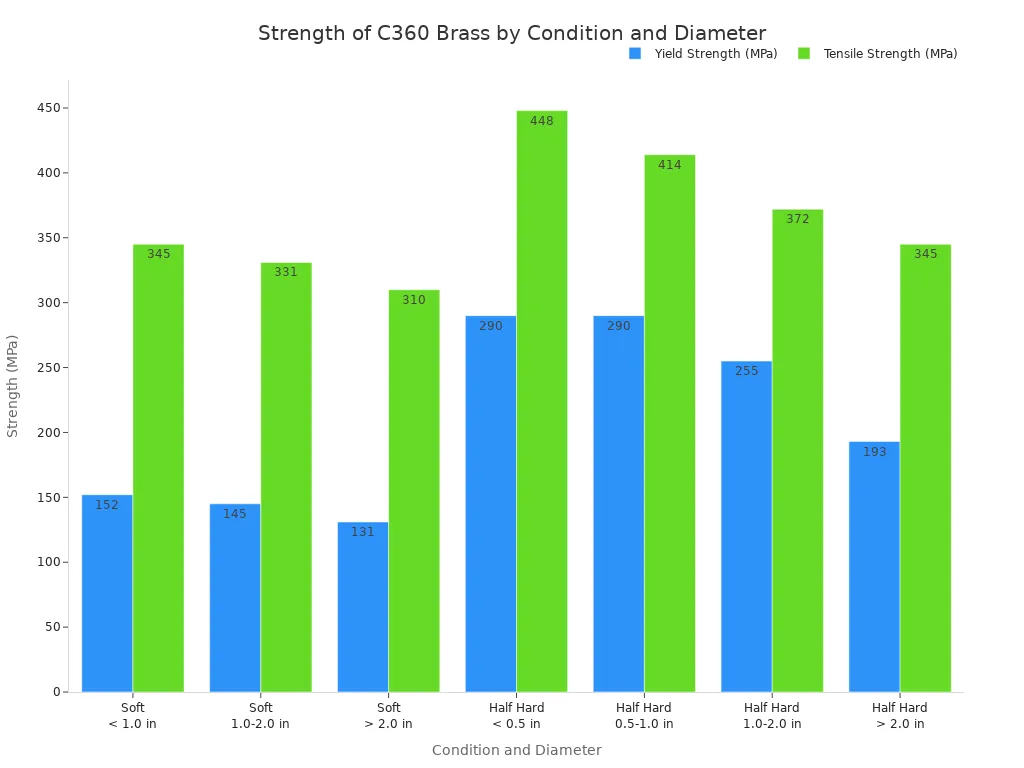
Tensile and Yield Strength
Tensile strength is the maximum stress a material can endure before breaking. Yield strength is the point at which it begins to deform permanently. For C360 brass, these properties vary based on the material’s condition (temper) and diameter. Harder tempers provide higher strength, making them suitable for more demanding eye bolts.
Hardness (Rockwell/Brinell)
Hardness measures a material’s resistance to surface indentation and scratching. Harder brass eyebolts are more resistant to wear and surface damage. This property is often measured on the Rockwell B or Brinell scales.
Ductility and Malleability
Ductility is a material’s ability to be stretched without breaking, while malleability is its ability to be shaped. Brass is both ductile and malleable. This allows manufacturers to form it into the complex shape of these eye bolts without creating internal stresses that could lead to failure.
Special Properties
Brass possesses unique properties that make it the only viable choice for certain hazardous or sensitive applications.
Non-Sparking Characteristics
One of the most important features of brass eyebolts is their non-sparking nature. A strike against a steel surface will not create a spark. This makes them essential for safety in environments with flammable materials.
- Oil & Gas fields
- Chemical processing plants
- Grain silos and handling facilities
- Mining operations with combustible dust
- Paint and varnish manufacturing plants
Antimicrobial Efficacy
Copper and its alloys, including brass, are naturally antimicrobial. They can kill a wide range of harmful bacteria, viruses, and fungi upon contact.
Scientific studies confirm that copper alloy surfaces significantly reduce bacterial counts, including multidrug-resistant strains like MRSA. This makes brass eye bolts a valuable component in healthcare settings or food processing facilities to limit surface contamination.
Electrical and Thermal Conductivity
Brass is a good conductor of both electricity and heat. While this is not a primary consideration for most lifting applications, it can be relevant in specialized electrical or manufacturing environments where these properties are a factor.
Selection Criteria for Application
Choosing the correct brass swivel eye bolts is a critical engineering decision. A systematic approach ensures safety and optimal performance. This process involves analyzing the load, the operating environment, and the physical mounting requirements.
Matching the Bolt to the Load
The primary function of these eyebolts is to handle a specific load. A thorough assessment of the forces involved is the first step in the selection process.
Calculating Total Load
Engineers must calculate the total load the eye bolts will support. This calculation includes the weight of the object being lifted plus any rigging hardware like slings, shackles, or hooks. The selected component’s load capacity must always exceed this total calculated weight.
Static vs. Dynamic Loading
The nature of the load significantly impacts selection.
- Static Load: A stationary load that applies a constant, unchanging force.
- Dynamic Load: A load that changes due to motion, such as lifting, swinging, or repositioning. Dynamic forces are greater than static forces.
Considering Shock Loads
Users must prevent shock loading at all costs. A shock load occurs from sudden stops, drops, or rapid changes in direction. These events create a hazardous load that can exponentially increase tension on the eye bolts.
An instantaneous change in load greater than 10% of the rated working load is a hazardous shock load. This condition will invalidate the normal working load recommendations for the eyebolts. The component’s capacity is compromised, creating a high risk of failure.
Environmental and Operational Factors
The performance of brass eye bolts depends heavily on their surrounding environment. These factors can affect material integrity and lifespan.
Temperature Range
Brass can become brittle at extremely low temperatures and lose strength at high temperatures. Users must verify that the application’s operating temperature falls within the safe range specified for the brass alloy.
Chemical Exposure
While brass offers good chemical resistance, certain aggressive chemicals can cause corrosion. Planners should confirm the material’s compatibility with any chemicals present in the operating environment to ensure the long-term reliability of the secure attachment points.
Indoor vs. Outdoor Use
Brass performs well in both indoor and outdoor settings. Outdoor use will cause the material to develop a natural protective patina, which shields it from further atmospheric corrosion. This makes the eyebolts a durable choice for external applications.
Choosing the Correct Size and Thread
Proper mechanical fit is non-negotiable for safety. The size and thread of the eyebolts must perfectly match the mating hole to achieve the full rated load.
Mating Hole Preparation
Preparing the mating hole correctly is essential for strength. The wall thickness of the base material dictates the best approach.
- Steel: Direct tapping is suitable for thicknesses over 10mm.
- Aluminum: Direct tapping works for static assemblies over 7.5mm thick, but inserts are better for high-cycle use.
- Plastics: All plastics require threaded inserts, as plastic threads are prone to stripping.
Verifying Thread Compatibility
Surface coatings can alter thread dimensions. It is crucial to select the correct thread class to compensate for plating or powder coating thickness.
| Application | Thread Class | Assembly Feel | When to Use |
|---|---|---|---|
| General Assembly | 6H/6g | Moderate start pressure | Default choice |
| Coated Parts | 6H/5g6g | Easy hand start | After anodizing/coating |
| Field Assembly | 6H/5g6g | Easy in dirty conditions | Maintenance access |
Selecting Appropriate Shank Length
The shank length must be sufficient for proper thread engagement. The minimum engagement depth depends on the base material. For example, steel requires an engagement of at least 1.0 times the bolt diameter, while aluminum requires 1.5 times. This ensures the connection is strong enough to support the intended load.
Installation and Safety Guidelines
Proper installation and adherence to safety guidelines are paramount for the performance of brass swivel eye bolts. A disciplined approach, from initial inspection to final tightening, ensures these components function as reliable and secure attachment points. Following established procedures prevents equipment failure and protects personnel.
Pre-Installation Inspection
Before any installation, a thorough visual inspection is a mandatory first step. This routine inspection helps identify defects that could compromise the safety and load-bearing capacity of the eyebolts. This critical inspection process must never be skipped.
Checking for Thread Damage
Users must carefully examine the threads for any signs of damage. Running a nut down the threads can help detect roughness or galling. Any stripped, crossed, or incomplete threads will prevent proper engagement and reduce the holding power of the eye bolts.
Inspecting for Cracks or Deformation
A detailed inspection of the entire component is necessary to find any physical flaws. Any defect compromises the structural integrity of the eye bolts. Key indicators of a faulty part include:
- Bends, Cracks, or Twists: Look for any hairline cracks on the shank or eye, bent shanks, or a twisted body.
- Surface Imperfections: Check for laps, seams, or other irregularities from the manufacturing process.
- Galling: Examine threads for raised or torn material, which indicates a problem.
- Dents or Distortions: Inspect the head and collar for any dents or bulges that could prevent proper seating.
Verifying Swivel Functionality
The swivel mechanism must rotate a full 360° smoothly and without any binding. A stiff or gritty swivel action indicates an internal issue. This functionality is essential for the eye bolts to align correctly with the load. A proper inspection confirms this.
Proper Installation Technique
Correct installation technique ensures the eye bolts can handle their rated load safely. Each step, from seating the collar to applying the right torque, is crucial for meeting safety standards.
Seating the Collar Flush
The collar, or shoulder, of the eye bolts must sit completely flush against the mounting surface.
A gap between the collar and the surface is extremely dangerous. This gap prevents the shoulder from resisting bending forces during an angular lift. This condition dramatically reduces the bolt’s capacity and can lead to sudden failure under load.
Achieving Correct Torque
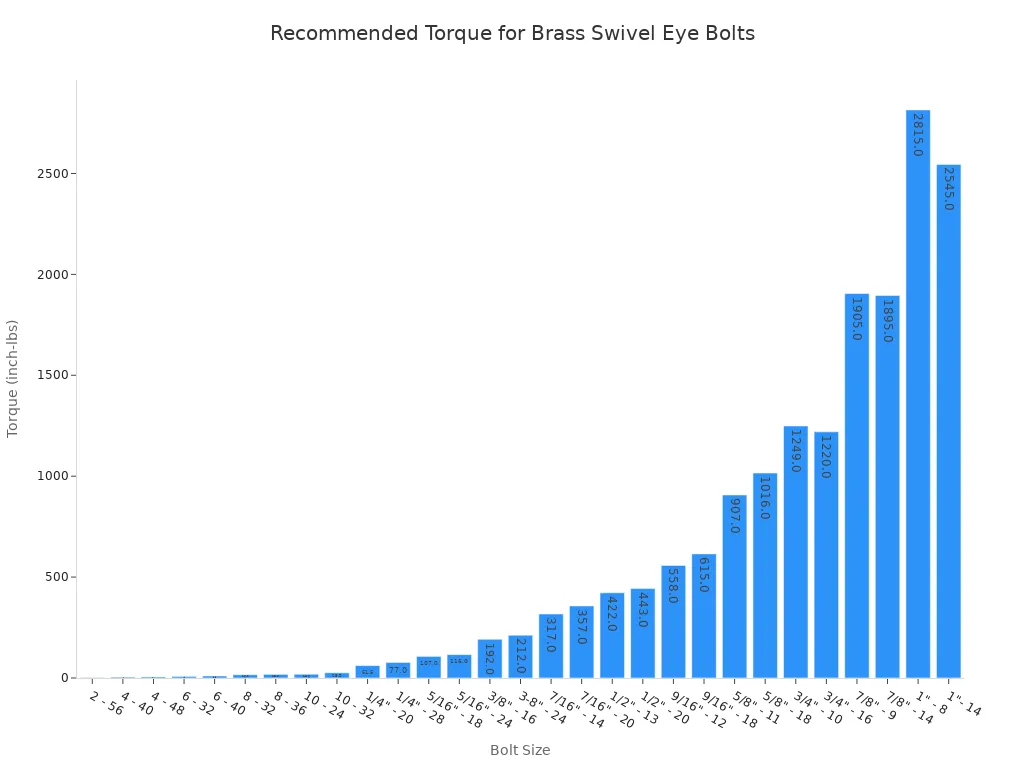
Applying the correct torque is essential. Over-tightening can strip the brass threads, while under-tightening can allow the eyebolts to loosen. Users should always use a calibrated torque wrench. The required torque varies by bolt size and the material of the tapped hole.
| Bolt Size | Brass Torque (inch-lbs) |
|---|---|
| 1/4″ – 20 | 61.5 |
| 5/16″ – 18 | 107.0 |
| 3/8″ – 16 | 192.0 |
| 1/2″ – 13 | 422.0 |
| 5/8″ – 11 | 907.0 |
Alignment with Load Direction
The swivel mechanism allows the eye to pivot toward the load. However, installers should initially align the eye in the general direction of the pull. This practice minimizes initial stress on the swivel components when the load is first applied.
Common Misuses and Limitations
Understanding the limitations of brass swivel eye bolts is as important as knowing how to install them. Misuse can lead to catastrophic failure.
Exceeding the Working Load Limit
The Working Load Limit (WLL) is the maximum safe load. This limit must never be exceeded. Users must account for the total weight, including all rigging, to ensure the load remains below the WLL.
Side Loading Non-Shouldered Bolts
Swivel eye bolts are shouldered and designed for angular loading. However, users must never apply a side load to a non-shouldered (plain pattern) eye bolt. This action will bend or break the bolt.
Use in High-Vibration Environments
Continuous vibration can cause any threaded fastener to loosen over time. In such environments, a periodic inspection to verify torque is necessary. Applying a suitable thread-locking compound can also help maintain a secure connection.
Applicable Standards and Certifications for Brass Swivel Eye Bolts
Adherence to established standards and certifications is non-negotiable in the world of rigging and lifting. These documents provide a framework for manufacturing quality and performance verification. They ensure that brass swivel eyebolts meet critical safety standards and function reliably under their specified loads. Purchasers and end-users rely on this documentation to guarantee product integrity.
Industry Standards and Specifications
Several key industry standards govern the design, material, and testing of eyebolts. These specifications create a baseline for quality and interoperability across the industry.
ASME B18.15 (For-Forged Eyebolts)
The American Society of Mechanical Engineers (ASME) B18.15 standard specifies requirements for forged eyebolts. It primarily focuses on dimensions and capacities. The standard covers carbon and stainless steel forged threaded eyebolts intended mainly for lifting applications. While written for steel, its dimensional principles are often referenced for high-strength brass eyebolts. The standard ensures that the physical dimensions, such as head diameter, are consistent with the bolt’s nominal size.

The standard provides detailed dimensional tolerances for every aspect of the component.
| Nominal Size | Shank Length (L) | Head Diameter (A, Max) | Head Diameter (A, Min) |
|---|---|---|---|
| 4 | 3/16″ | 0.212″ | 0.191″ |
| 6 | 3/16″ | 0.262″ | 0.238″ |
| 8 | 1/4″ | 0.312″ | 0.285″ |
| 10 | 5/16″ | 0.362″ | 0.333″ |
ASTM B16/B98 (Brass Rod, Bar, and Shapes)
ASTM International standards focus on the raw material itself. ASTM B16 (for Free-Cutting Brass) and ASTM B98 (for Copper-Silicon Alloy) define the required chemical composition and mechanical properties of the brass alloys used to manufacture the eyebolts. These standards ensure the base material has the correct strength, ductility, and corrosion resistance from the very beginning.
ISO 3266 (Lifting Eyebolts)
The International Organization for Standardization (ISO) 3266 provides specifications for general-purpose grade 4 lifting eye bolts. It is the global counterpart to standards like ASME. This standard outlines requirements for materials, dimensions, mechanical properties, and testing methods, ensuring a consistent level of quality for products used internationally.
Manufacturer Certifications
Certifications are documents provided by the manufacturer that prove a specific batch of eyebolts conforms to the relevant standards. They offer traceability and assurance of quality.
Certificate of Conformance
A Certificate of Conformance (CoC) is a formal declaration from the manufacturer. It states that the supplied products meet the specifications outlined in the purchase order and relevant industry standards. It is a general statement of quality compliance.
Material Test Reports (MTRs)
A Material Test Report (MTR) offers a much deeper level of detail. This document provides complete traceability back to the raw material batch, or “heat.” It includes critical data that verifies the material’s quality.
- Material Heat Number: A unique code to track the specific material batch.
- Material Grade: Confirms the specific brass alloy (e.g., C360, C464).
- Mechanical Properties: Lists tested values for tensile strength and yield strength.
- Chemical Requirements: Details the exact chemical composition of the alloy.
Load Testing Certification
This certification provides ultimate proof of an eye bolt’s capability. It confirms that samples from a production lot were physically tested to verify their Working Load Limit (WLL) and ultimate breaking strength. This document is crucial for applications where failure is not an option.
Key specifications define the correct brass swivel eye bolts for a specific load. The Working Load Limit (WLL) dictates the safe load these eye bolts can handle. The swivel function helps the eyebolts manage an angular load.
Important: Proper installation ensures the eye bolts support the intended load. The unique properties of these eyebolts make them the ideal eye bolts for hazardous environments where a safe load is paramount.
FAQ
Why choose brass over stainless steel for eyebolts?
Brass provides essential non-sparking and antimicrobial properties. It is the required material for specific hazardous environments. Stainless steel offers superior corrosion resistance in other applications. The choice depends entirely on the operational needs and safety requirements.
Can you use these eyebolts for angular lifts?
Yes. The swivel mechanism allows the eye to align with the load. This design makes these shouldered eyebolts ideal for angular lifts.
They maintain their full Working Load Limit (WLL) at angles up to 90 degrees, unlike fixed eye bolts that require significant de-rating.
What happens if you overtighten a brass eye bolt?
Overtightening can strip the soft brass threads. This damage compromises the connection’s strength and can lead to failure under load. Users must always use a calibrated torque wrench to apply the correct force for these components.
How often should you inspect these components?
Users should perform a visual inspection before each use. A thorough inspection of the eyebolts for wear, damage, and proper swivel function is mandatory. Regular checks ensure operational safety and reliability.
Are all brass eyebolts non-sparking?
Yes, all standard brass alloys are inherently non-sparking. This material property makes brass eyebolts essential for safety in explosive or flammable atmospheres where a spark from steel could cause a disaster.
What is the most critical specification to check?
The Working Load Limit (WLL) is the most critical specification. It defines the maximum safe load. Users must ensure the total weight never exceeds the WLL of the eyebolts to prevent equipment failure and ensure personnel safety.