When it comes to securing heavy loads, the integrity of your connection points is paramount. That’s why installing eye bolts correctly is so crucial. Our expertise lies in the meticulous process of bolt casting, ensuring each Eye Bolt we produce meets the highest standards of strength and durability. As a leading custom fasteners manufacturer, we understand that off-the-shelf solutions don’t always cut it. We specialize in crafting custom fasteners tailored to your specific needs, providing the precise fit and performance required for even the most demanding applications.
Section 1: Choosing the Right Eye Bolt for the Job
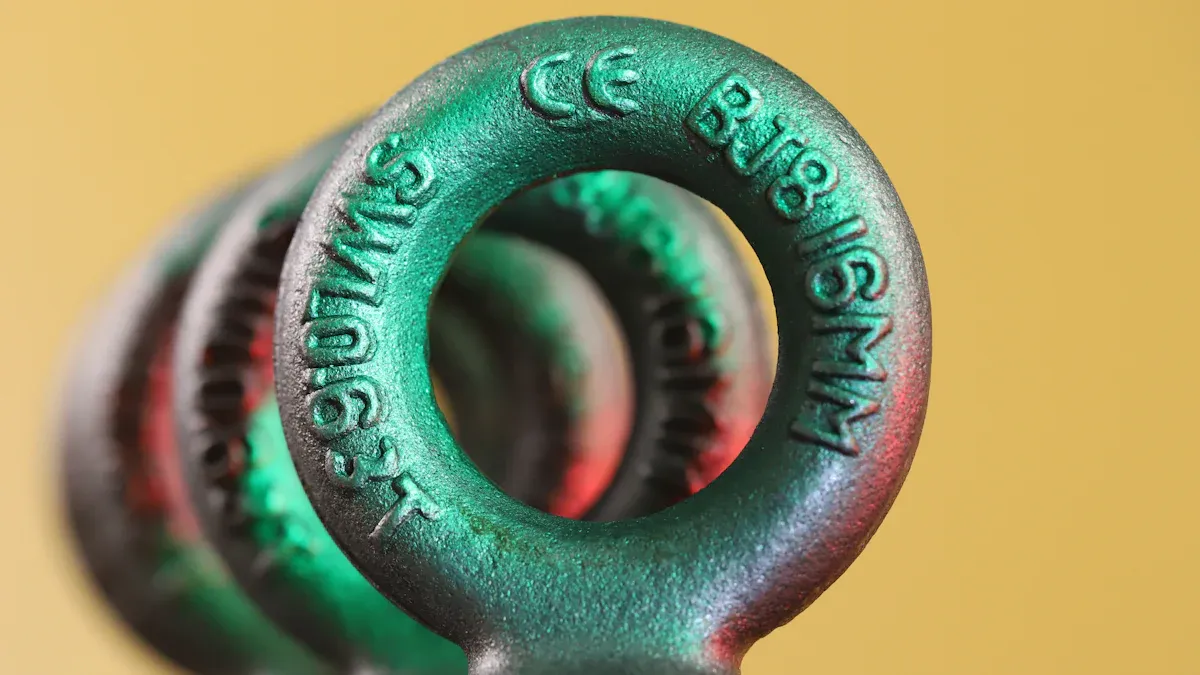
Selecting the correct hardware is the first and most critical step in any lifting operation. The type of eyebolts used, their capacity, and their suitability for the lift angle directly impact the safety and success of the task. Making an informed choice prevents equipment failure and ensures a secure lift.
Understanding the Three Main Types of Eyebolts
Different lifting scenarios require specific types of eyebolts. Each has a distinct design and application.
Shouldered Machinery Eye Bolts for Angular Lifts
Shouldered machinery eyebolts feature a collar or “shoulder” between the eye and the threads. This shoulder provides stability against bending forces, making these eyebolts suitable for both vertical and angular lifting. Manufacturers design these components to meet strict standards.
- ASME B18.15 covers the design of forged eye bolts.
- DIN 580 specifies dimensions and load ratings for lifting eye bolts.
- ISO 3266 defines requirements for forged steel lifting eye bolts.
Non-Shouldered (Plain Pattern) Eye Bolts for Vertical Lifts Only
Non-shouldered eyebolts, also known as plain pattern eye bolts, lack a stabilizing shoulder. They are designed exclusively for vertical, in-line lifting. Applying an angular load to these eyebolts can cause them to bend or break, leading to catastrophic failure. These eye bolts must comply with standards like ANSI/ASME B18.7.1.
Swivel Hoist Rings for Maximum Flexibility
Swivel hoist rings are the most advanced option for complex lifting. They offer a 360-degree swivel and a 180-degree pivot action. This design allows the lifting eye to align perfectly with the sling angle, maintaining 100% of its rated capacity at angles up to 90 degrees. They are made from high-strength alloy steel, providing superior performance and safety for any lifting angle.
How to Match the Eye Bolt to Your Load
Properly matching the hardware to the load is essential for safe lifting.
Calculating the Total Load Weight
Operators must first determine the exact weight of the object they intend to lift. This calculation should include the weight of any rigging hardware, such as slings, shackles, or spreader bars, to find the total load.
Understanding Working Load Limit (WLL)
The Working Load Limit (WLL) is the maximum mass or force that a piece of lifting equipment is certified to handle. Manufacturers determine the WLL by dividing the equipment’s minimum breaking strength by a safety factor. Users must never exceed the stated working load limit.
The Critical Role of the Design Safety Factor
The safety factor is a crucial ratio that provides a buffer between the working load limit and the point of failure. The industry standard for the safety factor typically ranges from 5:1 to 12:1. A 5:1 safety factor means the eyebolt’s breaking strength is five times its WLL. This built-in safety factor accounts for unforeseen variables in the lifting environment.
Angular Loading vs. Vertical Lifts
The angle of the lift dramatically affects the forces exerted on eyebolts.
Why Angular Lifts Demand Shouldered Eye Bolts
The shoulder on shouldered eye bolts sits flush against the load surface. It transfers the angular force, or shear load, directly to the head of the bolt. This prevents the threads from experiencing dangerous bending stress. Non-shouldered eyebolts cannot handle this stress.
How Lift Angle Reduces the WLL
When using shouldered eyebolts for angular lifting, their capacity decreases as the angle increases. For machinery eye bolts, angular lifts should never exceed a 45-degree pull from the bolt centerline. A lift at a 45-degree angle can reduce the WLL by as much as 75%.
Important Tip: Always consult the manufacturer’s load reduction chart. Ignoring these reductions is a common and dangerous mistake in lifting operations.
When Swivel Hoist Rings are the Safer Choice
Swivel hoist rings are the recommended solution for most angled lifts. Because they can pivot and rotate, they automatically adjust to the sling angle. This eliminates bending stress and allows them to maintain their full working load limit, making them a much safer choice for non-vertical lifting.
Material and Thread Specifications
Beyond the type of eyebolt, the material composition and thread specifications are fundamental details that dictate performance and safety. Selecting the right combination ensures the hardware can withstand both the load and the operational environment. The choice of material for eyebolts directly impacts their strength and environmental resistance.
Carbon Steel vs. Stainless Steel Eyebolts
Operators must choose between carbon steel and stainless steel based on the application’s demands. Carbon steel eyebolts, often made from quenched and tempered alloys like ASTM A449 or ASTM F568M, provide superior strength and are a cost-effective choice for general indoor lifting. However, they require a protective coating to prevent rust.
Stainless steel eyebolts offer excellent corrosion resistance, making them essential for use in marine, chemical, and food-grade environments. Different grades are available for specific conditions.
| Grade | Description | Common International Standards |
|---|---|---|
| AISI 304 | Austenitic, general corrosion-resistant | ASTM A193, EN 10088 |
| AISI 316 | Marine-grade, superior corrosion resistance | ASTM A276, DIN 17440 |
| Duplex 2205 | High strength, resists chloride stress cracking | ASTM A479, EN 1.4462 |
Protective Finishes: Galvanized vs. Zinc-Plated
For carbon steel eye bolts, a protective finish is crucial for longevity.
- Zinc-Plating: This process applies a thin layer of zinc, offering moderate corrosion protection. It is best suited for indoor applications where the eyebolts will not be exposed to moisture.
- Hot-Dip Galvanizing: This method involves dipping the eyebolts in molten zinc, creating a thick, durable, and metallurgically bonded coating. Galvanized eyebolts are ideal for outdoor and harsh environments.
Matching Thread Standards: UNC vs. UNF
The thread type affects both installation ease and load-bearing characteristics. The two primary standards are UNC (Unified National Coarse) and UNF (Unified National Fine).
UNC Threads:
- Have a coarser pitch, allowing for faster assembly and disassembly.
- Are more tolerant of minor thread damage or debris.
- Are less likely to cross-thread during installation.
UNF Threads:
- Possess a larger tensile stress area, giving them a higher load-bearing capacity.
- Provide better resistance to loosening from vibration.
- Allow for finer adjustments when setting preload torque.
The choice between them depends on whether the priority is installation speed (UNC) or precision and strength (UNF). Most standard machinery eye bolts use UNC threads.
Ensuring Sufficient Thread Length for Full Engagement
Proper installation demands that the threads of the eye bolt fully engage with the threads in the receiving hole. Insufficient engagement is a primary cause of thread stripping and catastrophic failure.
Safety Critical: As a rule, the minimum thread engagement length should be 1.5 times the bolt’s nominal diameter in steel. For softer materials like aluminum, this length should increase to at least 2.5 times the diameter to distribute the load safely across more threads. Never use eyebolts with damaged or insufficient threads.
Section 2: Pre-Installation Checks and Hole Preparation
A successful lift begins long before attaching a sling. Proper preparation of both the hardware and the load surface is a non-negotiable part of the process. A thorough pre-installation check prevents failures caused by worn components or improper hole preparation. This diligence ensures that all eyebolts can perform to their rated capacity.
Inspecting the Eye Bolt Before Every Use
Operators must perform a tactile and visual inspection on all eyebolts before each lift. This routine check is the first line of defense against equipment failure.
Checking for Bends, Cracks, and Deformation
Users should meticulously examine the entire eyebolt for any signs of damage. Even a hairline crack can compromise the structural integrity of the hardware, leading to catastrophic failure under load. Any bent shanks or deformed eyes are clear indicators that the component is unsafe for use. These damaged eyebolts must be removed from service immediately.
Verifying Thread Integrity and Smoothness
The threads are critical for a secure connection. Operators must check for any damaged, stripped, or distorted threads that could compromise holding power. Running a nut down the threads is a simple way to feel for roughness or galling. Using a thread gauge can confirm the correct pitch and identify wear on the eyebolts.
Confirming Legible WLL and Manufacturer Markings
All lifting eyebolts must have legible markings that identify the manufacturer and the Working Load Limit (WLL). If these markings are missing, painted over, or unreadable, the eyebolt is not compliant and must be discarded. This information is essential for safe load matching.
ASME B30.26 Removal Criteria
The American Society of Mechanical Engineers (ASME) provides clear guidelines for removing rigging hardware from service. An eyebolt must be rejected if any of the following conditions are present:
- Excessive pitting, nicks, gouges, or corrosion.
- A 10% reduction of the original dimension at any point on the component.
- Bent, twisted, or distorted parts.
- Excessive thread damage or wear.
- Any other visible damage that creates doubt about its continued safe use.
Preparing the Receiving Hole for Eye Bolts
The receiving hole is just as important as the eye bolts themselves. A poorly prepared hole will prevent a secure installation.
Tapping the Correct Thread Size and Pitch
The tapped hole must perfectly match the thread specification of the eye bolts. A simple formula for determining the correct tap drill size is Major Diameter - Pitch. Using the wrong tap size will result in a weak connection that can strip under load.
Calculating the Required Minimum Thread Depth
Sufficient thread engagement is necessary to develop the full strength of the eye bolts. While a few threads can hold significant force, a safe rule is to ensure a minimum thread engagement of 1.5 times the bolt’s diameter in steel. This depth increases to 2.5 times the diameter in softer materials like aluminum.
Cleaning Threads of Debris, Oil, and Burrs
After tapping, operators must thoroughly clean the hole. They should use brushes and compressed air to remove all metal chips, debris, and excess cutting fluid. A clean hole allows for smooth installation and full thread engagement for the eyebolts.
Inspecting the Load Material for Cracks or Defects
The final preparation step involves a close inspection of the load material around the tapped hole. The presence of cracks, voids, or other defects in the base material can compromise the entire lifting point.
Verifying the Load Surface Integrity
The surface where the eyebolt seats must be suitable for the forces involved.
Ensuring the Surface is Flat and Perpendicular to the Hole
For shouldered eyebolts, the load surface must be flat, smooth, and perpendicular to the hole’s centerline. This ensures the shoulder seats flush and properly transfers angular loads without creating dangerous bending stress on the threads.
Checking for Obstructions Around the Tapped Hole
The area around the hole must be completely free of obstructions. Any burrs, weld spatter, or other material will prevent the shoulder from making 100% contact with the surface, creating a hazardous gap.
Confirming Load Material Hardness and Strength
Operators must confirm the load material is strong and hard enough to withstand the clamping force and lifting load without deforming. Installing high-strength eyebolts into a soft base material can lead to thread stripping or material failure at the lifting point.
Section 3: The Step-by-Step Process for Installing Eye Bolts

Proper installation is where theory meets practice. Following a precise, step-by-step procedure for installing eye bolts is essential for translating the hardware’s rated capacity into a safe and secure lifting point. The method varies slightly depending on whether the lift is vertical or angular, but the core principles of a flush fit and proper torque remain constant.
Installation for Vertical (In-Line) Lifts
Vertical lifting is the most straightforward application for eyebolts. The force is applied directly in line with the bolt’s shank, minimizing complex stresses. A correct installation ensures this force is managed safely.
Hand-Tightening the Eye Bolt Until Snug
Operators begin the process by threading the eye bolt into the prepared hole by hand. They should continue turning the eyebolts until they feel the shoulder make initial contact with the load surface. This manual step prevents cross-threading and confirms the threads are compatible and clean.
Ensuring the Shoulder is Seated Flush to the Surface
This is a critical safety checkpoint. The shoulder of the eye bolt must sit completely flush against the load surface. There can be no gap between the two. A flush seat ensures that the load is transferred correctly through the body of the bolt. Visual indicators of a perfectly seated shoulder include:
- The shoulder of the eye bolt makes uniform and snug contact with the surface.
- No light is visible between the shoulder and the load surface from any angle.
- A gap of any size indicates an improper installation, and the lifting operation must not proceed.
Applying Final Torque with a Wrench
Hand-tightening is not sufficient for a secure lifting connection. Operators must use a calibrated torque wrench to apply the final tightening force. They should follow the manufacturer’s recommended torque value for the specific size and grade of the eyebolts. This ensures the correct preload is achieved without over-stressing the threads.
Verifying 100% Thread Engagement
After tightening, a final verification is necessary. Operators must confirm that the eye bolt has engaged the threads in the receiving hole to the required depth. For steel, this is a minimum of 1.5 times the bolt’s diameter. This full engagement is fundamental for the eyebolts to handle the intended lifting load.
Installation for Angular Lifts
Angular lifting introduces side loads, which demand additional steps during installation to maintain safety. Only shouldered eyebolts or swivel hoist rings are suitable for this type of lifting.
Orienting the Eye in the Plane of the Sling
For an angular lift, the eye of the bolt must be aligned in the same plane as the sling. This orientation ensures the force pulls directly through the strongest axis of the eye, preventing dangerous bending stress on the bolt. Misalignment can drastically reduce the lifting capacity of the eyebolts.
Using Shims to Achieve Correct Orientation
Sometimes, after tightening the eye bolt to the correct torque, the eye is not properly aligned for the lifting task. In this situation, operators can use thin, solid metal shims. It is permissible to shim up to half the screw pitch to achieve the correct orientation. This allows for a final alignment tolerance of approximately ±5º while maintaining a solid, flush connection for the eyebolts.
Why You Must Never Back Off the Bolt for Alignment
Operators must never loosen or “back off” a tightened eye bolt to achieve proper alignment. This action creates a dangerous gap between the shoulder and the load surface.
Critical Safety Warning: Backing off an eye bolt to align the eye completely negates the function of the shoulder. All angular load is then transferred directly to the threads, which are not designed to handle bending forces. This can lead to the eye bolt bending or shearing, resulting in catastrophic failure of the lifting point.
Tightening to Ensure a Perfectly Flush Shoulder
Just as with vertical lifting, the final step is to ensure the shoulder is perfectly flush after any shims are added. The goal of the installation is to create a solid, gapless connection between the eyebolts and the load. This solid connection is paramount for a safe angular lifting operation.
The Correct Use of Washers and Shims
Washers and shims are important tools in the installation process, but their misuse can introduce significant risk. Understanding their proper application is key to a secure setup.
When to Use Hardened Flat Washers
Operators should use hardened flat washers when the load surface is soft or when the receiving hole is slightly larger than the bolt shank. A washer helps distribute the clamping force over a wider area, preventing the eye bolt’s shoulder from digging into the material. It also provides a smooth, hard surface for the shoulder to seat against, ensuring a reliable lifting point.
How to Properly Use Shims for Alignment
Shims are exclusively for orienting shouldered eyebolts during angular lifting. Operators should use the minimum number of shims required to achieve alignment. The shims must be solid, flat, and cover the full contact area of the eye bolt shoulder. This ensures a stable and secure connection for the lifting hardware.
The Danger of Stacking Multiple Washers
While using a single hardened washer is acceptable, stacking multiple washers under an eye bolt is a dangerous practice. This introduces several points of failure into the lifting assembly. In high-load applications, it is always preferable to use a single washer with correctly sized eye bolts. The risks of stacking washers include:
- Loss of Preload: Stacked washers can slip, flex, and create uneven stress, which compromises the intended clamping force of the connection.
- Loosening Risk: Each additional washer creates another interface, providing more opportunities for vibration to cause the eyebolts to loosen during a lifting operation.
- False Torque Readings: The friction between multiple washers can skew torque wrench measurements, leading an operator to believe the bolt is tight when it is not properly preloaded.
Tightening and Torque Best Practices
Achieving the correct clamping force, or preload, is the final and most crucial step when installing eye bolts. This process ensures the connection remains secure throughout the lift. Proper tightening techniques are not optional; they are fundamental to safety and performance.
Why Hand-Tightening Alone is Unsafe
Relying on hand-tightening for eyebolts is a severe safety risk. Human strength alone cannot generate the necessary preload to secure a lifting point against operational forces. A hand-tightened bolt may feel snug, but it lacks the clamping force to prevent loosening under vibration or load shifts. This creates an unstable connection that can fail without warning.
⚠️ Unsafe Practice: A connection that is only hand-tightened can allow the eye bolt to back out or shift during a lift. This movement can introduce shock loading or cause the shoulder to lose its flush contact, leading to immediate failure.
Using a Calibrated Torque Wrench
Operators must use a calibrated torque wrench to apply a precise and measurable rotational force. A torque wrench is the only tool that guarantees the bolt is tightened to the manufacturer’s exact specifications. “Calibration” ensures the wrench’s readings are accurate. Using an uncalibrated tool is equivalent to guessing, which defeats the purpose of a controlled tightening process.
The benefits of using a calibrated torque wrench include:
- Achieving Correct Preload: It ensures the eye bolts have the right amount of tension to resist loosening.
- Preventing Damage: It helps avoid both under-tightening and over-tightening.
- Repeatable Accuracy: It allows for consistent and reliable installations across all lifting points.
Following Manufacturer-Recommended Torque Values
Torque is not a one-size-fits-all value. The correct torque specification depends on several factors, including the bolt’s diameter, thread pitch, material grade, and whether any lubricants are used. Operators must always consult the documentation provided by the manufacturer of the eyebolts. Applying a generic value can lead to an unsafe connection.
| Eye Bolt Size (UNC) | Material Grade | Recommended Torque (Example) |
|---|---|---|
| 1/2″-13 | Forged Steel | 35 ft-lbs |
| 3/4″-10 | Forged Steel | 120 ft-lbs |
| 1″-8 | Forged Steel | 250 ft-lbs |
Note: The values above are for illustrative purposes only. Always refer to the specific manufacturer’s guidelines.
The Risks of Over-Torquing and Thread Stripping
While under-tightening is dangerous, over-tightening presents its own set of critical risks. When an operator applies too much force, the eyebolts can be damaged permanently before a load is ever applied. Over-torquing introduces excessive shear stress as the threads engage, which significantly increases the risk of thread stripping.
This excessive installation load can cause permanent structural damage to the bolt or the tapped hole. This damage often manifests as thread deformation or even microscopic fractures within the bolt material. Furthermore, an incorrectly tightened fastener, such as an over-torqued eye bolt, can result in fatigue failure over time. This issue, along with loosening or thread stripping, can severely compromise the structural integrity of the entire lifting point, setting the stage for a catastrophic failure.
Section 4: Advanced Installation Scenarios and Solutions
Standard installations assume a perfect, threaded hole in a strong material. However, real-world lifting scenarios often present challenges. Operators must know how to handle advanced situations to create safe and reliable lifting points.
Through-Bolting for Unthreaded Holes
Sometimes, the load does not have a pre-tapped hole. Through-bolting provides a secure alternative for these cases.
Selecting the Correct Bolt Length
Operators must select eye bolts with a shank long enough to pass completely through the load. The bolt must have sufficient thread length extending past the opposite side to fully engage a nut.
Using a Hardened Washer and Nut
For applications involving untapped through-holes, operators should use longer length shoulder eyebolts. These are secured on the opposite side with a high-quality nut and a hardened steel washer. Washers compliant with the F436 standard ensure proper performance and prevent the nut from damaging the load surface during the lifting operation.
Achieving Proper Clamping Force
The nut must be tightened to the manufacturer’s recommended torque value. This action creates the necessary clamping force, squeezing the load between the eye bolt’s shoulder and the washer. This method creates robust lifting points when tapping is not an option.
Dealing with Uneven or Non-Perpendicular Surfaces
A flat, perpendicular surface is critical for shouldered eyebolts. An uneven surface prevents the shoulder from seating flush, creating a dangerous bending force on the bolt.
Spot-Facing the Surface to Create a Flat Seat
If the surface is rough or has minor obstructions, operators can use a spot-facing tool. This machine cuts a small, flat, circular area around the hole. This process ensures the shoulder of the eye bolt has a perfectly flat seat for a secure lifting connection.
Using Tapered Washers for Structural Beams
When installing eye bolts on angled surfaces like the flange of an I-beam, operators must use a tapered washer. This specialized washer has a sloped design that compensates for the angle, creating a perpendicular surface for the shoulder and ensuring a safe lift.
When to Reject a Lifting Point as Unsafe
Safety First: If a surface cannot be made flat or perpendicular, operators must reject it as one of the unsafe lifting points. No lifting operation is worth the risk of using a compromised connection. The integrity of the lifting points is non-negotiable.
Installing Eye Bolts in Softer Materials
Installing eye bolts into softer materials like aluminum or wood requires special consideration to prevent thread stripping or material failure.
Using Larger Washers to Distribute Load
A larger-diameter hardened washer should be used under the shoulder of the eyebolts. This distributes the clamping and lifting forces over a wider surface area. This prevents the shoulder from pulling into or deforming the softer material.
Calculating Required Thread Engagement Length
Softer materials require greater thread engagement to achieve the necessary holding strength. The minimum engagement length increases significantly compared to steel.
| Material | Minimum Thread Engagement |
|---|---|
| Steel | 1.5 x Bolt Diameter |
| Aluminum | 2.0 to 2.5 x Bolt Diameter |
| Wood/Plastics | Requires testing for optimal strength |
Considering Helical Inserts for Thread Reinforcement
For critical lifting in soft materials, operators can use helical inserts. These stainless steel coils are threaded into an oversized tapped hole. They provide durable, steel threads for the eyebolts, dramatically strengthening the lifting points and preventing failure. This is a key step when installing eye bolts in non-ferrous materials.
Section 5: Critical Safety Checks and Ongoing Maintenance
Proper installation is only part of the equation for a safe lifting operation. Operators must also perform diligent checks and adhere to ongoing maintenance protocols. These final steps ensure the integrity of the lifting points and prevent accidents caused by oversight or wear and tear. This commitment to safety is non-negotiable.
Common Mistakes When Installing Eye Bolts
Even experienced riggers can make mistakes. Understanding these common errors is the first step toward preventing them. Incident reports show that most failures stem from a handful of recurring installation problems.
Side-Loading a Non-Shouldered Eye Bolt
A primary error is applying an angular load to a non-shouldered (plain pattern) eye bolt. These eye bolts are designed only for vertical, in-line lifting. Side-loading them creates a powerful bending force on the threads, which can cause the bolt to bend or shear off, leading to catastrophic failure of the lifting points.
Failing to Seat the Shoulder Completely Flush
For shouldered eyebolts, the shoulder must make 100% contact with the load surface. A common mistake is leaving a gap, which prevents the shoulder from properly absorbing angular forces. This gap transfers the entire side load to the threads, creating the same hazardous condition as side-loading a non-shouldered bolt. This is a critical failure of the lifting process.
Using a Bolt with Insufficient Thread Engagement
Operators sometimes use eye bolts that are too short for the tapped hole. This results in insufficient thread engagement. A secure connection requires a minimum thread engagement of 1.5 times the bolt’s diameter in steel. Anything less compromises the holding power of the lifting points and dramatically increases the risk of the threads stripping under load.
Lifting with a Damaged or Corroded Eye Bolt
Using damaged hardware is a significant safety risk. Operators must inspect eyebolts before every lifting task. Any signs of cracks, bends, distortion, or significant corrosion mean the component is compromised. Employing damaged eye bolts poses a serious threat, as their load-bearing capacity is unknown and unreliable.
Ignoring WLL Reduction on Angular Lifts
A frequent and dangerous mistake is failing to account for the reduced capacity of eye bolts during angular lifting. The Working Load Limit (WLL) stated by the manufacturer is for a vertical lift only. As the lift angle increases, the effective capacity of the hardware decreases significantly. Ignoring this reduction overloads the lifting points and can lead to sudden failure. Following all safety instructions is crucial for a successful lifting operation.
Post-Installation Verification Checklist
After installing the hardware, a final verification ensures the lifting points are ready for the load. This simple checklist provides essential safety tips and should become a routine part of every lifting preparation.
Double-Checking for a Gapless Shoulder Contact
Operators should visually inspect the connection from all angles. They must confirm there is absolutely no gap between the eye bolt shoulder and the load surface. Running a feeler gauge or a thin piece of paper around the shoulder is a practical way to verify a perfectly flush fit.
Verifying Correct Eye Orientation for the Sling Angle
For angular lifting, the eye of the bolt must be aligned in the plane of the sling. Operators must double-check this orientation before attaching rigging. If the eye is misaligned, the force will pull against its weaker axis, creating a dangerous bending stress.
Performing a No-Load or Light-Load Test Lift
Before proceeding with the full lift, operators should perform a test lift. This involves slowly applying a small amount of tension or lifting the load just a few inches off the ground. This test helps seat the rigging, reveals any potential issues with the connection, and confirms the stability of the lifting points before the full weight is applied.
Understanding Load Reduction for Angular Lifts
The angle of the sling has a direct and dramatic impact on the force exerted on an eye bolt. This critical safety information helps operators calculate the true capacity of their hardware in any angular lifting scenario.
WLL Reduction at a 45-Degree Angle
When a shouldered eye bolt is loaded at a 45-degree angle from the bolt’s centerline, its capacity is significantly reduced. As a general rule, the WLL drops to approximately 30% of its vertical rating. For example, an eye bolt rated for 1,000 lbs in a vertical lift can only handle about 300 lbs at a 45-degree angle.
WLL Reduction at a 60-Degree Angle
As the angle becomes more horizontal, the reduction becomes even more severe. At a 60-degree angle, the WLL can drop to just 25% of its vertical capacity. That same 1,000 lb eye bolt can now only safely support 250 lbs.
⚠️ Important: Lifts at angles greater than 45 degrees are not recommended for standard machinery eye bolts. For such scenarios, a swivel hoist ring is the appropriate and safer choice.
Why Lifts Below 30 Degrees Are Unsafe
Lifting at a very low angle (an angle below 30 degrees from the horizontal surface) is extremely dangerous and should be avoided. At these shallow angles, the horizontal force on the eye bolt increases exponentially. This creates immense shear stress that can easily exceed the bolt’s capacity, even with a relatively light load.
How to Use a Load Angle Reduction Chart
Manufacturers provide charts that detail the WLL of their eyebolts at various angles. To use one:
- Identify the size and type of your eye bolt on the chart.
- Determine the angle of your lift (measured from the bolt’s vertical centerline).
- Find the corresponding reduced WLL for that angle.
- Ensure the load you are lifting does not exceed this reduced capacity.
Always refer to the specific manufacturer’s chart for the most accurate safety information.
Maintenance, Inspection, and Storage
A secure lift depends on the long-term integrity of the hardware. Diligent maintenance, regular inspection, and proper storage are essential practices that extend the life of eyebolts and ensure they remain safe for every operation. These routines are not just best practices; they are mandated by key industry regulations.
OSHA & ASME Inspection Schedules
Operators must follow established safety standards for lifting hardware. OSHA provides the legal framework, while ASME B30.26 offers the detailed “how-to” guidelines for compliance. These standards define two primary inspection frequencies. The interval depends on the service conditions of the eyebolts.
- Normal Service: Involves lifts within the rated load capacity. Periodic inspection is typically yearly.
- Severe Service: Involves normal service under abnormal conditions, such as extreme temperatures or corrosive environments. Periodic inspection is monthly to quarterly.
- Special Service: Involves unique or demanding applications, with inspection frequency determined by a qualified person.
Daily Pre-Use Visual Checks
A competent person must conduct a visual check before each shift or new use. This is known as a “frequent inspection.” This check focuses on identifying obvious signs of damage that would make the hardware unsafe. Operators should look for:
- Bends, cracks, or twists in the shank or eye.
- Significant nicks, gouges, or corrosion.
- Damaged or distorted threads.
- Missing or illegible manufacturer and WLL markings.
This daily inspection does not require written documentation, but it is a critical first line of defense against accidents.
Documented Periodic Inspections
A periodic inspection is a more thorough examination performed by a qualified person at regular intervals based on the service level. Unlike daily checks, these inspections must be documented. A written record provides proof of compliance and tracks the condition of each piece of hardware over time. This formal process ensures that even gradual wear on the eyebolts is identified and addressed before it can lead to a failure. These records are essential for any safety audit.
Storing Eyebolts in a Clean, Dry, Organized Manner
Proper storage prevents damage and corrosion when eyebolts are not in use. A disorganized pile of hardware can lead to thread damage, bending, and moisture exposure. Operators should store eyebolts in a designated area that is clean, dry, and protected from environmental factors. Using labeled bins or pegboards to separate them by size and capacity prevents confusion and ensures the correct hardware is selected for the next job. This simple discipline protects the investment in quality eyebolts and upholds a culture of safety.
Achieving a secure lift hinges on meticulous attention to detail. Operators must follow four core principles for maximum safety.
- Select the correct eye bolts for the load, choosing between shouldered, non-shouldered, or swivel types.
- Ensure a secure fit where the shoulder sits 100% flush with the surface and has full thread engagement.
- Respect the lift angle by using shouldered eye bolts, orienting the eye correctly, and applying the proper WLL reduction.
- Verify and inspect all hardware before and after installation, as this diligence is non-negotiable.
FAQ
Can operators reuse an eye bolt?
Yes, operators can reuse eye bolts. They must first conduct a thorough inspection before each lift, following ASME B30.26 criteria. Any hardware showing signs of bending, cracks, corrosion, or thread damage must be removed from service immediately to prevent failure during a lifting operation.
What happens if an eye bolt is over-tightened?
Over-torquing an eye bolt creates excessive stress on the threads and shank. This action can permanently stretch the bolt, strip the threads, or cause microscopic fractures. Such damage compromises the bolt’s structural integrity, leading to a sudden and catastrophic failure under load.
Why is backing off an eye bolt for alignment unsafe?
Backing off a tightened eye bolt creates a gap between the shoulder and the load surface. This gap prevents the shoulder from absorbing side loads during an angular lift. The force then transfers to the threads, which can cause the bolt to bend or shear.
Is it acceptable to weld an eye bolt to a load?
No, operators must never weld lifting eye bolts. The heat from welding alters the steel’s metallurgical properties, which are established during its forging and heat-treatment process. This change severely weakens the hardware, voids its WLL rating, and makes it unsafe for any lifting task.
How do operators choose between UNC and UNF threads?
The choice depends on the application. UNC (coarse) threads install faster and resist cross-threading, making them common for general use. UNF (fine) threads offer higher tensile strength and better resistance to loosening from vibration, suiting more precise or demanding lifting points.
What is the safest hardware for any angled lift?
For maximum safety and flexibility in angular lifting, swivel hoist rings are the superior choice. They pivot 180° and rotate 360°, allowing the lifting point to align perfectly with the sling angle. This design maintains 100% of the WLL at any angle up to 90 degrees.
Can a standard hardware store bolt be used for lifting?
No, standard bolts are not designed or rated for lifting. They lack the specific material strength, manufacturing process, and safety factor of a forged lifting eye bolt. Using a non-lifting bolt creates an extreme risk of failure, property damage, and serious injury.