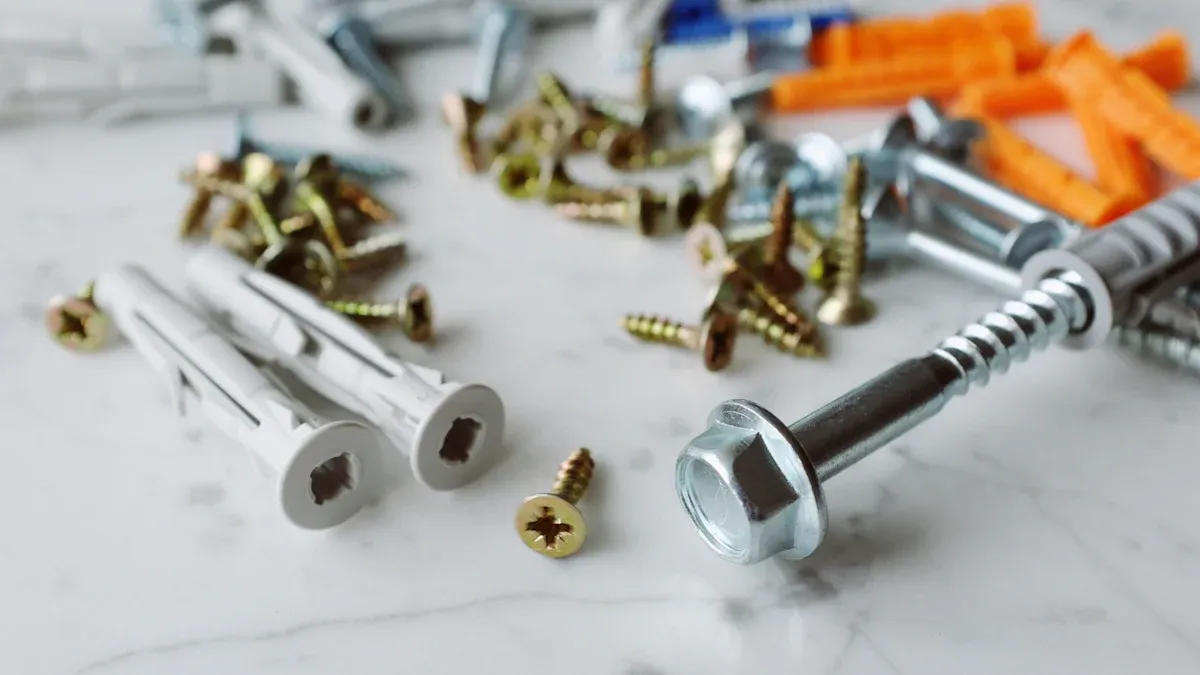
An expansion bolt is a mechanical anchor designed for a secure fastening in solid materials like concrete. It works by expanding a sleeve against the hole’s sides when tightened, generating strong frictional force. The history of anchoring is extensive; rock bolts first appeared for reinforcement in 1872. Today, the global market for bolts, including various Anchor Bolts, reached an estimated $47.89 billion in 2024. Many applications require specific expansion bolts, leading projects to a custom fasteners manufacturer for custom anchor bolts. These expansion bolts are critical for structural integrity and project safety.
Understanding the Mechanics of an Expansion Bolt
The reliability of an expansion bolt stems from fundamental physics principles. Its design cleverly converts rotational force into a powerful outward pressure. This pressure generates immense friction, locking the anchor firmly within the base material. Understanding this mechanism is key to appreciating its holding power and selecting the correct anchor for any application.
The Fundamental Working Principle
An expansion bolt operates on a simple yet effective mechanical concept: wedging. Tightening the bolt or nut draws a tapered cone into an expansion sleeve. This action forces the sleeve to expand outward, pressing it firmly against the walls of the pre-drilled hole.
Creating Frictional Force
The anchor’s holding capacity comes directly from frictional force. This force is the product of the normal force (the outward pressure from the sleeve) and the coefficient of static friction between the anchor and the base material. The mechanics involve several key ideas:
- The coefficient of static friction (μs) is greater than the coefficient of kinetic friction (μk). This means more force is needed to start movement than to maintain it, giving the anchor its initial powerful grip.
- Force transfer between connected plates primarily occurs through this friction.
- Once an applied load exceeds the friction capacity, the members slip until they bear directly on the bolt shank.
The Role of Torque and Expansion
Applying torque to the nut or bolt head is the catalyst for expansion. This rotational energy pulls the bolt’s wedge, creating the expansion that generates the normal force. The geometry of the load-bearing system can also significantly multiply forces. For example, a slight sag in a chain between two expansion bolts can increase the axial load on each bolt by several times. This “force-multiplier” effect is a balance of moments, demonstrating how seemingly small setup details can dramatically impact the forces an anchor must withstand.
Key Components of an Expansion Bolt Assembly
A standard expansion bolt assembly consists of several engineered parts working in unison. Each component has a specific role in creating a secure and lasting connection. The material quality of each part is critical for performance, especially in demanding environments.
The Threaded Bolt or Stud
The threaded bolt or stud is the core of the expansion bolt assembly. It provides the tensile strength to handle the load and the threads needed to engage the nut. Tightening this component initiates the expansion process. Manufacturers often produce these bolts from high-quality stainless steel, with grades like 304 and 316 Stainless Steel being common choices for their strength and corrosion resistance.
The Expansion Sleeve or Shield
The expansion sleeve is a metal cylinder that fits around the bolt. It is designed to expand when the wedge is drawn into it. This expansion is what presses against the sides of the hole, creating the friction that holds the entire expansion bolt assembly in place. Materials like 304 Stainless Steel are frequently used for sleeves to ensure durability.
The Expansion Wedge or Cone
The expansion wedge is a tapered component located at the end of the bolt. As the bolt is tightened, this cone is pulled into the sleeve, forcing it to expand. The angle and material of the wedge are precisely engineered to ensure smooth and effective expansion. High-grade materials, such as AISI 316 / A4 Stainless Steel, are often specified for this critical part.
The Nut and Washer
The nut and washer work together to secure the fixture. The washer distributes the load from the nut across the surface of the object being fastened, preventing damage. The nut, when turned, applies the necessary torque to the bolt, driving the entire anchoring mechanism.
The Main Types of Expansion Bolts Explained

Professionals select from various types of expansion bolts based on the specific demands of a project. Each anchor has a unique design, holding mechanism, and ideal use case. Understanding these differences is crucial for ensuring a safe and durable installation. The three most common types are wedge anchors, sleeve anchors, and drop-in anchors.
Wedge Anchors
Wedge anchors are the go-to choice for heavy-duty fastening into solid concrete. Their design provides exceptional tensile and shear strength, making them indispensable for structural applications. These powerful fasteners are a cornerstone of modern construction.
Mechanism and Design
The design of wedge anchors is simple yet robust. The anchor consists of a threaded stud with a tapered cone at one end and an expansion clip wrapped around it. Installers place the anchor into a pre-drilled hole and tighten the nut. This action pulls the stud upward, drawing the cone into the clip. The clip then expands outward, wedging itself firmly against the walls of the concrete hole. This creates immense frictional force, locking the anchor in place.
Manufacturers produce wedge anchors to meet stringent industry standards, ensuring reliability and safety. These specifications govern material strength, dimensions, and performance testing.
| Standard | Description/Application |
|---|---|
| ASTM E1512 | Standard Test Methods for Testing of Anchor Systems in Concrete |
| ISO 14592 | Standard for mechanical expansion anchors |
| ASTM A193 | Standard for alloy-steel and stainless steel bolting materials |
| DIN 7452 | German standard for wedge-type expansion anchors |
Common Applications
The high load capacity of wedge anchors makes them ideal for securing heavy items. Common applications include:
- Attaching structural steel columns and beams
- Mounting heavy machinery and industrial equipment
- Securing racking systems in warehouses
- Anchoring support ledgers and sill plates
Strengths and Limitations
The primary strength of wedge anchors is their incredible holding power. The load capacity increases significantly with the anchor’s diameter and embedment depth.
| Diameter | Minimum Embedment | Pull-Out (lbs.) | Shear (lbs.) |
|---|---|---|---|
| 1/4” | 1-1/8” | 877 | 1082 |
| 3/8” | 1-1/2” | 1223 | 3238 |
| 1/2” | 2-1/4” | 2999 | 5564 |
| 5/8” | 2-3/4” | 3749 | 6198 |
| 3/4” | 3-1/4” | 4978 | 9378 |
| 1” | 4-1/2” | 7329 | 17712 |
| 1-1/4” | 5-1/2” | 13162 | 24206 |
Note: The values above represent ultimate loads in 2000 PSI concrete. Professionals typically apply a 4:1 safety factor to determine the safe working load.
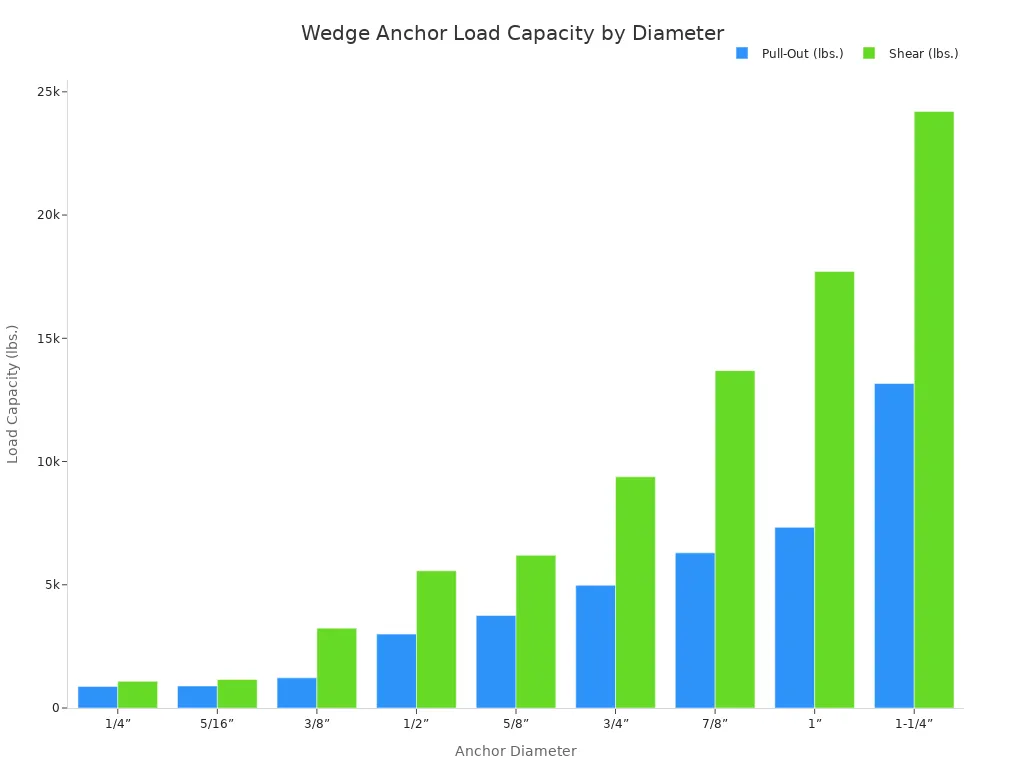
However, wedge anchors have limitations. They are designed exclusively for solid concrete and perform poorly in softer materials like brick or block. The installation of wedge anchors requires precise torque control; over-tightening can stress the concrete and compromise the connection. The reliability of wedge anchors makes them a top choice for demanding jobs. For heavy-duty needs, wedge anchors are often the best solution. The strength of wedge anchors is unmatched in many scenarios.
Sleeve Anchors
Sleeve anchors are versatile fasteners suitable for a wide range of base materials, including concrete, brick, and block. Their design offers reliable performance for medium-duty applications. The adaptability of sleeve anchors makes them a popular choice for general-purpose fastening.
Mechanism and Design
A sleeve anchor assembly includes a threaded bolt or stud, a nut, a washer, and a full-length expansion sleeve. As the installer tightens the bolt, it pulls a flared cone-shaped expander at the base of the bolt into the sleeve. This action forces the entire sleeve to expand outward along its length, creating a secure grip against the sides of the hole. This full-length expansion distributes the load over a larger surface area, making sleeve anchors effective in less dense materials.
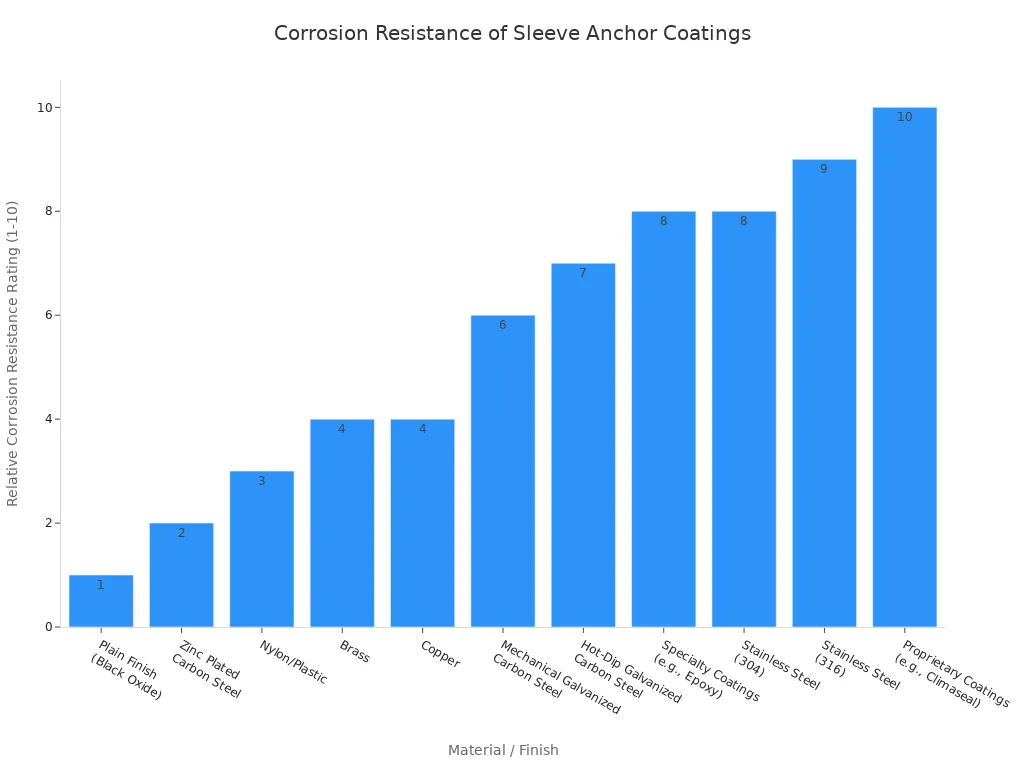
The material and coating of sleeve anchors are critical for durability, especially in outdoor or corrosive environments.
| Material/Finish | Characteristics |
|---|---|
| Zinc Plated Carbon Steel | Economical choice for dry, indoor use. |
| Hot-Dip Galvanized | Offers good corrosion resistance for outdoor applications. |
| 304 & 316 Stainless Steel | Provides superior corrosion resistance for wet or marine environments. |
| Proprietary Coatings | Advanced coatings offering exceptional protection in severe conditions. |
Common Applications
The versatility of sleeve anchors allows for their use in numerous projects. Common applications include:
- Fastening handrails and guardrails
- Securing window and door frames
- Mounting signage and satellite dishes
- Anchoring shelving and brackets to masonry walls
Strengths and Limitations
The main strength of sleeve anchors is their adaptability. They work well in various base materials where wedge anchors would fail. Additionally, many sleeve anchors are available with different head styles (e.g., hex, flat, round) to suit aesthetic and functional needs. The design of sleeve anchors also allows for easy removal if necessary.
However, sleeve anchors generally have a lower load capacity compared to wedge anchors of a similar diameter. They are not recommended for heavy structural loads. Proper hole size is also critical; an oversized hole will prevent the sleeve from expanding correctly, resulting in a weak connection. The versatility of sleeve anchors is their key advantage.
Drop-In Anchors
Drop-in anchors are female-threaded expansion bolts designed to sit flush with the surface of the base material. They are ideal for overhead applications and situations requiring a removable bolt.
Mechanism and Design
A drop-in anchor is a cylindrical shell with internal threads and four expansion slots at its base. Inside the shell sits a pre-assembled expander plug. After an installer drops the anchor into a pre-drilled hole, they use a special setting tool. Hammering the setting tool drives the internal plug downward, forcing the slotted end of the anchor to expand and lock against the concrete. This creates a permanent, threaded socket in the concrete, ready to accept a bolt or threaded rod. The design of drop-in anchors ensures a clean, flush finish.
Common Applications
The flush-mount design of drop-in anchors makes them perfect for specific tasks. Common applications include:
- Suspending conduit, cable trays, and HVAC ductwork from ceilings
- Anchoring fire sprinkler piping
- Creating anchor points for machinery that may need to be moved
- Securing threaded rods for overhead support systems
Strengths and Limitations
The primary advantage of drop-in anchors is the flush installation, which leaves no protruding parts. This is essential for overhead work and for creating a clean, finished appearance. The internal threads allow for easy removal and replacement of the fixture’s bolt without disturbing the anchor itself.
Installation Tip: Correctly setting drop-in anchors is crucial for safety. Always follow these steps:
- Drill a hole to the specified diameter and depth.
- Thoroughly clean all dust and debris from the hole using a wire brush and compressed air or a vacuum.
- Insert the drop-in anchor, threaded-end up, until it is flush with the surface.
- Insert the correct size setting tool into the anchor.
- Strike the setting tool firmly with a hammer until the tool’s shoulder meets the top of the anchor. This ensures full expansion.
The main limitation of drop-in anchors is their reliance on a setting tool for proper installation. Without it, the anchor will not expand correctly. They are also best suited for solid concrete and are not recommended for high-vibration environments or applications in cracked concrete. The performance of drop-in anchors depends heavily on correct installation.
| Anchor Type | Pros | Cons |
|---|---|---|
| Drop-in anchor | Flush finish; allows pre-installation; bolt is removable. | Requires a setting tool; not ideal for cracked concrete. |
| Wedge anchor | Extremely high load capacity; reliable for structural use. | Permanent installation; requires solid concrete; risk of over-torquing. |
| Sleeve anchor | Versatile across many base materials; adjustable. | Lower load capacity; requires precise hole size. |
Strike Anchors (Hammer-Set Anchors)
Strike anchors, also known as hammer-set anchors, offer a fast and straightforward solution for light to medium-duty fastening into solid concrete and masonry. Their simple, one-piece design makes them a favorite for projects where speed and efficiency are paramount. These anchors provide a permanent, tamper-resistant connection once installed.
Mechanism and Design
The design of strike anchors is ingeniously simple. Each anchor is a single unit consisting of a cylindrical body with an internal, hardened steel pin. The anchor body is slotted at the bottom. An installer first drills a hole to the correct diameter and depth. They then insert the anchor into the hole and strike the internal pin with a hammer. The force of the hammer blow drives the pin down into the anchor’s body. This action forces the slotted end to expand outward, creating a powerful frictional grip against the walls of the hole. The head of the pin sits flush with the anchor head, creating a finished look.
Common Applications
The quick installation of strike anchors makes them ideal for repetitive fastening tasks. Professionals commonly use them for:
- Securing electrical junction boxes and conduit straps
- Fastening metal track for interior wall framing
- Anchoring lightweight machinery and equipment
- Mounting brackets and supports to concrete or block walls
Strengths and Limitations
The primary strength of strike anchors is their speed of installation. The simple hammer-in process requires no special setting tools or torque wrenches, saving significant time on the job site. Their design also provides a degree of tamper resistance, as they cannot be easily uninstalled.
However, strike anchors are permanent and cannot be removed without damaging the base material. Their load capacity, while substantial, is generally lower than that of wedge anchors. For a 1/2″ x 4-3/4″ strike anchor with a 2″ minimum embedment in 2000 PSI concrete, the ultimate pull-out (tensile) strength is 2700 lbs., and the ultimate shear strength is 5400 lbs. The performance of strike anchors varies by size.
| Size | Pull-Out (lbs.) | Shear (lbs.) |
|---|---|---|
| 1/4” | 675 | 1200 |
| 5/16” | 1050 | 2250 |
| 3/8” | 1650 | 2550 |
| 1/2” | 2700 | 5400 |
| 5/8” | 4050 | 4950 |
| 3/4” | 5625 | 10125 |
Note: These values represent average ultimate loads in 2000 PSI concrete. A safety factor of 4:1 (25%) is generally accepted for safe working loads.
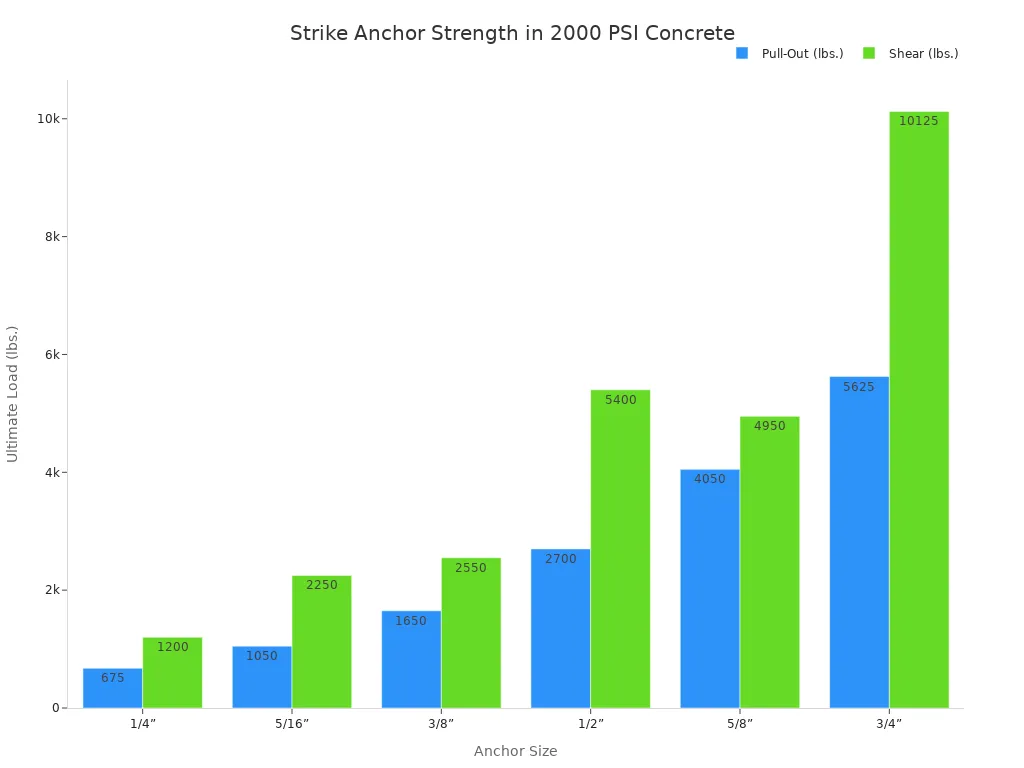
The reliability of strike anchors makes them a solid choice for many applications, but installers must match them to appropriate load requirements.
Lag Shield Anchors
Lag shield anchors are two-piece expansion shields designed for use with lag screws. They are particularly effective in softer or more brittle base materials like brick, mortar joints, and concrete block (CMU), where other expansion bolts might cause cracking or spalling.
Mechanism and Design
A lag shield anchor consists of a die-cast zinc alloy shield split into two halves. The exterior of the shield features ribs that help it grip the inside of the pre-drilled hole. An installer places the anchor into the hole. They then drive a lag screw through the fixture and into the shield. As the screw’s tapered threads advance, they force the two halves of the shield to expand outward, compressing it firmly against the base material.
For applications in concrete, masonry, and mortar joints, the long version of the Lag Screw Shield is utilized to increase holding values. The long style of lag shield anchors is specifically designed for use in soft or weak masonry materials. Its extended length allows for better development of strength within these less dense substrates, providing enhanced support.
Common Applications
The unique design of lag shield anchors makes them suitable for a variety of light to medium-duty tasks in masonry. Common applications include:
- Mounting gutters and downspouts to brick walls
- Securing satellite dishes and antennas
- Fastening handrails and signs to block or brick
- Anchoring shelving and brackets in older masonry
Strengths and Limitations
The main advantage of lag shield anchors is their performance in porous or brittle base materials. The shield’s expansion distributes the load over a wider area, reducing the risk of cracking the masonry. The lag screw can also be removed, allowing for the temporary removal of the fixture if needed.
Installation Tip: 💡 Always use a lag screw with a diameter that matches the anchor’s specification. Using an undersized screw will result in poor expansion and a weak connection.
The primary limitation is their relatively low holding power compared to anchors designed for solid concrete. They are not intended for heavy structural loads. The final strength of the connection also depends on the quality and condition of the base material and the proper sizing of the lag screw.
How to Choose the Right Expansion Bolt for Your Project
Selecting the correct expansion bolt is a critical decision that directly impacts the safety and longevity of an installation. A systematic approach ensures that the chosen anchor meets all project demands. This process involves a careful evaluation of the load, the base material, and the surrounding environment.
Step 1: Evaluate Load Requirements
The first step is to determine the forces the anchor must resist. These forces, or loads, are categorized by their magnitude and direction. Understanding the project’s load requirements is fundamental to choosing a safe and effective fastener.
Heavy-Duty Loads
Heavy-duty applications involve significant structural forces and demand the highest level of performance. These projects include mounting heavy machinery, securing structural steel, or anchoring wind turbine foundations. The forces can be tensile (pulling out), shear (cutting across), or a combination of both.
- Tensile Load: This force pulls components apart. Engineers calculate tensile stress (σt) as
F/A, whereFis the force andAis the bolt’s minimum cross-sectional area. - Shear Load: This force acts perpendicular to the bolt’s axis. Shear stress (τ) is calculated as
F/As, whereAsis the shear area. - Combined Loading: Many applications subject a bolt to both tensile and shear forces. Professionals evaluate this using interaction equations like the von Mises stress (σvm) to find a single equivalent stress value.
For these demanding jobs, high-strength anchors are essential. Wedge anchors are the most common choice for heavy-duty fastening in solid concrete. Industry standards like ASTM F1554 provide clear guidance on anchor strength.
| Anchor Type | Standard | Minimum Yield Strength | Application Category |
|---|---|---|---|
| Grade 55 Anchor Bolt | ASTM F1554 | 55 ksi | Medium-load applications |
| Grade 105 Anchor Bolt | ASTM F1554 | 105 ksi | High-stress, heavy-duty applications |
Grade 105 anchor bolts, with a minimum yield strength of 105,000 pounds per square inch (ksi), are specified for the most critical, high-stress applications.
Medium-Duty Loads
Medium-duty loads are common in both commercial and residential construction. These applications include securing handrails, mounting large signs, or anchoring racking systems. The load requirements are substantial but do not reach the critical levels of heavy structural connections. Sleeve anchors and larger-diameter strike anchors are excellent choices for these tasks. They offer a balance of holding power and versatility across different base materials. ASTM F1554 Grade 55 anchor bolts, with a 55 ksi minimum yield strength, are often suitable for these medium-load scenarios.
Light-Duty Loads
Light-duty applications involve fastening non-structural items with minimal weight. Examples include hanging shelving, securing electrical conduit, or mounting small brackets. The forces are relatively low, so the primary goal is a secure and stable connection. Lag shield anchors, smaller strike anchors, and some sleeve anchors are ideal for these projects. They provide sufficient holding power without the need for the high-strength capacity of a heavy-duty expansion bolt.
Step 2: Identify the Base Material
The material into which the anchor is installed is just as important as the load. The expansion mechanism of each anchor type is designed to work with specific materials. Mismatching the anchor and the base material can lead to catastrophic failure.
Solid Concrete
Solid, uncracked concrete provides the best substrate for most expansion bolts. Its high compressive strength allows it to withstand the outward pressure from an expanding anchor.
Important Note: Expansion anchor bolts apply radial force to the hole wall. This mechanism is highly effective in strong, unbroken concrete. However, this same force can damage or destroy weaker substrates.
For this reason, wedge anchors, strike anchors, and drop-in anchors perform exceptionally well in solid concrete. However, professionals should avoid using expansion anchors in cracked concrete.
| Anchor Type | Suitable for Cracked Concrete | Suitable for Uncracked Concrete |
|---|---|---|
| Expansion Anchors | No | Yes |
| Chemical Anchors | Yes | Yes |
For cracked concrete, chemical (epoxy) anchors are the recommended solution. They bind directly to the concrete with resin, avoiding the stress that causes mechanical expansion.
Concrete Block (CMU)
Concrete Masonry Units (CMUs), or concrete blocks, have hollow sections and a lower compressive strength than solid concrete. The expansion force from a wedge anchor can easily crack the block’s thin walls. Sleeve anchors and lag shield anchors are better choices here. Their expansion mechanism distributes the load over a larger surface area, reducing the risk of damaging the block.
Brick and Masonry
Brick and other masonry materials are often brittle. Similar to CMU, they are susceptible to cracking under the concentrated pressure of a wedge anchor. Lag shield anchors are specifically designed for these materials. Their two-part shield expands gently, providing a secure grip without spalling the brick face. Sleeve anchors can also be effective, especially in solid brick.
Stone and Granite
Natural stone and granite are dense and strong, similar to high-quality concrete. They can typically support heavy-duty anchors like wedge anchors. However, installers must exercise extreme caution during drilling and installation to prevent cracking these expensive materials. It is always wise to test an anchor in a discreet area first.
Step 3: Consider Environmental Factors
The project’s environment determines the necessary level of corrosion resistance for the anchor. Exposure to moisture, chemicals, or temperature swings can severely degrade a fastener over time, compromising its strength.
Indoor and Dry Conditions
For indoor applications with no exposure to moisture, standard zinc-plated carbon steel anchors are a cost-effective and reliable choice. This finish provides a basic level of protection against rust in a controlled, dry environment.
Outdoor and Wet Conditions
Outdoor installations expose anchors to rain, humidity, and temperature fluctuations. These conditions demand a higher level of corrosion resistance.
- Hot-dip galvanized anchors offer good protection for general outdoor use.
- 304 stainless steel provides even better resistance and is suitable for many outdoor and food-processing applications where cleanliness is key.
Solar ultraviolet (UV) radiation and temperature changes also impact material longevity. Exposure to UV-B radiation and elevated temperatures can shorten the service life of many materials by accelerating degradation. While this primarily affects plastics and organic components, it highlights the harshness of outdoor environments.
Corrosive Environments
The most aggressive environments require the highest level of protection. These include marine locations with saltwater exposure, industrial plants with chemical vapors, and areas using de-icing salts.
- 316 stainless steel is the premier choice for these conditions. It contains molybdenum, an element that significantly enhances its resistance to chlorides and pitting corrosion. Due to its robustness against salt, 316 is often called marine-grade stainless steel.
- Proprietary coatings are also available, offering advanced protection that can sometimes exceed that of stainless steel in specific chemical environments.
Choosing between 304 and 316 stainless steel is a common decision. Use 304 for general-purpose corrosion resistance, but always specify 316 for applications involving saltwater, harsh chemicals, or high moisture.
Practical Selection Guide for Expansion Bolts
Choosing the right expansion bolts from a sea of options can feel daunting. This practical guide simplifies the process. It breaks down anchor selection by comparing key characteristics and providing clear recommendations for common projects. Following this guide helps professionals ensure a secure and reliable installation every time.
Comparison Table: Anchor Type vs. Application
A direct comparison highlights the unique strengths of each anchor. The following table summarizes the key differences, helping installers match the right fastener to the job’s demands.
Anchor Type
Load Capacity
Base Material Suitability
Installation Complexity
| Anchor Type | Load Capacity | Base Material Suitability | Installation Complexity |
|---|---|---|---|
| Wedge Anchor | Heavy-Duty | Solid Concrete Only | Moderate (Requires torque wrench) |
| Sleeve Anchor | Light to Medium-Duty | Concrete, Brick, Block | Low to Moderate |
| Drop-In Anchor | Medium-Duty | Solid Concrete Only | Moderate (Requires setting tool) |
| Strike Anchor | Light to Medium-Duty | Solid Concrete | Low (Requires hammer only) |
| Lag Shield Anchor | Light-Duty | Brick, Block, Mortar Joints | Low to Moderate |
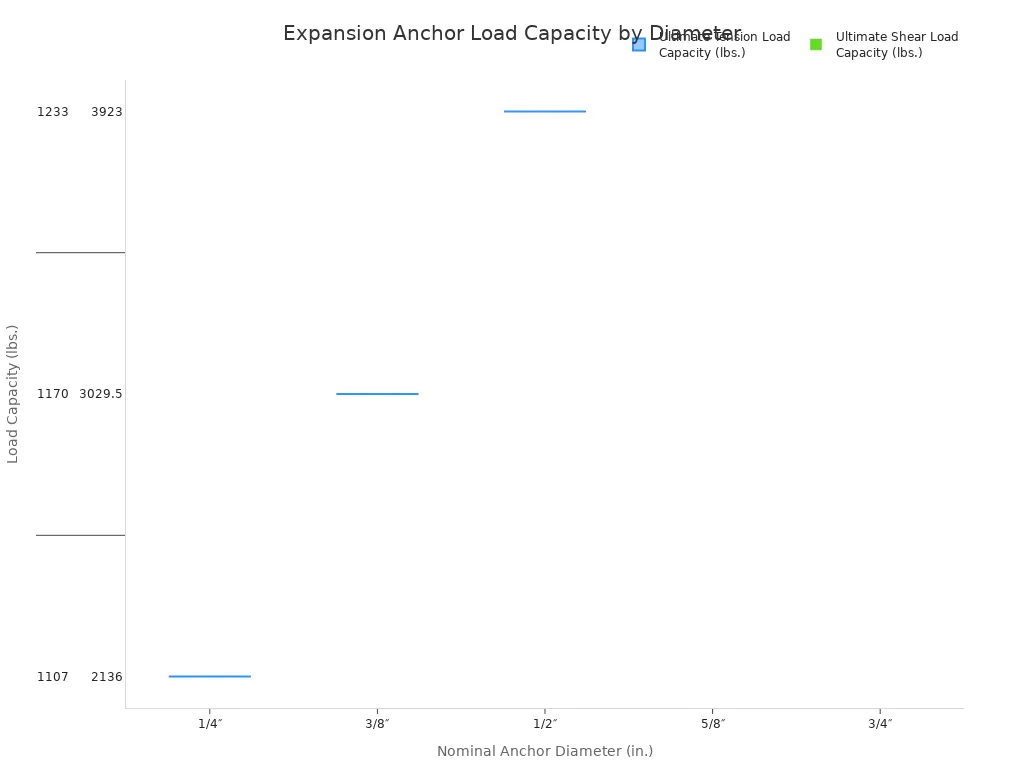
Load capacity is a critical factor. It varies significantly with anchor diameter and the compressive strength of the concrete. For example, in 4,000 PSI concrete, ultimate load capacities increase dramatically with size.
Pro Tip: 💡 Base material dictates anchor choice. Wedge anchors are specialists for solid concrete. Their immense, localized pressure requires a dense substrate. In contrast, sleeve anchors are versatile generalists. Their 360-degree expansion mechanism works well in a wide range of masonry materials, including hollow block and brick.
Project-Specific Recommendations
Theory is helpful, but practical examples clarify the best choices. Here are specific recommendations for common construction and installation projects.
Mounting Heavy Machinery
Heavy machinery generates significant static and dynamic loads. Safety and stability are paramount. For these applications in solid concrete, wedge anchors are the industry standard. The exceptional tensile and shear strength of wedge anchors ensures a permanent, reliable connection that can withstand operational vibrations. Professionals consistently choose wedge anchors for their unmatched holding power in demanding situations. The performance of wedge anchors is critical for securing high-value equipment.
Installing Structural Racking
Warehouse racking must support immense weight and comply with strict safety codes. The International Building Code (IBC) references ANSI MH16.1 as the standard for steel storage rack installation. This standard mandates proper floor-to-rack anchoring.
- Inspectors check for secure anchoring as a key safety requirement.
- Broken, loose, or missing anchors can compromise the entire system’s stability.
For this reason, high-capacity wedge anchors are essential. The design of wedge anchors provides the necessary strength to meet code and ensure a safe storage environment. Installers must use wedge anchors to secure the rack’s footplates firmly to the concrete slab. The reliability of wedge anchors makes them the only suitable choice for this critical structural task. Using wedge anchors is non-negotiable for code compliance. The strength of wedge anchors prevents catastrophic failure. Always use wedge anchors for structural racking.
Securing Handrails and Guardrails
Handrails and guardrails are critical safety features. They require secure anchoring into various base materials, from concrete stairs to brick patios. Sleeve anchors are an excellent choice for these medium-duty applications. The versatility of sleeve anchors allows them to work effectively in solid concrete, brick, and block. The full-length expansion of sleeve anchors distributes the load, reducing the risk of cracking brittle masonry. Many sleeve anchors also come with finished heads for a clean look. The adaptability of sleeve anchors makes them a go-to for this type of work. For guardrails, sleeve anchors provide a dependable connection. The design of sleeve anchors is ideal for these varied conditions.
Hanging Shelving and Cabinets
For light to medium-duty shelving and cabinet installations, versatility is key. Sleeve anchors are a superb option. They provide reliable holding power in concrete and masonry walls, common in garages and basements. The availability of different head styles (hex, flat, round) allows sleeve anchors to fit various aesthetic needs. If the base material is older brick or block, lag shield anchors offer a great alternative. However, for most general-purpose shelving, sleeve anchors provide the perfect balance of strength and ease of use. The simple installation of sleeve anchors makes them a favorite for both professionals and DIYers.
Essential Installation Guidelines

An installer’s precision determines the success of an expansion bolt. Following established guidelines is not just best practice; it is essential for safety and performance. A correct installation process ensures the anchor achieves its full load-bearing capacity. This section outlines the critical steps and parameters for a professional and secure anchor installation.
Preparing for a Safe Installation
Proper preparation is the foundation of a safe and effective installation. This phase involves gathering the right equipment and thoroughly understanding the manufacturer’s instructions for the specific anchor being used.
Required Tools and Safety Gear
Using the correct tools and personal protective equipment (PPE) is non-negotiable. A professional installer’s kit should always include:
- A drill with a hammering function (hammer drill)
- Properly sized masonry drill bits
- A calibrated torque wrench for accurate tightening
- A vacuum cleaner or compressed air for hole cleaning
- Safety gear, including gloves, safety glasses, and ear protection
Understanding Manufacturer Specifications
Every expansion bolt comes with a technical data sheet from the manufacturer. This document is the most important guide for the installation process. It provides critical information on hole size, embedment depth, torque values, and spacing requirements. Installers must review these specifications before beginning any work, as they can vary significantly between different anchor types and brands.
The Step-by-Step Installation Process
A successful installation follows a precise sequence. Each step in the installation process builds upon the last, and skipping or rushing any part can compromise the anchor’s integrity.
Drilling the Hole to Spec
The first physical step is drilling the hole. An installer must use a hammer drill equipped with a carbide-tipped masonry bit that matches the anchor’s required diameter. The hole must be drilled perpendicular to the surface and to the exact depth specified by the manufacturer. Over-drilling or under-drilling can prevent the anchor from setting correctly.
Cleaning the Hole Thoroughly
A clean hole is critical for achieving maximum holding power. Dust and debris left in the hole act as a lubricant, preventing the anchor’s expansion mechanism from properly gripping the concrete. The standard cleaning procedure involves using a wire brush and compressed air or a vacuum to remove all loose particles.
Note: Some advanced anchoring systems, like the fischer Highbond system FHB II, claim to eliminate the need for hole cleaning, potentially reducing installation time by up to 40%. However, unless using such a specific system, installers must always assume cleaning is mandatory.
Setting the Anchor Correctly
Setting the anchor involves placing it into the cleaned hole. For wedge and sleeve anchors, the installer taps the anchor into place until the nut and washer are snug against the fixture. For drop-in anchors, the anchor is set flush with the surface, and a setting tool is used to expand it. For strike anchors, a hammer is used to drive the internal pin and activate the expansion.
Applying the Proper Torque
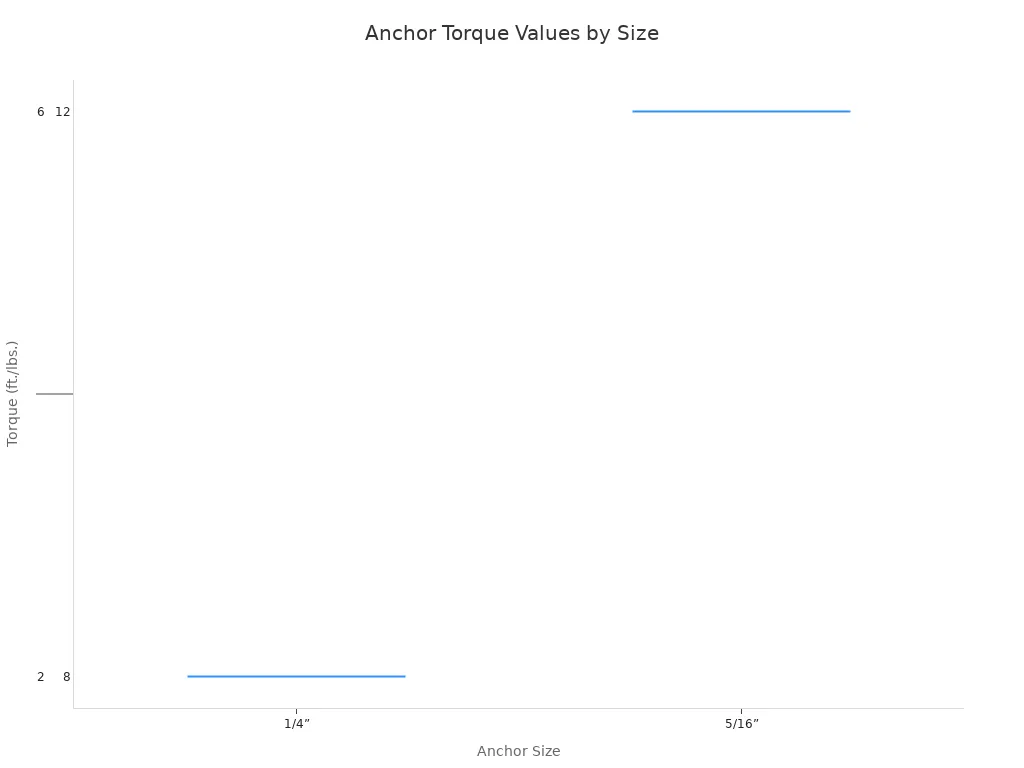
Applying the correct torque is the final, crucial step for wedge and sleeve anchors. An installer must use a calibrated torque wrench to tighten the nut to the manufacturer’s specified value. Over-torquing can stress the concrete and damage the anchor, while under-torquing will result in a weak connection.
| Size | Minimum Embedment | Torque (ft./lbs.) |
|---|---|---|
| 1/4” | 1/2” | 2 – 6 |
| 5/16” | 1” | 8 – 12 |
| 3/8” | 1-1/4” | 15 – 18 |
| 1/2” | 1-1/2” | 18 – 26 |
| 5/8” | 2” | 30 – 40 |
| 3/4” | 2-1/4 | 60 – 90 |
Critical Installation Parameters
Beyond the step-by-step installation process, installers must respect critical geometric parameters. These rules govern where an anchor can be placed relative to edges and other anchors.
Hole Diameter and Depth
The hole’s dimensions must be exact. An oversized hole will prevent the anchor from expanding enough to create friction. A hole that is too shallow will not allow for the required embedment depth, severely reducing the anchor’s pull-out strength.
Edge and Spacing Distances
An anchor’s strength depends on its interaction with a cone-shaped area of concrete. Placing anchors too close to an edge or to each other can cause these cones of influence to overlap or break out.
- Edge Distance: The suggested minimum distance from an unsupported edge is typically 5 anchor diameters.
- Spacing Distance: The minimum spacing between anchors should be at least 10 anchor diameters to prevent loss of capacity.
Disregarding these distances can lead to concrete cracking, spalling, or catastrophic anchor failure. Always consult the manufacturer’s data for specific requirements.
Common Mistakes to Avoid When Using Expansion Bolts
Even the highest quality anchor will fail if installed or selected incorrectly. Professionals can avoid costly and dangerous errors by understanding common pitfalls. These mistakes fall into two main categories: critical installation errors and common selection errors. Adhering to best practices is essential for a secure and reliable connection.
Critical Installation Errors
The installation process demands precision. A small deviation from the manufacturer’s instructions can severely compromise the anchor’s holding power. Installers must pay close attention to every detail.
Using an Incorrect Hole Size
Drilling a hole of the wrong diameter is a frequent mistake. A hole that is too large prevents the anchor’s sleeve from making firm contact with the base material. A hole that is too small will not allow the anchor to be inserted to the proper depth. Both scenarios result in a weak and unsafe fastening.
Insufficient Hole Cleaning
A clean hole is non-negotiable for a strong bond. Installers who skip this step leave dust and debris behind. This material acts as a lubricant, drastically reducing the frictional force the anchor can generate.
Warning: ⚠️ Failure to clean the hole can reduce an anchor’s holding capacity by over 50%. Always use a wire brush and compressed air or a vacuum to remove all particles.
Over-Torquing or Under-Torquing
Applying the correct torque is a critical final step. An installer using a standard wrench instead of a calibrated torque wrench risks making a serious error.
- Over-torquing applies excessive stress to the concrete, potentially causing it to crack and fail.
- Under-torquing fails to expand the anchor fully, resulting in a loose connection with very low pull-out strength.
Ignoring Edge Distance Requirements
Anchors generate immense outward pressure. Placing an anchor too close to an unsupported edge or another anchor can cause the concrete to break out. Professionals must always respect the minimum edge and spacing distances specified by the manufacturer to prevent this type of failure.
Common Selection Errors
Choosing the right anchor is the first step toward a successful project. A selection error can doom an installation before the drilling even begins.
Mismatching the Anchor to the Base Material
A common error is using an anchor designed for solid concrete in a softer material like brick or block. A wedge anchor, for example, will likely crack a hollow block. Installers must match the anchor’s expansion mechanism to the base material’s properties.
Underestimating the Project’s Load Requirements
Selecting an anchor without a clear understanding of the project’s load requirements is a recipe for disaster. A light-duty anchor cannot support a heavy structural element. Professionals must always calculate the tensile and shear forces involved and choose an anchor with a sufficient safety factor.
Choosing the Wrong Material for the Environment
The anchor’s material must suit its environment. Using standard zinc-plated expansion bolts in an outdoor or corrosive setting will lead to rust and eventual failure. For wet or marine environments, installers must specify corrosion-resistant materials like hot-dip galvanized or stainless steel.
The security of any fixture depends entirely on choosing the correct expansion bolt for the job. Professionals must always match an anchor’s design and capacity to the project’s specific load, base material, and environmental conditions.
Safety First: 👷 Prioritizing safety is essential. Installers achieve this by carefully following all manufacturer guidelines. These instructions detail critical parameters for hole size, cleaning, and torque specifications for each expansion bolt.
FAQ
Can I reuse an expansion bolt?
Most expansion bolts are designed for single-use, permanent installations. Removing a wedge or strike anchor damages the anchor and the base material. An installer should always use a new anchor for a new application to ensure safety and full holding power.
What happens if I over-torque an anchor?
Over-torquing an anchor applies excessive expansion force. This action can crack the concrete, damage the anchor’s threads, or cause a complete connection failure. Installers must use a calibrated torque wrench to apply the exact force specified by the manufacturer.
Why is cleaning the hole so important?
Dust and debris in a drilled hole act as a lubricant. This material prevents the anchor from gripping the concrete walls, severely reducing its holding capacity.
Warning: ⚠️ A dirty hole can reduce an anchor’s pull-out strength by more than 50%. Always clean the hole thoroughly.
Can I use any expansion bolt in brick?
No. Brittle materials like brick require specific anchors. Sleeve anchors and lag shield anchors distribute expansion force over a wider area, preventing cracking. Using a wedge anchor in brick will likely damage the material and create an unsafe connection.
What is the main difference between a wedge anchor and a sleeve anchor?
A wedge anchor provides heavy-duty strength in solid concrete only. A sleeve anchor offers medium-duty capacity but works in a wider range of materials, including concrete, brick, and block. The choice depends on the load and the base material.
How close to an edge can I install an expansion bolt?
Installers must maintain a minimum edge distance to prevent concrete breakout. A safe general rule is to keep the anchor at least five anchor diameters away from any unsupported edge. Always consult the manufacturer’s technical data for specific requirements.
Do I always need a torque wrench?
Yes, for anchors like wedge and sleeve anchors. A torque wrench ensures the installer applies the precise rotational force needed for proper expansion. Guessing the torque with a standard wrench leads to under-tightening or over-tightening, both of which create a weak connection.