
For most standard outdoor projects like decks or pergolas, a 1/2-inch diameter hot-dip galvanized wedge anchor is the best anchor for securing a 4×4 post to solid concrete. These structures support significant loads, often 40-60 pounds per square foot, making strong wedge anchors essential. If anchoring into brick or block, a 1/2-inch diameter sleeve anchor is the better option.
Key Takeaway: The required anchor length depends on the post base hardware. It must always ensure a minimum embedment of 2.5 to 3 inches. This minimum embedment creates a secure concrete anchor.
While standard wedge anchors are a reliable concrete anchor, a custom fasteners manufacturer can supply custom anchor bolts and other custom fasteners. A quality wedge anchor is one of the most common anchor bolts available for construction.
Key Factors for Choosing Anchor Bolts for 4×4 Posts
Selecting the correct hardware involves more than just grabbing a bolt off the shelf. A professional assessment considers the specific demands of the project. Three primary factors guide the decision: the loads the post will bear, the base material it connects to, and the specifications of the post base hardware itself. Proper evaluation of these elements ensures a safe and durable installation.
Load Requirements: What Will the Post Support?
The function of the 4×4 post dictates the forces the connection must resist. A post supporting a heavy roof carries a different load than one for a simple railing. The bolt’s load capacity must exceed the demands placed upon it. Key factors influencing a post’s load capacity requirements include:
- Live Loads: Transient forces from people, snow, or wind.
- Dead Loads: Constant forces from the structure’s own weight, like roofing materials.
- Wood Properties: The species, grade, and moisture content of the lumber affect its strength.
Understanding Shear Loads
Shear loads are horizontal forces that push sideways against the post and its anchor. Wind pressure on a pergola or the lateral force against a deck railing are common examples. The anchor must have sufficient strength to prevent it from bending or shearing off under this pressure.
Understanding Tension (Uplift) Loads
Tension loads, or uplift forces, attempt to pull the post straight up and out of its foundation. High winds getting under a large roof overhang can create significant uplift. The anchor’s design must provide enough grip within the base material to resist being extracted. A high load capacity is critical for resisting both shear and tension.
Matching Bolt Diameter to Load
A larger anchor diameter generally provides a greater load capacity. While a 1/2-inch bolt is standard for most 4×4 applications, projects with exceptionally high shear or tension loads may require a larger 5/8-inch bolt to ensure structural integrity.
Base Material: What Are You Anchoring Into?
The material of the foundation is a critical factor. An anchor designed for solid concrete will fail in a hollow block. Achieving proper material compatibility is essential for a secure connection.
Pro Tip: Always match the anchor type to the specific masonry material. Using the wrong anchor drastically reduces its holding power and compromises safety.
| Base Material | Characteristics | Recommended Anchor Type |
|---|---|---|
| Solid Concrete | High density and strength | Wedge Anchor, Sleeve Anchor |
| Hollow Block | Weaker with hollow cores | Sleeve Anchor, Toggle Anchor |
| Solid Brick | Brittle, moderate strength | Sleeve Anchor, Lag Shield |
Solid Poured Concrete
Solid concrete offers the best holding strength for a concrete anchor. Residential foundations often have a compressive strength of around 4,900 PSI, providing a dense and reliable base. Wedge anchors are ideal here because they expand tightly against the strong surrounding material.
Cinder Block or Hollow Brick
These materials are weaker and have hollow voids. A wedge anchor is ineffective because it needs a solid mass to expand against. A sleeve anchor is a better choice, as its expansion mechanism can grip the thinner walls of the block or span the hollow core. This ensures proper material compatibility.
Solid Brick or Stone
Solid brick is stronger than hollow block but more brittle than concrete. A sleeve anchor works well by distributing its expansion force more gently than a wedge anchor, reducing the risk of cracking the brick.
Post Base Hardware Considerations
The metal post base that connects the wood post to the foundation also has specific requirements that influence the choice of anchor bolts.
Matching Bolt Size to Base Holes
Most standard 4×4 post bases are manufactured with holes designed to accept 1/2-inch diameter bolts. Using a smaller bolt would create a loose, unsafe connection, while a larger bolt will not fit.
Accounting for Base Standoff Height
Many post bases include a standoff that elevates the wood post 1 inch or more above the concrete. This feature prevents rot by allowing moisture to drain away. If this standoff distance is large, it can create a lever effect that adds bending forces to the concrete anchor. According to design standards, if the standoff exceeds two bolt diameters (e.g., 1 inch for a 1/2-inch bolt), these bending effects must be considered in the anchor’s design.
Understanding Anchor Bolt Materials and Coatings
The material and coating of an anchor bolt directly impact its lifespan and structural reliability. Choosing the right material is not just about strength; it is about ensuring long-term material compatibility with the surrounding environment. Environmental factors like moisture, salt, and chemicals dictate which anchor bolts will resist corrosion and maintain their integrity over time.
Outdoor and Wet Conditions
Outdoor installations expose hardware to rain, humidity, and temperature fluctuations. This constant exposure to moisture accelerates rust and corrosion, which can compromise the anchor’s strength. Proper material selection is critical for safety and durability.
Hot-Dip Galvanized Steel
Hot-dip galvanization involves coating a steel anchor in a bath of molten zinc. This process creates a thick, durable layer that protects the steel from moisture and oxygen. It is the industry standard for most outdoor construction projects, offering a good balance of corrosion resistance and cost-effectiveness.
Stainless Steel
Stainless steel provides a higher level of corrosion resistance. It contains chromium, which forms a passive, self-healing layer of chromium oxide on the surface. This layer prevents rust far more effectively than a simple coating. Achieving the correct material compatibility is essential for longevity.
Corrosion Resistance: Galvanized vs. Stainless
- Stainless Steel: The chromium content creates a passive film that actively prevents rust. It performs exceptionally well even with minor scratches.
- Galvanized Steel: A zinc coating acts as a sacrificial barrier. This coating is effective against freshwater but corrodes 5 to 10 times faster when exposed to saltwater.
Indoor and Dry Conditions
Projects located indoors and protected from moisture do not require advanced corrosion protection. The controlled environment allows for more basic material options.
Zinc-Plated Steel
Zinc-plated anchors have a very thin electroplated coating of zinc. This finish offers minimal protection and is only suitable for dry, indoor applications where the hardware will never be exposed to moisture. Using these anchors outdoors will lead to rapid failure from rust.
Coastal or High-Corrosion Areas
Coastal regions, industrial zones, or areas where de-icing salts are used present extreme corrosion challenges. The high concentration of chlorides in the air and water aggressively attacks most metals.
Type 316 Stainless Steel
For marine environments or high-chloride zones, Type 316 stainless steel is the required choice. While standard stainless steel (Type 304) resists ordinary rust, it is vulnerable to pitting and crevice corrosion from chlorides. Type 316 includes molybdenum, an element that significantly enhances its defense against these specific types of corrosion. Saltwater spray tests confirm that Type 316 performs substantially better than other grades in marine-like conditions, making it the only suitable option for ensuring material compatibility in these harsh settings.
Comparing Common Types of Anchor Bolts
Different project conditions call for different types of anchor bolts. The three most common choices for securing 4×4 posts are wedge anchors, sleeve anchors, and J-bolts. Each has a distinct mechanism, ideal application, and set of advantages. Understanding these differences is key to selecting the right hardware.
Wedge Anchors: The Best Anchor for Concrete
For projects involving solid concrete, the wedge anchor is the undisputed champion. Its design provides unmatched holding power, making it the industry standard for structural connections. A quality wedge anchor is the strongest mechanical concrete anchor available.
How a Wedge Anchor Works
A wedge anchor is a one-piece fastener with a threaded stud on one end and a tapered cone with an expansion clip on the other. A user drills a hole into the concrete, cleans it thoroughly, and hammers the wedge anchor into place. Tightening the nut pulls the tapered cone up through the clip. This action forces the clip to expand and wedge itself firmly against the walls of the concrete hole, creating immense friction and holding strength. This mechanical expansion makes the wedge anchor a superior concrete anchor.
Best Use Cases
The wedge anchor excels in heavy-duty applications where strength and stability are paramount. Its design is specifically for solid concrete.
- Structural Posts: Securing deck, pergola, and carport posts to concrete footings or slabs.
- Heavy Machinery: Anchoring industrial equipment to concrete floors.
- Steel Columns: Fastening steel beams and columns to concrete foundations.
The incredible holding power of wedge anchors makes them essential for any project where failure is not an option. When working with solid concrete, the wedge anchor is the professional choice.
Pros and Cons
The wedge anchor offers significant benefits but has specific limitations.
| Pros | Cons |
|---|---|
| ✅ Highest Holding Power: Wedge anchors possess the greatest strength of any mechanical anchor, with some supporting loads over 6000 lbs. | ❌ Only for Solid Concrete: A wedge anchor will not work in hollow block, brick, or soft masonry. |
| ✅ Durability: High-quality wedge anchors are reliable and require minimal maintenance. | ❌ Permanent Installation: Once set, a wedge anchor is extremely difficult to remove. |
| ✅ Reliability: They are the preferred solution for heavy-duty applications where a secure hold is essential. | ❌ Requires Precise Hole: The hole diameter must be exact for the wedge anchor to function correctly. |
Did You Know? The mechanical expansion of a wedge anchor ensures a secure hold that can withstand heavy loads. This makes wedge anchors the best choice for projects exclusively involving solid concrete. The strength of wedge anchors is why they are trusted for securing everything from park benches to structural steel.
Sleeve Anchors: The Versatile Choice
Sleeve anchors are a versatile fastener suitable for a wider range of base materials, including concrete, brick, and block. They offer a reliable solution when the foundation material is less dense or has voids.
How They Work
A sleeve anchor consists of a threaded bolt enclosed by a metal sleeve or tube. As the user tightens the bolt head or nut, it pulls a tapered cone on the end of the bolt into the sleeve. This action causes the sleeve to flare out and expand against the base material. Unlike a wedge anchor, this expansion force is distributed over a larger surface area, making it safer for brittle materials like brick.
Best Use Cases
Sleeve anchors are the go-to option for light to medium-duty applications in various masonry types.
- Hollow Block or Cinder Block: The sleeve can span the hollow sections of the block, providing a secure grip where a wedge anchor would fail.
- Solid or Hollow Brick: The anchor’s gentle expansion reduces the risk of cracking the brittle brick.
- Light-Duty Concrete: Suitable for securing non-structural items like railing posts or tool mounts to solid concrete.
Pros and Cons
Sleeve anchors provide flexibility but do not match the raw strength of a wedge anchor.
| Pros | Cons |
|---|---|
| ✅ Versatility: Works in a wide range of materials, including solid concrete, brick, and block. | ❌ Lower Holding Power: Sleeve anchors typically support loads from 200 to 1000 lbs, far less than wedge anchors. |
| ✅ Removable: The anchor can be removed after installation if needed. | ❌ Not for Heavy Loads: Unsuitable for primary structural posts like those supporting a roof or deck. |
| ✅ Gentle Expansion: Less likely to crack or damage brittle base materials. | ❌ Less Reliable in Solid Concrete: A wedge anchor provides a much stronger and more reliable connection in solid concrete. |
J-Bolts: For New Concrete Pours
J-bolts, also known as cast-in-place anchor bolts, are installed while the concrete is still wet. They become an integral part of the foundation, offering excellent strength when placed correctly.
How They Work
A J-bolt is a simple threaded rod with a 90-degree bend at the bottom, forming a “J” shape. A user embeds this hook end into wet concrete. Once the concrete cures, the hook is permanently locked in place, providing strong resistance to pull-out or tension forces. The threaded end protrudes from the concrete surface, ready to accept the post base hardware.
Best Use Cases
J-bolts are exclusively for new construction projects where you have access to wet concrete.
- New Footings: Setting posts for new decks, pergolas, or pole barns.
- New Slabs: Anchoring posts for a new patio cover or garage structure.
- Foundation Walls: Securing sill plates for framing.
Pros and Cons
J-bolts offer great strength but require careful planning and placement.
| Pros | Cons |
|---|---|
| ✅ Excellent Strength: Becomes a monolithic part of the foundation, offering very high pull-out resistance. | ❌ Requires New Concrete: Cannot be used in existing, cured concrete. |
| ✅ Cost-Effective: J-bolts are generally inexpensive compared to post-installed anchors. | ❌ Placement is Critical: Mistakes in placement are permanent and very difficult to fix once the concrete hardens. |
| ✅ Simple Design: A straightforward and reliable anchoring method. | ❌ Requires Advanced Planning: The exact location must be known before the concrete is poured. |
Pro Tip: Setting J-Bolts Correctly The American Concrete Institute (ACI) does not recommend “wet-setting” anchor bolts. The preferred method involves using a template to hold the bolts in place during the pour. However, wet-setting is a common residential practice. If you use this method, follow these steps for better accuracy:
- Mark the bolt’s position on the concrete forms based on your plans.
- Thread a nut onto the bolt to act as a depth gauge for the post base.
- Insert the J-bolt into the wet concrete, ensuring it is at least two inches from any edge.
- Wiggle the bolt to remove air pockets and ensure concrete flows around the hook.
- Use a small float to smooth the concrete and a level to ensure the bolt is perfectly vertical.
- Check the bolt’s position frequently as the concrete begins to set.
Epoxy or Adhesive Anchors: The High-Strength Solution
When maximum strength and reliability are non-negotiable, professionals turn to epoxy or adhesive anchors. This system involves a two-part chemical adhesive, typically a resin and a hardener, that bonds a threaded rod to the base material. Unlike mechanical anchors that rely on friction, an adhesive anchor creates a monolithic bond with the substrate, offering unparalleled load-bearing capacity. This makes it the ultimate problem-solver for challenging or critical installations.
How They Work
The installation of an adhesive anchor is a precise chemical process. An installer first drills a hole to the specified diameter and depth. Next, they must meticulously clean the hole of all dust and debris using a wire brush and compressed air. This step is absolutely critical; failure to clean the hole properly will prevent the epoxy from bonding and cause the anchor to fail.
Once the hole is clean, the installer injects the two-part epoxy from a special dispensing gun with a mixing nozzle. The nozzle ensures the resin and hardener mix correctly as they enter the hole. The installer then inserts a threaded rod, spinning it to ensure complete coverage. The epoxy cures over a set period, which varies based on the product and ambient temperature. This chemical reaction forms an incredibly strong, waterproof bond between the rod and the surrounding masonry, creating a superior concrete anchor.
Best Use Cases
The unique properties of adhesive anchors make them ideal for a wide range of demanding situations where other anchors fall short.
- Cracked or Low-Strength Concrete: They do not exert expansion forces, making them the safest choice for installations in cracked concrete or near edges.
- Oversized or Irregular Holes: An adhesive can fill voids and secure a threaded rod in a poorly drilled hole where a mechanical anchor would have no grip. This makes it a versatile concrete anchor for repair work.
- Maximum Load Requirements: For primary structural columns or connections subject to extreme tension and shear forces, epoxy offers the highest possible holding strength.
- Vibrating Machinery: The solid bond is excellent at resisting dynamic loads and vibrations that could loosen mechanical anchors over time.
A Note on Cost and Complexity Chemical anchors generally have a higher material cost than mechanical anchors. The resins are more expensive, and installation requires special equipment like dispensing guns. However, for safety-critical applications, this added expense is often minor relative to the security it provides. On small projects with only a few fasteners, the overall cost difference may not be significant.
Pros and Cons
Adhesive anchors provide top-tier performance but come with specific installation requirements.
| Pros | Cons |
|---|---|
| ✅ Highest Strength: Offers the greatest load capacity of any post-installed concrete anchor. | ❌ Higher Initial Cost: The epoxy and dispensing tools are more expensive than mechanical bolts. |
| ✅ Extreme Versatility: Works in solid concrete, hollow block, brick, and even cracked concrete. | ❌ Requires Curing Time: The anchor cannot be loaded until the epoxy has fully hardened, which can take hours. |
| ✅ Stress-Free Fastening: Creates no expansion pressure, making it safe for installations near edges. | ❌ Technique-Sensitive: Installation success depends heavily on proper hole cleaning and procedure. |
| ✅ Waterproof Seal: The epoxy completely seals the hole, protecting the rod from moisture and corrosion. | ❌ Temperature Dependent: Curing times are affected by ambient temperature; some epoxies will not cure in cold weather. |
How to Determine the Correct Bolt Size
Selecting the correct anchor bolt size involves two distinct decisions: choosing the right diameter and calculating the proper length. Diameter determines the bolt’s strength and load-bearing capacity. Length ensures the anchor achieves a secure grip within the base material. A professional installer carefully considers both dimensions to guarantee a safe and lasting connection.
Choosing the Right Diameter
The anchor bolt’s diameter directly relates to its ability to resist shear and tension forces. A larger diameter provides greater cross-sectional area and, therefore, higher strength. The choice depends entirely on the load requirements of the 4×4 post.
1/2-Inch: The Industry Standard
For most structural applications involving 4×4 posts, such as decks and pergolas, a 1/2-inch diameter anchor is the standard. This size offers a robust balance of tension and shear strength, capable of handling the significant loads these structures impose. Most 4×4 post base hardware is manufactured with 1/2-inch holes, making this diameter the default, compatible choice.
5/8-Inch: For Heavy-Duty Applications
Installers select a 5/8-inch diameter anchor for projects with exceptionally high load demands. These may include posts supporting a heavy roof, a second-story deck, or commercial structures. The increased diameter provides a substantial boost in load capacity, offering an additional margin of safety for critical connections.
3/8-Inch: For Light-Duty Posts
A 3/8-inch diameter anchor is suitable only for light-duty, non-structural applications. Examples include fence posts not subject to high wind, decorative mailbox posts, or small garden railings. Its lower load capacity makes it inappropriate for any post that supports a primary structure or ensures personal safety.
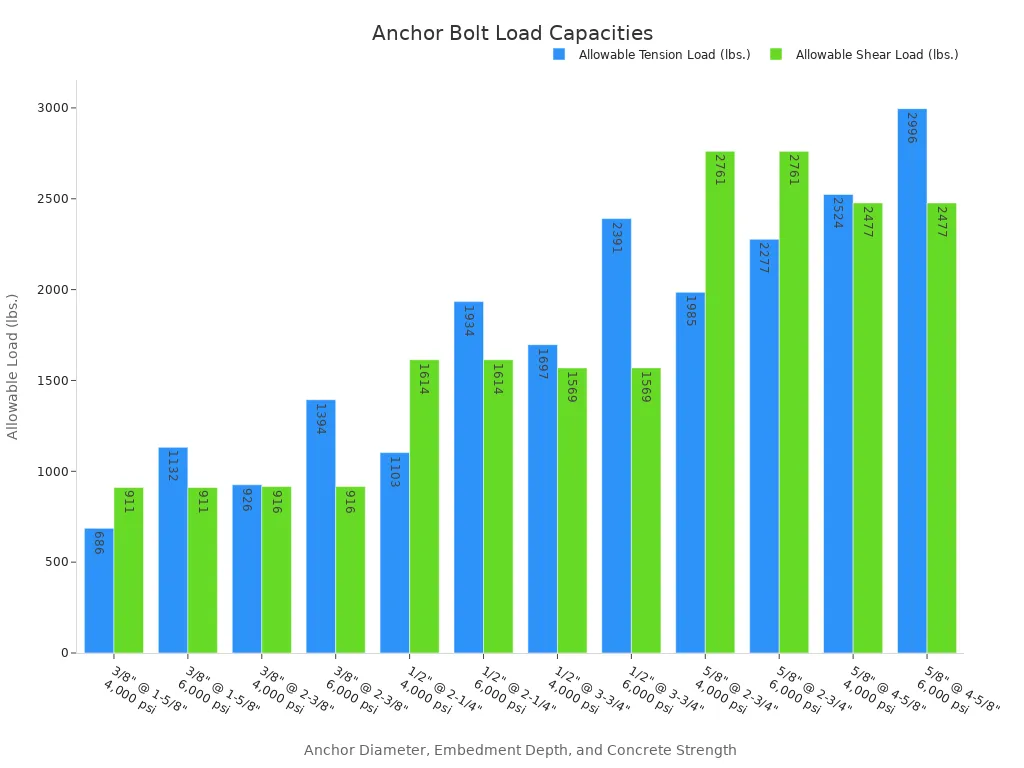
Anchor Load Capacity Comparison The following data illustrates how an anchor’s diameter and embedment depth affect its holding power in uncracked concrete. Notice how capacity increases significantly with both a larger diameter and a deeper embedment.
| Nominal Anchor Diameter (in.) | Minimum Embedment Depth (in.) | Concrete Compressive Strength (psi) | Allowable Tension Load Capacity (lbs.) | Allowable Shear Load Capacity (lbs.) |
|---|---|---|---|---|
| 3/8″ | 1-5/8″ | 4,000 | 686 | 911 |
| 1/2″ | 2-1/4″ | 4,000 | 1,103 | 1,614 |
| 5/8″ | 2-3/4″ | 4,000 | 1,985 | 2,761 |
Note: These allowable load capacities are for 304 Stainless Steel Wedge Anchors in normal-weight uncracked concrete, calculated with a factor of safety of 4.0.
Calculating the Correct Length
Once the diameter is chosen, the next step is to determine the correct bolt length. A bolt that is too short will not engage the concrete properly and will fail. A bolt that is too long can be wasteful and may interfere with other components.
The Minimum Embedment Rule
The most critical factor in determining length is the minimum embedment. This is the depth the anchor must be buried into the concrete to achieve its specified holding power. The International Building Code (IBC) and American Concrete Institute (ACI) provide clear guidance.
- The minimum effective embedment length for an anchor bolt is four times the bolt diameter (4db) or 2 inches, whichever is greater.
- For many structural applications, codes may require a much deeper embedment, often a minimum of 7 inches into the concrete.
Always check local building codes for specific requirements. For a standard 1/2-inch anchor, a common minimum embedment is between 2 1/2 and 3 inches for typical residential projects.
The Sizing Formula
A user can calculate the required anchor bolt length with a simple formula. This calculation ensures the anchor passes through the hardware and achieves the necessary minimum embedment into the base material.
Anchor Length = Post Base Thickness + Washer Thickness + Nut Height + Minimum Embedment
The thickness of the post base hardware is a critical part of this equation. The nut and washer must have enough thread to tighten down securely. An extra inch is often added to the total length to provide a safety margin and ensure sufficient thread projection.
A Practical Calculation Example
Let’s calculate the required length for a standard 4×4 post installation.
Identify the Components:
- Post Base Thickness:
1/4 inch(0.25″) - Washer Thickness:
1/8 inch(0.125″) - Nut Height (for a 1/2″ bolt):
7/16 inch(0.4375″) - Required Minimum Embedment:
3 inches(3.0″)
- Post Base Thickness:
Apply the Formula:
Length = 0.25" + 0.125" + 0.4375" + 3.0"Length = 3.8125 inches
Select the Bolt:
- The calculation shows a required length of 3.8125 inches. Since anchor bolts come in standard sizes, the installer would choose the next size up. In this case, a 4-inch long anchor with a 1/2-inch anchor diameter would be the correct choice. This selection ensures the anchor meets the minimum embedment depth while properly securing the hardware.
Step-by-Step Guide: Installing Wedge Anchors
A successful installation of wedge anchors depends on precision and adherence to correct procedure. The installation process is not complex, but every step is critical to ensure the wedge anchor achieves its maximum holding power. Following a systematic guide guarantees a secure and reliable connection for any structural post. This guide details the professional installation process for wedge anchors.
Tools and Materials Needed
An installer must gather the correct tools before beginning the project. Using the proper equipment prevents installation errors and ensures the wedge anchor functions as designed.
Safety Gear
Personal protective equipment is non-negotiable when working with concrete and power tools.
- Safety Glasses or Goggles
- Work Gloves
Drilling Tools
- Hammer Drill: This tool is essential for drilling into concrete efficiently.
- Carbide-Tipped Masonry Bit: The drill bit diameter must exactly match the diameter of the wedge anchor being installed.
Installation Tools
- Wire Brush and Blow-Out Bulb/Compressed Air: These are required for thoroughly cleaning the drilled hole.
- Hammer: Used to tap the wedge anchor into the hole.
- Wedge Anchor Setting Tool: This optional tool helps drive the wedge anchor correctly without damaging the threads.
- Torque Wrench: A torque wrench is mandatory for tightening the nut to the manufacturer’s specified torque value. This is a critical step for setting all wedge anchors.
Marking and Drilling the Hole
Accurate hole placement is the foundation of a proper installation. A misplaced hole can compromise the entire connection.
Positioning Your Post Base
The simplest method for perfect alignment involves using the post base itself as a template. An installer places the hardware in its exact final position. They then use a pencil or marker to mark the center of the anchor holes directly onto the concrete. This technique ensures the drilled holes will align perfectly with the hardware for the wedge anchors.
Selecting the Right Drill Bit
An installer must select a carbide-tipped drill bit that matches the nominal diameter of the wedge anchor. For a 1/2-inch wedge anchor, a 1/2-inch bit is required. Using the wrong size bit will cause the wedge anchor to either fit too loosely or not at all.
Drilling to the Correct Depth
The hole must be drilled deeper than the required embedment of the wedge anchor. A good rule of thumb is to drill the hole at least one anchor diameter deeper than the wedge anchor will be embedded. This extra space allows dust and debris to settle at the bottom of the hole without obstructing the wedge anchor.
Cleaning the Hole
This is the most critical and often overlooked step in the entire installation process. A clean hole is essential for the proper function of all wedge anchors.
Why Cleaning is Critical
Thorough cleaning of anchor holes is crucial before installation. Concrete dust left in the hole acts like a lubricant. It prevents the expansion clip on the wedge anchor from properly gripping the concrete walls. This failure to engage can reduce the holding power of wedge anchors by over 50%, leading to a catastrophic connection failure.
Methods for Cleaning
An installer must use a multi-step process to guarantee a clean hole for the wedge anchor.
- Blow: Use a blow-out bulb, pump, or compressed air to force the loose dust out of the hole.
- Brush: Scrub the interior walls of the hole with a properly sized wire brush to dislodge any remaining fine particles.
- Blow Again: Perform a final blow-out to remove all loosened debris. The hole is clean when no more dust emerges.
Installing the Anchor and Post Base
With a clean hole, the installer can proceed to the final steps of setting the hardware. This stage involves physically placing the wedge anchor and applying the precise force needed to secure it. Correct execution here ensures the connection is both stable and strong.
Setting the Anchor
Properly setting the wedge anchor requires a few deliberate actions. An installer follows a clear sequence to ensure the hardware aligns and the threads of the wedge anchor remain undamaged.
- The installer positions the post base over the clean, drilled holes.
- He threads the nut and washer onto the end of the wedge anchor. The nut should be flush with the top of the wedge anchor to protect the threads from the hammer blows.
- He carefully inserts the tip of the wedge anchor through the hole in the post base and into the concrete.
- Using a hammer, he drives the wedge anchor into the hole until the washer and nut are seated firmly against the surface of the post base. This process sets all wedge anchors correctly. All wedge anchors must be driven to the proper depth.
Tightening to the Right Torque
Tightening the nut is the most critical step. This action does not just make the connection snug; it activates the expansion mechanism of the wedge anchor. Applying the correct amount of rotational force, or torque, is mandatory for all wedge anchors.
Pro Tip: Use a Torque Wrench A torque wrench is the only tool that can ensure the correct installation force. For a common 1/2-inch hot-dip galvanized wedge anchor, the manufacturer-specified installation torque is between 50 and 60 ft./lbs. This specific torque value is necessary for the wedge anchor to be properly set in concrete.
An installer tightens the nut with a calibrated torque wrench. As he tightens it, the bolt pulls the tapered cone up into the expansion clip. This action wedges the clip against the concrete, creating the immense holding power of the wedge anchor.
- Under-torquing will fail to expand the wedge anchor sufficiently, resulting in a loose connection with very low holding power.
- Over-torquing can strip the threads or even crack the surrounding concrete, permanently compromising the integrity of the wedge anchor.
Following the manufacturer’s specifications for all wedge anchors is not optional; it is essential for a safe and reliable installation. The performance of all wedge anchors depends on this final step. All wedge anchors have a specified torque. All wedge anchors must be installed correctly.
Common Mistakes to Avoid When Installing Anchor Bolts
Even the highest quality anchor bolts will fail if installed incorrectly. A successful installation demands precision and an understanding of how the hardware functions. Avoiding common mistakes is just as important as selecting the right parts. Professionals prevent connection failures by sidestepping these frequent errors in selection, installation, and compliance.
Choosing the Wrong Bolt for the Job
The first opportunity for error occurs during selection. Matching the anchor to the base material and load is a foundational principle of safe construction.
Using Wedge Anchors in Block
A frequent and dangerous mistake is using wedge anchors in hollow cinder block or brick. Wedge anchors require a solid, dense material to expand against. In a hollow block, the expansion clip has nothing to grip, rendering the connection useless. This mismatch guarantees a low holding power and is a recipe for failure. For hollow materials, sleeve anchors are the appropriate choice, not wedge anchors.
Using Undersized Anchors
An installer must never use an anchor with a diameter too small for the anticipated load. A 3/8-inch anchor cannot safely do the job of a 1/2-inch anchor in a structural application. Using undersized wedge anchors compromises the entire structure’s integrity. The anchor’s diameter must always correspond to the load requirements and the post base hardware.
Incorrect Installation Practices
Proper procedure is not optional. The strength of the connection depends entirely on the quality of the installation process.
Not Cleaning the Hole Properly
An installer must clean the drilled hole meticulously. Concrete dust left inside acts as a lubricant. It prevents the expansion clip on wedge anchors from gripping the concrete walls. This simple oversight can reduce the holding power of wedge anchors by more than 50%, creating a severe safety hazard.
Over-Torquing or Under-Torquing
Applying the correct torque is critical for activating wedge anchors. An installer can identify under-torqued wedge anchors during testing with a calibrated torque wrench. Over-torquing is equally destructive and presents clear warning signs.
- Concrete cracking or splitting around the anchor
- Deformed or stretched threads on the bolt
- The bolt head snapping off during tightening
- Complete anchor failure or pull-out
Using a torque wrench to apply the manufacturer’s specified value for all wedge anchors is the only way to ensure a proper installation.
Drilling the Hole Too Shallow
The anchor must be embedded to the correct depth to achieve its rated strength. Drilling a hole that is too shallow prevents the wedge anchors from reaching the required minimum embedment. This results in dramatically reduced pull-out resistance and a weak connection that cannot support its intended load.
Ignoring Local Building Codes
Building codes are legal requirements, not suggestions. They exist to ensure structures are safe for public use.
Why Codes Matter for Safety
Local building codes provide minimum standards for construction practices, including how to anchor structural posts. These regulations are based on extensive engineering tests and are designed to prevent structural failures. Ignoring them puts property and lives at risk.
How to Check Local Requirements
Building codes are localized, meaning requirements can vary significantly based on geographical location. To find specific building code requirements for deck post anchoring, an installer’s initial action should be to consult the local building authority for detailed guidelines and necessary permits. They can provide information on the specific building permits and guidelines that must be followed.
An installer ensures a safe connection and proper minimum embedment by following a final checklist. This systematic approach simplifies the selection process.
- Identify Your Load: Determine if the post is structural (high load) or decorative (low load).
- Check Your Base Material: Confirm if the anchor will go into solid concrete, block, or brick.
- Consider the Environment: Select a corrosion-resistant finish for outdoor or wet conditions.
- Match the Diameter: Ensure the bolt diameter fits the post base hardware, typically 1/2-inch.
- Calculate the Length: Add the hardware thickness to the required minimum embedment depth.
When in doubt, an installer should always choose a stronger, more corrosion-resistant option and consult local building codes for specific requirements.
FAQ
What is the best anchor for a 4×4 post in solid concrete?
A 1/2-inch diameter hot-dip galvanized wedge anchor is the best anchor for securing a 4×4 post to solid concrete. This type of concrete anchor provides the highest load capacity for structural applications like decks and pergolas.
Can I use a wedge anchor in a hollow block?
An installer must not use a wedge anchor in hollow block. The anchor requires solid material to expand against. For hollow block, a sleeve anchor is the correct choice, as it ensures proper material compatibility and a secure connection.
How deep should anchor bolts be installed?
The required depth, or minimum embedment, depends on the anchor diameter and local codes. For a 1/2-inch anchor, a common minimum embedment is 2.5 to 3 inches. An installer always drills the hole deeper to accommodate dust.
What happens if I don’t clean the hole before installation?
Failing to clean the hole drastically reduces the load capacity of anchor bolts. Concrete dust prevents the expansion clip on wedge anchors from gripping the concrete, which can cause the connection to fail under load. The installation process requires a clean hole.
Do I need a torque wrench to install wedge anchors?
Yes, an installer must use a torque wrench. Applying the manufacturer’s specified torque is a critical step in the installation process. It activates the expansion mechanism of the wedge anchor, ensuring it achieves its full holding power.
What size anchor diameter is best for a deck post?
A 1/2-inch anchor diameter is the industry standard for most deck posts. This size fits standard post base hardware and provides sufficient strength for typical residential loads. For heavier structures, an installer might use a 5/8-inch diameter.