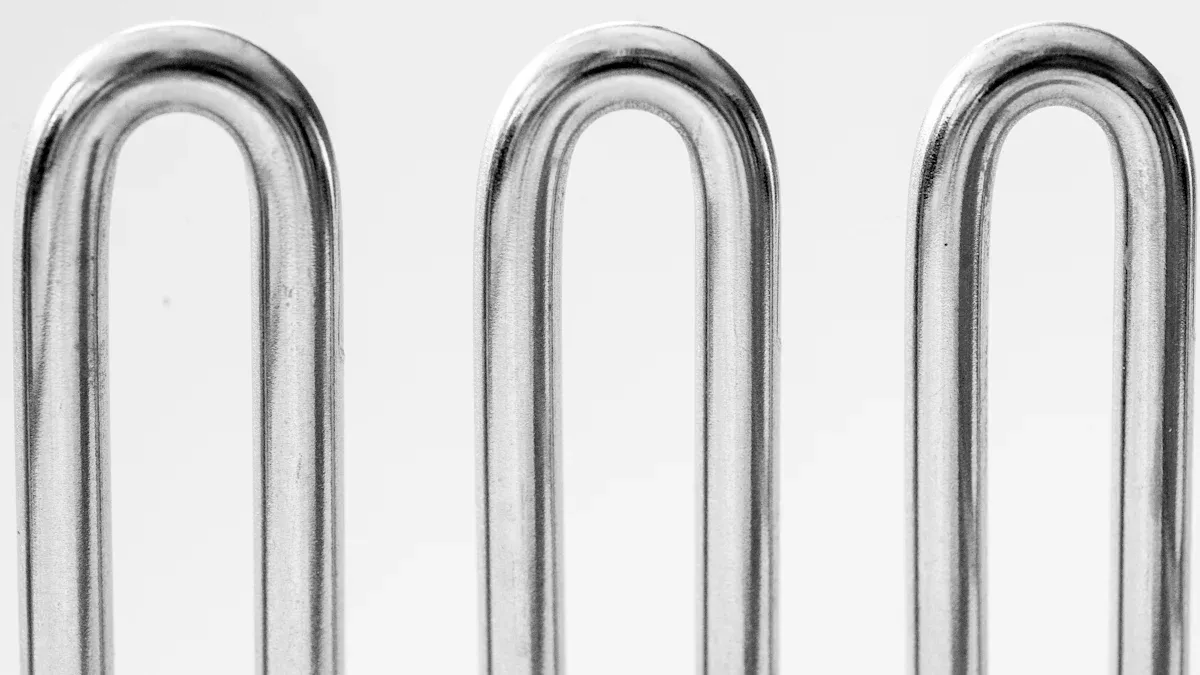
So, what is a u-bolt? A U-bolt is a fastener shaped like the letter ‘U’ with screw threads on both ends. Professionals primarily use this U-образный болт to secure pipes, tubes, or cables to a support structure. This provides firm placement and stability. As a key component in the industrial fastener market, u bolts contribute to a significant global industry. The process of литье болтов allows a производитель крепежных изделий на заказ to create a wide variety of нестандартные крепежные элементы for specific needs.
| Метрическая | Стоимость |
|---|---|
| Global Bolt (Fastener) Market Value (2021) | USD 29.3 Billion |
| Projected Market Value (2030) | USD 42.2 Billion |
| CAGR (2022-2030) | 4.4% |
The U-Bolts market in North America is projected to experience a Compound Annual Growth Rate (CAGR) of 12.6% from 2026 to 2033.
What is a U-bolt and Its Primary Functions?
Beyond the simple question of what is a u-bolt, understanding its core functions reveals its true value in engineering and construction. This single fastener performs three distinct yet related roles: acting as a pipe restraint, a pipe guide, and a structural anchor. Each function is critical for ensuring the safety, stability, and longevity of the system it supports. The specific application dictates which role the u-bolt will play.
Role as a Pipe Restraint
The most common function of u bolts is to act as a pipe restraint. In this capacity, the fastener clamps a pipe or tube securely to a support structure, effectively locking it in place. This function is governed by industry standards to ensure reliability.
Preventing Axial and Lateral Movement
A properly installed u-bolt prevents a pipe from moving along its length (axial movement) or from side to side (lateral movement). This rigid connection is essential in systems where precise pipe placement is critical for operational integrity. The design and application of these supports are defined by standards like MSS SP-58, which outlines:
- Allowable stresses and load ratings for support components.
- Minimum material standards for hangers and supports.
- Standardized product designs and manufacturing processes.
- Guidelines for selection, application, and installation.
Absorbing Vibration and Shock
Industrial piping systems often experience significant vibration from pumps, motors, or the flow of materials. U bolts help absorb and dampen these vibrations by creating a firm clamping force. This action protects the pipe from fatigue stress, reduces noise, and prevents the loosening of other nearby connections.
Role as a Pipe Guide
In some systems, completely restricting pipe movement is undesirable. This is where u bolts function as pipe guides, a role that showcases the benefits of using u-bolts for controlled motion.
Pipe guides are specialized supports that encourage pipe movement in a specific, controlled direction. They essentially nudge the pipe along its intended path while offering protection against unwanted shifts.
Allowing for Thermal Expansion
Pipes carrying hot or cold substances, such as steam or cryogenic fluids, expand and contract with temperature changes. A guide allows the pipe to slide axially to accommodate this thermal movement without causing stress on the pipe or its connection points. Often, these u bolts feature a thermoplastic coating that reduces friction and allows the pipe to slide smoothly.
Directing Controlled Movement
While allowing axial movement, a pipe guide simultaneously prevents vertical or lateral motion. This ensures the pipe expands and contracts along a predictable line, preventing it from buckling or interfering with adjacent structures. This dual function of allowing and restricting movement makes this fastener a sophisticated engineering tool.
Role as a Structural Anchor
The utility of the u-bolt extends beyond piping. Its simple and strong design makes it an effective structural anchor for a wide range of non-cylindrical applications.
Securing Items During Shipping
Logistics and shipping professionals use heavy-duty u bolts to anchor machinery, vehicles, and other large cargo to the beds of trucks or within shipping containers. The fastener provides a reliable and strong tie-down point, preventing dangerous load shifts during transit.
Attaching Components to Beams or Walls
In construction, a u-bolt is an excellent fastener for attaching various components to structural members. Workers use them to mount electrical conduit, support brackets, signage, and even antennas to steel beams, concrete walls, or wooden posts. This application demonstrates the fastener’s versatility in securing both round and square objects to a fixed surface.
Common Applications for U Bolts
The simple design of the U-bolt belies its immense versatility. Professionals across a vast range of sectors rely on this component for critical securing and support functions. Its application extends from massive industrial complexes to everyday consumer products. Understanding these common uses highlights the indispensable role the fastener plays in modern engineering and manufacturing.
Industrial Piping Systems
Industrial facilities are a primary environment for u bolts. Engineers use them extensively to manage complex networks of pipes, conduit, and cables, ensuring operational safety and efficiency.
Securing Process Pipes
Technicians use u bolts to rigidly clamp process pipes to structural supports like I-beams, channels, or walls. This application is vital for systems that transport various substances. Common examples include:
- Chemical processing lines
- Oil and gas pipelines
- Water and wastewater mains
- Compressed air systems
A secure connection prevents pipe vibration and unwanted movement. This protects the integrity of the entire piping system from operational stresses.
Supporting Conduit and Cable Trays
Beyond fluid transport, this fastener is essential for organizing and supporting electrical infrastructure. Electricians mount electrical conduit and heavy cable trays to ceilings and walls using u bolts. This method keeps high-voltage wiring and data cables safely contained and routed, preventing damage and maintaining an organized workspace.
Automotive and Vehicle Suspension
The automotive industry depends on the strength and reliability of u bolts for safety-critical applications, particularly in vehicle suspension and exhaust systems.
Attaching Leaf Springs to Axles
In trucks and heavy-duty vehicles, u bolts perform the crucial task of attaching the leaf spring assembly to the axle. This connection holds the vehicle’s suspension together and bears immense dynamic loads. Failure here can have severe consequences. A common failure mode is the fastener becoming loose from stretching over time.
Technicians often diagnose loose u bolts by listening for “clunking or banging noises over bumps.” This looseness allows the axle and spring to shift, which can alter the vehicle’s alignment and create dangerous handling problems.
Conversely, over-torquing the u bolts during installation can also cause significant damage by crushing the spring pack or warping the mounting surfaces.
Mounting Exhaust Systems
Mechanics also use u bolts to secure components of a vehicle’s exhaust system. They clamp exhaust pipes to hangers, brackets, and mufflers. This application ensures the entire system remains fixed to the vehicle’s undercarriage while allowing for minor shifts caused by vibration and thermal expansion.
Construction and Infrastructure
On construction sites, the U-bolt serves as a robust and adaptable anchoring solution. Its strength makes it suitable for both temporary and permanent structural installations.
Anchoring Rebar and Foundation Poles
Builders sometimes embed large, heavy-duty u bolts into wet concrete foundations. Once the concrete cures, the exposed threads provide an exceptionally strong anchor point. Workers can then attach steel rebar, support poles, or other structural elements directly to the foundation, creating a solid and durable connection.
Securing Roofing and Signage
This fastener provides a simple method for attaching materials to structural frames. Construction crews use them to secure corrugated metal roofing panels to steel purlins. They are also a popular choice for mounting large signs to cylindrical posts or square beams, offering a secure grip that withstands wind and weather.
Marine and Shipping
The marine environment presents some of the harshest conditions for metal components. Constant exposure to saltwater, humidity, and vessel motion demands hardware with exceptional durability and corrosion resistance. Marine professionals frequently choose u bolts for their strength and reliability in these challenging settings.
Fastening Deck Equipment
Ship decks are crowded with essential equipment that must remain secure, even in rough seas. Crews use stainless steel u bolts to fasten a wide variety of fixtures directly to the deck, railings, or superstructure. This specific fastener provides a secure grip that resists the constant vibration and shock of a vessel underway. Common applications include:
- Securing safety railings and stanchions
- Mounting life raft canisters and emergency gear
- Anchoring antenna masts and navigation equipment
- Fastening cleats and other mooring hardware
Примечание: For marine applications, Type 316 stainless steel is the preferred material. Its molybdenum content provides superior resistance to chloride corrosion, making it ideal for saltwater environments.
Securing Cargo in Transit
Preventing cargo from shifting is a top priority in the shipping industry. A loose container or piece of heavy machinery can cause catastrophic damage to a vessel and endanger the crew. Shippers utilize heavy-duty u bolts as robust tie-down points on ship decks and inside cargo holds. Dockworkers loop chains, cables, or high-strength straps through these anchors to lash down everything from shipping containers to industrial equipment, ensuring the load remains stable throughout the voyage.
Exploring the Different Types of U-bolts
Engineers select u bolts based on the specific demands of an application. The various types of u-bolts are primarily distinguished by their bend shapes and leg configurations. Understanding these differences is crucial for choosing the correct component for a job, as the geometry of the bolt directly impacts its function and suitability. The design ensures a secure fit against the supported object and the mounting surface.
By Bend Shape
The most common way to classify u bolts is by the shape of the bend at the bottom of the fastener. These shapes are designed to match the profile of the object being secured.
Round Bend U-bolts
The round bend is the most recognizable style. It features a classic 180-degree semicircular bend. Professionals use this type almost exclusively for securing pipes, tubes, and other cylindrical objects. The curved base cradles the pipe, providing a snug fit that distributes clamping force evenly around the circumference.
Square Bend U-bolts
Square bend u bolts have a flat bottom and two 90-degree corners, forming a squared-off shape. This design is ideal for securing items to square or rectangular structural members. Common applications include attaching components to:
- Square tubing
- I-beams
- Wood posts
- Channel iron
The flat base sits flush against the mounting surface, creating a stable and secure connection.
Semi-Round Bend U-bolts
A semi-round bend offers a middle ground between round and square shapes. Its bend is flatter and wider than a standard round bend. This specialized profile is useful for securing objects with an unusual or non-standard curvature. It provides a more customized fit where a perfectly round bend would leave gaps.
By Leg Configuration
Beyond the bend, the design of the legs also creates different types of u-bolts. These variations accommodate unique mounting challenges or serve entirely different functions.
J-bolts
A J-bolt is essentially a u-bolt with one leg and its corresponding threads removed, creating a “J” shape. This fastener functions less as a clamp and more as a hook or anchor. Builders often embed the curved end into wet concrete, leaving the threaded leg exposed. This creates a permanent, heavy-duty anchor point for securing walls, posts, or machinery.
Long Tangent U-bolts
Long tangent u bolts feature an extended straight section, or “tangent,” between the top of the bend and the start of the threads. This design provides greater clearance than a standard u-bolt.
Требуемый диаметр твердосплавного сверла A long tangent design is necessary when the mounting surface is exceptionally thick or when extra space is needed between the secured pipe and the support structure.
The table below highlights the key difference:
| Характеристика | Standard U-bolt | Long Tangent U-bolt |
|---|---|---|
| Leg Shape | Threads begin shortly after the bend. | Has a straight, unthreaded section (tangent) above the threads. |
| Основное применение | Standard pipe support applications. | Mounting through thick beams or insulation. |
U-bolt Materials and Protective Coatings
Selecting the right material and coating is a critical decision in the u-bolt specification process. The base material provides the necessary strength, while a protective coating shields the fastener from environmental corrosion. This combination determines the component’s lifespan and reliability in its intended application.
Common Base Materials
The mechanical properties of a u-bolt begin with its base material. Engineers choose a material based on the required load capacity, temperature range, and exposure to corrosive agents.
Plain Carbon Steel
Plain carbon steel is a common and cost-effective choice for general-purpose u bolts. It offers good strength for standard applications in dry, indoor environments. However, plain u-bolts lack inherent corrosion resistance. They will rust quickly when exposed to moisture, making them unsuitable for outdoor or marine use without a protective coating.
Stainless Steel (304 and 316)
Stainless steel u-bolts provide excellent corrosion resistance without needing an external coating.
- Type 304: This is the most common grade, offering solid protection against rust in most atmospheric conditions.
- Type 316: This grade contains molybdenum, which significantly enhances its resistance to chlorides. Professionals prefer Type 316 stainless steel u-bolts for marine and coastal applications where saltwater exposure is constant.
Alloy Steels (e.g., B7)
Alloy steels, such as ASTM A193 Grade B7, are heat-treated to achieve very high tensile strength. Engineers specify these high-strength u bolts for demanding applications involving high temperatures or high pressures. Common uses include securing pipe flanges in oil and gas refineries or power plants.
Essential Protective Coatings
Protective coatings create a barrier between the base metal and corrosive elements. The choice of coating directly impacts the durability of plain u-bolts in challenging environments.
Цинкование (гальваническое)
Zinc plating involves applying a thin layer of zinc to the steel. This coating provides a basic level of corrosion protection and a bright, aesthetic finish. It is suitable for dry, indoor applications but is not recommended for outdoor use. The thin layer can easily be scratched, exposing the steel underneath to rust.
Hot-Dip Galvanization
Hot-dip galvanizing creates a much thicker and more durable coating than zinc plating. The process involves dipping the steel into molten zinc, which forms a metallurgical bond with the surface. This robust layer offers long-term protection, even in harsh outdoor and marine environments.
Performance in Coastal Environments
Studies show a significant difference in durability between coatings. Hot-dip galvanizing is the most commonly specified protective coating in the marine construction industry for this reason.
| Тип покрытия | Thickness (microns) | Condition/Treatment | Observed Performance in Coastal Areas |
|---|---|---|---|
| Hot-dip Galvanized | Не указано | Стандартный | Good condition after 3 years of exposure |
| Zinc-plated | 14 to 17 | Стандартный | Considerable corrosion in less than a year |
| Zinc-plated | Minimum 25 | Chromate treated | No sign of corrosion after 2 years of exposure |
Fluoropolymer (Xylan/Teflon)
Fluoropolymer coatings, like Xylan or Teflon, offer premium performance. They provide a nonstick, low-friction surface with outstanding resistance to chemicals and corrosion. These coatings are essential in the Oil & Gas and Offshore industries. Key benefits include:
- Reduced friction for easier tightening
- Excellent chemical and corrosion resistance
- Wide temperature tolerance
- Nonstick properties to prevent material buildup
Кадмирование
Cadmium plating offers excellent corrosion resistance, particularly in saltwater environments. It also provides natural lubricity, which helps prevent galling on stainless steel u-bolts. However, due to the toxicity of cadmium, its use is now heavily restricted in many regions and industries for environmental and health safety reasons.
How to Correctly Measure a U-bolt
Selecting the correct u-bolt is essential for a secure and reliable installation. Accurate measurement ensures the fastener fits the pipe and support structure perfectly. Professionals identify four key dimensions to specify the correct component for any application. Taking precise measurements prevents installation issues and potential component failure.
Identifying Key Dimensions
Four critical measurements define the specifications of all standard u bolts. A technician must measure each one carefully to order the correct part. These dimensions correspond to the fastener’s diameter, width, length, and threading.
Rod Diameter (A)
The rod diameter is the thickness of the metal bar used to form the bolt. This measurement determines the fastener’s overall strength and load-bearing capacity.
Inside Width (B)
The inside width is the distance between the two legs of the u-bolt. This is a crucial dimension. It must match the outside diameter of the pipe or object being secured for a snug fit.
Inside Length (C)
The inside length measures the distance from the inside of the bend to the end of the threaded leg. This dimension must be long enough to pass through the support structure and accommodate washers and nuts.
Thread Length
This specifies the length of the threaded portion on each leg. The thread length must provide sufficient engagement for the nuts to be tightened to the correct torque.
Matching the U-bolt to Pipe Size
Manufacturers produce u bolts in standard sizes designed to fit common pipe dimensions. Understanding the relationship between pipe sizes and u-bolt sizes is key to making the right selection.
Understanding Nominal Pipe Size (NPS)
Professionals size u bolts based on the Nominal Pipe Size (NPS) of the pipe they will support. NPS is a North American standard set of sizes for pipes used for high or low pressures and temperatures.
It is important to note that NPS refers to the approximate inside diameter of the pipe, not the u-bolt itself or the pipe’s exact outside diameter. For example, a 3-inch NPS pipe has a fixed outside diameter of 3.5 inches. Technicians must know the pipe’s actual outside diameter to ensure a correct fit, as the fastener is designed to accommodate this external dimension.
Using a U-bolt Measurement Chart
Reference charts simplify the process of matching a u-bolt to a specific pipe. These charts correlate the Nominal Pipe Size directly to the required inside width of the fastener. Using a chart eliminates guesswork and ensures the selection of correctly matched sizes.
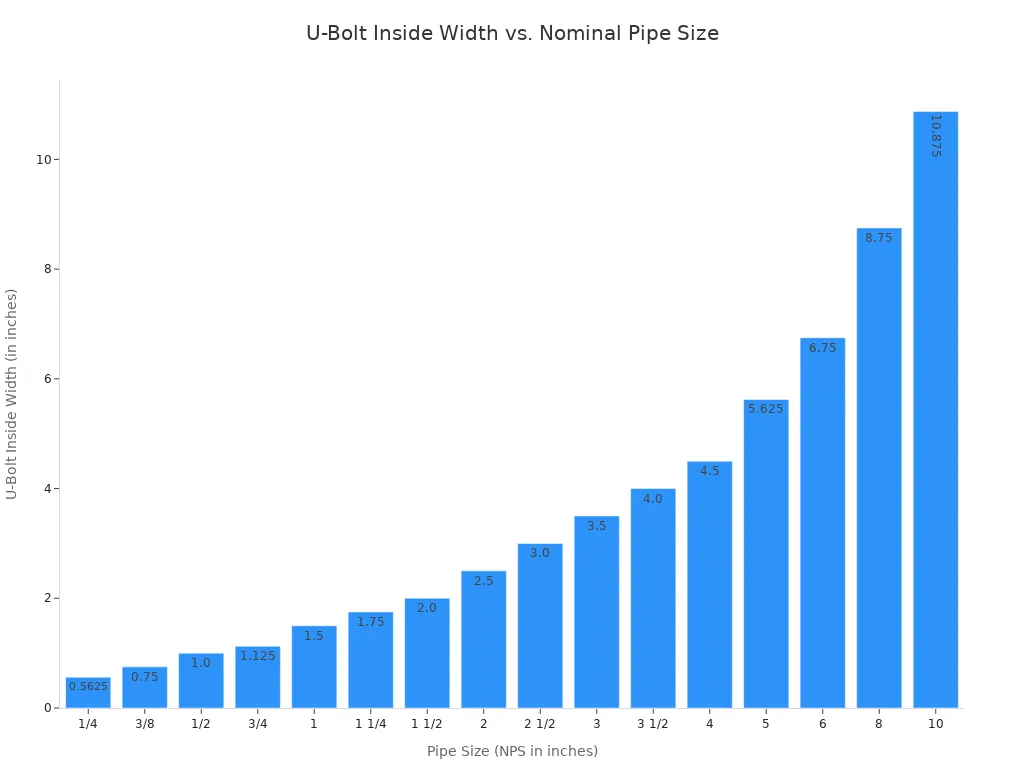
The table below shows some common NPS sizes and the corresponding inside width required for the u-bolt.
| Pipe Size (NPS) | U-Bolt Inside Width (Inches) |
|---|---|
| 1/2 | 1 |
| 1 | 1 1/2 |
| 2 | 2 1/2 |
| 3 | 3 1/2 |
| 4 | 4 1/2 |
| 6 | 6 3/4 |
| 8 | 8 3/4 |
By using the pipe’s NPS, a user can quickly identify the correct u-bolt sizes from a manufacturer’s catalog.
A Step-by-Step U-bolt Installation Guide
Proper installation is paramount for ensuring the safety and reliability of a u-bolt assembly. A correct procedure guarantees the fastener provides the intended clamping force without damaging the pipe or the bolt itself. Following a systematic process prevents common failures and extends the service life of the connection.
Required Tools and Components
Professionals gather all necessary items before beginning the installation. Using the right tools and matched components is the first step toward a secure and lasting fit.
U-bolt, Nuts, and Washers
Technicians should always use new u bolts, nuts, and washers for critical applications, especially in vehicle suspension systems. Reusing an old fastener is risky because it may have stretched from previous torquing. All components must be of the same material and grade to prevent issues like galvanic corrosion.
Calibrated Torque Wrench
A calibrated torque wrench is the most critical tool for this job. It is the only way to ensure the nuts are tightened to the manufacturer’s precise specifications. Guesswork can lead to dangerous over-torquing or under-torquing.
Защитные очки и перчатки
Personal Protective Equipment (PPE) is essential. Safety glasses protect the eyes from debris, while gloves protect the hands during the tightening process.
The Installation Process
A successful installation involves a sequence of deliberate steps. Each stage builds upon the last to create a secure, evenly stressed connection.
Position the U-bolt Correctly
An installer first places the u-bolt around the pipe or object. They then align its legs to pass squarely through the holes in the support bracket or plate. The fastener should sit perpendicular to the pipe to ensure even pressure distribution.
Hand-Tighten the Nuts
Next, the installer threads the washers and nuts onto the legs. They hand-tighten the nuts until they are snug against the mounting surface. This step removes any slack and properly seats all components before applying torque.
Apply Torque Evenly in Stages
Applying the correct torque is the most crucial phase. Technicians tighten the nuts in a gradual, alternating pattern to draw the plate up evenly. This prevents uneven stress on any single leg.
Требуемый диаметр твердосплавного сверла Never fully torque one side before the other. Tighten each nut incrementally, moving back and forth between them. This ensures the clamping force is applied uniformly across the mounting surface.
The required torque value depends on the bolt’s diameter, material grade, and application. For example, automotive suspension u bolts have specific requirements:
- 1/2 inch U-bolt: 90 ft-lbs
- 9/16 inch U-bolt: 130 ft-lbs
- 5/8 inch U-bolt: 180 ft-lbs
Industrial applications follow charts based on material specifications.

The table below provides a detailed reference for common industrial grades.
| Размер болта | ASTM A193 B7 / A320 L7 / A354 BC (Plain, ft-lbs) | ASTM A307 (Plain, ft-lbs) | SAE Grade 2 (Plain, ft-lbs) |
|---|---|---|---|
| 1/4″ | 10 | 3 | 5 |
| 3/8″ | 38 | 12 | 20 |
| 1/2″ | 93 | 29 | 49 |
| 5/8″ | 186 | 58 | 97 |
| 3/4″ | 329 | 104 | 173 |
| 1″ | 796 | 251 | 250 |
Perform a Final Inspection
After reaching the final torque value, the technician performs a final check. They verify that the mounting plate is not bent and that an equal number of threads are visible beyond each nut. This confirms a balanced and secure installation.
Common Installation Mistakes and How to Avoid Them
Even a high-quality fastener can fail if installed incorrectly. Technicians can avoid common installation mistakes by understanding the risks associated with improper torque and mismatched hardware. Adhering to best practices ensures the connection remains secure and reliable for its entire service life.
Over-Torquing the Nuts
Applying too much force when tightening the nuts is a frequent and damaging error. While a tight fit seems secure, excessive torque creates dangerous levels of stress.
Risk of Bolt Failure and Pipe Damage
Over-torquing generates excessive preload on the assembly. This extreme force can cause the u-bolt to stretch beyond its elastic limit, leading to strength failure of the fastener itself. Additionally, the intense clamping pressure can cause localized damage to the clamped components. The u bolts can crush or deform the surface of a pipe, compromising its structural integrity and creating a potential failure point.
Внимание: A torque wrench is not just a recommendation; it is a necessity. Always follow the manufacturer’s specified torque values to prevent component damage and ensure a safe installation.
Under-Torquing the Nuts
Insufficient torque is just as hazardous as excessive torque. A loose connection fails to provide the necessary clamping force, leaving the entire assembly unstable.
Creates an Insecure Fastening Point
An under-torqued u-bolt creates an insecure fastening point that cannot properly restrain the pipe or component. This looseness is especially dangerous in dynamic systems like vehicle suspensions. The consequences include:
- Suspension Misalignment: Loose components can shift, leading to poor vehicle handling and uneven tire wear.
- Component Stress: The movement can cause “axle walk” and place undue stress on leaf springs, leading to premature spring failure.
- Safety Hazards: In critical applications, loose parts can separate entirely, resulting in catastrophic equipment failure or accidents.
Using Incorrect or Mismatched Hardware
The integrity of a connection depends on all its parts working together. Using components made from different materials can introduce a destructive electrochemical process.
Risk of Galvanic Corrosion
Galvanic corrosion is a significant risk when installers use mismatched hardware, such as stainless steel u bolts with plain carbon steel nuts. This process occurs when two different metals are connected in the presence of an electrolyte like moisture.
- Stainless steel is more noble (less reactive) than carbon steel.
- When connected, the stainless steel effectively pulls electrons from the carbon steel.
- The carbon steel, acting as the anode, oxidizes and corrodes at an accelerated rate.
This reaction weakens the carbon steel component, causing it to rust and disintegrate, ultimately leading to the failure of the connection.
Improper U-bolt Alignment
An installer’s attention to detail is crucial for a successful u-bolt installation. The alignment of the fastener is just as important as the torque applied. A misaligned u-bolt can compromise the entire connection, leading to uneven stress and potential failure. Technicians must ensure the fastener sits perfectly perpendicular to the object it secures.
Causes Uneven Stress Distribution
Proper alignment ensures the clamping force distributes evenly across the pipe and the mounting surface. When a technician installs a u-bolt at an angle, it creates a dangerous imbalance. This misalignment concentrates the clamping force on specific points instead of spreading it out.
Critical Point: A crooked installation places immense stress on the high points of contact. This focused pressure can crush the pipe, damage protective coatings, and over-stress one leg of the fastener while leaving the other loose.
This uneven load creates several problems:
- Point Loading: The angled fastener no longer cradles the pipe. Instead, it creates sharp pressure points that can dent or even puncture the pipe wall, especially on thinner materials.
- Bolt Stress Imbalance: One leg of the u-bolt will bear a disproportionate amount of the load. This over-stressed leg is more likely to stretch or fracture, while the other leg may not have enough tension to secure the connection.
- Vibration and Loosening: An unevenly clamped connection is less effective at resisting vibration. The movement can cause the nuts to loosen over time, leading to a complete loss of clamping force.
To prevent these issues, installers must ensure the u bolts are positioned correctly before applying torque. The legs should pass straight through the mounting holes, and the bend should sit squarely on the pipe. A visual inspection before and during tightening confirms that the fastener remains perpendicular, guaranteeing a secure and balanced connection that will perform reliably.
This guide answers the question, what is a u-bolt, by showing its role as a fundamental fastener. Professionals recognize its versatility in restraining, guiding, and anchoring components across many industries. The safety and effectiveness of all u bolts depend on several key factors.
- Technicians must select the correct fastener type, material, and size for the specific application.
- Installers must follow proper procedures, especially the application of correct torque.
- Understanding what is a u-bolt and its proper use prevents component failure and ensures long-term system reliability.
Частые вопросы
Can technicians reuse old U-bolts?
Professionals should not reuse U-bolts, especially in critical systems like vehicle suspensions. The initial torquing process permanently stretches the fastener. Reusing a stretched bolt compromises its clamping force and creates a significant safety risk. This practice ensures maximum connection integrity.
Why is re-torquing U-bolts important?
Installers perform re-torquing after a short service period. New U-bolts can experience initial stretch and settling. Re-tightening the nuts to the specified torque value compensates for this settling. This action ensures the connection maintains its required clamping force for long-term safety and stability.
When should someone choose stainless steel over galvanized steel?
Engineers specify stainless steel U-bolts for applications requiring superior corrosion resistance without a coating.
Требуемый диаметр твердосплавного сверла Type 316 stainless is ideal for marine or chemical environments. Hot-dip galvanized steel offers robust protection for general outdoor use but may not suffice in highly corrosive settings.
How does one measure a U-bolt for a square object?
A technician measures a square bend U-bolt similarly to a round one. The key dimensions are rod diameter, inside width, and inside length. The inside width must match the width of the square or rectangular object being secured. This measurement ensures a flush, stable fit.
What are the signs of a failing U-bolt?
Visual inspection can reveal signs of U-bolt failure. Technicians look for:
- Visible rust or corrosion
- Cracks in the bend
- Stripped or damaged threads
- Looseness or movement in the assembly
Any visible damage indicates the fastener requires immediate replacement to prevent catastrophic failure.
Should installers lubricate U-bolt threads before tightening?
Lubrication affects the final torque reading. Installers should only lubricate threads if the manufacturer’s torque specifications are for a lubricated condition. Applying lubricant to a “dry torque” spec can lead to dangerous over-tightening. Always consult the specific torque chart for the fastener.