Selecting the correct hex nut plays a vital role in ensuring a project’s safety and performance. Industry research highlights how factors such as material composition, thread profile, and locking mechanisms directly impact mechanical reliability. The table below summarizes key findings:
| Evidence Type | Описание |
|---|---|
| Material Composition | Different materials provide varying strength, corrosion resistance, and thermal stability, impacting performance. |
| Thread Profile | The right thread design enhances grip and reduces slippage, optimizing connections in high-pressure systems. |
| Shear Force Resistance | Hex nuts can endure shear forces of up to 120,000 psi, making them ideal for critical components. |
| Механизм блокировки | Nylock nuts can reduce failure rates in machinery by up to 35% in high-vibration scenarios. |
A производитель крепежных изделий на заказ recommends matching nuts and bolts to the application environment. Custom fasteners tailored for specific conditions help professionals choose the right hex nut for maximum durability.
What is a Hex Nut?
Basic Definition
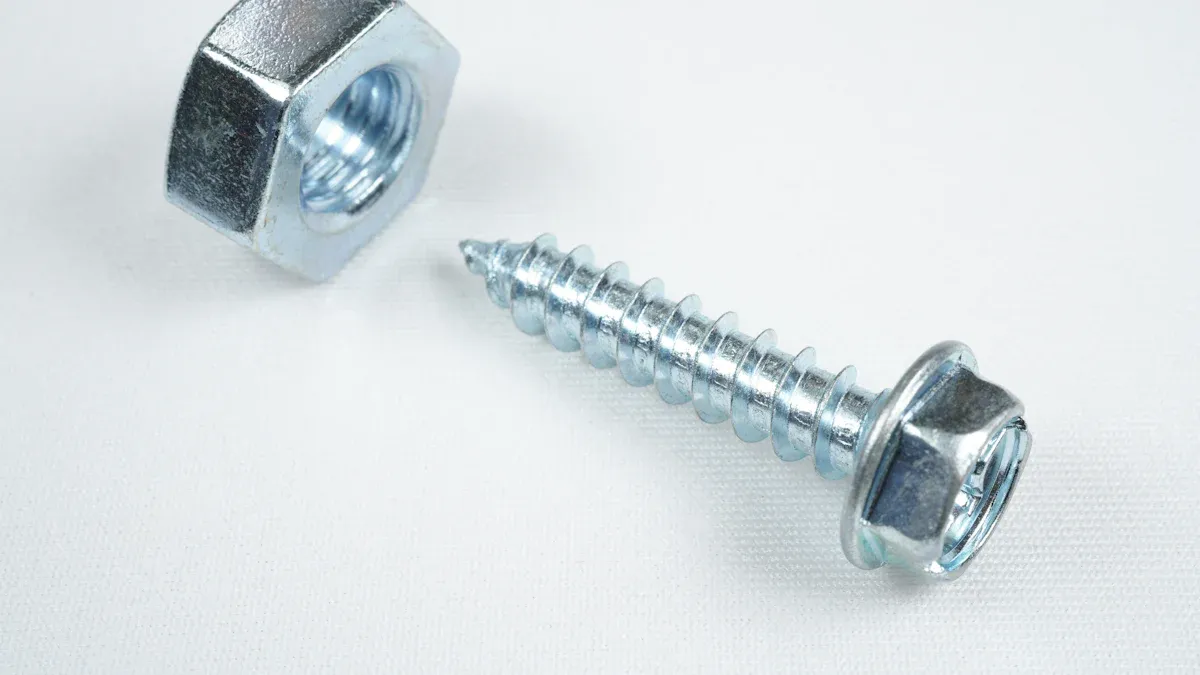
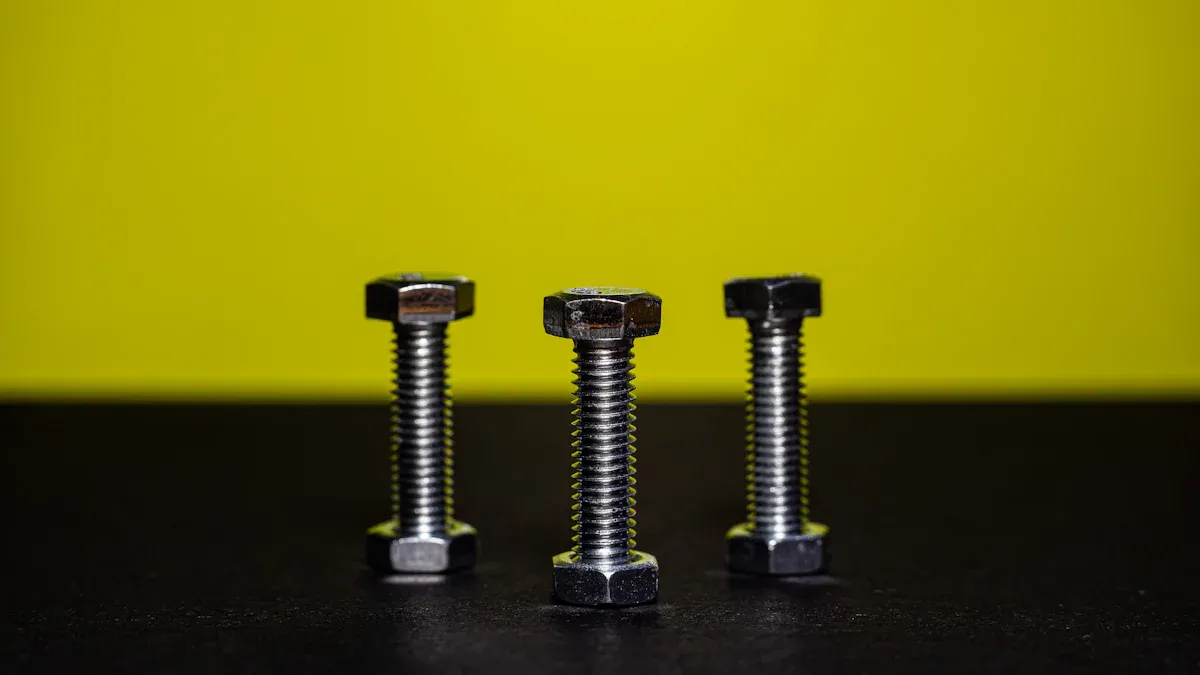
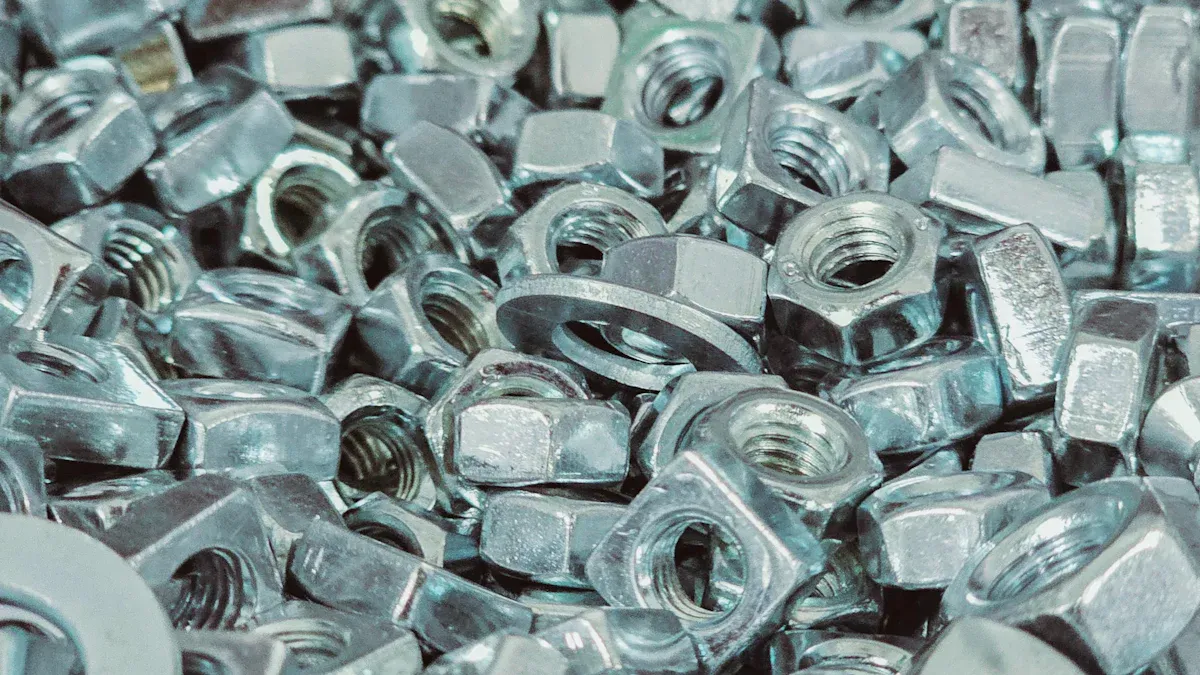
A hex nut is a six-sided fastener that works with a bolt or screw to secure two or more components together. The hexagonal shape allows users to grip the nut from multiple angles using a wrench or socket. This design provides both convenience and efficiency during assembly and disassembly. Hex nuts come in a range of sizes and materials, making them suitable for various mechanical, construction, and automotive applications.
Tip: The six-sided profile of a hex nut offers better torque distribution compared to square or round nuts. This feature helps prevent rounding off the corners during tightening.
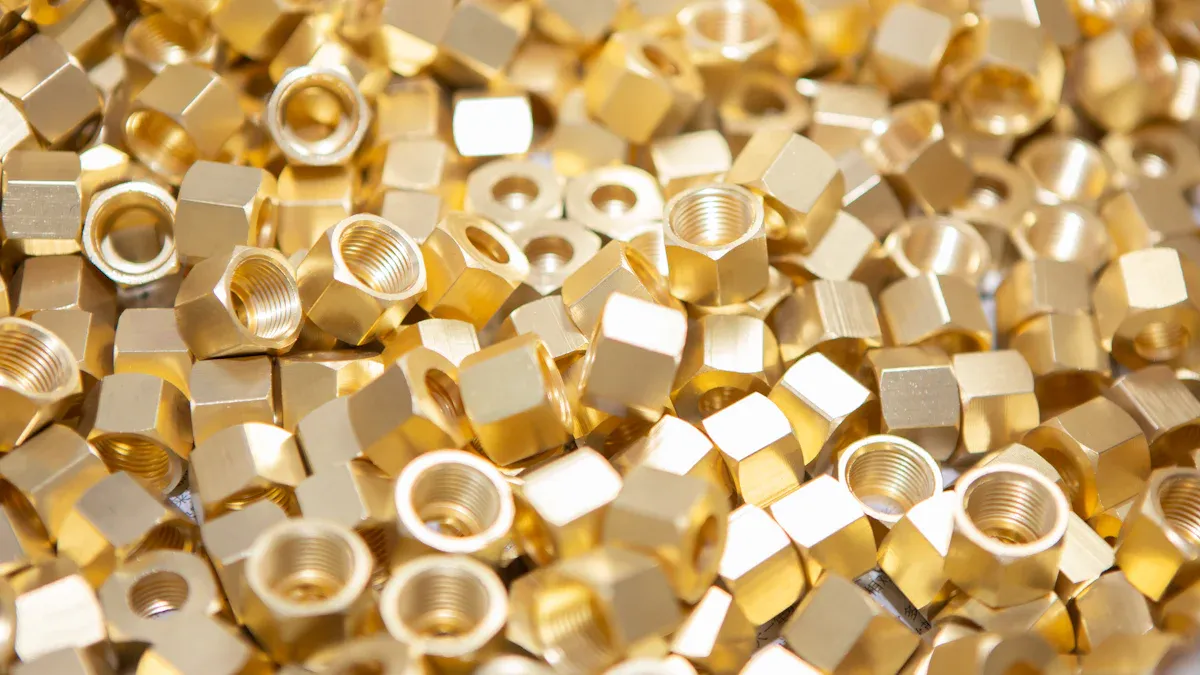
Manufacturers produce hex nuts in different materials, such as carbon steel, brass, and stainless steel. Stainless steel hex nuts, for example, resist corrosion and perform well in harsh environments. Engineers often select the material based on the demands of the project, including exposure to moisture, chemicals, or extreme temperatures.
Role in Fastening
Hex nuts play a critical role in fastening systems. They work by threading onto a bolt or screw, clamping the connected parts tightly together. This action creates a secure joint that can withstand tension, shear, and vibration. The effectiveness of a hex nut depends on proper selection and installation.
- Hex nuts provide:
- Reliable load distribution across the joint
- Resistance to loosening under vibration when paired with lock washers or lock nuts
- Easy removal and replacement for maintenance or repairs
Understanding hex nuts involves recognizing their importance in maintaining structural integrity. When paired with the correct bolt and washer, a hex nut ensures that assemblies remain tight and safe over time. In critical applications, such as bridges or heavy machinery, the right hex nut selection can prevent costly failures.
Note: Always match the thread type and size of the hex nut to the corresponding bolt. Mismatched threads can lead to stripped fasteners or joint failure.
By choosing the appropriate hex nut for each application, engineers and builders can achieve strong, durable, and reliable connections.
Key Factors for Hex Nut Selection
Selecting the right hex nut for any project requires a clear understanding of several important factors. These key factors to consider include material, size, and thread type. Each plays a crucial role in the performance, safety, and longevity of the assembly.
Материал
Стандарт DIN 933: объяснение importance of material in hex nut selection cannot be overstated. The material determines the nut’s strength, corrosion resistance, and suitability for specific environments.
Common Materials for Hex Nuts
Manufacturers produce hex nuts from a variety of materials, each offering unique benefits and typical applications:
- Stainless Steel: Used in environments where corrosion resistance is essential, such as chemical processing and food industries.
- Carbon Steel: Common in construction, machinery, and automotive components due to its strength and affordability.
- Alloy Steel: Chosen for heavy-duty applications requiring high strength.
- Black or Plain Finish: Offers minimal protection, often used indoors or where corrosion is not a concern.
- Galvanized: Coated with zinc for enhanced corrosion resistance, suitable for outdoor or damp environments.
- Plated: Features a thin zinc layer to resist corrosion.
- PTFE or Teflon Coated: Provides extra durability and chemical resistance.
- 18-8 Stainless Steel: Delivers higher corrosion resistance than carbon steel, ideal for chemical and food processing.
- 316 Stainless Steel: Offers superior corrosion resistance, perfect for harsh or marine environments.
Note: The choice of material directly affects both corrosion resistance and mechanical strength. For example, 316 stainless steel hex nuts outperform 18-8 stainless steel in harsh conditions.
How to Choose the Right Material
To choose the right hex nut material, consider the following:
- Exposure to moisture, chemicals, or extreme temperatures.
- Required mechanical strength for the application.
- Compatibility with the bolts and other materials to prevent galvanic corrosion.
- Environmental conditions, such as indoor versus outdoor use.
A project in a marine environment demands a different material than one in a dry, indoor setting. Stainless steel hex nuts suit corrosive environments, while carbon steel works well for general construction.
Размер
Size and thread considerations are fundamental for ensuring a secure and reliable connection. The size of a hex nut affects its load capacity and compatibility with bolts.
Measuring Hex Nut Size
Hex nut size includes several dimensions:
- Nominal Thread Diameter: The diameter of the bolt the nut will fit.
- Width Across Flats: The distance between two opposite sides of the nut.
- Thickness: The height of the nut, which impacts load-bearing capacity.
A table below summarizes the main size dimensions:
| Dimension | Описание |
|---|---|
| Номинальный диаметр резьбы | Matches the bolt diameter for proper fit |
| Width Across Flats | Determines wrench size and accessibility |
| Thickness | Influences load capacity and joint integrity |
Matching Size to Bolts and Screws
Proper selection requires matching the hex nut size to the bolt or screw. Using the wrong size can lead to stripped threads, loose joints, or even structural failure. The thickness of the nut also determines how much load it can bear, which is critical for maintaining joint integrity. Always ensure compatibility between the nut and bolt materials to avoid issues like galvanic corrosion.
Tip: Always check the manufacturer’s specifications for both the nut and bolt to guarantee a secure fit.
Тип резьбы
Thread type is another essential factor in hex nut selection. The thread must match the bolt for proper engagement and performance.
Coarse vs. Fine Threads
The table below highlights the differences between coarse and fine thread types:
| Характеристика | Coarse Thread | Fine Thread |
|---|---|---|
| Шаг резьбы | Larger pitch, fewer threads per inch | Smaller pitch, more threads per inch |
| Прочность | Generally less tensile strength | Higher tensile strength |
| Устойчивость к вибрации | Less effective in high vibration areas | Better for high vibration environments |
| Монтаж | Quicker installation, less prone to stripping | Requires careful alignment to avoid cross-threading |
| Typical Use Cases | Softer materials, construction projects | Strength-critical, vibration-prone applications |
Coarse threads work best in softer materials like aluminum and brass. Fine threads provide greater tensile strength and resist loosening in high-vibration environments.
Matching Threads to Bolts
Matching the thread type to the bolt is vital for assembly reliability. In construction, heavy hex nuts pair with structural bolts to join beams and machinery, handling high torque and shear forces. In automotive settings, prevailing torque hex nuts, such as nyloc nuts, prevent loosening from engine vibrations. Always ensure the nut’s diameter and thread pitch match the bolt to avoid stripping or cross-threading.
Примечание: Full thread hex bolts offer maximum engagement and clamp force, ideal for moving parts. Partial thread fasteners help with mechanical alignment in structural joints.
Understanding hex nuts and their key features ensures quality and safety in every project. By focusing on material, size, and thread type, anyone can choose the right hex nut for their specific needs.
Grade and Strength
Understanding Nut Grades
Nut grade stands as a critical indicator of mechanical performance. Manufacturers assign grades to hex nuts based on their tensile strength, hardness, and intended use. These grades help engineers and builders match nuts to bolts for optimal safety and reliability. The most common grading systems include metric and SAE (Society of Automotive Engineers) standards.
The table below summarizes the most widely used grades and their corresponding tensile strengths:
| Metric Grade | Tensile Strength (MPa) | Области применения |
|---|---|---|
| 8.8 | 800 | Medium-strength applications |
| 10.9 | 900 | High-strength applications |
| 12.9 | 1200 | Ultra-high-strength applications |
| SAE Grade | Предел прочности на растяжение (PSI) | Common Uses |
|---|---|---|
| Класс 5 | 120,000 | Automotive, machinery, structural |
| Grade 8 | 150,000 | Heavy-duty, aerospace, industrial |
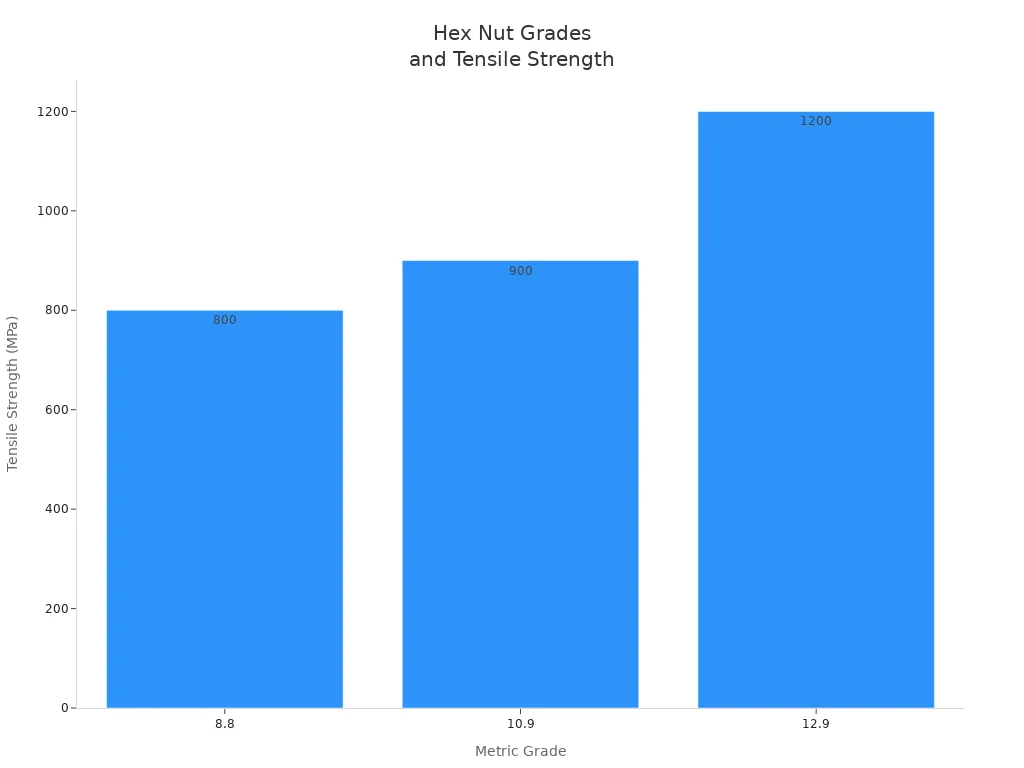
Higher grade numbers indicate greater tensile strength and suitability for demanding applications. For example, Grade 8 nuts provide high strength and are common in heavy machinery and industrial settings. Grade 5 nuts serve well in automotive and general construction.
Выбор правильного класса для вашего проекта
Selecting the correct grade ensures the hex nut can withstand the mechanical loads of the application. Engineers must consider the proof load stress, core hardness, and tempering temperature for each size and grade. The following table outlines these requirements for typical diameters:
| Диаметр | Proof Load Stress (Min psi) | Core Hardness (Rockwell) | Tempering Temperature (Min °F) |
|---|---|---|---|
| 1/4″ thru 1 1/2″ | 175,000 | C24 – C35 | 850 |
| Over 1 1/2″ | 175,000 | C35 | 850 |
When choosing the right hex nut, always match the grade to the bolt and the expected load. For high strength or critical applications, select a higher grade. Lower grades may suffice for light-duty or non-structural uses. Application-specific selection prevents premature failure and ensures longevity.
Tip: Never mix grades between nuts and bolts. Mismatched grades can compromise joint quality and safety.
Application and Environment
Использование внутри и снаружи помещений
The environment where the hex nut will be used directly affects its performance and durability. Indoor applications typically face less exposure to moisture and corrosive agents. Standard carbon steel nuts or those with a basic finish often suffice for these conditions.
Outdoor applications demand greater resistance to environmental factors. High humidity, rain, and temperature fluctuations can accelerate corrosion and weaken fasteners. In coastal regions, nearly 30% of fasteners may corrode within five years due to saline air. For these environments, nuts with high corrosion resistance, such as those made from grades of stainless steel or those with zinc plating or hot-dip galvanization, offer superior protection.
Note: The importance of material selection increases in outdoor and marine environments. Stainless steel hex nuts, fortified with chromium, form a protective oxide layer that resists rust and degradation.
Special Conditions (Heat, Corrosion, Vibration)
Certain applications require hex nuts to withstand extreme conditions. High temperatures can reduce the effectiveness of nylon inserts in nylock nuts, leading to potential failures in critical assemblies. High humidity and corrosive chemicals can degrade standard finishes, making corrosion-resistant materials essential.
Key factors to consider for special conditions include:
- Increased temperatures may cause nylon inserts to lose grip, especially in nylock nuts.
- High humidity accelerates corrosion, threatening the integrity of the nut and the entire assembly.
- In corrosive environments, such as chemical plants or coastal areas, select nuts with high corrosion resistance, like 316 stainless steel.
- Heavy hex nuts and jam nuts provide secure fastening in high-vibration environments, such as engine mounts and rotating machinery.
- Surface finishes, including zinc plating and hot-dip galvanization, enhance durability against wear and harsh conditions.
Engineers often use finished hex jam nuts in a double-nut locking configuration to prevent loosening in high-vibration settings. Heavy hex nuts, with their larger size and increased thickness, deliver superior tensile strength and secure fastening under extreme loads.
Callout: Application-specific selection of hex nuts, considering grade, size, thread, and material, ensures safety, reliability, and long-term performance in any environment.
By evaluating the application, environment, and mechanical requirements, professionals can choose the right hex nut for every project. This approach guarantees quality, safety, and longevity for all types of assemblies.
Types of Hex Nuts and Lock Nuts for Selection
Standard Hex Nuts
Standard hex nuts represent the most common choice for general fastening needs. Their six-sided design allows for easy tightening and loosening with standard tools. These nuts provide high load capacity and suit static or semi-static connections in construction, automotive, and machinery projects. Standard hex nuts offer a simple and cost-effective solution for many assemblies. However, they can loosen under vibration and may require additional components, such as lock washers, to maintain joint integrity.
Lock Nuts
Lock nuts address the challenge of fastener loosening in high-vibration environments. Engineers select these nuts when assemblies must maintain clamping force over time. Several types of lock nut exist, each designed to resist loosening through unique mechanisms. Common types of lock nut include nylon insert lock nuts, prevailing torque lock nuts, and all-metal lock nuts. These nuts often feature deformed threads, nylon inserts, or other features that increase friction and prevent rotation.
The following table highlights the main differences in application and performance between a standard hex nut and a lock nut:
| Характеристика | Hex Nuts | Lock Nuts |
|---|---|---|
| Advantages | Simple, cost-effective, high load capacity | Excellent vibration resistance, maintain clamping force |
| Disadvantages | Can loosen under vibration, may need additional components | More expensive, some designs not reusable |
| Применение | Used in static or semi-static connections | Ideal for high-vibration or safety-critical systems |
Lock nut vs hex nut selection depends on the specific requirements of the project. While a standard hex nut works well for static loads, a lock nut ensures safety and reliability in dynamic or safety-critical systems. Some types of lock nut are not reusable, which increases long-term costs but provides superior performance where failure is not an option.
Tip: Always choose the appropriate lock nut for assemblies exposed to vibration or movement. This practice prevents costly maintenance and enhances safety.
Flange Nuts
Flange nuts belong to the different types of hex nuts that improve load distribution and joint stability. These nuts feature an integral wide flange at one end, which acts as a built-in washer. The flange increases the contact area between the nut and the workpiece, spreading the load over a larger surface. This design reduces the risk of damage to the material and minimizes localized deformation.
- Flange nuts provide several advantages:
- The built-in washer function distributes pressure evenly.
- The larger contact area prevents the nut from embedding into softer materials.
- The design helps prevent loosening under vibration, offering a more stable hold.
Engineers often select flange nuts for applications where protecting the workpiece and maintaining joint integrity are priorities. The flange design also simplifies assembly by eliminating the need for a separate washer.
Note: Flange nuts offer a practical solution for assemblies that require both secure fastening and protection of the underlying material.
Cap Nuts
Cap nuts, also known as acorn nuts, feature a domed top that covers the exposed end of a bolt or threaded rod. This design protects both the fastener and surrounding components from damage. The smooth, rounded surface prevents accidental snagging or injury, making cap nuts a preferred choice in applications where safety and appearance matter. Furniture makers often use cap nuts to create a finished look and to shield users from sharp threads. Automotive and machinery industries also rely on cap nuts to prevent corrosion and contamination of threaded connections.
Cap nuts come in various materials, including stainless steel and brass. These materials offer resistance to rust and wear. The installation process remains straightforward, as users can tighten cap nuts with standard wrenches or sockets. When selecting from the different types of hex nuts, cap nuts provide both functional and aesthetic benefits.
Tip: Cap nuts work best in assemblies where exposed threads could cause harm or where a clean, polished appearance is desired.
Heavy Hex Nuts
Heavy hex nuts have a larger width and thickness compared to standard hex nuts. This increased size provides greater bearing surface and higher strength. Engineers select heavy hex nuts for structural applications, such as steel construction, bridge building, and heavy machinery. The extra mass allows these nuts to handle higher torque and greater loads without deforming.
A heavy hex nut pairs well with high-strength bolts, ensuring the joint can withstand significant stress. The larger contact area distributes force more evenly, reducing the risk of thread stripping or fastener failure. Heavy hex nuts often meet strict industry standards for strength and durability. Their robust design makes them essential in projects where safety and reliability cannot be compromised.
- Key advantages of heavy hex nuts:
- Enhanced load-bearing capacity
- Improved resistance to loosening under dynamic loads
- Compatibility with large-diameter bolts
Nylon Insert Lock Nuts
Nylon insert lock nuts, sometimes called nyloc nuts, incorporate a nylon ring within the nut’s threads. This ring creates a tight, friction-based grip on the bolt, which helps prevent loosening due to vibration or movement.
The nylon insert in these nuts creates a frictional force against the threads of the bolt. When vibrations occur, this frictional force helps to prevent the nut from rotating and loosening.
The nylon insert deforms slightly to fill the gaps between the threads, creating a tight fit. This tight fit acts as a barrier against the vibrational forces that would otherwise cause the nut to back off. Additionally, the elastic nature of the nylon allows it to absorb some of the energy from the vibrations, further enhancing the nut’s ability to stay in place.
Nylon insert lock nuts see widespread use in industries where vibration poses a risk to fastener security. These nuts maintain joint integrity in demanding environments.
- Common applications include:
- Automotive industry: Used to secure engine parts, suspension systems, and exhaust systems.
- Aerospace industry: Utilized in aircraft engines and critical components to maintain tightness under high-vibration conditions.
- Industrial machinery: Employed in conveyor belts, pumps, and motors to prevent downtime due to loose fasteners.
Nylon insert lock nuts offer a reusable solution for many assemblies, although repeated use may reduce the effectiveness of the nylon ring. They provide a cost-effective way to enhance safety and reliability in vibration-prone settings. When choosing a lock nut, engineers often select nylon insert types for their proven performance and ease of installation.
Jam Nuts
Jam nuts serve as a specialized solution among the different types of hex nuts. Engineers often select jam nuts when they need a compact and effective method to prevent loosening in threaded assemblies. A jam nut features a thinner profile compared to standard hex nuts. This design allows users to pair two nuts on a single bolt, creating a locking effect that resists vibration and movement.
A typical jam nut installation involves tightening the first nut against the workpiece, then threading the jam nut on top. The user applies torque to the jam nut, forcing it against the first nut. This action locks both nuts in place, reducing the risk of loosening. The jam nut technique proves especially useful in situations where a lock nut cannot be used due to space constraints or material compatibility.
Tip: Jam nuts offer a reliable locking mechanism without the need for additional hardware. This method works well in assemblies where vibration poses a threat to fastener security.
Jam nuts find frequent use in automotive, machinery, and industrial equipment. Technicians rely on jam nuts to secure adjustment points, such as tie rods or linkage assemblies. The thin profile allows for installation in tight spaces, making jam nuts ideal for applications with limited clearance.
The table below compares jam nuts to other lock nut options:
| Характеристика | Jam Nut | Nylon Insert Lock Nut | All-Metal Lock Nut |
|---|---|---|---|
| Профиль | Thin, compact | Standard hex nut size | Standard or slightly larger |
| Механизм блокировки | Double nut friction | Nylon insert | Deformed metal threads |
| Reusability | Высокая | Умеренная | Высокая |
| Устойчивость к вибрации | Хорошая | Отличная | Отличная |
| Типичные области применения | Adjustment points, tight spaces | Automotive, machinery | High-temperature environments |
Jam nuts provide flexibility for engineers who need a lock nut but must avoid nylon inserts or deformed threads. The jam nut method does not rely on material deformation or chemical resistance. Instead, it uses mechanical friction to maintain joint integrity.
Some professionals combine jam nuts with other lock nut types for added security. For example, they may use a jam nut alongside a nylon insert lock nut in assemblies exposed to extreme vibration. This approach enhances the locking effect and extends the lifespan of the fastener.
Jam nuts also support easy maintenance. Users can remove and reinstall jam nuts multiple times without degrading their performance. This feature makes jam nuts a cost-effective choice for projects requiring frequent adjustments or repairs.
Note: Always ensure proper torque when installing jam nuts. Insufficient tightening may reduce the effectiveness of the locking mechanism.
Jam nuts stand out as a practical option within the different types of hex nuts. Their versatility, compact design, and reliable locking action make them a valuable addition to any fastener selection process. Engineers and technicians can confidently use jam nuts to secure assemblies and maintain safety in demanding environments.
How to Match a Hex Nut to Your Project
Assessing Your Project Needs
Every project begins with a clear understanding of its requirements. Engineers evaluate the environment, mechanical demands, and industry standards before selecting a hex nut. The following table summarizes how material type, strength grade, and standards influence application-specific selection:
| Тип материала | Available Strength Grades | Industry Standards |
|---|---|---|
| Carbon Steel & Mild Steel | Class 8, 10, 12 | ISO 4033, ASTM A563, ASME B18.2.2 |
| Stainless Steel (Corrosion Resistant) | A2-70 (SS 304), A4-80 (SS 316) | ISO 3506 |
| Hardened & Alloy Steel (High Tensile) | Grade DH, Grade C, Class 10, Class 12 | ASTM A563, ISO 4032 |
Project assessment also involves several technical evaluations:
- Chemical analysis determines the composition of materials.
- Mechanical testing measures properties like tensile and hardness.
- Microstructural analysis checks for internal flaws.
- Tensile strength and fatigue testing ensure durability under repeated loads.
- Corrosion resistance and vibration resistance tests confirm suitability for demanding applications.
Selecting the right hex nut depends on these assessments, ensuring the fastener meets both the mechanical and environmental needs of the application.
Checking Compatibility with Bolts and Materials
Compatibility between hex nuts, bolts, and materials ensures reliable performance in all applications. Engineers follow a systematic approach:
- Grade match: The nut’s grade must align with the bolt’s grade for consistent strength.
- Size and type: The nut type and dimensions must fit the bolt precisely.
- Thread compatibility: Both bolt and nut must share the same nominal diameter and thread pitch.
- Material and coating suitability: Materials must withstand the service environment, and coatings should match climate demands.
- Engagement and length: The bolt must provide enough thread engagement within the nut for secure fastening.
Selecting the correct thread type and size is crucial. Unified National Coarse threads suit general applications, while Unified National Fine threads offer better vibration resistance, making them ideal for automotive and machinery applications. Hex bolts provide strong clamping force in heavy-duty machinery, steel structures, and vehicles, supporting critical applications.
Salt spray testing measures corrosion resistance, simulating years of wear. Automotive parts often require ninety-six hours of resistance, while outdoor structures may need over five hundred hours. Proper testing and matching coatings to the climate extend the lifespan of both bolts and nuts.
Considering Safety and Load Requirements
Safety and load requirements guide the final selection of hex nuts for structural applications. Engineers calculate the safety factor as the ratio of fastener strength to the actual load. For static loads, a safety factor of 2:1 to 3:1 is standard. Dynamic loads require a higher safety factor, often 4:1 to 6:1, and critical applications may demand 6:1 to 10:1 or more.
Material selection considers environmental exposure, load requirements, and chemical compatibility. High-grade steel hex nuts may receive treatments such as zinc plating for added corrosion resistance. Achieving correct preload through proper torquing is essential. Preload creates tension in the bolt and compression in the joined materials, which is crucial for joint integrity under dynamic loads.
Tip: Always verify that the selected hex nut meets or exceeds the safety and load requirements for the intended application. This practice ensures long-term reliability and reduces the risk of failure in demanding applications.
Step-by-Step Guide to Choose the Right Hex Nut
Identify the Application
Selecting the correct hex nut for any project begins with a thorough understanding of the application. Engineers and builders must evaluate several critical factors before making a decision. The following steps outline a systematic approach to identifying the application requirements:
- Thread Type & Size: Confirm that the thread matches the specifications of the bolts to prevent joint failure.
- Material Compatibility: Select a nut material that is equal to or stronger than the bolt to avoid corrosion and ensure durability.
- Strength Grade / Property Class: Ensure the nut’s strength meets or exceeds that of the bolt for safety under load.
- Coating & Surface Finish: Choose coatings and finishes based on environmental exposure to enhance durability.
- Temperature Resistance: Assess the operating temperature to prevent material degradation or failure.
- Load & Application: Determine the load conditions and select nuts designed for those specific requirements.
- Installation & Accessibility: Consider the available tools and space for installation to ensure proper tightening.
- Standards & Specifications: Follow recognized industry standards to guarantee quality and safety.
Tip: A detailed assessment of these factors helps prevent costly mistakes and ensures the fastener performs reliably throughout the lifespan of the assembly.
Select the Material (including stainless steel hex nuts)
Material selection plays a pivotal role in the performance and longevity of a hex nut. Stainless steel hex nuts stand out for their exceptional corrosion resistance, making them the preferred choice for harsh or outdoor environments. This advantage becomes especially clear when compared to non-stainless materials, which may not withstand moisture, chemicals, or salt exposure as effectively.
- Stainless steel hex nuts generally have a higher upfront cost compared to non-stainless alternatives.
- Their durability and longevity can lead to lower replacement costs over time, providing better overall value.
Stainless hex nuts are characterized by their high tensile strength and corrosion resistance, making them suitable for securing heavy components in both indoor and outdoor projects.
When choosing a material, engineers must also consider compatibility with the bolts and the surrounding environment. For example, pairing stainless steel nuts with stainless steel bolts prevents galvanic corrosion and ensures consistent performance. In less demanding environments, carbon steel or zinc-plated nuts may offer a cost-effective solution. However, for applications exposed to moisture, chemicals, or extreme temperatures, stainless steel hex nuts deliver superior reliability.
Determine the Size
Accurate sizing ensures a secure and reliable connection between the nut and the bolt. Size and thread considerations directly impact the strength and safety of the assembly. Engineers must measure the nominal diameter, thread pitch, and width across flats to match the nut precisely to the bolt.
- The nominal diameter must correspond to the bolt’s diameter for proper engagement.
- Thread pitch must match exactly to avoid cross-threading or stripping.
- The width across flats determines the correct wrench size for installation.
Size selection also involves evaluating the thickness of the nut, which affects load-bearing capacity. Using the correct size prevents joint loosening and structural failure. When engineers choose the right hex bolts and nuts together, they ensure the assembly meets all mechanical and safety requirements.
Note: Always verify the manufacturer’s specifications for both nuts and bolts to guarantee compatibility and optimal performance.
Purchasing considerations should include not only the immediate fit but also the long-term demands of the project. Proper attention to size and thread considerations helps avoid costly rework and ensures the integrity of the final assembly.
Choose the Thread Type
Selecting the correct thread type forms a crucial step when engineers aim to choose the right hex nut for any project. The thread must match both the mechanical demands and the environmental conditions of the assembly. Engineers follow a systematic approach to ensure optimal performance and reliability.
- They identify the material being fastened. For example, stainless steel hex nuts require threads compatible with stainless steel bolts to prevent galling and ensure smooth installation.
- They evaluate the loads and environmental conditions. Moisture, temperature, and vibration influence the choice of thread. Fine threads offer better resistance to vibration, while coarse threads suit softer materials and allow quicker installation.
- They select a thread form that meets both material and performance requirements. UNJF threads serve aerospace applications, while NPT threads provide sealing in plumbing and fluid systems.
- They check industry standards. Compliance with standards such as ISO, ASTM, or ASME ensures the assembly meets safety and quality benchmarks.
- They prototype and test the assembly before full production. Testing confirms the thread’s suitability under real-world conditions.
- They specify the thread type, pitch, and tolerance clearly on engineering prints. This practice prevents confusion and ensures consistency during manufacturing.
Tip: Engineers always match the thread pitch and diameter of the nut to the bolt. This step prevents cross-threading and ensures a secure fit.
The thread selection process also considers purchasing considerations. Engineers review the availability of compatible nuts and bolts, especially when sourcing grades of stainless steel for corrosion resistance. They avoid mismatched threads, which can lead to stripped fasteners and joint failure. By following these steps, engineers guarantee that the hex nut will perform reliably in its intended environment.
Pick the Grade
Choosing the appropriate grade for a hex nut determines its ability to withstand mechanical stress and environmental challenges. Engineers assess several criteria to ensure the nut matches the demands of the project.
- They analyze the load or stress the assembly will encounter. Proof load, yield strength, and tensile strength guide the selection process. Proof load represents the minimum force the nut can handle without permanent deformation. Yield strength marks the point where the nut begins to deform, and tensile strength indicates the maximum load before breaking.
- They evaluate the strength of the nut. High-stress applications require nuts with elevated grade numbers, such as Grade 8 or Class 12, to ensure safety and durability.
- They consider resistance properties. Nuts must resist corrosion, wear, and fatigue. Grades of stainless steel provide superior corrosion resistance, making them ideal for outdoor or marine environments.
- They assess temperature requirements. Some grades perform better at elevated temperatures, while others maintain integrity in cold conditions.
| Класс прочности | Испытательная нагрузка (фунты на квадратный дюйм) | Yield Strength (psi) | Tensile Strength (psi) | Typical Application |
|---|---|---|---|---|
| Класс 5 | 85,000 | 92,000 | 120,000 | Automotive, machinery |
| Grade 8 | 120,000 | 130,000 | 150,000 | Heavy-duty, industrial |
| Class 8 | 800 MPa | 640 MPa | 800 MPa | Medium-strength, construction |
| Class 12 | 1200 MPa | 1080 MPa | 1200 MPa | Ultra-high-strength, critical |
Note: Engineers never mix grades between nuts and bolts. This practice ensures consistent strength and prevents joint failure.
When engineers choose the right hex bolts and nuts, they match the grade to the expected load and environmental conditions. They select stainless steel hex nuts for assemblies exposed to moisture or chemicals. They use high-grade nuts for structural or safety-critical applications. This careful selection process ensures the assembly remains safe and reliable throughout its service life.
Select the Nut Type
Selecting the nut type tailors the assembly to the specific needs of the project. Engineers evaluate the application, environment, and mechanical requirements before making a decision.
- Standard hex nuts provide a simple and cost-effective solution for static loads. They suit general construction and machinery projects.
- Lock nuts prevent loosening in high-vibration environments. Nylon insert lock nuts and all-metal lock nuts offer enhanced security for automotive and industrial applications.
- Flange nuts distribute load over a wider area. They protect softer materials and reduce the need for separate washers.
- Cap nuts shield exposed threads. They improve safety and appearance in furniture and automotive assemblies.
- Heavy hex nuts deliver greater strength and bearing surface. Engineers use them in structural applications and heavy machinery.
- Jam nuts offer a compact locking mechanism. They work well in tight spaces and adjustment points.
| Nut Type | Ключевая особенность | Typical Use Case |
|---|---|---|
| Standard Hex Nut | High load capacity | Construction, machinery |
| Lock Nut | Vibration resistance | Automotive, industrial |
| Фланцевая гайка | Built-in washer | Protecting soft materials |
| Cap Nut | Thread protection | Furniture, automotive |
| Heavy Hex Nut | Enhanced strength | Structural, heavy machinery |
| Jam Nut | Compact locking | Adjustment points, tight spaces |
Callout: Engineers always select the nut type based on the mechanical and environmental requirements of the project. This practice ensures safety, durability, and reliable performance.
Engineers review purchasing considerations when selecting nut types. They confirm the availability of compatible nuts and bolts, especially for specialized applications. They choose the right hex nut by matching material, grade, thread, and nut type to the project’s demands. This comprehensive approach guarantees the assembly will meet industry standards and perform reliably in any environment.
Double-Check Compatibility
Ensuring compatibility between hex nuts and other fasteners stands as a critical step before final installation. Engineers and builders often encounter costly setbacks when they overlook this process. Double-checking compatibility helps prevent joint failure, material damage, and safety hazards.
A systematic approach to compatibility involves several best practices:
- Collaborate with trusted suppliers. Suppliers possess technical expertise and can recommend compatible nut grades based on the specified bolt grades. They often propose complete assemblies that meet industry standards, reducing the risk of mismatched components.
- Conduct trial assemblies. Assembling a sample joint allows engineers to verify fit and function. This process includes checking thread engagement, alignment, and ease of installation. Trial assemblies also reveal potential issues with thread pitch or diameter.
- Perform torque-tension tests. These tests confirm that the nut and bolt combination achieves the required clamping force without stripping or deforming. Torque-tension testing ensures that the assembly will perform reliably under load.
- Always match nut grade to bolt grade. Using a lower-grade nut with a higher-grade bolt can compromise joint strength and lead to premature failure. The nut must meet or exceed the mechanical properties of the bolt.
- Use washers under nuts on wood. Washers distribute the load and prevent the nut from embedding into softer materials. This practice maintains joint integrity and extends the lifespan of the assembly.
- Avoid substituting lower-grade nuts. Substituting a lower-grade nut for a higher-grade bolt reduces the overall strength of the connection. This mismatch can result in joint loosening or catastrophic failure under stress.
Tip: Double-checking compatibility before installation saves time and resources. It also ensures that the assembly meets safety and performance requirements.
Engineers who choose the right hex nut for their project always verify compatibility at every stage. This diligence guarantees that the fastener assembly will withstand operational demands and environmental challenges. By following these steps, professionals maintain high standards of quality and safety in every application.
Common Mistakes in Hex Nut Selection
Selecting the right hex nut for any project requires careful attention to detail. Many professionals encounter common pitfalls during the selection process, which can compromise safety, longevity, and performance in critical applications. Understanding these mistakes helps engineers and builders avoid costly errors and ensures reliable fastening in all environments.
Using the Wrong Size
Incorrect sizing remains one of the most frequent mistakes in hex nut selection. Engineers often overlook key factors when matching nuts to bolts. The following list highlights typical errors:
- Measuring corner to corner instead of flat to flat, which leads to inaccurate sizing.
- Guessing thread size by appearance rather than using precise measurement tools.
- Mixing metric and imperial sizes, resulting in poor fit and reduced joint strength.
- Ignoring thread pitch, which can cause mismatched engagement and unreliable fastening.
These mistakes can cause assembly failures, especially in applications where precise fit is essential. Proper measurement and adherence to standards ensure that bolts and nuts work together seamlessly, supporting the intended load and maintaining joint integrity.
Mismatching Threads
Thread compatibility plays a crucial role in the performance of fastener assemblies. When engineers mismatch threads between hex nuts and bolts, cross-threading often occurs. This issue diminishes the fastener’s ability to maintain torque, leading to reduced retention and potential joint failure. In critical applications, such as automotive wheel nuts, mismatched threads can result in severe safety hazards. Wheels may detach from vehicles, causing accidents and costly repairs. Engineers must always verify thread pitch and diameter to prevent these risks and ensure reliable performance.
Ignoring Material Compatibility
Material compatibility stands as a vital consideration in hex nut selection. When professionals ignore this factor, several negative consequences arise. The table below outlines the most common issues:
| Consequence | Описание |
|---|---|
| Galvanic Corrosion | Occurs when dissimilar metals contact each other, especially with moisture, leading to accelerated material loss. |
| Joint Weakening | Premature weakening of the joint reduces load capacity and reliability. |
| Seized Fasteners | Incompatible materials may cause fasteners to seize, complicating maintenance and repairs. |
| Cosmetic Corrosion | Visible corrosion can result in customer complaints and reduced product appeal. |
Engineers must select materials that complement each other, especially in applications exposed to moisture or chemicals. Stainless steel hex nuts provide high corrosion resistance, making them ideal for environments where longevity and durability are essential. Matching materials prevents galvanic corrosion and ensures that bolts and nuts maintain their structural integrity throughout the lifespan of the assembly.
Tip: Careful consideration of size, thread, and material compatibility prevents common mistakes and supports reliable performance in all applications.
Overlooking Environmental Factors
Many engineers and builders underestimate the impact of environmental factors when selecting hex nuts. This oversight can lead to premature failure, increased maintenance costs, and safety risks. Environmental conditions directly influence the long-term performance and reliability of fasteners.
Corrosive environments present one of the most significant threats to hex nut durability. Industrial sites, coastal regions, and chemical plants expose fasteners to moisture, salt, and aggressive chemicals. These elements accelerate corrosion, which weakens the nut and compromises the integrity of the entire assembly. Stainless steel and specially coated hex nuts offer enhanced resistance, but not all projects require or justify their higher cost. Selecting the wrong material for a harsh environment often results in rapid deterioration and unexpected downtime.
Temperature extremes also challenge the performance of hex nuts. High temperatures can cause certain materials to lose strength or deform. For example, nylon insert lock nuts may fail in elevated heat because the nylon softens and loses its locking ability. Low temperatures can make some metals brittle, increasing the risk of cracking under load. Engineers must consider both the maximum and minimum temperatures the assembly will face during its service life.
Vibration represents another critical factor. Machinery, vehicles, and structural components often experience constant or intermittent vibration. Without proper selection, standard hex nuts may loosen over time, leading to joint failure. Lock nuts, jam nuts, and other specialized fasteners help maintain clamping force in these demanding conditions.
Tip: Always match the hex nut material and type to the specific environmental challenges of the project. This practice extends the lifespan of the assembly and reduces maintenance needs.
Key environmental factors that affect hex nut performance include:
- Corrosive agents such as moisture, salt, and chemicals
- High and low temperature extremes
- Continuous or intermittent vibration
Ignoring these factors can result in:
- Accelerated corrosion and material loss
- Reduced mechanical strength and load capacity
- Increased risk of loosening and joint failure
A careful evaluation of the operating environment ensures that the selected hex nut will perform reliably throughout the intended lifespan of the assembly. Engineers who account for these variables protect both the safety and the investment of their projects.
Quick Checklist for Hex Nut Selection
A quick checklist streamlines the process of choosing the right hex nut for any project. This approach helps engineers and builders confirm that every critical factor receives proper attention before installation. The following table summarizes the most important considerations:
| Factor | Описание |
|---|---|
| Durability and Strength | High-quality hex nuts are made from strong materials like stainless steel, alloy steel, or brass, ensuring longevity and resistance to corrosion and wear. |
| Thread Accuracy | Precise thread cutting is essential for a strong connection, preventing slippage and loosening over time. Quality control ensures threads meet international standards. |
| Выбор материала | The choice of material affects performance; stainless steel for corrosion resistance, alloy steel for high strength, and brass for aesthetic or non-corrosive uses. |
Материал
Engineers always start with material when reviewing hex nut options. The right material ensures the nut can withstand the environment and mechanical demands of the project. Stainless steel offers excellent corrosion resistance, making it ideal for outdoor or marine applications. Alloy steel provides high strength for heavy-duty assemblies. Brass works well in non-corrosive environments or where appearance matters. Material selection should match the demands of the bolts and the surrounding conditions. Choosing the correct material prevents premature wear and extends the life of the assembly.
Tip: Always verify that the material of the hex nut matches or exceeds the requirements of the bolts and the environment.
Размер
Size plays a crucial role in the performance and safety of any fastener assembly. Engineers measure the nominal diameter, thread pitch, and width across flats to ensure a proper fit. The nut must match the size of the bolts exactly to avoid issues like cross-threading or joint failure. Using the correct size guarantees that the nut will distribute loads evenly and maintain joint integrity. A mismatch in size can lead to stripped threads or loose connections, which compromise safety.
- Confirm the nominal diameter matches the bolts.
- Check the width across flats for tool compatibility.
- Ensure the nut thickness supports the required load.
Тип резьбы
Thread type determines how well the nut engages with the bolts. Coarse threads allow for faster assembly and work well with softer materials. Fine threads provide greater holding power and resist loosening in high-vibration environments. Engineers must match the thread type and pitch of the nut to the bolts to ensure a secure connection. Thread accuracy also plays a key role in preventing slippage and maintaining long-term performance.
Note: Always inspect threads for damage or irregularities before installation. Proper thread engagement ensures the assembly will perform as expected.
A thorough checklist helps professionals avoid common mistakes and ensures every hex nut selection meets the demands of the project.
Класс прочности
Selecting the correct grade for hex nuts ensures that fastener assemblies meet the strength requirements of their intended applications. Manufacturers assign grades to nuts based on their mechanical properties, such as tensile strength and hardness. These grades must match or exceed those of the bolts used in the assembly. For example, Grade 5 and Grade 8 nuts pair with bolts of the same grade in automotive and heavy machinery applications. Lower-grade nuts may suffice for light-duty tasks, but high-stress environments demand higher grades.
A quick reference table helps clarify the relationship between nut grades and typical uses:
| Nut Grade | Compatible Bolts | Типичные области применения |
|---|---|---|
| Класс 2 | Класс 2 | Furniture, light fixtures |
| Класс 5 | Класс 5 | Automotive, machinery |
| Grade 8 | Grade 8 | Structural, heavy equipment |
Tip: Always match the nut grade to the grade of the bolts to prevent joint failure and ensure safety in all applications.
Nut Type
Choosing the right nut type tailors the assembly to specific needs. Standard hex nuts work well for most static connections. Lock nuts, such as nylon insert lock nuts, resist loosening in high-vibration environments. Flange nuts distribute pressure over a wider area, protecting softer materials. Cap nuts cover exposed threads, improving safety and appearance. Heavy hex nuts provide extra strength for structural applications. Jam nuts offer a compact solution for locking adjustments in tight spaces.
- Standard hex nuts: General-purpose, used with bolts in construction and machinery.
- Lock nuts: Prevent loosening in automotive and industrial applications.
- Flange nuts: Ideal for wood or plastic assemblies where load distribution matters.
- Cap nuts: Used in furniture and automotive applications for safety.
- Heavy hex nuts: Essential for bridge building and heavy machinery.
- Jam nuts: Useful for adjustment points in mechanical assemblies.
Selecting the correct nut type ensures that the fastener assembly performs reliably in its intended environment.
Применение
The intended application determines every aspect of hex nut selection. Engineers assess the environment, load requirements, and compatibility with bolts. Outdoor applications require corrosion-resistant materials, such as stainless steel, to withstand moisture and chemicals. High-vibration applications, like engines or industrial machinery, benefit from lock nuts or jam nuts to maintain joint integrity. Structural applications demand heavy hex nuts and high-grade bolts for maximum strength.
Note: Proper assessment of the application ensures that the chosen hex nut and bolts deliver long-term performance and safety in all applications.
By considering grade, nut type, and application, professionals create assemblies that meet industry standards and withstand the demands of real-world use.
Choosing the right hex nut ensures safety and success in every project. Matching material, size, thread, and grade to requirements supports reliable performance. The step-by-step guide and checklist help users make confident decisions. When uncertain or facing complex installations, consulting a hardware expert or manufacturer is advisable.
- Professionals can provide guidance for durability and reliability.
- Expert advice enhances material compatibility and long-term value.
- Specialists recommend considering environmental conditions and load requirements.
Частые вопросы
What is the difference between a hex nut and a lock nut?
A hex nut provides standard fastening. A lock nut includes features that resist loosening from vibration or movement. Lock nuts often use nylon inserts or deformed threads to maintain tightness in dynamic environments.
How can someone identify the correct thread size for a hex nut?
They should measure the bolt’s diameter and thread pitch using a thread gauge or caliper. Manufacturers often stamp size information on packaging. Always match the nut’s thread size and pitch to the bolt for a secure fit.
When should someone use stainless steel hex nuts?
Stainless steel hex nuts work best in environments exposed to moisture, chemicals, or salt. They resist corrosion and maintain strength outdoors, in marine settings, or in food processing applications.
Can hex nuts be reused after removal?
Most standard hex nuts can be reused if undamaged. Lock nuts with nylon inserts lose effectiveness after repeated use. Always inspect threads for wear or deformation before reusing any nut.
What happens if someone mixes nut and bolt grades?
Mixing grades can weaken the joint. A lower-grade nut with a higher-grade bolt may fail under load. Always match or exceed the bolt’s grade with the nut to ensure safety and performance.
Are washers always necessary with hex nuts?
Washers distribute load and protect surfaces. They are essential for soft materials or when vibration is present. In some cases, flange nuts can replace washers by providing a built-in load-spreading surface.
How does someone prevent hex nuts from loosening in high-vibration environments?
They should use lock nuts, jam nuts, or thread-locking compounds. Nylon insert lock nuts and all-metal lock nuts provide excellent resistance to loosening caused by vibration.