
Открытый крюк рым-болт is a versatile and cost-effective hardware option for straightforward, vertical industrial lifts. Its primary drawbacks include a significant capacity reduction during angular lifts and a high risk of failure due to improper installation. Understanding when to use eye bolts and when to opt for a safer alternative is crucial for ensuring operational safety.
Here’s a breakdown of recent statistics on rigging hardware failures:
| Источник | Statistic | Relevance to Rigging Hardware Failures |
|---|---|---|
| Centers for Disease Control (CDC) | 60% of crane-related fatalities | Directly attributed to rigging failures |
| Konecranes Training Institute | 27% of load drops | Directly tied to poor rigging practices |
| Study of 249 crane-related incidents | 27% of incidents were due to load drops | Typically from rigging failure |
These figures highlight the critical importance of proper hardware selection and use.
For specialized applications, a производитель крепежных изделий на заказ can provide solutions tailored to specific needs, including нестандартные крепежные элементы and unique литье болтов designs. However, for general lifting, the standard lifting eye bolts remain a common choice. The safe use of all eye bolts demands strict adherence to installation protocols.
The Primary Advantages of Using Eye Bolts in Rigging
Despite their limitations, рым-болты remain a staple in many rigging applications for several compelling reasons. Their benefits in cost, simplicity, and versatility make them an attractive choice when used correctly for appropriate tasks. A facility can leverage these advantages to create efficient and economical lifting solutions.
Pro 1: Cost-Effectiveness and Availability
Low Per-Unit Cost for Bulk Applications
One of the most significant advantages of eye bolts is their low per-unit cost. For operations requiring numerous attachment points, the savings can be substantial. They are a cheaper option compared to more complex lifting hardware. This makes them an economical choice for straightforward, straight-line lifts where advanced components are unnecessary. While alternatives like swivel hoist rings offer greater flexibility, they are typically more expensive upfront. For a simple hoist, standard eye bolts provide a cost-effective solution without compromising quality for the intended load.
Wide Availability from Industrial Suppliers
Standard-sized lifting eye bolts are readily available from nearly all industrial and rigging hardware suppliers. This widespread availability ensures that teams can quickly source replacements or procure new stock with minimal lead time. This accessibility prevents project delays and allows maintenance crews to keep a healthy inventory on hand for routine lifting and rigging tasks. Quick access to this lifting hardware is critical for maintaining operational tempo.
Pro 2: Simplicity in Installation and Use
Straightforward Installation for Vertical Lifts
The installation process for eye bolts is exceptionally simple for vertical lifts. A rigger can create a reliable connection for a hoist in minutes. The process involves:
- Verifying the receiving hole has clean and compatible threads.
- Screwing the eye bolt in until its shoulder is fully seated against the load surface.
- Connecting the hoist hook directly to the eye.
This simplicity reduces setup time and allows teams to prepare for a hoist efficiently.
Примечание: Simplicity should never lead to complacency. Even basic installations demand strict adherence to safety protocols to prevent catastrophic failures. A simple hoist can become dangerous if steps are missed.
Minimal Training Required for Basic Operations
Basic use of eye bolts for vertical lifts does not require extensive specialized training. Workers can quickly learn the correct procedures for inspection and installation. This allows for broader team competency in fundamental rigging tasks. While advanced rigging requires certified professionals, the basic principles of using an eye bolt for a direct hoist are easy to grasp. This straightforwardness empowers more team members to assist with a simple hoist under proper supervision.
Pro 3: Versatility for Basic Lifting Points
Creating Temporary or Permanent Attachment Points
Eye bolts offer excellent versatility for creating secure anchor points. Teams can install them temporarily for a specific one-time hoist or leave them in place as permanent lifting points on machinery and equipment. For example, a motor or pump may have pre-tapped holes specifically for installing lifting eye bolts during maintenance or replacement. This adaptability makes them a go-to component for many rigging scenarios.
Suitability for Static Loads and In-Line Forces
These components are engineered specifically for handling in-line tension. They excel when the force is applied directly along the axis of the shank, making them ideal for a straight vertical hoist. They are also well-suited for static loads, such as suspending equipment or using them as tie-down points where the forces are predictable and consistent. This specialization is key to their effectiveness in controlled rigging environments.
The Critical Disadvantages and Risks of Lifting Eye Bolts
While eye bolts offer simplicity, their misuse introduces severe risks. The most significant dangers stem from angular loading, improper installation, and vulnerability to mechanical failure. Understanding these disadvantages is fundamental to eye bolt safety and preventing catastrophic hoist incidents.
Con 1: Drastic Load Reduction with Angular Lifts
The Physics Behind Angular Load Derating
An eye bolt achieves its maximum strength when the force of a hoist is perfectly in-line with its shank. When a load is pulled at an angle, it introduces a combination of tension and bending forces. The shank is not designed to withstand this bending stress, which concentrates at the base of the threads and can lead to sudden failure.
Documented incidents confirm this danger. In one case, an eye bolt shank sheared off while lifting a load just half an inch. The rigging team had inspected all equipment, but the angular pull created forces that exceeded the bolt’s reduced capacity. The American Society of Mechanical Engineers (ASME) notes that even a slight angle of 6 to 15 degrees can slash an eye bolt’s working load limit to just 55 percent. This dramatic loss of strength makes angular lifts with standard eye bolts exceptionally hazardous.
Understanding Working Load Limit (WLL) Charts
Manufacturers provide charts that specify the reduction in rated load capacities for shouldered lifting eye bolts at different angles. Riggers must consult these charts before every angular hoist. The working load limit decreases sharply as the angle from the vertical axis increases.
Важно: These reductions apply only to shouldered eye bolts. Plain pattern (non-shouldered) eye bolts are never approved for angular lifting.
Here is a typical example of how rated capacity diminishes:
| Sling Angle (from Vertical) | Percentage of Rated Capacity |
|---|---|
| 90° (Vertical Hoist) | 100% |
| 60° | 55% |
| 45° | 30% |
| 30° | 25% |
| < 30° | Not Recommended |
Why a 45-Degree Angle Is a Critical Safety Threshold
Many rigging professionals consider a 45-degree angle a critical limit for shouldered eye bolts. At this angle, the load capacity is already reduced by approximately 70%. Pushing beyond this threshold places immense bending stress on the shank, drastically shrinking the safety factor. For any hoist requiring an angle greater than 45 degrees, safer alternatives like swivel hoist rings are the industry-standard recommendation. This practice ensures the rigging maintains its full rated load capacities and operational safety.
Con 2: High Risk of Improper Installation
Dangers of Insufficient Thread Engagement
For an eye bolt to achieve its full strength, it must have adequate thread engagement in the receiving hole. Insufficient engagement can cause the threads to strip under load, resulting in a sudden and complete failure of the hoist. The required engagement depth depends on the material of the tapped hole.
The ASME B30.26 standard provides clear guidelines. For a steel eye bolt threaded into steel, the minimum engagement length must be 1.5 times the bolt’s diameter. This requirement increases for softer materials.
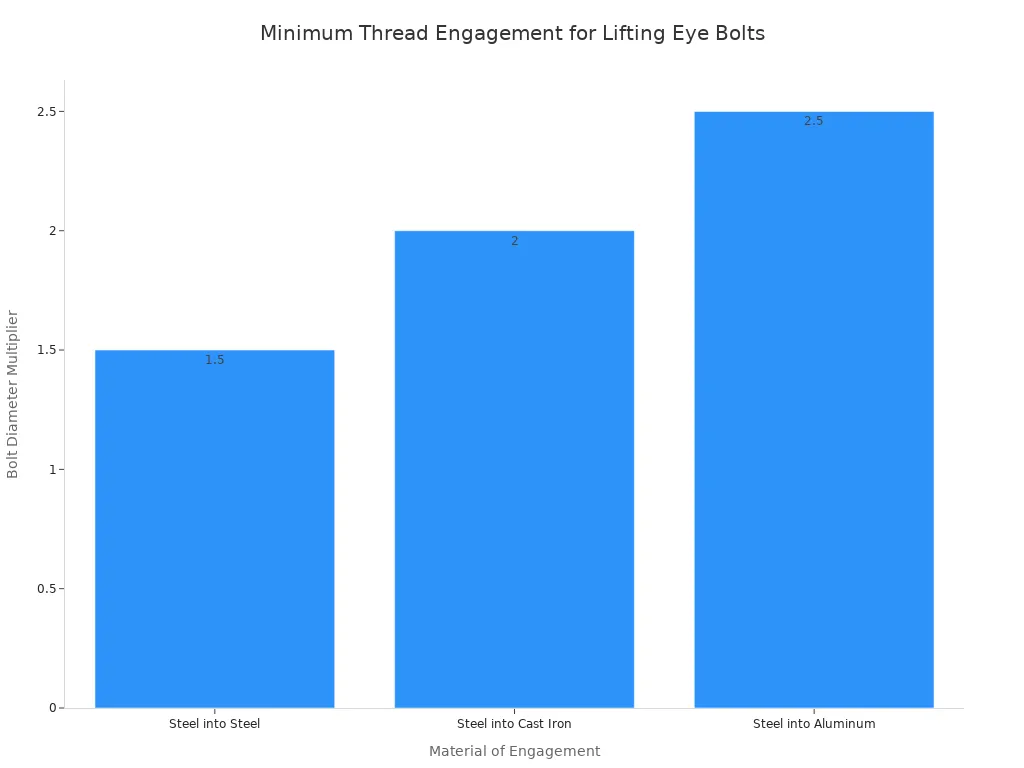
Riggers must always verify the hole’s depth and thread condition before installing lifting eye bolts for a hoist.
Failure to Properly Seat the Shoulder
Shouldered eye bolts are designed for their shoulder to sit completely flush and tight against the load surface. This contact is critical for transferring angular load forces properly. If a gap exists between the shoulder and the surface, any angular hoist will apply a powerful bending force directly to the threads, a condition the bolt is not designed to handle. This improper seating negates the benefits of the shoulder and can lead to a rapid failure of the hoist. Washers or shims are sometimes used to achieve proper orientation, but they must be of the correct size and strength.
Incorrect Orientation of the Eye to the Load
When performing an angular hoist with shouldered lifting eye bolts, the plane of the eye must be aligned with the direction of the pull. If the pull is applied across the plane of the eye, it creates a strong bending force that can bend the eye open or break the shank. This incorrect orientation is a common rigging mistake that compromises the entire hoist. Proper alignment ensures forces are channeled through the strongest axis of the eye bolts.
Con 3: Vulnerability to Mechanical Failure
Bending and Shear Forces from Off-Axis Loads
As discussed, off-axis or angular loads are the primary enemy of eye bolts. These forces introduce bending and shear stresses that the component is not engineered to resist. A vertical hoist applies pure tension, which is the ideal scenario. Any deviation from this creates complex forces that significantly reduce the working load limit and increase the risk of failure. This vulnerability is a core reason why specialized hardware is necessary for complex rigging.
Loosening and Backing Out from Vibration
In environments with significant vibration, such as on running machinery or during transport, eye bolts can gradually loosen and back out of their threaded holes. This reduces thread engagement and can cause the shoulder to lift from the surface. A loosened eye bolt presents a severe hazard, as its load-carrying ability is compromised without any obvious visual signs of damage. Regular inspection is the only way to mitigate this risk during a prolonged hoist or in a dynamic environment.
Material Fatigue from Repetitive Stress Cycles
All hardware is susceptible to material fatigue, and lifting eye bolts are no exception. Each hoist applies a stress cycle to the bolt. Over time, these repeated cycles can cause microscopic cracks to form, especially at points of stress concentration like the thread roots. These micro-cracks grow with each subsequent lift until they reach a critical size, leading to sudden, brittle failure without warning.
Several factors accelerate fatigue:
- Temperature: ASTM A489 carbon steel eye bolts have a temperature limit of 275°F (135°C). Operating above this temperature can reduce the material’s strength and make it brittle.
- Cyclic Loading: High-frequency or heavy load cycles accelerate the formation and growth of micro-cracks.
- Surface Defects: Nicks, gouges, or corrosion create stress risers that become initiation points for fatigue cracks.
This progressive and localized damage underscores the need for a rigorous inspection protocol to remove hardware from service before it fails.
A Guide to Eye Bolt Types and Their Intended Applications

Selecting the correct type of eye bolt is as critical as proper installation. Different designs, manufacturing processes, and materials dictate their intended use. Using the wrong type for a hoist can lead to equipment damage or catastrophic failure. This guide breaks down the common variations to ensure safe and effective rigging.
Shouldered vs. Non-Shouldered (Plain Pattern) Eye Bolts
Shouldered Eye Bolts: Designed for Angular Loading
Shouldered eye bolts feature a distinct collar or “shoulder” between the eye and the threads. This shoulder is designed to sit flush against the load’s surface, providing stability and transferring angular forces. This design makes them suitable for a hoist at an angle, but with significant capacity reductions.
ASME B30.26 Safety Guidelines:
- The shoulder must make full contact with the load surface.
- The plane of the eye must align with the direction of the pull.
- Lifts with shouldered eye bolts are permissible up to a 45° angle from vertical.
Following these rules is mandatory for any angular hoist using these components.
Plain Pattern Eye Bolts: Strictly for Vertical Lifts
Non-shouldered eye bolts, also known as plain pattern, lack a shoulder and consist of just a threaded shank and an eye. This simple design offers no resistance to bending forces. Therefore, riggers must use them exclusively for perfectly vertical, in-line lifts. Attempting an angular hoist with non-shouldered eye bolts is a severe safety violation that will likely cause the bolt to bend or break.
Forged vs. Wire-Formed Eye Bolts
Forged Eye Bolts: The Standard for Lifting and Rigging
Forged lifting eye bolts are created by heating and shaping a single piece of steel, which aligns the material’s grain structure and maximizes its strength. This process makes them the industry standard for any overhead hoist. To be rated for lifting, these eye bolts must have permanent markings.
- Manufacturer’s name or trademark
- Size or rated load
- Material grade (e.g., ‘A’ for alloy)
These markings allow riggers to verify the component’s suitability for lifting and rigging tasks.
Wire-Formed Eye Bolts: For Non-Lifting and Tie-Down Use Only
Wire-formed eye bolts are made by bending a piece of steel wire into an eye shape and welding it closed. They lack the continuous grain structure and strength of forged eye bolts. This type of lifting hardware is not rated for overhead lifting. Teams should only use them for light-duty, non-critical tasks like tie-downs, guiding lines, or static suspension of very light objects.
Material and Finish Considerations for Durability
Carbon Steel: The Go-To for General Purpose Lifting
Carbon steel is the most common material for standard eye bolts due to its excellent strength-to-cost ratio. It provides reliable performance for a wide range of general rigging applications in controlled environments. A zinc-plated finish is often applied to provide moderate corrosion resistance for a hoist.
Alloy Steel: For Higher Strength Requirements
When a hoist demands greater strength without increasing the bolt size, alloy steel is the superior choice. Quenched and tempered alloy steel eye bolts offer a significantly higher tensile strength than standard carbon steel. This makes them ideal for heavy-duty lifting where load capacity is the primary concern.
Stainless Steel: For Corrosive or Marine Environments
Stainless steel eye bolts provide exceptional resistance to rust and corrosion. This makes them essential for use in marine, chemical, or food processing environments. While their tensile strength is typically lower than high-grade alloy steels, their durability in harsh conditions is unmatched.
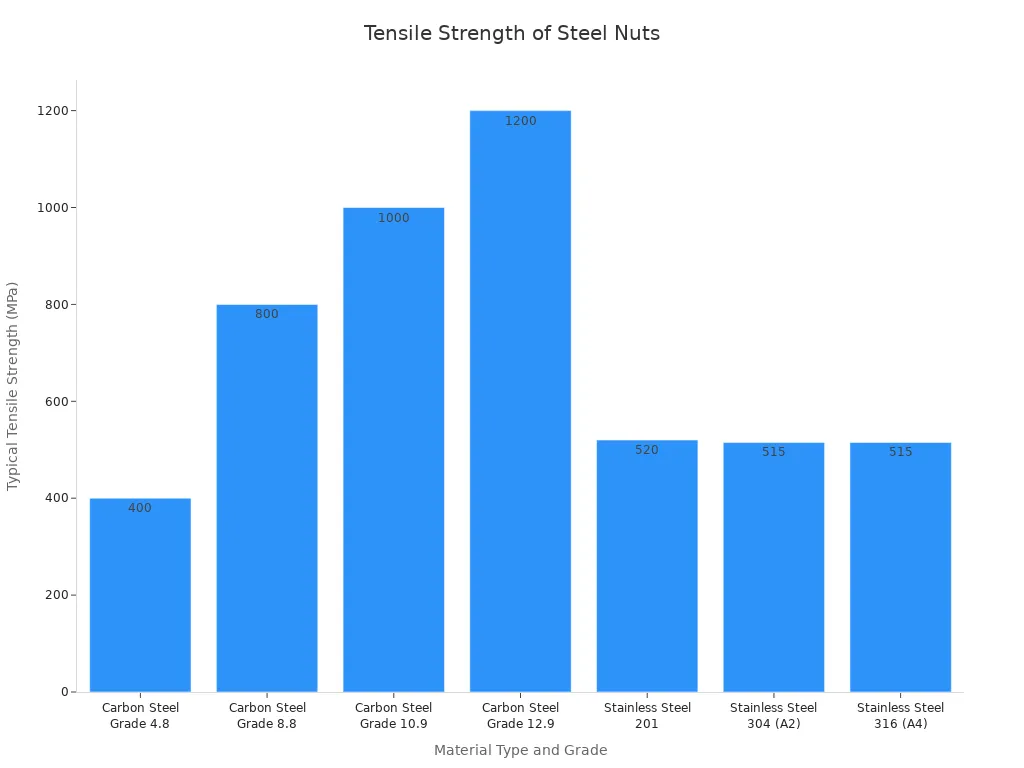
Choosing the right material ensures the long-term integrity and safety of the lifting point.
Safe Rigging Practices: Inspection and Installation Protocols
Proper use of рым-болты extends beyond selection. Rigorous inspection and installation protocols are the foundation of eye bolt safety. Every rigger must follow these procedures to prevent equipment failure and ensure a safe lifting and rigging environment. These practices protect both personnel and the load.
Pre-Use Visual Inspection Checklist
A thorough eye bolt inspection before each use is a non-negotiable safety step. This quick check can identify defects that compromise the integrity of the lifting hardware.
Checking for Bending, Stretching, or Deformation
Riggers should visually inspect the eye bolt from all angles. Any sign of bending in the shank or stretching of the eye indicates the component has been overloaded. A deformed bolt has lost its rated capacity and must be removed from service immediately.
Inspecting Threads for Damage or Wear
The threads are critical for a secure connection. Personnel must examine them for signs of stripping, corrosion, or damage. Damaged threads can prevent proper engagement, leading to a catastrophic failure under load.
Identifying Nicks, Gouges, and Cracks
Surface imperfections act as stress risers where cracks can form. Riggers must look for nicks, gouges, or cracks, especially at the base of the eye and the start of the threads. Any visible crack means the bolt is unsafe for any rigging task.
Step-by-Step Installation Guide
Correct installation is just as important as inspection. A mistake during setup can negate the strength of even a perfect eye bolt.
Verifying Full Thread Engagement in the Tapped Hole
The bolt must be screwed into the receiving hole to achieve full thread engagement. This ensures the load is distributed across a sufficient number of threads, creating secure anchor points. A shallow hole or insufficient turning can cause threads to strip.
Aligning the Eye Plane with the Load Direction
For any angular lift, the plane of the eye must be aligned with the direction of the sling line. This alignment channels force through the strongest part of the eye. Pulling across the eye creates dangerous bending forces.
Ensuring the Shoulder is Flush and Fully Seated
The shoulder of a lifting eye bolt must sit flush against the load surface. If a gap exists, shims or washers can be used to correct the orientation.
Professional Tip: When using shims, riggers must maintain at least 90% thread engagement in the receiving hole. The goal is to add just enough thickness to allow the eye to align properly when the shoulder makes firm contact with the shim stack.
Adhering to Periodic Inspection Standards
Beyond daily checks, all lifting equipment requires formal periodic inspections to ensure long-term safety and compliance.
Following ASME B30.26 Inspection Schedules
The American Society of Mechanical Engineers (ASME) provides standards for rigging hardware, including B30.26. This standard outlines the frequency and criteria for periodic inspections. Following these guidelines is a key part of a comprehensive rigging safety program.
Documenting Inspections and Criteria for Removal
Formal inspections require documentation. A written record must be created for specific types of rigging hardware, such as below-the-hook lifting devices and chain slings. This log should detail the condition of each item and confirm it meets the criteria for continued service. This documentation provides a clear history of the equipment’s condition.
When to Choose Alternatives to Eye Bolts for Safer Lifts
While lifting eye bolts serve a purpose, many rigging applications demand safer and more robust solutions. Knowing when to choose an alternative is a critical skill in modern lifting and rigging. For any hoist involving an angle, specialized rigging devices offer superior performance and safety.
Swivel Hoist Rings: The Superior Choice for Angular Lifts
How Swivel Hoist Rings Maintain 100% WLL
Swivel hoist rings are engineered to handle angular loads without capacity reduction. Unlike lifting eye bolts, their design allows the lifting point to align perfectly with the sling’s direction. This capability ensures the hoist ring can support its full rated load capacities from any angle, up to 90 degrees.
Pivoting and Swiveling to Eliminate Bending Forces
The key feature of a hoist ring is its ability to pivot 180 degrees and swivel 360 degrees. This movement accommodates shifts in the load’s center of gravity and eliminates dangerous bending forces on the bolt. The hoist ring’s bail lifts and rotates, ensuring the pull is always in-line. This dynamic adjustment is impossible for standard eye bolts and is essential for a safe angular hoist.
Ideal for Complex or Multi-Directional Lifts
These advanced rigging devices excel in complex scenarios. A hoist that requires flipping, turning, or maneuvering a load is a perfect use case for swivel hoist rings. Their flexibility allows for a smooth and controlled hoist, protecting both the load and personnel from the sudden shocks associated with less adaptable lifting hardware.
Lifting Lugs and Welded Padeyes
Custom-Engineered Solutions for Specific Equipment
Lifting lugs and padeyes are often custom-engineered and welded directly onto a piece of equipment. These permanent attachment points are designed for a specific hoist, with their strength and geometry calculated for a particular load. This makes them an integral part of the equipment itself.
When a Permanent, Welded Attachment is Best
A permanent, welded solution is preferable in many industrial rigging applications. Teams should choose welded lugs for a hoist in these situations:
- Applications needing a permanent, non-removable anchor point.
- Operations where loads must be rotated or repositioned multiple times.
- Lifts where high safety and permanent accessibility are critical.
- Long-term use under high mechanical stress, such as enduring over 20,000 load cycles.
Cost-Benefit Analysis: Eye Bolts vs. Hoist Rings
Сравнение первоначальных инвестиций и долгосрочной безопасности
Поворотные грузозахватные кольца имеют более высокую начальную стоимость по сравнению с рым-болтами. Однако эти первоначальные затраты являются инвестицией в долгосрочную безопасность и операционную эффективность. Риск аварии из-за отказа подъемного устройства значительно перевешивает первоначальную экономию от использования неподходящего такелажного оборудования.
Расчет совокупной стоимости владения и рисков
Совокупная стоимость владения (TCO) дает более четкую финансовую картину. TCO включает первоначальную цену, затраты на техническое обслуживание и остаточную стоимость компонента. Для поворотных грузозахватных колец требуются официальные проверки каждые 12 месяцев или 2500 циклов подъема. Хотя это увеличивает затраты на обслуживание, их долговечность часто приводит к более низкой TCO.
Пример TCO: Грузозахватное оборудование Более дешевый компонент может выйти из строя раньше и потребовать более частой замены, увеличивая долгосрочные затраты.
Переменная Компонент A (Низкая начальная стоимость) Компонент B (Высокая начальная стоимость) Первоначальная стоимость $20 $150 Техобслуживание и замена $150 $30 Совокупная стоимость владения $170 $180
Этот расчет показывает, как более высокие первоначальные инвестиции в качественный такелаж могут быть более экономичными в течение всего срока службы оборудования.
Рым-болты предоставляют ценное, недорогое решение для идеально вертикальных подъемов. Однако значительные риски, связанные с угловой нагрузкой и неправильной установкой, нельзя игнорировать. Для любого такелажа, связанного с углом, более безопасное оборудование, такое как поворотные грузозахватные кольца, является отраслевым стандартом.
В конечном счете, приоритизация безопасности при использовании рым-болтов через правильный выбор оборудования, тщательную проверку и надлежащее обучение необходима для каждой подъемно-такелажной операции. Эта приверженность обеспечивает безопасную рабочую среду.
Частые вопросы
В чем основное различие между рым-болтами с буртом и без бурта?
Рым-болты с буртом (плечом) имеют воротник, который позволяет им выдерживать угловые нагрузки, хотя и со значительным снижением грузоподъемности. Рым-болты без бурта (простые) лишены этой особенности. Персонал должен использовать их исключительно для идеально вертикальных, прямолинейных подъемов, чтобы предотвратить изгиб и разрушение.
Могут ли такелажники использовать любые рым-болты для подъема?
Нет. Только кованые рым-болты рассчитаны на подъем грузов. Они должны иметь постоянную маркировку с указанием производителя и номинальной нагрузки. Рым-болты, изготовленные из гнутой проволоки, менее прочны. Команды должны использовать их только для легких, неподъемных задач, таких как крепление оттяжек или в качестве узлов крепления.
Насколько угол снижает грузоподъемность рым-болта?
Снижение грузоподъемности является значительным. Угол в 45 градусов может снизить Рабочий Предел Нагрузки (WLL) на 70%.
Предупреждение по технике безопасности: Такелажники всегда должны сверяться с таблицей снижения номинальных характеристик производителя перед попыткой любого углового подъема. Никогда не следует гадать о грузоподъемности.
Когда команде следует выбрать поворотное грузозахватное кольцо?
Командам следует использовать поворотные грузозахватные кольца для любого подъема, связанного с углом. Они поворачиваются и вращаются, сохраняя 100% своей номинальной грузоподъемности с любого направления. Эта конструкция устраняет опасные изгибающие силы, которые подвергают риску стандартные рым-болты во время сложных или угловых подъемов.
Почему полное зацепление резьбы критически важно для безопасности?
Недостаточное зацепление резьбы может привести к срыву резьбы под нагрузкой, что вызовет внезапный отказ подъемного устройства. Болт должен быть ввернут достаточно глубоко, чтобы правильно распределить усилие. Необходимая глубина зависит от материала отверстия, в которое он ввинчивается.
Как часто следует проверять подъемные рым-болты?
Такелажный персонал должен проводить визуальный осмотр на наличие повреждений перед каждым использованием. Кроме того, формальные периодические проверки должны проводиться в соответствии с графиком, изложенным в стандарте ASME B30.26. Это обеспечивает долгосрочную безопасность и соответствие нормам для всего подъемного оборудования.