
Selecting the right flange face bolt is a critical engineering task for industrial applications. A project’s specific bolt choice factors determine the correct bolt. Professionals must choose фланцевый болт materials and grades that match the flange pressure and temperature requirements. A leak-proof flange seal depends entirely on the correct Flange Bolt.
The flange requires flange face bolts that meet its exact specifications. The flange design, flange material, and flange gasket all influence the bolt for various applications. A производитель крепежных изделий на заказ может предоставить нестандартные крепежные элементы or a unique литье болтов to meet these needs. The right flange face bolts ensure the flange remains secure, making this bolt selection vital for safe applications. These flange face bolts are essential.
Step 1: How to Choose Bolts Based on Material Properties
The first step to choose flange bolt integrity is selecting the right material. The operational environment dictates the best material choices for flange face bolts. Engineers must evaluate temperature, pressure, and chemical exposure to determine how to choose bolts that guarantee a safe, long-lasting connection. Different types of flange face bolts offer unique properties for specific applications.
Match Material to Temperature and Pressure
Temperature and pressure directly impact a bolt’s mechanical strength. Extreme heat can cause a bolt to soften and lose strength through a process called creep, while extreme cold can make it brittle. The right material choices for flange face bolts are essential for any flange.
Carbon Steel for General-Purpose Applications
Carbon steel flange face bolts are a cost-effective solution for general-purpose applications. They perform well in moderate temperature and pressure conditions where corrosion is not a primary concern. These types of flange face bolts are common in water, oil, and gas applications within controlled environments. A flange using these flange face bolts must operate within the material’s limits.
Alloy Steel for High-Temperature and High-Pressure Service
For high-temperature and high-pressure applications, alloy steel flange face bolts are the standard. Alloying elements like chromium, molybdenum, and vanadium enhance strength and creep resistance at elevated temperatures. This makes them ideal for power generation, petrochemical processing, and other demanding industrial applications. A flange in these settings requires robust flange face bolts.
| Материал | Key Alloying Element | Max. Operating Temperature | Примечания |
|---|---|---|---|
| ASTM A193 B7 | Chromium-Molybdenum | 450°C (850°F) | Above this, the material softens, losing strength. |
| ASTM A193 B16 | Chromium-Molybdenum-Vanadium | 540°C (1000°F) | Vanadium enhances creep resistance for higher temperature use. |
Нержавеющая сталь для устойчивости к коррозии
Stainless steel flange face bolts provide excellent corrosion resistance, making them suitable for applications involving moisture or corrosive chemicals. Different grades offer varying levels of performance. These types of flange face bolts are critical for a flange in corrosive applications.
- Austenitic stainless steel (e.g., 304, 316): Can operate up to about 870°C (1600°F).
- High-temperature stainless steel (e.g., 310): Can work at temperatures up to 1150°C (2102°F).
These types of flange face bolts are essential for food processing and marine applications.
Exotic Alloys for Extreme Environments
For the most extreme applications, engineers turn to exotic alloys. Materials like Inconel, Monel, and Hastelloy offer superior resistance to extreme temperatures, high-pressure applications, and aggressive chemicals. These specialized types of flange face bolts ensure reliability where other materials would fail. A flange in a severe service environment needs these advanced flange face bolts.
Ensure Chemical Compatibility
Chemicals can attack a bolt, leading to corrosion and failure. Proper material choices for flange face bolts prevent this.
⚠️ Avoid Коррозионное растрескивание под напряжением (КРН) Certain chemicals cause specific alloys to crack under tensile stress. For example, chlorides can cause SCC in austenitic stainless steel, while ammonia can damage copper-based alloys. A flange connection’s safety depends on avoiding these material-chemical combinations in your applications.
Reviewing Material Test Reports (MTRs)
A Material Test Report (MTR) is a quality assurance document that certifies a material’s chemical and physical properties. Professionals must review the MTR for each bolt lot. This confirms the bolt meets the required specifications for your applications. The MTR is proof of quality for any bolt.
Consulting Chemical Resistance Charts
Engineers use chemical resistance charts to verify a material’s compatibility with specific substances. These resources rate how different types of flange face bolts react to various chemicals. Consulting these charts helps prevent degradation and ensures the long-term integrity of the flange face bolts in chemical processing applications. This is a key step for any bolt selection in such applications.
Step 2: Determining the Correct Bolt Size and Dimensions
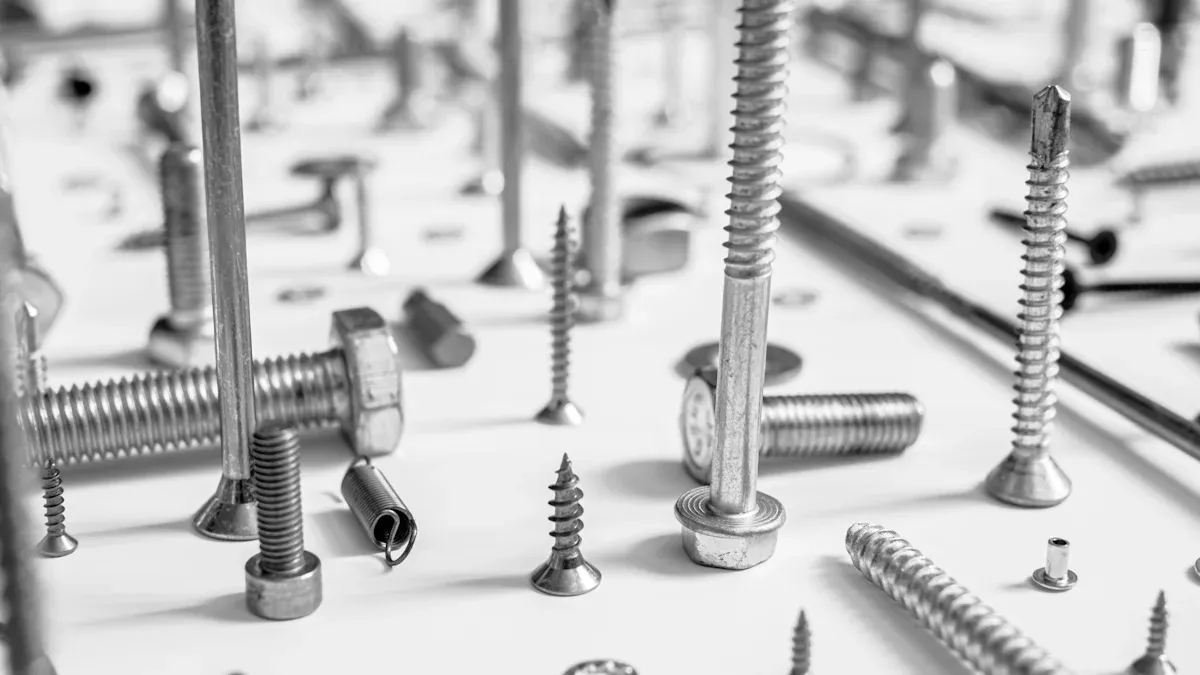
After selecting the material, the next step is to determine the correct bolt size and dimensions. An incorrect bolt size compromises joint integrity, leading to potential leaks and safety hazards. Professionals must match the bolt diameter, length, and thread type to the flange specifications to ensure a secure and reliable connection. This is a key part of how to choose flange bolt specifications correctly.
How to Find the Right Diameter and Length
The diameter and length of flange face bolts are critical for achieving the proper clamping force. A bolt that is too short will not engage the nut fully, while a bolt that is too long can interfere with other components.
Using Flange Specification Charts (ASME B16.5)
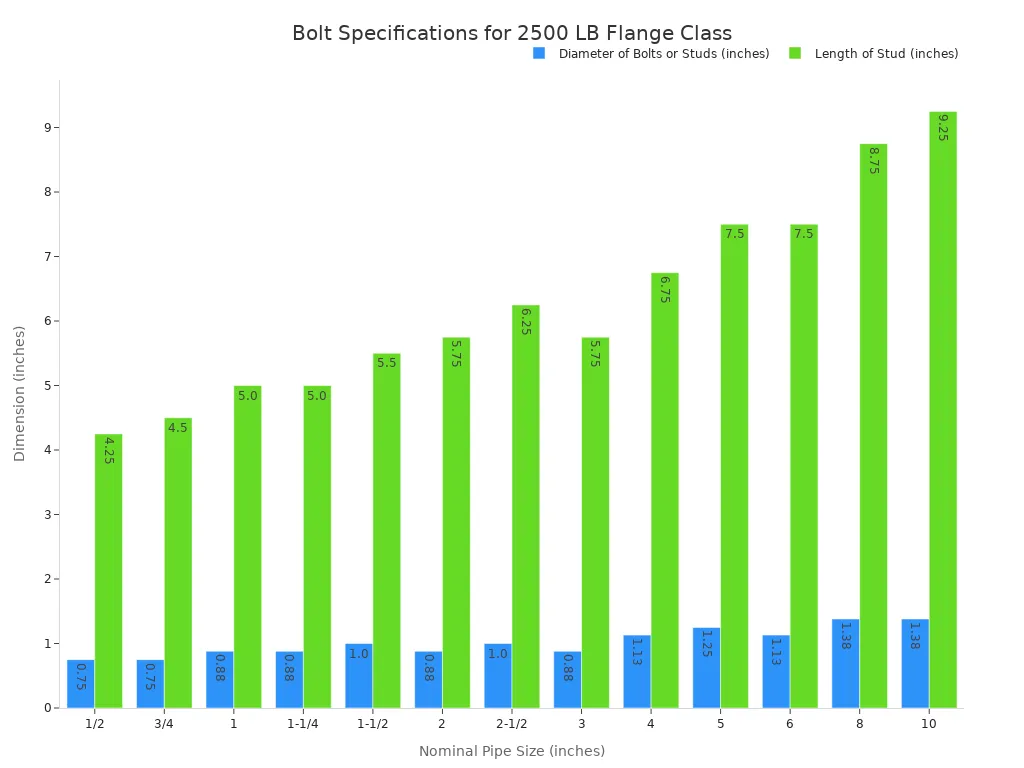
Industry standards provide charts that simplify bolt selection. ASME B16.5 is the primary standard for pipe flanges and flanged fittings. To use these charts, an engineer first identifies the flange class and nominal pipe size. The chart then specifies the required diameter, length, and number of flange face bolts for that specific flange.
For example, the chart below shows bolt requirements for a Class 2500 flange:
| Flange Class | Номинальный диаметр трубы | Количество болтов или шпилек | Диаметр болтов или шпилек | Длина шпильки (для фланца с выступом 1/4 дюйма) |
|---|---|---|---|---|
| Класс давления 2500 фунтов | 1″ | 4 | 0.88″ | 5″ |
| Класс давления 2500 фунтов | 2″ | 8 | 0.88″ | 5-3/4″ |
| Класс давления 2500 фунтов | 4″ | 8 | 1.13″ | 6-3/4″ |
| Класс давления 2500 фунтов | 6″ | 12 | 1.13″ | 7-1/2″ |
Расчет требуемой длины болта
В случаях, когда стандартные таблицы неприменимы, инженеры могут рассчитать требуемую длину болта. Основная формула:
Длина болта = (2 x Толщина фланца) + Толщина прокладки + (2 x Высота гайки) + Допуск на выступание
Этот расчет гарантирует, что болт будет достаточно длинным, чтобы пройти через оба фланца и прокладку, с достаточной длиной для полного зацепления гайки и выступания нескольких дополнительных витков резьбы. Это обеспечивает правильную длину болтов для фланцевого соединения.
Проверка количества отверстий под болты
Количество болтов на фланце так же важно, как и их размер. Использование правильного количества болтов обеспечивает равномерное распределение зажимного давления по периметру фланца. В таблицах ASME B16.5 указано точное количество отверстий под болты для каждого размера и класса фланца, что исключает догадки. Для безопасного уплотнения фланец требует именно этого точного количества.
Понимание спецификаций резьбы
Резьба на болте и гайке создает механическую фиксацию, удерживающую соединение вместе. Понимание спецификаций резьбы необходимо для выбора совместимых компонентов.
Крупная и мелкая резьба (UNC и UNF)
Резьба классифицируется как крупная (UNC) или мелкая (UNF). Каждый тип имеет определенные преимущества для различных областей применения. Резьба UNC более распространена в тяжелых промышленных условиях, в то время как резьба UNF предпочтительна для прецизионных применений. Выбор влияет на характеристики болтов фланцевого соединения.
| Характеристика | Крупная резьба (UNC) | Мелкая резьба (UNF) |
|---|---|---|
| Устойчивость к вибрации | Меньшее сопротивление самоотвинчиванию | Превосходное сопротивление самоотвинчиванию |
| Прочность и долговечность | Более прочная, менее склонная к срыву резьбы | Более подвержена срыву резьбы при высоких нагрузках |
| Области применения | Строительство, промышленное оборудование | Аэрокосмическая отрасль, прецизионное оборудование |
Обеспечение совместимости резьбы болта и гайки
Основное правило болтовых соединений: болт и гайка должны иметь идентичные характеристики резьбы. Несовпадение резьбы предотвратит правильную сборку и может повредить болты фланцевого соединения во время установки. Всегда проверяйте, чтобы тип резьбы (UNC или UNF), диаметр и шаг были одинаковыми для болта и гайки.
Понимание шага и диаметра резьбы
Шаг резьбы — это расстояние между соседними витками, а диаметр — общая ширина болта. Эти два параметра определяют размер болта. Теоретически, более мелкий шаг (больше витков на дюйм) обеспечивает большее механическое преимущество, создавая большее зажимное усилие при заданном крутящем моменте. Однако практические факторы, такие как трение, часто снижают это преимущество. “Коэффициент гайки” (K) в расчетах крутящего момента учитывает эти переменные, и реальная разница в зажимном усилии между болтами с крупной и мелкой резьбой часто минимальна. Фланцевое соединение зависит от правильного болта.
Шаг 3: Выбор правильного класса прочности болтов для фланцевого соединения
После того как инженер определил материал и размеры, следующий важный шаг — выбор правильного класса болтов для фланцевого соединения. Класс болта определяет его механические свойства, в первую очередь прочность. Эта характеристика является основополагающей для обеспечения того, чтобы болтовое фланцевое соединение могло выдерживать рабочие давления без разрушения. Болт более высокого класса обеспечивает большую прочность, что необходимо для применений под высоким давлением. Процесс выбора правильных болтов для фланцевого соединения должен учитывать требуемое зажимное усилие для надлежащего уплотнения фланца.
Как класс болта влияет на номинальное давление
Номинальное давление фланцевой системы напрямую связано с прочностью болтов. Более высокое внутреннее давление требует более сильного зажимного усилия для поддержания герметичности фланца. Использование болтов с недостаточным классом прочности может привести к недостаточному зажиму, что вызовет утечки или катастрофический отказ соединения. Следовательно, инженеры должны подбирать класс болта в соответствии с требованиями к давлению для конкретного применения.
Понимание распространенных классов ASTM (A193, A307, A320)
ASTM International устанавливает стандарты для классов болтов. Каждый класс имеет определенные химические и механические свойства, предназначенные для различных условий эксплуатации.
- ASTM A307: Этот стандарт охватывает болты из углеродистой стали общего назначения для фланцевых соединений. Класс A предназначен для общих применений, а Класс B — для фланцевых соединений в трубопроводных системах в условиях низкого давления.
- ASTM A193: Эта спецификация предназначена для болтов из легированной и нержавеющей стали для фланцевых соединений, используемых в условиях высоких температур или высокого давления. Класс B7 является распространенным выбором для промышленных применений благодаря своей высокой прочности.
- ASTM A320: Этот стандарт охватывает болты из легированной и нержавеющей стали для фланцевых соединений, используемых в условиях низких температур. Например, болты класса L7 разработаны для сохранения пластичности и устойчивости к охрупчиванию в холодных средах.
Выбор класса по требуемой прочности на растяжение
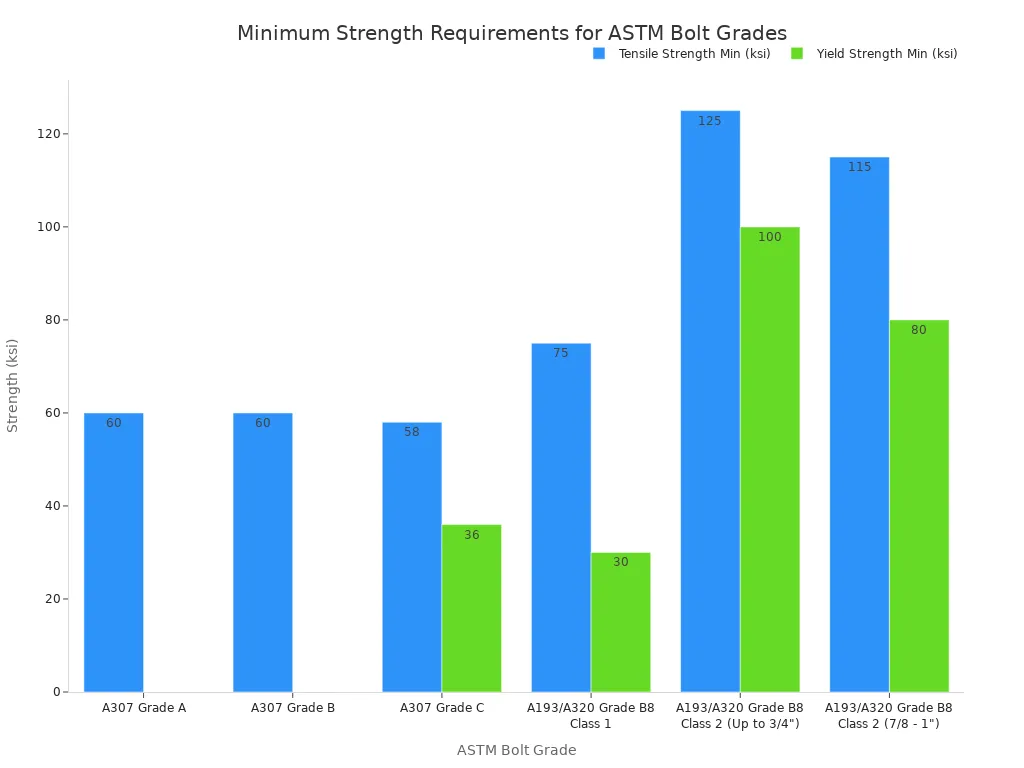
Предел прочности на растяжение — это максимальное напряжение, которое болт может выдержать перед разрушением. Предел текучести — это точка, в которой болт начинает необратимо деформироваться. При выборе правильных болтов для фланцевого соединения инженер должен выбрать класс, предел прочности и предел текучести которого превышают расчетные требования к нагрузке для фланца. В таблице ниже приведены минимальные прочностные свойства для распространенных классов.
| Маркировка класса | Минимальный предел прочности (тыс. фунтов на кв. дюйм) | Минимальный предел текучести (тыс. фунтов на кв. дюйм) |
|---|---|---|
| A307 Класс A | 60 | – |
| A307 Класс B | мин. 60, макс. 100 | – |
| A193/A320 Grade B8 Class 1 | 75 | 30 |
| A193/A320 Grade B8 Class 2 (Up to 3/4″) | 125 | 100 |
The Role of Head Markings and Stamps
Head markings are the identification codes stamped onto the head of a bolt. These markings are critical because they allow for visual verification of the bolt grade and manufacturer. This ensures the correct flange face bolts are installed on the flange.
How to Identify Bolt Grade by Markings
Engineers and installers can identify a bolt grade by its unique head stamp. These markings are standardized to prevent confusion.
- ASTM A307 класс A: The head is marked with “A307 A”.
- ASTM A193 Марка B7: The head is simply marked with “B7”.
- ASTM A354 Grade BD: The head displays “BD”.
Checking these markings is a simple but vital quality control step before installing any flange face bolts on a flange. This is a key part of how to choose flange bolt components correctly.
Verifying Authenticity and Compliance
Verifying head markings helps prevent the use of counterfeit or non-compliant flange face bolts. A counterfeit bolt may look correct but lacks the required material properties, posing a significant safety risk to the flange.
⚠️ DANGER: Counterfeit Bolts Compromise Safety The use of counterfeit flange face bolts has led to catastrophic failures. Pentagon audits found over a million bogus components in critical military systems, including helicopters and missile platforms. In one case, two counterfeit bolts on an M109 howitzer failed, leading to a fatality. Officials identified these parts by checking for improper head markings, such as Grade 8.2 boron steel bolts being falsely stamped with the six radial lines of a higher-strength Grade 8 alloy bolt. Always verify markings to ensure the bolt is authentic and compliant with the flange specifications.
Step 4: Understanding Flange and Gasket Compatibility
A bolted flange connection is a system of three components: the flange, the gasket, and the bolt. The success of the entire joint depends on these parts working together. The right flange face bolts create the necessary clamping force to compress the gasket, forming a tight seal between two flange faces. Selecting a bolt without considering the gasket type can lead to leaks or damage to the flange itself.
Matching Gasket Type to Bolt Strength
The gasket material determines how much force is needed to create a seal. The bolt strength of the selected flange face bolts must be appropriate for the gasket type. A mismatch can result in either a leaking connection or a crushed gasket.
Compressing Soft Gaskets (Non-Metallic)
Soft gaskets, such as those made from rubber or cork, require relatively low seating stress. They compress easily to fill imperfections on the flange surface. Using a high-strength bolt for this type of flange is often unnecessary and risky. Excessive force from a powerful bolt can crush the soft gasket material, causing it to extrude out of the joint and fail. Lower-strength flange face bolts are typically sufficient and safer for these applications.
Seating Semi-Metallic and Metallic Gaskets
Semi-metallic gaskets (like spiral-wound types) and metallic gaskets (like ring-type joints) are much harder. They require a significant amount of clamping force to “seat” or deform into the flange grooves. This seating action creates a highly reliable, metal-to-metal seal. An engineer must select flange face bolts with adequate bolt strength to achieve this high load. An under-specified bolt will not be strong enough to properly compress the gasket, resulting in a leak path on the flange.
How Bolt Selection Prevents Flange Damage
The right bolt selection does more than just seal the gasket; it also protects the flange from damage. The goal is to apply enough force to seal the joint without exceeding the mechanical limits of the flange.
Avoiding Over-Tensioning and Flange Warping
Over-tensioning a bolt can apply too much stress, causing the flange to warp or bow. A warped flange will not seal correctly and may need to be replaced. Proper bolt selection helps prevent this by matching the bolt’s capabilities to the flange and gasket requirements. Several factors contribute to joint failure and flange damage.
Key Causes of Flange Joint Failure
- Improper flange preparation, including uncleaned surfaces or misalignment.
- Incorrect gasket selection for the application.
- Poor installation procedures or using uncalibrated torque tools.
- Using low-cost, non-compliant flange face bolts or untrained personnel.
Ensuring Even Load Distribution
A secure seal depends on distributing the clamping force evenly across the entire flange. The number and pattern of flange face bolts are designed specifically for this purpose. Using the correct flange face bolts ensures each bolt can handle its designated load. Following proper tightening procedures is critical for achieving this balance. Best practices include lubricating the bolt threads, using a calibrated torque wrench, and tightening the flange face bolts in a crosswise or star pattern. This methodical approach prevents uneven stress on any single point of the flange, ensuring joint integrity.
Step 5: Deciding on a Protective Coating or Finish
Selecting a protective coating is a final, critical step in how to choose flange bolt components. A coating acts as a barrier, shielding the bolt from corrosion and other environmental threats. It can also improve installation efficiency and extend the service life of the entire flange assembly. The right finish ensures the flange face bolts perform reliably in their intended service environment.
When to Use Coated Flange Face Bolts
Engineers specify coated flange face bolts when the operational environment poses a threat to the base metal or when installation challenges like friction need to be managed.
Assessing Environmental Factors (Humidity, Saltwater, Chemicals)
Environmental conditions are a primary driver for coating selection. Coated flange face bolts are mandatory in marine environments due to constant exposure to saltwater, humidity, and temperature fluctuations. These harsh conditions can quickly cause rust and corrosion on an unprotected flange, leading to equipment failure. A protective coating is essential for long-term performance and safety. Chemical processing plants also require specific coatings to protect the flange from corrosive substances.
Preventing Galling During Installation
Galling, or cold welding, is a common problem when tightening fasteners, especially those made of stainless steel. The pressure during tightening can break down the material’s natural protective oxide layer. This breakdown allows direct metal-to-metal contact, which increases friction and can fuse the nut and bolt threads together.
💡 Tip: How Coatings Prevent Galling Protective coatings like PTFE or specialized lubricants act as a barrier между поверхностями резьбы. Этот барьер предотвращает разрушение оксидной пленки и снижает трение, обеспечивая плавный монтаж и позволяя прикладывать точный момент затяжки на фланце.
Сравнение распространенных типов покрытий
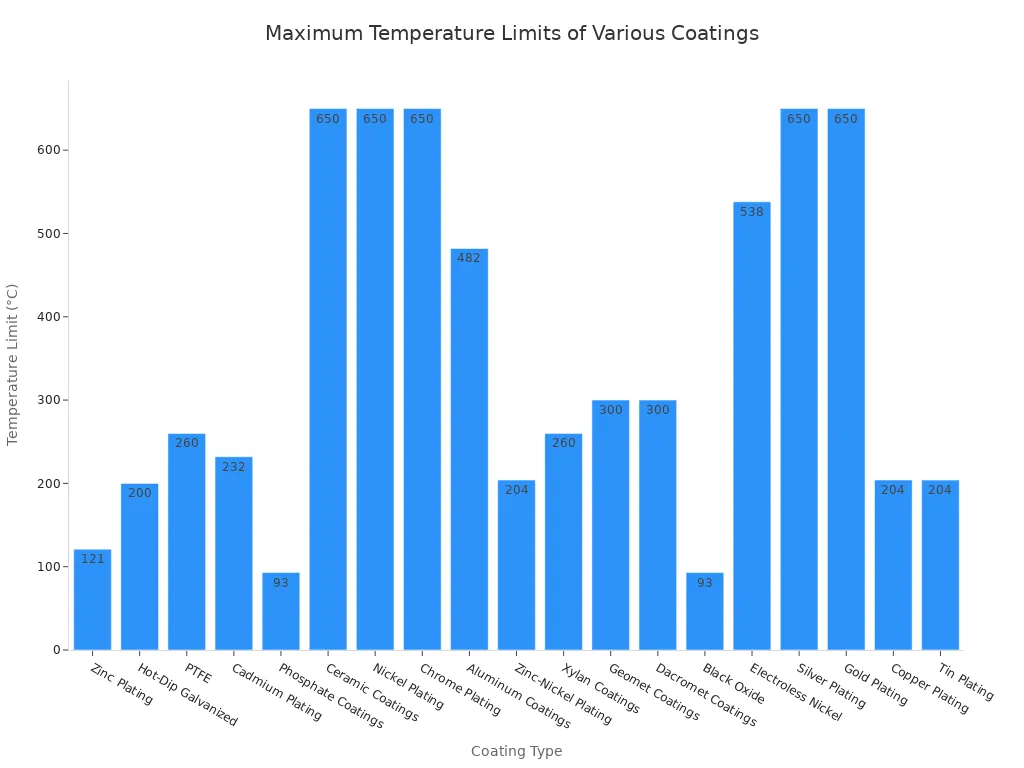
Существует широкий выбор покрытий, каждое из которых предлагает уникальный баланс коррозионной стойкости, температурных ограничений и стоимости. В таблице ниже представлено сравнение распространенных вариантов для фланцевых болтов.
| Тип покрытия | Коррозионная стойкость | Температурные ограничения | Стоимость |
|---|---|---|---|
| Цинкование (гальваническое) | Хорошо для умеренных условий | До 250°F (121°C) | Низкая |
| Горячее цинкование | Отлично подходит для использования на открытом воздухе | До 392°F (200°C) | Умеренная |
| ПТФЭ (фторполимер) | Отличная стойкость в химических средах | До 500°F (260°C) | Высокая |
| Кадмирование | Хорошая, особенно в морских условиях | До 450°F (232°C) | Умеренная до Высокой |
| Фосфатирование | Умеренная; создает основу для масла/краски | До 200°F (93°C) | Низкая |
Цинкование (гальваническое)
Цинкование — экономически эффективный выбор для мягких внутренних условий. Оно обеспечивает протекторный слой защиты, но может быть скомпрометировано при повреждении.
Горячее цинкование
Этот процесс предполагает погружение болтов в расплавленный цинк, создавая толстое, прочное и высоко коррозионностойкое покрытие. Это отличный выбор для наружного и промышленного применения.
Фторполимерные (ПТФЭ) покрытия
Часто известные под торговыми марками, такими как Teflon или Xylan, ПТФЭ-покрытия обеспечивают превосходную химическую стойкость и низкое трение. Это делает их идеальными для коррозионных сред и помогает предотвратить заедание.
Кадмиевые покрытия
Кадмий обеспечивает хорошую коррозионную стойкость и смазывающую способность, что снижает трение между гайкой и болтом. Однако его использование строго ограничено.
⚠️ ВНИМАНИЕ: Кадмий высокотоксичен Кадмий является токсичным тяжелым металлом, и его использование запрещено или строго регулируется во многих регионах из-за экологических проблем и проблем со здоровьем. При использовании с фланцем из нержавеющей стали он также может вызывать преимущественную коррозию.
Фосфатирование
Фосфатные покрытия сами по себе обеспечивают минимальную коррозионную стойкость. Их основная функция — служить подготовкой поверхности для вторичного покрытия, такого как масло или краска, которое обеспечивает основной защитный слой.
Шаг 6: Ключевые отраслевые стандарты для выбора соответствия фланцевых болтов
Соблюдение отраслевых стандартов не является опциональным; это фундаментальное требование для обеспечения безопасности и надежности любого болтового фланцевого соединения. Эти стандарты предоставляют универсальный язык для производителей, инженеров и монтажников. Они регулируют все: от химического состава материала до размерных допусков, гарантируя, что каждый компонент фланцевого узла работает как предсказуемая система. Следование этим установленным руководствам — единственный способ гарантировать, что болт пригоден для эксплуатации на ответственном фланце.
Обзор критических стандартов для болтовых соединений
Инженеры полагаются на основной набор стандартов для спецификации и проверки болтов. Эти документы от организаций, таких как ASME и ASTM, обеспечивают техническую основу для каждого решения. Соответствующий фланец зависит от понимания этих ключевых спецификаций.
Понимание стандарта ASME B16.5 для фланцев
ASME B16.5 — это основной стандарт для трубных фланцев и фланцевой арматуры. Он определяет размеры, номинальные давления-температуры и материалы для самого фланца. Ключевым моментом является то, что он также определяет количество, размер и тип болтов, требуемых для каждого класса фланца. Для большинства применений, особенно в высокотемпературных условиях, стандарт рекомендует использовать шпильки с гайкой на каждом конце для обеспечения надежного зажима фланца.
Следование материальным спецификациям ASTM
В то время как ASME определяет фланцевую систему, стандарты ASTM International определяют материал болта. Спецификации ASTM диктуют требуемый химический состав, механические свойства (такие как предел прочности при растяжении) и термообработку для каждого класса болта. Это гарантирует, что материал может выдерживать условия эксплуатации фланца. Распространенные комбинации включают:
| Тип материала | Спецификация болта | Спецификация гайки |
|---|---|---|
| Углеродистая сталь для высоких температур | A193 Gr B7 | A194 Gr 2H |
| Углеродистая сталь для низких температур | A320 Gr L7 | A194 Gr 7 |
| Аустенитная нержавеющая сталь | A193 Gr B8 | A194 Gr 8 |
Соблюдение стандарта ASME B18.2.1 для размеров болтов
Этот стандарт регулирует физические размеры болтов и шпилек. ASME B18.2.1 (для болтов) и ASME B18.2.2 (для гаек) определяют такие детали, как тип головки, длина резьбы и общие допуски. Соответствие гарантирует, что фланцевые болты будут правильно подходить к отверстиям фланца и правильно сопрягаться с гайками.
Важность прослеживаемости и документации
Указание стандарта — это только половина дела; инженер также должен убедиться, что поставляемые болты действительно ему соответствуют. Прослеживаемость обеспечивает это доказательство. Она создает документированную цепочку от сырья до готового болта на фланце.
Почему вы должны запрашивать сертификаты завода-изготовителя (MTR)
Сертификат завода-изготовителя (MTR) — это документ по обеспечению качества, который выступает в качестве “birth certificate” for the metal used to make the bolts. It provides a certified record of the material’s properties.
An MTR is non-negotiable for critical applications. It certifies the material’s chemical composition and mechanical properties (yield, tensile strength), confirming it meets the specified ASTM standard. This document is the ultimate proof that the material is suitable for a high-pressure flange.
Verifying Lot Numbers and Heat Codes
Traceability is achieved through a system of unique identifiers.
- Номер плавки: Этот код позволяет отследить болт до исходной расплавленной партии стали, подтверждая его химический состав с самого источника.
- Номер партии: Этот код отслеживает конкретную производственную партию готовых болтов для фланцев через такие процессы, как ковка и термообработка.
Вместе эти коды позволяют инспектору связать отдельный болт с его сертификатом качества (MTR), обеспечивая полную и проверяемую историю. Это гарантирует, что каждый болт, установленный на фланце, полностью соответствует требованиям и безопасен.
Шаг 7: Рекомендации по установке болтов для фланцев
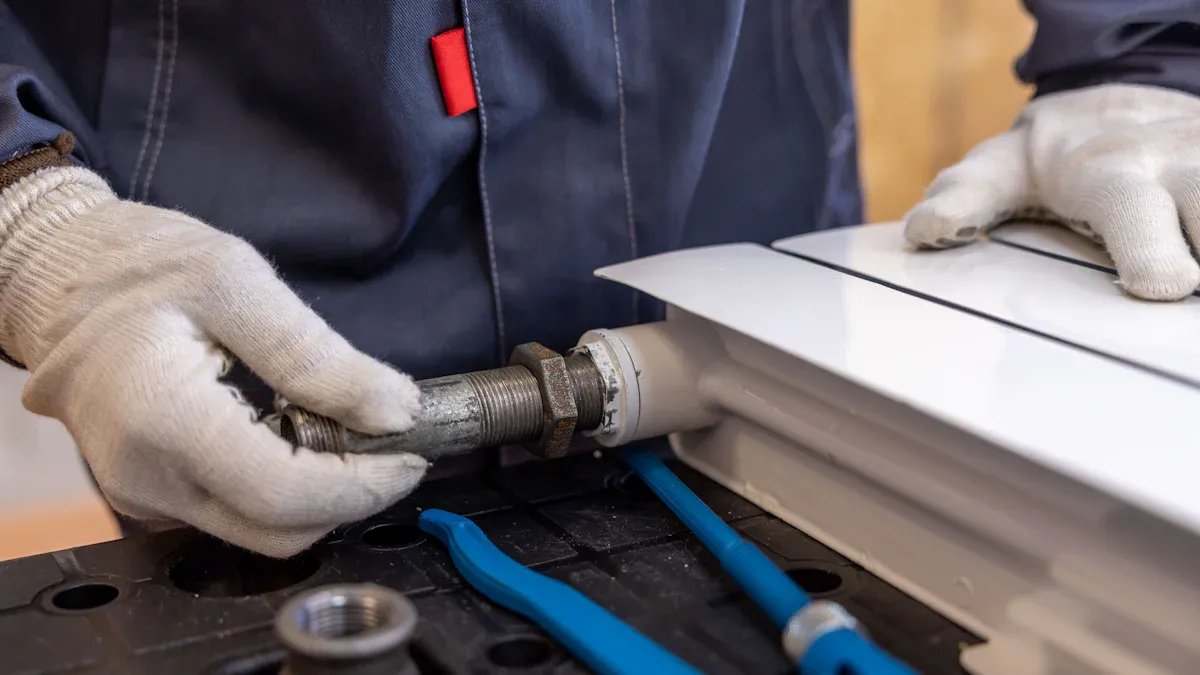
Правильная установка так же важна, как и выбор подходящих компонентов. Даже идеально подобранный болт может выйти из строя при неправильной установке. Эти рекомендации по установке болтов для фланцев направлены на достижение правильного момента затяжки и соблюдение точной последовательности затягивания. Успешная установка обеспечивает целостность и безопасность всего фланцевого соединения.
Почему правильный момент затяжки критичен для надёжного уплотнения
Момент затяжки — это вращательная сила, прикладываемая к гайке, но его реальная цель — создать определённое натяжение в болте. Это натяжение, известное как предварительная нагрузка, является сжимающей силой, которая удерживает фланцевое соединение. Успешная установка зависит от достижения правильной предварительной нагрузки.
Достижение правильной нагрузки на болт и предварительной нагрузки
Инженер должен понимать, что большая часть прикладываемого момента затяжки не создаёт предварительную нагрузку. При стандартной сухой установке трение поглощает около 90% энергии. Примерно 50% теряется на трение под поверхностью гайки, а 40% — в резьбе. Таким образом, только 10% момента затяжки растягивают болт и создают необходимую сжимающую силу. Эта зависимость определяется “коэффициентом гайки” (K), который учитывает трение. Правильная установка требует тщательного контроля этого фактора.
Предотвращение утечек и разрушения соединения
Неправильный момент затяжки напрямую ведёт к разрушению соединения. Как недостаточная, так и чрезмерная затяжка создают опасные условия для фланца. Неправильная установка может привести к выходу из строя прокладки, что часто проявляется в виде утечки жидкостей или газов.
| Ошибка при затягивании | Возникающее состояние | Последствие |
|---|---|---|
| Недостаточная затяжка | Недостаточная предварительная нагрузка на прокладку | Утечка и возможный разрыв соединения |
| Чрезмерная затяжка | Чрезмерная нагрузка на болт и фланец | Усталость болта, деформация фланца и разрушение прокладок |
| Неравномерная затяжка | Неравномерное распределение нагрузки | Локальные точки напряжения и пути утечки |
Соблюдение правильной схемы затягивания
Применение окончательного значения момента затяжки — не одноэтапный процесс. Методичная схема затягивания необходима для равномерного распределения нагрузки по фланцу. Эти рекомендации по установке болтов для фланцев критически важны для предотвращения перекоса при установке.
Объяснение звёздной (перекрёстной) схемы
Звёздная, или перекрёстная, схема является отраслевым стандартом для затягивания фланца. Эта техника предполагает последовательное затягивание болтов на противоположных сторонах фланца. Для фланца с 8 болтами монтажник затягивает болты в порядке 1-5-3-7-2-6-4-8. Установка выполняется в несколько проходов для постепенного увеличения нагрузки.
💡 Профессиональный совет: Типичная установка включает три прохода:
- Первый проход — 30% от окончательного момента затяжки.
- Второй проход — 60% от окончательного момента затяжки.
- Третий проход — 100% от окончательного момента затяжки.
Использование калиброванного динамометрического ключа
Достижение точного значения момента затяжки невозможно без правильного инструмента. Откалиброванный динамометрический ключ обязателен для любого ответственного фланцевого соединения. Использование некалиброванного инструмента вносит элемент угадывания и делает всю установку ненадёжной.
Роль смазки в достижении точного момента затяжки
Смазка — одна из самых эффективных рекомендаций по установке болтов для фланцев. Она стабилизирует коэффициент гайки (K), снижая трение. Это делает зависимость между приложенным моментом и достигнутой предварительной нагрузкой гораздо более предсказуемой. Для хорошо смазанного болта требуется меньший момент затяжки для достижения той же сжимающей силы, что и для сухого болта, снижая риск перегрузки материала во время установки. Правильная смазка — ключ к стабильной и безопасной установке.
Системная оценка потребностей проекта определяет, как профессионалы выбирают компоненты для фланцевых болтов. Выбор правильного болта для фланца критически важен для безопасности во всех областях применения.
Инженер проверяет материал, размер и класс прочности болтов для фланцев в соответствии со спецификациями фланца. Это обеспечивает надёжное соединение для различных применений и способствует общей безопасности. Соблюдение отраслевых стандартов, таких как ASME и ASTM, гарантирует целостность фланца. Следование точным процедурам установки — завершающий шаг для безопасности фланца в сложных условиях эксплуатации. Такое внимание к деталям обеспечивает безопасность работы.
Частые вопросы
Какой болт для фланцев наиболее распространён?
Шпильки ASTM A193 класса B7 являются отраслевым стандартом для большинства применений в трубопроводных системах предприятий. Инженеры выбирают их за высокую прочность и хорошую работу при умеренных и высоких температурах. Обычно они используются в паре с тяжёлыми шестигранными гайками ASTM A194 класса 2H для создания надёжных соединений.
Можно ли повторно использовать болты для фланцев?
Нет, в ответственных применениях профессионалы не должны повторно использовать болты для фланцев. Первоначальный процесс затяжки необратимо растягивает болт. Повторное использование болта снижает его сжимающую силу и увеличивает риск усталостного разрушения, что может привести к утечкам и опасным ситуациям на фланце.
Почему смазка важна для болтов фланцев?
Смазка уменьшает трение между резьбой гайки и болта во время установки. Это позволяет монтажнику достичь правильного натяжения болта с меньшим моментом затяжки. Она обеспечивает более точное и равномерное сжимающее усилие по фланцу, что критически важно для создания надёжного, герметичного соединения без утечек.
Что произойдёт, если класс прочности болта слишком низкий?
Использование болта с классом прочности, слишком низким для рабочего давления, приводит к недостаточной сжимающей силе. Болт может растянуться или сломаться под нагрузкой. Это может вызвать отказ прокладки, приводя к опасным утечкам или катастрофическому разрыву фланцевого соединения.
Как инженеры проверяют подлинность болтов?
Инженеры проверяют подлинность двумя ключевыми методами:
- Визуальный осмотр: Они проверяют маркировку на головке болта для подтверждения класса прочности и производителя.
- Проверка документации: Они запрашивают и проверяют Сертификат испытаний завода (MTR) для подтверждения химических и механических свойств болта в соответствии со стандартами ASTM.
В чем разница между шпилькой и машинным болтом?
Шпилька представляет собой стержень с резьбой без головки, используемый с двумя гайками. Машинный болт имеет головку на одном конце и требует одну гайку. Шпильки предпочтительны для фланцевых соединений, поскольку они обеспечивают более точное и равномерное зажимное усилие.